University of Nebraska - Lincoln
University of Nebraska - Lincoln
DigitalCommons@University of Nebraska - Lincoln
DigitalCommons@University of Nebraska - Lincoln
CSE Conference and Workshop Papers
Computer Science and Engineering, Department
of
2005
DGKD: Distributed Group Key Distribution with Authentication
DGKD: Distributed Group Key Distribution with Authentication
Capability
Capability
Pratima Adusumilli
Xukai Zou
Byrav Ramamurthy
University of Nebraska-Lincoln, [email protected]
Follow this and additional works at: https://digitalcommons.unl.edu/cseconfwork
Part of the Computer Sciences Commons
Adusumilli, Pratima; Zou, Xukai; and Ramamurthy, Byrav, "DGKD: Distributed Group Key Distribution with Authentication Capability" (2005). CSE Conference and Workshop Papers. 59.
https://digitalcommons.unl.edu/cseconfwork/59
This Article is brought to you for free and open access by the Computer Science and Engineering, Department of at DigitalCommons@University of Nebraska - Lincoln. It has been accepted for inclusion in CSE Conference and Workshop Papers by an authorized administrator of DigitalCommons@University of Nebraska - Lincoln.
Proceedings of the 2005
IEEE
Workshopon
Information Assurance and Security United States Military Academy, West Point,NY
DGKD:
Distributed Group Key Distribution with Authentication Capability
Pratima Adusumilli,
Xukai
Abstract- Group key management (GKM} is the most impor- tant issue i n secure group communication (SCC). The existing G K M protocols fall rnto three typical classes: centralized group key distri- bution (CGKD), decentralized group k e y management (DGKM), anddistributed/contributory group key agreement (CGKA). Serious p r o b - l e m s remains in these protocols, as they require existence of central trusted entrties (such as group controller or subgroup controllers), relayrng of messages ( b y subgroup controllers), or s t ~ c t member syn- chronization (JOT multiple round stepwise key agreement), thus suf- fering from the single point of failure and attack, perfonnance bot-
tleneck, o r misoperations in the situation of transmission delay or network failure. In thrs paper, we propose a new class of G K M pro- tocols: distnbuted group key distribution ( D G K D ) . T h e new DGKD protocol solves the above problems and surpasses the ezisting G K M
protocols Z R terms of simplicity, eficien.cy, scalabdity, and robust-
ness.
Keywords: Secure Group Communicatian, Group K e y
Management, Centralized Key Distribution, (Distributed) Contributory Key Agreement, Distributed K e y Distribu- tion.
I.
INTRODUCTION
Secure group communications
(SGC)
over networks (e.g,the Internet} refers to a setting in which a group of mem- bers can send messages to and receive messages from group members, in a way that outsiders are unable t o glean any information even when they are able to intercept the mes- sages.
SGC
is an inseparable component of cyber security. Broad critical applications such as collaborative work, tele- conferencing/medicine, multi-partner military action, and cyher forensics in critical fields depend onSGC for their
security.The
most
important problem facingSGC
is group key management (GKM). The primary difficulty forGKM
comes from member dynamics. How to design robust, scatabIe, efficient G K M protocols supporting high dynam- ics is the focus of all SGC researches. Many GKM prc- tocols have appeared in the literature and typically fall into three categories: centralized group key distribution(CGKD),
decentralized group key management withre-
laying (DGKM), and (distributed) contributory group key agreement (CGKA).there is a central trusted authority (called group controller ~n CGKD schemes
PI,
PI,
131,PI,
151, 161, 171,PIl PI1
This work was partially supported by the U . S . NSF grant CCR- P. Adusumili and X . Zou: School of Science, Purdue University at 3. Ramamurthy: University of Nebraska-Lincoln, Lincoln, NE.
0311577.
Indianapolis, Indianapolis, IN.
Zou,
Byrav Ramamurthy
0-7803-9290-6/05/$20.00 02005 IEEE. 286
(GC)) that js responsible for generating and distributing the group key. Whenever a new member joins or an exist- ing member leaves, the
GC
generates a new group key and distributes the new key to the group. The problems with the centralized schemes are the central point of failure, per- formance bottleneck, non-scalability, and the requirement of trustworthiness of the group controller by all members. In DGKM schemes[IO],
1111, [12], (131, the group is di- vided into multiple distinct subgroups and every subgroup has a subgroup controller(SC)
responsible for key man- agement for its subgroup. In addition, a nSC
has the key of its parental subgroup. When an SC receives a message from one subgroup, it decrypts the message, encrypts the message with the key of the other subgroup and sends to the other subgroup, i.e., relaying the message. The prob- lems withDGKM
are that SCs can still be considered as central and trusted entities (at a smaller scale) and the messages undergo multiple relaying before they reach the entire group. Relaying of every data message puts huge burden on SCs. In CGKA schemes [14], [14], 1151, [16], [17], [18], the group key is generated/agreed up by uniform con- tributions from all group members. These kind of schemes assume equality and uniform work load among group mem- bers. They are generally executed in multiple rounds and require strict synchronization. TheCGKA
protocols are primarily different variations of the n-party Diffie-Hellmankey
agreement/exchange 1141,[IS],
[19], [20], [17], [18]. The main problem with using this key exchange mechanism is t h a t the group members need synchronizationto
iteratively form parental keys from their two children’s keys. Once one member is slow or one rekeying packet is delayed, the key agreement process will be postponed or even misoperates. Moreover, there are dependances among nodes’ keys (i.e., a blinded node key is dependent on the secret node key and a parental key on its two child’s keys). This dependance results in the breaking of all ancestral keys once one key is compromised.To overcome the above problems we propose a new class of
GKM
protocols: called distributed group key distribu- tion (DGKD). The DGKD protocol does not assume any trusted and more powerful third party but allows the equal- ity of capability, responsibility, and trustiness among all group members. The protocol organizes the members in a tree structure and performs any rekeying operation in just two rounds, which do not need to be strictly synchronized. Digital Object Identifier: 10.1109/IAW.2005.1495965Proceedings of the 2005 IEEE Workshop
on
Information Assurance and Security United States Military Academy, West Point, NYThe new protocol also allows strong yct simple authentica- tion. In addition, DGKD has the following advantages: (1) one kcy (not two keys) per node; (2) iridependance of nodes’ keys; (3) robust against transmission delay, network failure or compromise of node keys. All these properties make the new protocol simple, robust, efficient and scalable.
The rest of the paper is organized as follows. Section I1 briefly describes the related work in the area of SGC. We propose the new protocol in Section I11 and the issues of performance and security are discussed in Section IV. Finally we conclude the paper in Section V.
11. RELATED WORK
Extensive rcsearch has been conducted on G K M and a considcrable number of protocots have been developed 1211, 1221, 1231, 1241, 1251, 1261,
1271,
1281,wit
1141, 131, 1301, 1311~1151, 1101, 1321, 1331, 141, 151,
[ W ,
1341, [351, 1361, 1371, 1381, 1121, 171, 1391, 1401, 1411, 1171, [1811 1421, 1431, 1441, 191, 1451, each with different properties and performance.SGC applications can typically be divided into broad- cast/muIticost communication, i.e., one sender and mul- tiple receivers, or o n e - t o - m a n y communication and group (or many-to-many) communication, i.e., every sender also being a receiver. Some G K M schemes 1211, 1461, [15], l l O ] , 1111, 1131 arc suitable for broadcast applications, some other schemes 1281, [14], [15], 1161, 1411, 1171, [I81 for many-to- many applications, arid there are also some schemes [3], [12], [7], [9] suitable for both kinds of apptications. Based on how the group key is fornicd and distributed, the G K M protocols are classified as CGKD, DGKM, and CGKA. Based on the
kind
of cryptosystem used, the schemes for SGC can be divided into public-key based schemes 1461, I l l J , [13] and secret-key based schemes. Based on the kind of seciirity, the SGC schcmes may be classified as uncon- ditionally secure or computationally secure 1471, 1431. Fur- thermore some schemes may resist against any number of colluding adversaries, whereas others 1221, 1231, 124, [25], 1261, [27], 1321, 1431 only resist against the collusion of up to certain number of adversaries. For a comprehensive sur- vey of state-of-art techniques and challenging problems in the area of SGC, readers are referred to the book “secure group communications over data networks”, which is pub- lished by Springer 1481.Among all the G K M protocols, the tree based GKM schenie (with various variants) [l], [2], [3], [49], [19],
IS],
[7], 1411, 181, [9], [50], 1511 is the most typical approach. The schenie is simple, efficient, scalable, and casy to im- plenicnt. The sdienie can be used for both one-to-many multicast cornrtiunication ;as well as many-to-many group cornmunication. Moreover the tree hascd G K M schcme has versions of both CGKD and
CCKR.
111. D l S T R I 3 U T E D GROUP KEY DISTRIBUTION (DGKD): A NEW CLASS OF G K M PROTOCOLS
A . Principle and assumption
There are some assumptions in existing schemes. In CGKD/DGKM, a secure channel is assumed to exist be- tween the GC/SC and each of the potential group mem- bers/subgroup members. This secure channel is gener- ally implemented by public key cryptosystems. In CGKA, which is typically based Diffte-Hellman key exchange which suffers from the Man-in-the-Middle attack, it is assumed t hat each group member is equipped with some authenti- cation capability which is also implemented by public key cryptosystems. SimiIarly, DGKD assumes that every group member has a publicly known (unforgeable) public key.
The new DGKD protocol adopts a tree structure and uti- lizes three basic mechanisms to implement distributed key generation and distribution: 1) the leaf key of a node is the public key of the corresponding group member and all the intermediate nodes’ keys are secret keys, 2) the spon- sor of a joining or leaving member initiates the key gen- eration and rekeying process and sends the new keys to co-distributors (i,e., the first round), 3) the co-distributors then help distribute the new keys t o group members in a distributed/parallel manner (i.e., the second round).
All group members have the same capability and are equally trusted. Also, they have equal responsibility, i.e. any group member could be a potential sponsor of other members or a co-distributor (depending on the relative lu cations of the member and the joining/leaving members in the tree). Thus there is no dependance on a single en- tity and even if a sponsor node fails a new sponsor for the joining/leaving member is chosen by other members. This improves the robustness of the protocol.
B. Sponsor
A
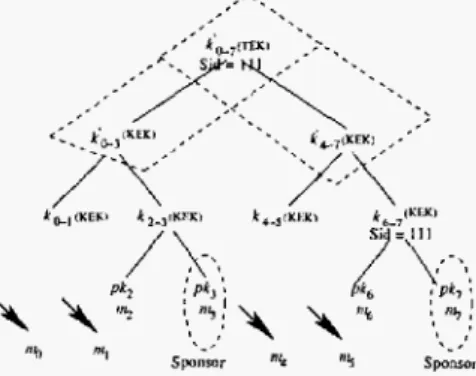
sponsor is a member and the sponsor of a subtree is defined as the member hosted on the rightmost leaf in the subtree (note: “rightmost” can be equally replaced with “leftmost”). Every node has a n associated sponsor field as shown in Figure 1.The sponsor field at a particular node is updated when it is along the joining or leaving member’s path. We show the joining algorithm for updating the sponsor field in Fig- ures 2.
When a member joins, the sponsor field along the joining members path is updated from bottom to t he root. If the new members id is greater than the sponsor id of the node then update the sponsor id with the new member’s id. This is continued until the root (See Figure 3 ) .
When m7 joins, the sponsor field along its path is up- dated. The sponsor id of the node k6--7 is lesser than the
id of m7, so it is updated t o 111. Similarly the sponsor id’s of nodes k4-7 and k0-7 are updated to 111. Whenever the
Proceedings of the 2005 IEEE
Workshop on Information Assurance and Security United States Military Academy, West Point, NY
Fig. 1. A tree showing sponsor for each node.
Every member
.iterate over all the nodes along the joining members path from leaf to the root
.if the joining members id is greater t h a n the sponsor id for t h a t node
sponsor id joining members id
.continue . else
.break
New Mcmbcr
Fig. 3. Updating the sponsor field when a member joins
Sid= 110
Fig. 2. Sponsor update: Join
Fig. 4. Updating a sponsor field when a member leaves. sponsor id for a node is greater than the joining members
id then the check can be stopped.
When a member leaves, every member checks along the path of the leaving member t o update t he sponsor field. If a node has the leaving member as the sponsor then they update the sponsor field with the sponsor id/member id of the other child if exists. This continues upto the root (See Figure 4).
When m7 leaves, the sponsor field along its path is up- dated. Since the leaving member is the sponsor all along its path, the sponsor field has to be updated by checking for the new sponsor for all the nodes. m6 becomes the new
sponsor for node ks--7. For node k4--7 the member ids of
both
its children are compared andthe
greater becomes the new sponsor, in this case m6. This continues until theroot.
C. Co-distributors
When a sponsor changes the keys along the path, i t needs to distribute them. The sponsor has to distribute the keys to all the members whose keys have been changed. But it does not know the keys along the other paths to dis- tribute the new keys. So, a cc-distributor is required to dis- tribute them. The cedistributor is the sponsor of a node on another path whose key is not known to the original sponsor. The sponsor encrypts the changed key with the co-distributors public key and broadcasts this information.
Thus, the co-distributor helps the sponsor in distributing the changed common keys along the other paths.
D. Initial group key generation and distribution Protocol Suppose
n
members m l ,...,
mrr decide to form a group. They build a virtual key tree and selects a sponsor t o de- cide a n order in which they join the tree. Every member updates the key tree by adding members in the key tree based on that order and they update the sponsor field inall the intermediate nodes. Then every member checks if it is responsible for generating any keys along its path. If so, it generates them and distributes the keys either directly
or
withthe
helpof
co-distributors.When
two sponsors are responsible for generating the same key then the rightmost among them generates it. As more members join the key tree the sponsors and the height of the key tree increase.As illustrated in Figure 5, 7727, 7715, m3 and m l are re-
sponsible for generating the keys. m7 generates all the keys ( k6-7, k 4 - 7 and k0-7 ) along its path to the root. Then it
encrypts as follows and broadcasts: {k6-71 k 4 - 7 , k 0 - - 7 } ~ k ~ ,
and { k D - - 7 , k 4 - 7 } p k s . m5 will decrypt k0-7 and k4--7 and
encrypt it as Ik0-7, k4-7}k4--5 where k ~ + is generated by m5 and sent to m 4 . Similarly keys are generated by m3 in the left subtree along its path and the root key which is generated by the rightmost sponsor m7 is sent to the co-distributor of the left subtree m3 as follows. { I c 0 - 7 } ~ 1 ; ~
Proceedings of the 2005 IEEE Workshop on Information Assurance and Security United States Military Academy, West
Point,
NYFig. 5. Initial key generation Example
is broadcast and m3 will decrypt kO-y and encrypts it as { k ~ - 7 } k ~ - ~ and broadcasts it. Thus every member has the newly generated keys along its path. Only two rounds are required for this protocol, one round for generating keys and distributing along the path and another for co-
distributors to distribute them. E. Join protocol
Step 1: New member broadcasts request for join Step 2: Every meniber . mn+l (PKn+l) - =. ml ,->mrl
.
updates the key tree by adding a new member node. Find sponsor for joining member:
. jf sibling present, sponsor = sibling . else sponsor = m,+l
. update the sponsor field along the path of the joining member to the root if required
. generates new secret keys along the joining members path and distribute them to co-distributors and to other memberr directly by encrypting with common key and broadcasting I encrypt the key sent by the joining members sponsor with appropriate key and broadcast
Step 3: If joining member’s sponsor is itself
Step 4: If cc-distributor is itself
I I
Fig. 6. Join Protocol.
Suppose there are TZ members in the group m l , ,..., m,. A new member m,+l makes a join request by broadcasting its public key PK. The rightmost member in the key tree authenticates the new member, decides the insertion loca- tion for the new member and broadcasts this information to other members. Additionally the rightmost member also sends the virtual key tree and list of public keys of other members to the new member. All other members update the key tree by adding a new member node in the specified location. Then every member checks to see if it is the spon- sor of the joining member. If the new member has a sibling it becomes the sponsor and generates new keys along the path.. If there is no sibling then the joining member itself
becomes the sponsor and generates the new keys along its path and distributes them. Members update the sponsor field appropriately i f required. Figure 6 describes the join protocol and Figure 7 shows the protocol operation when a new member joins.
Co-Cisrbu/..\, . . .
Fig. 7. A new member joins (becomes ms), m4 is sponsor and m3
and m7 are cedistributors.
When a new member joins, m7 determines the posi-
tion(i.e., ms) and places the member there. m7 broad- cwts the position of the new member to other members.
All members also determine that m4 is the sponsor of m5. So m4 initiates the rekeying process as follows: 1) gener- ates new keys k;-51 and k;l-7. 2) after determining the cedistributors m3 and “7, encrypts as follows and broadcasts: {ki-7r k & - 7 } p k 7 , and { k h - 7 } p k 3 , 3 ) . m3 will decrypt k;l-7 and encrypt it as {kh-7}ko-a and m7 will de- crypt k:--7 and kAm7 and encrypt them as { k i - 7 } k 6 - , and {kb-7}k4-7r 4 ) . m4 also encrypts and sends the keys to m5 as { k i - 5 , k i - , , k h - 7 } p k 6 . As a result, all the members will get the new keys.
When a new member joins, only the keys along its path to the root have to be changed and distributed, which can be achieved in two rounds with atmost logzn keys being changed.
F. Leave protocol
Step 1: Every member
updates the key tree by removing the leaving member node . updates the sponsor field appropriately along the leaving members path if required
. determines the sponsor for changing keys along the leaving
members path
. generates new secret keys along the path and distributes them to co-distributors and directly to other members . broadcasts the key sent by the leaving members sponsor by encrypting it with the appropriate key
Step 2: If sponsor of the leaving member is itself
Step 3: If cc-distributor is itself
L
Proceedings
of
the
2005IEEE
Workshop on Information Assurance and Security United States Military Academy, West Point, NYAssume that member ml leaves the group. Every mem- ber updates the key tree by deleting node ml and updates
th e sponsor field along the path if required. Then they determine the sponsor who generates new keys along the leaving members path and distributes them. If the leav- ing member does not have a sibling then the first sponsor along the leaving members path becomes responsible for changing the keys along the leaving member’s path (See Figure 8).
5
._’
Sponsor
Fig. 9. A member mg leaves.
As shown in Figure 9, when a member m5 leaves, all the members will remove the node and determine tha t m4 is the sponsor of m5. So m4 initiates the rekeying process as
follows: 1) generates new keys kk--5, k i m r , and
kb-,.
2) af- ter determining the co-distributors m3 and m7, encrypts a sfollows and broadcasts: and { k ; J - T } p k 3 , 3 ) .
m3 will decrypt
kb-7
and encrypt it as { k ; ) - 7 } k o - 3 and m7will decrypt kkT7 and khP7 and encrypt them as {ki-7}ks-7
and {kb--7}k4-7, 4). As a result, all the members will get the new keys.
When a memher leaves only the keys along its path to the root have to be changed and distributed, which can be achieved in two rounds with a t most lognn keys being changed.
U. Multzple j o i n protocol
Suppose m new members join, they make a join request by broadcasting their public keys. The rightmost member i n the key tree authenticates the new members, decides the locations for all the new members such t hat minimal num- her of keys are changed and broadcasts this information to other existing group members. The rightmost member also sends the virtual key tree and existing members public keys to the joining members. Every member upon receiv- ing this message updates its key tree by adding m new nodes in the determined positions. In order to perform niultiple joins in one aggregate operation, it is required t o find the common keys shared by the joining members in an efficient way. To achieve that we use an already proposed scheme, an efficient and scalable key tree based dynamic
Step 1: Every member
. updates key tree by adding new member nodes
.
updates the sponsor field along all the paths of the joining members. computes the keys that need to be changed
. determines the sponsors who are responsible for changing these keys
Step 2: If sponsor for one of the joining members is itself . changes the secret keys d o n g the joining members path and distributes them to co-distributors and directly to other members
. if same key has to be changed, check if right sponsor is itse
. if rightmost sponsor, change the key and distribute
.
broadcasts the key sent by the joining members sponsor byencrypting it with the appropriate key Step 3: If co-distributor is itself
Fig. 10. Multiple Join Protocol.
conferencing scheme called KTDC in [52] which uses an ef- ficient algorithm for computing the shared keys. There will be multiple sponsors responsible for changing the necessary keys. But here the shared keys which both sponsors have in common and which need to be changed will be changed by the rightmost sponsor among the sponsors (See Figure 10).
Fig. 11. New members mo, m l , m4 and mg join.
As shown in Figure 11, when new members join, m 7 will
determine the available positions (Le., ma, m l , m4, m5)
and place the members there. m7 broadcasts this infor-
mation to other group members. Ail members also know that
m5
is the sponsor of m4 and ml is the sponsor of mo. They also know tha t m3 and m7 are responsible forsending the key tree structure and the public key list to the joining members. m5 initiates the rekeying process as follows: 1) generates new keys k&-,, and
khm7.
2 ) af- ter determining the co-distributors m3 and m7, encrypts as follows and broadcasts: { k i - 7 , I C ; ] - 7 } p k 7 , and {kh--T}pk3, 3 ) .m3 will decrypt kbP7 and encrypt it as { k h - - 7 } k ; - 3 and m7
will decrypt
ki.-7
and kb-7 and encrypt them as { k i - 7 } k s - 7 and { k & - 7 ) k 4 - 7 , 4). m5 also encrypts and sends the keys tom4 as { k i p s , k i - 7 , kh--l}pkd. Similarly ml regenerates the
Proceedings of the 2005 IBEE Workshop on Information Assurance and Security United States Military Academy, West Point, NY
keys along its path except for the root key which should be changed by the rightmost sponsor 7125. Both m1 and m5 do these operations in parallel. As a result, all the members whose keys have been changed will get the new keys,
Since all the operations are done in parallel, rekeying can be achieved in two rounds by all the sponsors.
When a network event causes all the previously occurred partitions to reconnect this is called a merge. Mctge is similar to multiple join and this can also be achieved in two rounds which is better t h a n that in TGDH.
If.
Multiple leave protocolStep 1: Every member
.
updates the key tree by removing all leaving member nodes . updates the sponsor field along all the leaving members paths if required. determines t h e sponsors responsible for changing the keys along the paths
Step 2: If sponsor for one of the leaving member is itself
. generates new secret keys and drstributes them to
co-distributors and other members directly
. if same key has t o be changed, check if right sponsor is itse . i f rightmost sponsor, change the key and distribute Step 3: If c-distributor is itself
broadcasts t h e key sent by the leaving members sponsor by
encrypting it with the common key
Fig. 12 Multiple Leave Protocol
When multiple members leave, every member updates its key tree by deleting those member nodes and the sponsor fields along all the paths. Then they determine t h e keys
that need to he changed and t h c sponsors responsible for changing those keys. There will he multiple sponsors and each sponsor regenerates the keys and distributes them. If two sponsors are responsible for changing the same key then the rightmost among the sponsors will change the key (See Figure 12).
,.
I .
I I
r .
Fig. 13. hlernbers mo> m l , m4 and ms leave
As shown in Figure 13, when several rnenibers mo, m l ,
m4 and m5 leave, every member updates its key tree by
deleting those member nodes. Every member also deter- mines t ha t 1713 and m7 are the sponsors. 7717 initiates the
rekeying process as follows: 1) generates new keys and kh-7. 2 ) encrypts the new keys as follows and broad- casts:
{ki.-7j
k t ) - 7 } k s - , , and { k h - 7 } p k 3 , 3) m3 will decryptkL-7
and encrypt it as { k ; ) - 7 } k ~ - - 3 and broadcasts it. Simi- larly 7713 generates the keys k& and encrypts it with k2-3 and broadcasts it. Both m3 and m.7 do these operationsin parallel. As a result, all the members whose keys have been changed will get the new keys.
In case of a network failure which causes disconnectivity, the group gets split and this partition can be dealt with as
a multiple leave operation. Thus, even for network parti- tion the protocol requires only two rounds for regenerating and distributing the keys. This is a great improvement compared to TGDH which requires several rounds. I. Authentication in DGKD
Most CGKA protocols do not contain an authentica- tion component. Furthermore, the authenticated
CGKA
protocols [53], [54], [ 5 5 ] , [56], (571 are non-scalable and/or non-dynamic. In contrast, the new DGKD protocol is not only scalable and dynamic but also able to provide easy and strong authentication. Consider two scenarios: (1) the sponsor m4 transmits a new key kh-7 t o a cedistributorm3. (2) m3 transmits the key kt)-i to members m0,ml,m2 who are in the responsibility scope of m3. In the first case,
m4 signs the key kh-,(using mq’s private key), encrypts both kb-7 and the signed kb-,(using m3’s public key p k a ) , and sends the result to 7723. 7723 after receiving the message,
decrypts k;l-7 and then verifies m4’s signature. In the sec- ond case, m3 signs k;-,(by its private key), encrypts both kt)-i and the signed kkp7(using koP3 which covers mo to m3). Then each of the members from mo t o m2 can verify m3’s signature.
IV.
DISCUSSIONS
We discuss the performance and security of our protocol in this section and analyze the communication and compu- tation costs for join, leave, multiple join and multiple leave operations. Tree based Group Diffie-Hellman (TGDH) [19],
j34J is one of the most typical CGKA protocols in terms of efficiency and scalability, so we focus on the coniparison between DGKD and TGDH.
Key generation is independent, i.e., only the sponsor is involved, thus there is no need for synchronization with other members which is required in TGDH. In this sense, DGKD is more resilient to network congestion, delay and failure than TGDH.
DGKD
also has strong yet simple au- thentication. It is also collusion free because the new keys are independent of the old keys and no matter how many members collude they cannot get the keys. Thus, it is unconditionally secure. Both TGDH and DGKD requireProceedings of the 2005 IEEE
Workshop on Information Assurance and Security
United States Military Academy, West Point, NY
two rounds for single join and leave operations. As for multiple join and leaving operations, DGKD requires two rounds but TGDH requires log(p) rounds where p is the number of members involved. DGKD uses public key en- cryption for sending the keys to co-distributors and secret key encryption for further distribution of keys (from the co- distributors to the members). TGDH requires performing modular exponentiations which is in the same complexity as the public key encryption. In summary, DGKD is com- parable and in some cases better than TGDH in terms of communication and computation costs.
V.
CONCLUSION
We proposed a new class of GKM protocols for SGC with strong yet simple authentication capability. The proposed protocol solves some serious problems in the existing prc-
tocols and is simple, robust, efficient, and scalable. The future work is to implement and test the new protocol.
REFERENCES
R. Canetti, J. Garay, G. Itkis, D. Micciancio, M. N a o r , and
B. Pinkas, “Multicast security: a taxonomy and some efficient
constructions,” Proceedings of INFOCUM’SS: Conference on
Computer Communications, vol. 2, pp. 708-716, Mar. 1999.
R. Canetti, T. Malkin, and K. Nissim, “Efficient communication- storage tradeoffs for multicast encryption,” Lecture Notes i n Computer Science [Advances in Cryptology- E URQ CRYP T ’99),
G . Caronni, K . Waldvogel, D. Sun, and E. PLattner, “Eficient
security for large and dynamic multicast groups,” Pmceedings of
the Seventh IEEE International Workshop on Enabling Tech- nologies: Infmstmcture f o r Collaborative Enterprises ( W E T -
ICE ’98) (Cut. No.98TB100253), pp. 376-353, J u n e 1998.
H. Hamey and C. Muckenhim, “Group Key Management Proto- col (GKMP) Architecture,” RCF 20g4, July 1997.
H. Hamey and C. Muckenhim, “Group Key Management Proto-
col (GKMP) Specification,” RCF 2093, July 1997.
H. Harney and E. Harder, “Logical key hierarchy protocol,”
Internet Draft (work i n progress), draft-hamey-spartu-lkhp-sec- OO.txt, Internet Engineering Task Force, Mar. 1999.
G . Noubir, “Multicast security,” European Space Agency, Project: Performance Optimization of Internet Protocol Via Satellite, Apr. 1998.
D. Wallner, E. Harder, and R. Agee, “Key management for
multicast: Issues and architectures,” Internet Dru& (work
en progress), dra~-urall~er-key-arch-Ol.trt, Internet Eng. Tusk
Force, Sept. 1998.
C. K . Wong, M . Gouda, and S. S. Lam, “Secure group commu- nications using key graphs,” SIGCOMM ’SB, Also University of
Tezas a t Awtzn, Computer Science Technical report T R 97-23,
pp. 68-79, Dec. 1998.
L. R. Dondeti, S. Mukherjee, and A . Samal, “A dual encryp- tion protocol for scalable secure multicasting,” In Fourth IEEE Symposium on Computers and Communications, pp. 2-8, July
1999.
F. Du, L. M. Ni, and A . H. Esfahanian, “Towards solving mul-
ticast key management problem,” ICCCN’SS Eighth Intema-
tional Conjerence on Computer Communications and Networks,
pp, 232-236, Oct. 1999.
S. Mittra, “Iolus: A framework for scalable secure multicasting,”
Journal of Computer Communication Reviews, vol. 27, no. 4,
R. Molva and A . Pannetrat, “Scalable multicast security in dy-
namic groups,” 6th ACM Conference on Computer and Commu-
nications Security ( A C M CCS 1999), Singapore, pp. 101-112,
Nov. 1999.
vol. 1592, pp. 459-470, 1999.
pp. 277-288, 1997.
0-7803-9290-6105/$20.00 02005 IEEE. 292
M. Burmcsler and Y . Desrnedt, “Elficient and secure conference- key dislrihution,” Security Protocols Workshop. pp. 119-129, 1996.
L. R. Dondeti, ‘LEfficient private group communication over pub- lic networks,” Phd. Dissertation, CSE UNL, 1999.
I. Ingemarsson, D. Tang, and C. Wong, “A conference key dis- tribution system,” I E E E Transactions o n I n j o n a t i o n Theory,
D. Steer, I,. Strawczynski, W . Diffie, and M . Wiener, “A se-
cure audio teleconference system,” Advances m Cryptology-
CRYPTO’88, LNCS, Springer-Verlag, vol. 403, pp. 520-528,
Aug. 1990.
M. Steiner, G . Tsudik, and M . Waidner, “Difie-Hellman key dis-
tribution extended t o group communication,” ACM Conference
on Computer and Communications Security ( A C M CCS 19SS),
pp. 31-37, Mar. 1996.
Y . Kim, A . Perrig, and G . Tsudik, “Simple and fault-tolerant key agreement for dynamic collaborative groups,” In Proceedings of
the 7th AGM Conference on Computer and Communications
Security ( A C M CCS ZUUO), pp. 235-244, Nov. 2000.
Y. Kim, A. Perrig, a n d G . Tsudik, “Communication-efficient
group key agreement,” In Information System Security, Pro-
ceedings of the 17th International Information Security Confer- ence I F I P SEC‘OI, pp. 229-244, June 2001.
A. Bakkardie, “Scalable multicast key distribution,” RFC 1949, 1996.
A. Beimel and E. Chor, “Interaction in key distribution
schemes,” Advances in Cryptology - CRYPTU’93, LNCS,
Springer, Berlin, vol. 773, pp. 444-457, 1994.
A. Beimel and B. Char, “Communications in key distribution
schemes,” IEEE Ramactions on Information Theory, vol. 42,
R. Blom, “An optima) class of symmetric key generation sys-
tems,” Advances in Cryptology - EUROCRYPT’84, LNCS, Springer, Berlin, vol. 209, pp. 335-338, 1985.
C. Blundo and A. Cresti, “Space requirements for broadcast en-
cryption,” Advances i n Gyptology ~ EUROCRYPT’94, L N C S ,
Springer, Berlin, vol. 950, pp, 287-298, 1995.
C. Blundo, L. A. F. Mattos, and D. R. Stinson, “General-
ized Eeimel-Chor scheme for broadcast encryption and interac- tive key distribution,” Theoretical Computer Science, vol. 200, pp. 313-334, June 1998.
C. Blundo, A. D. Santis, A. Herzberg, S. Kutten, U. Vac- caro, and M. Yung, “Perfect secure key distribution for dynamic conferences,” Advances in Cryptology - CRYPTO’SZ, L N C S , Springer, Berlin, vol. 740, pp. 471-486, Aug. 1993.
M. Burmester and Y . Desmedt, “A secure and efficient confer- ence key distribution system,” Aduances in Cryptology - EU- ROCRYPT’94, LNCS, Springer, Berlin, vol. 950, pp. 275-286, May 1995.
I. F . Bab Briscoe, “Nark: receiver-based multicast non- repudiation and key management,” Proceedings of the 1st ACM conference o n Electronic commerce, pp. 22-30, Nov. 1999.
Y . Challal, H . Bettahar, and A . Bouabdallah, “Sakm: a scalable and adaptive key management approach for multicast communi-
cations,” A C M SIGCOMM Computer Communication Review,
vol. 34, p p ~ 55-70, Apr. 2004.
W. Chen and L . R. Dandeti, “Recommendations in using group key management algorithms,” D A R P A Information Suruivabil-
ity Conference and Exposation, vol. 2 , pp. 222-227, Apr. 2003.
A . Fiat and hl. Naor, “Broadcast encryption,” Advances in
Cryptology - CRYPTO’93, LNCS, Springer, Berlin, vol. 773, S. M . Ghanem and H. Abdel-Wahab, “A secure group key man- agement framework: Design and rekey issues,” Eighth I E E E International Symposium on Computers and Communications, pp. 797-802, June 2003.
Y . Kim, A . Perrig, and G . Tsudik, “Tree-baed group key agree-
ment,” A CM Transactions on Information Systems Security,
vol. 7, pp. 60-96, Feb. 2004.
F.-Y. Lee and S. Shieh, “Scalable and lightweight key distribu- tion for secure group communications,” International Journal of Network Management, vol. 14, pp. 167-176, May 2004.
vol. 28, pp. 714-720, Sept. 1982.
pp. 19-28, 1996.
Proceedings of the 2005 IEEE
Workshop on Information Assurance and Security United States Military Academy, West Point,
NY
[36] J.-C. Lin, C.-Y. Chou, F. h i , and K.-P. Wu, “A distributed key management protocol far dynamic groups,” 27th Anniial IEEE Conference on Local Computer Networks (LGN’O2), pp. 0113- 0122, Nov. 2002.
[37] D . Liu, P. Ning, and K . Sun, “Cryptographic protocols/ network security: Efficient self-healing group key distribution with revo- cation capability,” Proceedings of the 10th A G M conference on Computer and communication security, pp. 231-240, Oct. 2003. [38] C. Meadows and P. Syverson, “Group key management and sig- natures: Formalizing gdoi group key management requirements in npatrl,” Proceedings of the 8th AGM conference on Computer and Communications Security, pp. 235-244, Nov. 2001.
1391 C.-S. Park and D.-H. Lee, “Secure and efficient key manage-
ment for dynamic multicast groups,” ACM SIGOPS Operating
Systems Review, vol. 35, pp. 32-38, O c t . 2001.
[40] S. Rafaeli and D. Hutchison: “Hydra: A decentralised group
key management,” Eleventh IEEE International Workshops o n
Enabling Technologies: Infrastructure l o r Collaborative Enter-
prises (WETICE’UZ), pp. 62-67, J u n e 3002.
[41] A . T. Sherman and D. A. McGrew, “Key establishment in large dynamic groups using one-way function trees,” IEEE transac- tions on SoJtware Engineenng, vol. 29, pp. 444-458, May 2003. [42] M. Steiner, G. Tsudik, and M. Waidner, “Key agreement in dynamic peer groups,” IEEE Zhznsactions o n Parallel and Dis- tributed Systems, vol. 11, pp. 769-780, Aug. 2000.
[43] D. R. Stinson, “On some methods for unconditionally secure key distribution and broadcast encryption,” Design, Codes and Cryptography, vol. 12, pp. 215-243, June 1997.
1441 Y.-M. Tseng, “A scalable key-management scheme with mini- mizing key storage for secure group communications,” Interna- tional Journal of Network Management$ vol. 13, pp. 419-425, Nov. 2003.
[45] S. Zhu, S. Setia, and S. Jajodia, “Performance optimizations For
group key management schemes,” 23rd Intenational Confererice
o n Dastribvted Computrng Systems, pp. 163-171, May 2003.
1461 G . H . Chiou and W.T.Chen, “Secure broadcasting using the
Secure Lock,” IEEE Transactions o n Software Engineering,
vol. 15, pp. 929-934, Aug. 1989.
[47] D. R. Stinson, ed., Cqptugraphy: Theory and Practice. Boca
Raton, Florida, USA: CRC Press, Inc., 1995.
1481 X. Zou, B. Ramamurthy, and S. S. Magliveras, eds., Secure
Group Communications over Data Networks. New York, N Y ,
USA, ISBN: 0-387-22970-1 (The ebook ISBN: 0-387-22971-X): Springer, Oct. 2004.
1491 L. R. Dondeti, S. Mukherjee, and A. Samal, “DISEC: a dis- tributed framework for scalable secure many-to-many communi- cation,” i n Proceedings of Fifth IEEE Symposium o n Computers
and Communications (ISCC ZOUO), pp. 693-695, July 2000. 1501 X. B. Zhang, S . S. Lam, D.-Y. Lee, and Y. It. Yang, “Proto-
col design for scalable and reliable group rekeying,” Proceedings SPIE Conference 011 Scalabilety and D a f i c Control i n IF Net- works, pp. 87-108, Aug. 2001.
1511 X. Zou and B. Ramamurthy, “A block-free tree-hased group
Diffie-Hellman key agreement for secure group communications,”
Proceedings of International Conference on Parallel and Dis- tributed Com.puting and Networks, Innsbruck, Austria, pp. 288-
293, Feb. 2004.
[52] X. ZOU, S. Magliveras, and B. Ramamurthy, “Key tree based
scalable secure dynamic conferencing schemes,” Proceedings of Internutzonal Conference on Parallel and Distributed Comput- i n g and Systems (PDCS POO4), M I T Cambridge, M A , USA,
November 9-11, pp. 61-66, Nov. 2004.
1531 G. Ateniese, M. Steiner, and G. Tsudik, “Authenticated group key agreement and friends,” Proceedings of the 5th A C M con-
ference on Computer and communications security, C A , USA,
1541 E. Bresson, 0. Chevassut, and D. Pointcheval, “Dynamic group Difie-Hellman key exchange under standard assumptions,” A d - uunces i n Clyptology - EUROCRYPT’2002, LNCS, Springer,
Berlzn, vol. 2332, pp. 321-336, 2002.
155) E. Bresson, 0. Chevassut, D. Pointcheval, and J.-J. Quisquater, “Provably authenticated group Diffie-Hellman key exchange,”
pp, 17-26, 2008.
Proc. 8th Annual A C M Conference on Computer and Commu- nications Securzty (CCS’OI), pp. 255-264, 2001.
[SS] J . Katz and M. Yung, “ScalabIe protocols for authenticated group key exchange,” The 23rd Annual International Cryptology
Conference, CRYPT0 2003, C A , USA, Aug. 2003.
[57] H . 4 . Kim, S.-M. Lee, and D. H. Lee, “Constant-round authenti- cated group key exchange for dynamic groups,” A s i a c y y t a ’ O ~ ,
http://www. iyPs. re. k r / a c O ~ / ~ a t a / A s i a c ~ p ~ Z O O 4
/06%20Xey%20Management/O2-~~1in- Jeong%2OKim.pdJ