c H a p t e r
79
2
outCome
peRFoRmAnCe
This chapter explains each of Defence’s
outcomes and outputs, including our
achievement against performance targets and
the cost to the Government of our outcomes.
2.1 DEFENCE’S OuTCOME AND OuTPuT
STRuCTuRE
2.2 COST TO GOVERNMENT OF DEFENCE’S
OuTCOMES
2.3 OuTCOME ONE: COMMAND OF OPERATIONS
2.4 OuTCOME TWO: NAVY CAPABILITY
2.5 OuTCOME THREE: ARMY CAPABILITY
2.6 OuTCOME FOuR: AIR FORCE CAPABILITY
2.7 OuTCOME FIVE: STRATEGIC POLICY
2.8 OuTCOME SIX: INTELLIGENCE
2.9 OuTCOME SEVEN: SuPERANNuATION AND
HOuSING SuPPORT SERVICES FOR CuRRENT
AND RETIRED DEFENCE PERSONNEL
2.10 EXPLANATION OF SIGNIFICANT VARIATIONS
ACROSS DEFENCE OuTCOMES
80
oveRview oF the deFenCe
outComes And outputs
Defence outcomes are the results that theGovernment seeks from Defence, and are achieved through the successful delivery of outputs, to the standards set in the Portfolio Budget Statements 2005–06 and, where applicable, revised in the Portfolio Additional Estimates Statements 2005–06. The Defence Annual Report 2005–06 reports our
achievement against these targets, in both financial and non-financial terms.
The outcome and output structure has remained consistent for 2005–06 and covers 28 departmental outputs and three
administered outputs.
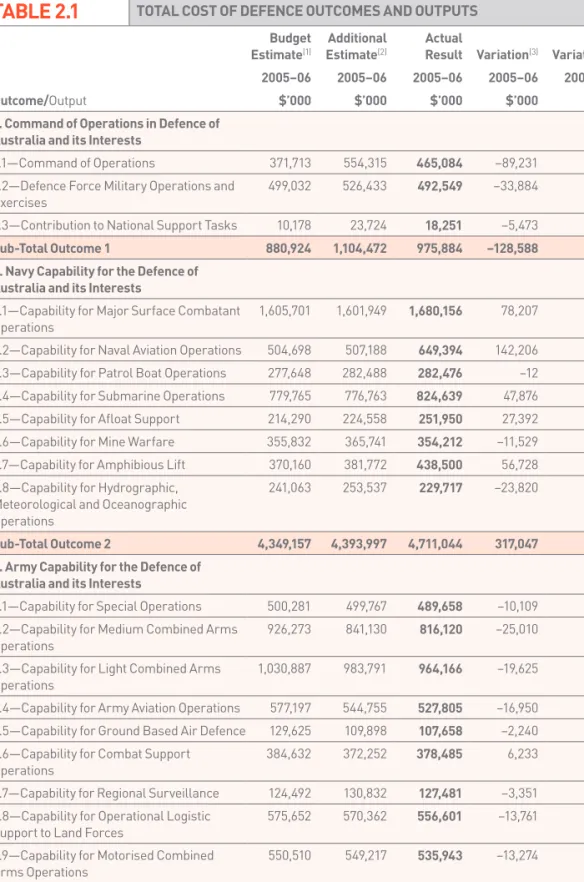
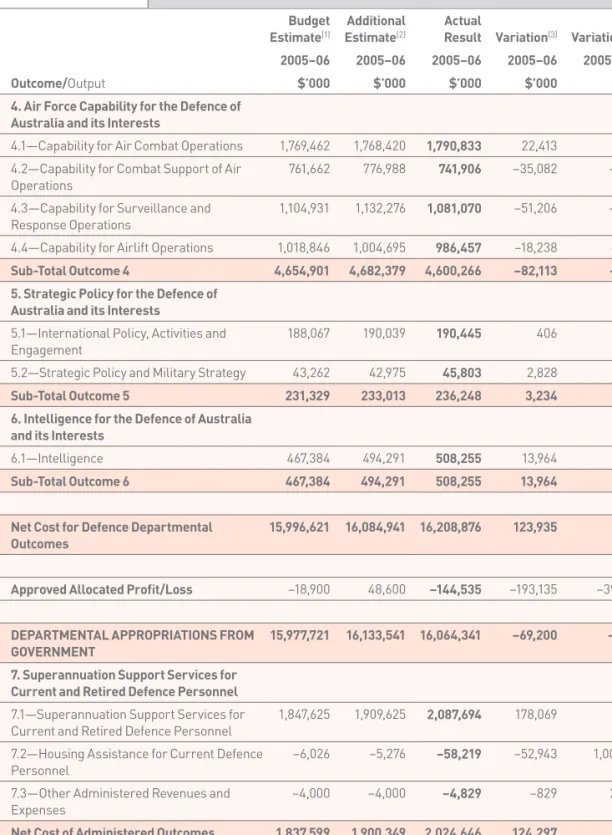
Defence’s departmental outcomes exceeded the revised estimate by $123.9m as detailed in Table 2.1. The variation is a reflection of the operating loss which is described in the financial overview and results mainly from significant accrual adjustments, in particular the write down of assets through impairment reviews of specialist military equipment, revaluation of building and infrastructure assets, and inventory adjustments following stocktaking activities and revaluation to meet AIFRS requirements.
The seventh outcome, Superannuation and Housing Support Services for Current and Retired Defence Personnel, covers activities not directly connected to the delivery of the capability outcomes and outputs. Outcome Seven and its three outputs are described on p. 144.
Defence continues to refine its cost attribution rules in order to improve the accuracy of its output costs. There are a number of variables that can influence output costs, including changes to preparedness levels and activity rates, operations, and redirecting funds to meet changing priorities and emergent cost pressures. Changes in the distribution of the workforce and technical adjustments aimed at improving the accounting for Defence’s assets and liabilities can have a major impact. Some of the variations evident between the revised estimate and actual result reflect accounting adjustments and refinements to attribution rules. There have been few changes to preparedness and activity levels from that which were planned, and few significant real variations between the revised estimate and actual result.
81
2.1
D e f e n c e ’ S o u t c o m e a n D o u t p u t S t r u c t u r etaBle 2.1
total coSt of Defence outcomeS anD outputSBudget estimate(1)
additional estimate(2)
actual
result Variation(3) Variation(3) 2005–06 2005–06 2005–06 2005–06 2005–06
outcome/Output $’000 $’000 $’000 $’000 %
1. command of operations in Defence of australia and its interests
1.1—Command of Operations 371,713 554,315 465,084 –89,231 –16.1
1.2—Defence Force Military Operations and
Exercises 499,032 526,433 492,549 –33,884 –6.4
1.3—Contribution to National Support Tasks 10,178 23,724 18,251 –5,473 –23.1
Sub‑total outcome 1 880,924 1,104,472 975,884 –128,588 –11.6
2. navy capability for the Defence of australia and its interests
2.1—Capability for Major Surface Combatant
Operations 1,605,701 1,601,949
1,680,156 78,207 4.9
2.2—Capability for Naval Aviation Operations 504,698 507,188 649,394 142,206 28.0 2.3—Capability for Patrol Boat Operations 277,648 282,488 282,476 –12 –0.0 2.4—Capability for Submarine Operations 779,765 776,763 824,639 47,876 6.2 2.5—Capability for Afloat Support 214,290 224,558 251,950 27,392 12.2
2.6—Capability for Mine Warfare 355,832 365,741 354,212 –11,529 –3.2
2.7—Capability for Amphibious Lift 370,160 381,772 438,500 56,728 14.9 2.8—Capability for Hydrographic,
Meteorological and Oceanographic Operations
241,063 253,537 229,717 –23,820 –9.4
Sub‑total outcome 2 4,349,157 4,393,997 4,711,044 317,047 7.2
3. army capability for the Defence of australia and its interests
3.1—Capability for Special Operations 500,281 499,767 489,658 –10,109 –2.0 3.2—Capability for Medium Combined Arms
Operations 926,273 841,130 816,120 –25,010 –3.0
3.3—Capability for Light Combined Arms
Operations 1,030,887 983,791 964,166 –19,625 –2.0
3.4—Capability for Army Aviation Operations 577,197 544,755 527,805 –16,950 –3.1 3.5—Capability for Ground Based Air Defence 129,625 109,898 107,658 –2,240 –2.0 3.6—Capability for Combat Support
Operations 384,632 372,252 378,485 6,233 1.7
3.7—Capability for Regional Surveillance 124,492 130,832 127,481 –3,351 –2.6 3.8—Capability for Operational Logistic
Support to Land Forces 575,652 570,362 556,601 –13,761 –2.4
3.9—Capability for Motorised Combined
Arms Operations 550,510 549,217 535,943 –13,274 –2.4
3.10—Capability for Protective Operations 613,377 574,783 673,261 98,478 17.1
Sub‑total outcome 3 5,412,926 5,176,788 5,177,177 389 0.0
82
c H a p t e r 2
Budget
estimate(1) estimateadditional (2) result Variationactual (3) Variation(3) 2005–06 2005–06 2005–06 2005–06 2005–06
outcome/Output $’000 $’000 $’000 $’000 %
4. air force capability for the Defence of australia and its interests
4.1—Capability for Air Combat Operations 1,769,462 1,768,420 1,790,833 22,413 1.3 4.2—Capability for Combat Support of Air
Operations 761,662 776,988 741,906 –35,082 –4.5
4.3—Capability for Surveillance and
Response Operations 1,104,931 1,132,276 1,081,070 –51,206 –4.5
4.4—Capability for Airlift Operations 1,018,846 1,004,695 986,457 –18,238 –1.8
Sub‑total outcome 4 4,654,901 4,682,379 4,600,266 –82,113 –1.8
5. Strategic policy for the Defence of australia and its interests
5.1—International Policy, Activities and
Engagement 188,067 190,039 190,445 406 0.2
5.2—Strategic Policy and Military Strategy 43,262 42,975 45,803 2,828 6.5
Sub‑total outcome 5 231,329 233,013 236,248 3,234 1.4
6. intelligence for the Defence of australia and its interests
6.1—Intelligence 467,384 494,291 508,255 13,964 2.8
Sub‑total outcome 6 467,384 494,291 508,255 13,964 2.8
net cost for Defence Departmental
outcomes 15,996,621 16,084,941 16,208,876 123,935 0.8
approved allocated profit/loss –18,900 48,600 –144,535 –193,135 –397.4 Departmental appropriationS from
GoVernment 15,977,721 16,133,541 16,064,341 –69,200 –0.4
7. Superannuation Support Services for current and retired Defence personnel 7.1—Superannuation Support Services for
Current and Retired Defence Personnel 1,847,625 1,909,625 2,087,694 178,069 9.3 7.2—Housing Assistance for Current Defence
Personnel –6,026 –5,276 –58,219 –52,943 1,003.5
7.3—Other Administered Revenues and
Expenses –4,000 –4,000 –4,829 –829 20.7
net cost of administered outcomes 1,837,599 1,900,349 2,024,646 124,297 6.5 total coSt to GoVernment 17,815,320 18,033,890 18,088,987 55,097 0.3 Notes:
1. Budget Estimates are consistent with Portfolio Budget Statements 2005–06 (pages 90 and 91).
2. Additional Estimates are consistent with Portfolio Additional Estimates Statements 2005–06 (pages 79–82). 3. Variations reflect the difference between Additional Estimates and Actuals.
83
2.2
C O S T T O G O V E R N M E N T O F D E F E N C E ’ S O U T C O M E STABLE 2.2
OVERALL COST TO GOVERNMENT OF DEFENCE OUTCOMES (DEPARTMENTAL AND ADMINISTERED)Outcome 1— Command of Operations Outcome 2— Navy Capabilities Outcome 3— Army Capabilities Outcome 4— Air Force Capabilities Outcome 5— Strategic Policy Outcome 6— Intelligence Total Defence Departmental Outcome Outcome 7— Superannuation and Housing Support Services for Current and Retired Defence Personnel Grand Total 2005–06 2005–06 2005–06 2005–06 2005–06 2005–06 2005–06 2005–06 2005–06 $’000 $’000 $’000 $’000 $’000 $’000 $’000 $’000 $’000 DEPARTMENTAL Income Revenue
Goods and services 35,555 113,987 211,668 174,395 6,954 5,140 547,700 – 547,700
Interest – 10 –17 12 –4 –1 – – –
Other revenues 4,949 23,974 23,442 30,726 1,188 3,413 87,693 – 87,693
Total Revenue 40,505 137,972 235,093 205,133 8,138 8,552 635,392 – 635,392
Gains – – – – – – – –
Net foreign exchange gains – – – – – – – – –
Assets now recognised 28,128 87,787 219,981 183,805 6,686 9,959 536,345 – 536,345
Net gains from sale of assets – – – – – – – – –
Other Gains 936 3,793 4,055 3,813 301 402 13,300 – 13,300
Total Gains 29,064 91,580 224,036 187,618 6.987 10,361 549,645 – 549,645
Total Income 69,568 229,552 459,129 392,751 15,125 18,913 1,185,037 – 1,185,037
84 c H a p t e r 2 outcome 1— command of operations outcome 2— navy capabilities outcome 3— army capabilities outcome 4— air force capabilities outcome 5— Strategic
policy outcome 6—intelligence
total Defence Departmental outcome outcome 7— Superannuation and Housing Support Services for current and retired Defence
personnel Grand total 2005–06 2005–06 2005–06 2005–06 2005–06 2005–06 2005–06 2005–06 2005–06 $’000 $’000 $’000 $’000 $’000 $’000 $’000 $’000 $’000 operating expenses Employees 458,497 1,441,356 2,651,692 1,428,458 88,463 217,343 6,285,808 – 6,285,808 Suppliers 544,226 1,824,072 1,979,439 2,113,955 152,349 217,036 6,831,078 – 6,831,078 Grants 270 1,469 2,808 1,220 134 156 6,057 – 6,057 Finance cost 2,782 18,467 25,625 19,948 1,010 1,153 68,985 – 68,985
Depreciation and amortisation 26,937 1,233,701 721,576 1,208,528 6,604 69,965 3,267,310 – 3,267,310 Write-down and impairment of assets 13,110 419,014 264,252 218,549 2,934 9,921 927,780 – 927,780
Net foreign exchange losses –5 131 719 14 –83 17 793 – 793
Net losses from sale of assets –230 1,659 –11,473 1,587 –71 11,514 2,987 – 2,987
Other expenses –132 726 1,669 758 32 63 3,115 – 3,115
total expenses 1,045,454 4,940,596 5,636,306 4,993,016 251,373 527,168 17,393,913 – 17,393,913 price to Government for Defence
Departmental outcomes 975,885 4,711,044 5,177,177 4,600,266 236,248 508,255 16,208,876 – 16,208,876 aDminiStereD
Revenues 729,562 729,562
Expenses 2,754,208 2,754,208
price to Government for Defence
administered outcomes 2,024,646 2,024,646
85
2.2
c o S t t o G o V e r n m e n t o f D e f e n c e ’ S o u t c o m e StaBle 2.3
coSt to tHe GoVernment of Departmental outcomeSBudget
estimate(1) additional estimate(2) actualresult Variation(3) Variation(3) 2005–06 2005–06 2005–06 2005–06 2005–06
$’000 $’000 $’000 $’000 %
income revenue
Goods and Services 186,682 374,716 547,700 172,984 46.2
Interest – – – – –
Other Revenues 186,159 248,536 87,693 –160,843 –64.7
total revenue 372,841 623,252 635,392 12,140 1.9
Gains
Net foreign exchange gains – – – – –
Assets now recognised 30,000 250,000 536,345 286,345 114.5
Revenue from sale of assets 95,063 – – – –
Other gains – – 13,300 13,300 – total Gains 125,063 250,000 549,645 299,645 119.9 total income 497,904 873,252 1,185,038 311,786 35.7 expenses Employees 6,587,528 6,358,716 6,285,808 –72,908 –1.1 Suppliers 6,946,746 7,121,909 6,831,078 –290,831 –4.1 Grants 1,275 7,275 6,057 –1,218 –16.7 Finance cost 32,075 29,914 68,985 39,071 130.6
Depreciation and amortisation 2,771,838 3,145,023 3,267,310 122,287 3.9 Write-down and impairment of assets 60,000 275,356 927,780 652,424 236.9
Net foreign exchange losses – – 793 793 –
Net losses from sale of assets 95,063 – 2,987 2,987 –
Other expenses – 20,000 3,115 –16,885 –84.4
total expenses 16,494,525 16,958,193 17,393,913 435,720 2.6
price to Government for Defence outcomes 15,996,621 16,084,941 16,208,876 123,935 0.8 approved allocated profit/loss –18,900 48,600 –144,535 –193,135 –397.4 Departmental appropriation from
Government for outcomes 15,977,721 16,133,541 16,064,341 –69,200 –0.4 Notes:
1. Budget Estimates are consistent with Portfolio Budget Statements 2005–06 (page 93).
2. Additional Estimates are consistent with Portfolio Additional Estimates Statements 2005–06 (page 83). 3. Variations reflect the difference between Additional Estimates and Actuals.
86 c H a p t e r 2
87
outCome one:
CommAnd oF opeRAtions
The ADF experienced high operational tempo throughout the year and the multi-faceted nature of our operational deployments and missions made this a demanding period. As the Chief of Joint Operations, I am responsible to the Chief of the Defence Force for the command of ADF operations across the world, and at home.
Despite the wide dispersal of our forces, and the very different types of operations which have been undertaken, 2005–06 has been, by any measure, a successful year for ADF operations. This success is in no small way due to the quality, the dedication and professionalism of the people who make up the ADF and wider Defence community. Over the past year, we have remained strongly and effectively engaged in both Iraq and Afghanistan.
Significant achievements in the Middle East include:
• Special Forces and helicopter operations in Afghanistan;
• the Al Muthanna Task Group in Iraq; • the Civil Military Cooperation Program of
community projects;
• training Iraqi land and naval forces; • air surveillance and transport across
the region;
• maritime security in the northern Persian Gulf, including a five-month period in which an officer from the Royal Australian Navy commanded the coalition Persian Gulf naval task force of around ten warships; and • the continued contribution of troops to the
united Nations Missions and Multi National Force of Observers in Syria, the Lebanon, Israel and Egypt.
Service with the united Nations in the Sudan and a substantial, very successful ADF relief effort in Pakistan were other key contributions made by the ADF outside our region during the year. The deployment of medical, logistic, security, communications and aviation troops and equipment to a devastated, mountainous and remote part of Pakistan provided many demanding challenges. The team performed extremely well and brought great credit to our nation with their success.
At home, and in our region, the ADF has also performed with distinction. In early March 2006, around 2,600 personnel supported Commonwealth and State security operations for the successful conduct of the
Commonwealth Games in Melbourne. Later that month, Operation Larry Assist was launched in response to the disaster relief request from the Queensland Government. ADF personnel and relief supplies began arriving in Innisfail within 24 hours of Cyclone Larry striking north Queensland. This prompt Defence response did much to alleviate the impact of the cyclone in coastal north o u t c o m e o n e : c o m m a n D o f o p e r a t i o n S
The Chief of Joint Operations, Lieutenant General Ken Gillespie, is accountable for delivering the Command of
Operations
88
c H a p t e r 2
Queensland and the Atherton Tableland, and provided much needed assistance to devastated towns, homes and families. In April 2006, the ADF also responded, again within 24 hours, to the riots and destruction in Honiara in Solomon Islands. Defence’s quick response and the presence of Australian land, sea and air forces calmed tensions and helped to restore law and order. This deployment continued to demonstrate Defence’s
credentials as a very strong team player in an Australian multi-agency context and as a regional coalition force leader. While the ADF contribution has been scaled down, it continues today under the auspices of the Regional Assistance Mission to Solomon Islands.
In late May 2006, Australia was invited by the Government of Timor-Leste to deploy a force to Dili to stabilise a rapidly worsening law and order situation and to prevent further bloodshed. The readiness levels of the ADF and the preparedness of the Defence intelligence and strategic planning processes enabled a substantial sea and air deployment to commence within a few hours of the Timor-Leste Government formally agreeing to the nature, size and status of our contribution. The ADF commander became the coordinator for the tactical strategies and operations’ outputs of the troop and police contributions made by Malaysia, New Zealand and Portugal. At the height of the operation almost 3,000 ADF personnel were deployed. While there has been some scaling down, a significant ADF contribution remains engaged in Timor-Leste.
Throughout this intense operational period, Defence has continued to refine its command and control doctrine and structures. In July 2005, the Chief of the Defence Force initiated a review of the ADF higher command and control arrangements, drawing on our operational experience and a body of research work completed since 2003. This review, known as the Wilson Review, developed options for a new concept for command and
control of ADF operations, which would build on the effectiveness of the current model, and would enhance the efficient use of people and technology into the future. The review outcomes were agreed by the Chiefs of Service Committee and the Chief of the Defence Force sought and gained Government agreement for the review outcomes. A transition program will see the outcomes in place by the end of 2008, which will coincide with the commissioning of the new Joint Operations Command facility at Bungendore. The new command and control arrangements will continue to see the Chief of the Defence Force commanding the ADF for operations through the Vice Chief of the Defence Force and for the raising, training and sustainment of the three Services through the Chiefs of the Navy, Army and Air Force. The most
significant change will see the current component and multi-headquartered method of command of operations replaced by a single, unified joint headquarters command model. This arrangement will cut duplication, simplify information management, make more efficient use of equipment and
manpower resources and move the ADF to an improved level of joint operations capability. The Joint Offshore Protection Command has been established and is now operating effectively under joint ADF and Australian Customs Service arrangements. The Joint Offshore Protection Command provides maritime surveillance and offshore protection for Australia. Within this organisation, the ADF is responsible for military surveillance and offshore protection functions, and the Australian Customs Service is responsible for civil maritime surveillance and law
enforcement, through its Coastwatch Division. under this arrangement, operations in our northern and southern waters to enforce the protection of Australia’s oceans and fisheries and to prevent illegal immigration have been a feature of the last year.
In summary, I am proud to report that throughout 2005–06 the ADF continued to
89 o u t c o m e o n e : c o m m a n D o f o p e r a t i o n S
2.3
successfully conduct military campaigns and operations. The ADF also continued to deliver the emergency and non-emergency support required of us by our Government, and expected of us by the Australian community. The performance of our people and equipment involved in operations and exercises, both overseas and domestically, and in the headquarters that enable and support these operations, has been outstanding. I thank our people for their professionalism, their valour and their endurance and I thank the Defence families for their support.
capaBility performance
information
output 1.1—commanD of operationS
The ADF command and control review and the work that has commenced for implementation of its recommendations has been a major focus of attention and attracted increased effort and staff resources as the year progressed. Despite this and a heavy operational workload, especially in the first half of 2006, the existing Headquarters Joint Operations Command continued to meet performance targets during 2005–06 and to provide credible options to the Government for unexpected contingencies at home and in our region.
taBle 2.4
commanD of operationSperformance targets performance
Australian operational concepts are further developed to support ADF planning against credible contingencies.
achieved. Ongoing development of current and new Australian operational concepts.
Joint Operations Command provides guidance for joint force preparedness in accordance with the Chief of the Defence Force’s direction.
achieved. The previous Joint Operations Command Operational Preparedness Requirement was updated and joint preparedness is assessed and reported monthly. Command of ADF forces is effective and the
Government’s strategic objectives for operations are achieved.
achieved. Command continues to be effective under the 2004 revised joint command arrangements that appointed VCDF as Chief of Joint Operations and the Theatre Commander for all ADF operations.
Development of ADF operational command
arrangements introduced in 2004 will continue. achieved. Most notable was the conduct of the Wilson Review into command and control and its subsequent implementation in preparation for the Joint Operations Command’s occupation of new facilities to be built at Bungendore, New South Wales.
90
c H a p t e r 2
output 1.2—Defence force military operationS anD eXerciSeS
Significant ADF operations supporting national objectives in both the immediate neighbourhood and further afield were continued, modified or commenced in 2005–06. Generic performance information in relation to the conduct of ADF military operations and major exercises is reported below, and specific information is included in Tables 2.9, 2.10 and 2.11.
taBle 2.5
Defence force military operationS anD eXerciSeSperformance targets performance
ADF operations meet their stated objectives within Government guidance.
achieved. 12 current operations, 9 that were ceased or completed and 1 in initial planning, met Government direction in 2005-06.
Number of current ADF operations 12 current ADF operations, including 4 contributing to the security of the immediate neighbourhood, 7 supporting wider interests and 1 peacetime national task.
Number of ceased or completed ADF
operations. 8 peacetime national tasks and 1 operation supporting wider interests were ceased or completed. 4 of these were consolidated into Operation Resolute which commenced on 17 July 2006.
Forces identified for operational tasks maintain
required preparedness levels. achieved. Joint preparedness levels were monitored against the Joint Operations Command Operational Preparedness Requirement. Preparedness deficiencies were reported and remedied as necessary.
ADF forces are effectively deployed and
sustained. achieved. ADF forces were effectively deployed, sustained and re-deployed during the period. The Program of Major Service Activities is
reviewed and modified where required. achieved. The Program of Major Service Activities was regularly reviewed and modified in response to changing priorities, world events and to meet identified training deficiencies.
The major ADF exercise commitments for 2005–06 are met:
Exercises Mercury 05, Bersama Lima 05, Bersama Shield 06, Deep Sabre 05, Regional Counter-Terrorist Subject Matter Expert Exchange 05, Red Flag 06 and Rimpac 06.
achieved. All major ADF exercises were conducted. Details of all scheduled exercises, whether conducted or cancelled, are included in the online version of the Defence Annual Report 2005–06, at www.defence.gov.au/annualreports.
Total number of exercises programmed over
2005–06. 67 ADF exercises were scheduled in the Program of Major Service Activities. Number of conducted ADF exercises. 52 programmed exercises were conducted.
Number of cancelled ADF exercises. 15 programmed exercises were either cancelled or postponed.
91 o u t c o m e o n e : c o m m a n D o f o p e r a t i o n S
2.3
output 1.3—contriBution to national Support taSkS
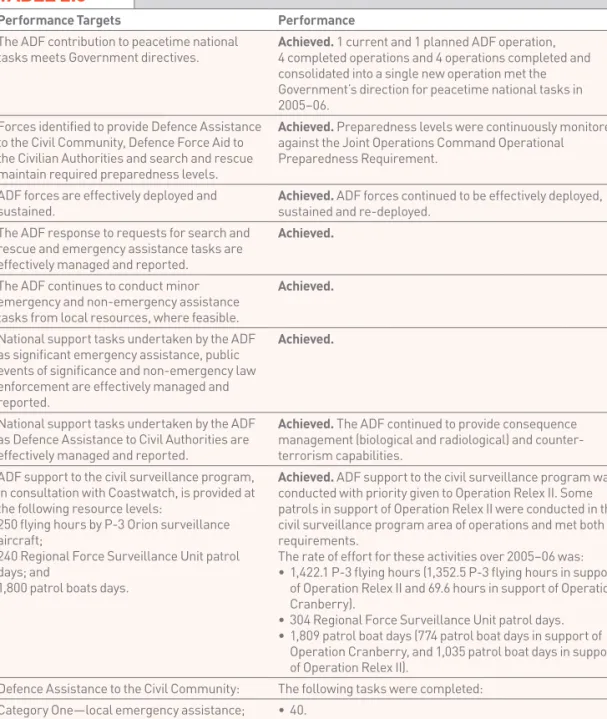
Peacetime National Support Tasks were dominated by the ADF commitment to supporting the 2006 Melbourne Commonwealth Games. There was also significant commitment to assist in relief efforts in Bali and Nauru that stretched the specialist capabilities of the ADF. Generic performance targets in relation to the conduct of ADF military operations and major exercises are reported in the table that follows and on pp. 94-99.
taBle 2.6
contriBution to national Support taSkSperformance targets performance
The ADF contribution to peacetime national
tasks meets Government directives. achieved. 1 current and 1 planned ADF operation, 4 completed operations and 4 operations completed and consolidated into a single new operation met the Government’s direction for peacetime national tasks in 2005–06.
Forces identified to provide Defence Assistance to the Civil Community, Defence Force Aid to the Civilian Authorities and search and rescue maintain required preparedness levels.
achieved. Preparedness levels were continuously monitored against the Joint Operations Command Operational Preparedness Requirement.
ADF forces are effectively deployed and
sustained. achieved. ADF forces continued to be effectively deployed, sustained and re-deployed. The ADF response to requests for search and
rescue and emergency assistance tasks are effectively managed and reported.
achieved. The ADF continues to conduct minor
emergency and non-emergency assistance tasks from local resources, where feasible.
achieved. National support tasks undertaken by the ADF
as significant emergency assistance, public events of significance and non-emergency law enforcement are effectively managed and reported.
achieved.
National support tasks undertaken by the ADF as Defence Assistance to Civil Authorities are effectively managed and reported.
achieved. The ADF continued to provide consequence management (biological and radiological) and counter-terrorism capabilities.
ADF support to the civil surveillance program, in consultation with Coastwatch, is provided at the following resource levels:
250 flying hours by P-3 Orion surveillance aircraft;
240 Regional Force Surveillance unit patrol days; and
1,800 patrol boats days.
achieved. ADF support to the civil surveillance program was conducted with priority given to Operation Relex II. Some patrols in support of Operation Relex II were conducted in the civil surveillance program area of operations and met both requirements.
The rate of effort for these activities over 2005–06 was: • 1,422.1 P-3 flying hours (1,352.5 P-3 flying hours in support
of Operation Relex II and 69.6 hours in support of Operation Cranberry).
• 304 Regional Force Surveillance unit patrol days. • 1,809 patrol boat days (774 patrol boat days in support of
Operation Cranberry, and 1,035 patrol boat days in support of Operation Relex II).
Defence Assistance to the Civil Community: The following tasks were completed: Category One—local emergency assistance; • 40.
Category Two—general emergency assistance; • 3. Category Three—civil emergency or disaster
recovery; • nil.
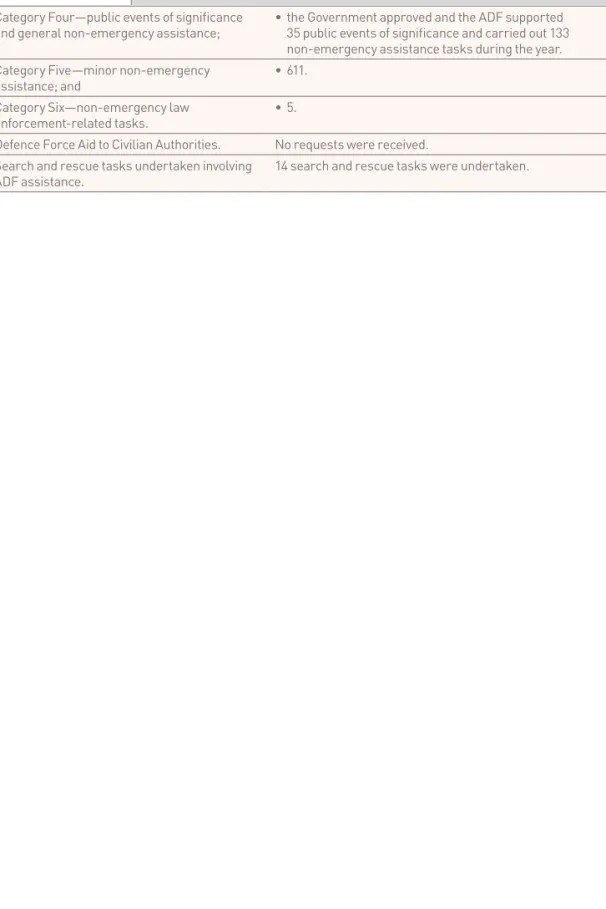
92
c H a p t e r 2
Category Four—public events of significance
and general non-emergency assistance; • the Government approved and the ADF supported 35 public events of significance and carried out 133 non-emergency assistance tasks during the year. Category Five—minor non-emergency
assistance; and • 611.
Category Six—non-emergency law
enforcement-related tasks. • 5.
Defence Force Aid to Civilian Authorities. No requests were received. Search and rescue tasks undertaken involving
ADF assistance. 14 search and rescue tasks were undertaken.
93 o u t c o m e o n e : c o m m a n D o f o p e r a t i o n S
2.3
coSt to GoVernment
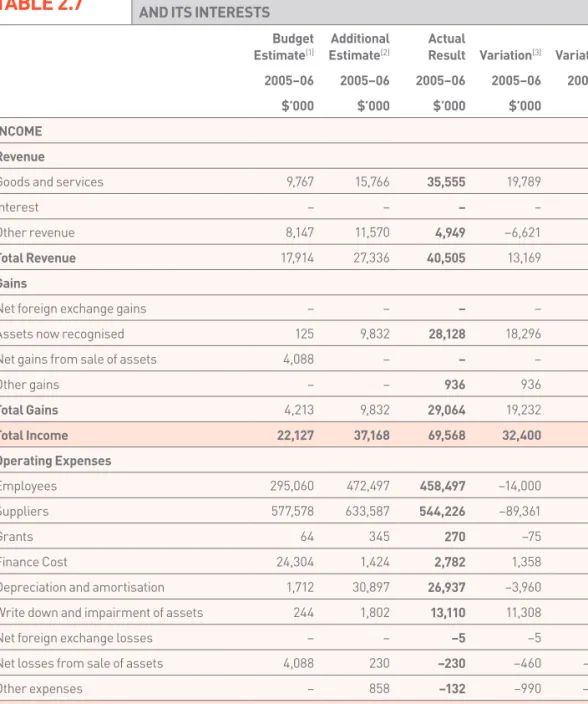
taBle 2.7
outcome one—commanD of operationS in Defence of auStralia anD itS intereStS Budgetestimate(1)
additional estimate(2)
actual
result Variation(3) Variation(3) 2005–06 2005–06 2005–06 2005–06 2005–06
$’000 $’000 $’000 $’000 %
income revenue
Goods and services 9,767 15,766 35,555 19,789 125.5
Interest – – – – –
Other revenue 8,147 11,570 4,949 –6,621 –57.2
total revenue 17,914 27,336 40,505 13,169 48.2
Gains
Net foreign exchange gains – – – – –
Assets now recognised 125 9,832 28,128 18,296 186.1
Net gains from sale of assets 4,088 – – – –
Other gains – – 936 936 – total Gains 4,213 9,832 29,064 19,232 195.6 total income 22,127 37,168 69,568 32,400 87.2 operating expenses Employees 295,060 472,497 458,497 –14,000 –3.0 Suppliers 577,578 633,587 544,226 –89,361 –14.1 Grants 64 345 270 –75 –21.7 Finance Cost 24,304 1,424 2,782 1,358 95.3
Depreciation and amortisation 1,712 30,897 26,937 –3,960 –12.8
Write down and impairment of assets 244 1,802 13,110 11,308 627.5
Net foreign exchange losses – – –5 –5 –
Net losses from sale of assets 4,088 230 –230 –460 –199.9
Other expenses – 858 –132 –990 –115.4
total expenses 903,050 1,141,640 1,045,454 –96,186 –8.4
price to Government for outcome one 880,924 1,104,472 975,885 –128,587 –11.6 Notes:
1. Budget Estimates are consistent with Portfolio Budget Statements 2005–06 (page 100).
2. Additional Estimates are consistent with Portfolio Additional Estimates Statements 2005–06 (page 87). 3. Variations reflect the difference between Additional Estimates and Actuals.
94
c H a p t e r 2
taBle 2.8
BreakDoWn of outcome one By outputBudget
estimate(1) additional estimate(2) result Variationactual (3) Variation(3) 2005–06 2005–06 2005–06 2005–06 2005–06
$’000 $’000 $’000 $’000 %
Output 1.1—Command of Operations 371,713 554,315 465,084 –89,232 –16.1 Output 1.2—Defence Force Military
Operations and Exercises 499,032 526,433
492,549 –33,884 –6.4 Output 1.3—Contribution to National
Support Tasks 10,178 23,724 18,251 –5,472 –23.1
price to Government for outcome one 880,924 1,104,472 975,884 –128,588 –11.6 Notes:
1. Budget Estimates are consistent with Portfolio Budget Statements 2005–06 (page 104).
2. Additional Estimates are consistent with Portfolio Additional Estimates Statements 2005–06 (page 88). 3. Variations reflect the difference between Additional Estimates and Actuals.
auStralian Defence force operationS
taBle 2.9
operationS contriButinG to tHe Security of tHe immeDiate neiGHBourHooD operation objective, status and contributionAstute(1) 25 May 2006 – continuing
Objective: To restore order in Timor-Leste and facilitate the evacuation of Australian and other approved foreign nationals.
Status: Current.
Contribution: A request for assistance from the Timor-Leste Government was received on 24 May 2006. Deployments commenced the following day and by 31 May approximately 2,500 ADF personnel had arrived in Timor-Leste, including a 1,800 strong battalion group, 23 armoured personnel carriers, 10 helicopters and 5 Navy ships. By the end of May, the ADF had provided leadership for a combined and joint military and police effort; secured key infrastructure; successfully repatriated hundreds of Australians; facilitated the return to barracks of the East Timorese Defence and Police Forces; confiscated hundreds of weapons; and assisted in the provision of humanitarian aid. The incidence of violence, arson, civil unrest and looting had reduced significantly by the end of June 2006. The ADF continues to provide support to the Timor-Leste Government in conjunction with the Australian Federal Police and Malaysian, New Zealand and Portuguese forces. The number of ADF deployed forces was reduced from mid-July 2006.
Chiron May 2005 – continuing
Objective: To support the united Nations Mandate and Australia’s national interests by contributing military advisers to assist in the development of Timor-Leste’s security and stability.
Status: Current.
Contribution: The ADF contributed three personnel who act as military advisers, on behalf of the united Nations Office in Timor-Leste, to the Border Patrol unit of the Timor-Leste Police. This is the follow-on mission from Operation Spire.
95 o u t c o m e o n e : c o m m a n D o f o p e r a t i o n S
2.3
operation objective, status and contribution Anode
July 2003 – continuing
Objective: To support the Coalition police forces in maintaining the rule of law in Solomon Islands.
Status: Current.
Contribution: Approximately 400 ADF personnel and significant equipment assets were deployed to Solomon Islands in the aftermath of the April riots. Approximately 140 personnel remained as at 30 June 2006, including an enhanced Task Force Headquarters element and a company group. The ADF continues to provide security support to the Regional Assistance Mission to Solomon Islands in conjunction with the Australian Federal Police and participating Pacific nations.
Gateway
1981 – continuing Objective: To conduct northern Indian Ocean and South China Sea maritime surveillance patrols. Status: Current.
Contribution: One P-3 maritime patrol aircraft. Operation Gateway continues to be conducted at a reduced rate of effort.
Note:
1. Operation Astute was not reported in the Portfolio Budget Statements 2005–06 or the Portfolio Additional Estimates Statements 2005-06 due to the immediate nature of the deployment.
taBle 2.9
continueDtaBle 2.10
SupportinG WiDer intereStSoperation objective, status and contribution Pakistan Assist
November 2005 – April 2006(1)
Objective: To provide assistance to the victims of the Pakistan earthquake. Status: Completed.
Contribution: An ADF medical team was deployed to the remote Dhanni area where it performed over 9,500 medical treatments, provided over 4,000 immunisations and delivered 5 babies. An Australian Army Black Hawk helicopter detachment performed 74 life saving aero-medical evacuations and distributed humanitarian supplies to villages and communities cut-off by earthquake damage.
Palate II June 2005 – continuing
Objective: ADF provision of a Military Liaison Officer to the united Nations Assistance Mission in Afghanistan.
Status: Current.
Contribution: One Military Liaison Officer. Azure
May 2005 – continuing
Objective: ADF contribution to the united Nations Mission in Sudan. Status: Current.
Contribution: 15 personnel to the united Nations peacekeeping force serving as headquarters staff and military observers.
Valient October – November 2004
Objective: To equip the Republic of Fiji Military Force united Nations Assistance Mission Iraq contingent for service in Iraq and providing training assistance to the Republic of Fiji Military Force personnel protection details, to assist in their preparation for service in Iraq. Status: Dormant. Operation Valient can be reactivated if required.
Contribution: No personnel are currently assigned to the operation but ADF stores remain on loan to the Fijian Government.
96
c H a p t e r 2
operation objective, status and contribution Catalyst
July 2003 – continuing
Objective: ADF contribution in support of the rehabilitation of Iraq. Status: Current.
Contribution: The ADF deployment to the Middle East Area of Operations comprised approximately 1,400 ADF personnel, including:
• an Australian National Headquarters element;
• approximately 95 personnel serving in the multinational force headquarters and units; • a maritime element of 1 frigate;
• aviation elements including C-130 Hercules and P-3 Orion aircraft and support detachments;
• a security detachment including Australian Light Armoured Vehicles to provide protection and escort for Australian Government personnel working in Baghdad; • a multi-role Task Group based in the southern Iraqi province of Al Muthanna; • a small number of personnel employed in the Combined Explosives Exploitation Cell
tasked with disarming explosive devices and conducting post-explosion assessments to determine the type of explosive devices used; and
• a tri-service Force Level Logistic Asset providing logistic support to all forces in Iraq and Afghanistan.
Slipper October 2001 – continuing
Objective: To contribute to the united States-led operation against international terrorism and to the Multinational Maritime Interception Force in the Persian Gulf.
Status: Current.
Contribution: The ADF currently has approximately 310 personnel deployed under Operation Slipper. This includes a Special Forces Task Group and a CH-47 Chinook helicopter detachment. Planning has been conducted for a Reconstruction Task Force of approximately 240 personnel to deploy in late 2006 to contribute to a Dutch-led Provincial Reconstruction Team under command of the North Atlantic Treaty Organisation. Mazurka
September 1982 – continuing
Objective: To provide personnel to the Multinational Force and Observers to monitor the security arrangements in the Sinai.
Status: Current.
Contribution: The ADF contributes 25 personnel to the Multi-National Force, serving as specialist staff and military observers.
Paladin June 1956 – continuing
Objective: To contribute to the united Nations Truce Supervisory Organisation in the Middle East.
Status: Current.
Contribution: The ADF contributes 12 unarmed military observers who supervise, observe and report on the various cease-fire arrangements, truces and peace treaties that have been negotiated between Israel and neighbouring Arab nations since 1948.
Note:
1. Operation Pakistan Assist was previously reported in the Portfolio Additional Estimates Statements 2005–06 under Peacetime National Tasks.
97 o u t c o m e o n e : c o m m a n D o f o p e r a t i o n S
2.3
taBle 2.11
peacetime national taSkSoperation objective, status and contribution Deluge
Planning activity Objective: To support the Asia–Pacific Economic Conference in 2007.Status: Planned.
Contribution: Planning with State and civil authorities commenced in 2005 with exercises scheduled for 2006–07.
Larry Assist March – April 2006
Objective: To support the Queensland Government following Tropical Cyclone Larry. Status: Completed.
Contribution: Details are provided in the feature article on this operation (see p. 100). Bali Assist II (1)
October 2005 Objective: To provide medical support to the victims of the 1 October 2005 Bali bombing.Status: Completed. Contribution: 2 C-130 aircraft deployed with medical supplies and Aero-Medical Evacuation teams on board. Two evacuation flights from Bali were conducted, evacuating 13 injured people and 8 accompanying family members. Donated medical supplies were transported to Bali.
Nauru Assist III
September 2005 Objective: To provide assistance to the Government of Nauru in disposing of unexploded wartime ordnance. Status: Completed.
Contribution: The ADF deployed an Explosive Ordnance Demolition team of 4 personnel, 1 medical assistant and a C-130 Hercules aircraft.
Acolyte February 2005 – April 2006
Objective: To support the 2006 Melbourne Commonwealth Games. Status: Completed.
Contribution: The ADF contributed 2,600 personnel for security, ceremonial and general support to the event. The ADF support included:
• air patrol by F/A-18 aircraft; • maritime element; • security support;
• an Incident Response Regiment; • venue communication coordination; • flag-raising ceremonial support; • operating vehicle check-points; and • pre-game venue searches. Relex II
March 2002 – consolidated
Objective: To conduct air and surface patrols across Australia’s northern approaches to deter unauthorised boat arrivals.
Status: Completed. Consolidated into Operation Resolute, which commenced on 17 July 2006.
Contribution: The ADF currently provides the following major assets: • 1 frigate;
• up to 4 Royal Australian Navy patrol boats;
• 1 Mine Hunter Coastal (dual force assigned to Operation Cranberry), with an additional one at reduced notice to move; and
• 1 P-3 Orion maritime patrol aircraft and an additional aircraft on stand-by. Mistral
1998 – consolidated
Objective: To support Australian sovereign rights and fisheries law enforcement in the Southern Ocean by contributing to Southern Ocean fisheries patrols.
Status: Completed. Consolidated into Operation Resolute.
Contribution: The ADF currently has 4 specialist personnel deployed in MV Oceanic Viking in support of the current Southern Ocean patrol.
98
c H a p t e r 2
Cranberry June 1997 – consolidated
Objective: To conduct surveillance in northern Australia.
Status: Completed. Consolidated into Operation Resolute. Operation Cranberry also included the subordinate Operation Breakwater.
Contribution: Surveillance to detect illegal activity, such as smuggling and illegal fishing, continued to be conducted using a range of ADF assets including:
• Fremantle and Armidale-class patrol boats;
• 1 Mine Hunter Coastal (dual force assigned to Operation Relex II); • P-3 Orion maritime patrol aircraft; and
• the Army Regional Force Surveillance units. Solania
1988 – continuing Objective: To conduct South-West Pacific maritime surveillance patrols.Status: Current.
Contribution: Operation Solania was conducted at a reduced rate of effort due to higher operational commitments.
Estes 1980 – consolidated
Objective: To conduct surface patrols in Bass Strait. Status: Completed. Consolidated into Operation Resolute.
Contribution: ADF surface patrols in Bass Strait continued when appropriate resources were available.
Note:
1. Operation Bali Assist II was not reported in the Portfolio Budget Statements 2005–06 or the Portfolio Additional Estimates Statements 2005-06 due to the immediate nature of the deployment.
99 o u t c o m e o n e : c o m m a n D o f o p e r a t i o n S
2.3
maJor Defence force
eXerciSeS
The following tables list the major joint and/or combined exercises conducted by the ADF during 2005–06. All other ADF exercises conducted, cancelled or postponed during
taBle 2.12
aDf eXerciSeSaDf Joint exercises objective Status
Mercury 05
October 2005 To test ADF interaction within the national multi-jurisdictional exercise. Conducted combined aDf/five power Defence arrangement exercises
Bersama Lima 05
September 2005 To practise and develop operational procedures and tactics with forces from Malaysia, New Zealand, Singapore and the united Kingdom in a joint / combined maritime exercise.
Conducted
Bersama Shield
April 2006 To practise and develop Air Defence procedures and tactics with forces from Malaysia, New Zealand, Singapore and the united Kingdom in a joint / combined air exercise.
Conducted
other combined exercises Deep Sabre 05
Proliferation security initiative 05–1 August 2005
To conduct a maritime weapons of mass destruction interdiction exercise in Singapore with participation from Canada, France, Germany, Holland, Japan, New Zealand, Russia, Singapore, united Kingdom and united States.
Conducted
Regional Counter-Terrorist Subject Matter Expert Exchange 05 August 2005
To improve interoperability by sharing counter-terrorist methodology and policy and to align tactics, techniques and procedures. Participation from Cambodia, China, India, Indonesia, Japan, Malaysia, New Zealand, Papua New Guinea, Philippines, Singapore, Thailand, united States and Vietnam.
Conducted
Red Flag 06
February 2006 To conduct coalition air combat training within the Integrated Air Defence System environment with forces of the united States and united Kingdom.
Conducted
Rimpac 06
June – July 2006 To improve interoperability with regional forces to operate in coalition arrangements by conducting a combined maritime warfare exercise. Participation from Canada, Chile, Japan, Peru, Republic of Korea, united Kingdom and the united States.
Conducted 2005–06 have been published in the online version of this report and can be accessed at www.defence.gov.au/annualreports.
100
operation larry aSSiSt
The ADF launched Operation Larry Assist in response to a request for assistance from the Queensland Government. Cyclone Larry struck at 7am on 20 March 2006, and by midnight the first convoy from the Townsville-based 3rd Brigade was headed north on the Bruce Highway. Additional troops and engineers with heavy plant and equipment followed early the next morning. The convoys arrived in Innisfail before road access was cut by rapidly rising floodwaters.
The aim was to stabilise the situation until the civil authorities could consolidate and fully manage the disaster relief operation without Defence support. The priorities were to provide drinking water, food and shelter, and to clear debris which blocked roads and endangered the population.
A Joint Task Force Headquarters was established to operate with the Queensland State Disaster Coordination Centre. An air bridge into Innisfail was developed to allow Air Force Hercules and Caribou aircraft to deliver essential stores. In the first four days of Operation Larry Assist, 75,000 litres of bottled water and 15.5 tonnes of tarpaulins were delivered.
Military helicopters including Seahawk, Black Hawk, Iroquois and a heavy lift Chinook assisted with delivering supplies and assessing the extent of damage. In one airlift, a Chinook from Townsville’s 5th Aviation Regiment helped to restore Innisfail’s electricity substation by delivering a 32 metre-high transmission tower from Townsville. The helicopters also played a crucial role in the aero-medical evacuation of patients.
Army personnel, including the Townsville-based 3rd Brigade and the
Cairns-based 51st Far North Queensland Regiment assisted across the region. Navy personnel from HMAS Cairns provided assistance to the Mareeba community, while several heavy landing craft were used to move equipment where roads were cut by flooding. Air Force personnel from units in Townsville, Amberley, Richmond and Williamtown transported supplies and cleared debris, and provided emergency support to the local population at Innisfail Showgrounds. Army medics assisted staff at Innisfail hospital while catering staff set up a field kitchen that prepared over 1,500 fresh meals for displaced locals.
One of the many homes destroyed by Cyclone Larry in Innisfail, North Queensland. Members of 3 Combat
Support Services Batallion Health Company, carry medical supplies to a Black Hawk helicopter to assist the Innisfail community.
c H a p t e r 2
2.3
101
The work by ADF personnel moving into devastated areas and carefully cleaning up debris and covering damaged roofs with tarpaulins generated a strong, positive reaction from local communities. As the initial emergency eased, schools became the focus for engineers who repaired roofing, boarded up broken windows, reconnected water services, cleared fallen trees and made powerlines safe.
Commanders on the ground reported that ADF personnel were incredibly focused and dedicated to the relief effort.
“The hardest thing was to get them to slow down and take a break”.
Soldiers from Townsville remove fallen trees in the streets of Innisfail.
An Air Force Caribou aircraft delivers troops and relief assistance supplies.
102
outCome two:
nAvY CApABilitY
Reflecting upon the Navy’s activities
throughout 2005–06, I am immensely proud of our achievements during another year of significant operational demand. The Navy participated in a range of ADF operations, providing the platforms (ships, submarines and aircraft) and people critical to achieving successful outcomes in naval and joint operations in our region and around the world. Our operational achievements have been complemented by an ongoing commitment to develop and implement personnel initiatives leading to a transformation in the way people are managed in the Navy. During 2005–06, the Navy welcomed new platforms into the fleet and continued to prepare for the introduction of new capabilities to meet future operational challenges.
operationS
During 2005–06, the Navy was called upon to respond to a wide range of global peace and law enforcement initiatives, regional security concerns, illegal offshore activities, and the provision of humanitarian aid in response to natural disasters at home and abroad. The Navy’s operational performance remains at a very effective level.
The Chief of Navy, Vice Admiral Russ Shalders, is accountable for delivering Navy Capability
Highlights of the Navy’s activities throughout 2005–06 included participation in a range of different operations:
• operation catalyst. The Navy continued its sixteenth consecutive year of commitment to maritime operations in the Persian Gulf with the deployment of HMA Ships
Newcastle, Parramatta and Ballarat as part of the united States-led stabilisation and recovery operations in Iraq. In June 2006, Commodore Peter Lockwood DSC, CSC, RAN assumed command of Task Force 158, as the second Royal Australian Navy commander charged with responsibility for protecting Iraq’s key oil infrastructure, conducting maritime interception operations, and training Iraqi forces to assume responsibility for their own maritime security in the future.
• operation anode. In April 2006, in response to civil unrest in Solomon Islands, HMA Ships Townsville and Armidale deployed as part of a multinational operation in support of coalition police forces working to restore law and order.
• operation astute. In May 2006, the frigate, HMAS Adelaide, pre-positioned off Dili, Timor-Leste in support of stabilisation operations in that country. This was followed by the deployment of a task force of seven ships including HMA Ships Manoora, Kanimbla, Tobruk and Success in response to the deteriorating security situation. Throughout the operation, Navy units provided transport for troops and equipment and logistics support to forces once they were on the ground.
103
2.4
o u t c o m e t W o : n a V y c a p a B i l i t yo u t c o m e t W o : n a V y c a p a B i l i t y
Closer to home and throughout the year, the Navy played a central role in border protection and fisheries patrols, with 160 foreign fishing vessel apprehensions and the conduct of 302 operational boardings. Patrol boats contributed 1,809 patrol days in support of Operations Relex II and Cranberry, the coordination of intelligence and provision of surveillance information to civil authorities, and Operation Breakwater, a period of increased patrol activity conducted in tandem with the Australian Fisheries Management Authority and Customs.
people
Continuing operational commitments and the introduction of new platforms and enhanced capabilities cannot be achieved without first class personnel. The quality of the Navy’s people, their dedication to the service of Australia and their outstanding achievements are world class. The Navy remains committed to introducing and implementing programs aimed at improving the work–life balance for the Navy’s people and creating a work environment where they wish to remain. ‘Sea Change’ is a Navy program designed to research, develop and implement a broad range of initiatives aimed at improving Service life with a positive impact on Navy recruitment and retention. Initiatives aimed at keeping sailors in the Navy, especially those with critical skills, are beginning to have positive effect. Attracting the young people we will need to crew future assets such as the Air Warfare Destroyer and amphibious ships remains a key concern in a tight labour market. ‘Sea Change’ initiatives such as establishing waterfront career management centres and developing five-year career plans have contributed positively to greater certainty for Navy people. Trials of other initiatives— such as flexi-crewing—seek innovative ways to improve Service life by providing sailors with more options for spending time ashore with their families and to undertake training.
SHipS, SuBmarineS anD aircraft
New ships and other naval capabilities were introduced into the Navy in 2005–06 with a number of assets being replaced or upgraded. HMAS Sydney, the first Adelaide-class guided missile frigate to be upgraded, returned to the fleet in 2005–06. The replacement of the Fremantle-class patrol boats with the Armidale-class patrol boats commenced in 2005–06. The new patrol boats offer
improvements in capability, sea-keeping, and habitability. In addition, the Collins class submarine combat system upgrade program progressed throughout 2005–06, including through the provision of new heavyweight torpedoes. The Sea King helicopter fleet resumed flying in 2005–06 following an intensive maintenance program conducted after the tragic loss of nine ADF members and a Sea King helicopter at Nias, Indonesia during earthquake relief operations.
Throughout 2005–06, the Navy has maintained a demanding tempo of operations, introducing new capabilities and contributing to
preparations for a significantly enhanced fleet. We are proud of our collective achievements and of each individual’s contribution. The Navy’s priorities will continue to be operations, people and platforms as we strive to achieve success in all that we do on behalf of the Australian public.
104
c H a p t e r 2
capaBility performance
information
output 2.1 capaBility for maJor Surface comBatant operationS
The surface combatant force provides the Navy with a fleet of surface ships capable of conducting a wide range of surface operations. The surface combatant force possesses combat capabilities in all three primary warfare areas (air, surface and undersea) and provides combined coalition and joint ADF command and control facilities for ADF operations. In 2005–06, the force was made up of five Adelaide-class guided missile frigates and seven Anzac-class frigates.
adelaide‑class guided missile frigates
HMAS Canberra was decommissioned in November 2005, making the Adelaide-class a force of five ships. HMAS Adelaide was planned to decommission at the end of 2006, but will now remain in service until the end of 2007 to provide the Navy with the continuity and flexibility needed to meet operational commitments, regional engagement obligations through the conduct of port visits and exercises with regional nations, and training for surface combatant fleet skills. The FFG upgrade Implementation project for four Adelaide-class guided missile frigates will ensure that the frigates can operate
taBle 2.13
capaBility for maJor Surface comBatant operationSperformance targets performance
Achieve levels of preparedness directed by the Chief of the Defence Force for military response options with a warning time of less than 12 months.
achieved. Levels were met in accordance with current preparedness directives.
Achieve a level of training that maintains core skills and professional standards across all warfare areas.
Substantially achieved. Collective and individual training in all disciplines continues to be conducted. Training throughput for some disciplines depends on ship availability.
Achieve mission capability(1) for assigned
tasks. Substantially achieved. 90 per cent (2,666 days) for the force. Mission capability was not fully achieved due to various systems-related defects. Class achievements:
Guided missile frigates—84 per cent (1,014 days). Anzac-class frigates—94 per cent (1,652 days). 5 Adelaide-class guided missile frigates—
1,164 unit Ready Days (uRD)(2). 5 guided missile frigates—104 per cent (1,211 uRD achieved). The over achievement was due to the early hand-back of HMAS Sydney from upgrade. HMAS Sydney was not fully mission capable, but did have the ability to undertake most tasks, thus providing an overall increase in ship availability.
7 Anzac-class frigates—1,737 uRD(3). 7 Anzac-class frigates—101 per cent (1,761 uRD achieved). The over achievement was due to a delay in the start of maintenance for HMAS Parramatta, which increased ship availability. Notes:
1. Mission capability measures capability for assigned tasks. It is defined as the required level of unit readiness for the actual tasking for which the force element has been scheduled at any time through its operational cycle. Tasking includes all scheduled activities to achieve assigned Defence operations, international engagement requirements and levels of preparedness required for a military response. Mission capability is assessed against uRD achieved to produce a percentage. The mission capability performance is calculated by dividing the total number of mission capability days recorded throughout the year by the uRD achieved, to produce a percentage.
2. unit Ready Days (uRD) are the number of days that a force element is available for tasking, by the Maritime Commander, either outside of major maintenance and within planned readiness requirements or in accordance with contracted availability.
105
2.4
o u t c o m e t W o : n a V y c a p a B i l i t yeffectively in the increasingly sophisticated maritime warfare environment. The FFG upgrade contract was renegotiated with the prime contractor, ADI Limited, in May 2006, formalising the Government’s decision to reduce the scope of the upgrade to four ships. The program commenced in 2003. The first ship, HMAS Sydney, returned to the fleet in 2005–06. This program is now rescheduled to be completed in 2009 to take into account the Navy’s operational requirements and the terms of the renegotiated contract.
anzac‑class frigates
HMAS Toowoomba, the seventh Anzac-class frigate, was commissioned in October 2005. The Anzac-class frigates are progressively undergoing capability enhancements including Harpoon missile, mine and obstacle avoidance sonar upgrades, and crew accommodation improvements.
output 2.2 capaBility for naVal aViation operationS
The naval aviation force provides the Navy with helicopters for conducting naval aviation operations and is made up of 16 Seahawks, six Sea Kings and 13 Squirrel helicopters. The introduction of the Super Seasprite helicopters to operational service has been delayed by the need to resolve problems identified during the flight test program. Seahawk helicopters provide the flights for embarkation in either Adelaide-class guided missile frigates or Anzac-class frigates. Squirrel helicopters were unable to meet their training targets due to a tail rotor fault that significantly reduced their availability while this was being rectified. Kalkara target operations in support of Navy and Air Force training and missile testing met all requested tasking assignments.
taBle 2.14
capaBility for naVal aViation operationSperformance targets performance
Achieve levels of preparedness directed by the Chief of the Defence Force for military response options with a warning time of less than 12 months.
partially achieved. Preparedness levels for the Sea King were not met. An intensive Maintenance Re-invigoration Plan has impacted on Sea King serviceability and subsequent availability. Further, the reduced size of the Sea King fleet and shortage of aircrew have also had an impact on overall availability. The Maintenance Re-invigoration Plan and aircrew shortages have had a similar effect on the other squadrons.
Achieve a level of training that maintains core skills and professional standards across all warfare areas.
Substantially achieved. Core skills and professional standards across all warfare areas were maintained. The number of Seahawk flights at sea was reduced to meet individual training and helicopter modification requirements ashore.
Achieve mission capability for assigned tasks.
Substantially achieved. Embarked flights and detachments were mission capable to meet all but a limited number of assigned tasks.
16 Seahawks—3,300 hours. 16 Seahawks—81 per cent (2,670 hours). Project demands on the Seahawk fleet, the Maintenance Re-invigoration Plan, and a shortage of aircrew have all combined to cause a significant but temporary decline in the achievement of flying hours.
6 Sea Kings—1,200 hours. 6 Sea Kings—82 per cent (980 hours). Sea King hours have been heavily affected by reduced serviceability as a result of the Maintenance Re-invigoration Plan.
106
c H a p t e r 2
output 2.3 capaBility for patrol Boat operationS
During 2005–06, the patrol boat force was made up of both Fremantle and Armidale-class patrol boats. The patrol boat force continues to make a large and effective contribution to the Civil Surveillance Program (managed by the Joint Offshore Protection Command) for the protection of Australia’s sovereignty, covering fisheries, quarantine, immigration and customs duties, and North West Shelf security patrols with emphasis on the protection of offshore oil and gas platforms. Patrol boats also contributed to international engagement and national security through the conduct of operations, port visits and exercises with regional nations.
At the end of 2005–06, ten (of an original 15) Fremantle-class patrol boats were in operation, and three Armidale-class patrol boats were in commission and operational. A further two Armidale-class patrol boats were undergoing operational workup in 2005–06 prior to commissioning in July 2006. The last Fremantle-class patrol boat is scheduled for decommissioning in May 2007. A further nine Armidale-class patrol boats are due to be progressively brought into service by January 2008. The mature Armidale-class patrol boat capability will be supported by a total of 21 crews. This combination of crews and hulls establishes a multi-crewing system that will result in an overall increase in operational availability and flexibility.
13(1) Squirrels—3,700 hours. 13 Squirrels—77 per cent (2,832 hours). Squirrel hours were significantly affected in 2005 by a tail rotor fault that severely limited availability while the fault was being rectified.
600–700 hours were lost during the rectification period. Squirrel serviceability has also declined as a consequence of the additional administrative aspects of the Maintenance Re-invigoration Plan. In addition, a project to fit improved crew seats affected availability. 11(2) Super Seasprites—975 hours. 10 Super Seasprites—17 per cent (168 hours). There was very
limited flying achieved until March 2006 when all Super Seasprites were grounded.
10 Kalkaras—available for
39 presentations.(3) 9 Kalkaras—31 per cent (12 presentations). The system was available for 39 presentations as per the contractual requirements. Only 12 were required to support Navy and Air Force training exercises and missile testing during 2005–06. One Kalkara was lost through the year in the course of a missile presentation serial.
Notes:
1. Twelve aircraft are operated, the thirteenth aircraft is held for attrition purposes.
2. The eleventh Seasprite has not been delivered from the united States to Australia at this point.
3. Kalkara is an unmanned aerial target system used for Navy and Air Force support. Presentations refer to the number of instances during which the system is used as a target in training or system testing exercises.
107
2.4
o u t c o m e t W o : n a V y c a p a B i l i t youtput 2.4 capaBility for SuBmarine operationS
This output, compromising six Collins-class submarines, provides the ADF with a capability for submarine operations, including anti-submarine warfare, maritime strike and interdiction, maritime surveillance and intelligence collection, and enhanced joint ADF operations. Two of the six submarines are fitted with augmented combat systems while the remaining four have received platform improvements to maintain capability levels until the completion of the class-wide combat system upgrade package. Installation of this upgrade has commenced with HMAS Waller, which is scheduled to complete a full cycle docking in early 2007. This submarine will be the first to enter operational service with the replacement combat system and
heavyweight torpedo.
taBle 2.15
capaBility for patrol Boat operationSperformance targets performance
Achieve levels of preparedness directed by the Chief of the Defence Force for military response options with a warning time of less than 12 months.
Substantially achieved. Slight underachievement due to fluctuations in patrol boat numbers during the phase out of Fremantle-class patrol boats, against the delivery schedule of Armidale-class patrol boats and operational acceptance. Achieve a level of training that maintains
core skills and professional standards across all warfare areas.
achieved. Levels were met in accordance with current preparedness directives.
Achieve mission capability for assigned
tasks. achieved. 95 per cent (4,480 days) for the force. Mission capability was not fully achieved due to defect rectification and, to a lesser extent, a lack of available operational relief personnel.
Class achievements:
Fremantle Class—96 per cent (4,009 days). Armidale Class—92 per cent (471 days). 10(1) Fremantle-class patrol boats—
4,179 uRD. 10 Fremantle-class patrol boats—100 per cent (4,179 uRD achieved). 3(2) Armidale-class patrol boats—546
uRD. 3 Armidale-class patrol boats—94 per cent (513 uRD achieved), due to late delivery and extension to unit preparation periods. Notes:
1. The number of Fremantle-class patrol boats reduced from 14 to ten during 2005–06. Originally planned to reduce to eight, the decommissioning schedule for the Fremantle-class patrol boats was changed to meet minor slippages, between two and six weeks, in some milestones of the Armidale-class patrol boat project for boats two through five. The Armidale-class patrol boat program was back on schedule by June 2006.
2. The number of commissioned Armidale-class patrol boats increased from one to three during 2005–06, with a further three scheduled to commission between July–September 2006. The six vessels have nine crews. Multi-crewing is used to enhance availability of the vessels.