UNIFIED IMPLICIT AND EXPLICIT FEEDBACK FOR MULTI-APPLICATION USER INTEREST MODELING
A Dissertation by
UKWATTA KANKANAMALAGE SAMPATH JAYARATHNA
Submitted to the Office of Graduate and Professional Studies of Texas A&M University
in partial fulfillment of the requirements for the degree of DOCTOR OF PHILOSOPHY
Chair of Committee, Frank Shipman Committee Members, Richard Furuta
James Caverlee Ann McNamara Head of Department, Dilma Da Silva
August 2016
Major Subject: Computer Science
ii ABSTRACT
A user often interacts with multiple applications while working on a task. User models can be developed individually at each of the individual applications, but there is no easy way to come up with a more complete user model based on the distributed activity of the user. To address this issue, this research studies the importance of combining various implicit and explicit relevance feedback indicators in a multi-application environment. It allows different applications used for different purposes by the user to contribute user activity and its context to mutually support users with unified relevance feedback. Using the data collected by the web browser, Microsoft Word and Microsoft PowerPoint, Adobe Acrobat Writer and VKB, combinations of implicit relevance feedback with semi-explicit relevance feedback were analyzed and compared with explicit user ratings.
Our past research show that multi-application interest models based on implicit feedback theoretically out performed single application interest models based on implicit feedback. Also in practice, a multi-application interest model based on semi-explicit feedback increased user attention to high-value documents. In the current dissertation study, we have incorporated topic modeling to represent interest in user models for textual content and compared similarity measures for improved recall and precision based on the text content. We also learned the relative value of features from content consumption applications and content production applications. Our experimental results show that incorporating implicit feedback in page-level user interest estimation resulted in
iii
significant improvements over the baseline models. Furthermore, incorporating semi-explicit content (e.g. annotated text) with the authored text is effective in identifying segment-level relevant content.
We have evaluated the effectiveness of the recommendation support from both semi-explicit model (authored/annotated text) and unified model (implicit + semi-explicit) and have found that they are successful in allowing users to locate the content easily because the relevant details are selectively highlighted and recommended documents and passages within documents based on the user’s indicated interest. Our recommendations based on the semi-explicit feedback were viewed the same as those from unified feedback and recommendations based on semi-explicit feedback outperformed those from unified feedback in terms of matching post-task document assessments.
iv DEDICATION
In memory of my father Mr. Jayarathna (1948-2001) you left fingerprints of grace on our lives. You shan’t be forgotten
This is for you, Nim and Pahan; you have been a constant support and encouragement during the challenges of graduate school and life. I am truly thankful for having you in
my life
v
ACKNOWLEDGEMENTS
Foremost, I would like to express my sincere gratitude to my advisor Dr. Frank Shipman for the continuous support of my Ph.D. study and research, for his patience, motivation, enthusiasm, and immense knowledge. His guidance helped me in all the time of research and writing of this thesis and getting a tenure track job. I could not have imagined having a better advisor and mentor for my Ph.D. study.
Besides my advisor, I would like to thank the rest of my thesis committee: Dr. Richard Furuta, Dr. James Caverlee and Dr. Ann McNamara, for their encouragement, insightful comments, and hard questions.
I thank my fellow colleagues (past and present) at Shipman Lab and Center for Study of Digital Libraries for the stimulating discussions (mostly about food), and for all the fun we have had in the last six years; Atish, Faryaneh, Luis, Gabe, Suin, Josh, Caio, Prasanth and Arun.
Most importantly, none of this would have been possible without the love and patience of my family. My immediate family to whom this dissertation is dedicated to, including my wife Nimmi and son Pahan have been a constant source of love, concern, support and strength all these years. I would like to express my heart-felt gratitude to my family and my in-laws which have aided and encouraged me throughout this endeavor.
Finally, I sincerely appreciate the financial support from Department of Computer Science & Engineering that funded parts of the research discussed in this dissertation.
vi TABLE OF CONTENTS Page ABSTRACT ... ii DEDICATION ... iv ACKNOWLEDGEMENTS ... v TABLE OF CONTENTS ... vi
LIST OF FIGURES ...viii
LIST OF TABLES ... x
1. INTRODUCTION ... 1
2. PROBLEMS AND ISSUES ... 4
2.1 Too Many Documents, Too Little Time ... 4
2.2 Relevance Feedback ... 5
2.3 Challenges in Personalized Information Delivery ... 6
2.4 Multi-Application Environments ... 7
3. LITERATURE REVIEW ... 9
3.1 Relevance Feedback ... 9
3.2 Explicit Relevance Feedback ... 11
3.3 Semi-Explicit Relevance Feedback ... 13
3.4 Implicit Relevance Feedback ... 15
3.5 Topic-Level Relevance Indicators ... 19
3.6 Hybrid (Implicit and Explicit) Relevance Feedback ... 21
3.7 Distributed User Modeling ... 22
4. SYSTEM ARCHITECTURE ... 26
4.1 Interest Profile Manager ... 26
4.2 Interest Representation ... 29
4.3 Explicit Feedback ... 31
4.4 Implicit Feedback ... 34
4.5 Models of User Interest ... 35
4.5.1 Topic Modeling of Textual Content ... 36
4.5.2 Multi-Application Weighting ... 38
vii
4.5.4 Unified Relevance Feedback Model ... 40
4.6 Dynamic IPM Architecture ... 41
4.6.1 Semi-Explicit Model ... 41
4.6.2 Unified model ... 43
5. USER EVALUATIONS AND RESULTS ... 46
5.1 User Study 1 - Topic Modeling (2013) ... 47
5.1.1 Similarity Metrics ... 47
5.1.2 Similarity Models ... 48
5.1.3 Confusion Matrix for Similarity Evaluation ... 50
5.1.4 Ground Truth Data Collection ... 51
5.1.5 User Study 1 – Results ... 52
5.1.6 Topic Modeling Approach Selection ... 52
5.2 User Study 2 – Unified Model Feasibility Study (2014) ... 56
5.3 User Study 3 – Dynamic System (2016) ... 63
5.3.1 User Tasks Procedures ... 64
5.3.2 User Tasks Definitions and Instructions ... 66
5.3.3 Task Documents and User Ratings ... 68
5.3.4 User Interest Shift (Sub-Tasks)... 68
5.3.5 Study Participants ... 69
5.4 User Study 3 – Results ... 71
5.4.1 Perception of Participants ... 71
5.4.2 Multi-Application Environments and Privacy Issues ... 72
5.4.3 Document Relevance ... 74
5.4.4 Task-Wise Interactions ... 75
5.4.5 Model Comparisons ... 75
5.4.6 Participant Task Activities ... 77
5.4.7 User Model Performance with User Ratings ... 79
5.4.8 Unified* User Model ... 79
5.4.9 Qualitative Analysis of Recommendations... 87
5.4.10 Qualitative Analysis of Interest Shift... 90
5.5 Summary ... 92
6. CONCLUSION AND FUTURE WORK ... 93
REFERENCES ... 96
APPENDIX A ... 107
APPENDIX B ... 113
viii
LIST OF FIGURES
Page
Figure 1: IR Cycle with Interactions in Everyday Applications ... 7
Figure 2: Types of Relevance Feedback Indicators ... 10
Figure 3: Interest Profile Manager Architecture ... 27
Figure 4: VKB Search List with Visualizations ... 30
Figure 5: Everyday Applications System Architecture ... 30
Figure 6: IPM Event Transition from Individual Applications ... 31
Figure 7: WebAnnotate User Highlights and System Recommendations ... 33
Figure 8: WebAnnotate Toolbar for Rating Paragraphs ... 33
Figure 9: Semi-Explicit Topic Modeling of Text Content ... 38
Figure 10: Semi-Explicit Relevance Feedback System Architecture ... 42
Figure 11: Semi-Explicit model Applications ... 43
Figure 12: Implicit Relevance Feedback System Architecture ... 45
Figure 13: Impact of Varying the Threshold in Topic Models ... 53
Figure 14: Impact of Varying the Number of Latent Topics ... 55
Figure 15: Performance Comparisons of Different Models ... 55
Figure 16: Comparison of Feature Weights Computed from WKNN ... 58
Figure 17: Precision-Recall Segment-level Performance Comparison ... 61
Figure 18: User Study Participants (a) Sex, (b) Age and (b) Ethnic Origin ... 70
Figure 19: Information Overload across Types of Computing Devices Usages ... 71
Figure 20: Number of Applications Available for the Given Task ... 72
Figure 21: How Easy for the User to Use Multiple Applications ... 73
ix
Figure 23: Document Relevance for Each Tasks ... 75
Figure 24: Which Model Helps to Find the Relevant Content? ... 76
Figure 25: Time Spent on Each Task ... 77
Figure 26: Quality of User Summary Based on 5 Reviewers Average Rating ... 79
Figure 27: Unified* Model Parameter Learning through Regression Analysis ... 80
Figure 28: Average RMSE (a) Aggregated Average RMSE (b) All 10 Participants ... 81
Figure 29: RMSE Values for 10 Participants from User Models ... 82
Figure 30: 1-way ANOVA Multiple Comparisons for 3 Models ... 83
Figure 31: Average RMSE with Average User Ratings (a) Aggregated Average RMSE (b) All 10 Participants ... 85
Figure 32: RMSE Values for 10 Participants for 3 Models with Average User Ratings . 86 Figure 33: Participants Average Ratings for Recommendations Quality ... 90
x
LIST OF TABLES
Page
Table 1: Interest Indicators from Applications ... 35
Table 2: Confusion Matrix for System Evaluation ... 51
Table 3: Performance Comparison of 5 Similarity Measures ... 53
Table 4: Task Topics with Post-Task Document Relevance Assessments ... 56
Table 5: Page-Level Performance of Interest Models ... 61
Table 6: Segment-Level Performance of Semi-Explicit Models ... 62
Table 7: User Study Groups ... 63
Table 8: User Ratings for All the Participants ... 65
Table 9: Task-wise Page and Word Count ... 68
Table 10: Task-Wise Interactions of Recommendations ... 76
Table 11: Quality of User Summary Based on 5 Reviewers Average Rating ... 78
Table 12: RMSE for 10 Participants from User Models ... 81
Table 13: RMSE for 10 Participants from User Models with Average User Ratings... 85
Table 14: Decision Matrix for System Recommendations Qualitative Analysis ... 87
1
1. INTRODUCTION
In everyday tasks, users often handle a large volume of information from the web, and routinely face with difficulty in finding useful information. As the amount of information available for consumption causes "information overload," there’s a high demand for personalized approaches for information access. Personalized information delivery is a possible solution for this particular problem in gathering, personalizing and providing appropriate information to users. The quality of these personalization efforts are mostly depends on the information beyond what is merely expressed in a user’s query. The traditional "one-size-fits-all" approach used in search systems has been replaced by the idea of this "personalizing" results for specific users based on the user preferences, context, and particular information need (Liu and Belkin 2010). These customization efforts may take the form of filtering out irrelevant information from available resources and identifying additional resources of interests to the users. Personalization also allows providers to gather, filter content, adjust and format to an individual user’s needs and preferences. Considerable research has addressed the problem of personalization in the context of search and assessing the relevance of document to the user’s information needs (James, Hinrich , Todd , Rob , Don et al. 2002, Micarelli, Gasparetti, Sciarrone and Gauch 2007, Pasi 2010, Bennett, White, Chu, Dumais, Bailey et al. 2012). Research in personalization is ongoing in the major fields such as information retrieval, data mining, artificial intelligent, among others. The effectiveness of these approaches are strongly contingent upon the quantity as well as the quality of information available about the user and her preferences.
2
(Barla 2011) explains how the user modeling and personalization can be separated into three distinct stages of data collection, user model inference, and adaptation and personalization. This process has cyclic characteristics in personalization and adaptation by continuously acquiring new relevance information about the user and by refining a user interest model to better reflect the learned inference to serve personalization efforts. There are number of issues associated with the each step of the process. The data collection should balance between user privacy and the amount of data to needed to deliver successful personalization. When a user accesses the personalization system for the first time, there is not enough information to provide efficient personalization. This cold-start problem poses a challenge to early application activity. These personalization activities in the early stage of the system usage can be critical to user retention (Tsiriga and Virvou 2004). More generally, the sources of such data should not pose additional burden on the user and the data collection process should be unobtrusive by nature. Finally, the inference techniques should be able to maintain a relationship to user characteristics with changes to their personal development, interest and knowledge.
Relevance feedback is an interactive activity in which the system engages the user in iteratively formulating a user model to fulfill information needs based on the user’s expectations. Such a user-system interaction is not usually a single user-system interaction based solely on a user query and a resultant list of items that the system has evaluated as relevant. There has been a shift from this “blind” and closed behavior of first generation of search systems to assessment of multiple relevance dimensions motivated by the deep study of the notion of relevance (Saracevic 2007, Pasi 2014). Inferring perceived relevance
3
of information content delivered to the user is a central task of interactive information retrieval systems (Moshfeghi, Pinto, Pollick and Jose 2013). Perceived relevance can then be used to represent user preferences (Kelly 2009), used as an input for a search tasks (Ruotsalo, Peltonen, Eugster, Głowacka, Konyushkova et al. 2013) and to measure the user’s satisfaction (Fox, Karnawat, Mydland, Dumais and White 2005) with the personalization effort of the system.
Although relevance feedback has received a great deal of attention in the user modeling literature on IR and search personalization, very little work has been done to study the process of unifying these heterogeneous relevance feedback in multi-application environments. Many existing personalized information delivery require user interventions in terms of explicitly indicating interests, or interrupting users during their activity to recognize user preferences. The work presented in this dissertation addresses this rarely investigated topic: the potential of aggregating activity across multiple applications for user interest modeling. While there are theoretical or software frameworks for distributed user modeling, assessments of modeling techniques are almost always reported in terms of single applications. In this work, we present and evaluate a multi-application modeling technique that combines implicit and semi-explicit feedback across multiple everyday applications. The following section addresses problems and issues, and Section 3 provides an overview of related work. Section 4 describes the architecture, interfaces, and other capabilities. Evaluation of user models and findings are discussed in Sections 5. Finally, Section 6 addresses conclusions and future work.
4
2. PROBLEMS AND ISSUES
Detailed knowledge about a user's interests is beneficial in web search, advertising, and personalized recommendations as well as in content targeting. The goal of personalized recommendations is to support users by identifying documents or the parts of a document that best match user’s interests during an open-ended information gathering task. Such recommendations can result in a more efficient use of the user’s time, e.g. that their time is spent on the most relevant documents.
2.1Too Many Documents, Too Little Time
Our past research shows that time is frequently a limiting factor in web search tasks: there are too many documents to assess and too much reading to do. The problem in such a search task is that even with the best web search engines, and the most effective query formulations, these tasks require people to work through long list of documents to examine potentially relevant documents or part of a document. Most users skim early documents, find portion of a document relevant to the current query, and determine additional information needs that result in further queries and more documents to process (Bae, Kim, Meintanis, Moore, Zacchi et al. 2010).
A user’s query provides the most direct evidence for a particular information need when creating a user model, and most existing retrieval and personalized information delivery systems rely solely on query inputs to create these user models (Shen, Tan and Zhai 2005). However, query inputs are often short and natural language is inherently ambiguous, therefore the resulting user interest models are inevitably impoverished.
5
Perhaps due to the difficulty in expressing a more precise query, many queries consist of only a few keywords to model the actual information need (Jansen, Spink and Saracevic 2000). These short queries often contain only marginally informative content about user’s actual intension therefore may return search results not relevant to the intended query concept (Stamou and Ntoulas 2009). In addition, query term mismatch is often compounded by synonymy and polysemy (Carpineto and Romano 2012), resulting in user confusion. In order to mitigate the inherent ambiguity of queries, web search engines are employing user models to customize search results based on the inferred interests of the user. The belief is that detailed knowledge about a user's interests, i.e. the user interest model, can improve support of searching and browsing activities as every user has a particular goal and a distinct combination of context and background knowledge (Sieg, Mobasher and Burke 2007).
2.2Relevance Feedback
As an alternative approach to improve the interest modeling, explicit feedback can be used to verify with the user how relevant or useful or satisfying the given documents are for her information need. But in a real world scenario, users are usually reluctant to make the frequent ratings of documents without an immediate benefit from their efforts (Grudin 1994, Kelly and Teevan 2003, Bae, Kim, Meintanis, Moore, Zacchi et al. 2010). Also, users rate far fewer documents than they read which is basically due to the interference of providing frequent explicit feedback with their normal reading and browsing patterns (Sarwar, Konstan, Borchers, Herlocker, Miller et al. 1998). User activity beyond explicit relevance feedback can also be used to infer interests. Annotation
6
and clipping behaviors provide more direct evidence of user interest while browsing and reading behaviors, such as dwelling/reading time, mouse clicks, mouse movements and scrolling provide more indirect evidence of user interest.
2.3Challenges in Personalized Information Delivery
Even though personalized information delivery has the potential to provide users accurate results relevant to search intensions, personalization is particularly challenging due to two key issues. First, it requires identifying the interests of users in semi-persistent user profiles. Estimating user preferences in a real user interaction with a web search engine is a challenging problem, since the interactions tend to be more noisy than controlled settings (Agichtein, Brill and Dumais 2006). Second, given the user preferences recorded in a user profile, personalized information delivery requires a way to alter the presentation of search results to reflect those preferences. This dissertation is focused on the first of these problems. A challenge for user interest modeling is that a particular user interacts with a limited amount of information while working on any particular task. It also takes time for users to search and select information before they understand what they really want. As a result, user modeling techniques may not understand what is of value to the user until it is too late and their interest has shifted.
7
Figure 1: IR Cycle with Interactions in Everyday Applications
2.4Multi-Application Environments
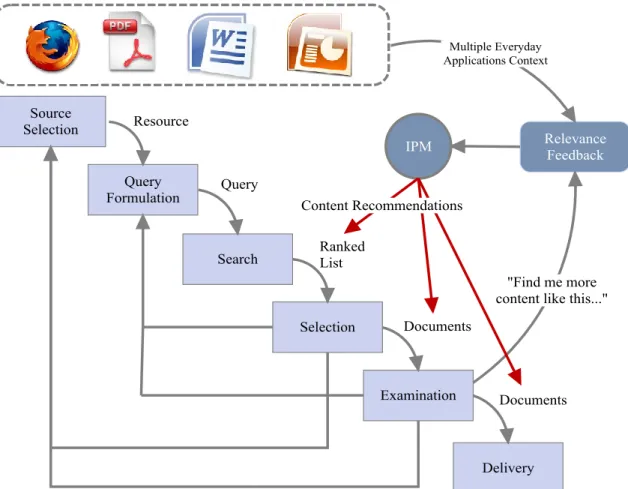
Real-world personalization is often dynamic in nature and information delivered to the user can be automatically personalized and catered to individual user's information needs (Lu, Agarwal and Dhillon 2009). Figure 1 presents the standard information retrieval process in a web search environment and interactions across multiple everyday applications. People interact with different applications, and have extra information about the content they are interacting with. These interactions results in implicit feedback (e.g.,
8
click-through data, reading time) and semi-explicit feedback (e.g., annotations) data that varies depending on their task and the type of information being explored. For example, a user may examine a list of search results in a web browser; she may use MS Word or PDF Reader to examine the contents of individual documents; she may use a note-taking tool to keep track of interesting snippets; and she may use MS Word or a presentation tool to author her own interpretation of what she has found. Therefore, a user model extracted from a single application is unlikely to be as effective as a user model based on the aggregate activity across applications (Badi, Bae, Moore, Meintanis, Zacchi et al. 2006). The particular approach being explored here looks to broaden current techniques by including a variety of direct and indirect evidence of interest across multiple applications.
9
3. LITERATURE REVIEW*
3.1Relevance Feedback
Relevance feedback has a history in information retrieval systems that dates back well over thirty years and has been used for query expansion during short-term modeling of a users' immediate information need (Kelly and Teevan 2003). Relevance feedback has been one component of the notion of context applied towards interactive search where the user can explicitly interact with the system to judge the relevance of information presented to her needs (Salton and Buckley 1997). With the combination of the context and explicit indication of relevance to the information, systems can better capture user preferences and alter the presentation of information. In recent years, there has been a shift from explicit to implicit techniques motivated by the need of obtaining preferences unobtrusively interrupting or burdening users. With these implicit techniques, user-system interactions are learned or inferred to collect elements of context in these interactions (Kelly and Belkin 2002, Fox, Karnawat, Mydland, Dumais and White 2005, Speretta and Gauch 2005). Therefore to capture the user’s interests, two main techniques of relevance feedback may be employed, namely (i) implicit: information can be derived by studying users behavior while using services (ii) explicit: information can be gathered by a direct intervention of the users themselves by filling some kind of predefined forms (Ruthven and Lalmas 2003, Viviani, Bennani and Egyed-Zsigmond 2010).
* Jayarathna, S., Patra, A., and Shipman, F. “Unified Relevance Feedback for Multi-Application User Interest Modeling,”
Proceedings of the 15th ACM/IEEE-Cs Joint Conference on Digital Libraries, pp.129-138, © 2015 Association for Computing
10
Figure 2: Types of Relevance Feedback Indicators
Figure 2 shows how user actions form a continuum from implicit to explicit feedback. There is a clear tradeoff between the quantity and quality when comparing implicit feedback with explicit feedback. Explicit feedback indicators are higher in quality but lower in quantity because it is rather burdensome to enter a rating for every item a user liked or disliked (Liu, Xiang, Zhao and Yang 2010). On the other hand, implicit feedback indicators are abundant in quantity but lower in quality because they must be interpreted by heuristic algorithms that make assumptions about the relationships between the observable low-level actions and the high level goals of users. In (Nichols 1998), authors evaluated the costs and benefits of using implicit feedback indicators over explicit feedback indicators. The results suggested that the implicit ratings can be combined with existing explicit ratings to form a hybrid system to predict user satisfaction. In (Jawaheer, Szomszor and Kostkova 2010), authors showed that implicit and explicit positive feedback complement each other with similar performances despite their different characteristics. This implies that systems can be designed to use the correlation between implicit and explicit feedback to tune the interest modeling algorithms based on implicit feedback.
11 3.2Explicit Relevance Feedback
User guided modeling techniques such as explicit relevance feedback systems rely on the information provided by the user to build a user model (Marios, Efi, Panagiotis and George 2013). Explicit feedback requires users to assess the relevance of documents or to indicate their interest in certain aspects of the content. Explicit evidence can also be obtained by direct intervention, asking the user about their preferences usually by giving a questionnaire when interacting with the system and asking users to select keywords or topics pertinent to their interests (Germanakos, Tsianos, Lekkas, Mourlas and Samaras 2008). Alternatively one can ask users for feedback about the items they have browsed using binary evaluations (e.g., like/dislike), ratings (5-point scale) and text comments. The data collected may contain demographic information such as age, gender, marriage status, profession, interests and/or preferences or personal information (Gauch, Speretta, Chandramouli and Micarelli 2007). In addition some methods allow users input via checkboxes and text fields by selecting values from a range. Many commercial systems have been exploring personalization for some time based on user preferences in order to customize interfaces. For instance, iGoogle† (Casquero, Portillo, Ovelar, Romo and Benito
2008), My Yahoo‡, NetVibes§, and uStart** are commonly utilized for customizing user
interfaces by collecting user preferences to create user profiles and services to adapt in order to increase the information accessibility. These web site contents are then
†h ttp://www.google.com /ig ‡ h ttps://m y.yahoo.com § h ttp://www.netvibes.com ** h ttp://www.u star t.or g
12
dynamically organized based on the collected user preferences. The user preferences in an interest model can also serve personalize services provided by other applications in order to improve the user satisfaction.
There are numerous techniques in the IR research such as Curious Browser where explicit feedback are in the form of user ratings of document relevance such as “relevance”, “readability” and “topic familiar before” ratings (Zigoris and Zhang 2006). WebMate (Chen and Sycara 1998) learn and keeps track of user interests incrementally with multiple pages provided explicitly by the user as relevance guidance. It extracts keywords from these pages and uses them for keyword refining in query formulations. Similarly, InfoFinder (Krulwich and Burkey 1997) system learns user profiles from sample documents that users submit while browsing. The system learns general profiles from the text that are likely to represent the users’ interests in document topics. Similarly, in contextual relevance feedback (Harper and Kelly 2006, Limbu, Connor, Pears and MacDonell 2006), the search results list is filtered based on user-collected document piles that are used as user profiles.
Explicit feedback has the advantages that it can be easily understood, is fairly precise and requires no further interpretation (Claypool, Le, Wased and Brown 2001). However these techniques also have some disadvantages. Generally, asking a user to complete a preliminary questionnaire or to identify keywords/topics of interest interferer with the natural interaction of the user (Hijikata 2004). Grading pages or rating items might also takes time away from the user’s main activity. Both direct and semi-direct explicit methods require users to invest effort and their willingness varies according to the
13
application they are interacting with (Schiaffino and Amandi 2004). Because of these additional burdens on the user, and/or privacy concerns, users may not choose to participate. Also users may not accurately report their own preferences, interest or demographic data and the user’s interest may change over time by making their user model increasingly inaccurate.
In some cases, users enjoy providing and sharing their feedback. This is most evident in services relevant to consumer products such as movie ratings Netflix††,
Movielens‡‡ and sites dedicated to collecting and sharing streaming music such as
Pandora§§, Last.fm***. All these explicit relevance feedback collection techniques have the
advantage that the form of the replies are more standardized than other relevance feedback techniques such as implicit feedback. The main drawback is that the user’s interaction with the system may be disrupted due to unwillingness of the user to provide the preference information due to lack of trust or time to participate in the process (Marios, Efi, Panagiotis and George 2013). In addition, users may not accurately or fully report their preferences and systems may not have facilities to update when the preferences have changed.
3.3Semi-Explicit Relevance Feedback
Some user actions, particularly bookmarking and clipping, can be interpreted as semi-explicit feedback in that the user’s action is a clear evidence of their desire to
†† h ttp://www.netflix.com ‡‡ h ttps://movielen s.or g §§ h ttp://www.pan dor a.com *** h ttp://www.last.fm
14
access this content. There are also various applications and services that can enable creating tags, highlights and other types of annotations allowing the users to provide additional information sources while reading electronic documents.
While reading printed documents, it is a common practice to write down various types of notes, underlines, and highlights as a mean of storing our thoughts, marking interesting parts of documents and for the ease of navigation later on. Similarly, many online tools allow such behaviors with electronic documents and add to the value of the information presented (Oard and Kim 2001). Annotations created by user can be consider as a form of user’s context while reading documents (Navrat 2012) or a body of words marked among text with the meaning of its position and content and what text it contains (Haiqin, Zheng and Qingsheng 2003). For a particular annotation, the surrounding text defines its context. A user can mark-up a portion of a document by highlighting a paragraph or attaching an electronic sticky note. Not all reading results in user annotations. Annotations are most likely when people read materials crucial to a particular task at hand and are infrequent when reading for fun (Shipman, Price, Marshall and Golovchinsky 2003). Annotations are used to identify which documents or portions of documents are interesting. But, if a document is large, users will frequently skim or stop reading when they feel they have met their information need. Consequently, potentially better document contents are left having never been reviewed (Badi, Bae, Moore, Meintanis, Zacchi et al. 2006). Visualizations can also draw user's attention to similar documents or document parts (Bae, Kim, Meintanis, Moore, Zacchi et al. 2010). Such visualizations include colors and icons to highlight annotated contents in a document overview (Price, Schilit and
15
Golovchinsky 1998). Spatial hypertext systems such as VIKI (Marshall and Shipman 1995) and VKB (Shipman, Hsieh, Maloor and Moore 2001) use similar visualization techniques to provide system-identified "interesting document contents" to support navigation. M4Note (Rudinei, Renan, Jose, Valter and Maria 2004) is designed as a way of providing annotations as metadata for indexing, retrieval, semantic processing and content enrichment. This can generate a structured document with an underlying description model that can be used in computations such as personalized tag hierarchies to support content enrichment. Recent work has also been conducted to study the user’s post-click behaviors relevant to interactions with text selections or highlights (Guo and Agichtein 2012, White and Buscher 2012). In these studies, text selection is used to find the search performance for queries by clustering users based on their similar behaviors. 3.4Implicit Relevance Feedback
Implicit feedback techniques have the advantage that the necessary data can be collected easily without burdening users. Implicit interest indicators are based on user actions and not on explicit value assessments. During a search task, readers may indicate their interest in documents by how they interact with them: by how much of the document they examine (e.g. how far into a document they scroll); and through other behaviors and events that are specific to the tools they are using. This interest may be recorded as users interact with documents and may be characterized via feature extraction. In learning from user behaviors, personalization attempts to infer user interests from logs of user activity, such as dwell time, click through, and other salient behaviors that can be easily captured. For example, the Curious Browser (Claypool, Le, Wased and Brown 2001) records
16
various types of implicit feedback include aspects of mouse usage, keyboard usage and the time spent viewing documents.
There has been a broad range of research conducted in the area of interpreting user interactions data for implicit relevance feedback. This work can be divided into research aiming at object-level feedback and research on segment-level feedback (Buscher, Van Elst and Dengel 2009). In many situations records of user activity have been used to estimate object-level relevance, that is relevance for entire documents (Oard and Kim 2001). This is in line with object-level feedback that is needed in the classical information retrieval scenarios where systems are adapting the response set for a query (Gerard 1971). Studies of these object-level implicit feedbacks have often focused on correlation between reading time and explicit feedback based on document length and textual features (Morita and Shinoda 1994, Claypool, Le, Wased and Brown 2001, Fox, Karnawat, Mydland, Dumais and White 2005). There is strong evidence that user’s spend more time on interesting articles than uninteresting ones. For example, there is a weak correlation between the document length and associated reading times because users tend to read in part and not entirety Additionally, assumptions about user work practice s complicate generalizing results but study of a more naturalistic scenario (Kelly and Belkin 2001, Kelly and Belkin 2002, Kelly and Belkin 2004) found that there was no general relationship between display time and the user’s explicit ratings of document relevance. The high variation of display time with respect to the different user and different task has led to adjusting display time thresholds for implicit feedback based on task type (White and Kelly 2006). This confirmed the idea of adjusting display time thresholds according to
17
task type leads to improved performance. (Rafter and Smyth 2001) showed for one specific task, adjusting individual measures can correlate the display time with user interest. In addition to considering display/reading time, additional studies have found that scrolling, exit type (Fox, Karnawat, Mydland, Dumais and White 2005), click-through (Joachims, Granka, Pan, Hembrooke, Radlinski et al. 2007) has been found to provide good indications of interests.
Segment-level feedback is much less explored compared to document or object-level methods. The user search behavior for estimating passage relevance for re-ranking is mostly done by studying correlation between level display time and segment-level feedback from an eye tracker (Buscher, Dengel and Van Elst 2008) (Buscher, Dengel and Van Elst 2008, Buscher, Van Elst and Dengel 2009). In (Kong, Aktolga and Allan 2013) user behavior information from section relevance has been used to improve section ranking. More specifically, four types of user search behaviors, dwell time, highlighting, copying and click at various section levels were used to improve section rakings. This study also reveals characteristics of user behaviors at segment-level. Based on the resultant dataset, authors claim that about 50% of segment-level dwells are shorter than 2 seconds, suggesting users skim many sections instead of reading them to entirety. For clicks, authors reveal that users tend not to click on sections in the top part of pages because they are already being displayed resulting in a position bias for section clicks.
Mouse clicks and movements can also indicate the relevance of content to the user. (Claypool, Le, Wased and Brown 2001) report the amount of scrolling on the web page along with several other implicit measures and their relation to explicit indicators. The
18
dwell time on the web page, the amount of scrolling and the combination of dwell time and scrolling led to the most arcuate predictions of user behaviors. In addition (Kríž 2012) has shown that time spent scrolling is a strong indicator of users potential interest in content. (Kantor, Boros, Melamed, Meñkov, Shapira et al. 2000) explore how users would follow the mouse pointer with their eyes while reading content. (Chen, Anderson and Sohn 2001). Their study indicates that, when participants use the mouse, 75% of the time the mouse and eye move to the same region of the screen. This suggests that there is a high correlation between mouse movements and eye movements. (Cooke 2006) confirms these findings by suggesting many users are active mouse users as they search for information, with 69% of the time mouse movements matching the eye movements. (Guo and Agichtein 2008) shows mouse movements as a way of inferring query intent based on the trajectories of mouse movements. The mouse movement data was superior to click-through data. The average accuracy of intent inference from click-click-through data was 62.95% while it was 70.2% using mouse movements. (Mueller and Lockerd 2001) suggest users tend to rest their mouse while reading and more detailed analysis of a user mouse movement can infer the user query intent. (Rodden and Fu 2007) further investigate this idea and introduce a user study to detect mouse movements in real time in order to recognize them as they occur. The study suggests that users tend to hesitate on links or text before clicking and that could potentially indicate there is more information on the page that are of interest to the user.
19 3.5Topic-Level Relevance Indicators
The document content filtering based on a user interest model can be done by topics discussed in relevant documents and then by representing these document collections in a vector space (Tang and Vemuri 2005). The learning algorithms used in traditional vector space models are usually divided into supervised learning, unsupervised learning and semi-supervised learning. The process of supervised document filtering is called classification and unsupervised filtering is called clustering.
Topic models learn bag of words from a collection of documents without any supervision (Stevens, Kegelmeyer, Andrzejewski and Buttler 2012). Topic models assume generative model which can be used to model a collection of documents by topics. These generative topic models can reveal topic level relations based on the words used within a document. Three major distinct approaches for topic modeling are the Latent Dirichlet Allocation (LDA) (Blei, Ng and Jordan 2003), Latent Semantic Analysis (LSA) (Dumais 2005) and Non-negative Matrix Factorization (Lee and Seung 1999). As shown by (Xu, Liu and Gong 2003, Shahnaz, Berry, Pauca and Plemmons 2006), NMF outperforms traditional vector space approaches for document clustering such as LSA and learn concise topics with similar performance with LDA. However, NMF learns more incoherent topics compared to LDA(Stevens, Kegelmeyer, Andrzejewski and Buttler 2012).
A particular document can be encoded in an n-dimensional vector where n is the total number of terms in the corpus. Each vector defines the relative importance of corresponding terms with respective to the semantics of the given document (Salton,
20
Wong and Yang 1975). In this vector space model, a collection of documents can effectively represented as a document-by-term matrix with a positive weight per corresponding term presented in the document or zero value otherwise. Given a term-by-document matrix with inherent non-negativity, the NMF (Lee and Seung 1999) can learn the underlying semantics or patterns in a text collection based on non-negative lower rank factors. The documents can be reconstructed combining these learned semantic features and set of documents with common features can be represented by a cluster.
(Harvey, Crestani and Carman 2013, Vu, Song, Willis, Tran and Li 2014) utilize LDA to determine user profile based on the latent topics from relevant documents. In this work, topic space is determined based on the relevant documents extracted from the query logs from user’s web search history. Mehrotra (Mehrotra 2015) explores the possibility of modeling users search tasks by coupling topical interests with the search task behavior to learn user representations. (Majumder and Shrivastava 2013) present an approach treating online service platforms (OSP) such as search engines, news websites, ad-providers etc., as black boxes and extract their output to formulate latent topic personalization (LTP).
The topics of the relevant documents are often obtained from human generated online ontologies such as Open Directory Project (ODP)††† (Bennett, White, Chu, Dumais,
Bailey et al. 2012, Raman, Bennett and Collins-Thompson 2013, White, Chu, Hassan, He, Song et al. 2013). In addition, click entropy (Teevan, Dumais and Liebling 2008, Teevan,
††† www.dm oz.or g
21
Dumais and Horvitz 2010, Song, Nguyen, He, Imig and Rounthwaite 2011) uses the ODP distributions for analyzing search content of pages. Web pages with low entropy is considered to have higher search focus (Kim, Collins-Thompson, Bennett and Dumais 2012). These approaches are mainly limited in functionality because many documents may not contain topics covered in online ontologies. Also, human-generated topics require expensive manual effort to categorize each document.
3.6Hybrid (Implicit and Explicit) Relevance Feedback
Hybrid relevance feedback methods attempt to exploit the benefits of implicit and explicit approaches. Hybrid methods can generate accurate user preference because implicit feedback lowers the user’s workload and explicit feedback compensate for the sparseness and inadequacies of implicit feedback (Paliouras, Alexandros, Ntoutsis, Alexopoulos and Skourlas 2006). Sela (Sela, Lavie, Inbar, Oppenheim and Meyer 2015) examine users’ interests in various news topics measuring the subjective satisfaction of news editions along with objective measures to infer actual interest in news items. Results suggest user interest is weakly correlated with reading duration, article length and reading order with explicit measures predicting interest in clearly defined topics.
There is clearly a tradeoff between the quantity and quality when comparing implicit feedback with explicit feedback. In (Nichols 1998), authors evaluate the costs and benefits of using implicit feedback indicators over explicit feedback indicators. The results suggest the implicit ratings can be combined with existing explicit ratings to form a hybrid system to predict user satisfaction. In (Jawaheer, Szomszor and Kostkova 2010), authors show the implicit and explicit positive feedback complement each other with similar
22
performances. Similarly, comparison of the implicit and explicit feedback in use of the Curious Browser reveals the time spent on a page, amount of scrolling on a page and the combination of time and scrolling had a strong correlation with the explicit feedback. This implies the systems can be designed to use the correlation between implicit and explicit feedback to tune the interest modeling algorithms based on implicit feedback. The WAIR system (Zhang and Seo 2001) learns the user interest by observing user interactions and then training on the explicit feedback data. After this learning phase, the system can estimate the relevance feedback implicitly based on the learned observations. The learned information is used to create a user profile and this profile is used in generating queries for retrieval process. In (Liu, Xiang, Zhao and Yang 2010), implicit and explicit feedback indicators are unified using a matrix factorization model (called Co-rating) that can effectively cope with the heterogeneity between these two forms of feedback. Similarly, in (Wang, Rahimi, Zhou and Wang 2012), a unification model based on matrix factorization called expectation-maximization collaborative filtering (EMCF) is introduced.
3.7Distributed User Modeling
Multi-application systems provide opportunities to gather user data from outside of the individual application itself. Aggregated user data may be useful to address the cold-start problem as well as the sparseness of user data. Connecting data from different sources and services from distributed application environments is in line with advancements in multi-core and multi-tasking architectures. While there are theoretical and software frameworks for distributed user modeling, assessments of modeling
23
techniques are almost always reported in terms of single applications. With a better understanding of the user interests, adaptive systems can provide better personalization. Sharing and reusing the user model information between applications can bring the advantage for profile providers as well as profile consumers by enriching the user models.
Current systems that provide personalized services to users are mostly develop their own proprietary application environments in ad-hoc manner as a part of a specific application requirement (Dim and Kuflik 2012). These proprietary user models are of evidence in system developer’s focus on specific characters of their users in order to provide a specific service (e.g., movie recommender system). Over the years, these user models and their application environments are moved from providing complete, monolithic solutions in user modeling servers (Kobsa 2007) to dynamic solutions in the areas of interoperability and interlinking (Leonardi, Abel, Heckmann, Herder, Hidders et al. 2010, Carmagnola, Cena and Gena 2011). User models can be developed by adapting the content consumed or produced by the user, and their specific task, background, history and information needs (Renda and Straccia 2005). These models can bring users’ attention to valuable content via personalized presentations. (Berkovsky, Kuflik and Ricci 2008) presented a definition of mediation to introduce cross-system personalization using the technique to integrate and match user modeling data. Recognizing the user interest based on observed user activity is confounded by idiosyncratic work practices. As a result, systems that aggregate evidence of user interest from a wide variety of sources are more likely to build a robust user interest model.
24
There are two main approaches to user modeling in a component-based architecture. These vary based on the degree of centralization of the user models. Decentralized (or distributed) user modeling had its roots in agent-based architectures; here fragments of user model are kept and maintained by each independent application. Another important distinction among user modeling approaches is whether the model is represented via features or content. Feature-based user models define a set of feature-value pairs representing various aspects of the user, such as interest in a specific category or a level of knowledge in a specific area. Content-based approaches take into account the user's area of interest, as an example, the textual content of documents the user has previously indicated as relevant. These systems generate recommendations by learning user needs with the analysis of available rated content.
In a centralized approach, the integrated user model is stored in a central server and the model is then shared across several user-adaptive applications. Apart from alleviating the applications re-inventing the wheel, centralized user model give an opportunity to share the same user model between several applications. These include generic user modeling servers such as IPM (Bae, Kim, Meintanis, Moore, Zacchi et al. 2010), CUMULATE (Brusilovsky, Sosnovsky and Shcherbinina 2005, Yudelson, Brusilovsky and Zadorozhny 2007), UMS(Kobsa and Fink 2006) and PersonisAD (Assad, Carmichael, Kay and Kummerfeld 2007) as well as framework developed for mashing up profile information (Abel, Baumgartner, Brooks, Enzi, Gottlob et al. 2005, Abel, Henze, Krause and Plappert 2008, Abel, Heckmann, Herder, Hidders, Krause et al. 2009, Houben, Leonardi and Van Der Slujis 2009) to facilitate aggregated user data.
25
PersonisAD is a distributed framework for building ubiquitous computing applications. It defines a user model based on data gathered from different sensors and combines their preferences using resolvers to provide a tailored experience. CUMULATE is a generic modeling server developed for a distributed E-Learning architecture to help students select the most relevant self-assessment quizzes by inferring their knowledge of a predefined set of topics based on authored relationships among activities in the educational applications and topics. UMS is a user modeling server based on the LDAP protocol which allows for the representation of user interests using a predefined taxonomy for the application domain.
Attempts to bridge user models in various systems require conversion of the user models data between various applications, domains and adhering to semantic representations (Martinez-Villaseñor, Gonzalez-Mendoza and Hernandez-Gress 2012). Some of these have been done using mapping techniques of user models (Vassileva, McCalla and Greer 2003, Bennani, Chevalier, Egyed-Zsigmond, Hubert and Viviani 2012) and more recently using machine learning methods (Berkovsky, Kuflik and Ricci 2008). These user modeling systems do not easily comply with a standard format, technique or vocabulary to enable user modeling interoperability (Martinez-Villaseñor, Gonzalez-Mendoza and Hernandez-Gress 2012).
This dissertation is based on the immediate need for approaches to setup user interests and the distinctions between them to be constructed based on the content encountered rather than pre-agreed upon by the contributing applications.
26
4. SYSTEM ARCHITECTURE*
4.1Interest Profile Manager
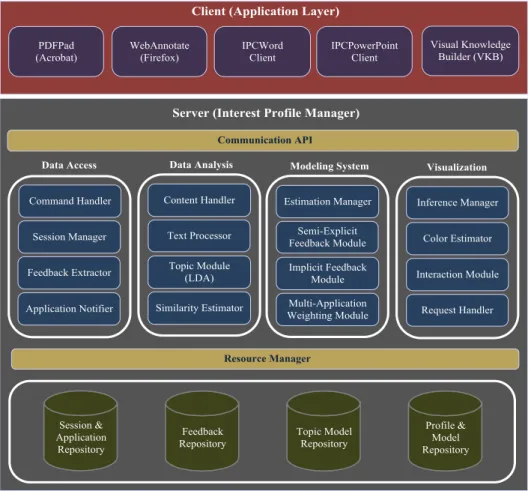
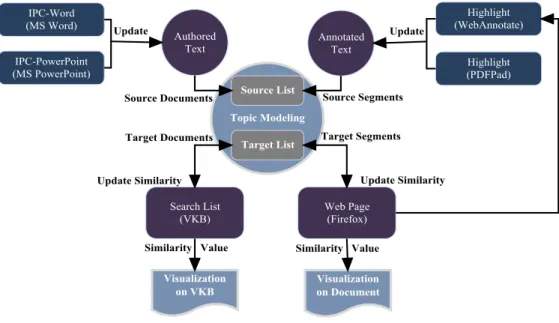
The Interest Profile Manager (IPM) is user profile server (see Figure 3) to support the personalized delivery of content across multiple applications. The IPM collects user activity across many applications and infers user interests using this implicit and semi-explicit interest information. It also shares the inferred user interests with registered applications that ask for it. The IPM can easily communicate with any application that can be modified to include the interest profile client software component enabling user interest modeling capability in existing applications.
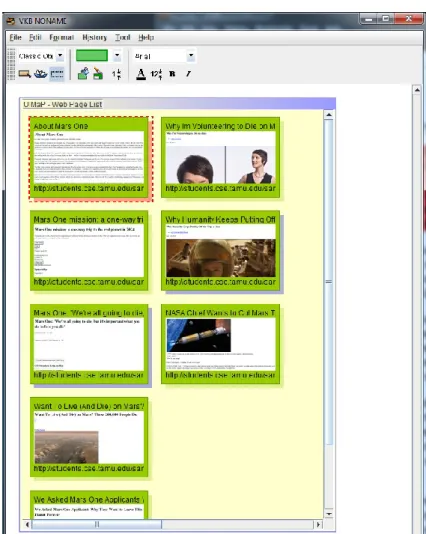
We have used the Mozilla-Firefox web browser and Visual Knowledge Builder (VKB)(Shipman, Hsieh, Maloor and Moore 2001) applications to present search results and also to visualize recommendations. The three other applications provide additional activity data but do not include visualizations: PDFPad which is an acrobat add-on; IPCWord which is a Microsoft Word add-on; IPCPowerPoint which is a Microsoft PowerPoint add-on. Records of user activity in PDFPad, Mozilla, MS Word and MS PowerPoint are stored in the IPM and drive the visualizations that the IPM generates for each of the application registered for relevant notification request (Jayarathna, Patra and Shipman 2015). For our implementation, we utilize VKB to act as an overview application
* Jayarathna, S., Patra, A., and Shipman, F. “Unified Relevance Feedback for Multi-Application User Interest Modeling,”
Proceedings of the 15th ACM/IEEE-Cs Joint Conference on Digital Libraries, pp.129-138, © 2015 Association for Computing
27
for a web search (see Figure 4). An interest profile is made up of the aggregated heterogeneous interest evidence collected from these different IPM clients.
The IPM defines the XML communication interface so that application clients can interact with IPM over TCP/IP. The IPM framework includes two modules involved in estimating the user interest, the Estimation Manager and the Estimation module which is again decomposed to 3 sub-modules: Multi-Application Weighting module, Implicit Feedback Module and Semi-Explicit Feedback Module.
28
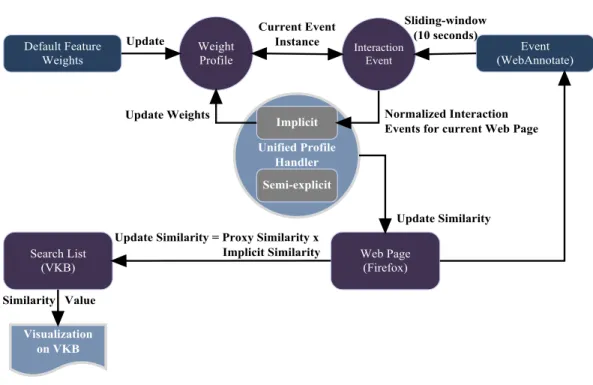
The Estimation Manger provides a generic high level interface to the other modules within the IPM and also enables multiple modules to estimate the user’s interests using different algorithms. In the Multi-Application Weighting module (see section 4.5.2 for discussion on multi-application weighting), each application is assigned a weight based on the particular user’s activities in the various applications. These learned weights are used to merge the estimated interests from the different applications when modeling the overall user interest. The implicit and semi-explicit relevance modules handle the implicit and semi-explicit relevance feedback indicators respectively. The combined outputs from these two sub-modules are used to estimate the final unified user interests for a search task.
The Resource Manager communicates with data repository to update the user interests according to the user activity data sent from application clients. The Data Repository also saves session data both in terms of contextual and temporal features so that the user activity can be defined as a group of search tasks related to each other in order to make inferences about evolving information needs. This is particularly important because if we are able to accurately identify changes to the users’ information seeking intent, then we will be in a better position to limit the application of particular inferences about user interests (Jones and Klinkner 2008). The Data Repository also saves both types of feedback data and application data received from application clients for further processing at the estimation modules.
29 4.2Interest Representation
Although each application has unique information that may be used to gauge human interest, this interest assessment needs to be sharable among the different applications to be useful in building the complete interest model of a user.
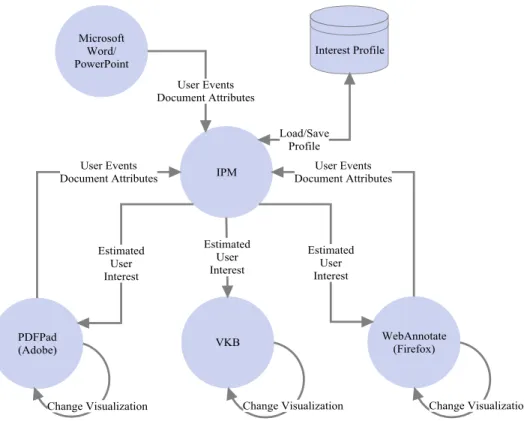
The IPM depends on an abstract XML representation for receiving interest-related information from applications and for broadcasting inferred interest to client applications. Because we realize that we cannot foresee all of the ways different applications will allow users to interact with documents, the representation is extremely general and extensible. Thus an interest profile consists of a document identifier, an application identifier, and a list of application-specific attribute/value pairs. In this way, new applications only have to inform the IPM of the attributes and how they demonstrate user interest when registering. While some of these applications support two-way communication, this is not required (see Figure 5 ); an application could merely provide information to the IPM or only receive interest information from the IPM. In the current architecture, VKB, PDFPad and WebAnnotate support two-way communications while Microsoft Word and PowerPoint support one-way communication. Applications also can be categorized into (i) Consumption Applications, for examining/annotating existing content; and (ii) Production Applications, for creating/authoring content (see Figure 6).
30
Figure 4: VKB Search List with Visualizations
31 4.3Explicit Feedback
Whenever a document is opened in Microsoft Word or PowerPoint, event handlers are registered for user events. Event handlers save each interaction and their values locally and send them to the IPM. Additionally, the content of the document and document characteristics are sent to the IPM at the time of closing the document.
Figure 6: IPM Event Transition from Individual Applications
Similarly, WebAnnotate parses raw text to identify every paragraph when a new web page is opened. It also appends mouse and keyboard events in a buffer and saves the
32
color and relevance score assigned to each annotation until the browser is moved to the background. All the raw information is sent to the IPM in an XML format at the next focus out event or web page close event. The buffer is reset once the focus is brought back to the web page.
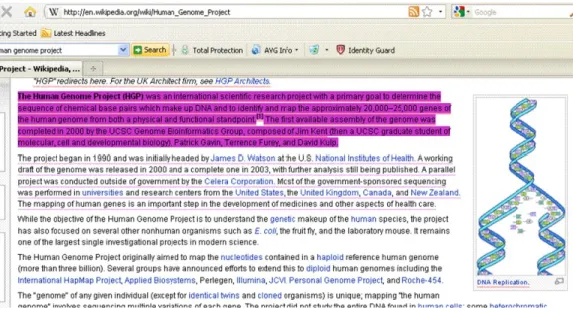
During an information gathering activity, useful documents may be long and cover multiple subtopics; users may read some segments and ignore others. The browser plug-in WebAnnotate (Bae, Kim, Meplug-intanis, Moore, Zacchi et al. 2010) enables basic annotation capabilities so that users can make persistent annotations on web pages and passages and get suggestions within these documents based on estimated user interests. The interest classes can be defined based on annotations’ color, type and content in WebAnnotate. To identify segments of new or unread documents to bring to the user’s attention, these classes are then compared against the segments of the document currently displayed in WebAnnotate generated by the text-tiling algorithm. When a match is identified, an underline (based on the intensity of the inferred interest value) of the appropriate color for the class is used to signal the similarity. In Figure 7 the user has opened the Wikipedia page for the Human Genome Project and highlighted text related to the history of the project. It can be seen that other paragraphs are underlined with the same color indicating that they are similar to the passage highlighted.
In the current study, WebAnnotate was extended to include three types of explicit ratings for content: “page relevance”, “page familiarity”, and “paragraph relevance” on a 5-point scale. After each paragraph annotation WebAnnotate allows the user to mark individual paragraphs as relevant or not to their task (see Figure 8).
33
A user might also use Microsoft Word or PowerPoint applications to open, read or modify some documents. The user’s actions while working on these applications can also be used to infer user’s interests. MS Word and PowerPoint consider all the data in one document to belong to a single interest class. The default color (in the current research study ‘Blue’ color) of the application is used to define the interest class.
Figure 8: WebAnnotate Toolbar for Rating Paragraphs
34 4.4Implicit Feedback
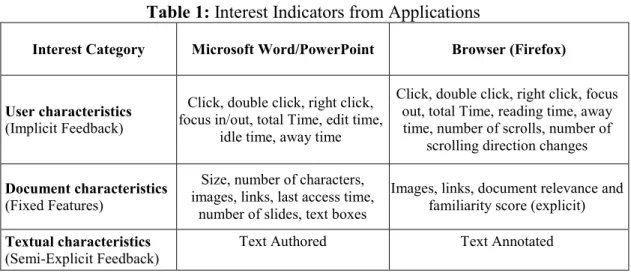
We utilize a set of the implicit feedback indicators during a document reading activity to characterize the interactions between the user and documents. These document reading activities include user actions during a passive reading in a consumption application (web browser or PDF reader). This consists of time spent in a document, number of mouse clicks, number of text selections, number of document accesses and characteristics of user scrolling behaviors such as number of scrolls, scrolling direction changes, time spent scrolling, scroll offset, and total number of scroll groups. Furthermore, we collect time spent on a production application (MS Word or PowerPoint), focus in/out and other formatting activities. Table 1 summarizes the user events and document attributes collected from both production and consumption applications during this research study.
The interest profile broadly contains three types of interest indicators, characteristics of the user, the document as a whole, and the textual content of the document (see Table 1). The user features are derived from implicit feedback data. All these features vary from one user to another as they heavily depend on the individual practices. Document features are high level features of the documents that are the same across users. Finally, document text features are generated from the user’s annotations in consumption applications and from the user’s authored content from production applications. Document text content provides evidence of more focused interest than the general document features. Such evidence is important when identifying the specific parts of documents that are expected to be relevant.
35
Table 1: Interest Indicators from Applications
Interest Category Microsoft Word/PowerPoint Browser (Firefox)
User characteristics (Implicit Feedback)
Click, double click, right click, focus in/out, total Time, edit time,
idle time, away time
Click, double click, right click, focus out, total Time, reading time, away time, number of scrolls, number of
scrolling direction changes Document characteristics
(Fixed Features)
Size, number of characters, images, links, last access time,
number of slides, text boxes
Images, links, document relevance and familiarity score (explicit) Textual characteristics
(Semi-Explicit Feedback) Text Authored Text Annotated
Another type of feature important in this work is content similarity. Content similarity metrics are used to measure the overlap between the textual content of the user’s previous interactions and any future text content. These similarities are computed between text considered valuable to the user (authored or annotated text) and all other paragraphs displayed in the browser and documents available in other applications. The similarity score represents the user’s interest expressed through the textual content. In this work, Latent Dirichlet Allocation (LDA) is used to compute the content similarity (see section 4.5.1) using the Hellinger Distance measure and are then normalized to be between [0-1] using min-max normalization.
4.5Models of User Interest
The IPM uses the document attributes (e.g. metadata, term vectors, user-assigned color of annotations) to determine classes of user interest. Attributes of the document as a whole and textual characteristic of document segments are selected based on evidence of
36
interest in individual documents. To aid in the creation of descriptions of document classes, the IPM includes term vector and metadata analysis capabilities as well as text tiling capabilities to allow clients and the IPM to analyze text at the sub-document level. Currently, user-assigned annotation color is used to identify the known members of an interest class while the identification of documents and document components similar to that class is based on the other document attributes and user characteristics.
The next subsections describe the use of topic modeling for similarity assessments of textual content in the user model or of potential value to the user, the weighting of features across the different applications, and the development of semi-explicit and unified feedback models.
4.5.1 Topic Modeling of Textual Content
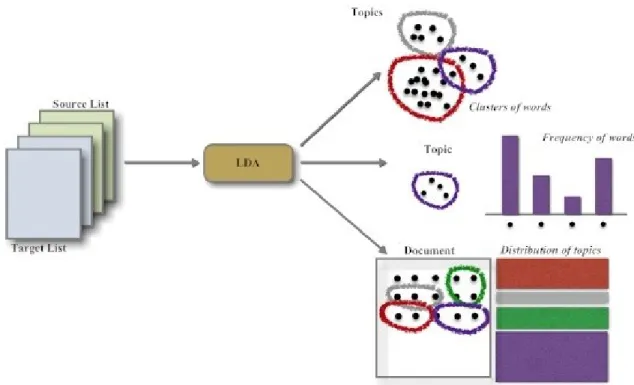
Before introducing our topic modeling approach for inferring user interests, we first give a brief review of the statistical model Latent Dirichlet Allocation (LDA) and its parameters used in this research study. LDA (Blei, Ng and Jordan 2003) is a hierarchical Bayesian model that assumes each document is a finite mixture of a set of topics 𝐾 and each topic is an infinite mixture over a set of topic probabilities. Unlike clustering methods, LDA does not assume that each document can only be assigned to one topic. Given a document collection, we use LDA to find a set of topics discussed in the document collection. Each topic is represented as a set of words that have a higher probability than others to appear in the text unit related to the topic. Based on the probability distribution of words in each topic, we can calculate the probability that each document may contain a topic and obtain a document-topic assignment.
37
We set LDA parameters; a number of topics 𝐾 = 5 to match the number of topic clusters anticipated, two smoothing parameters 𝛼 = 0.01 and 𝛽 = 0.01 (McCallum 2002). As words are the only observable variables in an LDA model, conditional independence holds true for the outputs of LDA model which are document-topic and topic-words distributions Φ and Θ.
For a corpus containing D documents (see Figure 9), the parameters, the 𝐷 × 𝐾 matrix of document-topic probability distribution per each document and the 𝐾 × 𝑊 matrix of topic-words probability distribution per each topic must be learned from the data. Parameter fitting is performed using collapsed Gibbs sampling (Porteous, Newman, Ihler, Asuncion, Smyth et al. 2008) with sampling and burn-in iterations set to 1 and 5 respectively. We look at the difference in the content from two text units by first computing the LDA document-topic distributions Φ𝑖 and Φ𝑗 (𝑖, 𝑗 = 1. . 𝐾, 𝑖 ≠ 𝑗) and then by calculating the divergence between these two document-topic distributions. The smaller the divergence is, the stronger the associated similarity is.
We performed an evaluation to determine the feasibility of topic modeling divergence methods in our context and to select among alternative topic modeling approaches. Based on those results, we use Hellinger distance (Bishop 2007) to compare the similarity between document-topic distributions (Equation 1).
𝐷𝐿𝐷𝐴+𝐻( Φ𝑖||Φ𝑗) = √1 2 ∑ (√Φ𝑖− √Φ𝑗) 2 𝐾 𝑖,𝑗=1 (1)
38
Figure 9: Semi-Explicit Topic Modeling of Text Content
4.5.2 Multi-Application Weighting
Once we have user, document, and textual characteristics as well as textual similarity measures, we need to weight the various features to predict the likelihood of interest in the target. Rather than using one set of weights for all users, we train the interest model using weighted K nearest neighbor (WKNN). This enables weights to adapt to the user-specific patterns present in the feature space. The weights for the features result in a classifier algorithm that predicts relevance the score for each paragraph on a 5-point scale. From here onwards, we denote C as the relevance label.
In this work, we have combined two variants of KNN, i.e., attribute-weighted and distance-weighted KNN to a build our weighted KNN classifier. By introducing a feature