Secure Bidirectional Proxy Re-Encryption for Cryptographic Cloud
Storage
IJun Shaoa, Rongxing Lub, Xiaodong Linc, Kaitai Liangd
aSchool of Computer and Information Engineering, Zhejiang Gongshang University, Hangzhou, Zhejiang, P.R. China bSchool of Electrical and Electronic Engineering, Nanyang Technological University, 50 Nanyang Avenue, Singapore 639798
cFaculty of Business and Information Technology, University of Ontario Institute of Technology, Ontario, Canada dDepartment of Computer Science, City University of Hong Kong, Tat Chee Avenue, Kowloon, Hong Kong
Abstract
Bidirectional proxy re-encryption allows ciphertext transformation between Alice and Bob via a semi-trusted proxy, who however cannot obtain the corresponding plaintext. Due to this special property, bidirectional proxy re-encryption has become a flexible tool in many dynamic environments, such as cryptographic cloud storage. Nonetheless, how to design a secure and efficient bidirectional proxy re-encryption is still challenging. In this paper, we propose a novel bidirectional proxy re-encryption scheme that holds the following properties: 1) constant ciphertext size no matter how many times the transformation is performed; 2) master secret security in the random oracle model, i.e., Alice (resp. Bob) colluding with the proxy cannot obtain Bob’s (resp. Alice’s) private key; 3) replayable chosen ciphertext (RCCA) security in the random oracle model. The above three properties are usually required in the cryptographic cloud storage. Furthermore, the proposed new master secret security may be of independent interest, as it is closer to the original desire: delegate the decryption rights while keeping the signing rights.
Keywords: bidirectional proxy re-encryption, replayable chosen-ciphertext attack, master secret security, multi-use, constant size, cryptographic cloud storage
1. Introduction
Proxy re-encryption (PRE) [2] allows a secure ciphertext transformation in a way that a semi-trusted proxy can use a re-encryption key delegated from Alice (and Bob) to re-encrypt a ciphertext under Alice’s public key into a new ciphertext that Bob can decrypt by using his own private key. However, the proxy cannot do any decryption on the ciphertexts of either Alice or Bob. If the re-encryption key can be used to do the re-encryption in both directions, the PRE scheme is called bidirectional; otherwise, it is called unidirectional. Both types of PRE schemes have their own interesting applications. In this work, we shall focus on bidirectional proxy re-encryption (BPRE), as it still encounters many research challenges when applied to practical scenarios.
Among the applications of BPRE [10, 14, 8, 20, 17, 18, 11, 9, 16], the cryptographic cloud storage (sharing) [20, 16] has become more and more popular. This kind of application usually works in a dynamic environment which requires the PRE scheme to hold multi-usability and constant ciphertext size. In other words, it demands that the transformed ciphertext can be further transformed while the ciphertext size keeps the same.
To the best of our knowledge, there are only few BPRE schemes [2, 6, 13, 19] satisfying the above requirements. However, those previously reported schemes in [2, 6, 13] suffer from the so-called collusion
IThe extended abstract of this paper appeared at Provsec 2014.
Email addresses: [email protected](Jun Shao),[email protected](Rongxing Lu),[email protected]
attack, i.e., Alice (resp. Bob) colluding with the proxy can obtain Bob’s (resp. Alice’s) private key. In practice, collusion resistance is crucial, especially when Alice (resp. Bob) uses the same private key to perform decrypting and signing, and she (resp. he) wants to delegate the decryption rights while keeping the signing rights. In the applications of cryptographic cloud storage (sharing), the cloud server (acting as the proxy in the BPRE scheme) is assumed to be not colluding with any user in the system. However, as we know, this assumption in the reality is not always true.
In general, the security notion dealing with the collusion attack is called master secret security proposed by Ateniese et al. [1]. Recently, Weng and Zhao [19] proposed two BPRE schemes based on pairings. One is multi-use but with only CPA secure, the other is CCA secure but not multi-use. Meanwhile, it has been showed that replayable chosen ciphertext (RCCA) security is also crucial in the applications of distributed storage [6]. Therefore, in this paper, to address the above challenges, we would like to propose the first scheme with multi-useability, constant ciphertext size, and RCCA security. The proposed BPRE scheme in this paper can (partially) solve the problem in the cryptographic cloud storage (sharing) mentioned above. Furthermore, the proposed BPRE scheme satisfies our new master secret security where Alice (resp. Bob) colluding with the proxy cannot sign messages on behalf of Bob (resp. Alice). This new definition is closer to the original desire for the master secret security, compared to the existing master secret security where Alice (resp. Bob) colluding with the proxy cannot obtain Bob’s (resp. Alice’s) private key.
1.1. Main Differences between the Conference Version and the Current Version
The main difference between the conference version [12] and the current version is the security model for the master secret security. In the conference version, the security model only captures the attacks aiming at computing private key, while the security model in the current version captures the attacks aiming at the forgery on signatures. The security obtained in the latter model is stronger than that in the former model, and the latter one is closer to the original desire for the master secret security.
To coordinate the new security model, we made the following changes in this current version.
• We added the definition of Auxiliary Digital Signature to the definition part.
• We added the signing oracle into the security games of the RCCA security and master secret security, and changed the winning requirements in the security game of the master secret security.
• We added a concrete auxiliary digital signature scheme.
• We gave the new security proofs in the new security models.
1.2. Related Work
At EUROCRYPT 1998, Blaze, Bleumer and Strauss [2] proposed the first BPRE scheme (namedBBS98) base on ElGamal encryption [7]. Later on, Canetti and Hohenberger [6] proposed the first (R)CCA-secure BPRE scheme (namedCH07) by using pairings. At PKC 2011, Matsuda, Nishimaki and Tanaka [13] proposed a new pairing-free CPA-secure bidirectional scheme (named MNT10). All of the above schemes hold multi-usability and constant ciphertext size, but they all suffer from the collusion attack. The main reason that the collusion attack works is that the re-encryption key is computed byskA/skB, where skA andskB are
the private keys of Alice and Bob, respectively. It is easy to see that onceskA (resp. skB) andskA/skB are
put together,skB (resp. skA) would be revealed.
Recently, Weng and Zhao [19] proposed two new BPRE schemes by using pairings. The first one (named
WZ11a) is multi-use, CPA-secure and master secret secure (in the sense of the old definition), and the second one (namedWZ11b) is multi-use, CCA-secure, and master secret secure (in the sense of the old definition). To obtain master secret security, the re-encryption key is computed bysk0
A/sk0B, whereskA0 andskB0 are not
the private keys but the decryption keys of Alice and Bob, respectively. The analogous relations between
skAandsk0Acan be found in the identity-based encryption [15, 3], where the private key generator’s master
secret key and the user’s private key can be considered as the analogiesskA andsk0A, respectively. Clearly,
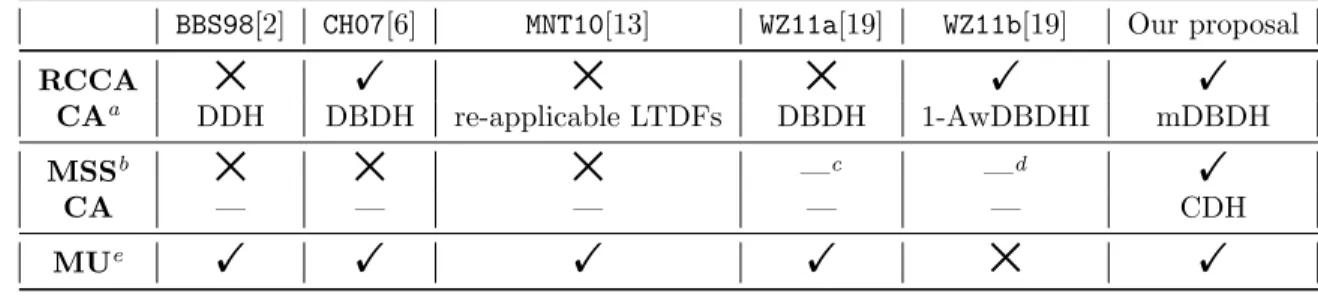
Table 1: Summary of bidirectional proxy re-encryption schemes.
BBS98[2] CH07[6] MNT10[13] WZ11a[19] WZ11b[19] Our proposal
RCCA # ! # # ! !
CAa DDH DBDH re-applicable LTDFs DBDH 1-AwDBDHI mDBDH
MSSb # # # —c —d !
CA — — — — — CDH
MUe ! ! ! ! # !
aCA denotes “Complexity Assumption”. bMSS denotes “Master Secret Security”.
cIt is unclear whether it can be proved secure in our new security model. dIt is unclear whether it can be proved secure in our new security model. eMU denotes “Multi-Useability”.
In Table 1, we summarize the existing BPRE schemes in terms of secrecy of message, master secret security, multi useability and their complexity assumptions. From this table, we can see that our proposal would be the only one that can hold the desired properties at the same time.
The rest of this paper is organized as follows. In Section 2, we give the definitions, security models of BPRE. Our new definition of the master secret security is given in this section. Then, we present our proposal in Section 3, including the description, security analysis and computation comparison. Finally, we draw our conclusions in Section 4.
2. Definitions
2.1. Definition of Bidirectional Proxy Re-Encryption
Definition 1 (Bidirectional Proxy Re-Encryption). A Bidirectional proxy re-encryption scheme is a tuple of probabilistic polynomial time (PPT) algorithms (KeyGen,ReKeyGen,Enc,ReEnc,Dec):
• KeyGen(1κ)→(pk, sk). On input of the security parameter 1κ, the key generation algorithmKeyGen
outputs a public key and private key pair (pk, sk).
• ReKeyGen(sk1, sk2) → rk1,2. On input of two private keys sk1 and sk2, the re-encryption key
gen-eration algorithm ReKeyGen outputs a bidirectional re-encryption key rk1,2. Since it is bidirectional, ReKeyGen(sk2, sk1) can be easily computed from ReKeyGen(sk1, sk2) via a public function F. For
instance, F is the inversion ofReKeyGen(sk1, sk2) in [2, 6, 19].
In general speaking, this algorithm is interactive, involving the delegator, delegatee and proxy.
• Enc(pk, m)→C. On input of a messagemfrom the message space and a public keypk, the encryption algorithmEncoutputs a ciphertextC.
• ReEnc(rk1,2, C1)→C2. On input of a re-encryption keyrk1,2 and a ciphertextC1, the re-encryption
algorithmReEnc outputs a re-encrypted ciphertextC2or a special symbolreject.
• Dec(sk, C) → m. On input of a private key sk, and a ciphertext C, the decryption algorithm Dec
Correctness of BPRE. For any message m in the message space and any key pairs (pk, sk),(pk0, sk0) ←
KeyGen(1κ), the following two conditions must hold:
Dec(sk,Enc(pk, m)) =mandDec(sk0,ReEnc(rk, C)) =m,
whererkis generated byReKeyGen(sk, sk0) orF(ReKeyGen(sk0, sk)), andCis the ciphertext for messagem
underpk from algorithm EncorReEnc if the bidirectional proxy re-encryption scheme is multi-use.
Recall the original desire for the master secret security: delegate decryption rights while keeping the signing rights. To give the definition of the master secret security closer to the original desire, we need to define the auxiliary digital signature for BPRE.
Definition 2 (Auxiliary Digital Signature). An auxiliary digital signature (ADS) for BPRE contains the following PPT algorithms (KeyGen,Sign,Verify).
• KeyGen(1κ)→(pk, sk). Identical to that in BPRE.
• Sign(sk, m)→σ. On input of a private keysk and a messagemfrom the message space, the signing algorithmSign outputs a signatureσ.
• Verify(pk, m, σ) → 0/1. On input of a public key pk, a message m from the message space and a signatureσ, the verifying algorithm Verifyoutputs 1 ifσis valid or 0 otherwise.
Correctness of ADS. The correctness of ADS is the same as that the traditional digital signature. That is, for any message m in the message space and any key pairs (pk, sk) ← KeyGen(1κ), the following two
conditions must hold:
Verify(pk, m,Sign(sk, m)) = 1 andVerify(pk, m0,Sign(sk, m)) = 0 wherem0 6=m.
2.2. Replayable Chosen Ciphertext Security for Multi-Use Bidirectional Proxy Re-Encryption
The replayable chosen ciphertext security for multi-use BPRE is defined by the following RCCA game played between a challengerC and an adversaryA. As usual, the challengerC does not answer any queries which the adversaryAcan answer by itself using the secret it has been supplied, and returns only one answer for the same query. Moreover, the adversaryAshould decide which party will be corrupted before the game starts. In other words, our RCCA security is defined in the static model.
Setup: The challengerC sets up the system parameters, and initializes one empty table Tk which will be
used to record all key pairs.
Phase 1: The adversaryAcan issue the following queries adaptively.
• Public key generation oracle Opk: C takes a security parameter 1κ, runsKeyGen(1κ) to generate
a key pair (pki, ski), givespki toAand records (pki, ski) in the tableTk. In the following,ski is
the corresponding private key ofpki.
• Private key generation oracle Osk: On input ofpki byA,C searches forpki in the tableTk, and
returnsski ifpki is corrupted.
• Re-encryption key generation oracle Ork: On input of two different public keys (pki, pkj) by A,
C returns the re-encryption key rki,j =ReKeyGen(ski, skj). It is required that bothpki andpkj
are corrupted or uncorrupted.
• Re-encryption oracle Ore: On input of (pki, pkj, C) byA, C returns the re-encrypted ciphertext
C0=ReEnc(ReKeyGen(ski, skj), C).
• Signing oracle Osign: On input of (pki, mi),CreturnsSign(ski, mi).
Challenge: Once Adecides that Phase 1 is over, it outputs two equal length plaintexts m∗
0,m∗1 from the
message space, and an uncorrupted public keypk∗ on which it wishes to challenge. C picks a random bit b∈ {0,1} and setsC∗=Enc(pk∗, m∗b). It sendsC∗ as the challenge toA.
Phase 2: This phase is almost the same as Phase 1 but with the following restrictions.
• Ore: On input of (pk1, pk2, C1) byA, if (pk1, C1) is a derivative of (pk∗, C∗), andpk2is corrupted,
C outputsreject. We say (pk1, C1) is a derivative of (pk∗, C∗) if one of the following conditions
holds.
– (pk1, C1) = (pk∗, C∗).
– (pk, C) is a derivative of (pk∗, C∗), and (pk1, C1) is a derivative of (pk, C).
– (pk1, C1)← Ore(pk, pk1, C), where (pk, C) is a derivative of (pk∗, C∗).
– The adversaryAcan use the re-encryption keys fromOrk to transform ciphertexts underpk∗
to that underpk by runningReEnc, andOdec(pk1, C1)∈ {m∗0, m∗1}.
• Odec: On input of (pki, Ci), if the output ism0∗or m∗1,C returnsreject.
Guess: Finally, the adversaryAoutputs a guessb0 ∈ {0,1}and wins the game ifb=b0.
Remark 1. Compared to the existing security game of confidentiality for PRE, our security game addition-ally contains the signing oracle. It is because that in our definition of BPRE, any BPRE scheme always has an ADS scheme.
We refer to such an adversaryAas an RCCA adversary. We define adversaryA’s advantage in attacking multi-use BPRE as the following function of the security parameterκ: AdvRCCA
MBPRE(1
κ) =|Pr[b=b0]−1/2|. Using the RCCA game, we can define RCCA security of multi-use BPRE.
Definition 3 (RCCA Security). If for any PPT RCCA adversaryAthe function AdvRCCAMBPRE(1κ) is
negli-gible, the multi-use bidirectional proxy re-encryption scheme is RCCA-secure.
2.3. Master Secret Security for Multi-Use Bidirectional Proxy Re-Encryption.
The master secret security for multi-use BPRE is defined by the following MSS game played between a challenger C and an adversary A. As usual, the challenger C does not answer any queries which the adversaryAcan answer by itself using the secret it has been supplied, and returns only one answer for the same query. Moreover, all the public keys involved in the following oracles (exceptOpk) are fromOpk. It is
worth mentioning that in the MSS game, the adversary does not need to decide the corrupted user before the game starts. In other words, our master secret security is defined in the adaptive model.
Find: The adversaryAcan issue the following queries adaptively.
• Public key generation oracle Opk: C takes a security parameter 1κ, runsKeyGen(1κ) to generate
a key pair (pki, ski), givespki toAand records (pki, ski) in the tableTk. In the following,ski is
the corresponding private key ofpki.
• Private key generation oracle Osk: On input ofpki byA,C searches forpki in the tableTk, and
returnsski.
• Re-encryption key generation oracle Ork: On input of (pki, pkj) byA,Creturns the re-encryption
keyrki,j=ReKeyGen(ski, skj).
• Re-encryption oracle Ore: On input of (pki, pkj, C) byA, C returns the re-encrypted ciphertext
C0=ReEnc(ReKeyGen(ski, skj), C).
• Signing oracle Osign: On input of (pki, mi),CreturnsSign(ski, mi).
Output: A outputs a tuple of (pk∗, m∗, σ∗). If all the following conditions are satisfied, then Awins the game.
• Verify(pk∗, m∗, σ∗) = 1.
• pk∗ has never been queried toOsk.
• (pk∗, m∗) has never been queried toOsign.
Remark 2. Compared to the existing security game for the master secret security, our security game addi-tionally contains the signing oracle, and the winning requirement changes from outputting a private key of an uncorrupted user to a successful forgery of the signature.
We also defineAdvMSSMBPRE(1κ) = Pr[AWins] for the security parameterκas that in RCCA security.
Definition 4 (Master Secret Security). If for any PPT MSS adversary Athe function AdvMSSMBPRE(1κ) is negligible, the multi-use bidirectional proxy re-encryption scheme is MS-secure.
2.4. Bilinear Groups
In this subsection, we briefly review the definitions about bilinear maps and bilinear map groups, which follow those in [3, 5].
1. GandGT are two (multiplicative) cyclic groups of prime orderq;
2. g is a generator ofG;
3. eis a bilinear mape:G×G→GT.
Let G and GT be two groups as above. An admissible bilinear map is a map e : G×G → GT with the
following properties:
1. Bilinearity: For all P, Q, R∈G, ˆe(P·Q, R) = ˆe(P, R)·eˆ(Q, R) and ˆe(P, Q·R) = ˆe(P, Q)·eˆ(P, R).
2. Non-degeneracy: If ˆe(P, Q) = 1 for allQ∈G, thenP =O, whereOis a point at infinity.
We say thatGis a bilinear group if the group action inGcan be computed efficiently and there exists a groupGT and an efficiently computable bilinear map as above. We denoteBSetupas an algorithm that,
on input the security parameter 1κ, outputs the parameters for a bilinear map as (q, g,
G,GT, e), where
q∈Θ(2κ).
2.5. Complexity Assumptions
The security of our proposal is based on the modified decisional bilinear Diffie-Hellman assumption and computational Diffie-Hellman assumption. Since the latter assumption is well-known, we only give the definition of the former assumption in this paper.
Definition 5 (Modified Decisional Bilinear Diffie-Hellman Assumption). Let (q, g,G,GT, e)←BSetup(1k).
The modified decisional bilinear Diffie-Hellman problem (mDBDH) in (G,GT) is defined as follows: given
tuple (g, ga, g1/a, gb, gc, T)∈
G5×GT as input, decide whetherS= ˆe(g, g)abc. An algorithmAhas advantage
εin solving the mDBDH problem in (G,GT) if
|Pr[A(g, ga, g1/a, gb, gc,ˆe(g, g)abc) = 0]−Pr[A(g, ga, g1/a, gb, gc, T) = 0]| ≥,
where the probability is taken over the random choices ofa, b, c∈Zq,S∈Gand the random bits ofA.
We say that the (t, )-modified decisional Bilinear Diffie-Hellman assumption holds in (G,GT) if not-time
3. Our Proposal
3.1. Description of Our BPRE Scheme
The system parameters are (q, g, h, e,G,GT), where (q, g, e,G,GT) are from BSetup, and his a random
element from G. Furthermore, it requires two secure cryptographic hash functions H1 :{0,1}∗ → {0,1}κ
andH2:{0,1}∗→ {0,1}κ, whereκis a security parameter.
• KeyGen: Select random x1, x2, z1 ∈Zq, Next, compute X1,g = ˆe(g, g)x1, X1,h = ˆe(g, h)x1, X2 =gx2,
Z1=gz1,z2= (x1−z1)/x2modq, andZ2=gz2. The public key is
pk= (X1,g, X1,h, X2, Z1, Z2),
and the private key is
sk= (x1, x2, z1, z2).
• ReKeyGen: On input two private keys sk = (x1, x2, z1, z2) and sk0 = (x01, x02, z01, z20), it outputs the
re-encryption key
rk= (rk1, rk2) = (z1/z10 modq, z2/z20 modq).
The re-encryption key can be computed efficiently by the method in [2, 6].
• Enc: On inputpk= (X1,g, X1,h, X2, Z1, Z2) andm∈GT, do the following steps.
– Choose randomrfrom Zq.
– Compute
u1=gr, u2=X2r, v=X r
1,h·m, u3=X1,gr ,
u4=H1(v||u3)r, u5=H2(v||u3)r
Note that the item u5 is only useful in the security proof.
– OutputC= (u1, u2, v, u3, u4, u5) as the ciphertext.
• ReEnc: On input a re-encryption keyrk = (rk1, rk2) = (z1/z10 modq, z2/z20 modq) and a ciphertext
C= (u1, u2, v, u3, u4, u5) under keypk= (X1,g, X1,h, X2, Z1, Z2), the proxy performs as follows.
– Check whether ˆ e(u1, H1(v||u3)) = ˆe(g, u4) (1) ˆ e(u1, H2(v||u3)) = ˆe(g, u5) (2) ˆ e(u1, Z1)·ˆe(u2, Z2) = u3 (3)
all hold. If not, abort; otherwise, do the next steps. – Computeu01=urk1 1 ,u02=u rk2 2 ,u04=u rk1 4 , andu05=u rk1 5 .
– Output (u01, u02, v, u3, u04, u05) as the re-encrypted ciphertext.
Note that u01=u rk1 1 =g r·z1/z01, u0 2=u rk2 2 =g r·x2·z2/z02 u04=urk1 4 =H1(v||u3)r·z1/z 0 1, u0 5=u rk2 5 =H2(v||u3)r·z1/z 0 1
• Dec: On input a private key (x1, x2, z1, z2) and any ciphertextC= (u1, u2, v, u3, u4, u5), the decryptor
performs as follows.
– Computem=v/(ˆe(uz1
1 , h)·ˆe(u z2
2 , h)). Note that if the ciphertext C is fromEnc, we have that
v/(ˆe(uz11 , h)·eˆ(uz22 , h)) = ˆe(h, gx1·r)·m/(ˆe(h, gz1·r)·eˆ(h, gz2·x2·r)) =m;
if the ciphertext Cis from ReEnc, we have that
v/(ˆe(uz1
1 , h)·eˆ(u z2
2 , h)) = ˆe(h, g
x01·r)·m/(ˆe(h, gz01·r)·eˆ(h, gz02·x02·r)) =m.
– Output the message m.
The correctness of the above BPRE scheme can be easily obtained by the description.
3.2. Description of Our ADS Scheme
The system parameters are almost the same as that in our BPRE scheme, except we need an additional secure cryptographic hash functionH3:{0,1}∗→Zq.
• KeyGen: Identical to that in our BPRE scheme.
• Sign: On input a private key sk = (x1, x2, z1, z2) and a message m, it outputs the signature σ =
H3(m||pk)x2, wherepk is the public key corresponding tosk.
• Verify: On inputpk= (X1,g, X1,h, X2, Z1, Z2), a signatureσand a messagem, if ˆe(X2, H3(m||pk)) =
ˆ
e(g, σ) holds, it outputs 1 or 0 otherwise.
It is easy to see that the above ADS scheme is the short signature scheme in [4], hence the correctness is obtained.
3.3. Security Analysis
Theorem 1. If the mDBDH assumption holds in G, our proposal is RCCA-secure in the random oracle
model. In particular, we have
AdvRCCAMBPRE(1κ)≤AdvAmDBDH(1κ),
whereAdvAmDBDH(1κ)is the advantage of thatAbreaks the mDBDH assumption under the security parameter
κ.
Proof. Assume there exists a RCCA adversaryAthat can break the RCCA security of our proposal. Then we can build another algorithmBthat can break the mDBDH assumption (i.e., giveng, ga, g1/a, gb, gc, T, it
is hard to decideT = ˆe(g, g)abc) by playing the RCCA game with A. The details are as follows. Before the
game starts,Bsetsh=gb.
H1 Oracle: On input of (v, u3), check whether the tuple (v, u3, α1) exists in the list LH1. If yes, return
(ga)α1; otherwise, it chooses a random α
1 from Zq, and then records (v, u3, α1) in the list LH1, and
returns (ga)α1. Note that if the input (v, u
3) is a part of the challenge ciphertext, thenBjust returns
gα1.
H2 Oracle: On input of (v, u3), check whether the tuple (v, u3, α2) exists in the list LH2. If yes, return
(g1/a)α2; otherwise, it chooses a randomα
2 fromZq, and then records (v, u3, α2) in the listLH2, and
return (g1/a)α2. Note that if the input (v, u
3) is a part of the challenge ciphertext, thenBjust returns
gα2.
H3 Oracle: On input of (m, pk), check whether the tuple (m, pk, α3) exists in the list LH3. If yes, return
gα3; otherwise, choose a random value α
3 from Zq, and then record (m, pk, α3) in the listLH3, and
returngα3.
• Opk: B chooses random elements z1, z2, x2 from Zq. If the public key is uncorrupted, then B
computesX1=gz1((ga)x2)z2 and returns
pk = (X1,g, X1,h, X2, Z1, Z2)
= (ˆe(g, X1),ˆe(h, X1), gx2, gz1,(ga)z2);
if the public key is corrupted, thenBcomputesX1=gz1(gx2)z2 and returns
pk = (X1,g, X1,h, X2, Z1, Z2)
= (ˆe(g, X1),eˆ(h, X1), gx2, gz1, gz2).
At last,B records (pk, X1, z1, z2, x2) inTk.
• Osk: On input of a corrupted public key pk by A, B gets (pk, z1, z2, x2) from Tk. B returns
sk= (z1+x2·z2modq, x2, z1, z2).
• Ork: On input of (pk, pk0) by A, B gets (pk, z1, z2, x2) and (pk0, z10, z20, x02) from Tk, and then
returns
rk= (rk1, rk2) = (z1/z10 modq, z2/z02modq).
Note that we have the following for the correctness. – If the two public keys are both uncorrupted,
sk= (z1+x2·a·z2modq, x2, z1, z2·amodq)
and
sk0= (z10 +x02·a·z20 modq, a·x02, z10, z20 ·amodq),
hence,rk= (rk1, rk2) = (z1/z01modq, z2/z20 modq).
– If the two public keys are both corrupted,
sk= (z1+x2·z2modq, x2, z1, z2)
and
sk0= (z01+x02·z20 modq, x02, z01, z20),
hence,rk= (rk1, rk2) = (z1/z01modq, z2/z20 modq).
• Ore: On input of C = (u1, u2, v, u3, u4, u5) and two public keys pk and pk0, B first checks the
well-formness as the real execution. If it does not pass, abort; otherwise, do the followings. – If the two public keys are both uncorrupted or corrupted, thenBgets the re-encryption key
from Ork, and returns the result ofReEnc.
– Otherwise, do the followings.
∗ Find the items (pk, X1, z1, z2, x2) and (pk0, X10, z10, z02, x02) in Tk.
∗ Computeu01=uz1/z2 1 ,u04=u z1/z2 4 , andu05=u z1/z2 5 .
∗ Find the original decryptor pko of the ciphertext C by checking ˆe(u1, X1) = u3 for all
items inTk. Assume that the found item is (pko, Xo1, zo1, zo2, xo2).
∗ Compute gr = uz1/zo1 1 , (ga)r = (u z1/zo1 4 )1/α1 and (g1/a)r = (u z1/zo1 5 )1/α2, where α1, α2
are the values inLH1 andLH2 corresponding to (v, u3), respectively.
∗ Ifpko and pk0 are both corrupted or uncorrupted, then compute u02 = (gr)xo2·zo2/z2. If
pko is corrupted andpk0 is uncorrupted, then compute u02= ((g1/a)r)xo2·zo2/z2. If pko is
uncorrupted andpk0 is corrupted, then computeu02= ((ga)r)xo2·zo2/z2. ∗ Output (u01, u02, v, u3, u04, u05) as the resultant ciphertext.
• Odec: On input of C = (u1, u2, v, u3, u4) under pk, B first checks the well-formness as the real
execution. If it does not pass, output ⊥; otherwise, re-encrypt the ciphertext to the one under a corrupted public key by querying Ore, then decrypt the resultant ciphertext by using the
corresponding private key.
• Osign: On input of (m, pk), B firstly gets the value ofα3 by queryingH3 hash oracle, and then
returnsX2α3.
Challenge: AsendsC two messagesm0, m1from Gand an uncorrupted public key
pk∗= (X1,g∗ , X1,h∗ , X2∗, Z1∗, Z2∗) = (ˆe(g, gz1∗(ga)z ∗ 2),ˆe(h, gz ∗ 1(ga)z ∗ 2), gx ∗ 2, gz ∗ 1,(ga)z ∗ 2),
B chooses a random numberb∈ {0,1}, and returns (u∗1, u∗2, v∗, u∗3, u∗4, u∗5) as the challenge ciphertext.
u∗1=gc, u∗2= (gb)x∗2, v∗= ˆe(gb, gc)z ∗ 1 ·Tx ∗ 2·z ∗ 2 ·mb, u∗3= ˆe(X1∗, gc), u4= (gb)α ∗ 1, u4= (gb)α ∗ 2, where (X∗
1, z1∗, z∗2, x∗2),α∗1 andα∗2 are fromTk,LH1 andLH2, respectively.
Note that if T =gabc, we have thatv∗= ˆe(gb, gc)z∗1·Tx∗2·z∗2 ·m
b= ˆe(gb, X1∗)c·mb. Phase 2: Almost the same as that in Phase 1, except the restrictions in the RCCA game. Guess: Aoutputs the guessb0. Ifb0 =b,B decidesT = ˆe(g, g)abc; otherwise,T 6= ˆe(g, g)abc.
It is easy to see that in the random oracle, the above simulation is perfect. Hence, we obtain this theorem. Theorem 2. If the CDH assumption holds inG, our proposal is MS-secure in the random oracle model. In
particular, we have
AdvMSSMBPRE(1κ)≤ Adv
A
CDH(1 κ)
e(1 +qsk)qH3
,
where AdvACDH(1κ) is the advantage of that Abreaks the CDH assumption under the security parameter κ, andqsk andqH3 is the number of private key generation queries and H3 hash oracle queries, respectively.
Proof. Assume there exists an MSS adversaryA that can break the MS security of our proposal. Then we can build another algorithm B that can break the CDH assumption (i.e., given g, ga, gb, it is hard to
computegab) by playing the MSS game withA. The details are as follows.
Find: Bbuilds the oracles as follows.
• H1,H2 hash oracles: Identical to the proof of Theorem 1.
• H3hash oracle: On input of (m, pk), check whether the tuple (m, pk, α3) exists in the listLH3. If
yes, returngα3. Otherwise, it decides whether (m, pk) is the target (message, public key) pair. If
yes, return gb; otherwise, choose a random valueα3 from Zq, and then record (m, pk, α3) in the
listLH3, and returngα3.
• Opk: Bchooses random elementsz1, z2, x2fromZq and decidesθ∈ {0,1}under Pr[θ= 1] =δ. If
θ= 0, thenBreturns pk = (X1,g, X1,h, X1, Z1, Z2) = (ˆe(g, gz1((ga)x2)z2),ˆe(h, gz1((ga)x2)z2),(ga)x2, gz1, gz2); ifθ= 1, thenBreturns pk = (X1,g, X1,h, X1, Z1, Z2) = (ˆe(g, gz1(gx2)z2),eˆ(h, gz1(gx2)z2), gx2, gz1, gz2) At last,B records (pk, z1, z2, x2, θ) in Tk.
• Osk: On input of a public keypkbyA,Bgets (pk, z1, z2, x2, θ) fromTk. Ifθ= 1, thenBreturns
sk= (z1+x2·z2modq, x2, z1, z2); otherwise,Boutputsfailure.
• Ork: On input of (pk, pk0) by A, B gets (pk, z1, z2, x2, θ) and (pk0, z10, z02, x02, θ0) from Tk, and
then returnsrk= (rk1, rk2) = (z1/z01modq, z2/z20 modq).
• Ore: Bcan use the re-encryption keys fromOrk to reply the queries.
• Odec: Identical to the proof of Theorem 1.
• Osign: Bfirstly gets the value ofα3 by queryingH3 hash oracle, and then returnsX2α3.
Output: Aoutputs a signatureσ∗=H3(m∗||pk∗)a·x ∗
2, thenB outputs the CDH solutionσ∗1/x ∗
2, where x∗ 2
is the value inTk corresponding to pk∗.
If B has guessed the right target (message, public key) pair and has not output failure, then the above simulation is perfect. On one hand, B has guessed the right target pair with the probability of 1/qH3 at
least. On the other hand, the probability of thatB has not output failureis δqsk(1−δ). The maximize
value ofδqsk(1−δ) is 1/(e(1 +q
sk)) whenδ= 1−1/(qsk+ 1). Hence, we obtain this theorem.
4. Conclusion
In this paper, we have proposed a novel multi-use, bidirectional proxy re-encryption with constant cipher-text size, master secret security and RCCA security. This proposed BPRE scheme can provide a (partial) solution to the collusion attacks in the current cryptographic cloud storage. Another contribution in this paper is that we propose a new definition for the master secret security. The new security definition is closer to the original desire for the master secret security compared to the existing definitions. There are still var-ious future works left, e.g., how to design a pairing-free, multi-use BPRE scheme with constant ciphertext size, master secret security, and RCCA security is still unknown.
Acknowledgements
The authors thank the anonymous reviewers for their insightful comments and helpful suggestions. In addition, this work was also supported by the National Basic Research Program of China (973 Program) No. 2012CB315804, NSFC Nos. 61472364, 61379121, and NSFZJ No. LR13F020003. Rongxing Lu would also like to thank the support of Nanyang Technological University under Grant NTU-SUG (M4081196) and MOE Tier 1 (M4011177).
[1] Giuseppe Ateniese, Kevin Fu, Matthew Green, and Susan Hohenberger. Improved proxy re-encryption schemes with applications to secure distributed storage. InNDSS. The Internet Society, 2005.
[2] Matt Blaze, Gerrit Bleumer, and Martin Strauss. Divertible protocols and atomic proxy cryptography. In Kaisa Nyberg, editor, EUROCRYPT, volume 1403 of Lecture Notes in Computer Science, pages 127–144. Springer, 1998.
[3] D. Boneh and M. Franklin. Identity-based encryption from the weil pairing. InCRYPTO 2001, volume 2139 ofLNCS, pages 231–229, 2001.
[4] D. Boneh, B. Lynn, and H. Shacham. Short signatures from the weil pairing. In ASIACRYPT 2001, volume 2248 ofLNCS, pages 514–532, 2001.
[5] Dan Boneh and Matthew Franklin. Identity-based encryption from the weil pairing. SIAM Journal of Computing, 32(3):586–615, 2003.
[6] Ran Canetti and Susan Hohenberger. Chosen-ciphertext secure proxy re-encryption. In Peng Ning, Sabrina De Capitani di Vimercati, and Paul F. Syverson, editors,ACM Conference on Computer and Communications Security, pages 185–194. ACM, 2007.
[7] T. ElGamal. A public key cryptosystem and a signature scheme based on discrete logarithms. IEEE Transactions on Information Theory, 31(4):469–472, 1985.
[8] Chun-Ying Huang, Yun-Peng Chiu, Kuan-Ta Chen, and Chin-Laung Lei. Secure multicast in dynamic environments. Computer Networks (Amsterdam, Netherlands: 1999), 51(10):2805–2817, July 2007. [9] Junbeom Hur. Improving Security and Efficiency in Attribute-Based Data Sharing. IEEE Transactions
on Knowledge and Data Engineering, 2012.
[10] Apu Kapadia, Patrick P. Tsang, and Sean W. Smith. Attribute-based publishing with hidden credentials and hidden policies. InNDSS. The Internet Society, 2007.
[11] Hsiao-Ying Lin and Wen-Guey Tzeng. A secure erasure code-based cloud storage system with secure data forwarding. IEEE Trans. Parallel Distrib. Syst, 23(6):995–1003, 2012.
[12] Rongxing Lu, Xiaodong Lin, Jun Shao, and Kaitai Liang. Rcca-secure multi-use bidirectional proxy re-encryption with master secret security. InProvable Security - 8th International Conference, ProvSec 2014, Hong Kong, China, October 9-10, 2014. Proceedings, pages 194–205, 2014.
[13] Toshihide Matsuda, Ryo Nishimaki, and Keisuke Tanaka. Cca proxy re-encryption without bilinear maps in the standard model. In Phong Q. Nguyen and David Pointcheval, editors,Public Key Cryptography, volume 6056 ofLecture Notes in Computer Science, pages 261–278. Springer, 2010.
[14] Ritesh Mukherjee and J. William Atwood. Scalable solutions for secure group communications. Com-puter Networks (Amsterdam, Netherlands: 1999), 51(12):3525–3548, August 2007.
[15] A. Shamir. Identity-based cryptosystems and signature schemes. In CRYPTO 1984, volume 196 of
LNCS, pages 47–53, 1984.
[16] Jun Shao, Rongxing Lu, and Xiaodong Lin. FINE: A fine-grained privacy-preserving location-based service framework for mobile devices. In2014 IEEE Conference on Computer Communications, INFO-COM 2014, Toronto, Canada, April 27 - May 2, 2014, pages 244–252, 2014.
[17] Yipin Sun, Rongxing Lu, Xiaodong Lin, Xuemin Shen, and Jinshu Su. An Efficient Pseudonymous Authentication Scheme With Strong Privacy Preservation for Vehicular Communications.IEEE Trans-actions on Vehicular Technology, 59(7):3589–3603, 2010.
[18] Guojun Wang, Qin Liu, Jie Wu, and Minyi Guo. Hierarchical attribute-based encryption and scalable user revocation for sharing data in cloud servers. Computers & Security, 30(5), 2011.
[19] Jian Weng and Yunlei Zhao. Direct constructions of bidirectional proxy re-encryption with alleviated trust in proxy. IACR Cryptology ePrint Archive, 2011:208, 2011.
[20] Shucheng Yu, Cong Wang, Kui Ren, and Wenjing Lou. Achieving secure, scalable, and fine-grained data access control in cloud computing. InINFOCOM, pages 534–542. IEEE, 2010.