Working Paper 8403
FORECASTING USING CONTEMPORANEOUS CORRELATIONS
b y M i c h a e l L. Bagshaw
Working papers o f t h e Federal Reserve Bank o f Cleveland a r e p r e l i m i n a r y m a t e r i a l s , c i r c u l a t e d t o s t i m u l a t e
d i s c u s s i o n and c r i t i c a l comment. The views expressed h e r e i n a r e t h o s e o f t h e a u t h o r and n o t n e c e s s a r i l y t h o s e o f t h e F e d e r a l Reserve Bank o f C l e v e l a n d o r t h e Board o f Governors o f t h e F e d e r a l Reserve System. September 1984
Key words: Contemporaneous correlations, forecasting, multivariate time
--
series.
Abstract
In this paper, we present a forecasting technique that uses
contemporaneous correlations for forecasting in a time series model when only
a subset of the variables are available for the current period. This method
potentially provides more accurate forecasts than the standard time series
forecasting method, which does not use contemporaneous data. This procedure
is illustrated with an example of forecasting the gross national product
(GNP), given current M-1 in a trivariate autoregressive moving average time
series model. Results indicate that during the more stable economic period of
1976:IQ through 1979:IVQ, this method indeed provides forecasts with smaller
root mean square errors than the standard forecasts. However, the results
during the more turbulent 1980s are mixed. This latter result indicates that
the relationship between the contemporaneous error terms from M-1 and GNP
changed during this period. However, the results for the period 1983:IIQ
through 1984:IIQ indicate that the relationship may have returned to pre-1980
form. The forecast errors during this latter period had smaller root mean
square errors when the contemporaneous errors were used.
I. I n t r o d u c t i o n
When f o r e c a s t i n g i n a m u l t i v a r i a t e framework, t h e r e a r e occasions when d a t a a r e a v a i l a b l e o n l y f o r a subset o f t h e v a r i a b l e s i n t h e model f o r t h e c u r r e n t t i m e p e r i o d . I t i s d e s i r a b l e t o use t h e a d d i t i o n a l i n f o r m a t i o n i n t h i s subset o f known v a r i a b l e s t o f o r e c a s t v a l u e s t h a t a r e n o t c u r r e n t l y
a v a i l a b l e . T h i s i n c l u d e s b o t h v a l u e s o f t h e unknown v a r i a b l e s i n t h e c u r r e n t p e r i o d and f u t u r e v a l u e s o f a l l v a r i a b l e s . I n m u l t i p l e t i m e s e r i e s models, any contemporaneous c o r r e l a t i o n s among t h e v a r i a b l e s a r e modeled as p a r t o f t h e e r r o r s t r u c t u r e . Consequently, t h e s t a n d a r d f o r e c a s t s generated b y t h e s e models cannot use t h e i n f o r m a t i o n f r o m c u r r e n t d a t a i n d e v e l o p i n g f o r e c a s t s . However, t h e i n f o r m a t i o n i n t h e contemporaneously c o r r e l a t e d e r r o r terms can be used t o o b t a i n f o r e c a s t s w i t h s m a l l e r e r r o r v a r i a n c e s . T h i s paper e x p l a i n s how t h e s e f o r e c a s t s can be o b t a i n e d and p r e s e n t s an example where t h e
contemporaneous c o r r e l a t i o n between t h e money s u p p l y (M-1) and nominal GNP i s used t o reduce t h e r o o t mean square e r r o r (RMSE) i n f o r e c a s t i n g c u r r e n t and f u t u r e GNP, g i v e n c u r r e n t M-1. While t h i s paper f o c u s e s on t h e m u l t i v a r i a t e ARMA t i m e s e r i e s models, t h e r e s u l t s h o l d f o r any m u l t i v a r i a t e models t h a t do n o t e x p l i c i t l y model t h e contemporaneous c o r r e l a t i o n s .
11. M u l t i v a r i a t e ARMA Time S e r i e s Models
The f o l l o w i n g i s a v e r y b r i e f d e s c r i p t i o n o f m u l t i v a r i a t e
a u t o r e g r e s s i v e moving average t i m e s e r i e s models (ARMA); T i a o and Box (1981) p r o v i d e a more d e t a i l e d d e s c r i p t i o n . The ARMA models can i n c l u d e seasonal
components; however, t h i s paper uses o n l y examples of nonseasonal models and, thus, p r e s e n t s o n l y a d e s c r i p t i o n o f t h e nonseasonal models. The g e n e r a l nonseasonal m u l t i v a r i a t e ARMA model o f o r d e r (p,q) i s g i v e n b y
where e (B) =
I
- e B-
...
- e B ~ , -4 --1
-4 where B = b a c k s h i f t o p e r a t o r ( i .e., B S Zi,t = Z i,
t - s>
9I
= k x k i d e n t i t y m a t r i x , - z = v e c t o r o f k v a r i a b l e s i n t h e model,-
@ . I s and e . ' s = k x k m a t r i x e s o f unknown parameters,
-J -J
e = k x 1 v e c t o r o f unknown parameters, and -0 a = k x
1
v e c t o r o f random e r r o r s t h a t a r e i d e n t i c a l l y and - i n d e p e n d e n t l y d i s t r i b u t e d as N ( O , C ) . Thus, i t i s assumed t h a t t h e a I s a t d i f f e r e n t p o i n t s i n t i m e a r ej
,tindependent b u t n o t n e c e s s a r i l y t h a t t h e elements o f
gt
a r e independent a t a g i v e n p o i n t i n t i m e .The n- period- ahead f o r e c a s t s f r o m t h e s e models a t t i m e t ( z t ( n ) ) a r e g i v e n b y
where f o r any v a l u e o f t,n,m,
[ L ~ + ~ - ~
]
i m p l i e s t h e c o n d i t i o n a l expected v a l u e s o f t h e random v a r i a b l e sL ~ + ~ - ~
a t t i m e t. I f n-m i s l e s s t h a n o r equal t o 0, t h e n t h e c o n d i t i o n a l expected v a l u e s a r e t h e a c t u a l v a l u e s o f t h e random v a r i a b l e s and t h e e r r o r terms. I f n-m i s g r e a t e r t h a n 0, t h e n t h e expected v a l u e s a r e t h e b e s t f o r e c a s t s a v a i l a b l e f o r t h e s e random v a r i a b l e s and e r r o r terms a t t i m e t. Because t h e e r r o r terms a r e u n c o r r e l a t e d w i t h p r e s e n t and p a s t i n f o r m a t i o n , t h e b e s t f o r e c a s t s ( i n s t a n d a r d t i m e s e r i e s f o r e c a s t i n g ) o f t h e e r r o r terms f o r n-m g r e a t e r t h a n 0 a r e t h e i r c o n d i t i o n a l means, which a r e 0. The f o r e c a s t s can be generated i t e r a t i v e l y w i t h t h eone- period- ahead f o r e c a s t s depending o n l y on known v a l u e s o f t h e v a r i a b l e s and e r r o r terms. The l o n g e r - l e n g t h f o r e c a s t s i n t u r n depend on t h e s h o r t e r - l e n g t h f o r e c a s t s .
111. Using Contemporaneous C o r r e l a t i o n s
I f some o f t h e v a r i a b l e s a t t i m e t+l a r e known, t h e n t h e expected v a l u e s o f t h e a s s o c i a t e d e r r o r terms a r e n o t n e c e s s a r i l y 0 i f t h e r e i s
contemporaneous c o r r e l a t i o n between t h e e r r o r terms. ( I n t h e f o l l o w i n g , t h e t e r m c u r r e n t s t a n d s f o r t i m e t+l, i.e., t h e t i m e p e r i o d f o r w h i c h t h e f i n a l v a l u e o f some o f t h e v a r i a b l e s i s known b u t n o t a l l . ) F o r example, c o n s i d e r t h e f o l l o w i n g s i m p l e model:
d
zwhere each e r r o r t e r m has a v a r i a n c e o f
1
and t h e contemporaneous c o r r e l a t i o n between al and a2 i s 0.5. The s t a n d a r d n- period- ahead f o r e c a s t s a t t i m e t f r o m t h i s model a r e g i v e n b ywhere t h e c o n d i t i o n a l expected values o f t h e e r r o r terms a r e 0 i n t h e s t a n d a r d m u l t i v a r i a t e f o r e c a s t s .
I n p a r t i c u l a r , t h e one- period- ahead f o r e c a s t s a r e
Thus, i n s t a n d a r d t i m e s e r i e s f o r e c a s t i n g , t h e one- period- ahead f o r e c a s t o f Z z ' t + l = 1 2 z l , t ' which has a s t a n d a r d e r r o r o f u2 ( t h e s t a n d a r d
e r r o r o f a2), which f o r t h i s model i s assumed t o be
1.
However, i f z1,
t+l i s known and z ~ i s not, t h e n a b e t t e r f o r e c a s t o f zZytcl ~ ~ + ~ can beo b t a i n e d b y u s i n g t h e contemporaneous c o r r e l a t i o n between al and a2. T h i s i s t r u e because al,t+l, which equals t h e f o r e c a s t e r r o r made a t t i m e t f o r z1 a t t i m e t+l (al, t+l = z l , t + l - z
1,t
( I ) ) , i s known. Thus, t h ec o r r e l a t i o n between al and a2 can be used t o e s t i m a t e aZytcl g i v e n a
l,t+1° For t h i s model, t h e r e l a t i o n s h i p ( d e r i v e d f r o m t h e
variance- covariance m a t r i x of t h e e r r o r t e r m s ) between t h e two e r r o r terms i s g i v e n b y
where e
is the error in predicting a
using al
t.
For this model,
2,t
2,t
Ythis error will have a variance of 0.75.
Thus, given
z ~ , ~ + ~ ,
the best
forecast of a2,t+l is given by
0.5
*
al,t+l; consequently, the forecast
Or
Z2,
t+l
is modified to be
This forecast will have an error of e2,t+l, which has a variance of
0.75 compared with the error variance of 1 for the forecast from the original
model, using only
z
to forecast
zZyt.
l,t
Thus, knowing
z
~
reduces
~
~
+
~
the error variance in forecasting
z ~ , ~ + ~
by 25 percent for this example.
Also, the forecast using contemporaneous data will remain unbiased. In this
model, because the forecast of
zl
depends on
z2,
this reduction in
forecast error variance for one-period-ahead forecasts of
z2
will lead to a
reduction of forecast error variance for forecasts of
zl.
For example, the
one-period-ahead forecast at time t+l for
zl
using contemporaneous
T h i s f o r e c a s t has an e r r o r el,t+2 g i v e n b y
S i m i l a r l y , t h e f o r e c a s t e r r o r al,t+l ( 1 ) f o r Z l Y t c 2 w i t h o u t u s i n g
contemporaneous d a t a i s
Thus, t h e one- period- ahead f o r e c a s t o f zl u s i n g contemporaneous
2 2 2
d a t a has a v a r i a n c e o f ol + qiZ1*oe2 = 1 + 0.75*qig1 w h i l e t h e f o r e c a s t
2 2 2 2
v a r i a n c e n o t u s i n g contemporaneous d a t a has a v a r i a n c e o f ol + @21*02 = 1 +
mZ1.
S i m i l a r l y , i t can be shown t h a t t h e r e i s a r e d u c t i o n i n t h e f o r e c a s t v a r i a n c e f o r f u t u r e p e r i o d s when u s i n g contemporaneous c o r r e l a t i o n s f o r t h i s model. Thus, t h e use o f contemporaneous d a t a reduces n o t o n l y t h e f o r e c a s t e r r o r o f t h e contemporaneous v a l u e o f t h e o t h e r v a r i a b l e i n t h i s model b u t a l s o t h e f o r e c a s t s o f t h e observed v a r i a b l e i n f u t u r e p e r i o d s .
I n general, t h e amount of r e d u c t i o n i n t h e contemporaneous p e r i o d and f u t u r e p e r i o d s w i l l depend on t h e c o r r e l a t i o n s between t h e e r r o r terms i n t h e known v a r i a b l e s and t h o s e i n t h e unknown v a r i a b l e s , as w e l l as t h e
I n t h e g e n e r a l case, t h e v a r i a b l e s can be d i v i d e d i n t o two s e t s
--
t h o s e f o r which i n f o r m a t i o n i s a v a i l a b l e f o r t h e c u r r e n t t i m e p e r i o d (L
A) and t h o s e f o r which c u r r e n t i n f o r m a t i o n i s n o t a v a i l a b l e(zNA).
I n t h e f o l l o w i n g d i s c u s s i o n , i t i s assumed t h a t t h e f i r s t kA v a r i a b l e s have d a t a a v a i l a b l e f o r t h e c u r r e n t t i m e p e r i o d and t h a t t h e r e m a i n i n g k-kA v a r i a b l e s do n o t . The e r r o r s i n t h e second group t h e n can be f o r e c a s t f r o m t h e known e r r o r s i n t h e f i r s t group. The r e l a t i o n s h i p between t h e unknown e r r o r s and t h e known e r r o r s ( a-
a kA x 1 v e c t o r ) can be r e p r e s e n t e d as -4,t = b . a(6)
ai ,t -I-A,t + 'i ,t f o r i = k A + l , k A + 2,...
,k, where - bi w i l l be a 1 x k v e c t o r o f e s t i m a t e d c o e f f i c i e n t s . Because t h e e r r o r terms i n e q u a t i o n 6 g e n e r a l l y w i l l be c o r r e l a t e d across e q u a t i o n s ( t h a t i s , e and e w i l l g e n e r a l l y be c o r r e l a t e d ) , t h e s e e s t i m a t e s s h o u l d be i ,t j,t determined b y u s i n g a g e n e r a l i z e d l e a s t squares e s t i m a t o r ( T h e i l 1971). Given t h e s e t o f e q u a t i o n s p r e s e n t e d i n e q u a t i o n 6, t h e f o r e c a s t s ( o r , e q u i v a l e n t l y , t h e c o n d i t i o n a l e x p e c t e d v a l u e s ) o f t h e unknown e r r o r s ai, t+l a r e( 7 ) aiYt(l) = bi%,t+l f o r i = kA+ 1, kA+ 2,
...
,k.The f o r e c a s t s u s i n g contemporaneous c o r r e l a t i o n s a r e t h u s g i v e n b y e q u a t i o n 3, where [$.t+n-j,~A,t+n-j] =
(1)
if n - j i s g r e a t e r t h a nI
(a,
t+l,bi$,
t+l ) i f n - j = l ( v e r s u s a f o r e c a s t o f1
f o r t h e unknown v a r i a b l e s i n normal m u l t i v a r i a t e t i m e s e r i e s f o r e c a s t i n g ) , and cit+n-j i f n - ji s l e s s t h a n
1.
Thus, t h e b a s i c change i n t h e f o r e c a s t s i s t h a t t h e c o n d i t i o n a l expected v a l u e o f ai,
t+l (i=kA+l,kA+2,...
,k) i s e s t i m a t e d from t h e known e r r o r s ($,t+l ) T h i s has an obvious impact on t h e f o r e c a s t s a t t i m e t+l. However, as p r e v i o u s l y i l l u s t r a t e d , i t a l s o may improve t h e f o r e c a s t s f o r l o n g e r t i m e p e r i o d s f o r a l l v a r i a b l e s , because f u t u r e f o r e c a s t s f o r a l l v a r i a b l e s may depend on t h e f o r e c a s t s a t t i m e t+l.I V . F o r e c a s t i n g GNP Using Contemporaneous M-1
To i l l u s t r a t e t h i s method o f f o r e c a s t i n g , we have a p p l i e d i t t o a t h r e e - v a r i a b l e , q u a r t e r l y model t h a t was e s t i m a t e d i n another ongoing r e s e a r c h p r o j e c t (Bagshaw and Gavin 1984). The v a r i a b l e s i n t h i s model a r e t h e money s u p p l y M-1, GNP i n c u r r e n t d o l l a r s , and t h e bond- equivalent y i e l d on Treasury b i l l s w i t h t h r e e months t o m a t u r i t y (RTB3). M-1 and GNP a r e b o t h s e a s o n a l l y a d j u s t e d and measured i n b i l l i o n s of c u r r e n t d o l l a r s ; RTB3 i s n o t s e a s o n a l l y a d j u s t e d and i s measured i n percentage p o i n t s . The model was e s t i m a t e d i n l n ( 1 + RTB3) and i n changes i n t h e n a t u r a l l o g a r i t h m o f M-1 and GNP, o r
v l n ( M - 1 ) and vln(GNP)). Because of t h e c r e d i t c o n t r o l s d u r i n g 1980, t h e s h i f t i n monetary p o l i c y d u r i n g t h e 1980s, and t h e D e p o s i t o r y I n s t i t u t i o n s
D e r e g u l a t i o n and Monetary C o n t r o l A c t o f 1980, t h e r e i s some q u e s t i o n whether t h e l a s t t h r e e o r f o u r y e a r s would be adequately r e p r e s e n t e d b y a model
e s t i m a t e d over an e a r l i e r t i m e p e r i o d . Consequently, we developed t i m e s e r i e s models c o v e r i n g two o v e r l a p p i n g t i m e p e r i o d s t o t e s t f o r t h i s problem. The two t i m e p e r i o d s were from 1959:IQ t h r o u g h 1976:IVQ and 1959:IQ t h r o u g h 1979:IVQ. These a l l o w f o r e c a s t s t o be produced f o r t h e t i m e p e r i o d s f r o m
1977:IQ
t h r o u g h1979:IVQ
and1980:IQ
t h r o u g h1984:IIQ.
I f t h e s e changes d i d indeed have an impact, t h e n t h e e a r l i e r p e r i o d s h o u l d be more s t a b l e t h a n t h e l a t t e r p e r i o d and t h e model s h o u l d p e r f o r m b e t t e r d u r i n g t h i s p e r i o d r e l a t i v e t o t h e l a t t e r p e r i o d .The models were e s t i m a t e d u s i n g t h e Tiao- Box procedure t o e s t i m a t e t h e parameters o f a m u l t i v a r i a t e s i m u l t a n e o u s e q u a t i o n model. The procedure i s an i n t e r a c t i v e one s i m i l a r i n p r i n c i p l e t o t h a t used i n s i n g l e Box- Jenkins m o d e l i n g (Box and J e n k i n s
1976).
The s t e p s i n v o l v e d a r e(1)
t e n t a t i v e l yi d e n t i f y a model b y examining a u t o c o r r e l a t i o n s and c r o s s - c o r r e l a t i o n s o f t h e s e r i e s ; ( 2 ) e s t i m a t e t h e parameters of t h i s model; and ( 3 ) a p p l y d i a g n o s t i c checks t o t h e r e s i d u a l s . These d i a g n o s t i c checks i n c l u d e checks o f
c o r r e l a t i o n s i n t h e r e s i d u a l s , n o r m a l i t y of r e s i d u a l s , e t c . I f t h e r e s i d u a l s do n o t pass t h e d i a g n o s t i c checks, t h e n t h e t e n t a t i v e model i s m o d i f i e d and s t e p s 2 and 3 a r e repeated. T h i s p r o c e s s c o n t i n u e s u n t i l a s a t i s f a c t o r y model i s o b t a i n e d .
When a p p l i e d t o t h e two t i m e p e r i o d s , t h i s t e c h n i q u e r e s u l t e d i n t h e same f u n c t i o n a l f o r m f o r t h e model, w i t h s l i g h t l y d i f f e r e n t e s t i m a t e d
parameters. The r e s u l t i n g model was
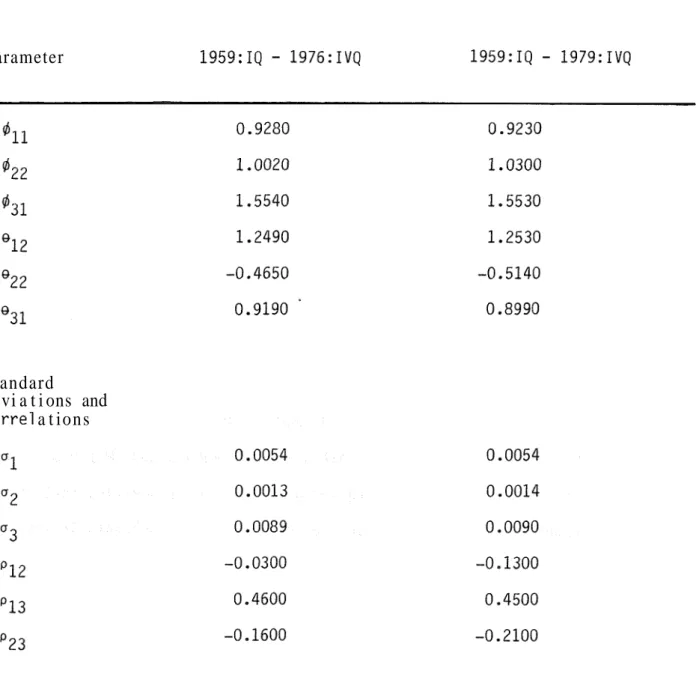
A l l o f t h e e s t i m a t e d parameters o f t h e model a r e s i g n i f i c a n t a t t h e
0.001
l e v e l ( s e e t a b l e1 ) .
There a r e no s i g n i f i c a n t c o r r e l a t i o n s r e m a i n i n g i n t h er e s i d u a l s , except f o r t h e contemporaneous c o r r e l a t i o n between t h e e r r o r terms i n M-1 and GNP, and t h e models passed t h e usual d i a g n o s t i c t e s t s .
Because o n l y t h e contemporaneous c o r r e l a t i o n between t h e e r r o r terms i n GNP and M-1 was s i g n i f i c a n t , we developed a f o r e c a s t o f t h e e r r o r i n t h e GNP e q u a t i o n g i v e n o n l y t h e e r r o r i n t h e M-1 equation. That i s , even though t h e d a t a f o r RTB3 were a v a i l a b l e even b e f o r e t h e d a t a f o r M-1, these d a t a do n o t p r o v i d e u s e f u l i n f o r m a t i o n i n f o r e c a s t i n g e i t h e r contemporaneous GNP o r
M-1. ( I n f a c t , we e s t i m a t e d r e g r e s s i o n s u s i n g b o t h contemporaneous e r r o r s i n
M-1 and RTB3 as independent v a r i a b l e s and t h e e r r o r i n GNP as t h e dependent v a r i a b l e . The RTB3 term was n o t s i g n i f i c a n t a t t h e 0.05 p e r c e n t l e v e l , and t h e a d d i t i o n o f t h e RTB3 t e r m d i d n o t s i g n i f i c a n t l y improve t h e r e g r e s s i o n . ) The r e s u l t i n g r e l a t i o n s h i p was
where bl was estimated t o be 0.792 i n t h e p e r i o d through 1976:IVQ and 0.768 i n t h e p e r i o d through 1979:IVQ. The standard d e v i a t i o n o f el was 0.0078 versus a standard d e v i a t i o n o f 0.0089 f o r a3 i n t h e p e r i o d through 1976:IVQ and 0.0080 versus 0.0090 i n t h e p e r i o d through 1979:IVQ. Thus, we would expect approximately a 12 p e r c e n t r e d u c t i o n i n t h e RMSE f r o m f o r e c a s t i n g GNP when contemporaneous M-1 i s a v a i l a b l e , compared w i t h u s i n g o n l y lagged M-1
.
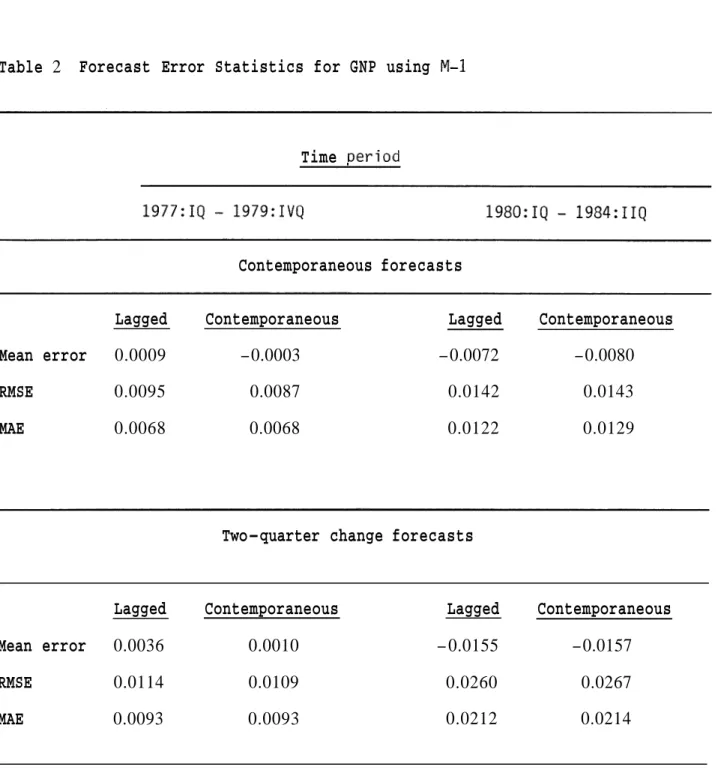
To t e s t t h e r e s u l t s on out- of- sample f o r e c a s t s , we used t h e model f i t t e d through 1976:IVQ t o f o r e c a s t GNP over t h e p e r i o d 1977:IQ through
1979:IVQ. I n one case, we used o n l y lagged M-1 and i n t h e second case, we used contemporaneous M-1. Also, we used t h e model f i t t e d t h r o u g h 1979:IVQ t o
f o r e c a s t o v e r t h e p e r i o d 1980:IQ t h r o u g h 1984:IIQ. I n a l l cases, t h e models were used t o f o r e c a s t b o t h contemporaneous changes i n ln(GNP) and changes i n ln(GNP) from t i m e t t o t i m e t+2, t h a t i s , t h e change f r o m t h e l a s t known v a l u e o f ln(GNP) t o t h e f o r e c a s t v a l u e f o r two q u a r t e r s a f t e r t h a t known v a l u e
o c c u r r e d (see t a b l e 2 ) .
From t h e s e r e s u l t s , we see t h a t d u r i n g t h e p e r i o d 1977:IQ t h r o u g h 1979:IVQ t h e r e was a decrease i n RMSE o f r o u g h l y 8 p e r c e n t u s i n g
contemporaneous M-1 i n f o r e c a s t i n g c u r r e n t GNP, as compared w i t h u s i n g o n l y lagged M-1. T h i s agrees q u i t e w e l l w i t h t h e t h e o r e t i c a l r e d u c t i o n o f 12 p e r c e n t . However, d u r i n g t h e p e r i o d 1980:IQ t h r o u g h 1 9 8 4 : I I Q t h e RMSE was a c t u a l l y m a r g i n a l l y l a r g e r u s i n g contemporaneous M-1. F o r t h e two- quarter change f o r e c a s t s , t h e r e was a r e d u c t i o n of r o u g h l y 4 p e r c e n t i n t h e f i r s t p e r i o d and an i n c r e a s e o f r o u g h l y 3 p e r c e n t i n t h e l a t t e r p e r i o d .
As mentioned e a r l i e r i n t h i s paper, t h e 1980s i s a t i m e when many e v e n t s would p o t e n t i a l l y a f f e c t t h e r e l a t i o n s h i p s among M-1, GNP, and RTB3. However, i t i s t h o u g h t t h a t t h e s e e v e n t s have changed a g a i n f r o m r o u g h l y
1 9 8 3 : I I I Q t o t h e p r e s e n t i n such a way t h a t t h e r e l a t i o n s h i p s would be back t o pre-1980 form. T a b l e 3 p r e s e n t s t h e contemporaneous f o r e c a s t e r r o r s f r o m 1 9 8 0 : I Q t o 1 9 8 4 : I I Q . From t h e s e e r r o r s , we see t h a t d u r i n g t h e p e r i o d o f 1 9 8 3 : I I Q t h r o u g h 1 9 8 4 : I I Q t h e f o r e c a s t u s i n g contemporaneous M-1 has done much b e t t e r t h a n t h e one u s i n g o n l y lagged M-1. I n f a c t , t h e RMSE f o r t h e
f o r e c a s t s u s i n g o n l y lagged M-1 was 0.0131 o v e r t h i s p e r i o d , w h i l e t h a t f o r t h e f o r e c a s t s u s i n g contemporaneous M-1 was 0.0101, a r e d u c t i o n o f
a p p r o x i m a t e l y 22 p e r c e n t . For t h e two- quarter change f o r e c a s t s , t h e t i m e p e r i o d o v e r which t h e l a t e s t change would a f f e c t t h e outcome i s f r o m 1983:IVQ
t o
1984:IIQ,
because t h e t w o - q u a r t e r change f o r1983:IIIQ
depends on t h e d a t a f r o m1983:IIQ.
TheRMSE
f o r t h e p e r i o d1983:IIQ
t h r o u g h1984:IIQ
u s i n g o n l y laggedM-1
was0.0210;
t h a t f o r t h e f o r e c a s t u s i n g contemporaneousM-1
was0.0188.
Thus, u s i n g contemporaneousM-1
reduced t h eRMSE
f o r t h i s p e r i o d b yr o u g h l y
10
p e r c e n t .V. Summarv
Because m u l t i v a r i a t e t i m e s e r i e s models i n c l u d e t h e contemporaneous c o r r e l a t i o n s i n t h e e r r o r s t r u c t u r e , t h e s e models do n o t use contemporaneous d a t a t o f o r e c a s t v a r i a b l e s t h a t a r e n o t a v a i l a b l e f o r t h e c u r r e n t p e r i o d .
However, as demonstrated i n t h i s paper, t h e s e d a t a can s u c c e s s f u l l y be used t o o b t a i n more a c c u r a t e f o r e c a s t s f o r t h e c u r r e n t and f u t u r e t i m e p e r i o d s .
Indeed, f o r e c a s t s of GNP u s i n g contemporaneous
M-1
had r o u g h l y an8
p e r c e n t s m a l l e rRMSE
d u r i n g t h e p e r i o d1977:IQ
t h r o u g h1979:IVQ
t h a n t h a t u s i n g o n l y laggedM-1.
The r e s u l t s d u r i n g t h e p e r i o d1980:IQ
t h r o u g h1984:IIQ
a r emixed. However, t h e r e s u l t s i n d i c a t e t h a t u s i n g contemporaneous