SOCIALIST REPUBLIC OF VIETNAM
DATA COLLECTION SURVEY ON
COOPERATION IN OVERSEAS BUSINESS
EXPANSION STRATEGY OF
SMALL AND MEDIUM-SIZED ENTERPRISES IN
AGRICULTURE SECTOR AND FUTURE
DIRECTION OF AGRICULTURAL COOPERATION
FINAL REPORT
Summary
March 2020
Japan International Cooperation Agency (JICA)
Nippon Koei Co., Ltd.
Meros Consulting Co., Ltd.
VT
JR
20-002
Source:Survey team
Location Map of Target Area
North West Ha Noi capital Son La province (Son La city) Nghe An Province (Vinh City) North EastRed river Delta
North Central Coast
South Central Coast Central Highlands
Mekong River Delta
Lam Dong Province (Da Lat City) Ho Chi Minh
city
Can Tho city
Ben Tre Province (Ben Tre City) Legend:
: Target Area
Site Photos
(1) Nghe An Province
Production materials for mushroom production
(ATC Investment and Production Joint Stock Company)
Fermenting process of fish source using wooden barrel
(Van Phan Fisheries Joint Stock Company)
(2) Lam Dong Province
Hydroponic plant culture of lettuce
(Phong Thuy Agricultural Product Trade Manufacturing Co., Ltd.)
Coffee bean roaster (specially ordered)
(La Viet Co., Ltd)
(3) Can Tho City
Drying machine for fruits (Mekong Fruit Co., Ltd)
Pre-processing of durian (Dai Thuan Thien Co., Ltd.)
(4) Ben Tre Province
Coconut processing factory (large scale: 5 ha) (Luong Quoi Coconut Co., Ltd.)
Coconut fruit processing (Mekong Impex Fresh Fruit Co., Ltd.)
(5) Son La Province
Production of lingzhi mushroom using raw timber (Manh Thang Company Ltd.)
Drying machine for fruits (Quyet Thanh Agriculture Cooperative)
(6) Seminar
i
Data Collection Survey on Cooperation in Overseas Business Expansion
Strategy of Small and Medium-sized Enterprises in Agriculture Sector and
Future Direction of Agricultural Cooperation
Final Report
Table of Contents
Page
ii
List of Abbreviation
ADB : Asian Development Bank
AMPF : Agricultural Marketing Platform
ASF : African Swine Fever
CAGR : Compounded Annual Growth Rate
CPTPP : Comprehensive and Progressive Trans-Pacific Partnership
DARD : Department of Agriculture and Rural Development
DOC : Department of Construction
DOF : Department of Finance
DOH : Department of Health
DOIT : Department of Industry and Trade
DOLISA : Department of Labour, Invalids and Social Affairs
DOT : Department of Transport
DPC : District People's Committee
DPI : Department of Planning and Investment
DR : District Road
EVFTA : EU-Vietnam Free Trade Agreement
FAO : Food and Agriculture Organization
FDI : Foreign Direct Investment
FVC : Food Value Chains
GAP : Good Agricultural Practices
GDP : Gross Domestic Production
GoJ : Government of Japan
GoV : Government of Vietnam
GPDP : Gross Provincial Domestic Production
GSO : General Statistical Office
HCMC : Ho Chi Minh City
HH : Household
ICD : International Cooperation Department (MARD)
JETRO : Japan External Trade Organization JICA HQ : JICA Head Quarter
JICA : Japan International Cooperation Agency
MARD : Ministry of Agriculture and Rural Development
MOF : Ministry of Finance
MOH : Ministry of Health
MOIT : Ministry of Industry and Trade
MOLISA : Ministry of Labour, Invalids and Social Affairs
MPI : Ministry of Planning and Investment
NGO : Non-governmental Organization
NH : National Highway
Nos : Number
NRD : New Rural Development
NTP : National Target Program
ODA : Official Development Assistance
iii
PPP : Public Private Partnership
PR : Provincial Road
SEDP : Socio-Economic Development Plan
SEDS : Socio-Economic Development Strategy
SWOT : Strengthens Weakness Opportunities Threats
TA : Technical Assistance
TBD : To be determined
UN : United Nations
UNDP : United Nations Development Programme
USD : United States Dollar
VASS : Vietnam Academy of Social Sciences
VAT : Value Added Tax
VCA : Vietnam Cooperative Alliance
VND : Vietnamese Dong
WB : World Bank
Measurement Units
Length Weight
mm = millimeter(s) g = gram(s)
cm = centimeter(s) (cm = 10 mm) kg = kilogram(s) (1,000 grams) m = meter(s) (m = 100 cm) ton(s) = metric ton(s) (1,000 kg) km = kilometer(s) (km = 1,000 m)
Time
Extent sec = second(s) cm2 = square centimeter(s) (1.0 cm × 1.0 cm) min = minute(s)
m2 = square meter(s) (1.0 m × 1.0 m) hr = hour(s)
km2 = square-kilometer(s) (1.0 km × 1.0 km)
ha = hectare(s) (10,000 m2) Others
Acre = 0.4047 hectare(s) (4,047 m2) ° = degree
°C = degrees Celsius
Volume % = percent cm3 = cubic centimeter(s)
(1.0 cm × 1.0 cm × 1.0 cm, or 1.0 ml)
m3 = cubic meter(s) Currency
(1.0 m × 1.0 m × 1.0 m, or 1.0 kl) US$ = United State dollar(s) L = liter (1,000 cm3) JPY = Japanese yen(s)
Final Report
S-1
SUMMARY
1. Preface
In Vietnam, agro-forestry-fishery sector plays an important part in the economy, accounting for 14.7% of GDP and 37.7% of the labor force in 2018. Along with the expansion of the domestic consumer market, many domestic and foreign companies have invested and expand their business to agriculture, forestry and fisheries sector, including the production process, as well as from distribution to processing.
The Vietnamese government wishes to increase the added value and improve international competitiveness of the agricultural sector, and has positioned agricultural development as an important policy. To support the efforts of the Vietnamese government, the Medium to Long term Vision for Japan - Vietnam Agricultural Cooperation (2015-2019), which was agreed by the two governments, gives priority to the investment and development of food value chain (FVC) including production, processing, distribution and consumption; the improvement of productivity and added value; and designates the model areas. Thanks to the efforts made by the public-private partnership between Japan and Vietnam, private enterprises, including Japanese companies, have been increasingly advancing into the agricultural field and they have achieved success to a certain extent. However, private companies still have to face with many shortcomings when doing business in Vietnam.
Therefore, with a view to gradually revise the Medium to Long-term Vision for Japan-Vietnam Agricultural Cooperation, in order to study the future direction of JICA in terms of supporting the overseas expansion of Japanese businesses (especially SMEs) and cooperation in agricultural sector, the survey team implemented data collection and assessment on assistance made to Japanese companies in agricultural field in Vietnam, business status of the companies invested in Vietnam.
The survey area is the whole of Vietnam, especially six model areas (firstly the suburb of Hanoi, secondly the suburban of Ho Chi Minh City, thirdly Nghe An province, fourthly Lam Dong province, fifthly Mekong River Delta adjacent to Can Tho City and Ben Tre Province), and the model area candidate for the next phase (temporarily Son La Province).
2. Agriculture and Food Value Chain in Vietnam
Agriculture, fishery and forestry sector is the backbone of the Vietnamese economy, accounting for around 38% of labor force (about 21 million people), and around 15% of the gross domestic product (GDP, amounting to USD 33 billion with an annual growth rate of 3.7%). Taking advantage of the diversified geographical and climate conditions with a stretch of 1,700 km from north to south, from coastal plains to inland highlands and mountainous areas, varieties of agricultural products are produced under various farming systems.
Domestic production cannot keep up with demand growth of domestic food market due to economic and population growth, which leads to increase of food imports. The food processing
Final Report
S-2
industry using imported raw material has been expanding. The domestic food market is estimated to increase approximately 30% over the next five years (2020-2025).
3. Nghe An Province Issues at each FVC stage
For fruits and vegetables, it is necessary to develop production areas of branded specialty products, improve quality and technical levels, and improve material supply to be resilient to the changing environment of demand in domestic and international market, intensified competition, and the climate change. Livestock production structure is expected to transform from small-scale production to dedicated medium-scale production. This change will highlight the need for development of the feed industry, slaughterhouse, meat processing and distribution network. In the marketing side, it is necessary to establish a distribution networks for trading to other provinces and international market. For the provincial market, it is necessary to take countermeasures with priority given to traditional market.
SWOT analysis from the view point of Japanese companies (especially SMEs)
Using SWOT analysis (strengths, weaknesses, opportunities, threats) based on relative comparison with the whole country or neighboring countries, the survey team analyzed the investment potential of Japanese companies (especially SMEs) and critical issues in the target province.
The strengths of Nghe An Province are as follows:
Abundant and low cost labor force. Many workers have been sent to Japan. Irrigated area will expand by 27,000ha by an irrigation projects of Japan’s ODA.
Production of fruits and vegetables increases due to expanding domestic and export market. Livestock and fisheries are also promising.
There are the companies with export experience.
Diverse weather and terrain conditions. Possible to grow tropical fruits. In mountainous areas, year-round supply is possible.
The opportunities of Nghe An province as follows:
Provincial government is active in FVC development, strengthening support and accepting foreign companies.
AMPF has been established, promoting contract farming between agricultural cooperatives/corporations and private companies in the province.
The population ranks 4th in Vietnam, and the market size in the province is rapidly expanding as the growing big city following Hanoi city.
There are local resources such as resort beaches, tourism development is underway. Transportation access to Hanoi will be improved by extension of the highway to the south. Increase export opportunities for fruits, etc. under expansion of CPTPP / EVFTA and SPS
Final Report
S-3
Increasing demand for food safety in urban areas such as Hanoi. Modern trade like supermarkets is expanding quickly.
High interest in Japanese companies. There are some successful cases of technical trainees in agriculture field after coming back to Vietnam.
Large enterprises and others are keen about investing in agricultural facilities and machines, being assisted bythe high-tech agriculture support policy.
Achievements and issues of Medium-to-long term vision for Japan-Vietnam Agricultural Cooperation
As a model region for “enhancing productivity and added value", Nghe An province has identified issues mainly related to production stage on FVC. Vietnamese government is expected to introduce the results of past JICA projects into Nghe An province, and promote agricultural mechanization based on the industrialization strategy. Japanese government, in turn, is expected to establish a contract-based production, distribution, processing and sales system for agricultural products through Japanese technical cooperation projects in consideration of the importance of establishing a food value chain based on market demands. As the result of Medium-to-long term vision for Japan-Vietnam Agricultural Cooperation, Vietnamese government has introduced the results of past JICA’s projects in order to improve productivity, safety and profitability and established AMPF officially, which will be operated by Nghe An province. The Japanese government has been rehabilitating irrigation facilities by ODA projects in northern Nghe An, which is expected to contribute the expansion of irrigated area and the increase of crop production such as rice, peanuts and sweet potatoes. JICA’s Technical Cooperation Project also contributed to the establishment of AMPF for acquisition and sharing of market information and developed Master Plan and Action Plan on agriculture development of Nghe An province through verification of the effectiveness of contract-based farming and roducts development. Regarding JICA’s Private Sector partnership Scheme, several projects have been implemented related to promotion of high value-addition on products by safety and reliability, processing technologies and cold chain facilities, and value chain development.
Except for farmland consolidation and self-sufficiency improvement through increasing feed production, both Japan and Vietnam governments and private companies have been implemented the tasks set in the medium to long term vision, and the results have been confirmed. There will be the major issues in the future, such as increasing of added values of agricultural products through introduction of advanced agricultural production technologies and post-harvest technologies, and market expansion by strengthening AMPF in order to promote the distribution and sales of the agricultural products to inside and outside of the province. Moreover, it is expected to strengthen the FVC through promotion of processing industry and branding of local products.
Direction for agricultural cooperation
Final Report
S-4
Promoting small scale irrigation development especially for horticulture
crops: Crop diversification from paddy to horticultural crops.
Strengthening cooperative and farmers’ organizations: promotion of joint sales, establishing major production areas.
In addition to market matching by strengthening the function of AMPF, promoting investment and strengthen tie-up with Japanese companies, including procurement of raw material (considering ASEAN-FVC project in the future, AMPF functions and activities may be expanded and coordinating activities with the other AMPFs in and out of Vietnam be promoted).
Introducing of advanced and applicable technologies, establishing and building capacity of farmer's organizations, enhancing a loan scheme, developing infrastructure including irrigation facilities for horticulture, establishing supply and processing system of safe products coordinating with the clean products in the neighboring areas such as Xiangkhouang province in Laos, etc.
Support sending technical intern trainees to Japan and post-training engagement in agriculture in Vietnam (Introduction of Japanese varieties and farming, production, processing, marketing and sales systems using technical intern trainees returned)
4. Lam Dong Province Issues at each FVC stage
Agricultural cooperatives and companies in Lam Dong province are highly motivated to introduce high-tech agriculture, cold storage, and food processing, etc., and therefore fund demand is strong. The room to expand farm land is limited especially in and around Da Lat city, where land prices are escalated, and priority of land use is given to highly profitable crops such as cut flowers. Soil fertility has been reportedly deteriorated due to repeated year-round cropping. Interests in soil improvement and organic farming are high among farmers. However, there are quality problems with fertilizers and pesticides, farmers have to depend on imported material including organic fertilizers.
SWOT analysis from the view point of Japanese companies (especially SMEs) The strengths of Lam Dong province are as follows:
Agricultural companies and cooperatives are very active and positively invest in agricultural technology and business
There are two industrial parks (Phu Hoi, Loc Son) specialized in agricultural processing. Farm machinery, green house, agricultural multi materials, seed/seedling from Japan are
marketed and sold.
Da Lat vegetables and flowers are the most famous in Vietnam with high competitiveness, and Da Lat is the largest vegetable and flower supply bases for Ho Chi Minh City.
Final Report
S-5
The high-tech sorting machine is in operation at the post-harvest processing center. Intermediate distribution business for vegetables has been expanding.
Cross seasonal cool climate allows year-round cropping. The opportunities of Lam Dong province are as follows:
The province is implementing agriculture restructuring where resources are being concentrated on agricultural development to build value chain.
The province is implementing development policies focusing on high-tech agriculture, smart agriculture and organic agriculture.
Under the strong leadership of the People's Committee, Lam Dong is actively attracting investment of Japanese companies and introducing products and technologies.
The province provides Japanese language training and low-interest loan to the technical intern trainees.
The Japan Desk has been established in the province. Domestic markets of cut flowers and coffee are expanding
A flower collection center is planned to be constructed in Da Lat City funded by Japan’s ODA.
EU’s reduced import tariffs, CPTPP and other trade agreements have made positve impact on vegetables export.
Developing as a tourist spot. Agro-tourism has potentials.
Quality enhancement and crop diversification are made possible through introduction of greenhouse farming.
Achievements and issues of Medium-to-long term vision for Japan-Vietnam Agricultural Cooperation
As a model “Food processing and product development”, Lam Dong Province have
implemented eight strategies for promoting agricultural development which was formulated in “Data collection survey for supporting Lam Dong province in formulating agriculture development model by multi-sector approach and promoting investment environment in agriculture sector.” The Government of Vietnam (GOV) is expected to develop the food processing and product development based on the Vietnam’s industrialization strategy.
As a result of Medium-to-long term vision for Japan-Vietnam Agricultural Cooperation, GOV has prepared a policy and budget arrangement, and implementation mechanism to realize the eight strategies. The Government of Japan carried out three data collection surveys including the afore mentioned survey to support formulating strategies and policies on agricultural development by the province. The Japan Desk Advisor was appointed to promote and support investment by Japanese companies. Under the JICA’s Private Sector partnership Scheme, projects for production and marketing of vegetables and flowers as well as food processing were intensively implemented in line with the eight strategies, contributing to promotion of high-tech agriculture.
Final Report
S-6
Among the eight strategies, vegetable post-harvest center has verified its effectiveness as it is continuously operated. For replicating the same model, specification and price of equipment and favorable financial scheme shall be considered. Branding activities have been carried out smoothly, proper monitoring and brand certification of agro-tourism shall be executed by the province. On the other hand, delay in ODA loan project lead to delay in construction of flower collection center and upgrading of production system with agricultural financing support. High land price is one of the biggest bottlenecks in attracting investment of agricultural park, and it is important to find an alternative solution such as transferring technologies to farmers nearby, promotion of contract farming, etc. instead of investing in the park.
Both Japanese and Vietnam governments and private companies have been implemented the tasks set in the medium to long term vision, and the results have been confirmed. Many Japanese companies have already invested in agricultural production and food processing, contributed to the added value improvement of agriculture in Lam Dong province. For further investment of Japanese companies, there are some remaining issues, such as securing of agricultural land, human resources development, development of distribution centers and road infrastructure.
Direction for agricultural cooperation
The followings are proposed as the direction of agricultural development in Lam Dong province. The continuous supports in line with the eight agricultural development strategies of Lam
Dong province is essential.
For securing of agricultural human resources, networking shall be made through research support of Da Lat University and field training at Japanese farms in the province. Moreover, employment of technical intern trainees returned and increasing employment conditions for local management staff need to be promoted.
Introducing advanced technologies (soil improvement, added-value production
technology): Promotion support of production and food processing technologies and products from Japanese companies, matching with local companies, coordination with Da Lat University. Da Lat brand certification shall be strengthened through introducing Geographical Indications (GI) and Good Laboratory Practice (GLP) in food industry. Regarding the delaying agricultural park, besides continuing to attract investment on the
agricultural park, alternative measures such as expansion of production area by promoting contract farming with neighboring farmers shall be promoted.
Improving and strengthening Japan Desk at DPI (coordination with the related departments of Lam Dong province, information collection, assessment and publicity)
Funding support: Providing financial support programs coordinated with private banks. 5. Ha Noi and Ho Chi Minh City Suburbs
Issues at each FVC stage
In Ho Chi Minh City, last mile logistics under the traffic regulation that disallows entry of trucks in urban area and cold chain development are the main issues. Development of “logistics
Final Report
S-7
operation complex” is promising to meet the increasing demand on logistics in the future. Demand of safe and organic vegetables is also increasing. The suburb areas of Ho Chi Minh and Hanoi become processing and export hubs, and products are collected from a vast area. This requires coordination with the other supplying regions for FVC development.
SWOT analysis from the view point of Japanese companies (especially SMEs) The strengths of Ha Noi and Ho Chi Minh City suburbs are as follows:
Farm machinery, green house, agricultural multi materials, seed/seedling from Japan are marketed and sold.
The number of farmers who produce and sell safe crops based on GAP (Basic GAP / VietGAP) has increased.
In the suburbs of Hanoi, consumption-based vegetable production is thriving.
The Agriculture High-Tech Park is located in HCM, and may be utilized by Japanese firms for technical demonstration.
Hanoi plans to develop logistics facilities including cold chains in suburbs.
Hanoi and HCM are the gateways of exporting fresh/processed fruits and vegetables. In HCM, many Japanese firms invest in the agriculture, fisheries, food industry as well as
logistics.
The opportunities of Ha Noi and Ho Chi Minh City suburbs are as follows:
Improving the added value and developing safe agricultural products are national important policy issues. In the suburbs of Hanoi, safe crop production and sales promotion based on GAP is being promoted by the Project for Improvement of Reliability of Safe Crop Production in the Northern Region.
The construction of the RETAQ center will strengthen the inspection system for pesticide residues and food hygiene.
Traditional market is shifting to modern market due to increasing income.
Demand for imported products and other foods has grown along with economic development which cause the increasing transportation volume through the north-south logistics route. Agricultural exports are expanding. Exports of fruits and vegetables increase sharply due
to SPS agreement.
Consumer’s awareness of food safety (organic, GAP, etc.) is increasing. Demand for frozen and refrigerated products is expanding.
Consumption of dairy products and livestock products is in the increasing trend due to changes in the life style.
Big supermarket chains are establishing their own Distribution Centers. SNS is increasingly utilized in business, improving the access to information. The interest in development of cold storage and reserved stocks is increasing.
Final Report
S-8
Achievements and issues of Medium-to-long term vision for Japan-Vietnam Agricultural Cooperation
As a model for “Developing distribution and cold chain”, in suburb areas of Hanoi and Ho Chi Minh cities, private companies are expected to invest in developing food safety and hygiene management systems, such as building and operating Logistics Centers, RETAQ Centers, etc. The Government of Vietnam is expected to promote investment in private logistics, retail businesses, operate of the RETAQ Center and ensure transparency of the management mechanism of food hygiene and safety.
As the result of Medium-to-long term vision for Japan-Vietnam Agricultural Cooperation, in Hanoi suburb, focusing on food safety, Japanese government has been implementing a technical cooperation project for promoting the dissemination of safe crop production and sales promotion in northern Vietnam, and a grant aid project for establishment of food inspection system. Regarding JICA’s Private Sector partnership Scheme, several projects have been implemented to support agricultural production based on the demand of urban area, for example, safe and secure vegetable production through organic vegetable production and soil improvement, and value chain development for high value-added agricultural products. In Ho Chi Minh City suburb, there is a collaboration of private sector partnership (agricultural demonstration test on organic fertilizers) at the agricultural high-tech park (AHTP) operated by the City’s People's Committee. Although projects related to food safety and hygiene management system have been progressing, no cold chain development project has been implemented. On the other hand, Vietnamese government is expected to promote production and sale of safe crops based on the results of the technical cooperation projects, and to enhance capacity of food hygiene management through the construction and operation of RETAQ center.
Overall, both Japanese and Vietnam governments and private companies have been implemented the tasks set in the Vision, and the results have been confirmed. Beside tasks set in the vision, food value chains have being developed by many Japanese agricultural and food companies.
Direction for agricultural cooperation
The followings are proposed as the direction of agricultural development in Ha Noi and Ho Chi Minh City suburbs.
To further promote the safety and improvement of added value to agricultural products, it is necessary to further disseminate safe crop, to improve the inspection capabilities, to introduce private technologies, and to develop cold chain infrastructure.
Establishing cold chain infrastructure through promoting private investment, and system development for marketing and logistics improvement, especially the products from the model provinces (coordination with DOIT).
Management capacity development for agricultural cooperatives and companies through
tie-up with progressive organizations (dispatching human resources, on-the-job training at an advanced organization, etc.).
Final Report
S-9
Particularly in the northern Vietnam, development of food value chain by strengthening the production and marketing capacity of agricultural cooperatives and companies (providing Japanese food supply, tie-up and supply to consumer’s organizations such as consumer’s cooperatives and groups, local product branding, etc.).
6. Mekong Delta (including Can Tho City, Ben Tre Province) Issues at each FVC stage
In Mekong Delta (including Can Tho city, Ben Tre province), it is necessary to strengthen further measures against saltwater intrusion, drought and flooding with introduction of new varieties and appropriate cultivation system. Ben Tre province takes highly interest in organic cultivation, but there are several problems such as difficulties in obtaining reliable fertilizers and expensive fee on organic certification. The province is also facing with several problems in aquaculture, such as environmental conservation in and around aquaculture area, good aquaculture seed production, and disease management.
SWOT analysis from the view point of Japanese companies (especially SMEs) The strengths of Mekong Delta are as follows:
Can Tho University is an essential training center of agriculture and related fields in the Mekong Delta region.
Mekong Delta has relatively lower labor costs and abundant workforce. Mekong Delta is rice granary that produces 30% of the paddy in Vietnam.
Ben Tre is the major production area of rice, shrimp, and pangasius, coconuts (40% share of national production), and pomelo.
The Ben Tre Water Management Project will prevent salinity intrusion and thereby contribute to stable production of rice and coconuts.
Many exporting and processing companies of fruits, coconut and fish are located in Ben Tre.
Demand for tourism is expanding. Can Tho and Ben Tre are potential travel destinations in addition to Phu Quoc, a major tourism site.
The opportunities of Mekong Delta are as follows:
Can Tho city and Ben Tre province are both proactive in attracting Japanese companies’ investment.
Every province gives priority to its FVC development policy.
Ben Tre Province supports branding of eight agriculture products including coconut and FVC development, as a part of its actions against drought and salt damages.
Domestic and overseas markets for fruits and cultured fish are expanding. The competitors in the fruit market are China and Thailand, and quality-wise their products are the same as the local products. By consolidating a certain amount of production and price competitiveness, market expansion is promising.
Final Report
S-10
Consumers are increasingly concerned about food safety in urban areas. The modern market such as supermarkets develops rapidly.
Achievements and issues of Medium-to-long term vision for Japan-Vietnam Agricultural Cooperation
As a model for “development of advanced human resources”, Can Tho city focuses on human resources development and strengthening of education and research capability of universities and research institutions on every stage on FVC in Vietnam. Mekong Delta including Ben Tre province, in turn, as a model for “consideration for climate change”, focuses on implementation of climate change adaptions such as mitigation of saltwater intrusion and reduction of greenhouse gas emissions.
Vietnamese government has promoted joint researches on FVC development between Can Tho University and private companies, and joint researches on climate change. Japanese government has implemented two big projects: Can Tho University improvement project (yen loan scheme) and Ben Tre water management project (yen loan scheme), the training of agricultural researchers and construction of advanced research facilities are ongoing. Within the framework of JICA’s Private Sector partnership Scheme, total of six projects were implemented in Mekong Delta, including four agricultural projects, one fishery project and one agro-fishery project. Regarding private investment, Japanese agricultural machinery dealers have launched their business, and fish processing and seasoning companies are considering investing in the region.
Future challenges include ensuring the implementation of the Ben Tre Province Water Management Project, further research and implementation of saltwater intrusion countermeasures and climate change adaptation, improvement of livestock quality control, reduction of disease and fry’s high sudden death, mitigation of environmental impacts, etc. In order to attract investment of Japanese companies, there are other issues such as establishment of organizations and quality control on the production side, industrial park development, transparency of administrative procedures, etc.
Direction for agricultural cooperation
The followings are proposed as the direction of agricultural development in Mekong Delta region including Can Tho city and Ben Tre province.
Promoting research and demonstration on saltwater intrusion countermeasures and reduction of greenhouse gas emissions in cooperation with the Yen loan projects (Can Tho University improvement project and Ben Tre water management project)
Infrastructure development to improve connectivity from the region to domestic and international market in consideration with characteristics of each province and city in the region.
Promoting utilization of private sector’s products and technologies such as crops resilient to salt damage, high value-added technologies, and environmental conservation technologies
Final Report
S-11 7. Son La Province
Issues at each FVC stage
Although there are currently few processing industries in the province, there is a demand of introduction of simple processing technologies such as drying machines and even high interest in organic farming. On the other hand, Son La province is facing with several issues, such as difficulty in making farmers and workers comply with contracts and work rules because there are many ethnic minorities and the percentage of workers who have received vocational training is low, material supply (organic fertilizer production and drip irrigation devices) and establishment of production system for organic farming, establishment of relationship with major buyers (retailers, processing companies, exporters in Hanoi suburb).
SWOT analysis from the view point of Japanese companies (especially SMEs) The strengths of Son La province are as follows:
Development of local human resources implemented by foreign companies.
Agriculture cooperatives and private companies implement vegetables and fruits processing Farmland with relatively high altitude is distributed close to Hanoi
Major arterial national roads have been developed.
Agriculture-related FDI companies are from Japan, Korea, Taiwan and the United States. The opportunities of Son La province are as follows:
Provincial government is formulating support measures for agriculture processing industry. The province has made achievement on exporting coffee and tea, export of fruits and other
produces is highly potential.
Increasing export opportunities of fruits due to CPTPP/EVFTA and SPS agreement with
the US, etc.
Despite the problem with the low retention at companies due to ethnic minorities’ customs, improvement can be expected from university education and vocational training school education.
Direction for agricultural cooperation
The followings are proposed as the direction of agricultural development in Son La province. Development of vegetable and fruit production as the supply base of highland products for
Ha Noi and other major urban markets in northern provinces.
Development of major production area of export products (fruits, processed fruits, tea, coffee) and improvement of product quality.
Final Report
S-12
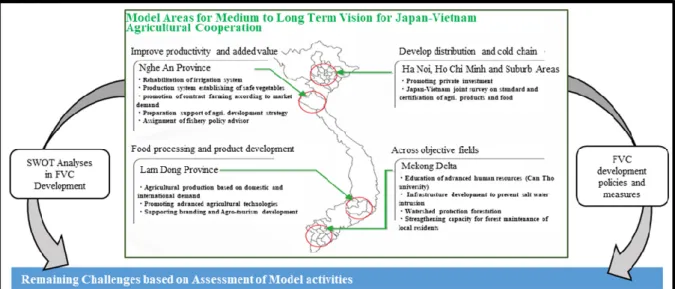
8. Achievements and issues of Medium-to-Long Term Vision for Japan-Vietnam Agricultural Cooperation (2015-2019)
The major achievements and Issues of Medium to Long Term Vison for Japan-Vietnam Agricultural Cooperation are as bellows:
Main Action Plan Main Activities Main Results
Enhancing productivity and added value
• Rehabilitation of irrigation facilities
• Establishment of production system for safe vegetables
• Promotion of contract farming to meet the market demands
• Support for formulating agricultural development strategies
• Dispatch of a fisheries policy advisor
• Construction and rehabilitation of irrigation facilities (sluices, waterways, head works, etc.)
• Dissemination of safe crop production
• Establishment of production system to meet market demand through contract farming
• Establishment of Agricultural Marketing Platform (AMPF)
Food processing and product development
• Agricultural production based on domestic and overseas demand
• Introduction of advanced agricultural technologies
• Support for promotion activities for branding and agritourism
• Formulation of agricultural promotion policies and strategies
• Introduction of Japanese advanced agricultural equipment
• Production management using ICT solutions
Developing distribution and cold chain
• Promotion of private investment
• Japan-Vietnam joint researches on standards and certifications of crop and food
• Continuous investment by Japanese agribusiness companies through ODA
• Improvement of consumers’ behavior through safe crop awareness activities
Cross-sectoral activities
• Infrastructure development to prevent saltwater intrusion
• Reforestation of watershed conservation forest
• Capacity building for forest management by local people
• Construction of sluices to prevent saltwater intrusion
• Enhanced research and education system
Forthcoming Challenges 1. Insufficient infrastructure
Irrigation facilities and climate change mitigation Processing facility/ logistics hub/ wholesale market Distribution access, road
2. Shortage of human resources, technology and equipment for sustainability, modernization, and high added value in agriculture
Human resource development and organization establishment
Stable supply of crop quality and quantity
Dissemination of advanced and basic technologies
3. Promotion of private investment
Complex and unclear agricultural, land and investment-related legal procedures Insufficient funding for agricultural investment
Securing partner companies (business matching and investment information)
4. Improvement of safety of crops
Vulnerable inspection system of safety crops Safety problems of agricultural input materials
Improvement of crop and food safety by strengthening the certification and traceability system
Final Report
S-13
5. Responding to changing trends in the domestic and international societies Shifting production areas corresponding to changing markets
Consideration and response to environment and climate change
Control of infectious diseases Future Priority Initiatives
1. Promoting the development of agriculture-related infrastructure from production to processing and distribution to build a food value chain
2. Introduction of Japanese advanced agricultural technologies and equipment utilizing technologies of private sector
3. Agricultural promotion policy and strategic support and human resource development to promote investment and dissemination of safe and reliable crop cultivation.
9. Future direction for agricultural cooperation (Draft) Direction for Agricultural Cooperation (Draft)
Comprehensively support the following areas that the Vietnamese government attaches importance to: 1) Infrastructure development related to agriculture, 2) Introducing advanced agriculture (technology and machines), 3) Agriculture Promotion Policy - Strategic Support - Human Resource Development, and contribute to the improvement of productivity and added value of agriculture in Vietnam.
Introduce advanced agriculture utilizing Japanese technology through further improvement of agricultural investment environment to attract private companies to invest and expand production in Vietnam agriculture.
Enhance activities in model areas (suburban areas including Ha Noi and Ho Chi Minh City, Nghe An province, Lam Dong province, Mekong Delta (Can Tho city and Ben Tre province), Son La province) and disseminate the experience and knowledge of these areas to neighboring provinces.
10. Recommendations on future direction of JICA cooperation for solution of the relevant issues
Regarding FVC development policies measures and their activities, interview survey to the local private companies and cooperatives that were interviewed in June to August, 2019 was implemented. We quantified the number of implementation programs related to food value chain development outlined in the provincial Socio-Economic Strategy (2016-2020), and then evaluated the main development policies and the priority order of each solution. Based on the results of this assessment, together with the demands from private enterprises, we conducted priority scoring of both the development policy and the initiatives (from 1 to 5 points scale), then calculated overall evaluation. Based on the result of assessment, priority policy measures and their activities for JICA assistance were selected as follows:
Final Report
S-14
1) Nghe An Province
1. Improvement of irrigation works and establishment of a training center for management and maintenance of irrigation works (continued)
2. The support for urban agriculture
3. Maintaining high-tech agriculture, applying technology related to vegetables and fruit trees. 2) Lamdong Province
1. Logistic infrastructure development
2. Technical support for soil improvement and advanced agricultural technology 3. Promoting the application of high value-added production technology
3) Can Tho City
1. Safe and high value-added production technology 2. Logistics infrastructure to improve connectivity 4) Ben Tre Province
1. Logistics and other infrastructure to improve connectivity and production activities 2. Safe and high value-added production technology
5) Suburb areas of Hanoi and Ho Chi Minh areas
1. Applying technology from private companies to improve safety and add value 2. Developing infrastructure related to cold chain
3. Strengthening business capacity for cooperatives and agricultural enterprises 6) Son La Province
1. Promoting the construction of infrastructures (roads, irrigation and flood protection systems) 2. Support improving food processing technologies
3. Strengthening the cultivation of safer agricultural products (vegetables)
The above mentioned priority development measures (drafts), except for Son La province, are all identified as the issues in the next phase of the Medium-to-long term vision for Japan-Vietnam Agricultural Cooperation. Regarding the measures for FVC development in each province or city in the future, higher priority given to the above mentioned second and third development measures are recommended.
In addition to the above priority policy measures for the model areas, i) Expansion of model areas and ii) Establishment of National FVC Development Platform shall be recommended as follow:
1) Expansion of Model Areas
Son La province has high potential for supplying temperate and highland vegetables and fruits to the Hanoi capital and surrounding the cities. Moreover, the existing food processing run by private companies and agricultural organizations have development potential for value added processing. Son La province strongly promotes FVC development as a priority provincial policy. JICA is implementing “the Project for Improvement of Safe Crop Production in the Northern Region (technical cooperation project)” at present that may be extended to Son La province together with the provincial priority policy measures. The other high potential provinces such as the Central Highland including Dak Lak province could be supported under the one of activities of National FVC development Platform.
2) Strengthening ABJD function and Establishment of National FVC Development Platform
MARD is mandated to support the local government for FVC development. For the nationwide FVC development promotion, establishment of “National FVC Development Platform” will be
Final Report
S-15
necessary under linkage with the all local governments and the central ministries concerned. The National FVC Platform shall implement, by using ABJD functions, future formulation of FVC development assistance and monitoring of their activities, promotion of FVC investment from Japan, coordination among the FVC companies, round table meeting by area and subject, etc. The Platform could be organized under MARD, and the MARD relevant departments, the central ministries related FVC such as MPI, MOIT, MOH, etc. and the model provinces and others may coordinate for FVC development nationwide.
It is recommended that strengthening of ABJD functions in terms of staffing and budget to be increased. For answering the needs from small and medium enterprises from Japan, assignment of several specialists according to the necessary activities will be indispensable. Also, staff assignment and budget allocation from MARD are expected.
Final Report
S-16
Figure Assessment of FVC Development Cooperation Activities and Future Framework for JICA Assistance in FVC Development and Agriculture Sector