LARGE-CLASS TEACHING/LEARNING
A C-SELT PROJECT AT CHALMERS UNIVERSITY OF TECHNOLOGY,
SWEDEN, 2001/2002
A report by Mikael Holmquist [email protected]
Department of Education, Göteborg University Sven Andersson
[email protected] Per-Åke Jansson
School of Mechanical Engineering, Chalmers University of Technology Åke Fäldt
School of Electrical Engineering, Chalmers University of Technology
The report has been presented at ‘Chalmers Grundutbildningskonferens’, Lingatan, Bohuslän. August 13-15, 2002.
University education is often performed in large groups with more than 100 students present. This one-year project was carried out during 2001/2002 as part of the effort to improve and develop teaching and learning in large groups at Chalmers University of Technology. The project is part of the C-SELT (Chalmers Strategic Effort on Learning and Teaching) Project and is also closely connected to the pedagogical effort within the CDIO (Conception-Design-Implementation-Operation) Project. Four different courses with more than 100 students, respectively, were studied. The students responded to a questionnaire and follow-up interviews were made both with some students and teachers. Special attention was given to the students’ beliefs about what makes a ‘good’ course. Despite the fact that the students’ experience of educational and pedagogical alternatives was limited the results from the study show important parameters to take into account when planning for a ‘good’ course and trying to change from a more traditional lecture style to a more interactive approach. It is about creating a well functioning team of teachers who are interested in the students learning and aware of the different learning styles among the students. As regards lecturing the teachers should contemplate alternatives to; the content usually presented in a lecture, the way a lecture usually is organized, and the lecture as a teaching/learning method.
Page Introduction 1 Literature 2 Background 4 Methodology 5 The questionnaire(s) 6
Interviews with students 7
Interviews with teachers 8
The courses 8
Algebra, M1 8
Computer programming, D1 9
Strength of materials, M2 10
Physics B, E2 10
Results from Questionnaires 11
Commentary 13
Results from Interviews 13
Commentary 18
Discussion and conclusions 18
Acknowledgements 21
References 22 APPENDICES
A: Suggestions for further reading 23
B: Letter to educational staff 25
C: Survey questionnaire 27
D: Factors for the Survey questionnaire 29
E: Diagrams showing results from questionnaires 31
F: Question sheet used in interviews with students 33 G: Question sheet used in interviews with teachers 35
Introduction
University education is often conducted through lectures to large groups with more than 100 students present. Large group teaching has, however, been criticized for resulting in one-way communication and making it difficult for teachers to arouse enthusiasm and interest in students for the subject.
In the year 2000 Chalmers University of Technology initiated a five-year strategic plan, the C-SELT (Chalmers Strategic Effort on Learning and Teaching) project (C-SELT Project, 2002). The aim is to become a university of learning, using bottom-up action-learning projects (initially on assessment, attitudes to learning, innovation and integration in curriculum and learning). So far about twenty individual projects have received funds from the C-SELT project. The work presented here on large class teaching and learning is the result of one of these projects.
The project began in the fall of 2001. The first part of the project was a study of the literature with the intention of identifying good ideas already available in the field; a list of suggestions for further reading was compiled. At the same time a survey of teaching practices in Mechanical Engineering (first three years) was carried out within the CDIO project (CDIO: Conception-Design-Implementation-Operation, see page 4). During this time, courses at Chalmers suitable for further studies were identified. Educational staffs in several different schools were asked to name one or two courses which, based on course evaluations, could be regarded as “good” or successful. The selected courses were Algebra-M1, Computer programming-D1, Strength of materials-M2, and Physics B-E2.
The study of the selected courses, which included the participation of both teachers and students, was initiated by giving the students a survey questionnaire. The questionnaire consisted of 44 statements to which the students could respond on a five-point scale from disagree to agree. As a follow-up of the students’ responses to the questionnaire, interviews were conducted with both students and teachers. Four sets of interviews were carried out, one per course, each set involving about 8 students and the teacher responsible for running the course.
In the evaluation of the responses to the questionnaires and the interviews special attention was given to the questions: What designates a “good” course? Why is a certain course regarded as less “good”? The results and their implications for large group education at Chalmers are discussed in this report.
So far, the project and its outcomes have been presented to the project theme group in C-SELT, and also been the subject of discussions in different groups of teachers at Chalmers.
Literature
The growth in participation in higher education during the 1990s has again put questions related to teaching and learning in large groups on the agenda for educators and researchers. The fact that widening access is bringing students from a broad spectrum of achievement and from diverse backgrounds into the university system presents a considerable challenge to all involved in higher education. At the same time the evolution of ideas about teaching and learning has moved from a knowledge-based to a student-centered view (Bowden & Marton, 1998). This stimulates discussion about ways to improve the learning environment for students. It is important to emphasize that such improvements, with respect to change of teaching methods, should be built on conditions and objectives clearly described.
Our argument is that the ‘best’ approach to teaching will vary both with the nature of the learning being undertaken and the context in which it takes place, and above all with the object of learning. If the aim is to have students develop the capability to discern the relevant aspects of any situation and to address them simultaneously, the best learning method is the one which is optimal in relation to that aim. (Bowden & Marton, 1998, p.130)
Despite the fact that the demise of the lecture method has been predicted for a long time, it still remains the most widely used teaching method in higher education. One reason could be that lectures are popular with those charged with organizing university education. They provide a cost-effective means of teaching large groups of students. Quite a few research studies have tried to describe the role of the lecture method in higher education. Lyngfelt (2000) reports a study in which 9 university teachers at Chalmers University of Technology were interviewed about how they look upon the academic lecture, what it is and what role it plays in their teaching. How a lecture is constituted for those teachers is, according to Lyngfelt’s conclusions: A lecture is delivered to a group of students gathered together in a course and aims partly at an explanation of the course content, partly at a deeper understanding regarding the theoretical implications and the applicability of the course content. The lectures should also be motivating and contribute to a problem-oriented attitude towards the subject.
How large-class teaching could be enriched is discussed by Biggs (1999), among others. He gives a description of advantages and limitations of the lecture and considers that the lecture is as good as the lecturer, not as a crowd-pleaser, but as a scholar. Student to student interaction in the large-class setting is part of his suggestions to improve active learning in the large class. Biggs also claims that the students’ learning activities should form the basis for the choice of teaching methods.
Usually the lecture and the tutorial are the givens, and in practice we bend our objectives to suit. What I am suggesting is precisely the opposite: we tune our teaching methods to elicit from students the learning activities most likely to produce the desired learning outcomes. (Biggs, 1999, pp.117-118)
It does surprise us that he says nothing about the role of the students’ earlier experiences of different learning activities. Which kinds of learning activities are within the range of possibilities from the students’ point of view? We made this one of the questions driving the project.
In spite of the findings that the lecture is less effective than other methods for promoting thought and changing students’ attitudes, it seems likely that the lecture will retain its place as one of the most widely used teaching methods for some time to come. This point of view forms the basis for Horgan (1999) arguing in favor of lecturing for learning. She also brings in student views of ‘good’ lecturing by referring to two different studies, carried out at two different universities during the 1990s. Students appreciated lecturers who incorporated responses from the students, made themselves available afterwards or who collected feedback from a bulletin board on the World Wide Web. At Chalmers the lecture is the most widely used teaching method for large class teaching, a situation that gave rise to our questions about students beliefs about the lecture as a teaching and learning method.
Change in academic work is provoked by many different causes such as more universities and more students, different students, different courses with different purposes, increased cost and increased answerability, demands for more flexible teaching, and internationalization (Martin, 1999). Presumably such causes will have different influences at different places. Nevertheless, it seems likely that there are parallels between academic staff’s experiences of working and students’ experiences of studying and there are good reasons for taking into account both teachers’ and students’ approaches to teaching and learning. In the summary of the teacher oriented study conducted by Lyngfelt (2000), she concluded that cognizance of the teachers’ approaches to the academic lecture is not enough to form the basis for a valuation of such a teaching method. It has to be completed with knowledge of the students’ approaches to
the lecture as part of their learning environment. Thus, throughout this project and consequently in the report, we have the intention of emphasizing the students’ viewpoints.
There are of course a lot of other sources for further reading, with respect to both teaching and learning in general and to the improvement of lecturing in higher education in particular. As part of this the reader will find a list of suggestions for further reading in Appendix A.
Background
Chalmers University of Technology offers Ph.D and Licentiate course programmes as well as MScEng, MArch, BScEng and nautical programmes. There are about 5,500 students taking MScEng and MArch programmes, about 1,700 are on BEng and merchant marine courses and 1,000 are attending other undergraduate courses.
There are 12 different MScEng programmes:
Automation and Mechatronics Engineering, Bio Engineering, Computer Science and Engineering, Electrical Engineering, Engineering Physics, Industrial Design Engineering, Industrial Engineering and Management, Information Engineering, Chemical Engineering, Chemical Engineering with Engineering Physics, Mechanical Engineering, Civil Engineering. Chalmers Lindholmen University College offers BSc programmes in Building and Civil Engineering, Computer Engineering, Electrical and Electronical Engineering, Chemical Engineering, Mechanical Engineering and Mechatronics Engineering.
In most of the MSc and BSc programmes more than 100 students are admitted each year. For various reasons, economic as well as traditional, a considerable amount of the education offered consists of lectures for large groups of students. As was pointed out in the introduction this kind of education has often, for different reasons, been criticized.
Parallel to the C-SELT (Chalmers Strategic Effort on Learning and Teaching) project, the School of Mechanical Engineering at Chalmers is participating in CDIO (CDIO Project, 2001), which is a project in cooperation with Linköping Institute of Technology, the Royal Institute of Technology in Stockholm and the Massachusetts Institute of Technology. The CDIO project aims at improved engineering education by making the Conception-Design-Implementation-Operation - CDIO - of systems and products the context of engineering education. The C-SELT project on large class teaching and learning is closely connected to the pedagogical effort within the CDIO project.
Methodology
Focusing on large group teaching and learning, courses at Chalmers suitable for further studies were identified. Educational staffs at several different schools were approached through a letter (see Appendix B). They were given a short description of the purpose of the project, and were asked for suggestions as to which courses based on evaluations, could be regarded as “good” or successful. Depending on the schedule for the project work we gave priority to courses that were implemented during the fall of 2001. We received answers from almost everyone and we observed that, in almost all of the suggested courses, lectures played an important role. This could have been due to questions of interpretation regarding formulations in our letter but also to the fact that such courses were typical at different schools. The latter conclusion is strengthened by the results from a survey concerning teaching practices, in the School of Mechanical Engineering at Chalmers (CDIO project, 2001). We decided to focus on 4 courses, covering both years 1 and 2 courses and representing different schools at Chalmers. The selected courses were:
• Algebra, M1 (Mechanical Engineering, year 1)
• Computer programming, D1 (Computer Science and Engineering, year 1)
• Strength of materials, M2 (Mechanical Engineering, year 2)
• Physics B, E2 (Electrical Engineering, year 2)
The studies of the selected courses, which included the participation of both teachers and students, were initiated by going through the course information and by having a first talk with the teacher responsible for running the course. As an instrument for the investigation of the students’ view on the teaching and learning situation in the selected course, a survey questionnaire was chosen. This part of the investigation aimed at a comprehensive description of the situation; a survey questionnaire was a convenient method to use. The survey questionnaire was administered to all groups of students. In order to see possible changes in the students’ view, the questionnaire was distributed twice, at the beginning and at the end of the course. As a follow-up to the students’ responses to the questionnaire, both students and teachers were interviewed. We used interviews to gain a deeper insight into the reasons behind the students’ responses to the questionnaire. Four sets of interviews were conducted; one per course and each set involved about 8 students and the teacher responsible for running the course.
The questionnaire(s)
Our survey instrument was based on an indicator instrument from Australia, which is called the Course Experience Questionnaire (CEQ). It is used annually in Australia to evaluate how people who have graduated from university value that programme afterwards. The instrument uses 25 questions to measure the following factors or indicators:
• Good teaching
• Clear goals and standards
• Appropriate assessment
• Appropriate workload
• Generic skills
• Satisfaction with course
The CEQ defines generic skills as if the studies may lead to improvement of skills that are useful in a wider context than just university courses. In the original version of the questionnaire the generic skills are measured by six questions. The factor of satisfaction with course corresponds to one question. The remaining 18 questions are of a process character, which means that the students are asked to judge whether the teaching has displayed certain qualities or not. The questions were taken from the report of the 1995 investigation (Johnson, Ainley & Long, 1996). We used the enlarged version by Lander and Larson (1997) and following their example we added the factor, ‘The role of the lecture’ consisting of four questions (for details see Appendix D).
We finally arrived at 44 different questions, all formulated as statements with which the students could agree or not on a five-point scale. See Appendix C for the survey that we used for the four courses. The version used in the Algebra M1 course differed from the others with respect to the questions in the factor called the role of the lecture. Instead there were questions used concerning the requirement that the student write a weekly journal.
During the fall of 2001 the questionnaire was administered twice to students on each of the 4 courses. The first administration was at the beginning of the course, which meant about two weeks after the introduction, and the second time at the end, close to the final examination. The second time, the students were requested to indicate if they had or had not answered on the preceding occasion. We only analyzed those, from the second time, who had also answered the questionnaire the first time. All quantitative data were compiled with
respect to different groups of questions related to the factors as mentioned above. The distribution of the students’ responses to the questionnaire was then presented diagrammatically (for illustration see Appendix E).
Interviews with students
The interviews were all conducted with volunteer students. Four sets of interviews were carried out during the spring of 2002, approximately two months after the courses were completed. Each set of interviews corresponded to a particular course and the students were, with a few exceptions, interviewed in pairs. The distribution of students among the four courses was as follows: Algebra M1; 7 students (5 females, 2 males), Computer programming D1; 8 students (0 females, 8 males), Strength of materials M2; 8 students (4 females, 4 males), and Physics B E2; 8 students (1 female, 7 males). Altogether 17 one-hour interviews were conducted and all of them, with the exception of three, were tape-recorded. The exceptions were because of technical problems and instead the interviewer took notes. The first author conducted all interviews in the Algebra course and two interviews in each of the other courses. The other authors conducted the remaining interviews. This arrangement was made deliberately, with the aim of involving all the project members in the process.
We used the idea of translation of thematic research questions into interview questions to provide thematic knowledge and dynamical contribution to a natural conversational flow in the interviews (Kvale, 1996). This topic was discussed several times among the project members and ended in a question sheet, which formed the common basis for the interviews (see Appendix F for details). An important reason for the use of such a question sheet was to minimize diversities in the way the interviews were conducted and to have a structure for the data analysis that followed. Some interview questions were also connected to some students’ responses to the questionnaire. However, the interviews did not slavishly follow those questions in sequence, the question sheet serving as a checklist for the interviewers.
Instead of transcribing the tape-recorded interviews, we used structured listening to the recordings and simultaneous note taking. We used a somewhat free interplay of techniques during the analysis, an ad hoc meaning generation (Kvale, 1996). The first time the interviewer listened to the complete interview with the purpose of gaining an overall impression, and then specific passages were chosen to bring out connections and structures significant to the questions raised in the project. The structured listening was based on four main questions, formulated by a synthesis of the questions used in the interviews.
Interviews with teachers
The interviews with the teachers mostly influenced our descriptions of the courses. The questions used in the interviews (see Appendix G) were mainly the same as those used in the interviews with the students, but with the focus of those questions related to the organization of the students’ work in the course.
The courses
The following descriptions of the courses studied in the project, are built on course information such as the course syllabus and description available as paper documents or web pages on the Internet. They are also influenced by our informal conversations with teachers responsible for running the course. The descriptions include our minimal interpretations in order to present, as clearly as possible, an idea of the different courses studied.
Algebra, M1
The algebra course is built around the common context of linear algebra, such as concepts like vectors, matrixes, determinants, complex numbers, polynomials and algebraic equations. The course is organized in “theme weeks” as follows:
Day 1: An introductory lecture for 2 hours with an introduction to the theme, the area of the following week, objectives and goals, examples, important theorems and relations.
Days 2 & 3: The students work in small groups of 4 with a total “class” of about 30 students and with one teaching assistant. The teaching assistant serves as a coach but can also demonstrate further examples within the content area for the whole class. More extensive questions are left to be worked on after the class.
Day 4: The students are examined on that week’s work. Day 5: A concluding lecture for all students.
Important to the organization is the students working in groups of 4, thereby encouraging discussion and, according to the examiner, encouraging learning by explaining to someone else. Another important idea is the day 2 assignment, larger problems on which the students are examined on day 4, orally and in written form. The students are also encouraged to write a journal over each theme week in order to reflect on their learning. The journal also contributes to the evaluation in the examination. The 14 homework problems and the 6 journal writings
can altogether give a maximum of 20 points, and every student needs to have at least 12 points from this part of the examination to pass. In addition, the students need to gain at least 12 points from the 30 points awarded in the final examination.
In the fall of 2001, 180 students were admitted to the program of Mechanical Engineering at Chalmers, which started with an introduction to the algebra course on September 4 and ended with a final written examination on October 25.
Computer programming, D1
The course in Computer programming is compulsory for the 150 first year students at the MSc programme in Computer Science and Engineering. The purpose of the course is to provide the students with a basic knowledge of computer programming. The course is divided into three parts. The study conducted here concerns the second part only. The aim of this part is to develop the students' skills further by the use of an object oriented language. After the course the students are expected to be able to write, implement, test and document simple programs.
It should be noted that three other subjects are studied in parallel to the programming course. Many students have a very good knowledge of computer programming to start with, and are likely to give low priority to the programming course.
The course is organized into three different forms; lectures, group meetings and laboratory sessions. The lectures are given in a large group of 150 students. There are only 9 lectures during the 7 weeks of the course. The main role of the lecture is to give an overview and an introduction to the most important parts of the course. During the group meetings the students work in groups of 7-8 students with access to a supervisor. Each group meets the supervisor once a week to discuss exercises, problems and possible solutions, difficult concepts in the lectures or the book, etc. During the laboratory sessions the students work in pairs with compulsory exercises. Supervisors are available during scheduled hours, but much of the work is carried out by the students on their own.
Strength of materials, M2
Strength of materials is compulsory to all 150-second year students of Mechanical Engineering as well as to the 30 students of Industrial Engineering Design. These students have all studied basic mathematics and mechanics needed for the course. It is given as one of three parallel courses and ranges over an entire semester (16 weeks). The course is an introduction to the subject strength of materials and the basic problem solving methods applied. Thus the aim of the course is to give a broad and basic education in the parts of the subject relevant to a mechanical engineer, rather than to give a deep understanding in a more narrow area. After examination the student should have knowledge about common problems within the subject strength of materials, be able to design simple constructions, have enough knowledge to judge when a more thorough analysis is needed, and be prepared for further studies within the area.
Education is given as: lectures where theory is covered (2 x 2 hours/week), recitations where problems are solved by a teaching assistant (2 x 2 hours/week), and design tasks with problems to be solved independently but with support by assistants. During the course 6 design tasks are given. They should be presented in writing and are graded either as pass or fail. To be admitted to the final written exam, students must have passed three design tasks. There is also a small test during the course. This is voluntary and gives bonus points for the exam. To pass the course the student can either pass the written examination, or pass the small exam together with 4 design tasks.
It is stated that the student should be prepared to work 200-250 hours plus the scheduled lectures and exercises (approximately 90 hours) to assimilate the course material.
Physics B, E2
The Physics B course is the second part of two consecutive physics courses that the 200 students in the Electrical engineering program take during the fall semester in their second year. The seven weeks of study time in part B starts with two weeks study of the theory of special relativity and nuclear physics and the remaining five weeks is spent on solid-state physics. Part A contains quantum physics and statistical physics which means that the two physics courses are expected to give the students a solid ground to take further courses in, for
instance, semiconductor physics. The physics course contains a laboratory course with four half-day laboratory sessions dealing with both classical and modern physics.
There are three two-hour lectures per week and each student is offered a two-hour tutorial twice a week. The lectures cover the main part of the course content and many of the students use the lecture notes as their main course literature. In the tutorials the students work on problems themselves and the teachers are available to answer questions. The students are given one hand-in problem per week and there is also an exercise examination half way through the course. A student who does well on the hand-in problems and the exercise examination has about 3-4 points of the 10 needed to pass the final examination. The final examination is written.
Results from Questionnaires
The information about the number of students in the different courses and the distribution of the students participating in the questionnaire study are displayed in Table 1.
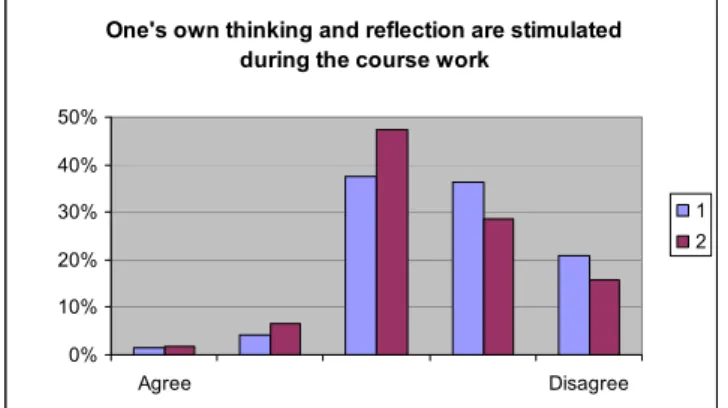
Some results from the course Strength of materials, M2 are displayed in Figure 1 to 3. These three diagrams and the corresponding ones for the other courses were used as material in the interviews with both students and teachers. They were asked to try to explain from their point of view how they interpreted the results shown in the diagrams. In the diagrams the horizontal-axis is graded to the five-point scale, agree to disagree, and the vertical-axis indicates the percentage of students answering the questionnaire corresponding to a certain point on the scale. The left column of each scale point shows the percentage of students answering the questionnaire the first time, the right column representing the second time, but only those who answered both the first and second time are included.
The results shown in the diagrams in Figure 1 and 2 correspond to the factor, or key aspect, which we called ‘the role of the lecture’ and the results in the diagram in Figure 3 to what was called ‘stimulation for one’s own thinking’ (for details see Appendix D).
The lectures are of great importance for my understanding 0% 10% 20% 30% 40% 50% 60% Agree Disagree 1 2
As a student you are active during lectures
0% 5% 10% 15% 20% 25% 30% 35% 40% Agree Disagree 1 2 TABLE 1
Distribution of the students participating in the questionnaire study
Figure 1. Percentages of answers to question 26 in the course Strength of materials, M2.
Figure 2. Percentages of answers to
question 34 and 38 in the course Strength of materials, M2.
Number of students answering the questionnaire Course University year No of students First time Second time Both first/sec time
Algebra, M1 1st 180 141 120 102
Comp programming, D1 1st 150 86 46 35
Strength of materials, M2 2nd 180 115 72 57
One's own thinking and reflection are stimulated during the course work
0% 10% 20% 30% 40% 50% Agree Disagree 1 2
Figure 3. Percentages of answers to question 27, 32 and 42 in the course Strength of materials, M2.
Commentary
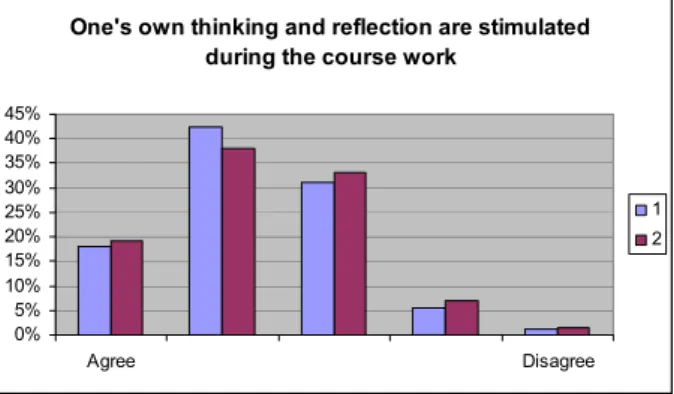
The students’ responses to the questionnaires produced a lot of quantitative data of which we found it most useful to chose those presented in Figure 1 to 3. An important reason for our choice was the contradictory picture of the students’ beliefs about the role of the lecture, displayed in Figure 1 and 2. The result displayed in Figure 3 was of particular interest with respect to the overall goal for engineering education, to foster independent engineers. The corresponding factors are not content related and the results are valid when making a comparison between the four courses. Some similarities and differences between the courses could be interpreted as being due to differences in the course descriptions, while the cause and effect for others presumably had other explanations. The corresponding three diagrams for the courses Algebra M2, Computer programming D1, and Physics B E2 are displayed in Appendix E. The complete results and diagrams corresponding to the eight factors used in the questionnaire study can of course make important and useful materials for further discussions. This collection of statistical material is available from the authors.
Results from Interviews
The data from the interviews were arranged according to four main questions. They are explored below with the help of student comment. These follow some exemplars chosen because they are seen as representing the essentials of the students’ answers to a certain question. In this part of the report we use a vocabulary where a lecturer is the one who gives the lectures and a teacher is someone who is in the teaching team.
Of what kind of reputation concerning the education at Chalmers, were the students aware prior to entering?
The students repeatedly emphasize the same; Chalmers has in general a very good reputation. When they were asked to express what possible reasons there are for such a reputation, most of them talked about Chalmers as a trademark.
Student 1:
I have heard that Chalmers is a good university. Something you can trust. Reputation is not focused on education.
Quite a few students pointed out that the reputation was not based on education but more on what education at Chalmers might lead to, a degree which is highly valued in the labour market. The following student makes the point:
Student 2:
I had not heard anything concrete about education or the layout of teaching and learning. It is about the desire to get a good job.
When students referred to the reputation as it appears in newspapers and magazines, it was about Chalmers as a university of technology where eminent research is carried out. In summary the students claimed that there are many other reasons, rather than just the good reputation, for them having chosen to be educated at Chalmers. They mentioned reasons like geographical location, Göteborg as a big city, family tradition, etc.
Which is the role of the lecture, asserted by the students? In a specific course? From a general point of view?
For the most part the students’ answers about the role of the lecture were given from a general point of view. Certainly, there were answers having references to a specific course but commonly those answers were about the lecture as part of an organization, such as if the lectures fitted well into the time schedule, or not.
Almost all of the students described the role of the lecture in a contradictory way. On one hand, the lecture as such is not seen as an opportunity for learning. On the other hand, the lecture is regarded as an endorsement for other study activities. The most important purpose of the lecture is to offer a structured overview, which is holistic. Even students who, in the first part of the interview, declared that the lecture as a method for learning means nothing to them returned frequently to the lecture as a source for a general view of the subject or topic studied. The lecture is also seen as supportive for one’s own studies, like reading the course
literature. Some students alleged that for them the lecture as such is not the problem. The problem is to be in “phase”, which means that the momentums of their studies are consistent with the demands of the course.
Student 3:
I learn the best/most when I am in phase. Then it’s not so important what the rest looks like. If you are prepared before a lecture then you learn in a good way, and the other way around if you are not prepared. The biggest problem is to be in phase.
They focused more on the responsibility that lies with the students and meant that demands for good actions during a lecture should be raised both on students and lecturers.
Another role for the lecture is that of motivating and arousing enthusiasm, which help students to learn and to commit to learning.
Student 4:
The lecture offers a good introduction, I get an idea of the subject. Then I study by myself, really learn, and any questions that may occur I’ll bring to the teacher. This will lead to my learning of the content. The lectures are not that important for learning, it’s more about being absorbed.
There was a great demand for lecture notes among the students. For the most part they were eager to have access to lecture notes no matter how they were produced, by themselves, by a person on the same course, or by the teacher. The lecture notes were often seen as defining the course. Some students considered that good lecture notes could be a substitute for the course book and even replace the lecture.
Student 5:
Lectures are not suitable for my learning style. The lectures could be replaced by having access to lecture notes, for example by a web page on the Internet.
At the same time there were students who regarded the process of taking lecture notes as very important for one’s own structuring of the course content and thereby also as a basis for learning. Some students asked for lecture notes prepared as the teacher’s guide to the course literature.
What kinds of arguments did the students’ use when discussing: what designates a ‘good’ course? Less ‘good’?
What a “good” course really is can be debated endlessly, but when the students were asked to give their descriptions they expressed little doubt. They repeatedly emphasized the importance of what they called ‘good teaching’ in a course, and they had the significance of
the lecturer’s role in focus. The lecturer should have enthusiasm for and sound knowledge of the subject matter.
Student 6:
It is the interplay between one’s own interests in the subject and the way the subject is treated in the course. Above all by the lecturer, who should be competent and committed.
The lecturer is also, from the students’ point of view, the one who is responsible for the formation of an enthusiastic and well functioning team of teachers.
Student 7:
The commitment is of great importance, which means all involved lecturers and teachers showing pleasure in their work.
Student 8:
The lecturer plays an important role, should be enthusiastic and present a good structure. The communication between the lecturer and the teaching team is important - to take the sense of the student group.
The students meant that they need to know how they are doing before it is too late to do much about it. They therefore asked for what they called an ‘open door mentality’ where lecturers and teachers in the team are within easy reach while the course is in progress. Lecturers and teachers who are genuinely interested in the students learning designate a ‘good’ course.
For some students it was a question of structure and organization. Student 9:
It is about lecture structure, that the lecturer controls content and time. That the lecturer knows what we need to learn to pass the course. Concrete and structured – (natural) scientific thinking. Bam! Bam! This is what you should know!
The arguments used by the students for what designates a ‘good’ course were for the most part expressions concerning how a course is carried out and how persons involved are acting. There were also arguments concerning what a course is about, that is the course content as subject for the student’s learning. A great many students emphasized the meaning of the content from a utility point of view. In the short run, they expected teachers frequently to give examples of appropriate applications to demonstrate connections to real life situations. In the longer run they asked for teachers’ guidance to see how the content in a certain course is connected with the content in both courses studied at the same time and future courses. Likewise, they said, it is of importance how connections between course content and the
future exercise of an engineering profession are demonstrated. Some of the students also turned their attention to how challenging they found the course content. A situation where the course content is perceived as neither too difficult nor too easy is a characteristic they give for a ‘good’ course. The degree of difficulty should be within reason and the course goals attainable.
How did the students’ explain the presented results (diagrams)?
At the end of each interview the students were asked to try to explain from their point of view how they interpreted the results shown in the diagrams (for details see p. 11 and Appendix E). Due to this and the fact that the diagrams, as regards the content, showed results connected to the overall discussion the students’ explanations took on the nature of syntheses of what they said earlier during the interview. Certainly, the results from the questionnaires are specific to each course but the interpretations made by the students have some characters in common.
Two of the diagrams showed a contradictory picture of the students’ beliefs about the role of the lecture. Of course the pictures were somewhat different for different courses but, nevertheless, the students explanations generally included some parameters representative of large class teaching and learning. Whether the lectures are or are not seen as being of great importance to one’s understanding of the content is determined by how much benefit the students think they derive from the lecture. This in turn is determined by what qualities the lecturer has. When it comes to the question about the students’ activity during lectures, the discussions usually were about how to define the concept of activity. A somewhat polarized grouping could be observed among the definitions made by the students in the interviews. On one hand there are those implying that activity always is synonymous with interaction between people and on the other hand there are those implying that activity does not necessarily mean interaction and therefore also could mean mental activity. According to the students’ point of view, this might explain the contradictory picture.
At a first glance at the diagram showing the distribution of students’ response to the statement that one’s own thinking and reflection are stimulated during the coursework, most of the students were somewhat surprised. Spontaneously, they expected more students to agree with the statement. After a while they gave expression to more balanced interpretations, which took into account how different parts of the course work acted as a positive or negative stimulus for one’s own thinking. Some of the students mentioned the demands raised by the
examination as having a negative effect on the students’ own thinking and reflection whereas others mentioned problem solving in small groups as an instance to the contrary.
Commentary
It is always important to reflect upon to what extent the presented results are representative for the whole group of students. In this case all of the interviews were conducted with volunteer students and there is obviously no principle of selection. Despite this we believe that those students who showed willingness to take part in the interviews gave expression to opinions occurring in the large group of students. Especially when it is appreciated that several of them were working members of different groups dealing with educational questions at Chalmers. However, there are other experiences which may have had an influence on the students’ answers. Several students call our attention to the fact that their approach to teaching and learning was strongly influenced by their searching for rational solutions in an arduous study situation with several courses taking place at the same time. They also regarded their own perspectives as limited because of the fact that they had no or little experience of alternative ways in which courses could be pursued.
Discussion and conclusions
In the evaluation of the responses to the questionnaires and the interviews special attention was given to the questions; what is a “good” course? And consequently why is a certain course regarded as less “good”? Conclusions drawn from the interpretation of the results is not unambiguous, but there are some implications for large group teaching.
The students believe that if a course should be regarded as ”good” it is necessary that the lecturer arouses enthusiasm, is a good scholar who likes being a teacher, and creates an enthusiastic team of teachers who have an ”open door mentality” and are interested in the students learning. Furthermore, from the students’ point of view it is necessary that:
• the course is well structured
• teachers know their subject
• the course content is seen as useful
The students’ emphasis on the need for good structure and on the teacher’s knowledge of the subject is well supported by findings in other studies (Horgan, 1999; Martin, 1999). However, the other two qualities emphasized are more specific for the findings in this project. When the students talked about the course content and its usefulness they often mentioned it in terms of how the content was or was not seen as connected to coming courses and the future exercise of a profession. The statement that a course should be neither too difficult nor too easy is interpreted as giving expression to the student’s desire to be challenged in accordance to her or his individual ability and capacity.
Another request from the students is for lecture notes, in particular if the textbook is too large. Such notes have, of course, different meanings for different students. The most frequently used expressions among students in this study were, the lecture notes as a teachers guide to reading and the lecture notes as a substitute for the textbook.
Further, the students believed that, rather than a lecture being an opportunity for learning, it should have a role of motivating, arousing enthusiasm, and offering an overview, which is holistic.
When taking all this into consideration, it implies that teachers should contemplate alternatives to
• the content usually presented in a lecture
• the way a lecture usually is organized
• the lecture as a teaching/learning method
The main reason for a lecturer to think about alternatives to the content chosen for a certain lecture is the importance of finding a good balance between necessary details and the students desire to get a holistic overview. It is also about the teachers’ approaches to the content taught. How will those approaches align with a student’s comprehension of the content taught? The question of organization during a lecture is in the main connected to the teachers’ approaches to teaching and learning. There is an important interplay between the teacher’s approach and the learners’ approach (Bowden & Marton, 1998; Martin, 1999). The students in the study gave expression to how they adjust their learning approach so that it corresponds with the teacher’s approach. This is a strong argument for why alternatives are necessary and an assumption is that the lecturer should be able to move between different approaches.
One might argue that students rarely come up with proposals for alternatives and this is also the case in this study. We believe that the students’ experience of educational/ pedagogical alternatives is limited by their courses, which means that they have few actual
possibilities to come up with any alternatives. But learners respond differently to different styles for learning and an assumption of homogeneity of learning style is fallacious. Therefore teachers have a responsibility to offer the students suitable alternatives.
In the interviews with the students, questions concerning the quality of a lecture often appeal to parts of the presented content learners of different reasons could not understand during the lecture. This is not to say that a lecturer is bad but often not aware of the different learning styles among the students. The widespread assumption that all this appears clear to the lecturer, is not supported by research findings.
We are not claiming that the lecture should be abandoned. But our study has shown that there are important parameters to take into account when trying to change from a traditional lecture to a more interactive approach. With respect to the complexity of teaching and learning situations, our assumption is that a step-by-step change works best for both students and teachers. Our hope is to have contributed to the materials that support Chalmers teaching staff in making appropriate choices and implementing them in their own courses and programmes. This is a goal formulated in the general recommendations for projects concerning improvement in learning and teaching at Chalmers University of Technology. Part of the realization of this is the feedback, which will be given during workshops and seminars for the students and teachers involved in the project.
In spite of the fact that a lot of examples of how to improve lecturing as a teaching method are described in the literature, we still need more studies of how to implement those alternatives into the ongoing activity in the engineering education at universities like Chalmers and a strategy for making lecturers aware of why they should change and how. What kinds of teaching and learning methods, with respect to learning outcomes, are most beneficial for students in a specific course? How to implement the use of such methods, especially in consideration of large classes?
Acknowledgements
This study was made possible with the funding from the C-SELT (Chalmers Strategic Effort on Learning and Teaching) project at Chalmers University of Technology. We would like to express our appreciation to all students, teachers, educational staffs, and other helpful contributors to our data gathering. We also like to express our gratitude to Professor Leone Burton for fruitful discussions during the project work and for being most helpful when it comes to the writing of this report.
References
Biggs, J. (1999). Teaching for Quality Learning at University. What the student does. Buckingham, UK: Open University Press.
Bowden, J. & Marton, F. (1998). The University of Learning. London: Kogan Page. CDIO Project. (2001). The CDIO Project Homepage, http://www.me.chalmers.se/cdio C-SELT. (2002). The C-SELT Project Homepage,
http://www.pedu.chalmers.se/inst/startmeny.html
Horgan, J. (1999). Lecturing for Learning. In H. Frey, S. Ketteridge, S. Marshall (Eds.), A Handbook for Teaching & Learning in Higher Education. (pp 83-94). London: Kogan Page.
Johnson, J., Ainley, J, & Long, M. (1996). The 1996 Course Experience Questionnaire CEQ. A report for the Graduate careers Council of Australia. Parkville Victoria: GCCA.
Kvale, S. (1996). Interviews: an introduction to qualitative research interviewing. Thousands Oaks, California: Sage.
Lander, R. (1996). Djupa och ytliga studiemönster. Teori och metod för kvantitativa mått [Deep and surface approach to study] (Rapport No. 1996:13). Göteborg, Sweden: Göteborgs University, Department of Education and Educational Research.
Lander, R., & Larson, M. (1997). Hur var kursen? Utprövning av ett instrument för att mäta kursupplevelser vid Göteborgs universitet vt 1997 [What about the course?] (Rapport 1997:10). Göteborg, Sweden: University of Göteborg, Department of Education and Educational Research.
Lyngfelt, A. (2000). Kunskap som mål eller medel? Om synen på den akademiska
föreläsningen, förmedlad av Chalmers-lärare 1998/99 [Teachers’ ideas of the academic lecture]. Utbildning & Demokrati, 9(2), 9-27.
Martin, E. (1999). Changing academic work. Developing the learning university. Buckingham, UK: Open University Press.
Appendix A
Suggestions for further reading
Anderson, D., Brown, S., & Race, P. (1998). 500 Tips for Further and Continuing Education Lecturers. London: Kogan Page. ISBN 0-7494-2411-7
Baillie, C., & Fitzgerald, G. (2000). Motivation and attrition in engineering students. European Journal of Engineering education, 25(2), 145-155.
Bligh, D. (1998). What’s the use of lectures? Exeter, UK: Intellect.
Brown, S. (1995). Assess your own teaching quality. London: Kogan Page.
Brown, S., & Glasner, A. (Eds.). (1999). Assessment Matters in Higher Education. Choosing and Using Diverse Approaches. Buckingham: Open University Press. ISBN 0-335-20242-X
Brown, G., Bull, J., & Pendlebury, M. (1997). Assessing Student Learning in Higher Education. London: Routledge. ISBN 0-415-14460-4
Cowan, J. (1998). On becoming an innovative university teacher: reflection in action. Buckingham: Open University Press.
Entwistle, N., & Ramsden, P. (1983). Understanding student learning. London: Croom Helm. Falchikov, N. (2001). Learning together: peer tutoring in higher education. London:
RoutledgeFalmer.
Gibbs, G. (1992). Lecturing to more students: Teaching more students, part 2. Polytechnic and Colleges Funding Council, Oxford: Oxonian Rewley Press.
Gibbs, G. (ed.). (1994). Improving student learning: theory and practice. Oxford: Oxford Centre for Staff Development.
Gibbs, G., Habeshaw, S., & Habeshaw, T. (1989). 53 Interesting ways to appraise your teaching (2nd ed.). Bristol: Technical and educational services.
Herskin, B. (1995). Undervisningsteknik for universitetslærere. Frederiksberg: Samfundslitteratur. ISBN 87-593-0525-8
Learning Styles. Special Issue. (2001). International Journal of Engineering Education, 17(1).
Lenschov, R. J. (1998). From teaching to learning: A paradigm shift in engineering education and lifelong learning. European Journal of Engineering education, 23(2), 155-162. Marton, F., Hounsell, D., & Entwistle, N. (eds.). (1997). The experience of learning:
implications for teaching and studying in higher education. Edinburgh: Scottich academic press.
Newton, D. P. (2000). Teaching for understanding. What it is and how to do it. London: RoutledgeFalmer. ISBN 0-415-22791-7
Prosser, M., & Trigwell, K. (1999). Understanding Learning and Teaching. The Experience in higher education. Buckingham: Open University Press. ISBN 0-335-19831-7
Ramsden, P. (1992). Learning to teach in higher education. London: Routledge Falmer. Richardson, J. T. E. (2000). Researching Student Learning. Approaches to studying in
campus-based and distance education. Buckingham: Open University Press. ISBN 0 335 20515-1
Savin-Baden, M. (2000). Problem-based learning in higher education: untold stories. Buckingham: Open University Press. ISBN 0-335-20337-X
Schwartz, P., Mennin, S., & Webb, G. (Eds.). (2001). Problem-based learning. Case studies, experience and practice. London: Kogan Page. ISBN 0-7494-3492-9
Trigwell, K., & Prosser, M. (1996). Changing approaches to teaching: a relational perspective, Studies in Higher Education, 21, 275-84.
Trigwell, K., Prosser, M., & Waterhouse, F. (1999). Relations between teachers’ approaches to teaching and students’ approaches to learning, Higher Education, 37, 57-70.
Van Dijk, L., & Jochems, W. (2002). Changing a traditional lecturing approach into an interactive approach. International Journal of Engineering Education, 18(3), 275-284. Van Dijk, L. A., Van der Berg, G. C., & Van Keulen, H. (2001). Interactive lectures in
engineering education. European Journal of Engineering education, 26(1), 15-28. Resources on the Internet:
AJEE - Australasian Journal of Engineering Education. http://elecpress.monash.edu.au/ajee/ ASEE – American Association for Engineering Education. http://www.asee.org/
EJEE – Euorpean Journal of Engineering Education. http://www.ntb.ch/SEFI/Publications/journal.html
GJEE - Global Journal of Engineering Education. http://www.eng.monash.edu.au/uicee/gjee/ H3E – Higher Engineering Education for Europe. Co-operation between Engineering
Education Institutions' and Students' associations. http://www.hut.fi/Misc/H3E/ IJEE - The International Journal of Engineering Education. http://www.ijee.dit.ie JEE – [American] Journal of Engineering education.
Appendix B
Letter to educational staff
As part of the project aimed at Chalmers developing as a University of learning we are about to run the project “Large-Class teaching/learning”. The project is to be carried out during the academic year 2001/2002.
Our intention is to make a survey of courses given in large classes and where well functioning teaching methods are used. The survey is at first-hand aimed at large groups (more than 100 students) but our interest also includes courses with fewer students in which teaching methods also suitable for large classes are used.
We ask you to suggest some (2-3) courses in your programme, which are regarded as “good” courses. Depending on the schedule for the project we will give priority to courses you are giving during the fall of 2001.
We look forward to hearing from you before September 14.
Many thanks for your cooperation!
[Original message in Swedish] [Som ett led i Chalmers pedagogiska satsning har undertecknade fått i uppdrag att genomföra projektet ”Pedagogik för undervisning i stora grupper” under läsåret 2001/2002.
Som framgår av det bifogade dokumentet har vi för avsikt att kartlägga kurser med väl fungerande undervisning i stora grupper. Kartläggningen avser i första hand sådana kurser som bedrivs med stora (mer än 100 studenter) studentgrupper. Dock intresserar vi oss också för kurser med färre deltagare men där undervisningsformen kan tänkas applicerbar på en större studentgrupp.
Vi vänder oss till Dig för att be Dig välja ut några (2-3) kurser inom Ditt program som Du tycker är ”bra”. Eftersom vi ska redovisa våra resultat våren 2002 vill vi i första hand ha exempel på kurser som ges under höstterminen.
Vi vill gärna ha Ditt svar senast 14 september. Med vänlig hälsning]
Appendix C
Survey questionnaire
Chalmers University of Technology / Göteborg University
Course evaluation in the project ”Large class teaching and learning”
Please mark with an X that corresponds with your reaction to the suggestions below. Some of the questions are similar, which is done with intent to increase the validity. Thank you for your assist.
In general – how do you encounter the course?
Agree (It often says ’the teachers’ but think Agree Don’t hardly not ’the teacher’ if that is better) totally partly know at all 1. It is always easy to know the standards of work expected ❑ ❑ ❑ ❑ ❑
2. The course helps me to develop my problem-solving skill ❑ ❑ ❑ ❑ ❑
3. The teaching staff in the course motivates me to do my best ❑ ❑ ❑ ❑ ❑
4. The workload is too heavy ❑ ❑ ❑ ❑ ❑
5. This course sharpens my analytical skills ❑ ❑ ❑ ❑ ❑
6. I usually have a clear idea of where I am going and what
is expected of me in this course ❑ ❑ ❑ ❑ ❑
7. The staff puts a lot of time into commenting on my work ❑ ❑ ❑ ❑ ❑
8. You only need a good memory to do well on this course ❑ ❑ ❑ ❑ ❑
9. The course helps me to develop my ability to work as a
team-member ❑ ❑ ❑ ❑ ❑
10. As a result of this course, I feel more confident about
tackling unfamiliar problems ❑ ❑ ❑ ❑ ❑
11. The course improves my skills in written communication ❑ ❑ ❑ ❑ ❑
12. The staff seems more interested in testing what I have
memorised than what I have understood ❑ ❑ ❑ ❑ ❑
13. It is often hard to discover what is expected of me
in this course ❑ ❑ ❑ ❑ ❑
14. I am generally given enough time to understand the things
I have to learn ❑ ❑ ❑ ❑ ❑
15. The staff makes a real effort to understand difficulties
I might be having in my work ❑ ❑ ❑ ❑ ❑
16. The teaching staff normally gives me helpful feedback
on how I am going ❑ ❑ ❑ ❑ ❑
17. The teachers are very good at explaining things ❑ ❑ ❑ ❑ ❑
18. There are too many examination tasks on plain facts ❑ ❑ ❑ ❑ ❑
19. The teachers work hard to make the subject interesting ❑ ❑ ❑ ❑ ❑
20. I feel a strong pressure to do well in this course ❑ ❑ ❑ ❑ ❑
21. The course helps me to develop my ability to plan my
In general – how do you encounter the course?
Agree (It often says ’the teachers’ but think Agree Don’t hardly not ’the teacher’ if that is better) totally partly know at all 22. It is so much to cover in the course, that there is no way
that it all could be thoroughly comprehended ❑ ❑ ❑ ❑ ❑
23. The teachers made it clear right from the start what they
expected from the students ❑ ❑ ❑ ❑ ❑
24. Overall, I am satisfied with the quality of the course ❑ ❑ ❑ ❑ ❑
25. The examination helps me to understand the content better ❑ ❑ ❑ ❑ ❑
26. The lectures are of great importance for my understanding ❑ ❑ ❑ ❑ ❑
27. The teachers encourage us to try our own ideas ❑ ❑ ❑ ❑ ❑
28. The course is far too burdensome ❑ ❑ ❑ ❑ ❑
29. The teachers pay regard to what the students need to get
illuminated in the content ❑ ❑ ❑ ❑ ❑
30. The lectures are effective and clear ❑ ❑ ❑ ❑ ❑
31. The teachers actively try to find why certain topics are
difficult for us ❑ ❑ ❑ ❑ ❑
32. We are encouraged to find our own solutions to the problems ❑ ❑ ❑ ❑ ❑
33. The teachers lectures part of the content in a clear way ❑ ❑ ❑ ❑ ❑
34. The teachers make a real effort to have us actively taking
part of lectures ❑ ❑ ❑ ❑ ❑
35. The teachers adjust their teaching according to what the
students find difficult ❑ ❑ ❑ ❑ ❑
36. The lectures are mostly a repetition of the course
literature content ❑ ❑ ❑ ❑ ❑
37. The course strengthens my ability to discuss with others in a
trustworthy and reasonable way ❑ ❑ ❑ ❑ ❑
38. As a student you always have a passive role in lectures ❑ ❑ ❑ ❑ ❑
39. In the examination I am expected not only to show what I have learnt, but also to apply my knowledge theoretically or
practically ❑ ❑ ❑ ❑ ❑
40. The teachers have useful comments on my work in the course ❑ ❑ ❑ ❑ ❑
41. The course helps me to become better at explaining to others ❑ ❑ ❑ ❑ ❑
42. The teachers encourage us to use our own ideas ❑ ❑ ❑ ❑ ❑
43. The teachers like the examination to show if I can generalize
my knowledge into new situations ❑ ❑ ❑ ❑ ❑
44. I think this is an interesting and rewarding course ❑ ❑ ❑ ❑ ❑
Appendix D
Factors for the Survey questionnaire
Factors [according to Lander & Larson (1997) for all questions except no 26, 36, 34 and no 38]. The numbers refer to the questionnaire in Appendix C.
Factors Question Reversed tendency
Good teaching 17, 30, 33
Good feedback 7, 16, 40
Support when needed 15, 29, 31, 35
Support for motivation 3, 19
(These 4 factors could in fact be summarized to ”good teaching”)
Stimulation for one’s own thinking 27, 32, 42
The role of the lecture 26, 36, 34, 38 36, 38
Appropriate workload 4, 14, 20, 22, 28 4, 20, 22, 28
Clear goals and standards 1, 6, 13, 23 13
Appropriate assessment
- reproducing or not 8, 12, 18 8, 12, 18
- learning examination 25, 39, 43 Generic skills
- Problems solving skills 2, 5, 10 - Ability to write and plan 11, 21 - Teamwork, reasoning, and discussion 9, 37
- Ability to report 41
To write a journal is of great importance to my learning 0% 5% 10% 15% 20% 25% 30% 35% Agree Disagree 1 2
Good teaching in the course
0% 10% 20% 30% 40% 50% 60% Agree Disagree 1 2
One's own thinking and reflection are stimulated during the course work
0% 5% 10% 15% 20% 25% 30% 35% 40% 45% Agree Disagree 1 2
Appendix E
Diagrams showing results from questionnaires
Course: Algebra, M1
The diagrams in Figure 4 to 6 display the results corresponding to the three factors, ‘the role of the journal’, ‘good teaching’, and ‘stimulation for one’s own thinking’.
Figure 4. Question 26 and 36.
The lectures are of great importance for my understanding 0% 5% 10% 15% 20% 25% 30% 35% 40% Agree Disagree 1 2
As a student you are active during lectures
0% 10% 20% 30% 40% 50% Agree Disagree 1 2
One's own thinking and reflection are stimulated during the course work
0% 10% 20% 30% 40% 50% 60% Agree Disagree 1 2
The lectures are of great important for my understanding 0% 10% 20% 30% 40% 50% 60% Agree Disagree 1 2
As a student you are active during lectures
0% 5% 10% 15% 20% 25% 30% 35% 40% Agree Disagree 1 2
Course: Computer programming, D1
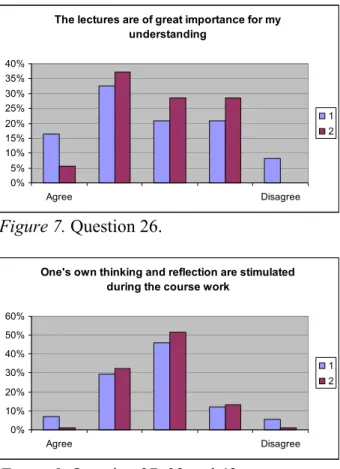
The diagrams in Figure 7 and 8 display the results corresponding to the factor ‘the role of the lecture’. The results in Figure 9 correspond to the factor ‘stimulation for one’s own thinking’.
Figure 7. Question 26.
Figure 8. Question 34 and 38. Figure 9. Question 27, 32 and 42. Course:Physics B, E2
The diagrams in Figure 10 and 11 display the results corresponding to the factor ‘the role of the lecture’. The results in Figure 12 correspond to the factor ‘stimulation for one’s own thinking’.
Figure 10. Question 26.
Figure 11. Question 34 and 38. Figure 12. Question 27, 32 and 42.
One's own thinking and reflection are stimulated during the course work
0% 10% 20% 30% 40% 50% 60% Agree Disagree 1 2
Appendix F
Question sheet used in interviews with students
”Research questions”: Interview questions:
- to make the role of the lecture clear What is the main reason for you being a student at Chalmers? - instances where the lecture is regarded as the
best teaching method? Instances where it has been successfully replaced?
What reputation has the education at Chalmers?
- If the lecture is in use, how can it be
improved? Do you find the subjects studied so far, of interest to you? -If the lecture is to be replaced, what are the
alternatives? In what way do you learn best?
How do you know that learning is taking place?
In what way do you expect the teachers to give feedback to you?
- to study different methods used for facilitating interaction between the teacher and the students in large-class settings.
How was the course organized? (What types of teaching were in use?) Do you think that the used types of teaching correspond with the description of the course? How do you look upon the connection
between teaching methods and assessment?
- to make a survey of what arguments there are behind statements like “This course is good”.
What designates a ”good” course? Give examples of a “good” course and a “bad” course respectively. Arguments?
Use results from the questionnaire. Bring the students face to face with diagrams. (Written response!).
What is your explanation to the results displayed in diagram 1 and diagram 2? What is your explanation to the results displayed in diagram 3?
Appendix G
Question sheet used in interviews with teachers
” Research questions”: Interview questions:
- to make the role of the lecture clear
- instances where the lecture is regarded as the best teaching method? Instances where it has been successfully replaced??
What reputation has the education at Chalmers?
- If the lecture is in use, how can it be improved?
- If the lecture is to be replaced, what are the
alternatives In what way do students learn best?
How do you know that learning is taking place with students?
In what way do you think the teachers should give feedback to a student?
- to study different methods used for facilitating interaction between the teacher and the students in large-class settings.
How was the course organized? (What types of teaching were in use?) Do you think that the used types of teaching correspond with the description of the course? (Connection to course goals?)
How do you look upon the connection between teaching methods and assessment? (What role has the lecture in this context?)
- to make a survey of what arguments there are behind statements like “This course is good”.
What designates a ”good” course?
Use results from the questionnaire. Bring the teacher face to face with diagrams.
What is your explanation to the results displayed in diagram 1 and diagram 2? What is your explanation to the results displayed in diagram 3?