HAMILTON
COMMUNITY ACTION PROGRAM FOR CHILDREN EVALUATION
August 2012
Prepared by:
Carla Klassen, Social Planner Kunitomo Kamizaki, Social Planner Assistant Lauren Hurst, McMaster University Placement Student
Funded by:
© The Social Planning and Research Council of Hamilton 162 King William Street, Suite 103, Hamilton, ON L8R 3N9
Phone: 905.522.1148 Fax: 905.522.9124 E-mail: [email protected]
Website: sprc.hamilton.on.ca
ACKNOWLEDGEMENTS
We gratefully acknowledge Public Health Canada for funding to support the Hamilton Community Action Program for Children (CAPC).
Thanks also to the United Way of Burlington and Greater Hamilton for their ongoing support of the Social Planning and Research Council of Hamilton.
I would like to thank Kunitomo Kamizaki and Lauren Hurst for their invaluable research assistance, transcription, facilitation, analysis, and writing contributions.
I am also grateful to my colleagues at SPRC, especially Patti McNaney, Alison Miller, and Don Jaffray, for their insight and input throughout the course of this evaluation.
Thanks also to Chris Borst at the City of Hamilton Community Services for his excellent data and map preparation.
Finally, thanks to the participants whose expertise we drew on in this evaluation: Hamilton CAPC Council members, key community informants, CAPC program participants, and staff.
TABLE OF CONTENTS
EXECUTIVE SUMMARY ... 1
1.0 INTRODUCTION AND BACKGROUND ... 2
1.1 Project Description ... 2
1.2 Project Mission, Goals and Objectives ... 2
1.3 Program Descriptions ... 2
1.4Context and Purpose of Evaluation... 4
2.0 METHODOLOGY ... 5
3.0 SCHOOL READINESS FINDINGS ... 7
4.0 EDUCATIONAL PROGRESS FINDINGS ... 12
4.1 Elementary School Findings ... 12
4.2 Secondary School Findings ... 16
4.3 Discussion ... 19
5.0 HAMILTON CAPC COUNCIL FOCUS GROUP... 20
6.0 KEY INFORMANT INTERVIEW FINDINGS ... 22
6.1 Participant Interview Findings ... 22
6.2 Staff Interview Findings ... 23
6.3 Community Key Informant Findings ... 24
7.0 DISCUSSION ... 30
8.0 RECOMMENDATIONS ... 32 APPENDIX A – INTERVIEW QUESTIONS ... I
EXECUTIVE SUMMARY
The Community Action Program for Children (CAPC) is a national program aimed at promoting child health and wellbeing through early, preventative interventions with children 6 years of age and under and their families. As part of this national program, Hamilton CAPC has provided services and supports to families with children 6 years of age and under in East Hamilton, focusing particularly on families with lower incomes or who are experiencing social or geographic isolation, since 1993. The CAPC catchment area is East Hamilton and Stoney Creek with the area boundaries of Lake Ontario (north), 50 Road (east), the Hamilton escarpment (south) and Strathearne Road (west).
The purpose of this local evaluation is to assess the long-term impacts of CAPC in east Hamilton since 1993 and offer recommendations for program improvement. Methods used in this evaluation include:
analysis of Early Development Indicator data in the CAPC catchment area; analysis of Education Quality and Accountability Office data;
18 key informant interviews with CAPC program participants, CAPC staff, and community key informants;
a focus group with the Hamilton CAPC Council;
and a participatory session with the Hamilton CAPC Council to explore key findings and generate recommendations.
Findings suggest that CAPC has contributed to generally improving outcomes for young children in east Hamilton, and that community organizations collaborate with one another more because of CAPC’s work. Overall, CAPC was seen as having brought more focus and awareness of conditions in east Hamilton. In discussions about engaging ethno-culturally diverse communities, word of mouth was seen as one of the best ways to connect. Many participants were concerned with a lack of awareness about CAPC in both the general public and among residents in the CAPC catchment area. Finally, CAPC’s funding, which does not increase with inflation, contributed to program stability for many partners, but also challenged program partners to offer the same programming with less funding over time. These last two findings, concerning awareness of CAPC and funding limitations, were prioritized by members of the CAPC Council as requiring the most urgent action.
Recommendations developed by the CAPC Council around these two issues included holding more events, generating stories about CAPC programs and participants with local media outlets, promoting CAPC through daycares and schools, sharing information with other communities and programs, using social marketing and branding to increase visibility of CAPC, and looking for other sources of funding. These recommendations, and others developed by the Hamilton CAPC Council, should form the basis of an action plan for the Hamilton CAPC Council over the next phase of its work.
Given both the strengths of better outcomes for young children and having strong collaborative relationships, and the challenges of limited resources and limited awareness of CAPC, it may also be worthwhile to explore opportunities for further collaboration between CAPC, the Ontario Early Years Centres, and the Best Start Network, all of whom are involved with supports in early childhood in Hamilton. Such collaboration could support decision making in areas of evaluation and planning to use limited resources strategically.
1.0 INTRODUCTION AND BACKGROUND
1.1 Project DescriptionThe Community Action Program for Children (CAPC) is a national program aimed at promoting child health and wellbeing through early, preventative interventions with children 6 years of age and under and their families. As part of this national program, Hamilton CAPC has provided services and supports to families with children 6 years of age and under in East Hamilton, focusing particularly on families with lower incomes or who are experiencing social or geographic isolation, since 1993. The CAPC catchment area is East Hamilton and Stoney Creek with the area boundaries of Lake Ontario (north), 50 Road (east), the Hamilton escarpment (south) and Strathearne Road (west). (See Figure 1 on page 13 for a map illustrating the borders of the Hamilton CAPC catchment area.)
The Social Planning and Research Council of Hamilton serves as the sponsoring agency for the project. The Hamilton CAPC Council, which consists of residents of the CAPC catchment area, acts as a connecting group between Hamilton CAPC and the wider community, raising issues of concern, developing responses, and providing input into the project as it seeks to achieve its goals. 1.2 Project Mission, Goals and Objectives
The mission of the CAPC project is as follows:
CAPC provides the opportunity for residents of East Hamilton/Stoney Creek to play an active role in planning for their communities.
CAPC believes that families/community want to provide the best for their young children, but there is a reality of barriers to resources, which is a serious restriction to goal achievement. CAPC feels that active involvement of community residents (living or working in the area) is the
key to reducing these barriers and improving child health. The goals and objectives of the CAPC program are:
To improve the health and well being of children aged 0 – 6 To work with parents to make parenting easier
To reduce child abuse and neglect
To work collaboratively with community members to direct and improve CAPC so as to best serve the needs of parents and children
1.3 Program Descriptions
Hamilton’s CAPC project currently provides ten partnering programs for children and families in the CAPC catchment area. The programs are babyshowers, Community Access to Child Health (CATCH), Boys and Girls Club of Hamilton, Hamilton Public Library, Home Management Workers, Skills Through Activities and Recreation (S.T.A.R.), Today’s Family Early Learning and Childcare, Catholic Family Services, St. Joseph’s Immigrant Women’s Centre, and Hamilton Partners in Nutrition.
babyshowers
babyshowers is an independent, nonprofit organization committed to helping families meet the basic needs of their children. They collect new and gently used baby and toddler items to give through established community agencies in Hamilton. Referrals are made through Public Health Nurses, Family Home Visitors, Hamilton Health Sciences, St. Martin’s Manor, the Maternity Centre, St. Joseph’s Immigrant Women’s Centre, CATCH, and The Hamilton Children’s Hospital.
Community Access to Child Health (CATCH)
CATCH is a community development program in East Hamilton and Stoney Creek. The goal of the program is to work together with community residents in promoting healthy children, families and
community support. CATCH strives to create safer environments for children both inside and outside the home by offering a variety of programs including a Parent and Tot Interactive Playgroup.
Boys and Girls Club of Hamilton
Boys and Girls Club of Hamilton operate a Lunch and Life Skills Program which offers the opportunity for parents to prepare nutritious lunches and snacks. They also provide a Multicultural Parent Education Program that addresses the needs of newcomer families in the areas of education and employment. Hamilton Public Library – Red Hill Branch
The Hamilton Public Library offers the Multicultural Early learning Development Project (MELD) intended to reach newcomer families and provide parents with supports for their children’s early learning and school readiness development. Supports include dual language family workbooks, accessible dual language collection and family based programs including the Summer Reading Club and Storytime for Newcomer Families.
Home Management Program
The Home Management Program offered by the City of Hamilton Public Health Services is designed to support and assist parents with children ages 0 to 6. Home Management Workers meet with parents in their homes and focus on the development of life skills, child rearing skills and household management skills. In addition, they assist parents in the development of action plans for returning to school or finding employment.
Skills Through Activities and Recreation (S.T.A.R.)
S.T.A.R. provides skill development programs for children between the ages of 5 to 15 in order to address the challenges faced by low-income families. S.T.A.R.’s goal is to provide children with opportunities for participation in recreational activities and to promote an interest in positive activities for children. Their partnership with CAPC enables the participation of 5 and 6 year olds in the programs.
Today’s Family Early Learning and Child Care
Today’s Family is a multi-service agency that strives to meet the diverse cultural, social and economic needs of families. In partnership with CAPC, Today’s Family provides supports to enable local residents to start up small childcare businesses in their own homes including regular home visits. This partnership addresses the issues of a lack of childcare spaces in the area and the difficulty experienced by the newcomer population finding work in Canada.
Hamilton Partners in Nutrition (HPIN)
Hamilton Partners in Nutrition (HPIN) is a partnership of community agencies and community members that supports and facilitates local student nutrition programs for children and youth in Hamilton. Hamilton CAPC offers some financial support to HPIN programs in the catchment area to help address need for nutritious food as part of healthy child development.
Immigrant Women’s Centre (IWC)
Immigrant Women’s Centre (IWC) works with immigrant and refugee women and their families towards their mission of clients fully participating in a just and supportive Canadian Society. The partnership between CAPC and IWC seeks to strengthen connections between services aimed at immigrant and refugee women and services aimed at families with young children. This work is particularly important given the recent closure of Settlement Integration Services Organization (SISO), which had an office in the ethno-racially diverse CAPC catchment area.
Catholic Family Services (CFS)
CAPC’s partnership with Catholic Family Services (CFS) supports modest enhancements to a partnership between St. Martin’s Manor and Angela’s Place in order to provide additional services and participation incentives for programs offered to Angela’s Place tenants and young parents in the community. These supports are for a fathering group and a young mother’s respite service.
1.4 Context and Purpose of Evaluation
The Public Health Agency of Canada (PHAC), the funding agency of CAPC, published a national
Summative Evaluation of the program from 2004-20091. The argument emerging from the findings of the Summative Evaluation is that early child development research shows early interventions help child wellbeing and development, particularly for marginalized groups; CAPC programs reach higher proportions of marginalized populations; therefore, CAPC programs contribute to healthy child
development. In addition, qualitative program data show a range of positive impacts from programs on children, parents, and communities.
Recommendations from the 2004-2009 Summative Evaluation emphasize the importance of and commitment to evaluating the relevance, impact, and cost effectiveness of CAPC nationally. The Management Response and Action Plan from the 2009 Summative Evaluation indicates that a National Outcomes Evaluation Strategy for CAPC will be developed by spring 2012. 2
Given that these comprehensive approaches to evaluation are being undertaken at a national level across CAPC sites, the local evaluation can be designed to serve more local interests and strengthen program orientation, implementation, and engagement.
In this context, the purpose of this local evaluation is 1) to assess the long-term impacts of CAPC in east Hamilton since 1993; and 2) offer recommendations for program improvement. A mix of quantitative and qualitative methods will be used to build this assessment (see 2.0 Methodology).
1
http://www.phac-aspc.gc.ca/about_apropos/evaluation/reports-rapports/2009-2010/capc-pace/index-eng.php
2
2.0 METHODOLOGY
The central research question guiding this evaluation is: What have been the most significant impacts from CAPC in East Hamilton since it began in Hamilton in 1993? Because CAPC, like all social programs, works in a dynamic environment where conditions are always changing, it is difficult to say with certainty that changes observed in its catchment area are solely because of its intervention. We cannot attribute the change only to CAPC’s work. Instead, this evaluation employs a contribution analysis approach, where the aim is to uncover what changes have taken place that CAPC has been part of or contributed to. Part of the research methodology attempts to address how much of a contribution CAPC has made to changes identified by the various data sources consulted.
To construct an answer to the research question, five distinct aspects of research were conducted. First, City of Hamilton data on school readiness using the Early Development Indicator (EDI) in the CAPC catchment area was analyzed. The EDI measures the vulnerability of groups of children across five domains of development: physical health and well-being, social competence, emotional maturity,
language and cognitive development, communication skills and general knowledge. EDI data on levels of vulnerability in the CAPC catchment area for each domain of vulnerability were explored for the years 2002, 2005, 2008, and 2010 and at various levels of geography (i.e. census tracts and the City of Hamilton’s larger areas called Keeping Score on Kids (KSK) areas). Using a contribution analysis approach, we can infer that a portion of the changes observed have been as a result of CAPC’s interventions in the area. These data also give a sense of where there may be higher concentrations of vulnerability and where supports may be most beneficial.
The second aspect of this research was an analysis of academic scores from schools in the CAPC catchment area. The Education Quality and Accountability Office (EQAO) is a provincial organization that collects standardized tests for students in all Ontario schools in grades 3, 9, and 10. While students in these grades are older than the maximum age in CAPC’s target demographic of children birth to age 6, the period of time in which CAPC has been running means that many children who have participated in CAPC programs could be captured in these standardized tests as they have gotten older. EQAO scores for CAPC catchment area schools were analyzed from 2000-2011 for primary schools (from 2001 for secondary schools), and compared with scores for the school Board and the Province.
To complement the quantitative and broad contextual information from the quantitative sources of the first two aspects of this evaluation research, the third aspect was qualitative key informant interviews with 18 interviewees from three groups. The first group was made up of current and past participants in CAPC programs. Sampling in this group was limited but purposive. Participants included those who had been involved in CAPC for several years as program participants and/or as Hamilton CAPC Council members, or who were formerly involved in CAPC. Participants were interviewed in person or by phone and
received a gift card to a store of their choosing in recognition of their time and contributions. Participants were contacted by the evaluator after agreeing to be contacted through the CAPC outreach worker or CAPC program partner managers. Due to time constraints four participants were interviewed, which is less than the targeted 5-10 participants planned for this evaluation. (Prioritizing more structured and wide-ranging opportunities for participant contribution is recommended for next year’s evaluation of the
project.) Participants were asked questions such as what they thought the biggest difference that the CAPC program they participated in has made, what they liked about the program, how ethno-racially diverse they perceived other participants to be, and some basic demographic questions. (See Appendix A for a full list of interview questions).
The second group of interviewees consisted of direct CAPC staff, which included the CAPC program manager and outreach worker/volunteer coordinator. Staff were asked about the needs of residents within the catchment area that CAPC is working to address, what the most significant impacts have been from CAPC as a whole, what kinds of strategies are being used to engage residents of various ethno-racial communities, and what could improve CAPC as a project (all questions are listed in Appendix A).
The third and final group of interviewees were ‘community key informants,’ made up of 12 leaders within the community who have had some direct or indirect involvement with Hamilton CAPC over time. A list of potential interviewees was generated through consultation between SPRC’s Executive Director, the CAPC Program Manager, and the evaluator. Potential interviewees held some decision making power (either currently or in the past) about a program linked with CAPC. Potential interviewees were contacted and invited to participate, and most agreed to be interviewed, while others recommended colleagues who might have a better understanding of CAPC. Some interviewees were current or past program partners, past staff, or other senior managers from community agencies and local government who are generally familiar with CAPC’s work and some of the conditions in east Hamilton. Community key informants were asked about what they saw as the most significant impacts from CAPC’s work, how much they think CAPC has contributed to changes that have occurred in east Hamilton, and what strategies could improve outreach to various ethno-racial communities. (see Appendix A). All audio recorded interviews were transcribed; interviews that took place by phone were captured in detailed notes that were typed through the course of the interviews. All transcripts were then analyzed using NVivo qualitative analysis software and coded by themes emerging from the interviews as well as by basic characteristics of interviewees (such as position, length of participation, and organization).
The fourth aspect of research for this evaluation was a focus group conducted with the Hamilton CAPC Council, in which there were 9 participants. Participants were asked what they see as the role of the council, the most significant impacts from CAPC’s work in the community, and suggestions for improving the CAPC project. (All questions are listed in Appendix A.) Detailed notes were also transcribed at the focus group.
The fifth aspect of research was a participatory session with members of the Hamilton CAPC Council in which key findings were reviewed and recommendations were generated by members through interactive activities. In the session, overall key findings (as outlined in section 7.0 Discussion of this report) were written in plain language on chart paper. Participants were then asked to place sticky notes of the Council’s previously identified priorities on the chart paper with the key finding they felt fit best with each priority. Priorities identified through the Council’s earlier visioning exercise were: Events, Hamilton CAPC Council Recruitment and Awareness, Promoting CAPC, and Advising CAPC. Participants were then put into groups of three and asked to write down suggested actions related to any of the key findings that would build on what was working or improve on what was not working as well. These were also placed on the chart paper where each key finding was listed. Finally, participants prioritized the recommendations by placing one of two stickers on the actions or findings they felt were most important or should happen first. These prioritized suggested actions form the recommendations in this report (Section 8.0
3.0 SCHOOL READINESS FINDINGS
As discussed in section 2.0 Methodology, the Early Development Indicator (EDI) measures children’s readiness to learn at school, which refers to “the child's ability to meet the task demands of school, such as being cooperative and sitting quietly and listening to the teacher, and to benefit from the educational activities that are provided by the school.”3 Teachers of 4 and 5 year olds use several months of interaction and observation to complete the EDI questionnaire.
The five domains of development in which children’s vulnerability is assessed are: physical health and well-being, social competence, emotional maturity, language and cognitive development, communication skills and general knowledge.
The physical health and well-being domain includes: holding a pencil
running on the playground
adequate energy levels for classroom activities independence in looking after own needs daily living skills
The social knowledge and competence domain includes: curiosity about the world
eagerness to try new experiences
knowledge of standards of acceptable behaviour in a public place ability to control own behaviour
appropriate respect for adult authority cooperation with others
following rules
ability to play and work with other children The emotional health/maturity domain includes:
ability to reflect before acting
a balance between too fearful and too impulsive ability to deal with feelings at the age-appropriate level empathic response to other people's feelings
The language and cognitive development domain includes: reading awareness
age-appropriate reading and writing skills age-appropriate numeracy skills
board games
ability to understand similarities and differences
ability to recite back specific pieces of information from memory The communication skills and general knowledge domain includes:
skills to communicate needs and wants in socially appropriate ways symbolic use of language
storytelling
age-appropriate knowledge about the life and world around
Because the common measure used is the percentage of children who are vulnerable in one or more of these domains, lower percentages are more desirable.
3
Early Development Indicator (EDI): A Population-based Measure for Communities – Factsheet. Available at: http://www.offordcentre.com/readiness/files/EDI_Factsheet.pdf Accessed March 7, 2011.
City of Hamilton Community Services Department staff prepared several charts and maps of EDI data for the CAPC catchment area as a whole. Chart 1 below shows changes in the percentages of children who are vulnerable in one or more of the domains in the CAPC catchment area. From 2002 to 2010, the overall child vulnerability of the CAPC catchment area decreased by approximately 4% to approximately 22%4. In real numbers, in 2002 the area had 272 children identified as vulnerable in at least one domain out of 967 children assessed. By 2010, vulnerability was identified in 198 out of 882 children in the CAPC catchment area.
The narrow lines that intersect each bar represent margins of error; changes in these rates are only statistically significant when error bar areas do not overlap. Therefore, the decreases in vulnerability between each period could simply be normal variation between years and not be statistically significant, although they do show a positive trend of reduced rates of vulnerability. Still, the error bars from the 2002 rate and 2010 rate in Chart 1 do not appear to overlap, and therefore this difference is likely to be a statistically significant decrease in vulnerability. Many factors and conditions have likely contributed to this, one of which is CAPC programming. The extent of CAPC’s contribution to this change is not precisely measurable, but the positive direction of these results suggests that the conditions for young children in the community as a whole are improving, which contributes to CAPC’s goals.
Chart 1: CAPC Catchment – EDI Vulnerability Overall
4
The Chart 2 below shows the child vulnerability rates for the CAPC catchment area by each of the five domains from 2002 to 2010. Overall, the CAPC catchment area shows decreases in the vulnerability of all domains from 2002. However, the error bars again show that most of the changes from year to year are not statistically significant and may simply be normal variation. For example, in Chart 2 we see that the physical domain shows a slight increase in vulnerability from 2002 to 2005, but the minimum level on the error bar in the 2005 rate is below the maximum level of the error bar on the 2002 rate, meaning that this change is within normal expected variation and may not indicate a real change in vulnerability rates. Rates of vulnerability in the cognitive domain, on the other hand, have decreased sufficiently to be statistically significant, suggesting that real improvements have occurred. (This can be seen because the maximum level of the error bars in the 2008 and 2010 rates are below the minimum level of the error bar in the 2002 rate.) The decrease in vulnerability rate for the communication domain from 2005 to 2010 is almost large enough to be considered statistically significant. Further research with this instrument will be needed to confirm the significance of the improvement.
Despite the lack of statistically significant decreases in vulnerability rates for the remaining domains, these data do suggest modest improvements. Again, although we cannot tease out the exact contribution CAPC has made to these changes, certainly CAPC has been part of the environment in which these changes have taken place.
Chart 2: CAPC Catchment – EDI Vulnerability Domain by Development
Although data for the entire City of Hamilton are not shown here, an expert at the City of Hamilton also noted the following trends:
• The CAPC catchment area has seen a decrease in vulnerability in the physical domain while the City’s overall vulnerability rate has increased;
• The social domain also shows slightly better (lower) rates of vulnerability in the CAPC catchment area than in the city;
• The CAPC catchment area shows essentially no change (that is, not a statistically significant change) in the vulnerability in the emotional domain, while the City overall shows some improvement.
It is also important to note that changes within each domain at a larger scale (i.e. all of Hamilton) are more significant because of the larger sample size.
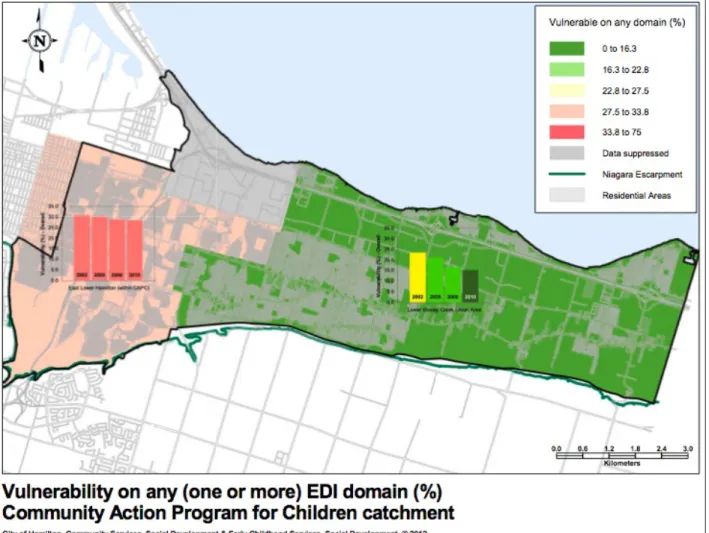
It is also possible to explore some the EDI data spatially; Figure 1 below shows the percentage of child vulnerability in one or more of the domains measured within the CAPC catchment area5. This map shows that the western portion of the catchment area has higher rates of vulnerability than the eastern portion (the former municipality of Stoney Creek). The charts overlaid on the regions also show change in rates of vulnerability over time (2002, 2005, 2008, and 2010). The western portion has seen fairly consistent rates of vulnerability, although with a modest decrease; the 2010 rate remains at nearly 30%. The eastern portion of the catchment, on the other hand, has seen more dramatic improvement over the same period. In 2002 this portion of the catchment’s vulnerability rate was between 22.8% and 27.5%; by 2010 the area showed a vulnerability rate in the range of 0%-16.3%.
Figure 1: Vulnerability on any (one or more) Edi domain (%) Community Action Program for Children Catchment
These results could be complicated by mobility rates (i.e. proportions of residents moving in and out of the area as their situations change). What this map makes clear, however, is that a significant proportion of young children in the western portion of the CAPC catchment area would continue to benefit from supports offered by CAPC programs given the higher rates of vulnerability.
5
EDI data was also explored by each domain at a smaller unit of geography (Census Tract or CT). These maps showed so much variation that few discernible patterns emerged, except that in general there were lower rates of vulnerability in the eastern areas as shown in Figure 1. Because this data did not yield many clear findings it is not included in this report.
Earlier research has shown that the kinds of support offered by CAPC do improve conditions for young children, but we are not able to get a clear measure of the types or degree of such improvements. The larger question in the face of consistently higher rates of vulnerability is whether programming on the scale that CAPC is able to offer is sufficient intervention to ‘move the needle’ on the challenges faced by many households in east Hamilton.
4.0 EDUCATIONAL PROGRESS FINDINGS
4.1 Elementary School Findings
Academic achievement can be a strong indicator of student wellbeing, and is often associated with success later in life. This section discusses educational progress findings based on data collected by the Education Quality and Accountability Office (EQAO) for the period of 2000-2011 for elementary schools (2001-2011 for secondary schools).
Chart 3: Percentage of students at CAPC catchment area elementary schools achieving provincial standard, 2000-2011
Chart 3 above shows the percentage of students at CAPC elementary schools who achieved the provincial standard in reading, writing, and math from 2000 to 2011. This chart shows that elementary student achievement in CAPC catchment area schools shows a generally improving trend in all subjects. The increase in percentage of students achieving the provincial standard has not been steady, however. Scores have also varied by subject: writing scores showed the most improvement over this period with an increase of 18.5%, while reading results improved by 18%, and math scores improved by 9.1%. Despite the significant improvement in reading achievement, scores in this subject are generally lower than in writing or math. The general trend of improvement is encouraging, but in order to put these results into context we must compare these trends with data from the school board and the province, discussed below.
Chart 4: Elementary schools reading achievement, 2000-2011
As Chart 4 shows, the provincial average in reading has been consistently above that of CAPC catchment area school scores.6 With some variation, reading scores at the provincial and CAPC levels have
improved over the ten year period shown above. The most dramatic improvement has been in CAPC area schools, whose reading scores improved by 18%, while provincial scores improved by 15%. This means that the gap between scores in the CAPC catchment area and province has narrowed in this period. It is also worth noting that because of the smaller sample size of CAPC area schools, percentages in each of the comparative graphs in this section will show more variation from year to year in comparison to the province-wide percentages.
6
CAPC scores are the medians of scores at schools in CAPC catchment area. Provincial scores are the averages of all students’ scores across the province. While not an ideal methodology, this approach was deemed more appropriate than comparing the average scores of CAPC schools because of the small sample size, i.e. one school with very high or very low scores could skew an average of scores of CAPC schools.
Chart 5: Elementary schools writing achievement, 2000-2011
Chart 5 compares scores at the CAPC catchment area and provincial levels in writing achievement over time. As in reading achievement, the provincial average in writing has been consistently above scores at the CAPC catchment area schools. Also similar to the reading achievement results, these writing results show a generally improving trend at both levels with some variation, especially in the smaller sample size of CAPC schools. Provincial writing scores increased by 21%, while CAPC catchment area scores increased by 18.5%. The gap between CAPC schools and the provincial average has actually widened slightly over the 2000-2011 period. The most recent year’s results show that there is more work to do to fully bridge the gap between CAPC area schools and the provincial average.
Chart 6: Elementary schools math achievement, 2000-2011
As in reading and writing, Chart 6 above shows that the provincial average in math has been higher than the board and CAPC area school scores. CAPC area schools showed more variation in math scores than in other elementary subjects. Despite variations at both scales, though, Chart 6 also shows a generally improving trend over time: CAPC area schools increased by 15.5% from 2000-2011, and the province improved by 11%. This means that, as in other subjects, the gap between CAPC area schools’ achievement and achievement at the provincial level in math has narrowed somewhat.
4.2 Secondary School Findings
Chart 7: Percentage of students at CAPC secondary schools achieving provincial standard, 2001-2011
Chart 7 shows that secondary student achievement in the CAPC catchment schools has generally improved in all subjects, with some variation between years. Applied math has improved the most in this period by 21%, followed by literacy at 12.5%, and academic math by 9.1%. This graph demonstrates that overall the percentages are significantly lower in applied math in comparison to academic math and literacy over this period. The data from 2004-2005 shows marked increases in academic math and literacy. The data from 2005-2006 also shows marked increases in applied math and literacy. Causes for these increases are not clear, but could be explored further.
Chart 8: Secondary schools academic math achievement, 2001-2011
As with the elementary school data discussed above, results from CAPC area secondary schools are more meaningful when compared with results from the province. Unlike the data discussed so far, however, Chart 8 shows that CAPC catchment area schools have achieved higher scores than the provincial average in several years in the last decade. Again, with minor variations, this graph shows that the scores at both levels have been increasing since 2001. Over this period the provincial percentages increased by 20% and CAPC schools by 11.5%. CAPC area schools have shown results on par or even above provincial averages in some years, though the gap widened slightly between 2009 and 2011.
Chart 9: Secondary schools applied math achievement, 2001-2011
Chart 9 shows that scores at both the CAPC catchment area and provincial levels have generally
improved. The province and CAPC catchment area schools’ percentages have increased by at least 20% over this period. In the 2005-2006 school year the CAPC catchment area school percentage is
significantly higher than provincial scores. There is, however, a significant drop in applied math
achievement in 2006-2007 in CAPC schools. Causes for these outcomes within CAPC schools for these years are not clear, but could warrant additional study.
Chart 10: Secondary schools literacy achievement, 2001-2011
Chart 10 above demonstrates that the provincial average in literacy has generally been above the board and CAPC scores in this time period. Again, with some variations, both score levels show a generally improving trend: CAPC catchment area schools’ percentages increased by 13.5%, while the provincial scores increased by 8%. Unlike in applied and academic math, the literacy achievement of CAPC catchment area schools has remained below the province for each year during this period. However, it appears that the gap between the province and CAPC catchment area schools has narrowed.
4.3 Discussion
These graphs demonstrate an overall improvement in the EQAO scores for CAPC elementary and secondary schools over the period of 2000 to 2011. Generally the gap between the CAPC schools and the provincial average has also narrowed in most subjects during this period, although gaps do persist in many subject areas. Our conclusions from these graphs are somewhat limited by the fact that data from CAPC schools is based on median percentages for achieving the provincial standard, rather than the average percentages used by the province. Although we cannot conclude that CAPC has been the only factor in EQAO scores improving in CAPC catchment area schools, it is reasonable to suggest that CAPC has been one of the contributing factors in these changes, especially given CAPC’s long history in the area. Based on these findings, CAPC and its partners in and out of schools should celebrate the area’s students’ success and continue to support improvements in educational achievement.
5.0 HAMILTON CAPC COUNCIL FOCUS GROUP
A focus group was held with members of the Hamilton CAPC Council in January 2012 as part of a regular meeting of the council. The CAPC Program Manager and Outreach Worker/Volunteer Coordinator were not present for the focus group in order to allow participants to feel more comfortable in sharing their views.
Most focus group participants had been involved with the CAPC Council for three or more years, although two members indicated that their involvement with the council had been for six months or less. The length of time that participants had lived in the area varied considerably, with some participants having lived in the area for between one and five years, while others have lived in the area for more than 20 years. The ways in which participants became involved with the council also varied. Some participants were involved in specific activities in the neighbourhood and sought support and connection with other groups through the CAPC Outreach Worker. Several participants joined the council after becoming aware of it through participation in a CAPC partner program or through volunteering. Some participants, having newly arrived in Canada, wanted to become involved in community affairs and joined the council as a way to participate in locally generated solutions to problems facing the community as a whole.
Participants were asked to describe what they see as the role of the Hamilton CAPC Council. Identifying needs in the community, generating solutions, sharing information, and connecting people, particularly newcomers to Canada, to resources were seen as key parts of the council’s role. One participant identified that many newcomers may not have a vehicle when they first arrive in the area and also likely have limited awareness of what supports are available; because of CAPC’s location in Riverdale (where a high concentration of newcomers exists) the information and connecting role that CAPC plays fills a gap for community members for whom travel out of the neighbourhood is challenging. The council was also described as a good way to meet people and make connections, creating opportunities to become aware of a wider range of issues and programs. Several participants talked about making a change or making a difference in their community. The main annual event hosted by CAPC (Fallfest, formerly Summerfest) was also identified as an important part of CAPC’s work.
In terms of impacts of participation in the council, many participants spoke about having been helped at some point in time by the CAPC Outreach Worker in a variety of ways, from connecting with other groups, to helping to settle in Canada, to use of a computer. One participant said that the CAPC council was more fulfilling than other groups of which the participant had been a part.
Participants also discussed what they saw as the most significant changes from CAPC’s work. Increased programming for children was identified as one of the most significant impacts from the project. CAPC’s role as a connector and information sharing resource was also discussed, including connecting families with young children, newcomers, and other residents with limited awareness of available resources. Part of the connecting role occurs between members of the council itself; as one participant put it, “We find out we’re not alone in terms of the problems we face.” Changed relationships between tenants and property managers in the area were also articulated as key impacts of CAPC’s work.
When asked about how the CAPC Council could be improved, participants discussed three main ideas. Several participants talked about wanting to do more outreach in order to engage residents from a wider geographical area. Although there was a sense among participants that doing more outreach would be desirable, many participants raised concerns about the capacity of the Outreach Worker to handle a
larger volume of concerns and requests for support that would surely accompany such outreach. To be clear, this concern was related only to what participants saw as an already very full workload for the Outreach Worker and was not a comment on any shortcomings of the worker. Several participants made a second set of suggestions, related to the perception of strained capacity, which was that the Outreach Worker could offer more support and facilitate more outreach if more resources were available. The third suggestion was that the council could benefit from having more connection with other programs in the community as well as with other communities.
6.0 KEY INFORMANT INTERVIEW FINDINGS
6.1 Participant Interview Findings
Four current and former participants in CAPC programs were interviewed as part of the evaluation, some of whom had current or prior involvement with the Hamilton CAPC Council. All four participants
interviewed were women, and none of the interviewees were born in Canada. Because time constraints prevented the evaluator from interviewing participants from more program partners, findings in this section give a partial snapshot of participants’ views on CAPC as a project and its partner programs. Participants had participated in CAPC in some way for a minimum of four years, and some had been involved with CAPC for over ten years.
Participants discussed several significant impacts from CAPC’s work as a project or from the partner program they participated in. As identified in the focus group with CAPC Council members, participants felt that a major impact from CAPC was to connect community members with one another to work to improve conditions in the area. As one interviewee put it,
I think it’s in the community and it brings the community together in a positive manner, cross cultures. Especially in this community here, when you have somebody like Alison – it makes a huge difference, she’s so approachable. It’s visible in the community – you hear about it and see a difference. I know it’s helped a lot of people. (participant)
Several interviewees also credited CAPC with helping them find employment, which allowed them to support their families. For one participant, “CAPC got me back to work for sure.” Participants also felt that CAPC and its program partners had helped them to settle in Canada. CAPC and its partners were also seen as giving information to parents about programs they can join, which was seen as helpful. Children were often described as enjoying holiday events hosted by CAPC and its partners. In addition to more intangible benefits, a very concrete impact of CAPC’s work offered was the construction of a new playground in the area.
Offering programming in east Hamilton was also seen as a significant impact. As one participant emphasized, its geographic focus has lessened transportation barriers for families with children:
CAPC and all those programs have made a huge impact. ...it is convenient. There is no bus line here ... [I]f you want to get refugee assistance for one year or anything...you are living on limited financial resources. So to go to downtown you pay $2.55 one direction and to $2.55 for the other direction, and if you have to bring your kids, you spend $20 to make a family trip to just get information and talk to someone in downtown. So just that is logical and it makes sense that CAPC is located in these parts of the city with high immigrant population. (program participant) Participants generally had very positive opinions of the CAPC council and its partner programs. The council itself and partner programs were seen by all participants as being very ethno-racially diverse and having representation from many communities.
Some participants also suggested some ways in which CAPC could be improved, particularly in terms of outreach. One participant expressed concern that CAPC’s work may be focused more on the specific neighbourhood of Riverdale rather than across the entire catchment area, saying:
[people often] say...”a concentrated area is here.” I personally do feel we are not giving 100% of work we could give. So, all these people who live in these areas [outside of Riverdale] are somehow left aside. Because when you say CAPC, you think of Riverdale. CAPC’s catchment area is here [not only in Riverdale]. Nobody knows about it [CAPC] in this part. (program participant)
Another participant, however, felt that there was good awareness in the community of CAPC and its contributions.
6.2 Staff Interview Findings
Staff were asked to identify some of the needs in the CAPC catchment area that CAPC is addressing, and responses yielded several themes. First and foremost, CAPC provides parenting education and programming for families with young children, which addresses a need for this kind of support. Many of the needs being addressed can be considered symptoms of poverty, although staff acknowledged that poverty as a whole was too large an issue for CAPC as a project to tackle, saying: “I am not going to talk about how we are addressing poverty. We don't… that’s a big broad issue and the program cannot address that. In particular, what we address is needs associated with poverty.” One example given was that food insecurity is often a symptom of poverty, and CAPC program partners provide student nutrition programs, lunch and learn series, or refer clients to food banks.
Another important need that CAPC was seen as addressing is simply in supporting and providing accessible services in east Hamilton. In the words of one staff member,
I think that was sort of what started it off with having accessible programming because as we know transportation is a huge issue related to income and related to parents and kids’ difficulty to travel to downtown. And what would happen is people wouldn't be able to access services because of too many barriers to it. So the CAPC program is really community-based, that is one of the differences as well compared to other services existing at that time. (staff interview) Staff also reported that CAPC offers crucial support for newcomers, a community that is highly
concentrated in Riverdale, where the CAPC office is located. Housing needs were also identified as being addressed by CAPC’s work, as was employment. Education about services was another need that CAPC was seen as addressing in the catchment area.
Interviewees were asked about how CAPC currently engages with ethno-racially diverse communities, including newcomers to Canada. CAPC’s current partnership with the Immigrant Women’s Centre (IWC) was identified as a key piece of the project’s strategy for reaching out to newcomer communities. This effort has been made more challenging over the last roughly year and a half by the closure of the largest immigrant and refugee serving organization in Hamilton, with whom CAPC had partnered extensively. This closure left a gap in the community’s awareness of where to seek services, and CAPC’s partnership with Immigrant Women’s Centre is an important way to reconnect community members with information and services for newcomers to fill that gap.
Another important tool being used in outreach to ethno-racially diverse communities is translation of documents and promotional materials into multiple languages. This makes information more accessible to community members whose English is limited.
The Public Health Agency of Canada, CAPC’s funder, has set three priorities for Ontario CAPCs for 2012-2014, which are healthy weights, mental health, and child safety. Staff interviewees were asked about some of the ways that CAPC tries to address these priorities. Staff agreed that these priorities are being addressed through programming offered by CAPC’s program partners. For example, Hamilton Partners in Nutrition helps address healthy weights by providing a supportive, all-inclusive and non-judgmental breakfast, snack, or lunch. Another example is the Boys and Girls Club’s Multicultural Parent Education Program, which helps address injury prevention through workshops on home/street safety, food safety, sun safety, and the food handlers program. One of the programs that helps to address mental health promotion is Catholic Family Services’ Respite Service, which offers young mothers time when they can leave their children with Early Child Care staff for up to four hours, providing an
opportunity for mothers to take a break so that time spent with their children can be more appreciated. Interviewees were also asked to talk about the most significant impact from CAPC’s work in east
Hamilton, and responses fell under three main headings. The first, mentioned above, is simply providing programming in east Hamilton as a way to address the concentration of services offered downtown and the concentration of communities who can benefit from supports and services in the area. The simple fact of geographical location and focus is a defining feature of CAPC’s work. The second major impact identified was children and parenting education. The extent of this impact is unknown, but program partners will share stories of individual family successes and experiences. Even without quantitative data on this, though, staff experiences with individual families whose stress levels may be lowered by receiving support, or referral information, are significant. In the words of one staff member,
I can always help someone in some way. For example, I can follow up and check in on housing application, go through their building selection form together. They go home not as stressed, which is a better situation for the kids. (staff member)
A third major impact from CAPC’s work that staff identified was improvement in tenant housing because of better relationships with property managers and landlords.
Lastly, staff members were asked for ideas on how CAPC as a project could be improved, which generated eight main suggestions. These are by:
1. Collecting better participant demographic information about program participants to better understand and respond to the population being served;
2. Exploring the impact of more full-day kindergarten for participants in the CAPC catchment area; 3. Continuing to strengthen the partnership with IWC to meet the needs of newcomers;
4. Partnering with Francophone and Aboriginal CAPCs in Hamilton to strengthen networks and referrals between these projects;
5. Having more learning opportunities, designed in consultation with stakeholders;
6. Generating more visibility of CAPC, such as through social marketing and branding activities; 7. Securing a larger CAPC office and another public-use computer in order to accommodate
meetings and greater computer access, respectively; and
8. Considering opportunities to hire staff members who speak Punjabi, Urdu, or Arabic. These suggestions could each bring unique improvements to CAPC as a whole.
6.3 Community Key Informant Findings
This section discusses key themes emerging from community key informant interviews. Several of these themes echo those raised by the other interviewee groups.
Stable Funding
Because CAPC is a federal program that has been running since 1993, it has been able to provide sustainable financial resources to program partners. Most interviewees, those from program partner agencies in particular, agreed that the stable funding from CAPC has made it possible to sustain and enhance their services and programs. There is a general sense that without CAPC funding, partner agencies would not be able to provide the same level of services and programs they do now, let alone respond to growing and changing needs in East Hamilton.
One concern raised by some interviewees, however, is that although funding has been consistent, the amount of funding has not changed over time. This means that the funding has not been indexed with inflation rates, increasing costs, growing newcomer populations in east Hamilton, or other factors. The lack of funding capacity to respond to changing contexts seems to limit organizational responses to neighbourhood needs. Given the limits in funding, some participants expressed concerns about partnering with new programs when existing partners see a need for increased resources. As one interviewee put it, “that’s where some of the frustration comes from about funding new programs without consideration for the old ones” (community key informant).
Partnership and Collaboration
The sustainable funding of CAPC has also enabled a consistent presence of CAPC in the catchment area. Also, from the perspective of partner agencies, this consistent funding and presence has increased the predictability for them to plan and deliver their services and programs on an ongoing basis. In this way, some interviewees suggest that the stability that CAPC has brought has contributed to build a foundation for better service coordination and collaboration among partner organizations, particularly in east Hamilton.
In addition to this community infrastructure, CAPC has played a central role in bringing different agencies and key stakeholders together. Most community key informants valued the collaboration that was not seen as happening to the same extent before CAPC. One interviewee who observed the CAPC’s work from its beginning recalls the transition brought by CAPC’s effort:
We used to all operate…in a silo and [were] very protective about our own missions. ‘Nobody can do what we can do so we have to be the one to go there and do that’. That’s history now. CAPC has been part of that change to ensure not all of us are working individually in the silo, but together we can make Hamilton’s east a better place...they have been good at partnering and collaborating. (community key informant)
Most interviewees mentioned that inter-agency collaboration would have happened in some capacity without CAPC. What CAPC has done better, however, is that rather than starting from scratch, CAPC has built on existing community assets and leveraged their resources to boost better collaboration and partnership. Through information and resource sharing, it has not only contributed to avoiding service duplication but also to better responses to growing needs in east Hamilton.
There is awareness that partner agencies have been able to avoid service duplication through collaboration, but some interviewees felt that collaboration at a larger scale should be improved,
particularly when it comes to the coordination of different initiatives dealing with the healthy development of young children by three levels of governments: CAPC, the Ontario Early Years Centres (OEYCs), and the City of Hamilton’s Best Start Network. For example, one interviewee notes that the lack of partnership with OEYC has been one big missing piece in CAPC as the mission of OEYC overlaps several key points that the Public Health Agency of Canada prioritizes. One possible avenue for increased partnership with
OEYC was evaluation itself, as the OEYCs in Hamilton collect extensive data. A Place-Based Approach
In addition to consistent CAPC funding, its geographic focus has contributed to enhance the accessibility to those services. Most interviewees agreed that establishing east Hamilton as a catchment area was an appropriate and necessary decision. Prior to CAPC, community and social services were primarily concentrated in downtown Hamilton. Meanwhile, many people who need those services, particularly newcomer populations, have been increasingly concentrated in east Hamilton. For example, the Riverdale neighbourhood, within the CAPC catchment area, has five times the City average of
newcomers (16% vs. 3%7). Addressing this inaccessibility to essential community services is one of the key reasons why CAPC has targeted east Hamilton. Many interviewees saw CAPC’s focus on east Hamilton as addressing that spatial mismatch, which can serve needs of children and families in the area by addressing social and geographical isolation those families face.
Thanks to these place-based initiatives that have created the physical and social infrastructure in east Hamilton, CAPC has also played a crucial role in drawing public attention and awareness to East Hamilton, and particularly Riverdale, an area requiring priority investments:
I think the other thing it did is to put Riverdale on the map. I think prior to that, there wasn’t an understanding or recognition of that community. But because of the political involvement, the City’s investing in things like spaces, ... connections with local landlords, all of that stuff, building a recreation centre, I mean all kinds led the neighbourhood to be recognized that wasn’t
previously and was a very isolated neighbourhood. (community key informant)
When we look at the neighbourhood-scale impact of CAPC beyond the agency level, one interviewee observed a long-term impact of the ongoing funding and its geographic focus on East Hamilton:
Consistency is useful. It’s built up a brand reputation and built up a bit of consistency for people and I think that shouldn’t be overlooked because consistent and ongoing presence keeps people interested. So other stuff comes and goes, and that’s ok. You’ve got to have that consistency to what’s your base. And in that area, not many other bases… You don’t go to Riverdale without any platform we look at to build on in the future phase of neighbourhood. It is simply too large
geography to go into without any support. But we know there is a support out there [in CAPC]. (community key informant)
In this regard, the combination of the CAPC’s fairly stable funding and its geographic focus have contributed to building a strong neighbourhood base that can further improve the effectiveness of collaboration and service coordination.
Population-Level Change
On the other hand, some interviewees noted mixed results with this geographically-targeted approach. There is a question of program reach beyond the Riverdale neighbourhood. One key informant suggests:
If we were just talking about the Riverdale neighbourhood and an immediate area around that, I would say the significance was high. To say east Hamilton - it’s much harder and I think that the effect was really diffused…I don’t think the effect was that significant in the whole area. I think it
7
was more like there are certain buildings and there’s a certain neighbourhood. (community key informant)
Other interviewees also echoed this question of program reach, while acknowledging the limit to what CAPC can do with the current resources. For some interviewees, CAPC programs provide essential services to families, but are limited in their ability to address growing community needs. They cannot serve enough number of families who need services so that it has been difficult for CAPC to achieve statistically significant impacts at a wider scale. This was not seen as the fault of CAPC or its program partners, but simply of the limited resources with which they work to address significant challenges. Although the CAPC catchment area is across east Hamilton, some interviewees felt that the limit of program reach is, to some extent, due to CAPC’s focus on Riverdale in terms of community outreach. Of course, CAPC program partners offer services across the catchment area. Still, some interviewees shared the view that when clients they supported needed information, referrals, or support other than what they themselves (program partners) could offer, sending those clients to the CAPC Outreach Worker would be helpful for the client. Without denying the importance of having CAPC located in an area with relatively high needs, one interviewee noted that for community members who live outside of Riverdale, it is still hard to access to Riverdale without driving or taking public transportation from other parts of CAPC’s large catchment area. Some program partners also discussed their own limits of being bound by certain service catchment areas within CAPC’s catchment. Front-line workers recognized that most issues lie beyond one neighbourhood and understand there are always people outside those neighbourhood boundaries who might benefit from support from a given program. The challenge of program reach also raises an important question about outreach to community members.
Ethno-Racial Diversity and Outreach
Given the ethno-racial diversity in east Hamilton, it is a positive sign that most community key informants agreed that program participants tend to reflect the diversity of the neighbourhood(s). Some interviewees who were more involved with CAPC in the past reflected that participants were not as ethno-racially diverse as the area’s population. Still, interviewees recognized that reaching out to a range of community members can be challenging. A common strategy often employed by partner agencies is to distribute flyers that are translated into different languages. The effectiveness of this approach was questioned by some interviewees who valued more on-the-ground outreach strategies, such as engaging residents in person at community events, programs, or places where people gather, such as places of worship or coffee shops. One interviewee emphasized the importance of having free space in the community where groups of residents can meet for various purposes, organizing around issues in the community as they come up, is a crucial ingredient in effective outreach.
Face to face relationship building with ethno-racially diverse community members can be an important part of raising awareness about supports available to more marginalized groups, which can help address some of the symptoms of marginalization. Through awareness-raising, community members can also become more engaged in shaping and informing the services that are provided in a given area, ideally making services more responsive to the communities they serve.
Although east Hamilton has gained more public awareness, several interviewees felt that CAPC has been struggling with raising awareness of its self. In the words of one interviewee,
I think, though, in last few years, I just don’t hear about [CAPC]. I don’t know that if it is because it is part of a large organization. I am not saying it is negative or positive. I am sure of both. You just don’t hear of them anymore. But the name is not out there as much as it used to be…They need
to get back there with name and leadership and promote what they are doing. Sometimes it seems they are not there anymore. (community key informant)
But many interviewees also felt that there was room for better outreach to engage more people. One strategy is an outreach approach that emphasizes a community development perspective, such as hiring staff that represent those diverse groups and investing in community members’ leadership:
I think you have to invest in leadership within those specific communities. I’ve actually come to a conclusion that it’s very hard to have effective outreach by mainstream organizations of any kind to truly engage ethno-specific communities. It is better to invest in leadership in those
communities and build alliances in and communication across them. (community key informant) Another strategy discussed was direct community engagement. Several interviewees discussed the ineffectiveness and limited reach of paper/media based outreach strategies given the diverse population that CAPC aims to serve, including newcomers. Having flyers translated is important but how community members know about CAPC is more crucial. One interviewee emphasizes a direct, face to face outreach strategy:
For all the marketing in the world, what tends to work a lot better is these people locally saying it is a good place to go - people tend to come. If they don’t say that, people don’t tend to come, no matter what information or fancy brochures or website. That was the general feedback we got. I think to go to people and bring them to the program is becoming an effective tool. In certain areas, we have a walking program where people literally are knocking on the door, encouraging people to come and walking with and introducing them to the program. So a whole outreach model is having a community development worker or something same…bringing people to programs (community key informant)
Echoing this, another interviewee suggests:
I think more opportunities are there for newcomers to come together in a face-to-face setting is really what is more important because isolation, you know, word of mouth, that is sort of marketing is the most important to newcomers… I am always the proponent of what we can do something is face-to-face time and we try to make sure we can do that. (community key informant)
Word of mouth and direct engagement approach were seen as effective outreach strategies that contribute to building trust and relationships with community members. As in any program, there are constraints (especially financial) that limit the capacity of CAPC outreach, which promotes the use of more cost-efficient methods such as flyers, emails, or front-desk reception.
Shift in Approach and the Importance of Branding
Some interviewees, particularly those who had been involved in CAPC for a long time, described a shift in CAPC from a direct programming approach to a funding approach. Some interviewees felt that CAPC used to be a more community-driven program than it is currently. Some also suggested that the way services were delivered changed when the administration of the CATCH program was moved from the Social Planning and Research Council of Hamilton (SPRC). CATCH is now administered by Wesley Urban Ministries, though CATCH is still a program partner of CAPC. CAPC’s approach of providing program funding to agencies whose work fits within its mandate, a more indirect approach to programming, was seen as by some interviewees as limiting CAPC’s ability to coordinate between
services. This approach was also seen by some as being connected with decreased awareness of CAPC in the community in general. As one community key informant notes:
I think that there’s not nearly as much public profile of CAPC as there used to be and I think that’s a mistake… I don’t see as much, so I don’t think people know about the program in general and the programs it offers. The programs that are embedded in huge agencies have become a budget line. There’s the accountability issue and a profile issue. There used to be a lot more CAPC outreach into the community than there is now. … When CAPC first began, people were excited. There was a lot of splash. Programs were highlighted. I think that’s not happening anymore. You need to keep the community excited. If we want to be serious about maintaining the funding, we need to keep the community onside and I don’t see any efforts to do that. (community key informant)
Another interviewee saw a connection between the challenges of branding, the importance of physical space, and the value of face to face engagement:
I find people can get brought in physically and introduced. [People can have] some worries, walking into a new place, especially with children involved, there’s a high degree of protection people want for their kids. So more we can bridge that gap better. Community organizations simply don’t have reach and resources to do a blanket-marketing...we don’t have enough money...We don’t have a rec centre, everybody knows a rec centre. When you don’t have that [physical space], how do you also connect with folks? ... I think the outreach component of it is really important. People need help navigating.(community key informant)
This quotation suggests that having physical space where residents can become familiar with programs and other people in their communities is a crucial way to reach out, especially in the context of community organizations not being financially able to engage in large-scale marketing campaigns. In this context, community spaces and face to face engagement are even more important.
There was a perception among some interviewees that CAPC’s public presence is weak and needs to be strengthened. Some interviewees emphasized that CAPC has to brand itself so that it can increase its public profile in the city. However, interviewees had different perspectives on the effectiveness of
branding as a strategy to achieve CAPC’s commitment to serve vulnerable families, as many participants access CAPC programs without knowing those programs are supported by CAPC. This issue may not be about branding in a marketing sense, but rather about how to connect with more community members. In contrast, one key informant stresses that collaboration matters more than branding, saying:
We can all see what piece of the puzzle we’ve got and then families don’t need to know CAPC, OEYC (Ontario Early Years Centres), funding, bureaucratic stuff – it doesn’t matter. We need that for accountability, but it shouldn’t have to be a brand. The brand should be different. It should be our vision. Lots of different funding streams go into that. (community key informant)
In light of this, it would be important to clearly identify the goals of building a more public brand or marketing strategy. These findings raise important issues for consideration as CAPC moves forward.