Learning to teach the Cambridge
CAE: A case study
ASHLEY IRVING and BARBARA MULLOCK – University of New South Wales
ABSTRACT
In Australia, the Cambridge Certificate in Advanced English (CAE) is not as well known as the International English Language Testing System (IELTS) or the Test of English as a Foreign Language (TOEFL). Courses that prepare students for the CAE are typically taught by only those with previous experi-ence of teaching the CAE, and little is known about how teachers develop competence in teaching such courses. This article looks at one teacher’s first attempt at teaching a preparation course for the Cambridge CAE from two perspectives. One is from the perspective of teacher cognition, describing the experiences of a teacher moving to an unfamiliar teaching context, and the other is from the perspective of washback. The teacher’s experiences are triangulated with data collected from interviews with seven experienced CAE teachers, thereby providing a broader perspective on how knowledge and skills may be transferred from one teaching context to another, and how exams can influence teaching and learning.
Introduction
In commercial language schools, a common perception is that preparation courses for the Cambridge CAE examination tend to be difficult courses to teach, and management will choose only a certain type of teacher to teach them. This teacher, preferably, is one who has taught the CAE before. Failing this, the teacher selected to teach the CAE tends to be experienced in teaching advanced learners, and to have a good knowledge of grammar. But for an inexperienced teacher, what is it like to teach a CAE preparation course for the first time? What aspects can present difficulties, and what aspects of teaching general English can be successfully transferred to teaching? In addition, what is the influence on the teacher of the fact that the course is preparing students for an important exam?
One way of viewing these questions is from the perspective of how language tests or examinations affect teaching and learning. The influence of an examination or test on teaching and learning (‘washback’ or ‘back-wash’) has been a concern of language testers for a number of years.
However, these influences are complex and often unpredictable (Alderson and Wall 1993; Wall and Alderson 1993; Alderson and Hamp-Lyons 1996; Bailey 1996; Watanabe 1996; Hamp-Lyons 1998; Read and Hayes 2003, 2004; Spratt 2005 inter alia). The influence of a test1may be observed on a
number of aspects of the teaching–learning process, and the process of washback may be mediated by various factors (Bailey 1996; Watanabe 1996). There is also evidence that the higher the stakes of the test, the stronger the urge to engage in specific test preparation practices (Mehrens and Kaminsky 1989 cited in Alderson and Hamp-Lyons 1996; Shohamy, Donitsa-Schmidt and Ferman 1996).
The CAE is one example of a high-stakes test. It was introduced in 1991, and is the second highest level of certification offered in the University of Cambridge English as a Second Other Language (ESOL) Examinations suite. Located between the First Certificate in English (FCE) and the Certificate of Proficiency in English (CPE), it claims to correspond to the IELTS bands 6.5–7. As a qualification in English (significantly, Cambridge ESOL does not term it a measure of language proficiency), the CAE is accepted by employers and higher education institutions in Europe (especially the United Kingdom). Each year it is taken by over 60 000 candidates from more than 67 countries, though the majority of candidates enter in European and South American countries. Nearly 80% of candidates are young (average age 23) and 70% are women (CAE handbook2001).2
In Australia the CAE is less well known than in Europe or South America, but it is becoming more common for international students, especially from northern Europe (particularly Switzerland) and Japan, to combine a working holiday in Australia with an attempt at the CAE.
Empirically based studies specifically focusing on washback of Cambridge ESOL Examinations (other than IELTS) are under-represented in the research. An exception is the FCE–TOEFL comparability study (Davidson and Bachman 1990; Bachman et al 1995), though the focus of this study is not the washback effect. We were unable to find any research examining the washback of the CAE, or any studies examining how teachers approach the task of preparing students for the CAE. Nor were we able to locate any research relating to the experiences of novice teachers as they taught exam preparation courses for the first time.
In the literature review that follows, we briefly describe the CAE exami-nation, summarise the literature on washback, and then present an overview of literature on Teaching English to Speakers of Other Languages (TESOL) teachers’ experiences of moving to different instructional contexts (different types of course or different proficiency levels).
ASHLEY IRVING AND BARBARA MULLOCK
THE CAMBRIDGE CAE TEST INSTRUMENT
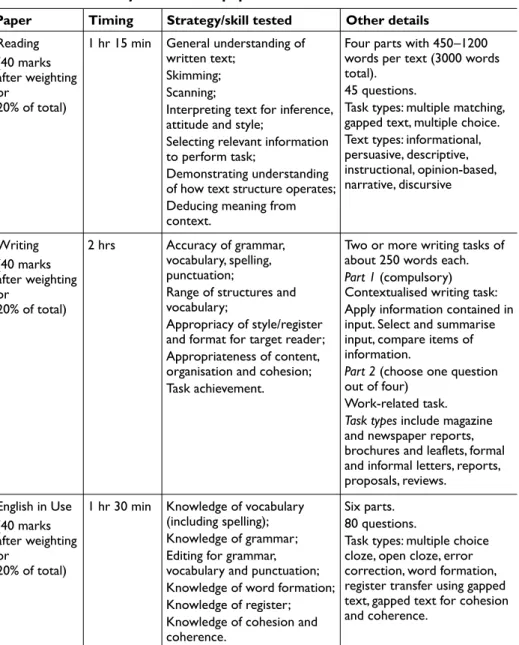
The CAE examination consists of five papers in the areas Reading, Writing, English in Use, Listening and Speaking. Each paper is worth 20% of the total score, and a total of 60% overall is required for a pass. Details about the papers, including the skills and strategies tested in each paper, are contained in Table 1 below.
Table 1: Summary of the CAE papers
Paper Timing Strategy/skill tested Other details
Continued … Six parts.
80 questions.
Task types: multiple choice cloze, open cloze, error correction, word formation, register transfer using gapped text, gapped text for cohesion and coherence.
Knowledge of vocabulary (including spelling); Knowledge of grammar; Editing for grammar, vocabulary and punctuation; Knowledge of word formation; Knowledge of register; Knowledge of cohesion and coherence. 1 hr 30 min English in Use (40 marks after weighting or 20% of total)
Two or more writing tasks of about 250 words each.
Part 1(compulsory) Contextualised writing task: Apply information contained in input. Select and summarise input, compare items of information.
Part 2(choose one question out of four)
Work-related task.
Task typesinclude magazine and newspaper reports, brochures and leaflets, formal and informal letters, reports, proposals, reviews.
Accuracy of grammar, vocabulary, spelling, punctuation;
Range of structures and vocabulary;
Appropriacy of style/register and format for target reader; Appropriateness of content, organisation and cohesion; Task achievement. 2 hrs Writing (40 marks after weighting or 20% of total)
Four parts with 450–1200 words per text (3000 words total).
45 questions.
Task types: multiple matching, gapped text, multiple choice. Text types: informational, persuasive, descriptive, instructional, opinion-based, narrative, discursive General understanding of written text; Skimming; Scanning;
Interpreting text for inference, attitude and style;
Selecting relevant information to perform task;
Demonstrating understanding of how text structure operates; Deducing meaning from context. 1 hr 15 min Reading (40 marks after weighting or 20% of total)
Paper Timing Strategy/skill tested Other details
Source: http://www.cambridgeesol.org/exams/cae.htm (accessed February 3, 2005)
From this description, it would seem clear that for many CAE candidates, a preparation course is advisable, because of the comparatively complex nature of the test tasks and the test as a whole (for example, knowledge of register and genre in both the English in Use paper and the Writing paper). It is perhaps not surprising, then, that about 80% of candidates undertake a preparation course before sitting the examination (CAE handbook 2001). Davidson and Bachman (1990) argue that the Cambridge ESOL examina-tions are better described as courses of study, rather than as tests of proficiency which measure language ability regardless of test preparation (such as, in theory, TOEFL). Unlike American agencies such as the Educational Testing Service (which produces TOEFL), which see themselves as autonomous, independent, objective providers of reliable information on educational measurement, Cambridge ESOL Examinations (also referred to as University of Cambridge Local Examinations Syndicate UCLES) is a semi-centralised testing agency, which confers with members of the education community to offer exams that are certifications of a level of achievement:
[S]ince [Cambridge ESOL] tests are the results of interaction with many other persons and agencies in British education, the concept of an exam is itself broader than a test. In U.K. education, an exam is better characterized as a course of study. It denotes both a given measurement event and the curriculum leading up to that event. In this scheme, tests are usually seen as certifications. For example, when a candidate takes the FCE, the score is reported as a certified level of achievement. The candidate may take that certificate to, for example, a potential employer as proof of ‘having the FCE’. (Davidson and Bachman 1990: 25) Face-to-face oral interaction with examiner and up to three candidates.
Four parts: Interview, individual long turn, collaborative task (with partner(s)), discussion (with partner(s) and examiner) Candidates provided with stimulus materials, eg photographs, drawings. Fluency;
Accuracy;
Range of structures and vocabulary; Pronunciation; Interaction; Task achievement. 15 min approx. Speaking (40 marks after weighting or 20% of total)
Tape-recording and booklet test. Candidates listen to several passages and respond to items on each passage.Text sources: interviews,
discussions, lectures, conversations. Understanding general
meaning of spoken text; Extracting detailed and specific information from spoken text; Inferring speakers’ attitudes and opinions. 45 min approx. Listening (40 marks after weighting or 20% of total)
ASHLEY IRVING AND BARBARA MULLOCK
If we accept Davidson and Bachman’s argument, then we would expect a preparation course for any Cambridge ESOL exam to significantly increase a candidate’s chance of success. Surprisingly, though, while Bachman et al (1995) reported that taking a preparation course for the FCE had an impact on test takers’ scores, the impact was not large. Those to ben-efit most from such a preparation course were candidates of lower ability, but the effects were still small. The largest effect was for the English in Use paper (which has some similarity to its equivalent in the CAE).
As noted earlier, we were unable to find any research literature on how the CAE, specifically, is typically taught, or on any teacher’s first attempts to teach it. ‘How to’ literature on teaching exam courses is also relatively rare, though May (1996) provides a series of teaching ideas, and Burgess and Head (2005) provide a more discursive account of suggested teaching approaches. Of interest to this paper, Burgess and Head (2005) comment that in many respects teaching exam classes should differ little from teaching general English classes, partly because the sorts of tasks set in formal (high stakes) examinations tend to resemble language practice tasks contained in most good course books, which in turn resemble as far as possible real-life uses of language.3 However, they point out that there are differences between teaching general English classes and exam classes. These include the extra responsibility entailed in preparing students for high-stakes examina-tions, and the need for disciplined teaching in order to get all students to a required level in a limited time. Such factors reduce the flexibility and scope for creativity and spontaneous decision-making that can characterise general English classes. Another factor is maintaining student motivation, which is important in any course, but becomes more challenging in exam courses because of the pressurised nature of exam preparation courses, where there is a need to provide intense practice on a restricted number of task types and to coach students in exam techniques and procedures. They suggest teachers deal with this by, for instance, building variety and fun into the course, and also by catering to the individual needs and concerns of the students. Finally, Burgess and Head point out that a sound knowledge of the exam itself is essential (2005: 1–2).
WASHBACK
Washback is defined in a number of different ways in the literature. For this paper, the definition that will be adopted is that of Bailey (1996: 259): ‘the influence of testing on teaching and learning’. Alderson (2004: ix) notes there is no longer any doubt washback exists, but the forms it takes, the effects it has, what brings it about and the reasons it occurs are complex and
still under investigation. Space does not permit a lengthy discussion of washback, and for this the reader is directed to Cheng, Watanabe and Curtis (2004) and Spratt (2005).
Empirically based studies have shown that tests may have more impact on instructional content and materials than on teachers’ methodology (Wall and Alderson 1993; Cheng 1997, 2004; Hamp-Lyons 1998; Wall 2000; Andrews, Fullilove and Wong 2002). The curriculum may be narrowed, focusing attention only on those areas most likely to be tested (Alderson and Wall 1993; Lam 1994 cited in Spratt 2005; Cheng 1997, 2004), though this finding is not borne out in all studies (see, for example, Shohamy, Donitsa-Schmidt and Ferman 1996; Watanabe 1996; Read and Hayes 2003). More curriculum time may be devoted to exam preparation than the general language development (Lam 1994 in Spratt 2005), and time constraints may affect content and choice of methodology (Alderson and Hamp-Lyons 1996; Read and Hayes 2003).
Materials designed for exam preparation courses are described by Spratt as ranging from those with high exam technique orientation (relying heavily on parallel exam forms) to those that attempt to develop ‘relevant language skills and language, emphasizing more the content domain from which the exam is derived’ (Spratt 2005: 10). Materials typical of the high exam tech-nique orientation were the focus of Hamp-Lyons’ (1998) study, where she concluded that the skills developed by a number of textbooks for TOEFL preparation courses consisted of test-taking strategies and mastery of lan-guage features, which had been observed on previous forms of the TOEFL test, rather than real-life communicative language use. This, she argued, is in the long run harmful (and of dubious ethicality) for language learners because ‘time and student energy are diverted from mainstream, well-designed language classes, built around appropriate curricula and materials for the proficiency level of the students, into unproductive test-mimicking exercises’ (Hamp-Lyons 1998: 335), which coach merely for score gain without developing true language mastery.
The extent to which teachers use materials at the ‘high exam technique’ end of the continuum varies. Read and Hayes (2003) noted that 90% of institutions surveyed in New Zealand used exam preparation textbooks for IELTS preparation courses. However, in their case study of two IELTS preparation courses, one an intensive IELTS preparation course and the other a more general English for Academic Purposes (EAP) course, there was greater use of exam-like materials in the former than in the latter, which used a wider range of texts and materials. Alderson and Hamp-Lyons (1996) also noted heavy use of exam materials in their study of TOEFL
ASHLEY IRVING AND BARBARA MULLOCK
preparation courses. Teachers in Watanabe’s (1996) study, however, attempted to innovate and use materials they had designed themselves.
The way that teachers teach for exams varies widely (Alderson and Hamp-Lyons 1996; Watanabe 1996; Read and Hayes 2003; Hayes and Read 2004) and can be unpredictable and even unintended (Cheng 1997, 2004; Andrews, Fullilove and Wong 2002). In Shohamy, Donitsa-Schmidt and Ferman (1996), a low-stakes Arabic exam had negligible effect on method-ology, whereas the introduction of a high-stakes English as a Foreign Language exam resulted in preparation that included a number of activities that simulated exam tasks or developed exam skills or strategies. Read and Hayes (2003) noted far higher use of exam-related tasks such as practice tests, homework and general test-taking advice in the intensive IELTS preparation course compared with the more general EAP course.
As regards classroom interaction in relation to washback, Alderson and Hamp-Lyons (1996) observed that exam classes spent less time on pair and group work, that teachers talked more and students less, and there was less laughter than in more general courses. Read and Hayes’ study (2003) supported this finding, with the teacher in the intensive IELTS preparation course spending considerably less time assisting students either individually or in pairs or groups, and more time talking about the test and giving the students advice on test-taking strategies.
While exam preparation courses are widespread, there is little empirical evidence available on whether students have ‘learnt more or learnt better because they have studied for a particular test’ (Wall 2000: 502). As we have reported above, Bachman et al (1995) found that, for the FCE, lower ability learners seem to benefit the most. Read and Hayes (2003) used a retired version of the IELTS exam as a pre- and post-test in their study of IELTS preparation courses, but found no significant score increases between the two groups. Andrews, Fullilove and Wong (2002) also failed to find a statis-tically significant improvement in test scores between a group that had been prepared for a new oral test in Hong Kong and a group that had no such preparation. They concluded that the washback of the new test was limited to ‘familiarisation with the exam format, and the rote learning of exam specific strategies and formulaic phrases’ (Andrews, Fullilove and Wong 2002: 220–1). Perhaps the strongest conclusion that can be drawn from the literature is that the pivotal factor in washback is the teacher: his/her beliefs, attitudes, educational levels, experience and personality appear to be major factors determining the extent and intensity of washback (Alderson and Hamp-Lyons 1996; Alderson 2004; Spratt 2005). There is still need for further research on this aspect of washback, as Alderson (2004: xi) suggests:
much more attention needs to be paid to the reasons why teachers teach [for tests] the way they do. We need to understand their beliefs about teaching and learning, the degree of their professionalism, the adequacy of their training and of their understanding of the nature of and rationale for the test.
Following on from Alderson, one aim of the current study is to investigate the impact of washback on a novice teacher teaching a CAE preparation course for the first time.
TEACHING IN UNFAMILIAR INSTRUCTIONAL CONTEXTS
In TESOL there is little research on how experienced teachers conceptualise new instructional contexts, what pedagogical knowledge and skills they take with them, and what difficulties they face. One study of interest is Burns (1996), which explored the changes and developments in the nature of thinking and beliefs of English as a Second Language teachers, experienced in teaching more advanced learners, as they taught classes of slow-track beginners. Using one teacher as a case study, Burns found the teacher’s pre-active planning was informed primarily by the major concept of tasks, rather than course goals or objectives, about which the teacher was relatively vague. Central to decisions about classroom content and teacher–learner roles were (a) descriptions of the learners and their characteristics, their existing abilities and skills, and their likely progress and (b) beliefs about nature of learning and about learning roles and responsibilities that learners should adopt. The latter principally entailed the importance of learners being self-directed, and of interacting with each other in the classroom. Interestingly, the teacher’s beliefs about interaction in the classroom were in sharp contrast to her instructional behaviour, which was observed to be strongly teacher-centred, with the teacher taking most control of the inter-action. What emerged from the study was a tentativeness in planning, which was shared by all the teachers, and was exacerbated by unfamiliarity with the learner group (Burns 1996: 167–9). The teachers described the process of planning for their learners as ‘feeling their way’ (Burns 1996: 169). A useful framework with which to examine teachers’ first experiences of teaching a new course is Shulman’s (1986, 1987) concepts of pedagogical knowledge and pedagogical reasoning skills. Pedagogical knowledge is
for the most regularly taught topics in one subject area, the most useful forms of representation of those ideas, the most powerful analogies, illustrations, examples, explanations and demonstrations – in a word, the ways of represent-ing and formulatrepresent-ing the subject that makes it comprehensible to others … [Also] an understanding of what makes the learning of specific topics easy or difficult: the conceptions and preconceptions that students of different ages and backgrounds bring with them to the lessons. (Shulman 1986: 9)
ASHLEY IRVING AND BARBARA MULLOCK
Shulman characterised pedagogical reasoning as the process by which the teacher transforms the subject matter of instruction into ‘forms that are pedagogically powerful and yet adaptive to the variations in ability and background presented by the students’ (1987: 15). For TESOL, Burn’s (1996) study (and Shulman’s description above) would suggest that peda-gogical knowledge and pedapeda-gogical reasoning skills are not constant or uniform across different TESOL teaching contexts, but differ according to the nature (or purpose) of the course and learner factors, such as proficiency. We were unable to find any empirical studies of teachers’ experiences in moving from general English language teaching to teaching the CAE or other Cambridge exam preparation courses. Nor were we able to find any empirically based studies on teaching the CAE or allied Cambridge courses (Burgess and Head [2005] offer practical advice, but do not provide an account of empirically based research as such). The area of TESOL teacher education dealing with teachers moving to new instructional contexts (different courses or proficiency levels), then, is an area of teacher education that is clearly underdeveloped.
Our study, then, was an attempt to explore a number of issues relating to how a TESOL teacher may cope with new instructional context, that of teaching an exam preparation course. The major research questions formu-lated included the following:
• What is it like to teach a CAE preparation course for the first time? Which areas are problematic and which are less so?
• How does this experience compare with the experiences of more experi-enced CAE teachers?
• How does washback manifest itself in an exam preparation course taught by a teacher inexperienced in this type of course?
The present investigation METHOD
Primary data for the present study were derived from a journal kept by a novice CAE teacher (the first author) in late 2002. This journal was then subjected to secondary analysis by the second author, and further data were collected from interviews with experienced CAE teachers. These phases are described in more detail below.
In the first phase of the study, the first author (hereafter referred to as the teacher) followed the five-step procedure for journal studies suggested by Bailey (1983, 1990) and Bailey and Ochsner (1983). This included writing
a candid account of the classroom experience, editing this account for public consumption, identifying significant events and, finally, interpreting and discussing factors important to language learning.
In the next phase, secondary analysis was conducted by the second author in the manner outlined in Lincoln and Guba (1985: 347–48). The teacher’s report was read several times, and then details were written of each event, incident or emerging theme on index cards, together with the week of the incident and the page of the journal in which the incident occurred.
Next, two forms of analysis were conducted: course chronology and thematic category. The first form of analysis was designed to assist the second author (who had no experience of teaching the CAE) to gain a deeper understanding of how the course unfolded. In this procedure, the index cards were sorted according to the week during which they occurred, giving a clear picture of the course chronology. The second form of analysis was designed to identify themes and concerns. In this procedure, the index cards were sorted into categories on the basis of intuitive ‘look alike, feel alike’ criteria. Then each category was given a title that summarised the category.4 The sorting process was then repeated twice. In the next stage, the teacher independently reviewed the category titles and definitions and, once agree-ment was reached over these, carried out the sorting process three times. Inter-rater reliability was calculated at 95%.5
As a result of the secondary analysis, a number of interview questions were generated (see Appendix 1). In the third phase, these questions formed the basis of interviews, conducted by the teacher, with seven experienced CAE teachers working in commercial language schools in Sydney. The interview procedure was designed to triangulate and to add perspective to the findings from the journal and secondary analysis. The interviews were audio-recorded, transcribed and cross-referenced with the concerns raised in the journal.
THE SUBJECTS
The teacher
The teacher had approximately 18 months of experience teaching general English in Australia and six months in South America. He had taught the FCE once.6
The students
The class consisted of ten students (four males and six females), only seven of whom were actually candidates for the CAE.7Four of these seven students were also concurrently candidates for the Cambridge FCE, though they
ASHLEY IRVING AND BARBARA MULLOCK
were not attending FCE preparation classes. Their countries of origin included Japan, Thailand, Brazil, Switzerland, Poland and Hungary. Their ages ranged between 18 and the mid-30s, though most were under 25. Some had just completed high school, others their first degree, and yet others had a degree and work experience. Some were taking the course to acquire certi-fication for work or study purpose, and others because of recommendations by friends. The FCE, CAE, and CPE were the only courses in advanced English offered by the institution. All students were required to sit an entrance test before being admitted to the course. This entrance test, with a cut-off mark of 40%, consisted of CAE exam papers from a published test book, but did not include the Writing sub-test. All students obtained excellent results on the reading section of the entrance test, with some close to 100%, while even the weaker students scored more than 70%. These weaker students, however, had far lower scores on the English in Use paper (between 30% and 35%) but were accepted into the course because their average scores exceeded 40%. During the course, many of the students had jobs after school hours.
THE COURSE
The course was held at a commercial language college in Sydney over 12 weeks in 2002.8 A typical day during the course involved five hours in the
classroom, plus some set homework. The materials consisted of a set text-book (O’Connell, 1996, Focus on Advanced English CAE) and a number of supplementary materials provided by a previous teacher.
TEACHER’S EXPECTATIONS
Before the course began, the teacher was confident of his classroom manage-ment skills and teaching methodology, but anticipated difficulties in the organisation of the course (selecting, staging and sequencing activities and tasks) and in coping with the workload. He was also concerned that his knowledge of grammar would not enable him to answer fully students’ questions on language structure. A further concern was that he did not fully understand the Cambridge scoring criteria for the Speaking and Writing papers, finding them opaque.
PRE-COURSE PREPARATION
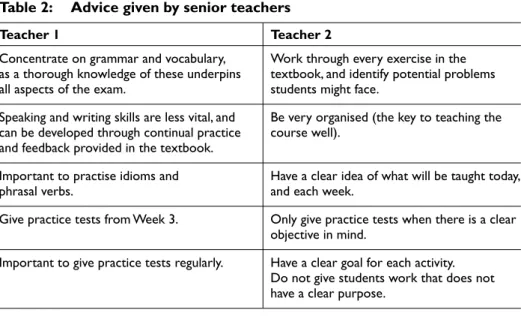
The teacher was provided with no training from the language institution in which he worked. His preparation consisted of studying the course book, and consultations with two colleagues with some experience of the CAE. A summary of their advice is provided in Table 2 below.
Table 2: Advice given by senior teachers
Teacher 1 Teacher 2
Concentrate on grammar and vocabulary, Work through every exercise in the as a thorough knowledge of these underpins textbook, and identify potential problems all aspects of the exam. students might face.
Speaking and writing skills are less vital, and Be very organised (the key to teaching the can be developed through continual practice course well).
and feedback provided in the textbook.
Important to practise idioms and Have a clear idea of what will be taught today,
phrasal verbs. and each week.
Give practice tests from Week 3. Only give practice tests when there is a clear objective in mind.
Important to give practice tests regularly. Have a clear goal for each activity. Do not give students work that does not have a clear purpose.
The Cambridge ESOL Examinations website did not exist at the time the course was conducted, nor had Burgess and Head (2005) been published.
THE EXPERIENCED CAE TEACHERS
The TESOL teaching experience of the CAE teachers ranged between 4 and 12 years, with an average of 8. Their experience teaching the CAE ranged from 1.3 years to 12 years, with an average of 4 years. Four teachers were male and three were female.
Results
In what follows, we examine the chronological stages of the course and then the major thematic categories that emerged from the data. Findings from the interviews are interwoven with the two parts.
THE CHRONOLOGICAL STAGES OF THE COURSE: ANALYSIS ACCORDING TO TIME OF OCCURRENCE
The course appeared to comprise four phases, which we have entitled ‘settling in’, ‘getting serious’, ‘feeling the pressure’ and ‘letting nature take its course’.
‘Settling in’ (Weeks 1–5) was an introductory phase where the teacher was ‘finding his feet’. In this phase he became aware at a fundamental level how the course differed from a general English course. This is best charac-terised by the realisation that his role was different: his role was to help students prepare themselves to pass an examination:
RUNYI CHEN AND BERNARD HIRD
Went through ‘conditionals’ with the students but felt the textbook glossed over it. It didn’t really teach it. This seemed strange to me until I realised, again, this was an exam course. It is expected that the students are already familiar with the grammar points. If they are not, then it is up to them to study and learn these points. The best I can do is present them with supple-mentary material for homework, and correct it with them in class. (Week 1) This realisation had consequences for how best to approach the next 12 weeks with respect to planning and organising the timetable.
The teacher became familiar with the students and, in doing so, became aware of their preferred learning styles, though the implications of these preferences were not apparent to him at this stage:
[The students] respond really well to tasks which are interactive with other students, but not so much to those which require them to work on their own. Not really sure how to solve this one. Will probably just have to leave it for now, and see if this changes closer to the exam, once they start doing far more
actual exam exercises under exam conditions. (Week 3)
In this stage, a number of problems relating to planning, selecting and sequencing, and conducting activities arose. For example, placing writing at the end of the day’s work was not a concern in general English classes, but was counterproductive with the CAE:
Need to try and ensure that writing tasks are not done in the last hour. Interactive exercises involving speaking or exam questions are probably better suited to this time of day. Anything requiring focused concentration is too
dif-ficult because the students are too tired. (Week 4)
Further, student feedback indicated that a small number of lessons were overly teacher-centred, with too much teacher talk, such as the lesson segment described below:
On one day, there were a number of speaking tasks, which the students had to complete with their partners. This in itself was not a problem. However, by the time I explained what I wanted them to do and gave them feedback on how they performed, I had done far more talking than they had! Even though the aim was to get them to practice some exam tasks for the speaking test.
(Week 3) In the second stage, ‘getting serious’ (Weeks 6–7), the teacher became more familiar with the requirements for the Speaking and Writing papers, and more confident about the marking criteria for the Speaking paper. However, understanding the criteria for marking the Writing paper remained prob-lematic. He administered the first set of practice tests for Reading, Listening and Language in Use papers, and the Speaking test was administered by a colleague, who was also a CAE examiner. Writing was not tested, partly
because the teacher considered the writing of two essays per week as homework was sufficient, and partly because of his lack of confidence in understanding the Cambridge marking guides. He was concerned that if he interpreted the criteria incorrectly there could be negative consequences for the students. In addition, a more experienced colleague advised against setting and marking writing tests at this stage of the course.
The results were positive for the Reading and Listening papers, but less positive for English in Use. However, the teacher then became concerned that the tests, which were not past papers but from a course book, were too easy, thus giving results that were misleading. He then decided the students would need to be worked harder if they were to pass the examination.
The third stage, ‘feeling the pressure’ (Weeks 8–11), was characterised by an increase in homework, and an increased incidence of practice testing. In Week 10 the class sat another set of practice tests under exam conditions. While their performance in the Reading, Speaking, and English in Use papers was positive, their performance in the Listening test was not, with no student scoring over 60% (which would constitute a pass in this paper). A full Writing paper was not administered. Instead, the students completed only the compulsory Part 1 task from the textbook. The results of this task were disappointing, indicating, according to the teacher, that the students had failed to practise timed writing adequately outside the class. Burgess and Head (2005: 51) comment that copious writing practice is essential in exam courses, and is commonly assigned for homework to allow optimal use of class time.
In this stage there was an increase in tiredness on the students’ part, with falling attendance and lateness commonplace. The teacher also reported feeling increasingly tired. The following entries from Week 10 are examples:
First two days of the week almost all students were late for class. Four of them missed the listening test, which I wasn’t happy about. They had been told repeatedly what the exam timetable was this week, yet made no effort to be on time. This is a reflection of their general attitude at the moment. (Week 10) Class continues to struggle. Students are now taking days off. Irony is that it is those students who can least afford it. One student appears to have given up. This could be a problem as they can’t practice their speaking exercises with their partner9, so the partner is disadvantaged. This general slip in standards is starting to affect me. Struggling not to lose my temper with them, but they are not making it easy. They are so close to the exam. (Week 10) These problems with student attendance came to a head in Week 11 when the teacher became very stressed. He became so concerned that his
ASHLEY IRVING AND BARBARA MULLOCK
stress was affecting his teaching performance and jeopardising students’ chances of success in the exams that he considered asking for a replacement teacher for the final week. He requested a senior teacher to speak to the students about the issue. This attempt to ‘get the students back on course’ appeared to ‘clear the air’ but also provided a valuable learning experience for the teacher:
Talk with the students was quite productive but I would NEVER ask someone else to do it again for me. Students were quite good. They pointed out that they were aware it was their responsibility to be on time, not mine. That I wouldn’t be blamed if they failed. I told them this was not the issue. It was about respect for the teacher and giving themselves the best chance they could … One girl did make the comment that she was disappointed that I felt the need to get someone else to speak to them. That after all the work we had done together I wasn’t able to speak directly to them myself about this. In hindsight I believe she was correct. I think that the stress of the exams clouded my thinking on this issue. Rather than just get it out in the open and deal with it, I let it build up over time. This was a mistake on my part. (Week 11) The final stage, ‘letting nature take its course’, was the wind-up phase of Week 12. There were few notable events during this week, apart from the start of the official examinations:
The first of the exams are this week. Speaking on Tuesday and Listening on Wednesday. Due to this, it will be a fairly fractured week. The aim is to keep the students reasonably relaxed and positive. This week they will be doing one more [practice] Reading and English in Use test, and another timed essay.
(Week 12) The results of the final examination (released to the teacher two months after the completion of the course) showed that of the eight students who finally sat the test, only three passed. However, the four students who were sitting concurrently for the FCE passed that examination with ease. The fact that the final results were far lower than expected led the teacher to seriously question his own performance during the course.
THEMATIC CATEGORIES
Four major thematic categories emerged from the data: ‘teaching procedures’, ‘student issues’, ‘teacher issues’ and ‘classroom management’.
‘Teaching procedures’ concerned planning, selecting, ordering, and pacing content and learning experiences; resources; and logistics, including the scheduling of homework, and marking. The dominant theme in this cate-gory related to planning, as the teacher had foreseen, and it manifested itself in tentativeness regarding the selection, sequencing and staging of activities.
Many of the planning problems seemed to relate to lack of familiarity with the CAE exam format. Without an intimate knowledge of the exam, it was difficult for the teacher to decide how to structure the course in order to build on learners’ strengths and to address their difficulties in relation to what was required in the exam. The experienced CAE teachers did not think this lack of knowledge was uncommon in a novice CAE teacher. As one teacher commented, ‘The first time you teach CAE you really focus on the exam, understanding it and being one step ahead of the students’ (Teacher 7).
Difficulties in interpreting the scoring criteria for both the Speaking and the Writing tests made it hard for the teacher to help individual students become aware of what areas they needed to improve. This was a major factor contributing to his reticence to give the students the Writing papers as part of the practice test regime. His difficulty in understanding the writing criteria (and thus how to deal with students’ writing problems) persisted through-out the course. Interpreting the writing criteria is a common problem for novice teachers, according to another experienced CAE teacher:
You can’t know the exam that well until you’ve had a couple of classes go through it. Even in terms of marking, some of the writing, for example, your opinion may differ from the examiners, so things like that come with experience. (Teacher 3) Bachman et al (1995) comment that the FCE scoring procedures for subjectively marked sections of the paper place considerable weight on the experience, seniority and the accumulated knowledge of experienced testers about how the procedure has been followed over a number of years. This appears to be the case for the CAE, and so the teacher’s difficulties are perhaps not surprising.
Other planning-related issues seemed to have been caused by a suspension of the teacher’s accumulated knowledge and experience. For example, in Week 4 the teacher realised that he had neglected the vital step of conduct-ing an initial needs analysis, an oversight he believed returned to haunt him throughout the course: he was not able to begin to try to meet student needs early in the course because he was unaware of what they were. Students became aware of weaknesses they needed to work on only during Week 9.
Finally, an interesting aspect of the course was the need to provide a balance between giving adequate practice and maintaining student morale. The following excerpt from Week 6 illustrates this tension:
Students started sitting practice tests this week. The students are all exhausted after three days of exams and course work. Have had to lighten up on the homework this week, and I sent them home early on one day. I know there is a lot of work to do, but it was obvious that an early finish would be of
ASHLEY IRVING AND BARBARA MULLOCK
more benefit. We are however not getting through the material as quickly
as I would like. (Week 6)
In the interviews, three experienced CAE teachers commented that keeping the students motivated and focused was one of the most difficult aspects of teaching the CAE. Teacher 3 puts this most clearly:
The most difficult [thing] could be keeping the momentum going … keeping them focused. I know they are motivated [but] the main work of the exam
course is you’ve got to keep that going. (Teacher 3)
The teachers also confirmed the need to balance the duller aspects of the course with activities that were more entertaining: to ‘teach and motivate the students and keep them interested’ (Teacher 6). In the words of Teacher 4:
You’ve got to have a little bit of something else going on in class to keep the students interested, to reward them, to make it a little bit interesting, to make it a little more fun for them at times … to manage the class and to keep the students motivated and interested … rather than sticking rigidly to your
course book. (Teacher 4)
‘Student issues’ involved student reactions, feelings, motivation, atten-dance and responsibility. Major themes related to tiredness, inadequate student motivation, and learning roles and responsibilities. Tiredness was a major problem with this particular group of learners, and began to affect students as early as Week 3, increasing as the course progressed. Tiredness may also have caused problems with attendance and lateness. The teacher noted that, on average, only three or four students were in attendance for the first half hour of the class each day. After that, the remainder of the class would trickle in, often only attending for as little as two or three hours of the five-hour day.
An ongoing problem was lack of agreement about the learning roles and responsibilities that the learners should adopt. On the part of some students, there was an inability or unwillingness to take responsibility for their own learning (cf Burns 1996):
[An] area that caused me much concern over the course [was that the] majority of students seemed unable or unwilling to take complete responsibility for their studies … They all had different expectations for taking the course and the majority had never studied with the intensity of effort which this course required. They were being asked to step outside their ‘comfort zones’, which is
always difficult. (Journal report)
The teacher became aware of the problem in Week 1, though he attributed it to materials that failed to motivate the students. However, it persisted, as the following quote from Week 9 shows:
[I’m] [d]efinitely not testing in class this week. The students know what their particular problem areas are, so will let them work on those. It’s interesting that few students have approached me so far, despite [my] repeatedly asking them to see me if they have any problems. Not many of them are using the listening lab, despite having problems with the listening [results on the practice test the previous week were poor]. They are not really taking full
responsibility for their own studies. (Week 9)
The issue of students accepting responsibility for their own learning is taken up in the ‘Discussion’ below.
There did not seem to be any personal antipathy towards the teacher under-lying the students’ attendance and motivation problems. In fact, a measure of the positive feelings the students had towards the teacher is given by their decision to hold a surprise birthday party for him on his 40th birthday:
Friday was my 40th birthday. The students had worked this out even though I hadn’t told anyone. They held a surprise celebration for me in class. It was obvious they had gone to a lot of trouble and it’s not something that I’ll ever forget. Teaching this course really has been a terrific experience for me, both
professionally and personally. (Week 9)
‘Teacher issues’ involved the teacher’s own reactions and feelings to the course and the students as the course unfolded, his motivation, his know-ledge of course content, and his changing perceptions of his roles and responsibilities as the teacher of a CAE preparation course. These issues were, to some extent, intertwined.
The major teacher-related issues were the pressures of time management (both in and outside the classroom) and coping with his own tiredness. The teacher, perhaps, felt the pressure more acutely than the students: trying to keep up with the preparation and marking so that he remained ‘just one step ahead of the students’ created significant stress:
There was never enough time to do all the things I wanted and I had to do a lot of work at home in the evenings and on weekends. This meant that other areas, such as my social life, were compromised to a large degree. This was a mistake. The exam class became my main focus for the twelve weeks, which mean than any problems would be magnified and occasionally blown out of
all proportion. (Journal report)
He was unprepared for the problems he would face organising himself to cope with the enormous workload of the course. He comments:
Keeping up with the marking workload is essentially [an issue] of organisation. I found that I needed to set aside one or two nights a week to make sure it was done. Unfortunately I didn’t follow this at the start of the course, which meant I was always trying to catch up. I couldn’t afford to fall too far behind because
ASHLEY IRVING AND BARBARA MULLOCK
it would have made the feedback on the essays redundant. Ideally, the students should have them returned as soon as possible so they can incorporate any comments I made into their next essay. (Journal report) Both the experienced CAE teachers and Burgess and Head (2005) confirm how crucial it is to be well organised when teaching the CAE.
Another complicating issue was knowledge of course content, which, in this context, comprised knowing what, specifically, students needed to be able to know and do in order to pass the CAE examination. For a clearer perspective on this issue, we turn to the data gathered from the experienced teachers. All experienced teachers mentioned the need for high levels of familiarity with, and understanding of, not only the examination format (cf Burgess and Head 2005) but also the marking criteria, available textbooks and supplementary materials. With respect to the examination format, there was general agreement that detailed knowledge of every task on the paper was required, and for some papers this was quite extensive:
The main things [CAE teachers] have to be familiar with are every part of the exam. The Use of English [paper] is probably the one that [teachers] feel [students] need to most work on. [Teachers] need to be familiar with every single question in that. The writing is something [the students] get loads and loads of work on, and [teachers] need to be prepared for every genre that may
come up in the optional section. (Teacher 1)
Teacher 4 pointed out that the knowledge of genre required in the CAE is far more extensive than that required in IELTS:
IELTS [is] just primarily academic, but in the CAE … there is much more of an emphasis on stylistic difference between an informal letter, a composition,
an article, those sorts of things. (Teacher 4)
Also important was knowledge of test-taking techniques, including strategies for attacking each question. One teacher commented that the breadth of knowledge that successful CAE students (and, of course, the teacher) are expected to have makes teaching the course especially difficult, in part because it is hard to find textbooks that adequately cover such a broad and varied range of content knowledge:
I think [what makes the CAE difficult to teach] is the breadth of knowledge that they’re expected to have at that level. When it comes down to collocations or whatever, there are certain things that you’ll have to, I suppose, hope come up in context, or in a text that you’re studying. They’re not necessarily taught
in textbooks. (Teacher 3)
As the course progressed, the novice CAE teacher’s knowledge of the course content developed and deepened, but all stages of the course were a case of ‘feeling the way’ (cf Burns 1996).
Deficiencies in his knowledge of course content meant that preparation, for example, needed great care, especially when there was a lack of congruence between the textbook and supplementary exercises:
The additional exercises that I chose from a supplementary textbook turned out to be completely different to the Student’s Book. Also some of the questions were beyond the scope of the course. They were chosen ‘on the fly’ because I hadn’t organised the students’ homework properly. Again, this emphasises the need to ensure that my preparation isn’t rushed, and the importance of doing the exercises beforehand to avoid hidden problems. More thought beforehand could avoid many of these problems. (Week1) The gradualness of the process of acquiring sufficient knowledge of the test appeared, in part, to be due the complexity of the CAE examination. As suggested above (see also Table 1), the complexity rests not only in the test as a whole, but in some of its component tasks (such as in the English in Use and Writing papers). The novice teacher commented, in retrospect, that it was only after teaching subsequent CAE classes that fuller familiarity with the test was achieved. Only through further experience was he able to deepen his knowledge of what was required and increase his confidence in his teaching skills and techniques for this type of course.
In relation to the novice teacher’s knowledge of grammar, despite his early fears of not having sufficient knowledge of grammar to teach the CAE effectively, problems of a grammatical nature surfaced only in Week 1, and were more a result of lack of adequate preparation:
First day, lack of preparation was exposed. Had to give an explanation on gerunds and ‘-ing’ participles, and was patently not clear. Confused the stu-dents further. Tried to give it off the cuff and failed. Didn’t prepare the exercise properly and was found out. Still a good lesson for me early in the course. No excuses, just need to make sure that I’ve done the work required. If I don’t do
it, it will be found out during the lesson. (Week 1)
The teacher commented:
As the course unfolded, my fears [that my knowledge of grammar would not be sufficient] proved to be unfounded. It became pretty clear early in the course that there were no new grammar points to be introduced. It was purely revision of what the students had studied, and I had taught, in the General English courses. As long as I had prepared properly, I was able to anticipate most of the students’ questions. The key was the preparation. This involved doing all the exercises before the students did. (Journal report) The new roles and responsibilities the novice teacher encountered during the course included not only acquiring a sound knowledge of all aspects of the examination itself (including marking criteria) and familiarising his
ASHLEY IRVING AND BARBARA MULLOCK
students with the test format, but also arranging the teaching plan in order to get all students to the required proficiency level in a limited time, coaching them in exam techniques and procedures, and maintaining their motivation during the course. As a consequence of these new roles, significantly more time was required for lesson planning and preparation:
Even though preparation is a very important part of my job [as a CAE teacher], I’m finding that I’m just too tired to do it properly. (Week 3) The process of building test familiarity included the setting up and administering of regular practice tests. It also included interpreting marking schemes and giving corrective feedback. These activities involved acquiring specialised knowledge and skills, some of which the novice teacher devel-oped by working with a Cambridge examiner:
The students were given a full speaking test by a Cambridge examiner. They were not given grades, but rather he spent quite a bit of time after each test going through their performance and giving comments on what they needed to work on individually. [Note that the novice teacher’s lack of content knowl-edge did not allow him to do this as effectively as an examiner.] … One of the issues which came out of these tests was the issue of spoken grammar, and [my] question of how the students can correct it. Possibly by making some individual tapes for the students on their speaking tests and doing some work
based on these. (Week 9)
As with knowledge of the course content, with the passage of time, the teacher developed clearer ideas about the nature of his roles and responsi-bilities as a CAE teacher. Crucially, he realised that spending considerable amounts of time preparing and organising the lessons was blurring his focus, and he was losing sight of the ‘big picture’: the students were the ones who had to try to improve their English and pass the exam. His responsibility lay in ‘setting up the framework for the course’ and then allowing them the opportunity to achieve what they wanted. He could not do this for them. While he could try to motivate them in various ways, ultimately working to improve their English and pass the examination was their responsibility.
‘Classroom management’ involved classroom dynamics and discipline, and contained by far the smallest number of tokens. This theme was regarded as separate from teaching procedures because it concerned inter-personal matters between teacher and students that appeared to be of a nature inherently different to teaching procedures or issues that were merely learner-related.
There were, at times, problems with class dynamics related to a minority of the students who were not sitting the examination, and at times related to individual personalities. Discipline matters, often believed to be unusual
in classes for adult learners, concerned poor student attendance and what the teacher believed was an unproductive attitude:
Already signs of students becoming very comfortable with me and taking small liberties which they wouldn’t usually. As the students are mostly young, I’m not sure if this will be a problem going forward, and whether I will need to re-establish my position as ‘Teacher’. It will depend on their level or maturity. For the moment I will keep going as I am and do my best to stay relaxed and maintain a sense of humour. Just try to enjoy the students. (Week 1) Feiman-Nemser and Floden (1986) point out that a central and funda-mental aspect of all teaching is managing the tension between forming a personal bond with students in order to motivate them to learn, and maintaining authority and discipline in the classroom. The experienced CAE teachers spoke of the importance of getting to know the students and developing a good relationship with them to try to motivate them, but commented that at the same time one had to be ‘strict’ with them, especially as regards homework.
Discussion
It is clear from the journal that the course was stressful for many of the learners, and especially stressful for the teacher. Test anxiety, or negative attitudes and feelings generated by exams in both teachers and learners, are well documented in the research (Alderson and Hamp-Lyons 1996; Shohamy, Donitsa-Schmidt and Ferman 1996; Cheng 1998 cited in Spratt 2005 inter alia). Spratt (2005) comments that test anxiety is one of a number of factors outside the exam itself that influences the extent and intensity of washback.
In the current study, the learners’ stress would appear to be related, in part, to their inability to devote their full attention to the course because of ambiv-alent attitudes towards the course and/or work commitments. Motivation, then, appeared to be a major problem for some students in the present study. It may have been the case that some of the students had ‘got talked into doing’ the CAE by their friends, and such students, according to the experienced CAE teachers, commonly suffer from lack of motivation. The other students who may have lacked sufficient motivation were those who were not sitting the exam, and whose attitude may have rubbed off on other members of the class. Some experienced teachers confirmed that this factor could make teaching CAE classes difficult. They commented that students not taking the exam could be quite resistant to exam practice activities, and their presence in the classroom could shift the focus in the course towards a curriculum that was ‘more general in approach’ with ‘more communicative’ tasks (Teacher 3). In the end, this tends to make no one happy:
ASHLEY IRVING AND BARBARA MULLOCK
the students who aren’t doing the [exam], not always but generally, their work ethic is not as strong. They don’t do the homework as much and that can affect the class … If students haven’t done it, that’s really disruptive … It can affect the work ethic [of the other students]. (Teacher 4) It sort of polarises the students, you know. Like, if they’re not taking the exam, they really don’t want to get involved in activities other students want to get involved in. Sort of does make the class jealous, a lot of them. It drags down
the work ethic. (Teacher 6)
However, other experienced teachers did not find this to be the case, so the core problem seems to revolve around the motivation of individual students. Success for students, according to the experienced CAE teachers, is dependent to a large extent on their willingness to put in a number of hours outside class and to work independently. We have mentioned above that amongst many of the learners in the current study, there was perhaps a lack of understanding of the importance of independent work, or an unwillingness or inability to put in the effort. An important role of the teacher in a test preparation course is to develop autonomy, independence and self-reliance in learners (Bailey 1996). These goals are important, not least because of the amount of material that needs to be mastered in a limited time in order to pass the exam. As an experienced CAE teacher commented:
I think the most important thing is teaching the students how to learn themselves, making them become more independent in their learning because there is just so much material to cover. A lot of it has to be done at home and they can’t really rely on the teacher to provide them with all the information. (Teacher 5) Heavy out-of-class workloads tend not to be characteristic of most general English courses (and were not characteristic of the EAP course in Read and Hayes 2003), and it may be the case that in the current study a number of students did not realise how much work would be required outside the class-room in order to pass the exam. Alternatively (or in addition) their language skills may not have been at the level of proficiency whereby they were able to achieve the level required to pass within the 12-week time period. Another possibility is that the entrance test provided misleading results, giving students (and teacher) a false sense of security by allowing them into the course with too low a level of English.
As we have noted, the course was stressful for the teacher, and a number of factors can be put forward to explain this. One, clearly, was the students’ apparent lack of adequate motivation, exacerbated by the inclusion in the class of individual students who were not taking the exam.
However, we would suggest that a major factor contributing to the novice teacher’s stress was related to limitations in what Shulman (1987: 15) refers to as pedagogical content knowledge and pedagogical reasoning skills. As a novice teacher, he had not yet had the opportunity to build up peda-gogical content knowledge of the CAE exam (including its format and marking criteria), the course structure, the materials, and, as is evident from the interviews with the experienced teachers, typical student behaviours and needs. Because of these limitations in knowledge, he experienced difficulties in pedagogical reasoning – the process of transforming knowledge of the subject matter of the course into ‘forms that are pedagogically powerful and yet adaptive to the variations in ability and background presented by the students’ (Shulman 1987: 15). In other words, his lack of knowledge and experience of teaching the CAE meant he had only a limited store of schemata to draw on for planning and sequencing lessons. Without a clear representation of what the learners needed to be able to do (especially for the Writing paper), he found it difficult to formulate an effective overall plan of attack for the course as a whole, or even, in some instances, for particular activity and lesson sequences.
Lest we form the conclusion that the teacher was grossly at fault for the deficiencies in his pedagogical content knowledge and pedagogical reasoning skills, Richards (1998: 86–7) states that lack of pedagogical content know-ledge and reasoning skills is common for novice teachers (and perhaps, we might add, inevitable). What experience would seem to bestow on teachers is the ability to conjure up a mental format when they think of a particular kind of lesson (Richards and Lockhart 1994: 118). When they teach subsequent classes, experienced teachers are able to develop, according to the character-istics of the learners that comprise the class, variations on the formats they have evolved. As two of the experienced teachers commented, ‘You can’t know the exam that well until you’ve had a couple of classes go through it’ (Teacher 3).
It is clear from the literature that effective exam preparation attends to exam familiarisation, test-taking strategies and general language development, and these features distinguish an exam preparation course from a general English course. If one doesn’t understand an examination and its format thoroughly, it will be difficult to develop familiarity with the examination in one’s students (cf Andrews, Fullilove and Wong 2002) and to plan effectively. As one teacher put it, ‘ultimately, the main point is [for the students] to be able to pass the exam’ (Teacher 1). To do this, as Hughes (1989: 46) comments, the test must be ‘known and understood by students and teachers’. A further feature that the experienced CAE teachers spoke of was
ASHLEY IRVING AND BARBARA MULLOCK
the development of students’ test-taking strategies or techniques, for example, by getting students to use the preparation time given before the listening test to read through the questions and predict the answers. But a novice teacher may not always be aware of such strategies.
In our study, in order to compensate for limitations in his understanding of the CAE, the teacher based his planning and teaching procedures upon the advanced general English classes he was familiar with, while trying to incorporate some of the snippets of advice given to him by his two more experienced colleagues. These efforts, however, were not always entirely effective. An example is his attempt during the first week of the course to familiarise the students with the exam by introducing, over five days, each of the five papers. When he got to the Writing paper, the lesson ‘went very badly’, with the students failing to become engaged with the lesson. When asked what the problem was, the learners responded that he had talked too much (cf Alderson and Hamp-Lyons 1996; Read and Hayes 2003), they had little to do and they did not understand what they were being asked to do, and consequently they were bored. A senior teacher whom he approached later with his lesson plan confirmed the students’ views, adding that as a whole the lesson lacked a clear purpose, the tasks were ill-defined with no checking of output or comprehension, and the reading required was unfocused and at too high a level. These appear to be teaching mistakes that we would expect novice teachers to produce, yet we find them produced by a well qualified, reasonably experienced teacher. Why? Lack of pedagogical content knowledge and pedagogical reasoning skills specific to the CAE appear to have resulted in a suspension of the teacher’s accumulated knowledge and experience in this instance. The teacher himself went on to comment:
I spent some time mulling over all this feedback … I believe that I spent so much time thinking about what I was going to teach the students that I forgot one important thing. The course was exam preparation for the students. They just want and need to work. They are not there to listen to the teacher, unless absolutely necessary. This is an important lesson and one [of ] which I needed
to be reminded. (Week 1)
It is also worth considering whether a teacher with more substantial years of experience of the TESOL classroom would have faced such problems.10
Two experienced teachers thought that it was important for CAE teachers to have experience of teaching higher levels, though the number of years they had in mind was not mentioned:
I guess teachers need to have a fair degree of experience. They need to be pretty confident with their grammar and vocabulary, or able to prepare them so that when they go into class, they are confident with that material. (Teacher 4)
I think the more experience you have teaching, the easier it is to grasp what
you have to teach in the CAE. (Teacher 6)
However, other teachers though that ‘some experience’ of teaching higher levels was sufficient (Teacher 3), and what was more important was the teacher’s confidence in his or her own ability (Teacher 2):
I taught [my first CAE preparation course] fairly early on in my teaching career. I think it helped me to become a better teacher. It was fairly challeng-ing. It would be fairly challenging for a recently qualified teacher, but if a teacher was confident in their own ability, I wouldn’t have problems putting a recently qualified teacher onto a CAE course. (Teacher 2) There is clearly merit in the argument that the more experience a teacher had in teaching higher levels, the easier it would be adjust to the CAE. However, we would argue that even a highly experienced teacher would face a degree of difficulty in his or her first attempt at teaching the CAE because of the complexity of the examination format, and because of limitations in pedagogical content knowledge and pedagogical reasoning skills. The comments of the experienced CAE teachers support this view. However, further studies are required for confirmation.
A further cause of the teacher’s stress appears to have been insufficient institutional support. First, other than being given the course book, the teacher was provided with no training prior to the course. While it is clear from the interviews that all the experienced teachers used a course book, and that this was the most influential factor in determining the course structure, reading the course book alone would not seem sufficient to give a novice teacher a clear idea about the shape of the course and how it should evolve. Burgess and Head (2005: 2) suggest working through at least one sample paper, though one suspects that while this is useful, it may not be sufficient to develop much familiarity with the test. Possibly it would have been more helpful for the teacher if he had been given the opportunity to co-teach, or even just sit in on, a CAE preparation course.
Second, within his institution there were no mechanisms set up to provide him with formative evaluation by management, or ongoing assistance and support during the course (and the Cambridge ESOL website was not in operation at that time). This could have been valuable for the teacher’s professional development and also helpful for the learners, who as fee-paying students have a right to expect a high level of service. Had management observed some of his lessons, or a ‘buddy’ system been set in place, perhaps some of the stress he felt would have been reduced, and the outcomes for the students improved.
ASHLEY IRVING AND BARBARA MULLOCK
The other significant factor that may have added significantly to the pressure of the teacher’s workload was the fact that the CAE is a high-stakes exam, and his success with the course was strongly tied to his own sense of professional self-esteem. As pointed out by one of the experienced CAE teachers, the reputation of a language school can ride in part on its success rate for Cambridge exams, and this information is often used for promo-tional purposes. There was also a great deal of pressure on the novice teacher because of industry structure factors.11 Like all teachers in his institution,
the teacher was employed on a casual basis. There was a fear, however unfounded, that if his student pass rate was not satisfactory, his job would be under threat.
Hamp-Lyons (1998) sees the role of training teachers for test preparation courses to be an ethical concern for the TESOL industry. She asks where responsibility should lie: with the institutions that run test preparation courses, with textbook writers and publishers, with testing agencies or with teacher education, and raises the possibility of accreditation for teaching test preparation courses. Considering the difficulty experienced by the teacher in the current study in understanding the marking schemes for the Writing paper, and to a lesser extent the Speaking paper, it would seem that the testing agency should take some responsibility for providing training for novice teachers of exam preparation courses. The Cambridge ESOL Examinations website goes some way towards addressing this need, but the seriousness of the problems faced by the teacher in the current study suggest that more elaborate training is necessary, especially in regards to working with the marking schemes for the Speaking and Writing papers. As mentioned above, Bachman et al (1995) observed that scoring procedures for subjectively marked sections of the FCE papers place considerable weight on the experience, seniority and the accumulated historical knowledge of experienced testers about the procedure. The CAE uses similar scoring procedures, so teachers with no previous experience of the CAE (and no access to the Cambridge ESOL website) are at a serious disadvantage in understanding how to inter-pret the marking schemes so as to ensure candidates have extensive familiarity with the examination. There are obvious implications for the students of such teachers too.
In summary, the washback of the CAE on the inexperienced teacher in this study appeared to be intense or strong (Watanabe 2004). It was intense in terms of test anxiety and also in the way it determined to a very considerable extent what happened in his classroom. The teacher became an ‘exam slave’ (Lam 1994 in Spratt 2005: 11), though his attempts to familiarise students with the examination were marred by a lack of clear understanding of the