Routine Practices and
Additional Precautions
In All Health Care Settings, 3
rd
edition
Provincial Infectious Diseases Advisory Committee (PIDAC)
Published: August 2009 Second Revision: July 2011 Third Revision: November 2012
PIDAC: Routine Practices and Additional Precautions in All Health Care Settings | November, 2012 i
The Ontario Agency for Health Protection and Promotion (Public Health Ontario) is a Crown corporation dedicated to protecting and promoting the health of all Ontarians and reducing inequities in health. As a hub organization, Public Health Ontario links public health practitioners, front-line health workers and researchers to the best scientific intelligence and knowledge from around the world. Public Health Ontario provides expert scientific and technical support relating to communicable and infectious diseases; surveillance and epidemiology; health promotion, chronic disease and injury prevention; environmental and occupational health; health emergency preparedness; and public health laboratory services to support health providers, the public health system and partner ministries in making informed decisions and taking informed action to improve the health and security of Ontarians.
The Provincial Infectious Diseases Advisory Committee on Infection Prevention and Control (PIDAC-IPC) is a multidisciplinary committee of health care professionals with expertise and experience in Infection Prevention and Control. The committee advises Public Health Ontario on the prevention and control of health care associated infections, considering the entire health care system for protection of both clients/patients/residents and health care providers. PIDAC-IPC produces “best practice” knowledge products that are evidence-based, to the largest extent possible, to assist health care organizations in improving quality of care and client/patient/resident safety.
Disclaimer for Best Practice Documents
This document was developed by the Provincial Infectious Diseases Advisory Committee on Infection Prevention and Control (PIDAC-IPC). PIDAC-IPC is a multidisciplinary scientific advisory body that provides evidence-based advice to the Ontario Agency for Health Protection and Promotion (Public Health Ontario) regarding multiple aspects of infectious disease identification, prevention and control. PIDAC-IPC’s work is guided by the best available evidence and updated as required. Best Practice documents and tools produced by PIDAC-IPC reflect consensus positions on what the committee deems prudent practice and are made available as a resource to public health and health care providers.
Suggested Citation:
Ontario Agency for Health Protection and Promotion, Provincial Infectious Diseases Advisory Committee. Routine Practices and Additional Precautions in All Health Care Settings. 3rd edition. Toronto, ON: Queen’s Printer for Ontario; November 2012.
NOTES
This document is intended to provide best practices only. Health care settings are
encouraged to work towards these best practices in an effort to improve quality of care. Provincial Infectious Diseases Advisory Committee (PIDAC)
Ontario Agency for Health Protection and Promotion www.oahpp.ca
Tel: 647-260-7100 Email: [email protected]
All or part of this report may be reproduced for educational purposes only without permission. © Queen’s Printer for Ontario, 2012
PIDAC: Routine Practices and Additional Precautions in All Health Care Settings | November, 2012 ii
Routine Practices and Additional
Precautions in All Health Care Settings,
3
rd
Edition
This document is current to November 2012.
November, 2012 revision:
New material in this revision is highlighted in mauve in the text.
Summary of Major Revisions: Page Revision
ALL Replaced the term “barrier equipment” with “personal protective equipment”
ALL Replaced the term “environmental controls” with “control of the environment” vii-xii Added definitions
6 Added Physical Barriers as an engineering control
14-15 Added requirement for mask and eye protection for wound irrigation
16 Clarification of procedures that generate droplets / aerosols and procedures with documented transmission (Box 6)
19 Added requirements for food preparation and dispensing
20 Added legislated requirements for sharps handling
21 Added information on physical barriers
21 Added information on hand hygiene equipment
21 Added information on HVAC systems
23 Added requirements for meningococcal, tetanus and diphtheria vaccines
30 New Table 2 showing clinical syndromes and type of Additional Precautions that should be used
31 Added new information on impact of Additional Precautions on quality of care
32 Added more evidence for using Contact Precautions
38 Added new information on N95 respirator failure
39 Added more guidance for visitors to airborne infection isolation rooms
44 Added information on protective environments
47-48 Added information and new recommendation on staff not eating in care areas
PIDAC: Routine Practices and Additional Precautions in All Health Care Settings | November, 2012 iii
PIDAC-IPC would like to acknowledge the contribution and expertise of the following individuals that participated in the development this document:
PIDAC-IPC Members: Dr. Mary Vearncombe, Chair Medical Director
Infection Prevention and Control, Microbiology Sunnybrook Health Sciences Centre, Toronto Dr. Irene Armstrong
Associate Medical Officer of Health Toronto Public Health, Toronto Donna Baker
Manager, Infection Prevention and Control Bruyère Continuing Care, Ottawa
Anne Bialachowski
Manager, Infection Prevention and Control St. Joseph’s Healthcare, Hamilton
Rena Burkholder
Infection Prevention and Control Professional Guelph General Hospital, Guelph
Judy Dennis
Manager, Infection Prevention and Control Children’s Hospital of Eastern Ontario, Ottawa
Dr. Kevin Katz
Infectious Diseases Specialist and Medical Microbiologist
Medical Director, Infection Prevention and Control North York General Hospital, Toronto
Dr. Allison McGeer Director, Infection Control Mount Sinai Hospital, Toronto Shirley McLaren
Director of Client Services CanCare Health Services, Kingston Dr. Kathryn Suh
Associate Director, Infection Prevention and Control The Ottawa Hospital, Ottawa
Dr. Dick Zoutman
Professor, Divisions of Medical Microbiology and Infectious Diseases
Queen’s University, Kingston
Chief of Staff, Quinte Health Care, Belleville
Ex-officio Members: Erika Bontovics
Manager, Infectious Diseases Policy and Programs Ministry of Health and Long-Term Care, Toronto Dr. Leon Genesove
Chief Physician, Health Care Unit Occupational Health and Safety Branch Ministry of Labour, Toronto
Pat Piaskowski Network Coordinator
Northwestern Ontario Infection Control Network Public Health Ontario, Thunder Bay
Liz Van Horne Scientific Lead
Manager, Infectious Disease Prevention and Control Resources
Public Health Ontario, Toronto Public Health Ontario Staff:
Camille Achonu Epidemiologist
Infection Prevention and Control Dr. Maureen Cividino
Occupational Health Physician
Shirley McDonald
Infection Prevention and Control Specialist /Technical Writer Dr. Samir Patel
Clinical Microbiologist
PIDAC: Routine Practices and Additional Precautions in All Health Care Settings | November, 2012 iv
Table of Contents
Provincial infectious diseases advisory committee (PIDAC) ... I Table of contents ... IV Abbreviations ... VI Glossary of terms ... VII About this document ... XIII Evidence for recommendations ... XIII How and when to use this document... XIII Assumptions and best practices for infection prevention and control ... XIV Routine Practices And Additional Precautions In All Health Care Settings ... 11. Basic Principles ... 1
A. Mechanisms of Transmission of Microorganisms in Health Care Settings: The ‘Chain of Transmission’ ... 1
B. Principles of Routine Practices and Rationale ... 2
C. Principles of Additional Precautions and Rationale ... 3
D. Accountability of Health Care Providers and Health Care Organizations ... 5
2. Best Practices ... 5
A. Routine Practices ... 5
Elements that Comprise Routine Practices ... 5
Routine Practices for Visitors ... 7
Risk Assessment ... 7
Hand Hygiene ... 9
Personal Protective Equipment (PPE) ... 10
Control of the Environment ... 17
Administrative Controls ... 21
Recommendations for Routine Practices ... 24
B. Additional Precautions ... 26
Elements that Comprise Additional Precautions ... 26
Cohorting ... 28
Additional Precautions AND Visitors ... 29
Initiation and Discontinuation of Additional Precautions ... 29
Impact of Additional Precautions on Quality of Care ... 31
Contact Transmission and Contact Precautions ... 31
Droplet Transmission and Droplet Precautions ... 35
Airborne Transmission and Airborne Precautions... 38
PIDAC: Routine Practices and Additional Precautions in All Health Care Settings | November, 2012 v
Protective Environment ... 44
Recommendations for Additional Precautions ... 44
C. Occupational Health and Hygiene Issues ... 47
Post-exposure Follow-up ... 47
Respiratory Protection Program, Fit-testing and Seal-checking ... 47
D. Audits of Compliance with Provision of Feedback ... 48
Summary Of Recommendations For Routine Practices And Additional Precautions In All Health Care Settings ... 49
Appendices ... 56
Appendix A: Ranking System for Recommendations ... 56
Appendix B: Performing a Risk Assessment Related to Routine Practices and Additional Precautions... 57
Appendix C: Decision-Making Related to Accommodation and Additional Precautions ... 59
Appendix D: Time Required for Airborne infection isolation Room to Clear M. tuberculosis ... 62
Appendix E: PIDAC’s Routine Practices Fact Sheet for All Health Care Settings ... 63
Appendix F: Sample Signage for Entrance to Room of a Patient Requiring Contact Precautions in Acute Care Facilities ... 64
Appendix G: Sample Signage for Entrance to Room of a Patient Requiring Contact Precautions in Non-acute Care Facilities ... 65
Appendix H: Sample Signage for Entrance to Room of a Patient Requiring Droplet Precautions in All Health Care Facilities ... 66
Appendix I: Sample Signage for Entrance to Room of a Patient Requiring Droplet and Contact Precautions in Acute Care Facilities... 67
Appendix J: Sample Signage for Entrance to Room of a Resident Requiring Droplet and Contact Precautions in Non-acute Care Facilities ... 68
Appendix K: Sample Signage for Entrance to Room of a Patient Requiring Airborne Precautions in All Health Care Facilities ... 69
Appendix L: Recommended Steps for Putting On and Taking Off Personal Protective Equipment (PPE) ... 70
Appendix M: Advantages and Disadvantages of PPE ... 72
Appendix N: Clinical Syndromes/Conditions with Required Level of Precautions ... 74
PIDAC: Routine Practices and Additional Precautions in All Health Care Settings | November, 2012 vi
Abbreviations
ABHR Alcohol-Based Hand Rub
AIIR Airborne Infection Isolation Room
AP Additional Precautions
ARI Acute Respiratory Infection
ARO Antibiotic-Resistant Organism
CCC Complex Continuing Care
CDI Clostridium difficile Infection
CPE Carbapenemase-Producing Enterobacteriaceae
CSA Canadian Standards Association
DIN Drug Identification Number (Health Canada)
EMS Emergency Medical Services
HAI Health Care-Associated Infection
HEPA High Efficiency Particulate Air
HSCT Haematopoietic Stem-cell Transplant
HVAC Heating, Ventilation and Air Conditioning
ICP Infection Prevention and Control Professional
LTC Long-Term Care
MMR Measles/Mumps/Rubella Vaccine
MOHLTC Ministry of Health and Long-Term Care (Ontario)
MRSA Methicillin-Resistant Staphylococcus aureus
NIOSH National Institute for Occupational Safety and Health (U.S.)
OHA Ontario Hospital Association
OHSA Occupational Health and Safety Act
OMA Ontario Medical Association
PHAC Public Health Agency of Canada
PHO Public Health Ontario
PIDAC Provincial Infectious Diseases Advisory Committee
PPE Personal Protective Equipment
RICN Regional Infection Control Networks
RP Routine Practices
RP/AP Routine Practices/Additional Precautions
RSV Respiratory Syncytial Virus
TB Tuberculosis
PIDAC: Routine Practices and Additional Precautions in All Health Care Settings | November, 2012 vii
Glossary of Terms
Acute Respiratory Infection (ARI): Any new onset acute respiratory infection that could potentially be spread by the droplet route (either upper or lower respiratory tract), which presents with symptoms of a fever greater than 38C and a new or worsening cough or shortness of breath (previously known as febrile respiratory illness, or FRI). It should be noted that elderly people and people who are immunocompromised may not have a febrile response to a respiratory infection.
Additional Precautions (AP): Precautions (i.e., Contact Precautions, Droplet Precautions and Airborne Precautions) that are necessary in addition to Routine Practices for certain pathogens or clinical presentations. These precautions are based on the method of transmission (e.g., contact, droplet, airborne).
Administrative Controls: Measures put in place to reduce the risk of infection to staff or to patients (e.g., infection prevention and control policies/ procedures, education/ training).
Aerosol: Small droplet of moisture that may carry microorganisms. Aerosols may be light enough to remain suspended in the air for short periods of time, allowing inhalation of the microorganism.
Airborne Infection Isolation Room (AIIR): A room that is designed, constructed and ventilated to limit the spread of airborne microorganisms from an infected occupant to the surrounding areas of the health care setting. This is also known as a negative pressure room. NOTE: The Canadian Standards Association uses the term Airborne Isolation Room, abbreviated AIR.
Airborne Precautions: Used in addition to Routine Practices for clients/patients/residents known or suspected of having an illness transmitted by the airborne route (i.e., by small droplet nuclei that remain suspended in the air and may be inhaled by others).
Alcohol-Based Hand Rub (ABHR): A liquid, gel or foam formulation of alcohol (e.g., ethanol,
isopropanol) which is used to reduce the number of microorganisms on hands in clinical situations when the hands are not visibly soiled. ABHRs contain emollients to reduce skin irritation and are less time-consuming to use than washing with soap and water.
Antibiotic-Resistant Organism (ARO): A microorganism that has developed resistance to the action of several antimicrobial agents and that is of special clinical or epidemiological significance.
Barriers: Equipment or objects used to prevent exposure of skin, mucous membranes or clothing of staff to splashes or sprays of potentially infectious materials.
Carbapenemase: A class of enzymes that inactivate carbapenem antibiotics by hydrolysing them. In almost all instances, these enzymes hydrolyse not only carbapenem antimicrobials but also first- , second- and third-generation cephalosporins and penicillins (e.g., piperacillin-tazobactam). The genetic information to produce carbapenemases is often located on a mobile genetic element (e.g., plasmid, transposon), which frequently also carries resistance to other classes of antimicrobials, such as fluoroquinolones and aminoglycosides.
Carbapenemase-Producing Enterobacteriaceae (CPE): For the purposes of this document, these are Enterobacteriaceae that are resistant to carbapenem antimicrobials (e.g., imipenem, meropenem, ertapenem) through the production of carbapenemase.
Chain of Transmission: A model used to understand the infection process.
CHICA-Canada: The Community and Hospital Infection Control Association of Canada, a professional organization of persons engaged in infection prevention and control activities in health care settings. CHICA-Canada members include infection prevention and control professionals from a number of
PIDAC: Routine Practices and Additional Precautions in All Health Care Settings | November, 2012 viii
related specialties including nurses, epidemiologists, physicians, microbiology technologists, public health and industry. The CHICA-Canada website is located at: http://www.chica.org.
Cleaning: The physical removal of foreign material (e.g., dust, soil) and organic material (e.g., blood, secretions, excretions, microorganisms). Cleaning physically removes rather than kills microorganisms. It is accomplished with water, detergents and mechanical action.
Client/Patient/Resident: Any person receiving care within a health care setting.
Cohorting: The assignment of a geographic area such as a room or a patient care area to two or more clients/patients/residents who are either colonized or infected with the same microorganism, with staffing assignments restricted to the cohorted group of patients. See also, Staff Cohorting.
Colonization: The presence and growth of a microorganism in or on a body with growth and multiplication but without tissue invasion or cellular injury or symptoms.
Complex Continuing Care (CCC): Continuing, medically complex and specialized services provided to both young and old, sometimes over extended periods of time. Such care also includes support to families who have palliative or respite care needs.
Contact Precautions: Used in addition to Routine Practices to reduce the risk of transmitting infectious agents via contact with an infectious person.
Contamination: The presence of an infectious agent on hands or on a surface, such as clothing, gowns, gloves, bedding, toys, surgical instruments, care equipment, dressings or other inanimate objects.
Continuum of Care: Across all health care sectors, including settings where emergency (including pre-hospital) care is provided, hospitals, complex continuing care, rehabilitation hospitals, long-term care homes, outpatient clinics, community health centres and clinics, physician offices, dental offices, offices of other health professionals, public health and home health care.
Direct Care: Providing hands-on care (e.g., bathing, washing, turning client/patient/resident, changing clothes, continence care, dressing changes, care of open wounds/lesions, toileting).
Disinfectant: A product that is used on surfaces or medical equipment/devices which results in disinfection of the surface or equipment/device. Disinfectants are applied only to inanimate objects. Some products combine a cleaner with a disinfectant.
Disinfection: The inactivation of disease-producing microorganisms. Disinfection does not destroy bacterial spores. Medical equipment/devices must be cleaned thoroughly before effective disinfection can take place. See also, Disinfectant.
Droplet Precautions: Used in addition to Routine Practices for clients/patients/residents known or suspected of having an infection that can be transmitted by large infectious droplets.
Engineering Controls: Physical or mechanical measures put in place to reduce the risk of infection to staff or patients (e.g., heating, ventilation and air conditioning systems, room design, placement of hand washing sinks).
Environment of the Client/Patient/Resident: The immediate space around a client/patient/resident that may be touched by the client/patient/resident and may also be touched by the health care provider when providing care. In a single room, the client/patient/resident environment is the room. In a multi-bed room, the client/patient/resident environment is the area inside the individual’s curtain. In an ambulatory setting, the client/patient/resident environment is the area that may come into contact with the client/patient/resident within their cubicle. In a nursery/neonatal setting, the patient environment includes the inside of the bassinette or incubator, as well as the equipment outside the bassinette or incubator used for that infant (e.g., ventilator, monitor). See also, Health Care Environment.
PIDAC: Routine Practices and Additional Precautions in All Health Care Settings | November, 2012 ix Extended Spectrum Beta-Lactamase (ESBL): Enzymes that may be produced by some strains of
Enterobacteriaceae that hydrolyse all cephalosporins, including third-generation cephalosporins such as cefotaxime, ceftriaxone and ceftazidime, as well as aztreonam.
Eye Protection: A device that covers the eyes and is used by health care providers to protect the eyes when it is anticipated that a procedure or care activity is likely to generate splashes or sprays of blood, body fluids, secretions or excretions, or within two metres of a coughing client/patient/resident. Eye protection includes safety glasses, safety goggles, face shields and visors.
Facial Protection: Personal protective equipment that protect the mucous membranes of the eyes, nose and mouth from splashes or sprays of blood, body fluids, secretions or excretions. Facial protection may include a mask or respirator in conjunction with eye protection, or a face shield that covers eyes, nose and mouth.
Fit-Check: See Seal-Check
Fit-Test: A qualitative or quantitative method to evaluate the fit of a specific make, model and size of respirator on an individual. Fit-testing must be done periodically, at least every two years and whenever there is a change in respirator face piece or the user’s physical condition which could affect the
respirator fit.6
Hand Care Program: A hand care program for staff is a key component of hand hygiene and includes hand care assessment, staff education, Occupational Health assessment if skin integrity is an issue, provision of hand moisturizing products and provision of alcohol-based hand rub that contains an emollient. For more information about implementing a hand care program, refer to PIDAC’s Best Practices for Hand Hygiene in All Health CareSettings, available at: http://www.oahpp.ca/resources/pidac-knowledge/best-practice-manuals/hand-hygiene.html.
Hand Hygiene: A general term referring to any action of hand cleaning. Hand hygiene relates to the removal of visible soil and removal or killing of transient microorganisms from the hands. Hand hygiene may be accomplished using soap and running water or an alcohol-based hand rub. Hand hygiene includes surgical hand antisepsis.
Hand Washing: The physical removal of microorganisms from the hands using soap (plain or antimicrobial) and running water.
Health Care-Associated Infection (HAI): A term relating to an infection that is acquired during the delivery of health care (also known as nosocomial infection).
Health Care Environment: People and items which make up the care environment (e.g., objects, medical equipment, staff, clients/patients/residents) of a hospital, clinic or ambulatory setting, outside the immediate environment of the client/patient/resident. See also, Environment of the
Client/Patient/Resident.
Health Care Facility: A set of physical infrastructure elements supporting the delivery of health-related services. A health care facility does not include a client/patient/resident’s home or
physician/dentist/other health offices where health care may be provided.
Health Care Provider: Any person delivering care to a client/patient/resident. This includes, but is not limited to, the following: emergency service workers, physicians, dentists, nurses, respiratory therapists and other health professionals, personal support workers, clinical instructors, students and home health care workers. In some non-acute settings, volunteers might provide care and would be included as health care providers. See also, Staff.
Health Care Setting: Any location where health care is provided, including settings where emergency care is provided, hospitals, complex continuing care, rehabilitation hospitals, long-term care homes,
PIDAC: Routine Practices and Additional Precautions in All Health Care Settings | November, 2012 x
mental health facilities, outpatient clinics, community health centres and clinics, physician offices, dental offices, offices of other health professionals and home health care.
HEPA Filter: High efficiency particulate air filter with an efficiency of 99.97% in the removal of airborne particles 0.3 microns or larger in diameter.7
Hospital-Grade Disinfectant: A low-level disinfectant that has a drug identification number (DIN) from Health Canada, indicating its approval for use in Canadian hospitals.
Infection: The entry and multiplication of an infectious agent in the tissues of the host. Asymptomatic or sub-clinical infection is an infectious process running a course similar to that of clinical disease but below the threshold of clinical symptoms. Symptomatic or clinical infection is one resulting in clinical signs and
symptoms (disease).
Infection Prevention and Control (IPAC): Evidence-based practices and procedures that, when applied consistently in health care settings, can prevent or reduce the risk of transmission of microorganisms to health care providers, other clients/patients/residents and visitors.
Infection Prevention and Control Professional(s) (ICPs): Trained individual(s) responsible for a health care setting’s IPAC activities. In Ontario an ICP must receive a minimum of 80 hours of instruction in a CHICA-Canada endorsed infection control program within six months of entering the role and must acquire and maintain Certification in Infection Control (CIC
®
), when eligible.Infectious Agent: A microorganism, i.e., a bacterium, fungus, parasite, virus or prion, which is capable of invading body tissues and multiplying.
Long-Term Care (LTC): A broad range of personal care, support and health services provided to people who have limitations that prevent them from full participation in the activities of daily living. The people who use long-term care services are usually the elderly, people with disabilities and people who have a chronic or prolonged illness.
Mask: A device that covers the nose and mouth, is secured in the back and is used by health care providers to protect the mucous membranes of the nose and mouth.
Methicillin-Resistant Staphylococcus aureus (MRSA): A strain of Staphylococcus aureus that has a minimal inhibitory concentration (MIC) to oxacillin of ≥ 4 mcg/ml and contains the mecA gene coding for penicillin-binding protein 2a (PBP 2a). MRSA is resistant to all of the beta-lactam classes of antibiotics, such as penicillins, penicillinase-resistant penicillins (e.g., cloxacillin) and cephalosporins.
Mode of Transmission: The method by which infectious agents spread from one person to another (e.g., contact, droplet or airborne routes).
N95 Respirator: A personal protective device that is worn on the face and covers the nose and mouth to reduce the wearer’s risk of inhaling airborne particles. A NIOSH-certified N95 respirator filters particles one micron in size, has 95% filter efficiency and provides a tight facial seal with less than 10% leak.8, 9
Occupational Health and Safety (OHS): Preventive and therapeutic health services in the workplace provided by trained occupational health professionals, e.g., nurses, hygienists, physicians.
Organizational Risk Assessment: An evaluation done by the organization or facility in order to implement controls to mitigate identified hazards.
Personal Protective Equipment (PPE): Clothing or equipment worn for protection against hazards.
Point-of-Care: The place where three elements occur together: the client/patient/resident, the health care provider and care or treatment involving client/patient/resident contact.
PIDAC: Routine Practices and Additional Precautions in All Health Care Settings | November, 2012 xi Portal of Entry: The anatomic site at which microorganisms get into the body, i.e., mucous membranes of nose, mouth and broken skin.
Portal of Exit: The anatomic site at which microorganisms leave the body, i.e., secretions and excretions that exit the respiratory tract, GI tract or broken skin.
Pre-Hospital Care: Acute emergency client/patient/resident assessment and care delivered in an uncontrolled environment by designated practitioners, performing delegated medical acts at the entry to the health care continuum.
Provincial Infectious Diseases Advisory Committee (PIDAC): A multidisciplinary scientific advisory body that provides to the Chief Medical Officer of Health evidence-based advice regarding multiple aspects of infectious disease identification, prevention and control. More information is available at:
http://www.pidac.ca.
Public Health Agency of Canada (PHAC): A national agency which promotes improvement in the health status of Canadians through public health action and the development of national guidelines. The PHAC website is located at: http://www.phac-aspc.gc.ca/new_e.html.
Public Health Ontario (PHO): Public Health Ontario is the operating name for OAHPP. The PHO website is located at: http://www.oahpp.ca.
Regional Infection Control Networks (RICN): The RICN of Ontario coordinate and integrate resources related to the prevention, surveillance and control of infectious diseases across all health care sectors and for all health care providers, promoting a common approach to infection prevention and control and utilization of best-practices within the region. There are 14 regional networks in Ontario. More information is available at: http://www.ricn.on.ca.
Reservoir: An animate or inanimate source where microorganisms can survive and multiply (e.g., water, food, people).
Respirator: See N95 respirator.
Respiratory Etiquette: Personal practices that help prevent the spread of bacteria and viruses that cause acute respiratory infections (e.g., covering the mouth when coughing, care when disposing of tissues).
Risk Assessment: An evaluation of the interaction of the health care provider, the
client/patient/resident and the client/patient/resident environment to assess and analyze the potential for exposure to infectious disease.
Routine Practices (RP): The system of infection prevention and control practices recommended by the Public Health Agency of Canada to be used with all clients/patients/residents during all care to prevent and control transmission of microorganisms in all health care settings.
Safety-Engineered Medical Device: A non-needle sharp or a needle device used for withdrawing body fluids, accessing a vein or artery, or administering medications or other fluids, with a built-in safety feature or mechanism that effectively reduces exposure incident risk. Safety-engineered devices are licensed by Health Canada.
Seal-Check: A procedure that the health care provider must perform each time an N95 respirator is worn to ensure it fits the wearer’s face correctly to provide adequate respiratory protection. The health care provider must receive training on how to perform a seal-check correctly.6
Sharps: Objects capable of causing punctures or cuts (e.g., needles, syringes, blades, clinical glass).
Staff: Anyone conducting activities in settings where health care is provided, including but not limited to, health care providers. See also, Health Care Providers.
PIDAC: Routine Practices and Additional Precautions in All Health Care Settings | November, 2012 xii Staff Cohorting: The practice of assigning specified health care providers to care only for
clients/patients/residents known to be colonized or infected with the same microorganism. These health care providers would not participate in the care of clients/patients/residents who are not colonized or infected with that microorganism. See also, Cohorting.
Susceptible Host: An individual who is at risk for infection.
Terminal Cleaning: The thorough cleaning of a client/patient/resident room or bed space following
discharge, death or transfer of the client/patient/resident, in order to remove contaminating microorganisms that might be acquired by subsequent occupants and/or staff. In some instances, terminal cleaning might be used once some types of Additional Precautions have been discontinued. Refer to PIDAC’s Best Practices for Environmental Cleaning in All Health Care Settings10 for more information about terminal cleaning. Available at: http://www.oahpp.ca/resources/documents/pidac/Environmental%20Cleaning%20BP_ENGLISH_FINAL_2012-07-15.pdf.
Vancomycin-Resistant Enterococci (VRE): Strains of Enterococcus faecium or Enterococcus faecalis that have a minimal inhibitory concentration (MIC) to vancomycin of ≥ 32 mcg/ml. and/or contain the resistance genes vanA or vanB.
PIDAC: Routine Practices and Additional Precautions in All Health Care Settings | November, 2012 xiii
Preamble
About This Document
This document outlines the practice of Routine Practices and Additional Precautions (RP/AP) in health care settings across the continuum of care (see below) including, but not limited to, pre-hospital care, acute care, complex continuing care, rehabilitation facilities, long-term care, chronic care, ambulatory care and home health care.
The goal of Routine Practices and Additional Precautions is to reduce the risk of transmission of microorganisms in health care settings through:
understanding the concepts of the chain of transmission
understanding the concepts and application of Routine Practices (RP)
understanding barriers and enablers that affect compliance with Routine Practices knowing why and when to use Additional Precautions (AP)
using, applying and removing personal protective equipment correctly when indicated for the
protection of the client/patient/resident or the staff member.
For recommendations in this document:
Shall indicates mandatory requirements based on legislated requirements or national standards
(e.g., Canadian Standards Association – CSA).
Must indicates best practice, i.e., the minimum standard based on current recommendations in
the medical literature.
Should indicates a recommendation or that which is advised but not mandatory. May indicates an advisory or optional statement.
Evidence for Recommendations
The best practices in this document reflect the best evidence and expert opinion available at the time of writing. As new information becomes available, this document will be reviewed and updated.
Refer to Appendix A, Ranking System for Recommendations, for grading system used for recommendations.
How and When to Use This Document
The Routine Practices and Additional Precautions set out in this document must be practiced in all settings where health care is provided, across the continuum of health care. This includes settings where emergency (including pre-hospital) care is provided, hospitals, complex continuing care facilities,
rehabilitation facilities, long-term care homes, outpatient clinics, community health centres and clinics, physician offices, dental offices, offices of other health professionals, public health and home health care.
PIDAC: Routine Practices and Additional Precautions in All Health Care Settings | November, 2012 xiv
Assumptions and Best Practices for Infection Prevention and Control
The best practices in this document are based on the assumption that health care settings in Ontario already have basic infection prevention and control (IPAC) systems in place.11 These settings should work with organizations that have IPAC expertise, such as academic health science centres, regional infection control networks (RICN), public health units that have professional staff certified in IPAC and local IPAC associations (e.g., Community and Hospital Infection Control Association (CHICA) – Canada chapters), to develop evidence-based programs.In addition to the above general assumption about basic IPAC, these best practices are based on the following additional assumptions and principles:
1. Adequate resources are devoted to IPAC in all health care settings. See PIDAC’s Best Practices for Infection Prevention and Control Programs in Ontario,11 available from the Public Health Ontario (PHO) website at: http://www.oahpp.ca/resources/pidac-knowledge/best-practice-manuals/infection-prevention-and-control-programs-in-ontario.html.
2. Programs are in place in all health care settings that promote good hand hygiene practices and ensure adherence to standards for hand hygiene. See:
a) PIDAC’s Best Practices for Hand Hygiene in All Health Care Settings,12 available from the PHO website at: http://www.oahpp.ca/resources/pidac-knowledge/best-practice-manuals/hand-hygiene.html. b) Ontario’s hand hygiene improvement program, Just Clean Your Hands, available at:
http://www.oahpp.ca/services/jcyh/.
3. Adequate resources are devoted to Environmental Services/Housekeeping in all health care settings that include written procedures for cleaning and disinfection of client/patient/resident rooms and equipment; education of new cleaning staff and continuing education of all cleaning staff; and ongoing review of procedures. See Best Practices for Environmental Cleaning in All Health Care Settings,10 available from the PHO website at: http://www.oahpp.ca/resources/pidac-knowledge/best-practice-manuals/environmental-cleaning-for-prevention-and-control-of-infections.html.
4. Programs are in place in all health care settings that ensure effective disinfection and sterilization of used medical equipment according to Best Practices for Cleaning, Disinfection and Sterilization in All Health Care Settings,13 available from the PHO website at: http://www.oahpp.ca/resources/pidac-knowledge/best-practice-manuals/cleaning-disinfection-and-sterilization.html.
5. Regular education (including orientation and continuing education) and support is provided in all health care settings to help staff consistently implement appropriate IPAC practices. Effective education programs emphasize:
the risks associated with infectious diseases, including acute respiratory illness and
gastroenteritis
hand hygiene, including the use of alcohol-based hand rubs and hand washing
principles and components of Routine Practices as well as additional transmission-based
precautions (Additional Precautions)
assessment of the risk of infection transmission and the appropriate use of personal
PIDAC: Routine Practices and Additional Precautions in All Health Care Settings | November, 2012 xv
appropriate cleaning and/or disinfection of health care equipment, supplies and surfaces or
items in the health care environment
individual staff responsibility for keeping clients/patients/residents, themselves and
co-workers safe
collaboration between professionals involved in occupational health and IPAC.
NOTE: Education programs should be flexible enough to meet the diverse needs of the range of health care providers and other staff who work in the health care setting. The local public health unit and regional infection control networks may be a resource and can provide assistance in developing and providing education programs for community settings.
6. Collaboration between professionals involved in occupational health and IPAC is promoted in all health care settings, to implement and maintain appropriate IPAC standards that protect workers.
7. There are effective working relationships between the health care setting and local public health. Clear lines of communication are maintained and public health is contacted for information and advice as required. The obligations (under the Health Protection and Promotion Act, R.S.O. 1990, c.H.714) to report reportable and communicable diseases is fulfilled. Public health provides regular aggregate reports of outbreaks of reportable diseases in facilities and/or in the community to all health care settings.
8. Access to ongoing IPAC advice and guidance to support staff and resolve differences is available to the health care setting.
9. There are established procedures for receiving and responding appropriately to all international, national, regional and local health advisories in all health care settings. Health advisories are communicated promptly to all affected staff and regular updates are provided. Current advisories are available from local public health units, the Ministry of Health and Long-Term Care (MOHLTC), Health Canada and Public Health Agency of Canada (PHAC)websites and local RICN.
10.Where applicable, there is a process for evaluating PPE in the health care setting, to ensure it meets quality standards.
11.There is regular assessment of the effectiveness of the IPAC program and its impact on practices in the health care setting. The information is used to further refine the program.11
Occupational Health and Safety requirements shall be met:
Health care facilities are required to comply with applicable provisions of the Occupational
Health and Safety Act (OHSA), R.S.O. 1990, c.0.1 and its Regulations.15 Employers, supervisors and workers have rights, duties and obligations under the OHSA. Specific requirements under the OHSA and its regulations are available at:
Occupational Health and Safety Act: http://www.e-laws.gov.on.ca/html/statutes/english/elaws_statutes_90o01_e.htm
Ontario Regulation 67/93 Health care and Residential Facilities: http://www.e-laws.gov.on.ca/html/regs/english/elaws_regs_930067_e.htm
The Occupational Health and Safety Act places duties on many different categories of individuals
PIDAC: Routine Practices and Additional Precautions in All Health Care Settings | November, 2012 xvi
licensees, officers of a corporation and workers. A guide to the requirements of the Occupational Health and Safety Act may be found at: http://www.labour.gov.on.ca/english/hs/pubs/ohsa/index.php.
The OHSA section 25(2)(h), the ‘general duty clause’, requires an employer to take every
precaution reasonable in the circumstances for the protection of a worker.
Specific requirements for certain health care and residential facilities may be found in the
Regulation for Health Care and Residential Facilities, available at:
http://www.e-laws.gov.on.ca/html/regs/english/elaws_regs_930067_e.htm. Under that regulation there are a number of requirements, including:
Requirements for an employer to establish written measures and procedures for the health and
safety of workers, in consultation with the joint health and safety committee or health and safety representative, if any. Such measures and procedures may include, but are not limited to, the following:
safe work practices
safe working conditions
proper hygiene practices and the use of hygiene facilities
the control of infections
immunization and inoculation against infectious diseases.
The requirement that at least once a year the measures and procedures for the health and
safety of workers shall be reviewed and revised in the light of current knowledge and practice.
A requirement that the employer, in consultation with the joint health and safety committee
or health and safety representative, if any, shall develop, establish and provide training and educational programs in health and safety measures and procedures for workers that are relevant to the workers’ work.
A worker who is required by his or her employer or by the Regulation for Health Care and
Residential Facilities to wear or use any protective clothing, equipment or device shall be instructed and trained in its care, use and limitations before wearing or using it for the first time and at regular intervals thereafter and the worker shall participate in such instruction and training.
The employer is reminded of the need to be able to demonstrate training, and is therefore
encouraged to document the workers trained, the dates training was conducted, and the information and materials covered during training.
Under the Occupational Health and Safety Act, a worker must work in compliance with the Act
and its regulations, and use or wear any equipment, protective devices or clothing required by the employer.
The Needle Safety Regulation (O.Reg 474/07) has requirements related to the use of
hollow-bore needles that are safety-engineered needles. The regulation is available at: http://www.e-laws.gov.on.ca/html/regs/english/elaws_regs_070474_e.htm.
Additional information is available at the Ministry of Labour Health and Community Care Page:
PIDAC: Routine Practices and Additional Precautions in All Health Care Settings | November, 2012 1 Transmission occurs when the
agent, in the reservoir, exits the reservoir through a portal of exit, travels via a mode of transmission and gains entry through a portal of entry to a susceptible host.
Routine Practices and Additional
Precautions in All Health Care Settings
Terms used in this document (see glossary for details and examples)
Health Care Provider: Any person delivering care to a client/patient/resident.
Staff: Anyone conducting activities within a health care setting (includes health care providers).
Health Care Setting: Any location where health care is provided, including settings where
emergency care is provided, hospitals, complex continuing care, rehabilitation hospitals, long-term care homes, mental health facilities, outpatient clinics, community health centres and clinics, physician offices, dental offices, offices of other health professionals and home health care.
1.
Basic Principles
A.
Mechanisms of Transmission of Microorganisms in Health Care Settings:
The ‘Chain of Transmission’
The transmission of microorganisms and subsequent infection within a health care setting may be represented by a ‘chain’, with each link in the chain representing a factor related to the spread of
microorganisms. Transmission does not take place unless all six of the elements in the chain of transmission are present (Figure 1).
Figure 1: The Chain of Transmission
By eliminating any of the six links through effective infection prevention and control measures, or ‘breaking the chain’, transmission does not occur (Figure 2).
PIDAC: Routine Practices and Additional Precautions in All Health Care Settings | November, 2012 2
Transmission may be interrupted when:
the agent is eliminated or inactivated or cannot exit the reservoir
portals of exit are contained through safe practices
transmission between objects or people does not occur due to barriers and/or safe practices
portals of entry are
protected
hosts are not susceptible
Figure 2: Breaking the Chain of Transmission
B.
Principles of Routine Practices and Rationale
Routine Practices are based on the premise that all clients/patients/residents are potentially infectious, even when asymptomatic, and that the same safe standards of practice should be used routinely with
all clients/patients/residents to prevent exposure to blood, body fluids, secretions, excretions, mucous membranes, non-intact skin or soiled items and to prevent the spread of microorganisms.
The consistent and appropriate use of Routine Practices by all health care providers with all patient
encounters will lessen microbial transmission in the health care setting and reduce the need for
Additional Precautions.
The risk of transmission of microorganisms involves factors related to the microbe, the source client/patient/resident, the health care environment and the new host.8
Health care providers must assess the risk of exposure to blood, body fluids and non-intact skin and identify the strategies that will decrease exposure risk and prevent the transmission of microorganisms. This risk assessment followed by the implementation of Routine Practices to reduce or remove risk should be incorporated into the culture of each health care setting and into the daily practice of each health care provider. The goals of Routine Practices are listed in Figure 3.
Health care providers must assess the risk of exposure to blood, body fluids and non-intact skin and
identify the strategies that will decrease exposure risk and prevent the transmission of
PIDAC: Routine Practices and Additional Precautions in All Health Care Settings | November, 2012 3 Figure 3: Goals of Routine Practices
C.
Principles of Additional Precautions and Rationale
Additional Precautions are used in addition to Routine Practices for clients/patients/residents known or suspected to be infected or colonized with certain microorganisms to interrupt transmission. Refer to Appendix N, Clinical Syndromes/ Conditions with Required Level of Precautions, for a list of
microorganisms/diseases that require Additional Precautions.
Additional Precautions include the use of barriers, PPE and control of the environment that are put in place for encounters with the client/patient/resident or their immediate environment. In some
instances, specialized engineering controls may be required (e.g., airborne infection isolation room for a patient with tuberculosis) or enhanced cleaning protocols for the client/patient/resident environment (e.g., Clostridium difficile – C. difficile, vancomycin-resistant enterococci - VRE).
The application of Additional Precautions may differ depending on the health care setting and the needs of the client/patient/resident, particularly in long-term care and the community. More information about Additional Precautions is available in Section 2.B.
Staff in all health care settings must follow Routine Practices and Additional Precautions and facilities must implement a program that includes:
written policies and procedures that include risk assessment
staff education and training in indications and techniques for Routine Practices and
Additional Precautions, including hand hygiene
a program to measure compliance with Routine Practices and Additional Precautions,
including hand hygiene
Routine Practices Prevent Transmission of Microorganisms… …from Patient to Patient …from Patient To Staff …from Staff To Patient
Routine Practices Prevent Transmission of Microorganisms… …from Patient to Patient …from Patient To Staff …from Staff To Patient …from Staff To Staff
PIDAC: Routine Practices and Additional Precautions in All Health Care Settings | November, 2012 4
sufficient and easily accessible PPE (e.g., gloves, masks, eye protection, gowns) available for
health care providers and other staff who are exposed to blood and body substances, with education and training in their use
healthy workplace policies including a sharps injury prevention program;16 staff
immunization program; requirement for staff to remain home if ill with an infection which may be transmitted to clients/patients/residents or other staff; and promotion of
respiratory etiquette for clients/patients/residents and staff
control of the environment to reduce the risks of transmission of microorganisms.
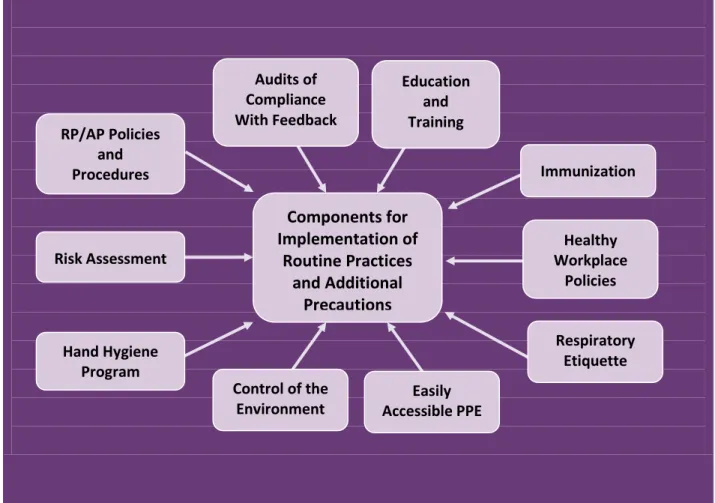
Successful implementation of Routine Practices and Additional Precautions (RP/AP) requires the support of senior administration. Figure 4 shows components required for the successful
implementation of Routine Practices and Additional Precautions in health care facilities.
Figure 4: Components Required When Implementing Routine Practices and Additional Precautions RP/AP Policies and Procedures
Components for
Implementation of
Routine Practices
and Additional
Precautions
Immunization Healthy Workplace Policies Risk Assessment Respiratory Etiquette Hand Hygiene Program Education and Training Audits of Compliance With Feedback Control of the Environment Easily Accessible PPEPIDAC: Routine Practices and Additional Precautions in All Health Care Settings | November, 2012 5
D.
Accountability of Health Care Providers and Health Care Organizations
Adherence to recommended IPAC practices decreases transmission of microorganisms in health care settings.17-21 Despite this, there are numerous studies on the behaviour of health care providers that show poor compliance with hand hygiene22-24 and the use of protective barriers,25-27 placing both staff and clients/patients/residents at risk.
Organizations have a responsibility to have systems in place with established procedures that enable compliance with Hand Hygiene, Routine Practices and Additional Precautions. Both the employer and the employee have duties under the Occupational Health and Safety Act15:
‘An employer shall ensure that the equipment, materials and protective devices as prescribed are
provided’ [S. 25(1)(a)] and ‘the equipment, materials and protective devices provided by the employer are maintained in good condition’ [S. 25(1)(b)];
‘A worker shall use or wear the equipment, protective devices or clothing that his employer
requires to be used or worn’ [S. 28(1)(b)] and ‘a worker shall report to his or her employer or supervisor the absence of or defect in any equipment or protective device of which the worker is aware and which may endanger himself, herself or another worker’ [S. 28(1)(c)].
Preventing transmission of microorganisms to other clients/patients/residents is a patient safety issue, and preventing transmission to staff is an occupational health and safety issue. Health care providers are accountable to practice safely in a manner that protects clients/patients/residents and themselves by following established organizational IPAC policies and procedures.
The consistent and appropriate use of Routine Practices by all health care providers will lessen microbial transmission in the health care setting and reduce the need for Additional Precautions.
2. Best Practices
A.
Routine Practices
Routine Practices refer to infection prevention and control (IPAC) practices to be used with all
clients/patients/residents during all care, to prevent and control transmission of microorganisms in all health care settings. Routine Practices must be incorporated into the culture of each health care setting and into the daily practice of each health care provider to protect both the client/patient/resident and health care provider.
Routine Practices must be incorporated into the culture of each health care setting and into the
daily practice of each health care provider to protect both clients/patients/residents and providers.
ELEMENTS THAT COMPRISE ROUTINE PRACTICES
The basic elements of Routine Practices are listed in Box 1 and include:
a) risk assessment of the client/patient/resident and the health care provider’s interaction with the client/patient/resident;
b) hand hygiene to be performed with an alcohol-based hand rub or with soap and water before and after contact with a client/patient/resident or their environment, before invasive/aseptic
PIDAC: Routine Practices and Additional Precautions in All Health Care Settings | November, 2012 6 Refer to PIDAC’s Best Practices for Hand Hygiene in All Health Care Settings12, available on
the PHO website at: http://www.oahpp.ca/resources/pidac-knowledge/best-practice-manuals/hand-hygiene.html.
Refer to Ontario’s evidence-based Just Clean Your Hands program for more information about hand hygiene; available at: http://www.oahpp.ca/services/jcyh/.
c) control of the environment, including:
appropriate placement and bed spacing, such as single room and private toileting facilities
for clients/patients/residents who soil the environment
cleaning of equipment that is used for/on more than one client/patient/resident between
uses according to the recommendations found in PIDAC’s Best Practices For Cleaning, Disinfection and Sterilization in All Health Care Settings,13 available at:
http://www.oahpp.ca/resources/pidac-knowledge/best-practice-manuals/cleaning-disinfection-and-sterilization.html
cleaning of the health care environment, including safe handling of soiled linen and waste
(e.g., sharps) to prevent exposure and transmission to others, as detailed in PIDAC’s Best Practices for Environmental Cleaning in All Health Care Settings, available on the PHO website at:10 http://www.oahpp.ca/resources/pidac-knowledge/best-practice-manuals/environmental-cleaning-for-prevention-and-control-of-infections.html
engineering controls, such as:
o well-maintained heating, ventilation and air conditioning (HVAC) systems with
sufficient air changes per hour
o barriers, such as the use of Plexiglass
®
screens or curtainso point-of-care sharps containers and alcohol-based hand rub dispensers o adequate dedicated hand wash sinks
d) administrative controls including:
policies and procedures to ensure that staff are able to deal effectively with transmission
risks associated with infectious illnesses
staff education to heighten awareness of infectious diseases, their mode of transmission
and prevention of transmission
healthy workplace policies that exclude staff from working when ill with a communicable
disease that would put clients/patients/residents and colleagues at risk
immunization programs for staff and for clients/patients/residents where applicable respiratory etiquette for both staff and clients/patients/residents
monitoring of compliance with feedback is built into the program to measure compliance
with Routine Practices, including hand hygiene
sufficient staffing levels to enable health care providers to comply with IPAC policies and
procedures
e) sufficient, easily accessible and appropriatePPE to prevent health care provider contact with blood, body fluids, secretions, excretions, non-intact skin or mucous membranes.
PIDAC: Routine Practices and Additional Precautions in All Health Care Settings | November, 2012 7
ROUTINE PRACTICES FOR VISITORS
Although visitors are less likely to transmit infection in the health care setting than staff, they should receive instruction regarding specific facility control measures before they visit a client/patient/resident, to ensure compliance with established practices:
Visitors should not enter the health care setting if they are sick or unable to comply with hand
hygiene and other precautions that might be required.
Hand hygiene before and after visiting should be emphasized.
If PPE is required by the visitor, this should be accompanied by instruction in its correct
application, use and disposal.
Instructional materials may be provided to visitors on recommended hand hygiene and respiratory etiquette practices.
RISK ASSESSMENT
The first step in the effective use of Routine Practices is to perform a risk assessment. A risk assessment must be done before each interaction with a client/patient/resident or their environment in order to determine which interventions are required to prevent transmission during the interaction,28 because the client/patient/resident’s status can change.
The risk assessment process will be a dynamic one, based on continuing changes in information as
care progresses, thus must be done before each interaction with a client/patient/resident.
Assessing Risk of Transmission
The risk of transmission of microorganisms between individuals involves factors related to:
the client/patient/resident infection status (including colonization) the characteristics of the client/patient/resident
the type of care activities to be performed the resources available for control
the health care provider immune status.8
BOX 1: Elements of Routine Practices
Risk Assessment + Hand Hygiene + Personal Protective Equipment
+
Control of the Environment
(Placement, Cleaning, Engineering Controls) +
Administrative Controls
(Policies and Procedures, Staff Education, Healthy Workplace Policies, Respiratory Etiquette, Monitoring of Compliance with Feedback)
PIDAC: Routine Practices and Additional Precautions in All Health Care Settings | November, 2012 8
Table 1 lists factors affecting the risk of transmission of microorganisms in health care settings. The health care provider must perform a risk assessment of each task or interaction that includes:
assessing the risk of:
contamination of skin or clothing by microorganisms in the client/patient/resident
environment
exposure to blood, body fluids, secretions, excretions, tissues exposure to non-intact skin
exposure to mucous membranes
exposure to contaminated equipment or surfaces
recognition of symptoms of infection (e.g., syndromic surveillance).18 See Box 9 for a list of
clinical syndromes requiring the use of PPE and other controls pending diagnosis.
Where there is a risk of transmission of infection based on the risk assessment, appropriate controls must be put into place and appropriate PPE must be used to protect the health care provider, other staff and clients/patients/residents at least until a definitive diagnosis may be made. For example:
If the client/patient/resident has uncontained diarrhea, PPE such as gloves and a gown should
be considered when changing the bed sheets, to prevent contamination of hands and clothing.
If the client/patient/resident is soiling the environment outside of the immediate bed area, a
single room is preferable to limit transmission to other clients/patients/residents.
Use avoidance procedures that minimize contact with droplets (e.g., sitting next to, rather than
in front of, a coughing client/patient/resident when taking a history or conducting an examination).
Refer to Appendix B, Performing a Risk Assessment Related to Routine Practices and Additional Precautions, for more information related to risk assessment.
Table 1: Factors affecting risk of transmission of microorganisms in a health care setting
Microorganism/Infectious Agent
Presence of a large amount of the infectious agent
Low infective dose required for infection (i.e., high infectivity)
High pathogenicity/virulence
Airborne-spread
Able to survive in the environment
Able to colonize invasive devices
Able to exist in an asymptomatic/carrier state Source Client/Patient/Resident
Incontinent of stool and stool not contained by incontinence products
Draining skin lesions or wounds not contained by dressings
Copious uncontrolled respiratory secretions
Inability to comply with hygienic practices and IPAC precautions
PIDAC: Routine Practices and Additional Precautions in All Health Care Settings | November, 2012 9
Environment
Inadequate cleaning
Shared care equipment without cleaning between clients/patients/residents
Crowded facilities
Shared facilities, such as multi-bed rooms (e.g., toilets, sinks, baths)
High patient-nurse ratio Susceptible Host
Patient in intensive care unit or requiring extensive hands-on care
Patient has invasive procedures or devices
Non-intact skin (client/patient/resident or staff)
Debilitated, severe underlying disease
Extremes of age
Recent antibiotic therapy
Immunosuppression
Lack of appropriate immunization
Inadequately educated, trained or non-compliant staff
Adapted from: Routine Practices and Additional Precautions for Preventing the Transmission of Infection in Health Care; Health Canada, CCDR July 1999; Vol. 25 Supplement 4: p.19
HAND HYGIENE
Hand hygiene is considered the most important and effective ipac measure to prevent the
spread of health care-associated infections. In order to implement a comprehensive hand
hygiene program in a health care facility, refer to:
Ontario’s evidence-based Just Clean Your Hands hand hygiene improvement program for hospitals and long-term care,29 available at: http://www.oahpp.ca/services/jcyh/.
PIDAC’s Best Practices for Hand Hygiene in All Health Care Settings,12 available on the PHO website at: http://www.oahpp.ca/resources/pidac-knowledge/best-practice-manuals/hand-hygiene.html.
The World Health Organization’s Clean Care is Safer Care hand hygiene campaign is available at:
http://www.who.int/gpsc/en/.
Hand Hygiene Program
A multifaceted, multidisciplinary, facility-wide hand hygiene program, which includes demonstrable administrative leadership, education, champions and environmental enablers can be effective at reducing the incidence of HAIs.19, 30
All health care settings must implement a comprehensive hand hygiene program that incorporates the following elements11:
the program is multifaceted and multidisciplinary to provide leadership and decision-making hand hygiene agents are available at point-of-care in all health care settings
education is given to health care providers about when and how to clean their hands
PIDAC: Routine Practices and Additional Precautions in All Health Care Settings | November, 2012 10
Health care facilities must also include11:
senior and middle management support and commitment to make hand hygiene an
organizational priority and address non-compliance
environmental changes and system supports, including alcohol-based hand rub (ABHR) at the
point-of-care and a hand care program
ongoing auditing and observation of hand hygiene practices, with feedback to health care
providers
client/patient/resident engagement
opinion leaders and champions modeling the right behaviour.
Alcohol-based Hand Rub (ABHR)
To make it possible for health care providers to clean their hands at the right time, ABHR or a hand hygiene sink must be provided at the point-of-care, where busy health care providers can clean their hands without leaving the client/patient/resident.31 ABHRs are the preferred method to routinely decontaminate hands in clinical situations when hands are not visibly soiled as they provide for a rapid kill of most transient
microorganisms, are less time-consuming than washing with soap and water and are easier on skin.19, 32-35
PERSONAL PROTECTIVE EQUIPMENT (PPE)
PPE is used to prevent transmission of infectious agents from patient-to-staff. The same
equipment will also prevent transmission from patient-to-patient, to-patient and
staff-to-staff.
PPE is used alone or in combination to prevent exposure, by placing a barrier between the infectious source and one’s own mucous membranes, airways, skin and clothing.8, 18 The selection of PPE is based on the nature of the interaction with the client/patient/resident and/or the likely mode(s) of
transmission of infectious agents. Selection of the appropriate PPE is based on the risk assessment (e.g., interaction, status of client/patient/resident) that dictates what is worn to break the chain of
transmission. For more information about risk assessment, see Section 2.A., Risk Assessment, and Appendix B, Performing a Risk Assessment Related to Routine Practices and Additional Precautions. PPE should never be used indiscriminately and overuse may have negative impacts, such as:
interference with quality of client/patient/resident care36, 37 (see also Section 2.B, Impact of
Isolation on Quality of Care)
waste and increased cost
staff may be less likely to wash their hands when wearing gloves for routine tasks
shortages of PPE that result in inappropriate use (e.g., re-use of gloves and gowns), leading to
increased transmission of microorganisms38, 39
environmental concerns relating to disposable PPE, washing agents and chemicals.
PPE should be put on just prior to the interaction with the client/patient/resident. When the interaction for which the PPE was used has ended, PPE should be removed immediately and disposed of in the appropriate receptacle. The process of PPE removal requires strict adherence to a formal protocol to prevent recontamination.40 Refer to Appendix L, Recommended Steps for Putting On and Taking Off Personal Protective Equipment (PPE), for instructions for putting on and taking off PPE.