Abstract
This dissertation sets out to explore what appears to be a fast growing trend within the international community towards making human rights the point of departure of its development agendas. Alongside the new rights agenda lays the agenda derived from the international development targets, which mainly focus on poverty and human development. Subsequently, the importance and focus has been increasing within the international community over the past few years on a new approach which combines human rights and development. This approach is most commonly known as the rights-based approach to development (RBA).
In this dissertation the objective is to seek an understanding of what the RBA is and if it can live up the expectations placed upon it, such as it being the key to ending poverty and making development work a thing of the past. The study uses qualitative research methods in its attempt to realize its objectives. A sizeable amount of data collection in the form of literature researched and analysis was conducted along with interviews and observational analysis. In order to get a sense of how the RBA is understood and used by international organizations and to some degree how it works on the ground the study focused its attention on the UNICEF National Committee in Iceland and the Save the Children organization in Iceland
The dissertation concludes that there are many difficulties and challenges faced by the RBA. The promoters of the RBA need to demonstrate that the approach is more than just rhetorical fluff that offers little to the real problems faced by people on the ground. RBA must be designed, applied and understood in such a way that development workers and practitioners without being human rights lawyer, PhD in development studies or carrying any other professional title can participate in and benefit from the approach. Furthermore, difficult moral and judicial question are also faced by the RBA. However it is the researcher’s
opinion that if the critical issues identified in this dissertation can have a satisfactory solution this approach will be a force to be reckoned with and can offer a window of opportunity and hope for positive change in international development.
Úrdráttur
Mannréttindi skipa sífellt veigameiri sess innan alþjóðasamfélagsins, þar með talið innan þróunargeirans. Samfara auknu vægi mannréttinda hefur sú
hugmyndafræði notið vaxandi fylgis að efling mannréttinda sé órjúfanlegur hluti árangursríkrar þróunarsamvinnu. Afsprengi þessarar hugmyndafræði er hin svo kallaða „réttindamiðuð nálgun að þróun” (e. rights-based approch to
development) sem sameinar bæði hugsjónir og markmið mannréttinda og þróunar. Markmið þessarar meistararitgerðar í þróunarfræðum og
alþjóðasamskiptum er að varpa ljósi á þá hugmyndafræði sem býr að baki
réttindamiðaðri nálgun að þróun. Leitað er svara við spurningum á borð við hvað réttindamiðuð nálgun að þróun sé og hvort hún geti mögulega staðið undir þeim markmiðum sem margir telja að hún geti komið til leiðar, eins og til dæmis að þróunarsamvinna verði óþörf. Rannsóknin byggir á eigindlegri aðferðafræði en slíkar rannsóknir fela m.a. í sér að safnað er fjölbreyttum gögnum sem
rannsakandinn síðan túlkar. Tekin voru viðtöl og þátttökuathuganir framkvæmdar, auk textagreiningar samkvæmt þessari aðferðafræði. Í því augnamiði að auka skilning á upplifun starfsfólks alþjóðlegra stofnanna sem notast við réttindamiðað nálgun, og að vissu leiti hvernig nálgunin virkar í framkvæmd, var sjónum fyrst of fremst beint að Barnahjálp Sameinuðu þjóðanna og Barnaheillum á Íslandi.
Það er niðurstaða rannsóknarinnar að víða er pottur brotinn þegar kemur að réttindamiðaðri nálgun að þróun. Talsmenn þessarar nálgunar þurfa að sýna fram á að nálgunin sé meira en uppskrúfuð orðræða sem býður ekki uppá raunverulegar lausnir á þeim vandamálum sem fólk í þróunarríkjum stendur frammi fyrir. Réttindamiðuð nálgun að þróun þarf að vera þannig úr garði gerð að þeir sem starfa innan þróunargeirans þurfi ekki að vera mannréttindalögfræðingar, doktorar í þróunarfræðum eða bera sambærilega titla til að taka þátt í og njóta þess sem nálgunin hefur uppá að bjóða. Réttindamiðuð nálgun að þróun stendur einnig frammi fyrir flóknum siðferðilegum og réttarfarslegum spurningum. Þrátt fyrir allt er það þó skoðun rannsakandans að takist talsmönnum nálgunarinnar að bæta ákveðinn vanda sem nálgunin stendur frammi fyrir þá sé hún sannarlega komin til að vera og hefur alla burði til að vera boðberi vonar og jákvæðra breytinga á þróunarferlinu.
Acknowledgements
This masters dissertation, The Rights-Based Approach; a New Era for International Development? is the final project in Development Studies and International Relations at the School of Social Sciences at the University of Iceland, worth 60 ECTS units. The main adviser for this dissertation was Professor Jónína Einarsdóttir at the faculty of anthropology.
I would like to thank all those who participated in this research, both at UNICEF Iceland and Save the Children Iceland, where I was welcomed into their place of work and the staff set aside valuable time to share their thoughts and ideas with me. I would also like to express my gratitude to all those who in one way or another contributed to the research and helped shape the final conclusions through interviews and sharing information.
I am deeply indebted and grateful to my friends and family, especially my father, Jóhann Haukur Sigurðsson for providing the support, encouragement and means necessary to complete this dissertation.
Heartfelt thanks also go to Ingunn Ásdísardóttir who carefully proof-read the dissertation.
I would also like to express my gratitude to UC Berkeley for giving me an invaluable opportunity to study and do research at that prestigious institution. I thank my adviser at UC Berkeley, Professor Jerry Sanders for all his help and advice.
Last but certainly not least, I am especially grateful to my main adviser, Professor Jónina Einarsdóttir, for all her precious help and guidance.
Contents
Abstract ...3 Úrdráttur...4 Acknowledgements ...5 Contents ...6 Introduction...8Chapter 1: The origin of human rights ...10
1.1. The birth of human rights... 10
1.1.2 Religious visions...11
1.1.3 Philosophical visions...15
1.3. The United Nations ... 17
1.2.1 Human Development and Human Rights...19
Chapter 2: Rights-based approach to development ...21
2.1. What is a human rights-based approach?... 22
2.2. Adopting a rights-based approach to development. ... 26
2.2.1. Legal basis...26
2.2.2. Normative framework...27
2.2.2.1. Universality and indivisibility:...27
2.2.2.2. Equality and non-discrimination...28
2.2.2.3. Participation and inclusion...28
2.2.2.4. Accountability and the Rule of Law...29
2.2.3. Process goals... 32
2.3. Needs-based approach versus a rights-based approach... 32
Chapter 3: Criticism and challenges ...35
3.1. Rights-discourse: Utopia or reality? ... 35
3.2. Cultural relativism ... 43
Chapter 4: Research Methodology ...46
4.1. Qualitative research ... 47
4.2. Ethnography... 48
4.3. Literature analysis ... 49
4.4. Interviews and observational analysis ... 49
4.6. Choosing the research topic... 51
Chapter 5: The academic community and RBA ...52
5.1. Conclusion ... 57
6.1. The Convention on the Rights of the Child ... 57
6.1.1. Basic human rights standards and the CRC...60
6.1.2. The right to life and development...61
6.1.3. The right to education and equality...62
Chapter 7: UNICEF and the RBA to development...63
7.1. The history of UNICEF ... 63
7.1.2. UNICEF: mission and mandate... 65
7.1.2.1. Elimination of All Forms of Discrimination against Women...66
7.2. UNICEF’s process towards a RBA ... 67
7.2.1. Communication – the process of realizing rights. ... 68
7.3. Theoretical components of a RBA within UNICEF ... 71
Chapter 8: Save the Children ...77
8.1. History of Save the Children ... 78
8.2. Save the Children’s RBA ... 80
Chapter 9: UNICEF Iceland and SC Iceland...84
9.1. Everything rights-based ... 85
9.2. Convention on the Rights of the Child and the Millennium Development Goals ... 87
9.3. Advocacy and politics ... 88
9.4. Fundraising ... 91
9.5. Knowledge ... 92
9.6. Project choice ... 94
9.7. Ownership, participation, democracy... 95
9.8. Rights-Based Approach in the field. ... 97
9.9. Knowledge in the field ... 98
9.10. Ownership in the field ... 99
Chapter 10: Discussion ...99
Conclusion...108
Reference list ...111
Annex I: ...121
Introduction
There seems to be a fast growing trend within the international community (both within the United Nations (UN) and other international bodies) towards making human rights the fulcrum of its development agendas. The new rights agenda runs parallel with the agenda derived from the international development targets, which mainly focus on poverty and human development. Consequently, the importance and focus has been increasing within the international community over the past few years on a new approach which combines both human rights and development. This approach is most commonly known as either the rights-based approach to development or the human rights-based approach to development.
Much praise and excitement has surrounded the debate of the rights-based approach. However, it is legitimate to ask whether a rights-based approach offers value-added over a poverty or human development approach? Is a rights discourse simply another form of advocacy for human development or does it signal the beginning of a new era; a new framework for all stakeholders that guides the development agendas?
Thus, the aim of this research is to make an effort to answer these
questions, and many others that arise, such as: What is a right-based approach to development? What are human rights? How do human rights and development relate? Is there a consensus among development practitioners and staff at international organizations, on what that approach means? What is the rhetoric surrounding human rights and development in the academia? How does it work in the field?
There are mainly two reasons why this research topic was chosen. Firstly, there is the researchers general interest in the issue of human rights (in theory and practice), sparked largely by volunteering for Amnesty International in 2004. Secondly, receiving a full scholarship to study for one year (2006-2007) as a Visiting Research Scholar at the prestigious, University of California, Berkeley, presented a unique opportunity to really delve into the topic of human rights. This led to the researchers “discovery” of the rights-based approach to development, an approach which brings together the researcher two main fields of interest (i.e. human rights and development).
In chapter one the historical background of human rights (its visions, concepts and ideology) from its religious origins to its role within the United Nations are broadly examined. The relationship between human rights and human development is also discussed. The theoretical background for the study will be presented in chapter two, consisting of a literature review of issues related to the rights-based approach. In chapter three, the study looks at the critical debates surrounding the rights-based approach and some challenges it faces. Then in chapter four the research design of the study is outlined. Furthermore, the chapter presents the background of choosing a research topic. The rhetoric surrounding human rights and the rights-based approach to development in one of the worlds most extinguished academic institutions (as representative of the academic community) will be the subject of chapter five. Through the ethnographic apparatus, mainly the observational analysis, the researcher examines how the issues and concepts of human rights and a rights-based approach to development are approached in that influential community. Chapter six then narrows the focus of the rights-based approach to address its effect on issues concerning the rights of the child. Chapters seven and eight, present an overview of the history of the United Nations Children’s Fund (UNICEF) and Save the Children (SC) and the theoretical background behind their project/program application of the rights-based approach to development.
Finally, the interviews and observational analysis conducted at UNICEF’s and SC’s country offices in Iceland will be outlined in chapter nine followed by discussions and the conclusion of the research.
Chapter 1: The origin of human rights
This chapter will attempt in broad-brush strokes to shed light on the history and origin of human rights and how it relates to international development. It will begin by looking at the religious visions that constituted the birth of human rights ideology followed closely by its philosophical visions. The focus is then narrowed towards the West where it can be said that human rights got structured into the legal and moral framework that are known today, especially with the foundation of the United Nations. Finally, the relation between human rights and human development will be discussed. What, if anything, do they share in common? How did their “union” bring life to the so called Rights-Based Approach (RBA) to development? These and other questions will be discussed in this chapter which should shade some light on the enormous historical context that the approach (i.e. an RBA) originates from.
1.1. The birth of human rights
Professor Lauren1 (1998: 4) points out in his book, The Evolution of International Human Rights, that
…the historical origins of powerful visions capable of shaping world events and attitudes like those of international human rights are rarely simple. Instead they emerge in complicated and interrelated ways from the influences of many forces, personalities and conditions in different times and diverse settings.
According to Lauren (1998), the history of human rights, or more correctly, the vision of it did not really have any single birthplace or origin, such as Western cultures or societies. It can be traced to different parts of the world, different
1
Prof. Paul Gordon Lauren is an internationally-recognized scholar and teacher on international relations, diplomacy and human rights.
cultures, religions and philosophies. In fact, it has been with men and women ever since they abandoned nomadic life and settled in organized societies.
In addition to being complex, Lauren (1998) argues, the visions of human rights can also be very disturbing and deep, because they have a way of striking at our very core and compel us to face difficult and disturbing issues, such as human nature and what it means to be human, these visions view both the best and the worst of human behavior and question how we ought to relate to one another. They force us to examine the purpose of government and the exercise of power and last but not least question our own actions and values in relation to those who suffer. Lauren points out the evolution of human rights did not start with
assertions of entitlement or demand for human rights but with the discussion of
duty.
1.1.2 Religious visions
If I define my neighbor as the one I must go out to look for, on the highways and by ways, in the factories and slums, on the farms and in the mines, –then my world changes. This is what is happening with the “option for the poor,” for in the gospel it is the poor person who is the neighbor par excellence….
Gustavo Gutiérrez, The Power of the Poor in
History.2
Despite their vast differences, complex contradictions, internal paradoxes, cultural variations, and susceptibility to conflicting interpretation and fierce argumentation, Lauren (1998) argues, all of the major religions seek in one shape or form to speak to the human responsibility to others. Therefore, they share a universal interest in addressing the integrity, worth and dignity of all persons and consequently, the duty toward other people who suffer without distinction (Lauren 1998).
In Hinduism, for example, the worlds oldest religion, the sacred scriptures address “the existence of good and evil, wisdom, the necessity for moral behavior,
2
A quote taken from Paul Farmer’s book, Pathologies of Power: health, human rights and the new war on the poor (2005:139).
and especially the importance of duty (dharma) and good conduct (sadachara)
towards others suffering in need” ( Lauren 1998: 5). All human life, no matter who it belongs to, is considered sacred and worthy of love and respect. According to Lauren, the most important ethical principle found in Hinduism, and one that became very important to Mahatma Gandhi, is the non-injury of others. It is universally and directly stated as follows: “Non-injury (ahimsa) is not causing pain to any living being at any time through the actions of one’s mind, speech or body” ( Lauren 1998: 5).
Similar trends can be found in Buddhism, maintains Lauren (1998). Some 2500 years ago its founder, Siddhartha Gautama also addressed the universal issues of human relationships, the equal worth of the life of each person and the showing of compassion for other people’s pain and suffering. Siddhartha Gautama also adamantly attacked the caste system in India of his day consequently opening his order to everyone, regardless of his or her social or political position. His followers where urged to practice universal brotherhood and equality. Perhaps the following quote by the current religious leader of Buddhists, the Dalai Lama, helps explain the kind of ethics this religious tradition is based on? “The world’s problems will be solved only by showing kindness, love and respect for all humanity as brothers and sisters…and if we understand each other’s fundamental humanity, respect each other’s rights and share each other’s problems and sufferings” ( Lauren 1998: 6).
It is hard to say whether one should include Confucianism in this section on religious tradition or if it should be better suited among the philosophical ones. Given that it is and was practiced in much the same way as a religious tradition, it can be argued that it belongs here. As mentioned in Lauren’s (1998), book Confucian put much more enfaces on human relationships and ethical life than on spiritual matters in the realm beyond (as other religions tend to). According to Confucianism, “harmony and cooperation exist when all persons honor their duty and responsibility toward others, overcoming their own self-interest and egotism, treating all human beings as having equal worth, and recognizing that within the four seas, all men are brothers” (Lauren 1998: 7). A well-known Confucian dictum gives a good insight into this philosophy: “If there be righteousness in the heart, there will be beauty in the character. If there is beauty in the character, there will be harmony in the home. If there is harmony in the home, there will be order
in the nation. If there be order in the nation, there will be peace in the world.” (Lauren 1998: 7).
Islamic doctrines are no less true to the aspects of shared brotherhood and duty to one’s neighbor. Among its pillars are: charity, justice, sanctity of life, personal safety, freedom, mercy, compassion and respect for all humans (Lauren 1998). Islam also teaches that there should exist absolute racial and religious equality. According to Lauren, the religious equality that Islam guarantees is probably the first charter of freedom of conscience in human history. A similar charter can now be found in article 18 in the Universal Declaration of Human Rights (UDHR) (25+ Human Rights Documents 2005: 6).
The Jewish religion, or Judaism, is based on a monotheistic theology and as such speaks of the shared fatherhood of God to all people and the fundamental importance of the creation of human beings as members of one family and as individuals endowed with worth (Lauren 1998), therefore making all humans equal. Its scriptures also talk about the responsibilities or duties of individuals towards each other. A good example of these obligations can be found in the well known and dramatic story of the two brothers, Cain and Abel. A short version of the Biblical story is that, Cain is the tiller of the soil, and Abel, his brother, a keeper of sheep when Abel cannot be found the Lord asks Cain about his brother’s whereabouts and well-being. Attempting to escape blame and any responsibility for a murder, Cain denies knowing and then seeks refuge by posing a universal and enduring question: “Am I my brother’s keeper? As Martin Buber (1966: 86) points out in his book, I and Thou,, this disingenuous and false reply has been the subject of countless books dealing with “human nature, ethical behavior towards others, social justice…the rights of foreign strangers in ones own land, the existence of one law that establishes a uniform standard of treatment and equality for all, and responsibilities toward those in need”.
The tenets of Christianity are, needless to say, no less true to the aspects of being a brother’s keeper, Lauren maintains (1998). On the contrary the importance of responsibility and compassion for one another is even extended. During his ministry more than two thousand years ago, Jesus continually challenged the authorities and social system of his day. In his teachings he stressed for example the importance of love, forgiveness, compassion, equality of all persons in the sight of God, of loving one another as he loved us (i.e. unconditionally), and
consequently he stressed the responsibilities and/or duty to protect and care for one another. It is interesting to note, Lauren says, Jesus also demonstrated a level of respect for women, children and outsiders that was highly unusual in his day.
Like all visions, the various religious visions that have now been mentioned represent precisely that – a vision, not reality (Lauren 1998). And despite their various different approaches none of them could escape “secularization, perversion, or corruption in one form or another and in ways that provide a pretext for governments to engage in repression at home and aggression abroad or allowed the powerful to mask their greed” (Lauren 1998, 8). As Lauren (1998: 8) points out “in religious terms, humans often proved themselves to be precisely that –all too human.”
However, one must not forget or ignore the fact that there have always been people that have attempted to act on the teachings of their religious mentors or prophets. In Lauren’s (1998: 9) words these people “lived in particular historical times and places that conditioned and at times determined what they could reasonably accomplish…[m]ore often than not, they reflect simply an orientation of heart and spirit”. Although they may not always have been successful, that does not diminish the ultimate value of the ideal they or future generations were aiming for. As Lauren shows, these actions yielded three important contributions to the evolution of international human rights. First, the values, normative standards, and ideals that those religious traditions established were extremely important sources of inspiration and strength for those who fought or campaigned for human rights, not the least during times of oppression, persecution and hardship. Secondly, by seeking to develop a universal sense of obligation toward humankind or moral imperative these religious traditions helped establish an ingredient vital for any and all international human rights: a concept of responsibility to common humanity. Any demands or claims for human rights would have remain unanswered, localized or isolated unless there had been people in other places in the world who believed that they had responsibilities to protect others regardless of where they might be placed in the world o what station they belonged to, in other words they felt they had ‘duties beyond borders’. Third, these religious traditions provided an inherent beginning for discussions about rights by developing concepts of duties. “Duties and rights are closely interrelated
and correlative concepts because the responsibilities of some imply rights that can be claimed by others” (Lauren 1998: 9).
1.1.3 Philosophical visions
Through out the centuries religious people weren’t the only ones to contribute to the evolution of international human rights by pondering over difficult question about human relationships, either as individuals or groups. Moral and political philosophers contributed their fair share as well. In Lauren’s (1998) careful description of the philosophical origins of international human rights, he shows how philosophic thinkers in all corners of the world wrestled with similar issues and concerns. Just as the religious thinkers the philosophers reflected on questions like the meaning of social justice, human nature and responsibilities and duties to other people, to name a few. What sets them apart, however, from the religious thinkers, and apart from their many differences of perspective and diverse approaches is the fact that they sought to understand and answer these complicated questions trough “secular inquiry and human reason” (Lauren 1998: 10) but not through divine revelation or scripture.
Although, as previously mentioned, ideas and concepts about general human rights did not originate in one geographical area, time, culture or even form of government, it does not mean that all societies have always subscribed to the same believes and values. Meaning that the ideas and values in question were approached in different ways and, maybe more importantly, the way they were practiced differed among different geographical areas, cultures and ages. However, it is necessary to recognize that the moral worth of each person is a belief that “no single civilization, or people, or nation…or even century can claim as uniquely its own” (Lauren 1998: 11). Thus there seems to be a common denominator between these various ideological origins that led to the formation of international human rights as we know them today. Even though it cannot be said that human rights evolved from a single origin there is no denying the crucial part played by the West. What the West most importantly provided was “not a monopoly of ideas on the subject, but rather much greater opportunities for visions such as these to receive fuller consideration, articulation, and eventually implementation” (Lauren 1998: 12).
During the Enlightenment, Western philosophers began to defend and debate what was then known as “natural rights” or “laws”. In his book Lauren (1998: 16) cites a French philosopher, Denis Diderot, who described “natural law” in his Encyclopédie ou dictionnaire raisonné des science, des arts et des métiers
(1755) as being understood by all people and that “[t]hey provide the most basic foundation for human society by defining what is naturally and universally just for all human beings without any reference to kings, aristocracy, popes or bishops, class country or time period.” As noted by Lauren, Diderot challenged existing authority when he used such language of equality and individual rights for all. Diderot’s ideas about natural law were made perfectly clear when he asserted. “Tell yourself often: I am a man, and I have no other true, inalienable natural rights than those of humanity” (Lauren 1998: 16).
In The Evolution of Human Rights Lauren (1998: 16) remarks:
Such philosophical ferment and expressions of natural law and natural rights, stressing as they did ‘inalienable’ and ‘unalterable’ individual freedom from control whether in politics, trade, societal conventions, intellectual endeavors, or religious belief, provided inspiration and justification for the revolutionary struggles against absolutist regimes that convulsed the West at the end of the eighteenth century.
Lauren (1998) argues that that European monarch provoked the challenges in the first place by refusing to adapt to changing times and relinquish some of their powers and privileged positions. Their failure to respect the most basic freedoms and equalities found in the philosophy of natural law fueled the public to demand them, or as Lauren puts it: “absolutism prompted man to claim rights precisely because it denied them” (1998: 16).
The first war to be fought based on those ideas was the one between the American colonists and their British masters in 1776. The outcome of that war was the so called “Bill of Rights” which invoked entitlements to life, liberty and property for all men (Lauren 1998). One of the most influential revolutions in history, the French revolution, which started in 1789, yielded most of the civil and political rights we know to day in its declaration of The Rights of Man and
Citizen. As Jonsson (2003) points out in his book Human Rights-Based Approach to Programming, it is clear that despite criticism from liberal economists in the 19th century the human rights ethic was instrumental in achieving a number of key human development transformations, such as the abolition of slavery, recognition of trade unionism, and quest for universal suffrage.
1.3. The United Nations
The formation of the UN has played a pivotal role in the way human rights are understood today. The Charter of the United Nations, signed on June 26th 1945, begins by reaffirming a “faith in fundamental human rights, in the dignity and worth of the human person, equal rights of men and women and of nations large and small…” (25+ Human Rights Documents 2005). It continues by stating that among the purposes of the United Nations one is,
…to develop friendly relations among nations based on respect for the principle of equal rights and self-determination of peoples…[and] to achieve international cooperation …in promoting and encouraging respect for human rights and for fundamental freedoms for all without distinction as to race, sex, language or religion… (25+ Human Rights Documents 2005: 5).
In article 56 of the Convention “all members pledge themselves to take joint and separate action in cooperation with the Organization for the achievement of the purposes set forth in Article 55” (25+ Human Rights Documents 2005: 2). Despite the fact that human rights constitute the very foundation of the UN, the organization did not put them very high on its list of priorities. The main reason for this, according to Weston (1992), is the many different interpretations member states have on human rights, which is not helped by “the Charter’s many vague and ambiguous human rights clauses” (Weston 1992: 23). Another reason human rights weren’t in the forefront was due to the big divide between civil and political rights (CPR) on the one hand and economic, social and cultural rights (ESCR) on the other during the Cold War. Although there are still some remnants of this division the gap has become increasingly smaller over the past couple of decades
(Jonsson 2003). As Jonsson points out in his book the sudden revival of human rights as a major instrument within the UN is to a large extent due to the commitment and work of the UN’s former Secretary-General, Kofi Annan. Only a few months after taking office in 1997 Mr. Annan announced his plan for UN reform. He set up an agenda which included a stronger human rights promotion and peacekeeping operations (Global Policy Forum n.d.). In a statement to the Commission on Human Rights in 1999 he announced:
As the Secretary-General of the United Nations I have made human rights a priority in every program the United Nations launches and in every mission we embark on. I have done so because the promotion and defense of human rights is at the heart of every aspect of our work and every article of our Charter.
(UN Cyberschoolbus. n.d.). At the United Nations Millennium Summit, in September 2000, the largest-ever number of world leaders agreed to a set of time-bound and measurable goals and targets commonly known as the Millennium Development Goals (MDGs). They include eleven goals relating to development and poverty eradication. The Summit also adopted the Millennium Declaration, which outlines a wide range of commitments in human rights, good governance and democracy (UN 2002).
In December 2000, the General Assembly adopted a resolution that encouraged all actors, including all UN organizations, member states, the Bretton Woods Institutions, the World Trade Organization,, civil society organizations, and the private sector to partake in the implementations of the Millennium Declaration and achievement of its goals (Jonsson 2003).
At the 57th session of the General Assembly in 2002the Secretary-General, Kofi Annan, introduced his report: Strengthening of the United Nations: An Agenda for Further Change. In it he further emphasizes the promotion and protection of human rights as they are “the bedrock requirement for the realization of the Charter’s vision of a just and peaceful world” (UN 2002: 2).
The above mentioned series of initiatives has caused all UN agencies to recognize human rights in their work, and inspired UN development agencies to develop a human rights-based approach to development (Jonsson 2003). The
process of adopting a human rights approach has not been easy or accepted by all. Nonetheless, The World Bank and many UN agencies – including UNDP, UN Division on the Advancement of Women, UNFPA, WFP, UNICEF, WHO, FAO, ILO, UNDAF, the UNAIDS secretariat – have declared their commitment to human rights, and most have issued policies and guidelines aimed at bringing a human rights orientation to their work. Many bilateral development agencies – such as CIDA, the U.K’s DFID and Sweden’s Sida, as well as development NGO’s – such as Action Aid, OXFAM, Save the Children and Care have increasingly adopted a human rights language in their work and subsequently seem to be leaning more and more toward a human rights-based approach to development (Jonsson 2003).
Before delving into the issue of rights-based approach to development (RBA) we will first look briefly at the backland of human development and how it subsequently emerged with human rights approaches.
1.2.1 Human Development and Human Rights
In the Declaration on the Right to Development, adopted by the General Assembly on the 4th of December 1986 it is stated that:
… development is a comprehensive economic, social cultural and political process, which aims at the constant improvement of the well-being of the entire population and of all individuals on the basis of their active, free and meaningful participation in development and in the fair distribution of benefits resulting there from…. (25+ Human Rights Documents 2005: 95).
The Declaration further reminds states under the Charter of their obligations “to promote universal respect for and observance of human rights and fundamental freedoms for all without distinction of any kind … (25+ Human Rights Documents 2005: 96). Thus the Declaration is essentially saying that international human rights and human development are in essence one and the same thing, sharing common goals and visions. However, it has only been in the last few decades that the two disciplines (i.e. human rights studies and development
studies) began sharing knowledge and experience that eventually brought them close enough together to form the so-called rights-based approach to development. Let us take a quick look at the two “schools of thought”, their parallel evolution and eventual “union”.
The debate surrounding international development has for the most part been focused on the connection between economic growth and development (i.e. rapid economic growth was seen as the key to human development). For several decades now it has become more widely accepted that human well-being should be the main objective of development and that this objective can not be reached by economic means alone. According to Jonsson (2003), this attitude in international development practice towards a more “humanitarian” or “people-centered” approach owes a lot to the work of the United Nations Development Program (UNDP). In chapter 1 of the 1990 report, (its first human development report) titled Concept and Measurement of Human Development, The United Nations Development Program defines development as follows:
Human development is a process of enlarging people's choices. In principle, these choices can be infinite and change over time. But at all levels of development, the three essential ones are for people to lead a long and healthy life, to acquire knowledge and to have access to resources needed for a decent standard of living. If these essential choices are note available, many other opportunities remain inaccessible.3 (HDR 1990: 10)
This definition implies a new vision of human development which the agency has been active in promoting. Jonsson (2003: 6) points out that the UNDP’s analyses “have contributed to an improved understanding of the relationship between economic growth and human development.” By this he means that it is not solely
3
Since 1990 the UNDP’s definition of development has been subject to some changes and evolution –mostly in the form of additions, such as sustainability etc. In 1996, for example, the agency divided international development into three different, yet equally important components comprising: (1) capability to be well nourished and healthy, (2) capability for healthy
reproduction, and (3) capability to be educated and knowledgeable (Human Development Report 1996).
a question of one or the other, economic growth or human development, but a complex relationship of the two.
In his latest book, Development as Freedom, the esteemed economist Amartya Sen (2000) defines development as the expansion of capabilities or substantive human freedoms for each person “to lead the kind of life he or she has reason to value” (Sen 2000: 87). This definition basically combines human rights with human development. What Sen’s definition also shows is a shift in development approaches which go beyond an emphasis on basic needs – that dominated the development seen from the 1980’s and onwards – towards increasing peoples choices or freedoms.
In the final decades of the twentieth century, human rights and human development were both recognized as important dimensions of international affairs but did not interact or exchange much knowledge or experience. They evolved on separate, yet parallel tracks that only recently have begun to intersect with one another. According to Marks (2003), this intersection has not been studied to any proper degree, whether it is in policy documents, by the “development school” or “the human rights school”. As Marks points out in his paper, “The human rights framework for development: seven approaches”, one can define, at the conceptual level, human rights and human development “with a sufficient degree of abstraction as to be virtually identical…” – since both deal with the importance of the human condition –“…and essentially unimpeachable” (Marks 2003: 1).
Chapter 2: Rights-based approach to development
In recent years several different development approaches have emerged that build on the human rights framework. They include the so-called rights (or human rights)-based approach to development (RBA/HRBA). In this chapter a close look will be taken to the nature and/or concepts, definition(s) and value of that approach for development practice and thinking and how it relates to child development and their rights as they are set forth in the CRC and other human rights documents.
2.1. What is a human rights-based approach?
According to Ljungman (2004) human rights-based approaches have gained more attention in the development discourse in the last decade. Although there does not seem to be any single or universally agreed definition of what constitutes as a rights-based approach or, in other words, an approach that is based on the human rights framework for development there are indications that such a consensus is slowly emerging. However, the most frequent linking of human rights and human development in policy has been the so-called rights-based approach to development. There are a few definitions describing what a RBA to development stands for. In 2004 The United Nations Office of the High Commissioner for Human Rights (UNHCHR) defined a RBA to development as being:
…a conceptual framework for the process of human development that is normatively based on international human rights standards and operationally directed to promoting and protecting human rights. Essentially, a rights-based approach intergrades the norms, standards and principles of the international human rights system into the plans, policies and processes of development. The norms and standards are those contained in the wealth of international treaties and declarations (UNHCHR 2004: 2).
Only two years later this same UN agency had revised its definition as follows: A rights-based approach to development is a conceptual framework for the process of human development that is normatively based on international human rights standards and operationally directed to promoting and protecting human rights. It seeks to analyze inequalities which lie at the heart of development problems and redress discriminatory practices and unjust distributions of power that impede development progress.
Mere charity is not enough from a human rights perspective. Under a human rights-based approach, the plans, policies and processes of
development are anchored in a system of rights and corresponding obligations established by international law. This helps to promote the sustainability of development work, empowering people themselves – especially the most marginalized –to participate in policy formulation and hold accountable those who have a duty to act (UNHCHR 2006).
Clearly, this latter definition has been considerably revised and a few well known development and human rights concepts have been added such as – sustainability,
participation and empowerment from the development discourse – and most marginalizedaccountability and duty from the human rights discourse. Given this description is probably the most recent description of the RBA to development, it offers the most holistic definition of the approach compared with a few other definitions found during the course of this research
Not surprisingly perhaps, the Human Rights Council of Australia (HRCA) is much more centered on the international human rights law aspect in its definition of a RBA, according Sengupta, Negri and Basu, in the their book Reflections on the Right to Development, when the HRCA defines RBA as:
A body of international human rights law is the only agreed international framework which offers a coherent body of principles and practical meaning for development cooperation, [which] provides a comprehensive guide for appropriate official development assistance, for the manner in which it should be delivered, for the priorities that it should address, for the obligations of both donor and recipient governments and for the way that official development assistance is evaluated (Sengupta et al. 2005: 28).
In her report A Human Rights Approach to Development, Julia Häusermann (1998: 32) writing for the Department for International Development of the United Kingdom, defines the human rights approach to development as one that:
…puts people first and promotes human-centered development, recognizes the inherent dignity of every human being without distinction, recognizes and promotes equality between women and
men, promotes equal opportunity and choices for all…, promotes national and international systems based on economic equity, equity in the access to public resources, and social justice, and promotes mutual respect between people….
This definition appeals much more than the above mentioned definitions to one’s sense of social justice or moral values. In a way it can be described as being of a more romantic nature than the HRCA one.
According to the UNDP publication, A Human Rights-Based Approach to Development Programming in UNDP – Adding the Missing Link (2004: 2) a rights-based approach constitutes a:
…holistic framework methodology with the potential to enrich operational strategies in key focus areas. It adds a missing element to present activities by enhancing the enabling environment for equitable development, and by empowering people to take their own decisions. It brings in legal tools and institutions – laws, the judiciary and the rule of law principle – as a means to secure freedoms and human development. It is further based on the recognition that real success in tackling poverty and vulnerability requires giving the poor and vulnerable both a stake, a voice, and real protection in the societies where they live. A human rights-based approach is not only about expanding people’s choices and capabilities but above all about the empowerment of people to decide what this process of expansion should look like.
Despite several differences, most of the above definitions share important commonalities that help support the understanding of what an RBA to development implies. These include, for example, an express linkage to rights (or laws) as they are captured in the UN Charter, the Universal Declaration of Human Rights and subsequent legally binding human rights instruments. Consequently underlining the importance of the inalienable, universal, non-negotiable, indivisible and interdependent nature of human rights.
Ljungman (2004). argues that accountability on the part of states, policy-makers and international actors whose actions affect the rights of people is
another crucially important element that sets the RBA apart from other development approaches. Making people active agents of change instead of passive recipients of aid. Moving development efforts away from the realm of charity to that of obligation can also make the process of monitoring progress a lot easier.
Another concept that many agencies use when defining their understanding of a rights-based approach to development (including UNIFEM, UNDP and OHCHR) is the concept empowerment. However, as Frankovits (2002) notes this phrase is often used by those intending to simplify the human rights approach reducing it to the so-called PANEL analysis, which is the acronym for participation, accountability, non-discrimination, empowerment and
linkage to human rights. According to Frankovits (2006: 54), Stefan Priesner made the following remarks about the participation, empowerment and linkage to human rights aspects of the PANEL analysis: “…[they] are good for guidance, but may be more confusing than adding value. I am still convinced that if the principle of non-discrimination is taken seriously we can come to a fundamentally different programming”. Thus, not everyone agrees on the importance of certain concepts of the approach.
The concept of participation resonates throughout most RBA definitions. It is well known to most development practitioners from earlier development approaches but adapts well with the RBA. It encourages collective action and alliances rather than individual efforts. Equality the rights-based approach means that a normative stance on the half of the oppressed and excluded should be taken in all development efforts, thus focusing on marginalized groups like women and children. And last but not least, the concept sustainability implies that efforts should be directed at the root causes of the problems, such as structural injustice, instead of considering only the effects of that problem, such as poverty (Jonsson 2003).
As mentioned above the commonalities discussed above between various definitions of the rights-based approach give an idea of some of the more important concepts included in most agencies’ understanding of the approach.
2.2. Adopting a rights-based approach to development.
In her article, Ljungman (2004: 7) identifies three basic features that distinguish a rights-based approach to development from other development approaches. These are:
a) The legal basis
b) The normative framework
c) The process of realizing the overall goal in which the process is a goal in itself
2.2.1. Legal basis
The fundamental difference between a rights-based approach to development and other development approaches is the claim by the former that others have duties to facilitate the fulfillment of people’s rights and fundamental freedom which thereby necessitates action. This claim is based on international law that specifies obligations that are legally binding under international law. According to Ljungman (2004), states have agreed to these binding international legal obligations by ratifying or acceding to the international human rights treaties. That requires them to take necessary legislative, administrative or policy measure and to provide appropriate remedies in case of violations. In relation to implementation, a state commits itself to report on its practices and performances.
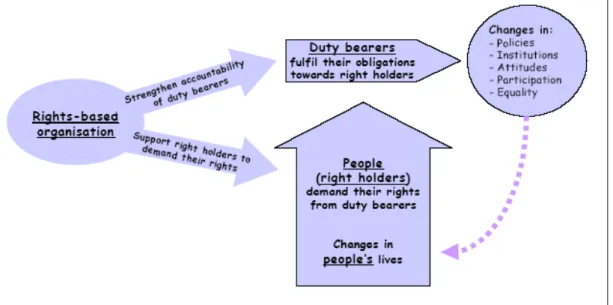
The fact that the RBA is backed by international law means that it accepts the universal legitimacy of the conceptual framework that essentially consists of duty-bearers and rights-holders. By identifying rights-holders and their entitlements and duty-bearers and their obligations it works towards strengthening the capacities of rights-holders to make their claims of duty-bearers to meet their obligations (UNHCHR 2004). Therefore, it can be said that the core strategy of the RBA to development is a two-pronged one, where the aim is to realize rights by: a) strengthening duty-bearers to fulfill their obligations and b) empowering rights-holders to invoke their rights (Ljungman 2004). Although these two “poles” (rights-holders vs. duty-bearers) are at the center of the approach it is still a dynamic approach which leaves room for additional contexts and specific elements to be added depending on the circumstances.
2.2.2. Normative framework
There are four key pairs of principles that are derived from the human rights instruments that constitute the rights-based approach’s normative framework. According to Ljungman (2004) these are:
¾ UNIVERSALITY and INDIVISIBILITY
¾ EQUALITY and NON-DISCRIMINATION ¾ PARTICIPATION and INCLUSION
¾ ACCOUNTABILITY and RULE OF LAW
Table 1: Key pairs of principles in the RBA’s normative framework.
2.2.2.1. Universality and indivisibility:
The principle of universality implies that every woman, man and child is entitled to enjoy her or his human rights simply by virtue of being human. It is this universality of human rights that distinguishes them from other types of rights – such as citizenship rights or contractual rights (R. Shigekane, verbal reference, September 28 2006).
The principle of universality requires that no particular group, such as poor women and children, be left out of the reach of development assistance programs (UNDP 2004). Universalism also implies that the rights are inalienable in that they cannot be taken away from someone or voluntarily given up. As Ljungman (2004) points out in her article, what this means for the RBA to development is that special efforts are required in making sure that sufficient knowledge and understanding of human rights and their indivisibility and inalienability exists both among individuals and communities. In practice, it is probably safe to say that this implies that all development programs both should include civic education and raise awareness and/or motivate authorities. Firstly, the education would have to be both an effort on its own and also an integral part of specific development initiatives, which would enhance knowledge about human rights and duties. In order for such education to be effective the information would have to be presented in an accessible way for all (taking into account high illiteracy in many regions and geographically isolated groups for example) Secondly, it is imperative to raise awareness and/or encourage motivation among principal
bearers (as well as the range of local, national and international moral duty-bearers) through dialogue and advocacy, making sure the knowledge of human rights exists on both sides of the table, so to speak.
2.2.2.2. Equality and non-discrimination
The principle of equality is a fundamental principle in human rights, according to the UDHR (25+ Human Rights Documents 2005). It confirms that every human person is entitled to human rights, whether he or she is living in poverty and social isolation or is visible, abundant and articulate. It means that all people within a society enjoy equal access to the available goods and services that are necessary to fulfill basic human needs. As stated by international law, “the principle of non-discrimination prohibits non-discrimination in the enjoyment of human rights” in any way, shape or form – “such as race, color, sex, languages, religion, political or other opinion….” (UNDP 2004: 7) According to the UNDP:
Equality before the law or in practice prohibits discrimination in law or in practice in any field regulated and protected by public authorities. Thus, the principle of non-discrimination applies to all state policies and practices, including those concerning healthcare, education, access to services, travel regulations, entry requirements and immigration (UNDP 2004: 7).
What this means for RBA to development is that the development effort should, as Ljungman (2004: 9) puts it “target excluded groups that may, for instance, have inadequate access to social services. These groups may be discriminated by state policies and practices and/or cultural practices or, in other ways enjoy less [ESCR] than others.”
2.2.2.3. Participation and inclusion
Participation is not just a principle but also a right in itself – as stated in article 1 of the Declaration on the Right to Development (1986: 1):
The right to development is an inalienable human right by virtue of which every human person and all peoples are entitled to participate in, contribute to, and enjoy economic, social, cultural and political development, in which all human right and fundamental freedoms can be fully realized.
What this means is that participation is not simply good or desirable in terms of ownership and sustainability but it carries a legal and moral component represented in rights which have profound consequences for the design and implementation of development activities (UNDP 2004). In the words of the OHCHR’s (2004: 27) report:
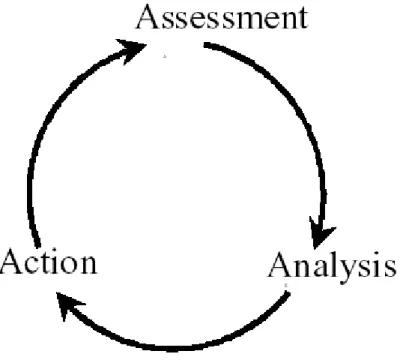
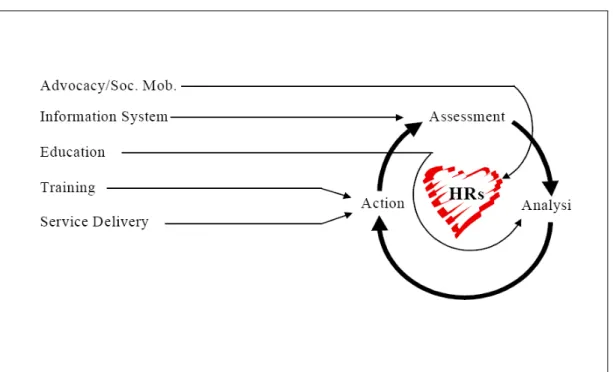
Participation means ensuring that national stakeholders have genuine ownership and control over development processes in all phases of the [development] programming cycle: assessment, analysis, planning, implementation, monitoring and evaluation. Human rights standards influence the conditions as well as the reasonable limitations of participation. For processes to be truly participatory, they should reflect the requirement for “active, free and meaningful” participation under the United Nations Declaration on the Right to Development. Women in rural areas have the right to participate in development planning at all levels (Convention on the Elimination of all forms of discrimination against Women, art 14) and children’s views must likewise be taken into account (Convention on the Rights of the Child, art. 12). However, the right to participate in public affairs (International Covenant on Civil and Political Rights, art. 25) does not necessarily give particular groups of people an unconditional right to choose any mode of participation.
2.2.2.4. Accountability and the Rule of Law
The UNDP (2004: 8) presents the following statement:
States have the primary responsibility to create the enabling environment in which all people enjoy all human rights, and have the
obligation to ensure that respect for human rights norms and principles is integrated into all levels of governance and policy-making.
Thus, the principle of accountability is derived from the States’ duties (or other duty-bearers) which in turn are derived from rights. To demand the accountability of policy-makers and other actors whose actions’ impact on the rights of others, as Ljungman (2004), Jonsson (2003) and Theis (2003b) argue contributes to moving development from the realm of charity (or needs-based development approach) to that of obligation, making it easier to monitor progress. In the next section of this chapter the main difference between the needs-based and rights-based approaches will be discussed further.
Therefore, in Ljungman’s (2004: 12) view, and many others who have contributed to the literature on the subject of a rights-based approach to development it is “arguably the most important value-added of a rights based approach”. The principle of accountability, therefore, requires that governments (as the legal and principle duty-bearer): a) accepts responsibility for the impact it has on people’s lives, b) co-operates by providing information, undertaking transparent processes and hearing peoples views and, c) responds adequately to those views (UNDP 2000).
Furthermore, the UNDP (2004) and Uvin (2004) both argue that the principle of accountability can not be separated from the principle of the Rule of Law, which is where the comparison between the two ends on the topic. The UNDP’s understanding of the principle of the Rule of Law is essentially a legal understanding. It includes for example: access to justice and redress for abuse of human rights, resolution of competing claims and the just distribution of public resources. The organization maintains that rights must be protected by law and arbitrated by competent, unbiased and independent processes, and not through some capricious discretion. Now, as Uvin (2004) argues it is well known that such impartial and independent processes are often scarcely available in many developing countries. Non-the-less, the UNDP document goes on to stating that “without a sound legal framework, without an independent and honest judiciary, economic and social development risk collapse…the rule of law ensures that no one is above the law, and that there will be no impunity for human rights violations” (2004: 8). Many authors, including Uvin (2004), have argued that the
legal resource is the hardest hurdle to jump in achieving rights, especially so in countries where legal resource is most needed, but also in others: for example, in India, which has a well-developed legal framework, it has been estimated that it would take 350 years to clear the current backlog of court cases, even if no new cases were added (verbal reference by Beth Neitzel4
Clearly, many developing countries (and in some cases the more developed ones) lack the means and resources for a sound and just legal systems. When applying RBA to development it is therefore necessary to require conditions for transparency and avenues for challenging and seeking redress for decisions or actions negatively affecting rights. While it is up to duty-bearers to determine the appropriate mechanisms of accountability themselves, all mechanisms must be accessible, transparent and effective (OHCHR 2002). As Ljungman (2004) points out, other duty-bearers – such as donors, NGO’s, aid organizations and development practitioners – are accountable in the same way.
The four pairs of principles (universality and indivisibility, equality and non-discrimination, participation and inclusion, accountability and the rule of law) described above are at the center of a rights-based approach. In her article, Ljungman (2004) states that only those programs that use all of the above principles should be allowed to call themselves rights-based approaches. In her opinion those agencies that only use some or parts of the principles are really ‘just’ applying a rights-based perspective – which she explains as possibly signaling a gradual approach to a full fletched RBA to development or some kind of first step in that direction. Others, for example, Jonsson (2003) and Theis (2003b), when speaking of the rights-base approach seem to mix that quite freely with the term rights-based perspective. Hence, it appears to be somewhat debatable whether or not the term perspective applies to an “actual” RBA or if it should only be used when talking about some kind of precursor to a RBA. In Uvin’s (2004) view it is certainly not necessary to apply to the letter every aspect of the approach every time. It depends on the agency or organization in question each time as well as the location and origin of the programs being implemented.
4
Beth Neitzel is an honors PhD student in the Faculty of Political Science at the University of California Berkeley.
2.2.3. Process goals
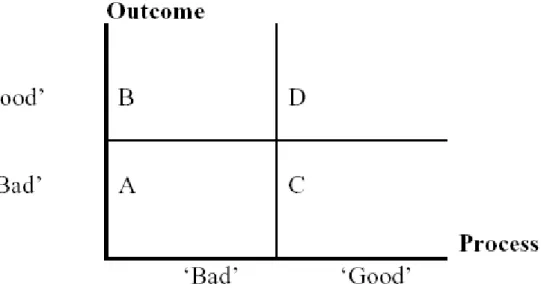
In a rights-based approach to development the process of achieving a development goal is as important as the outcome of that goal. Furthermore, as Theis (2003b, 5) points out, rights-based goals differ from partial and time-bound development goals. They “are 100% goals or visions that relate directly to the realization of human rights”, meaning, they are only fully realized when all women, men and children enjoy these rights completely. Thus, they require more specific focus and co-operation between agencies and other stakeholders. Also, because they are 100% goals they naturally may take longer to be fully achieved.
Because it can be presumed that an individual is the subject of his or her rights as well as an active participant in his or her development, rights need to be both active – dependent on the participation of individuals and groups – and practical – they must be applicable in the daily lives of people (Ljungman 2004). As stated by the Human Rights Council of Australia (2001) it is thus important for the realization of human rights that they are not just promoted and protected but also enjoyed and experienced, which emphasizes again, the relationship between duty-bearer and rights-holders. Among the most important rights and freedoms in this respect are the right to information, freedom of expression, the right to take part in the conduct of public affairs and the right to participation in the development process (Mikkelsen 2005).
2.3. Needs-based approach versus a rights-based approach
Jonsson (2003) argues that a rights-based approach to development shares many elements with preexisting development approaches – such as the emphasis on participation, the focus on transparency to promote good governance and various empowerment strategies. In the history and process of both development work and human rights work many useful tools have been created that are still fully valid and useful for a RBA to development. In other words there is no need to reinvent the wheel. However, although the needs based approach shares many common features with the rights-based approach and despite the fact that human rights are in essence needs-based claims there are some fundamental differences between the two approaches that need to be outlined. Jonsson holds that, without a doubt, the most important difference separating the needs-based approach from the
rights-based approach is that the former doesn’t assume the existence of duty-bearer. As he points out: “ When demands for meeting needs have no ‘object’, nobody has a clear cut duty to meet needs, and rights are vulnerable to ongoing violation” (2003: 20).
One of the main goals of basic-needs approaches is usually to obtain additional resources to help people gain access to services. In contrast, the equity principle in the RBA to development calls for a more equitable distribution of existing resources so that everyone has access to the same resources (Jonsson 2003). This often means involvement in political debates, either directly between the development practitioner and relevant duty-bearer or by assisting people to assert their rights. Quoting Jonsson again (2003: 20): “While a basic needs approach does not necessarily recognize willful or historical marginalization, a human rights approach aims directly at overcoming such marginalization”.
Another important difference between the two approaches, also noted by Jonson (2003), has to do with motivation. As noted earlier, in order for people to enjoy their rights, the duty to fulfill them needs to be met by the appropriate or accountable duty-bearer who in turn needs to be motivated by the claims of rights-holders to do so. But because basic needs can, in principle, be met through charitable action alone they deny the existence of such acceptance, because it doesn’t take rights and responsibilities into account. Therefore, in a rights-based approach compassion and solidarity replace charity, as Jonsson (2003: 20) explains:
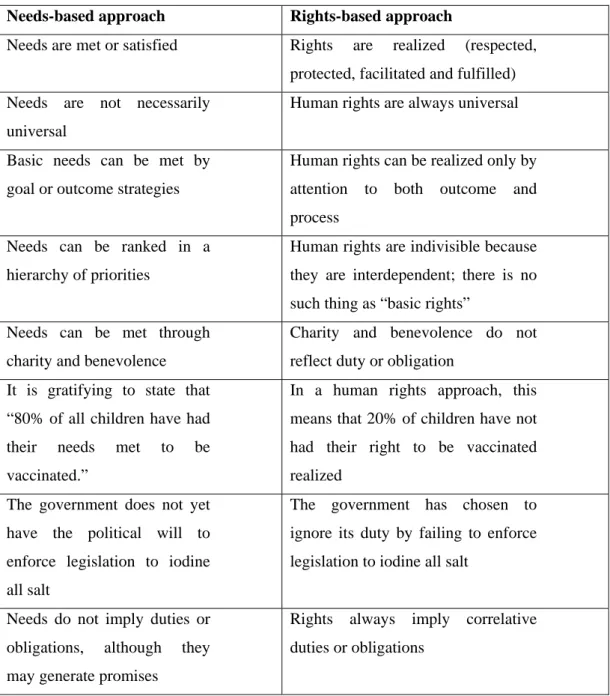
A requirement of the human rights approach, then, is that insofar as possible, everybody must have a human rights ‘heart’ reflected through decisions and actions. Decisions and action must be taken in recognition that every human being is a subject of rights, not an object of charity or benevolence. While charity often disempowers the poor and other vulnerable people, creating dependence, solidarity empowers people and enhances their capacity to improve the quality of their lives. Table 2 illustrates some differences between the commonly applied needs-based approach and the rights-based approach to development (Jonsson 2003: 21).
Needs-based approach Rights-based approach
Needs are met or satisfied Rights are realized (respected,
protected, facilitated and fulfilled) Needs are not necessarily
universal
Human rights are always universal
Basic needs can be met by goal or outcome strategies
Human rights can be realized only by attention to both outcome and process
Needs can be ranked in a hierarchy of priorities
Human rights are indivisible because they are interdependent; there is no such thing as “basic rights”
Needs can be met through charity and benevolence
Charity and benevolence do not reflect duty or obligation
It is gratifying to state that “80% of all children have had their needs met to be vaccinated.”
In a human rights approach, this means that 20% of children have not had their right to be vaccinated realized
The government does not yet have the political will to enforce legislation to iodine all salt
The government has chosen to ignore its duty by failing to enforce legislation to iodine all salt
Needs do not imply duties or obligations, although they may generate promises
Rights always imply correlative duties or obligations
Table 2: Needs-based approach vs. rights-based approach (Jonsson 2003: 21)
Chapter 3: Criticism and challenges
It would be an overstatement to claim that there exist a widespread consensus on the nature and scope (i.e. definition) of international human rights – and consequentially rights-based approaches, although there is a general acceptance of the core principles. Some of the most basic questions have not yet received conclusive answers – and are likely to remain contested for the unforeseeable future. Weston (1992) mentions some of the more common questions that are currently disputed – such as: are human rights to be viewed as divine, moral or legal entitlements? Should they be validated by intuition, custom, social contract theory, principles of distributive justice or as prerequisites for happiness? Are they to be understood as irrevocable or partially revocable? Should they be broad or limited in number and content? And so on and so forth. An attempt to settle, specifically these questions, will not be made in this chapter, or this dissertation for that matter, they merely give an idea just how many issues surrounding the concept of human rights are still unclear. However, a closer look will be taken, for instance, to the questions of the universality of human rights, the practicality of the so called rights-discourse in development and what some believe to be nothing more than a fluffy rhetoric. Finally some light will be shed on the much contested cultural relativism.
3.1. Rights-discourse: Utopia or reality?
Among the many who have challenged the universality or, maybe more to the point, the universal practicality of human rights is the universally recognized magazine The Economist. Two articles, in the August issue of 2001, take on the question whether human rights and human development should be integrated. In the first article the author wonders whether it helps to think of poverty or inadequate health care as violations of basic rights (Economist 2001a)? The other wonders if it makes sense to broaden the concept of human rights (i.e. ESCR) in developing countries where these “new rights” (2001a: 9) are either ignored or
simply do not exist. Supposedly, one could guess that the author of this piece is an American, since he seems to think of economic, social and cultural rights as “new rights” as if they just attained legal codification, but such a view is quite common especially within the U.S. who is among the relatively few states that have not yet ratified the covenant (Save the Children Sweden n.d.). Putting the nationality of the author aside we shall look at how he outlines the most principal arguments for and against economic, social and cultural rights.
Economic, social and cultural rights represent the most common set of issues development programs (whether rights-based or otherwise) tend to focus on. Among the more popular arguments against second generation rights, (as they are often referred to) is that they include “positive liberties” (i.e. freedoms/rights
to). It is a widely held believe that the so-called “negative liberties“, also known as civil and political rights (i.e. freedoms/right from) have a higher status than the ESCR. For example, the CPRs are thought to be cheaper to protect since they call for acts of omission rather than commission and they cannot clash with each other (Economist 2001a), which makes them easier to interpret from a legal point of view. Contrastingly ESCR can be very expensive to provide – such as the right to healthcare – and thus governments are sometimes compelled to choose some and ignore others simply because they lack the economic means to provide them.
Although there certainly is a lot of truth to the notion that ESCR have a greater margin for interpretation than their fellow CPRs, reality is not quite so clear cut, as pointed out by the Economist (2001a). There certainly are fiscal limits to the protection of most first-generation rights (CPRs) just as there are to second-generation rights (ESCRs). National defense and criminal-justice systems – both belonging to CPR’s – are not exactly cheap to maintain. But how does all of this relate to rights-based approach to development? In the Economist article, which surveys this from a practical point of view (as opposed to philosophical), it is maintained that in order to promote ESCR in the poorer countries of the world – which is certainly the task at hand for RBA to development – the rights in question would have to be promoted and protected in the vaguest and most general terms possible in order to have any kind of universal scope to them. As such, the Economist concludes, those rights will either mean nothing, if they are regarded as just empty cliché’s, or, if the “intention is to move from stating rights