A methodology for developing resilient distributed control
systems.
TAHOLAKIAN, Aram M.
Available from Sheffield Hallam University Research Archive (SHURA) at:
http://shura.shu.ac.uk/20418/
This document is the author deposited version. You are advised to consult the publisher's version if you wish to cite from it.
Published version
TAHOLAKIAN, Aram M. (1997). A methodology for developing resilient distributed control systems. Doctoral, Sheffield Hallam University (United Kingdom)..
Copyright and re-use policy
See http://shura.shu.ac.uk/information.html
Sheffield Hallam University
ProQuest Number: 10701064
All rights reserved
INFORMATION TO ALL USERS
The quality of this reproduction is dependent upon the quality of the copy submitted.
In the unlikely event that the author did not send a com plete manuscript and there are missing pages, these will be noted. Also, if material had to be removed,
a note will indicate the deletion.
uest
ProQuest 10701064
Published by ProQuest LLC(2017). Copyright of the Dissertation is held by the Author.
All rights reserved.
This work is protected against unauthorized copying under Title 17, United States C ode Microform Edition © ProQuest LLC.
ProQuest LLC.
789 East Eisenhower Parkway P.O. Box 1346
A Methodology for Developing
Resilient Distributed Control Systems
Aram Meguerditch Taholakian BEng
(Hons)A thesis submitted in partial fulfilment of the
requirements of Sheffield Hallam University for the degree of
Doctor of Philosophy
Abstract
Manufacturing industries rely on automated manufacturing systems to improve the
efficiency, quality and flexibility of production. Such systems typically consist of a variety of manufacturing machinery and control hardware, e.g. CNC machine tools, robots, PCs,
Programmable Logic Controllers (PLCs) etc., which operate concurrently. The cost of developing and implementing an automated manufacturing system is high, and is particularly so if the control system is found to be unreliable or unsafe during operation. Distributed Control Systems are generally used to control complex concurrent systems, At present the methods used to develop DCSs tend to follow a sequence of steps, viz. a statement of the requirements of the DCS, a functional specification of the DCS, the design of the DCS, generation of the software code for the DCS, implementation of the software. This step approach is inadequate because of the dissimilarity of techniques used to represent each step, which leads to difficulties in ensuring equivalence between the final
implementation of the DCS and the initial requirements, which in turn leads to errors in the final software. To overcome this, work has been conducted to unify the specification, design, and software coding phases of the DCS development procedure by ensuring formal
equivalencies between them. One particular outcome of such previous work is a tool named Petri Net - Occam Methodology, developed by Dr. P. Gray, which produces dependable Occam code for DCSs. Gray’s methodology produces readable designs, directly from the specification of systems, in a graphical but formal way, and results in a Petri Net graph which is equivalent to the final Occam code. However, his methodology is not for a complete DCS but only for one containing Transputers.
The PLC is widely used in industry and an integral part of DCSs for Automated Manufacture. This research has developed a methodology, named PN<=>PLC, which produces dependable PLC control programs, in a graphical but formal way, directly from a system’s specification. It uses the same tool, Petri Nets, for both designing and simulating the control system, and specifies rules which ensure the correct design, simulation and encoding of PLC programs. The PN designs are a one-to-one equivalent to PLC code and can be directly translated into Ladder Diagrams. Therefore if the simulation shows the design to be correct, the final software will be correct.
PN<=>PLC works as a stand alone tool for developing dependable PLC control programs, and also unifies with Gray’s methodology to produce a complete tool for developing a resilient DCS containing Transputers and PLCs. The unification of the two methodologies is also reported in this thesis.
Table of Contents
1. Introduction... ... 2
1.1 Automated Manufacture... 2
1.1.1 Flexible Manufacturing... 2
1.2 Distributed Control Systems...3
1.3 Development of Distributed Control Software...5
1.3.1 Informal Methods for Designing DCSs...6
1.3.2 Formal Methods for Designing DCSs...6
1.4 The Need for a Methodology for Developing DCSs... 8
2. Background...12
2.1 The FMC at the School of Engineering... 12
2.1.1 Levels of Control...14
2.1.2 Reasons for Distributing Control...16
2.2 Gray’s Petri Net - Occam Methodology... 17
2.2.1 Transputers and Occam... 18
2.2.1.1 Occam: Language Definition...18
2.2.2 Introduction to Petri Nets ... 19
2.2.2.1 High Level Petri N ets...21
2.2.3 The Motivation and Objectives of Gray’s Methodology...22
2.2.4 Gray’s Methodology Applied to the FMC...24
2.2.5 Advantages, Disadvantages and Claims of Gray’s Methodology ...26
2.3 Programmable Logic Controllers...26
2.3.1 Available PLC Programming Tools and Techniques... 27
2.3.1.2 Structured Text...28
2.3.1.3 Function Block Diagram... 28
2.3.1.4 Sequential Function Chart... 28
2.3.1.5 Ladder Diagram...29
2.3.1.5.1 Step Ladder Diagram...30
2.3.2 Review of Existing PLC Languages...30
2.4 PNs and PLCs: Previous Work... 32
2.4.1 PNs for Designing and Modelling DCSs Containing PLCs... 32
2.4.2 PNs for Designing PLC Programs... 32
2.5 The Aim and Objectives of the Ph.D. Research ... 34
3. The Application of Gray’s Methodology to an Overall DCS...37
3.1 Gray’s Methodology Applied to a Simple PLC Control Task... 37
3.1.1 Design and Simulation...38
3.1.2 Translation of PN into LDs...42
3.2 Discussion... 43
4. PN<=>PLC: The Methodology... 46
4.1 Design Process... 47
4.1.1 Design Rules...48
4.1.2 Terminology and Symbols... 52
4.2 Translation Process... 54
4.2.1 Translation Rules...54
4.3 Simulation Process...56
4.3.1 Simulation Steps...57
4.3.2 Simulation Steps Applied to Scenario 2 ...61
4.4 The Investigative Approach Taken to Develop P N oP L C ... 64
4.5 Designing the Control Algorithm of the Oil Tank Using SFCs... 70
5. PN<=>PLC Applied to the FMC...73
5.1 PN<=>PLC Applied to the Puma Work Station...74
5.1.1 Enable Vice to Table PN Group... ... 76
5.1.2 PN<r>PLC and Timers... 82
5.1.3 Conveyor Controller... 84
5.2 PN<=>PLC Applied to Miller Work Station... 84
5.3 PN oPLC Applied to Lathe Work Station...87
5.3.1 Terminology and Symbols (Revised)... 92
5.4 Error Handling... 94
5.4.1 Reliability and Safety Achieved by PN<=>PLC... 97
5.4.1.1 Reporting Errors... 101
6. Unification of the Methodologies... 105
6.1 The Graphical and Logical Unification of the Methodologies... 105
6.2 The Unification of the Methodologies for Simulation... 109
6.3 The Unification of the Methodologies for Translation... I l l 6.4 Fault Avoidance and Elimination Achieved by the Unified Methodology 112 6.5 Discussion...113
7. Conclusions and Recommendations for Future Work... 117
7.1 Conclusions... 117
7.2 Recommendations for Future Work...120
References... 123
List of Figures
Figure 2-1 Layout of the FMC at the School of Engineering...13
Figure 2-2 Levels of Control of the FM C...14
Figure 2-3 The Labyrinth PN Graph of the FM C...inside back cover Figure 2-4(a) A Simple Petri Net... 19
Figure 2-4(b) A Marked Petri Net...20
Figure 2-4(c) Marking After the Firing of the Transition... 20
Figure 2-4(d) Inhibitor Arc PN Graph Showing the Marking Before and After the Firing of the Transition... 21
Figure 2-5 Gray’sPN Graph for the Control of the FM C inside back cover Figure 3-1 Oil Tank Level...38
Figure 3-2 PN Graph of Oil Tank Level Control Produced By Gray’s Methodology... ...38
Figure 3-2(a) Marking Achieved as a Result of Simulating Oil Sensor Switching on... 39
Figure 3-2(b) Marking Achieved as a Result of Simulating Push Button Being Pressed...40
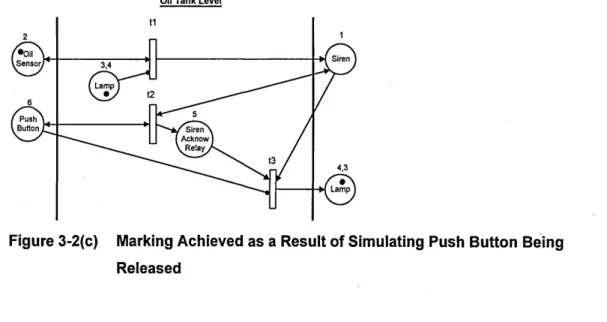
Figure 3-2(c) Marking Achieved as a Result of Simulating Push Button Being Released ...40
Figure 3-2(d) Marking Achieved as a Result of Simulating Oil Sensor Switching off...41
Figure 4-1 Layout of PN<=>PLC Graph...47
Figure 4-2(a) First Design Rule Applied to Siren... 48
Figure 4-2(b) Second Design Rule Applied to Siren...49
Figure 4-2(bl) A Realistic Marking Applied to Figure 4-2(b)...50
Figure 4-2(b2) Evolution of the Marking After Applying Simulation Step 3 to Figure 4-2(bl)... 50
Figure 4-2(c) Design Rules Applied to Siren and Lamp... 51
Figure 4-2(d) Final PN<=>PLC Graph of Oil Tank Level Control...52
Figure 4-3(a) LD Showing the Conditions for Switching the Siren on. First Translation Rule...54
Figure 4-3(b) LD Showing How the Siren is Latched on. Second Translation Rule... 55
Figure 4-3(c) LD Showing the Conditions for Switching the Siren off. Third Translation Rule...55
Figure 4-3(d) Final LD. An Exact Behavioural Equivalent to the PN<=>PLC Graph Shown in Figure 4-2(d)...56
Figure 4-4(a) Initial Marking Representing the Oil Sensor Switching on, i.e. Scenario 1, Event (a). Simulation Step 2... 58
Figure 4-4(b) Evolution of Marking After Applying Simulation Step 3 to Figure 4- 4(a)...58
Figure 4-4(c) Marking which Represents Scenario 1, Event (b)...60
Figure 4(d) Evolution of Marking After Applying Simulation Steps to Figure 4-4(c)...60
Figure 4-4(e) Marking which Represents Scenario 1, Event (c)...60
Figure 4(1) Evolution of Marking After Applying Simulation Steps to Figure 4-4(e)... 60
Figure 4-4(g) Marking which Represents Scenario 1, Event (d)...61
Figure 4(h) Evolution of Marking After Applying Simulation Steps to Figure 4-4(g)...61
Figure 5(b) Evolution of Marking After Applying Simulation Steps to Figure
4-5(a)... 62
Figure 4-5(c) Marking which Represents Scenario 2, Event (b)...62
Figure 5(d) Evolution of Marking After Applying Simulation Steps to Figure 4-5(c)... 62
Figure 4-5(e) Marking which Represents Scenario 2, Event (c)...63
Figure 5(f) Evolution of Marking After Applying Simulation Steps to Figure 4-5(e)... 63
Figure 4-5(g) Marking which Represents Scenario 2, Event (d)...63
Figure 5(h) Evolution of Marking After Applying Simulation Steps to Figure 4-5(g)... ... 63
Figure 4-6 Petri Net Graph of Oil Tank Level Control... 65
Figure 4-6(a) Evolution of the Marking After Simulating Scenario 1, Event (a) 66 Figure 4-6(b) Evolution of the Marking After Simulating Scenario 1, Event (b) 66 Figure 4-6(c) Evolution of the Marking After Simulating Scenario 1, Event (c). 67 Figure 4-6(d) Evolution of the Marking After Simulating Scenario 1, Event (d) 67 Figure 4-7(a) &Figure 4-7(b) Two Possible LD Interpretations of the PN Graph Shown in Figure 4-6...70
Figure 4-8 Design of Oil Tank Level Control Using SFCs... 71
Figure 4-9 LD Translation of the SFC in Figure 4-8...71
Figure 5-1 Initial Error Checks Performed Using a ‘pulse’... 77
Figure 5-2 PN Graph Showing the Use of a ‘group signal’... 78
Figure 5-3 PN Group Containing Initial Error Checks...80
Figure 5-4 PN Group Showing an Alternative Error Check... 81
Figure 5-8 A PN Group Showing the Use of a Timer...82
Figure 5-13 Ladder Diagram Translation of ‘Milling PN Graph’... 87
Figure 5-14 A Ladder Diagram Equivalent to Figure 5-13...87
Figure 5-15 Enable Vice to Table PN Step... 89
Figure 5-15L Step Diagram Translation of Figure 5-15... 91
Figure 5-24 Puma Station Error Status PN Graph ... 99
Figure 5-23 Puma Station Complete Status PN Graph... 101
Figure 6-1 A PN Graph Showing the Unification of PN<=>rLC with Gray’s
Dedication
I wish to dedicate this thesis to all my family, especially my father and my mother for
their moral and financial support throughout my studies.
I also wish to dedicate this thesis to my partner for her support and patience,
particularly throughout the writing-up period.
Acknowledgments
I would like to express my sincere gratitude to my director of studies, Dr W M M
Hales, for his excellent supervision and support. I would also like to thank my
supervisor, Prof F Poole, Mrs J Grove, Mr G Cockerham and Prof E Lo for their
support and advice.
Thanks also to all technicians involved, colleagues and friends.
Declaration
I declare while registered as a candidate for the University’s research degree, I have
not been a registered candidate or enrolled student for another award of the University
or other academic or professional organisation. I further declare that no material
contained in this thesis has been used in any other submission for an academic award.
Chapter 1
Introduction
Contents
1. Introduction... 2
1.1 Automated Manufacture... 2
1.1.1 Flexible Manufacturing... 2
1.2 Distributed Control Systems ... 3
1.3 Development of Distributed Control Software...5
1.3.1 Informal Methods for Designing DCSs...6
1.3.2 Formal Methods for Designing DCSs... 6
Chapter 1
1. Introduction
This chapter gives a brief introduction to Distributed Control Systems (DCSs), mainly
Flexible Manufacturing Cells, and discusses the current approaches used to develop
the various parts of a DCS. The introduction then concludes by identifying a need for
a methodology for developing a dependable DCS, such that the methodology is
applicable to all aspects of the DCS, and not just the higher levels or the lower levels,
in a formal but readable way.
1.1 Automated Manufacture
Manufacturing industries employ a wide range of technologies in their processes to
improve their competitive strength in the market place. Recent advancements in
information technology have produced fully automated, efficient but complex
manufacturing systems. Programmable automation tools, such as Programmable
Logic Controllers (PLCs), Robots and computer numerical control (CNC) machines,
are used to increase the efficiency and quality of manufacturing plants. Automated
Manufacturing Systems offer numerous advantages such as short lead-times, low
work-in-progress, reduced labour and hence reduced unit costs, and quick change-over
times. They also provide flexibility which enables rapid responsiveness to market
changes.
1.1.1 Flexible Manufacturing
The ability to meet customer demands and remain in touch with an ever increasing
competitive market place [Ford 1991] has resulted in manufacturing industries
Chapter 1
(FMCs) have been well established for a number of years [Narahari and
Viswanadham 1986, Huang and Chang 1992, Lu and Huang 1992, Chao et al 1992]
and are used in batch manufacturing industries to improve the efficiency of
production. They consist of a number of CNC machine tools, automated work/tool
handling equipment and a control system to synchronise the operation of the machine
tools and handling equipment. The integration and coordination of a group of FMCs
produces a larger flexible manufacturing environment often referred to as a Flexible
Manufacturing System (FMS) [Simpson et al 1982, Ayers 1988]. FMSs can be used
to produce complex products, where individual components are made in various
FMCs and then assembled in a Flexible Assembly System (FAS) [Williams and Lill
1987].
The safe and reliable operation of Flexible Manufacturing Cells is clearly desirable, if
not essential for their effective use. However FMCs are complex systems the
elements of which operate concurrently, and interact at irregular times depending
upon the components to be produced. Therefore the development of a control system
is not a trivial affair [Slack 1988, Duan and Kumara 1993]. Control systems not only
consist of computer algorithms, but also computer hardware, communications
protocols and cell monitoring equipment, such as sensors and transducers.
1.2 Distributed Control Systems
Some automation tasks are simple to achieve, whereas others, for example FMCs, are
far from simple, because they consist of a number of autonomous devices which
operate concurrently, but also in synchronisation with each other.
Chapter 1
and is particularly so if the design is found to be unreliable during or after
implementation.
Controlling complex concurrent systems is only feasible if the task of control is
distributed amongst a number of devices (section 2.1.2). Flexible manufacturing
operational strategies such as Distributed Control are now established practices in
industry. Real time control is achieved by distributing the various functions of a
control system which operate concurrently. It is essential however that these functions
or elements communicate with each other to achieve complete synchronisation of the
whole system. Such communication could be achieved by networking individual PCs,
which each run sequential programs. However as the number of processors increases,
the management overhead increases [Das and Fay Freund 1983].
The programming strategies and languages available for conventional
microprocessors do not model a parallel architecture [Naghdy and Strickland 1989].
Apart from developing the program for each processor separately from others, the
programmer has to introduce techniques for synchronisation and communication of
one processor with others. However the software is directly dependent on the
hardware. By increasing the number of processors, the complexity of the software
design, development and testing will multiply. Expansion or modification of the
operation of the hardware requires major modification of the software.
In recent years, systems specific processors and software have been developed to
overcome the above mentioned problems. For example, the combination of the
Transputer (a microprocessor, see section 2.2.1) and its programming language
Chapter 1
various industries for embedded systems, numerical analysis, image processing and
Real-Time Distributed Control Systems.
1.3 Development of Distributed Control Software
At present the methods used to develop Distributed Control Systems tend to follow a
sequence of steps:
• Statement of requirements of the DCS
• Statement of the functional specification of the DCS
• Design of the DCS to meet the specification
• Generation of the software code for the DCS
• Implementation of the software
It is widely acknowledged that this method has its drawbacks [Shatz and Wang 1987,
Boehm 1988, Jelly and Gorton 1994]. The requirements and specification are usually
written in English, the design may be depicted graphically or textually, and the
software usually written in a high level language. This leads to difficulties in ensuring
equivalence between the final implementation of the DCS and the initial requirements,
because of the dissimilarity of techniques used to represent the steps, and the
differences in the expertise of those who develop each step. The development of one
step is a translation of the previous step, thus there is no reliable isomorphism between
the steps. Practitioners attempt to ensure equivalence between the various steps by
checking the equivalence of each step with its preceding step. Some methods used to
do this are formalised, and some are ad hoc; none are totally satisfactory [Bloomfield
Chapter 1
To improve on this method of developing DCSs, equivalence of representation is
required at each step. The ideal way to achieve this would be to develop a
methodology which uses the same language, one that all parties could understand, at
each stage of the development, and could be verified against the system requirements
prior to implementation.
1.3.1 Informal Methods for Designing DCSs
Distributed Control Systems are often categorised into more than one level of control.
For example the control of an FMC may be divided into several levels ranging from
the Programmable Logic Controller (PLC) operated sensor and actuator control level,
to a high decision making level, often referred to as the Cell Controller (CC) level.
A considerable amount of research into the different levels of DCSs has been recently
carried out by various parties. For example, many have attempted to develop
alternative PLC program representations (discussed further in Chapter 2, section 2.4).
For the most part, these attempts have focused, not only on the lowest level of a DCS,
but also on a particular aspect of the software development process, mainly modelling.
There have also been attempts to use Petri Nets (PNs) to design PLC programs, but
virtually all the resulting PN models pay scant regard to the readability [Taholakian
and Hales 1995], which severely restricts their practical applications: a design which
is unclear to read is difficult to check for correctness, difficult to maintain and
difficult to update, i.e. it is unreliable.
1.3.2 Formal Methods for Designing DCSs
Extensive research has also been carried out into the higher levels of DCSs. For over a
unapter i
Weston has researched into areas such as Computer Integrated Manufacture (CIM)
and has produced computerised systems for developing CIM systems [Weston 1991,
Weston 1993], namely CIM-BIOSYS, which is an infrastructure designed to integrate
the various software applications needed to achieve highly autonomous and flexible
CIM systems. The group has also investigated the behavioural modelling of CIM
systems using techniques such as CIM-OSA and Stochastic Timed Petri Nets
[ESPRIT/AMICE 1991, Aguiar and Weston 1993], and of late has investigated the
use of PNs to design code for DCSs [Ariffin et al 1995].
A large amount of research has been carried out by various parties into the use of Petri
Nets for modelling and performance evaluation of DCSs: [Kamath and Viswanadham
1986, Huang and Chang 1992, Viswanadham and Narahari 1992, Barkaoui and Ben
Abdallah 1993* Hilal and Ladet 1993, Reddy et al 1993]. Numerous publications
referring to the use of PNs for the detection of faults, specifically “deadlock”, are also
widely accessible [Murata and Shenker 1989, Viswanadham et al 1990, Ezpeleta et al
1995].
A group of academics and researchers at Sheffield University has worked on
automatically producing software from a system specification, for implementation on
a parallel platform consisting of Transputers and C40s [Bass et al 1994]. Others have
also investigated the implications of Transputers and Parallel Processing for DCSs
[Draper and Holding 1989, Tudruj 1992, Lau and Seet 1993, Sundaram and Narahari
1993, Moore and O’Donoghue 1994].
At the School of Engineering (SOE), Sheffield Hallam University, there is ongoing
Chapter 1
reports on a PN-Occam based methodology for developing DCSs (Chapter 2, section
2.2.3). Gray’s methodology pays strict attention to the readability and
comprehensibility of the design. Gray claims that the design translates, with exact
equivalence, into the Occam programming language to run on Transputers. He also
claims that it is expandable and avoids control errors such as “deadlock” from being
introduced into the code. However Gray’s methodology has only been applied to
Transputers and Occam, which is only part of an overall DCS. More than often DCSs
in manufacturing industries consist of more than one type of controller. The PLC is
widely used in industry (section 2.3), in conjunction with other controllers such as
PCs and Transputers, to achieve Distributed Control. There is no evidence whether
his methodology is applicable to such an overall DCS.
1.4 The Need for a Methodology for Developing DCSs
From the preceding discussion it is apparent that the current methods for developing
distributed control software do not ensure dependability of the system. Although
work has been done on designing parts of DCSs, there is no methodology for ensuring
that an overall DCS is dependable and meets the requirements.
A need has been identified for a methodology for designing DCSs such that:
• the methodology is easy to understand and of practical use in industry.
• the methodology is applicable to all aspects of a DCS and not just the higher
levels or the lower levels.
Chapter 1
• the design is represented in a readable format which enables parties other than just
the original designer to understand the design and thus reliably check for
correctness, reliably maintain and expand the system.
• the designer is guided towards designing an error free control system prior to
implementation.
• the design is modular to allow flexibility of the DCS.
• the design is graphical but formal and supports simulation thus eliminating the
need to translate the design into an independent simulation software to analyse.
• the design is equivalent to the control algorithm, i.e. there are formal rules for
translating the design into the final control code to ensure that the two operate in
exactly the same way. Thus if the design is correct, then the control code will be
Chapter 2
Background
Contents
2. Background... 12
2.1 The FMC at the SOE... 12
2.1.1 Levels of Control...14
2.1.2 Reasons for Distributing Control...16
2.2 Gray’s Petri Net - Occam Methodology... 17
2.2.1 Transputers and Occam... 18
2.2.1.1 Occam: Language Definition...18
2.2.2 Introduction to Petri Nets... 19
2.2.2.1 High Level Petri N ets...21
2.2.3 The Motivation and Objectives of Gray’s Methodology...22
2.2.4 Gray’s Methodology Applied to the FMC...24
2.2.5 Advantages, Disadvantages and Claims of Gray’s Methodology...26
2.3 Programmable Logic Controllers...26
2.3.1 Available PLC Programming Tools and Techniques...27
2.3.1.1 Instruction List... 27
2.3.1.2 Structured Text... 28
2.3.1.3 Function Block Diagram...28
2.3.1.4 Sequential Function Chart...28
2.3.1.5 Ladder Diagram... 29
2.3.1.5.1 Step Ladder Diagram...30
2.4 PNs and PLCs: Previous Work...32
2.4.1 PNs for Designing and Modelling DCSs Containing PLCs... 32
2.4.2 PNs for Designing PLC Programs... 32
Chapter 2
2. Background
This chapter describes the Flexible Manufacturing Cell at the School of Engineering
which was used as the test bed for the reported research project. It discusses the
control and the communication between the various levels of the control. The chapter
also introduces Petri Nets and a Petri Net - Occam methodology, which was the
outcome of previous research carried out at Sheffield Hallam University’s School of
Engineering. The incompleteness of previous approaches, including the Petri Net -
Occam methodology, are discussed, and in particular their inapplicability to low level
PLC control. The PLC is an integral part of an FMC, and in this chapter the
inadequacies of existing PLC programming strategies are also discussed. A need for a
methodology for developing PLC based DCSs is identified. Finally the aims and the
objectives of the PhD research are stated.
2.1 The FMC at the School of Engineering
Gray’s Petri Net - Occam methodology was the initial motivation for this research
project. The Flexible Manufacturing Cell (FMC) at the School of Engineering (SOE),
Sheffield Hallam University, was chosen for the development and testing of both
Gray’s methodology and the reported Ph.D. research. It is therefore appropriate to
describe the FMC prior to explaining Gray’s methodology.
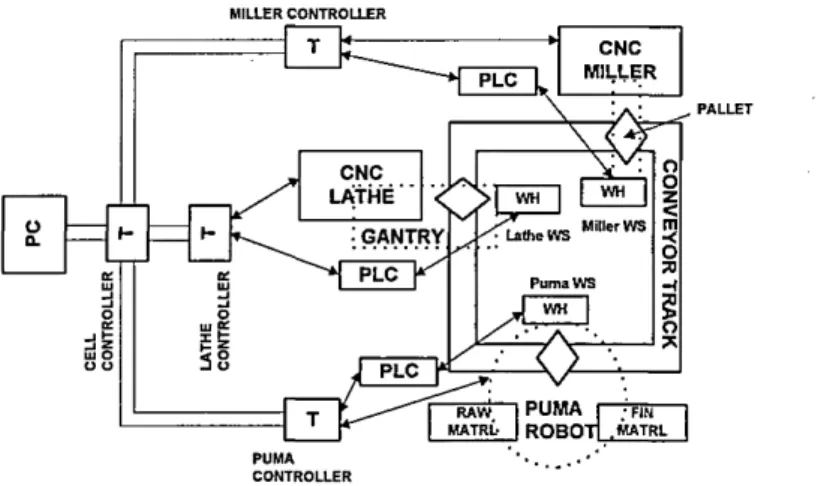
The FMC consists of a CNC lathe, CNC milling machine, a conveyor track, and three
work stations (WS) as follows:
□ Puma WS for loading and unloading raw material and finished parts.
Chapter 2
□ Miller WS for loading and unloading the miller.
The loading and unloading of raw materials and finished parts is carried out by a six
axis, programmable Puma robot. The loading and unloading of the lathe is carried out
by a pneumatically operated gantry robot, while a pneumatic cylinder loads and
unloads the miller by ramming a workpiece to and from a fixture on the milling table.
A conveyor track transports components to and from the work stations. This
equipment is referred to as the work handling (WH) equipment (Figure 2-1, below).
Chess pieces designed for blind players are the chosen components for the cell. This
introduces flexibility into the cell for the following reasons:
1. Different machining processes are employed to produce the pieces, which are in
turn machined differently to distinguish the two colours by touch.
2. Chess sets of different dimensions or styles can be produced.
MILLER CONTROLLER
MILLER
LATHE
Miller WS
GANTRY Lathe WS
P u m a WS
•FIN
ROBOT! MATRL PUMA
CONTROLLER
Chapter 2
2.1.1 Levels of Control
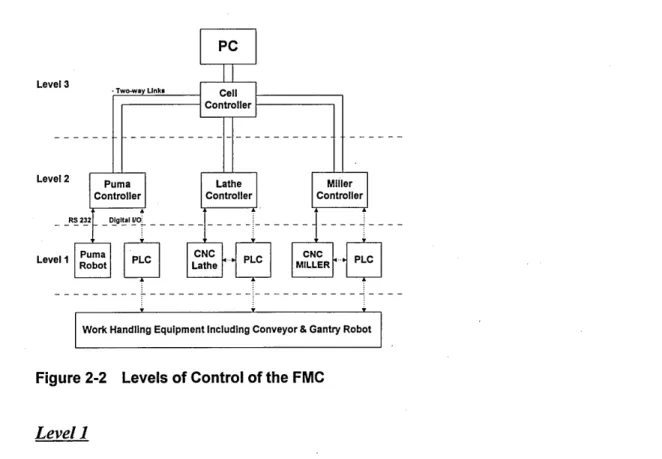
The equipment used to perform the logical control of all the elements within the FMC
is distributed between Transputers and PLCs (Programmable Logic Controllers), and
divided into three levels of control, as shown in Figure 2-2.
Level 3 ♦ T w o -w ay Link»
Level 2
D igital J/O j
Level 1 Pum aR obot PLC L atheCNC PLC MILLERCNC PLC Cell
C o ntroller
L athe
C o ntroller C ontrollerMiller PC
P um a C on tro ller
W ork H andling E q u ip m en t Including C o n v ey o r & G antry R obot
Figure 2-2 Levels of Control of the FMC
Level 1
The simple sequential control of primitive devices, such as actuators and sensors, is
carried out in Level 1 using PLCs.
One PLC is devoted to the Puma WS. The opening of the dogs on the conveyor,
closing them when the pallets have moved on, and the monitoring of the appropriate
sensors at the Puma WS, to determine the arrival/departure of pallets at/from the
station, is carried out through this PLC.
A second PLC is devoted to the Miller WS. It monitors the appropriate sensors at the
V s M c i|J ie i £
cylinder, the milling fixture clamp and instructs the miller to start or stop machining.
The PLC also monitors the machining status of the Miller.
A third PLC is used to control and monitor the Lathe WS and the gantry robot,
synchronising the opening and shutting of the lathe door with the entry and exit of the
robot arm whilst loading and unloading workpieces. The execution of the “Start
Machining” command to the Lathe, and the monitoring of the machining status is also
carried out through this PLC.
Level 2
The control of the machine tools, robots and the PLCs conducting Level 1 control is
achieved in this level.
The Puma Transputer, for example, instructs the Puma robot to execute the program
“Load Cell”, which is used to place a blank from the raw material stock in a vice on a
pallet. It also instructs the PLC at the Puma WS to convey pallets between work
stations.
The Miller Transputer, for example, instructs the PLC at the Miller WS to transfer the
vice into the fixture on the milling table and clamp it in place.
The Lathe Transputer instructs the PLC at the Lathe WS to operate the gantry robot,
to load or unload the lathe, and to monitor the arrival of pallets and the opening and
closing of their vice accordingly.
Level 3
Level 3 is conducted by the Cell Controller. The Cell Controller's task is to ensure
Chapter 2
instructions to the Level 2 controllers to load and unload the machine tools, to start
machining cycles and convey parts round the cell.
2.1.2 Reasons for Distributing Control
Having established that the control of the School of Engineering’s cell is achieved by
distributed control, it is important to explain the reasons behind such a design. Why,
for instance, is the whole cell not controlled by only one computer.
Two essential reasons:
1. To reduce the complexity of the control algorithms/computer programs.
Even with the small FMC at the SOE., the number of sensors that need monitoring,
and the number of actuators which need operating is very large. Since the various
parts of the cell operate concurrently, the control of such an environment by one
sequential algorithm becomes virtually impossible, and certainly inefficient. Changes
within the cell would mean redesigning the complete control algorithm, hence making
future growth a very difficult task. An example of concurrency within the cell could
be, when a part is to be unloaded from the conveyor by the Puma robot, also a part is
to be loaded onto the miller and whilst this is being carried out, the lathe finishes
machining and requires its workpiece to be removed.
2. To achieve the required communications necessary to operate the machine tools
and work handling equipment.
There are several types of data that have to be communicated within the cell. For
example, whether a sensor is on or off, which program the Puma is to run, what
component is to arrive at the Miller. This data is communicated in different ways
U l l d ( J l C I £.
off (24 or 0 volts) and requires only two wires to transmit its data. However, more
complex messages have to be passed between station controllers and the machine
tools, e.g. to instruct the Puma to run a certain program requires the Puma station
controller to transmit the command “EXEC LOADPART”, and the Puma to reply
“PART LOADED”. RS 232C is used to handle this duplex communication.
Messages which pass between the Cell Controller and the station controllers may be
transmitted simultaneously, therefore a Local Area Network (LAN) having a multiple
access communication protocol is used. A single control algorithm to handle all these
communications in Real-Time would be difficult or perhaps impossible to write.
2.2 Gray’s Petri Net - Occam Methodology
Over the years, Petri Nets (section 2.2.2) have been used in modelling safety critical
systems to reduce faults in the system by removing them before use [Sahraoui et al
1987, Leveson and Stolzy 1987, Viswanadham and Johnson 1988, Reddy et al 1993].
FMCs are a particular case of safety critical systems in that, although automated they
work in conjunction with humans.
Gray conducted research to show that Occam and Transputers could considerably
simplify the design of DCSs for FMCs. He chose to use Petri Nets as the formal
method for developing DCSs, but soon found that Petri Net graphs can become very
complex (Figure 2-3, inside back cover). The graph is not readable and difficult to
follow.
For these reasons and inspired by the capabilities of Occam and Petri Nets, Gray
developed a methodology for producing dependable distributed control software for
Chapter 2
It is important however to discuss Transputers, Occam and Petri Nets, in more detail,
for a better understanding of the methodology.
2.2.1 Transputers and Occam
The combination of the Inmos developed hardware and software called Transputer
and Occam respectively has now been recognised as a solution to the problem of
programming concurrent systems.
A Transputer is a microcomputer with its own local memory, and with
communication links for connecting one Transputer to another Transputer [Inmos Ltd.
1990]. The protocols for communications between Transputers is built into the
hardware of the Transputer chip. It can be used in a single processor system, or in
networks to build high performance parallel architectures. By linking processors
together, a linear increase in data processing capacity can be achieved, as opposed to
the limited processing capacity of typical multi-processor control systems (MPCS). A
MPCS can only be increased to a certain limit before experiencing a drop off in
effective computing power [De Gaspari 1992].
2.2.1.1 Occam: Language Definition
Occam simplifies the writing of concurrent programs by taking most of the burden of
synchronisation away from the programmer [Inmos Ltd. 1989]. Occam uses channels
for communicating values and does not distinguish between two processes (programs)
running concurrently on different computers, or concurrently on the same computer.
However channels are one-way only, and therefore two are needed for a two-way
Although Occam provides synchronised communication, the programmer is still left
with the responsibility of avoiding “deadlock”, i.e. a process waiting for
communication that will never arrive, for it is prepared to do so forever . For the non
professional programmer, or rather the professional engineer and system designer,
avoiding deadlock, in even a relatively simple FMC such as the one in the School of
Engineering, is difficult.
2.2.2 Introduction to Petri Nets
Petri Nets are a tool for the study of systems, and a graphical representation of
systems [Peterson 1981]. In 1962 Carl Adam Petri, a German mathematician defined
Petri Nets as a mathematical modelling tool for describing relations between
conditions and events, whether sequential or concurrent. The basics of Petri Net
graphs are as follows:
Places. Transitions and Arcs
A place is represented by a circle and a transition is represented by a bar or a box.
Places and transitions are connected by arcs (Figure 2-4(a), below). An arc is
directed and connects either a place to a transition or a transition to a place. Arcs
directed from a place to a transition define the place to be an input of the transition.
Arcs directed from a transition to a place define the place to be an output of the
transition. Thus in Figure 2-4(a) A, B and C are input places to transition tl, and D
and E are output places of tl.
Chapter 2
Markins
Marking is the assignment of tokens or marks to the places of a PN (Figure 2-4(b),
below). A token is represented by a dot in a place. The marking at a certain moment
defines the state of the system described by the PN. In Figure 2-4(b) the input places
A, B and C are said to be active. Places can also be ‘bounded’, which means there is a
limit on the maximum number of tokens a place can hold. e.g. a place bounded to one
token can only contain one token at any one time.
Figure 2-4(b) A Marked Petri Net
Fir ins of Transitions
A transition can only be fired if each of its input places has at least one token. The
transition is then said to be fireable or enabled (Figure 2-4(b), above). Firing of a
transition consists of withdrawing a token from each of its input places and adding a
token to each of its output places (Figure 2-4(c), below). The firing of a transition is
indivisible (has zero duration), except when considering Timed or Synchronised PNs
U l l d p i m £.
Inhibitor Arcs
An inhibitor arc is a directed arc which joins a place to a transition. However its end
is marked with a small circle (Figure 2-4(d), below). The inhibitor arc between the
input place C and the transition means that the transition is only enabled if the place C
does not contain a token, as shown in Figure 2-4(d).
Before Firing After Firing
Figure 2-4(d) Inhibitor Arc PN Graph Showing the Marking Before and After the Firing of the Transition
The above is not a definitive description of PNs, but is sufficient for understanding the
methodology.
2.2.2.1 High Level Petri Nets
High level Petri Nets are folded versions of the general Petri Nets described above.
Unfolding a high level Petri Net produces a set of places, where one place was, and a
set of transitions, where one transition was. Folding a general Petri Net into a high
level one is the reverse of this. The way in which general and high level Petri Nets are
read is different. In reading general Petri Nets more emphasis is given to places and
transition rather than tokens and arcs; “WIZIWIG, what you see is what you get”. In
high level Petri Nets more emphasis is given to reading tokens and arcs rather than
places and transitions, due to some, if not most, of the information being folded away.
Chapter 2
2.2.3 The Motivation and Objectives of Gray’s Methodology
Gray highlighted the need of a novel methodology in three stages as follows:
a) The needs of a Transputer based FMC
b) The needs of an Occam based methodology
c) The use of Petri Nets with Occam
A verification of these needs and a full criticism of current use of Petri Nets and
Occam is given in his thesis [Gray 1995]. Gray’s conclusion of these needs are drawn
from the suitability of Transputers and Occam as the hardware and software for the
control of a DCS, the lack of sufficient guidance in the development of flexible and
dependable Occam code, and the applicability of Petri Nets to DCSs and their
popularity in the manufacturing field.
In addition to the references to the lack of adequate guidance provided by other
existing Petri Net-Occam techniques, Gray highlights other significant disadvantages
associated with current practices, mainly the following:
1. The most common approach of developing Petri Net models is informal, i.e.
produce a Petri Net graph and analyse it. When the model is found to be incorrect,
it is then modified and re-analysed. This may be repeated several times before an
accurate model is achieved.
2. High level Petri Net graphs are often used because they are graphically more
concise than their equivalent general Petri Net graphs, but the information held
ir n a p ie r £.
3. Even general Petri Net graphs are almost always found to be very difficult to read,
and thus understand, because they are drawn in an unstructured fashion (Figure 2-
3, inside back cover).
4. Occam code refinement is tedious. The conventional approach of developing
Occam code is to draft its basic structure using DFDs or PNs, produce the Occam
code and try and compile it. If and when it does not compile, it is then modified
and re-compiled. This process is repeated until successful.
5. Using formal design techniques will help produce reliable and safe control
systems. However, a tedious development process is often involved in using
formal methods and mathematicians are required to design and verify the control
programs. This is costly both in time and in wages, and therefore industry is
reluctant to use such methods.
Having discussed the problems associated with existing DCS development methods
and techniques, Gray concludes that there is a need for a methodology which makes
better use of Petri Nets and Occam. The aims and objectives of his novel
methodology can be summarised as follows:
• to produce the specification of the DCS directly from the manufacturing
requirements.
• to produce the specification in a graphical but formal way, which will be
comprehensible during all stages of the development life cycle of the FMC, i.e.
specification, design, simulation, coding, implementation and maintenance.
• to obtain equivalence between the model and the code by exploiting the
Chapter 2
• to incorporate “deadlock” prevention into the methodology by having a
unidirectional communication protocol.
• to produce dependable Occam code to run on a network of Transputers for the
control of an FMC.
2.2.4 Gray’s Methodology Applied to the FMC
To achieve the aims and objectives listed above in section 2.2.3, Gray’s methodology
consists of four design steps and employs certain techniques which play a key role in
the development of dependable DCSs. For example, “deadlock” is avoided by
employing a technique that Gray calls “output-work-backwards” and a uni-directional
flow of information between the various controllers of the FMC. Where two way
communication is required between controllers, for example between the Cell
Controller and the Status Handler (Figure 2-5, inside back cover), then a client-server
relationship between the two is employed (discussed below).
The four steps of the methodology are:
Step 1 Identify concurrent and sequential operations.
Step 2 Produce a Petri Net graph for each controller.
Step 3 Combine the controller Petri Net graphs.
Step 4 Translate the Petri Net graphs into Occam code.
Each step consists of one or more tasks, as described below.
The task in step 1 is to analyse the overall concurrency of the FMC. Some operations,
such as the lathe and the miller machining at the same time, are stated in the
u n a p ie r c
are independent, for example lathe machining and the conveyor indexing. Most
sequential operations are also obvious, e.g. loading the lathe before machining, or
loading a part into a pallet before indexing (transporting) the part to the lathe. The
need for a Cell Controller (CC) and a Status Handler (SH) is also identified during
this step. The hierarchical nature of the manufacturing control system and the master-
slave method of communication often used in Transputer networks [Gray 1995]
prompts the need for a cell supervisor or master to the slave work station controllers.
The Status Handler is slave to the work station controllers but operates as a server to
the client Cell Controller. The task of the Status Handler is to prevent “deadlock” by
gathering feedback from the work station controllers, and acts as a buffer between the
Cell Controller and the rest of the cell. The communication between the Status
Handler and the Cell Controller is controlled, to avoid “deadlock”. The Status
Handler will not communicate with the Cell Controller unless the Cell Controller
requests an update for the status of the cell.
The tasks involved in step 2 are to examine the requirements of the controllers and
design the logic of the individual controllers. Petri Net graphs for each controller are
produced, which clearly list the inputs to the controllers, the logical operation of the
controllers and the outputs from the controllers. Where the inputs come from and
where the outputs go to, are also clearly stated during this step. Gray prescribes a
specific format for drafting PN graphs, to ensure that they are readable.
Step 3 is concerned with integrating the individual controller PN graphs to produce an
overall PN graph, which is the specification of the DCS. Managing the
Chapter 2
The task in step 4 is that of translating the Petri Net graph into Occam. The rules of
the methodology ensure that the overall PN graph is equivalent to the Occam
constructs, making the translation process reliable, efficient and relatively simple.
By following these steps, the overall PN graph for the control of the FMC described
in section 2.1 was produced (Figure 2-5, inside back cover).
2.2.5 Advantages, Disadvantages and Claims of Gray’s Methodology
Gray’s objectives for his methodology are worthwhile; he achieves a readable,
modular and dependable design which can be checked for correctness, and translated
reliably into control software. However, his methodology could not be used to design
a complete DCS which consists of controllers other than Transputers. In particular,
Gray does not consider PLCs which are very commonly used in industry worldwide.
Indeed PLCs are an integral part of the FMC chosen by Gray for the development of
his Petri Net - Occam methodology. Nevertheless, Gray claims that his methodology
produces a design which can be both reliably updated and expanded. These claims
were investigated as part of the research programme and are discussed in Chapter 6.
2.3 Programmable Logic Controllers
The PLC is a microcomputer which evolved from the conventional computers of the
late 1960s and early 1970s [Webb 1992]. Over the last twenty years the PLC has
become an integral part of industrial control systems due to its rugged structure and
high processing capabilities. The basic structure of the PLC consists of a Central
Processing Unit (CPU) and input/output modules or terminals. Increased technology
has made it possible to cram more functions such as numerous relays, timers and
V srictpiei £.
output signal from the PLC (I/Os) can be either 24 volts or 0 volts (section 2.3.1.5),
and are used to control a wide range of devices such as solenoids, actuators and
robots.
2.3.1 Available PLC Programming Tools and Techniques
One of the major restrictions to new PLC concepts being applied in industry is the
difficulty to change the desire of some users to use Ladders Diagrams [Webb 1992].
In fact, the Ladder Diagram approach of PLC programming, based on conventional
'relay logic', still remains the most commonly used technique employed by the vast
majority of industries in the UK and the USA [Jafari and Boucher 1994]. A decade
ago S. M. Cotter [Cotter and Woodward 1986] wrote: "Like it or not, then, the ladder
diagram is likely to be with us for some years yet." This still holds true today despite
the definition of other PLC languages in the IEC 1131-3 standard [IEC 1992] by the
International Electrotechnical Commission. The standard suggests five languages for
programming PLCs; Instruction List (IL), Structured Text (ST), Function Block
Diagram (FBD), Sequential Function Chart (SFC) and finally Ladder Diagram (LD).
However none of the five suggested languages are design methodologies, nor are they
widely accepted or tested, with the exception of Ladder Diagrams.
2.3.1.1 Instruction List
Instruction List is a textual low level language, similar to an assembler language,
without support for structuring. An Instruction List consists of a sequence of
instructions or operations, with each instruction beginning on a new line. It is useful
Chapter 2
2.3.1.2 Structured Text
Structured Text, as its name implies, is a structured textual high level language, which
has a similar syntax to the programming language PASCAL. Structured Text can be
used to create application specific function blocks. Complex statements involving
variables which represent a wide range of data types (including analogue and digital)
can be expressed using ST. It also supports types of data specific to batch processing
applications, such as time, date and duration. In addition, ST supports iteration loops
such as REPEAT UNTIL, conditional execution using IF-THEN-ELSE constructs,
and Math and Trig functions such as SQRT and SIN.
2.3.1.3 Function Block Diagram
This is a graphical language with some limited support for hierarchical structures.
FBDs allow program elements which appear as function blocks to be connected to one
another in a manner similar to a circuit diagram. A function block is a program
organisation unit, which, when executed, yields one or more values. The FBD is
suitable for applications which involve the flow of information or data between
control components.
2.3.1.4 Sequential Function Chart
SFCs are a graphical high level language which can be used to structure PLC code for
the purpose of performing sequential control functions. The basic elements of the SFC
are a set of steps and transitions, interconnected by directed links. Associated with
each step is a set of actions, and with each transition a transition condition. Since
SFC elements require storage of state information, the only program organisation
A program is defined in the standard as a “logical assembly of all the programming
language elements and constructs necessary for the intended signal processing
required for the control of a machine or process by a PLC”.
2.3.1.5 Ladder Diagram
The LD is based on conventional 'relay logic'. The required actions of the program are
represented sequentially by lines, or rungs, on the ladder diagram [Webb 1992]. The
input signals to the PLC are marked on the left hand side of the diagram. These
signals may be 'ON' or 'OFF' (24V or OV) and form the conditions for the output
signals (instructions from the PLC) which are marked on the right hand side of the
ladder. The physical input and output contacts, I/Os, of the PLC are clearly marked
on the ladder (XO, XI, X400, X401, etc, and Y30, Y31, Y430, Y431, etc.). The
internal relays of the PLC are also marked as M numbers (Ml 00, Ml 03, etc.). A
‘pulse’ is an internal relay which, if switched on, remains on for only the first scan of
the LD. The use of a ‘pulse’ is ideal for carrying out safety checks on the initial
starting conditions of the system, e.g. checking if a robot is in the safe position before
instructing it to perform an operation. In addition to internal relays and I/O contacts,
the PLC is also equipped with timers. The most common timing function is the ‘delay
on’ timer (section 5.1.2), which is the basic function. There are also several other
derived timing functions, such as ‘delay off, ‘interval pulse’ and ‘multiple pulse’
The order in which the program switches outputs on or off is dependent on the logic,
and not on the order of the rungs on the ladder diagram (discussed in more detail in
section 4.3). Therefore the input conditions must be carefully determined for each
Chapter 2
programming errors is high and verifying whether the program meets the specification
is difficult [Nagao 1993]. This is because Ladder Diagrams do not provide adequate
simulation support or analytical capabilities. Furthermore, the maintaining or
updating of the software, by anyone other than the original programmer, is both
difficult and time consuming.
2.3.1.5.1 Step Ladder Diagram
As the name suggests, the use of Step Ladders [Wardman 1994] allows a complex
PLC program to be divided into a number of steps, depending on the complexity of
the operations carried out by the PLC.
Each operation is given a step number at the beginning of the Step ladder and an input
address which forms the condition for that particular Step Ladder to be ‘Set’ (to start).
The internal ‘Step relay’ assigned for that Step (e.g. S601) is ‘Set’ once at the
beginning of the Step Ladder. The Step Ladder is ‘Reset’, by resetting the ‘Step
relay’, only if the required operation is carried out successfully. The layout of the
required actions in between the ‘Set’ and the ‘Reset’ lines is similar to that of a
standard Ladder diagram. However repeated instructions carried out by the PLC do
not cause programming complications as they can be grouped in separate Step
Ladders. Therefore the programming of the PLC is simplified and the risk of errors
reduced.
2.3.2 Review of Existing PLC Languages
The DTI/SERC sponsored collaborative project [SEMSPLC 1992-95] entitled
Software Engineering Methods for Safe PLCs (SEMSPLC) has produced a Code of
U l l c t p i c i £.
Code of Practice the IEC 1131-3 standard was criticised for suggesting a wide range
of techniques with no support to the engineer as to how to choose from the wide range
of techniques and to fit them into applications to achieve safety levels. SFCs, FBDs
and LDs have also been criticised for their restrictions and lack of analytical
capabilities [Jafari and Boucher 1994, Nagao 1993]. A detailed constructive criticism
of the IEC 1131-3 standard was also published by W. A Halang [Halang 1989]. Some
of the mentioned drawbacks of the languages were the poor timing control features
available and the fact that the duration of the single process states is implementation
dependent, and not under program control.
Sequential Function Charts are based on Grafcet [Courvoisier et al 1983] which
evolved from the work of several French research teams, working in areas such as
flow charts, simulation of logic systems and state diagrams. Firstly a French standard,
in 1987 it became an international standard, with slight adaptations [David and Alla
1992]. Although the structure of the SFC is tidy, with the majority of the control
detail hidden within the action blocks, it tends towards redundancy in manipulating
low level devices, such as sensors and actuators [Satoh et al 1992].
It is claimed in the IEC 1131-3 standard that all five languages are equivalent.
However, no verification of this is given in the standard. Some proprietary software
can translate Grafcet diagrams, which are nominally equivalent to SFCs, into Ladder
Diagrams. However, they produce very inefficient and lengthy Ladder Diagrams as
shown in section 4.4. Furthermore, the translation rules from the SFC to LD are far
Chapter 2
2.4 PNs and PLCs: Previous Work
This section is included for the sake of completeness . It briefly reviews previous
work where Petri Nets have been used in conjunction with PLCs. It shows the general
incompleteness of previous approaches in meeting the objectives of designing
dependable DCSs. This previous work can be categorised into two subject areas, as
follows:
1. PNs for designing and modelling PLC based DCSs.
2. PNs for designing PLC programs.
2.4.1 PNs for Designing and Modelling DCSs Containing PLCs
Various people have used PNs for designing and modelling DCSs that contain PLCs.
For the most part, Petri Nets have been used to model the overall system, and not the
control software. The various parts of systems, for example an assembly plant, have
been represented by PN graphs to investigate the flow of control between controllers
at a high level [Farrington and Billington 1996], but the lower level control software
has not been included. The control of low level devices, often by PLCs, forms a
critical part of manufacturing systems, and must be part of any design of a system.
Thus previous work in this area [Viswanadham and Johnson 1988, Borusan 1993,
Huang and Chang 1992, Gray 1995] is incomplete because they do not include the
PLC control logic in the overall design model of the DCS.
2.4.2 PNs for Designing PLC Programs
Research into the development of alternative PLC programming methods is still being
Chapter 2
The literature presented in this section refers to past research into the use of Petri Nets
specifically for designing PLC programs. The motivation for this past work appears
to be to overcome the problems encountered when using Ladder Diagrams to design
and code systems (section 2.3.2), in an attempt to make the design process more
reliable by using the modelling capabilities of PNs. However it is not apparent that
any of the attempts are an improvement on Ladder Diagrams. The readability of the
design is in no way an improvement from LDs, and in several cases a regression, due
to the lack of structure of the PNs [Taholakian and Hales 1995].
Some have demonstrated their approach using only a simple sequential program and
claim that it can be simply applied to any system [Henry and Webb 1988, Green 1990,
Badri and Henry 1992].
Others have not considered translation of their PN into any of the languages of the
IEC, and therefore have no proof if it works [Hasagawa et al 1990, Farrington and
Billington 1996].
Readability of the design has been addressed by some who use high level PNs.
However, the detail of the design is hidden away and when unfolded, this detail leads
to non-readability [Hasagawa et al 1990, Pardey et al 1994].
Most have applied the general principles of PNs to the PLC program by showing that
when a transition fires, its input place loses its token and the output place gains a
token simultaneously [Hasagawa et al 1990, Satoh et al 1992, Badri and Henry 1992,
Jafari and Boucher 1994]. However, it is not shown how a PLC program can reliably
perform the same task. This very important point is discussed in more detail in
Chapter 2
No-one has produced a methodology which enables a low level graphical PLC
program to be produced in a structured manner, i.e. which clearly shows all the inputs
to the PLC, the internal logic of the PLC, and the outputs from the PLC, stating
exactly what operations are intended by those outputs by using readable names and
not code, which is a significant advantage of Ladder Diagrams.
2.5 The Aim and Objectives of the Ph.D. Research
The aim of the research was to devise a methodology for developing dependable
overall DCSs. In order to meet the needs identified and to alleviate many of the
problems mentioned in Chapter 1, and also section 2.4, specific objectives were
identified:- ,
a) to devise a graphical and textual methodology for representing both the
specification and design of the control in an integrated format such that:
• the specification and design are identical.
• the design can be transformed, with exact equivalence, into software.
• the design can be modelled and proved to be correct: thus if the design is correct,
the software will be correct.
• the design can be readily understood by all, thus integrating the role and skills of
the specifier, designer, software writer and user of the system, and also enabling
reliable modifications, updates and maintenance to be made to the system.
b) to devise rules which will ensure that:
• the system is designed to be dependable. For example, rules will be formulated to
Chapter i
possibility of “deadlock” occurring.
• errors within the system are either avoided or eliminated at the design stage.
• proving the correctness of the design, through modelling, yields reliable results.
Gray’s approach was considered to be the most favourable compared to the other
approaches listed in the literature, due to its readability, reliability, modularity and his
claims of expandability. However, Gray’s methodology was found to be incomplete
because it only considers Transputers and Occam and not the overall DCS, which may
include other controllers such as PLCs. The application of Gray’s methodology to
PLC programming was conducted to test his claims of expandability and is discussed
Chapter 3
The Application of Gray’s Methodology to an Overall DCS
Contents
3. The Application of Gray’s Methodology to an Overall DCS... 37
3.1 Gray’s Methodology Applied to a Simple PLC Control Task... 37
3.1.1 Design and Simulation...38
3.1.2 Translation of PN into LDs... 42
u n a p ie r o
3. The Application of Gray’s Methodology to an Overall DCS
This chapter discusses Gray’s claims that his Petri Net - Occam methodology can be
expanded to accommodate all parts of a DCS. Gray’s claims of the expandability of
his methodology were investigated at the early stages of the research program, by
attempting to apply the methodology to develop the control software for the low level
PLCs. His methodology was found to be inapplicable to designing PLC programs.
The reasons for this are briefly explained and discussed in this chapter. The claims of
modularity and expandability were also tested and are discussed in Chapter 6.
3.1 Gray’s Methodology Applied to a Simple PLC Control Task
Gray applied his methodology to the School of Engineering’s FMC, and developed an
overall PN graph of the Distributed Control System (Figure 2-5, inside back cover).
Although this is readable, the concurrency within the system is clearly shown as are
the control logic and communications, it is not a complete design of the overall DCS.
This is because the control carried out by the PLCs is not included in the overall
design.
Gray’s methodology was tested on concurrent, as well as sequential, PLC control
systems. The example chosen in this section is not part of the School’s DCS.
However, it clearly demonstrates that by applying Gray’s methodology to PLC
programming, the resulting PN graph does not model the correct logic.
Example: Oil Tank Level
The operational requirements for the system shown below in Figure 3-1 are; when the
Chapter 3
releasing a spring return push button the siren is switched off and a lamp is switched
on. The lamp is switched off only if oil is added to the tank.
Oil Tank Siren Lamp
--- Control Panel Oil
Oil P u sh S e n s o r B utton
Figure 3-1 Oil Tank Level
3.1.1 Design and Simulation
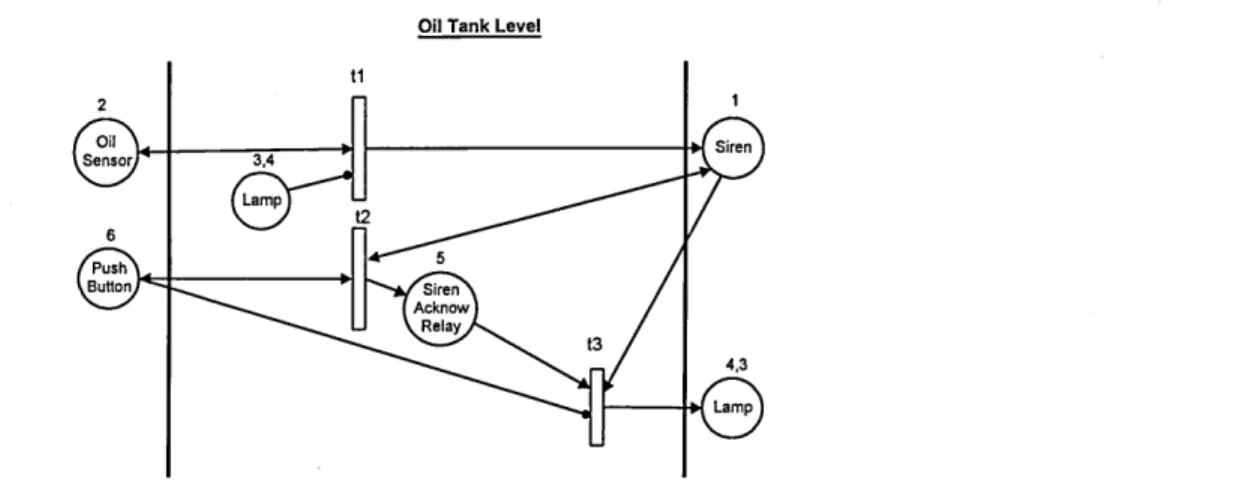
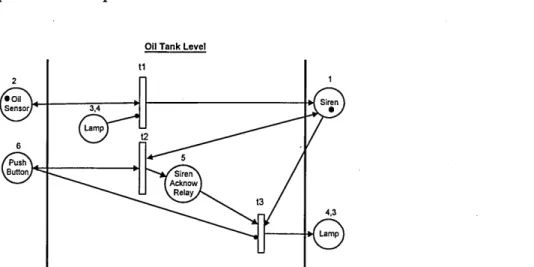
Gray’s methodology was applied to the control problem, Figure 3-1, and the PN graph
shown in Figure 3-2 was developed, directly from the requirements.
Oil T ank Level
Oil >
S en so rJ 3,4 W S iren
0 ^
P u sh
B utton ' S iren >
A cknow i R elay J
4,3
-M Lam p
Figure 3-2 PN Graph of Oil Tank Level Control Produced By Gray’s Methodology
As claimed, a readable design has been produced, in that the outputs are on the right-
hand side of the graph boundaries, the inputs are on the left-hand side of the
boundaries, and the internal logic is in between the boundary lines sequentially down
the page. However, it is not a dependable design, and Gray’s methodology does not
give full guidance to design dependable PLC control systems. For example, inhibitor
arcs had to be used but they are not part of his methodology. Instead, when