• No results found

Acceleration Based Gesture Recognition for Conducting with Hidden Markov Models

N/A
N/A
Protected

Academic year: 2020

Share "Acceleration Based Gesture Recognition for Conducting with Hidden Markov Models"

Copied!
111
0
0

Loading.... (view fulltext now)

Full text

(1)

Lehr- und Forschungseinheit Medieninformatik Prof. Dr. Heinrich Hußmann

Diplomarbeit

Acceleration-Based Gesture Recognition for Conducting

with Hidden Markov Models

Dominik Schmidt [email protected]

Bearbeitungszeitraum: 21.03.2007 bis 22.10.2007 Betreuer: Prof. Asim Smailagic, Ph. D.

(2)

any skill to conduct a virtual orchestra in realtime. As a first step, several user studies with musical conductors were performed to learn more about the interaction between conductor and orchestra.

The eWatch, a wearable computing and sensing platform, is selected as input device. It is worn like a regular wrist watch and transmits acceleration data via Bluetooth to the host computer.

Hidden Markov models are chosen to perform the gesture recognition task. While realizing a reliable and continuous gesture recognition, the proposed system is able to successfully reject non-meaningful hand movements, applying a threshold model. The system makes use of a discrete hidden Markov model in conjunction with a modified version of the Viterbi algorithm, which is specifically adopted for continuous gesture recognition.

By performing common conducting gestures, the user is able to indicate the measure. In addition, he or she can influence the orchestra’s tempo and volume by varying the gestures in speed and size. The evaluation of the proposed approach with different users yields a detection ratio of more than 94% and a reliability of more than 90% with an average latency around 90 ms for the user-dependent recognition.

(3)

München, October 22, 2007

(4)

ence, school of media informatics, of the Ludwig-Maximilians-Universität in München, Germany. While it was supervised by Prof. Bernd Brügge, Ph. D. of the Technische Universität München, I did the underlying research at the Institute for Complex Engineered Systems (ICES) at Carnegie Mellon University in Pittsburgh, PA, USA under the supervision of Prof. Asim Smailagic, Ph. D. and Prof. Daniel P. Siewiorek, Ph. D.

The input device used, namely the eWatch, has also been developed at ICES, who kindly provided me with an exemplar to work with. In the course of doing research for this thesis, the direction with respect to recognition methods and requirements was under constant change, either due to approaches that did not perform as expected, or due to new ideas that came up in the meantime. There is no written assignment of task.

(5)

1 Introduction 1

1.1 The Pinocchio System . . . 1

1.2 Motivation and Challenges . . . 2

1.3 Principle Methods . . . 2

1.4 Structure of this Thesis . . . 2

2 Related Work 5 2.1 Pattern Recognition with Hidden Markov Models . . . 5

2.2 History of Conducting Systems . . . 6

2.2.1 Buchla Lightning . . . 6

2.2.2 Mathews et. al. (1970 – 1997) . . . 9

2.2.3 Buxton et. al. (1980) . . . 10

2.2.4 Keane et. al. (1989 – 1991) . . . 11

2.2.5 Morita, Sawada et. al. (1989 – 1997) . . . 11

2.2.6 Bertini et. al. (1992) . . . 12

2.2.7 Bien et. al. (1992) . . . 13

2.2.8 Lee (M.), Brecht, Garnett et. al. (1992 – 2001) . . . 13

2.2.9 Tobey et. al. (1995 – 1996) . . . 14

2.2.10 Marrin et. al. (1996 – 2000) . . . 14

2.2.11 Borchers, Lee (E.) et. al. (1997 – 2006) . . . 15

2.2.12 Ilmonen et. al. (1997 – 1999) . . . 17

2.2.13 Usa et. al. (1998) . . . 17

2.2.14 Bianchi et. al. (2000) . . . 18

2.2.15 Segen et. al. (2000) . . . 18

2.2.16 Kolesnik et. al. (2004) . . . 18

2.2.17 Murphy et. al. (2004) . . . 18

2.2.18 Schertenleib et. al. (2004) . . . 19

2.2.19 Dillon et. al. (2006) . . . 19

2.2.20 Studies . . . 19

2.2.21 Comparison . . . 20

2.2.22 Discussion . . . 25

3 Preceding Studies 27 3.1 Conducting Gestures . . . 27

3.2 Initial User Studies . . . 28

4 Design Decisions 31 4.1 Requirements Elicitation . . . 31

4.2 Recognition Method Decision . . . 32

4.3 Hardware Decisions . . . 33

4.4 Software Decisions . . . 36

5 Conducting Gesture Recognition 39 5.1 Choice of Machine Learning Approach . . . 39

5.1.1 Artificial Neural Networks . . . 39

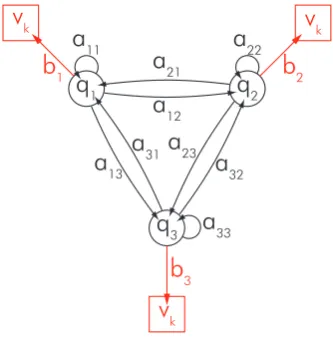
5.1.2 Hidden Markov Models . . . 39

5.2 Gesture Classification . . . 42

5.2.1 Preceding Considerations . . . 42

5.2.2 Hidden Markov Model Parameters and Feature Extraction . . . 44

(6)

5.4 Gesture Interpretation . . . 54

5.4.1 Tempo . . . 54

5.4.2 Volume . . . 54

6 Implementation 57 6.1 Testbed . . . 58

6.2 Recognition Algorithms . . . 59

6.3 eWatch Module . . . 61

6.4 Test Data Preparation Tools . . . 61

6.5 Evaluation Environment . . . 64

6.6 Recognition Subsystem . . . 65

6.6.1 Gesture Input Device Subsystem . . . 66

6.6.2 Filter Subsystem . . . 67

6.6.3 Recognizer Subsystem . . . 67

7 Evaluation 69 7.1 Method . . . 69

7.2 Results . . . 72

7.2.1 Number of States . . . 72

7.2.2 Number of Labels . . . 74

7.2.3 Cutoff Threshold . . . 76

7.2.4 Smoothing . . . 78

7.3 Discussion . . . 78

8 Conclusions 81 8.1 Strengths . . . 81

8.2 Limitations . . . 82

9 Future Work 83 9.1 Input Device . . . 83

9.2 Gesture Recognition . . . 83

9.3 Evaluation . . . 84

9.4 Pinocchio . . . 84

9.5 Outlook . . . 85

10 Acknowledgments 87

(7)

1 Introduction

When using a virtual orchestra system on the computer—with musicians that look and sound quite real—it does not seem to make a lot of sense to interact with it using traditional input de-vices. Telling the violist to play a little louder by turning the mouse’s scroll wheel might be efficient—but is far from the way you would communicate with a real instrumentalist; and making the musicians play faster by hitting the “+” key on the keyboard a couple of times is certainly un-derstood by the orchestra application—but again, this is not the way a conductor tells the orchestra to increase the tempo. The interaction between the user in the role of a conductor and the orches-tra simulated in the computer would be much more realistic if the same means of communication which are used in the real world could be used instead, namely conducting gestures. This virtual orchestra is an example for a computer application which benefits from providing alternative ways of communicating with the user, from offering new and more natural means of interaction, making it easier—and certainly much more fun in this case—to use the application.

This thesis presents the theoretical background, implementation, and evaluation of a gesture-based input device for an existent virtual orchestra system. A wearable computer platform resem-bling an ordinary wrist watch and equipped with several sensors is used to capture acceleration data, and a machine learning approach is then applied to recognize conducting gestures. The user of the system takes over the conductor’s role and can control the orchestra’s tempo and volume by means of common conducting gestures and by varying execution speed and size. In the following section, I shall introduce the existent orchestra system to be provided with a gesture input device. 1.1 The Pinocchio System

Pinocchio1[Brügge et al., 2007] is a virtual orchestra system originally targeted at children to

en-hance their interest in classical music in a playful manner. It is being developed at the Technische Universität München in cooperation with the Bavarian Radio Symphony Orchestra.

Pinocchio features a virtual concert hall populated by musicians which are represented using synchronized audio and video playbacks. As a key difference to other existent systems the user has the freedom to configure the musicians’ setup: Each musician can be selected and positioned freely in 3D space and can be addressed individually. Thus, it is possible to select certain instruments and to realize a virtual walk-through experience featuring a realistic 3D audio representation.

In the current version, the user can control the system with a baton whose movements are captured by a camera. Conducting gestures are recognized in order to control tempo and volume of the virtual orchestra. The audio and video footage used in the system has been acquired recording individual musicians of the Bavarian Radio Symphony Orchestra separately to increase the realism of the virtual orchestra. Currently, recordings of four musicians (two violin players, one violist, and one cellist) playing Mozart’s Quartet in C for Strings, “Dissonant” (KV465) are available.

Pinocchio started in 2004 as a first prototype of a conducting system and was called Marris. It was able to track the baton and to perform 3D audio mixing. In 2005, the project was renamed into Virtual Symphony Orchestra (VSO) and real musicians were recorded. It was also possible to position them freely in 3D space. VSO was running on a cluster of six iMacs. VSO++ was introduced in 2006, realizing several optimizations that enabled the conducting system to run on a single machine.

First experiments with alternative input devices have been conducted. Lachenmaier [Lachenmaier, 2006] added a conducting learning module to VSO++, applying artificial neural networks (ANN) to optical gesture recognition. Bierbaum [Bierbaum, 2007] realized a reengi-neering project optimizing poorly performing parts in order to make Pinocchio capable of han-dling more complex scores and larger virtual orchestras on a single machine. Besides the work

1The name Pinocchio was inspired by a gaze—or nose—recognition experiment. It is an abbreviation for

(8)

score to the conductor in realtime [Fenzl, 2007]. 1.2 Motivation and Challenges

The motivation behind this research is to enable the user to interact with a system in a natural way, i.e. in a way he or she would interact intuitively, considering the system’s application domain. In the case of Pinocchio, I shall develop an input device which is able to recognize hand gestures based on acceleration data, i.e. I am focusing on the application domain of musical conducting. The input device will be able to recognize and interpret conducting gestures—which are fairly complex and have a defined meaning—to control a virtual orchestra.

Choosing this specific application domain, however, does not limit the recognition method as such to conducting gestures. Since a general machine learning approach is applied, arbitrary hand gestures can be trained. That is, the hand gesture recognition approach to be developed in the context of this thesis may be applied to other application areas that benefit from a gestural input.

The work presented here covers several areas of computer science, thus posing challenges at different levels: First, in the context of human-computer interaction, adequate gestures have to be defined and a suitable hardware device has to be found and adopted. Second, a recognition algorithm has to be developed and evaluated. Third, the algorithm has to be implemented and embedded into an existent software architecture.

While accelerometers enable small an light devices, they only deliver relative information on motion and provide noisy data—making it more difficult to build a reliable gesture recognition system. The acceleration data thus needs to be preprocessed adequately. Since the user is likely to move the hand randomly during times he or she is not performing an intentional gesture, the recognition system must be able to discard non-meaningful movements without influencing the recognition rate of intentional gestures. In the following section, I shall give a brief introduction of the methods applied in order to realize a conducting gesture recognition system.

1.3 Principle Methods

The choice of input device fell onto the eWatch—a wearable computing and sensor platform devel-oped at the Institute for Complex Engineered Systems at Carnegie Mellon University in Pittsburgh, PA, USA. The device is worn as like regular wrist watch and transmits raw acceleration data of the user’s arm movements via Bluetooth to the host system.

After doing a literature research, covering existent orchestra systems on the one hand as well as more general gesture recognition approaches on the other hand, I chose discrete hidden Markov models (HMM) for recognizing conducting gestures. This approach requires several steps in order to preprocess the raw acceleration data, which have to be carefully chosen.

In order to evaluate the proposed gesture recognition approach, I collected several hours of gesture data performed by different users. Three different conducting gestures, representing dif-ferent measures, were performed by the users to test the system’s recognition performance. 1.4 Structure of this Thesis

The remainder of this thesis is structured as follows:

Chapter 2 provides an overview of related work. I shall discuss the application of hidden Markov models (HMM) to pattern recognition tasks before presenting the history of computer-based conducting and orchestra systems. This chapter enables the reader to gain an understanding of pattern recognition application areas and see Pinocchio in the context of similar systems.

(9)

per-formed with conductors, and discusses their implications with respect to the development of a new user interface for conducting gestures.

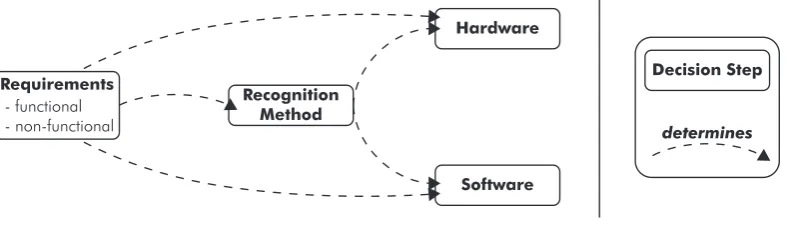
After performing a requirement elicitation at the beginning of chapter 4, I shall explain the de-cisions I made regarding the general gesture recognition method as well as hardware and software. This chapter defines the foundation for the system to be developed.

Based on this foundation, I shall describe my approach for conducting gesture recognition in chapter 5. After motivating my choice for HMM, I shall discuss the different modules of the gesture recognizer to be realized in the context of this thesis. This chapter makes the reader familiar with the theoretical background the subsequent implementation is based on.

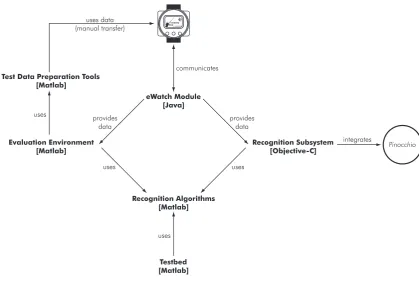
Chapter 6 describes the implementation of the conducting gesture recognizer as well as the integration into Pinocchio. Additionally, I shall introduce software tools I developed for the ac-quisition of user test data and the evaluation of the recognition performance.

In chapter 7, I shall evaluate the system’s performance with regard to detection ratio and reliability. The presented evaluation is based on gesture data acquired from different users. I shall conclude this chapter with a discussion of the results’ implications.

(10)
(11)

2 Related Work

In this chapter, I shall review related work that applies hidden Markov models (HMM) to different pattern recognition tasks—such as hand gesture, hand writing, or activity recognition, to name a few. Since this thesis focuses on the recognition of musical conducting gestures in the context of a virtual orchestra, I shall present prior work related to the application domain of computer-based conducting and orchestra systems separately in section 2.2, independent from the input modalities used.

2.1 Pattern Recognition with Hidden Markov Models

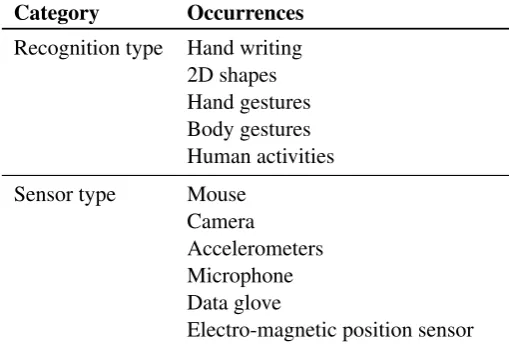
As motivated in section 5.1, I am applying HMM to the recognition of conducting gestures. In this section, I shall present an overview of prior systems and studies, applying HMM to a variety of pattern recognition tasks, while focusing on hand gestures as a general class of conducting gestures. In this review, I am classifying the presented systems by two categories, namely

[image:11.595.155.410.363.535.2]

• recognition type, i.e. which class of patterns does the system recognize, and • sensor type, i.e. which sensors are used and where are they positioned.

Table 2.1 shows the occurrences represented in the reviewed systems.

Category Occurrences

Recognition type Hand writing 2D shapes Hand gestures Body gestures Human activities Sensor type Mouse

Camera

Accelerometers Microphone Data glove

Electro-magnetic position sensor

Table 2.1: Classification categories of HMM-based recognition system

The approach proposed by [He and Kundu, 1991] is able to classify 2D-shapes. [Starner et al., 1994] recognize cursive hand-writing, using discrete HMM. [Yamato et al., 1992] use an image-based approach for human action recognition; the presented system is able to recog-nize six different human actions, namely different tennis moves.

(12)

the realization of context-aware applications. Both are using accelerometers and microphones in order to accomplish this task. Further activity recognition approaches are presented by [Krause et al., 2005, Krause et al., 2003]. These approaches do not apply HMM, but they are us-ing the eWatch, respectively a predecessor of the eWatch, as input device, which is also used in order to realize conducting gesture recognition in the context of this thesis (compare section 4.3). In the following section, I shall explain how conducting and virtual orchestra systems developed. 2.2 History of Conducting Systems

Over the last 35 years2, a multiplicity of systems have emerged around the topic of conducting a

computer–or the computer following a conductor. Aiming at different goals, different approaches have been developed. Nevertheless, some ideas remain the same across many of the conducting systems.

This section consists of a structured overview of existent computer-based conducting systems3

and the approaches they apply. This survey puts an emphasis on the gesture recognition part of the systems.

Section 2.2.1 starts with a brief description of an often used input device called the Buchla

Lightning. All the systems that have been considered are also briefly described in short paragraphs

which are categorized by their respective authors and ordered by their publish date. Two articles that do not include a detailed system description and mainly deal with studying the relationship between conductor and orchestra are presented in chapter 2.2.20. Chapter 2.2.21 closes this section with a comparison of the presented systems.

In addition, figure 2.1 shows a timeline which emphasizes the temporal sequence and illus-trates dependencies among the systems. Table 2.2 summarizes relevant innovations and technolo-gies together with their first appearance in a conducting system. A comparison of more general frameworks likeEyesWeborMax/MSPthat are used in some of the presented conducting systems can be found in [Grüll, 2005].

2.2.1 Buchla Lightning

Before the introduction of the actual conducting systems, it is useful to have a look at a com-mercially available input device as it is used by many of the presented systems. In his review of

theBuchla Lightning IIwhich is used by several conducting systems, [Rich, 1996] discusses its

features and capabilities. While the basic concepts remain the same, the version II adds internal sound, improved wands, and new software features.

Two hand held wands with an infrared emitter and a trigger button, resembling “high-tech drumsticks”, are used as control devices. Detectors track position and trajectory of each wand in 2D space. The system can operate at two different ranges: At up to 2.4m and at up to 4.8 m, impacting the possible operation time.

Space is divided in four times two zones. Each zone can be used to define different behaviors. In general, MIDI events are assigned to hand gestures, but the system comes with a powerful software offering its own, object-oriented programming language. Therefore it is possible to define complex interactions.

Although Rich emphasizes the system’s capabilities to be used as an instrument, they also mention the already included conduct program. The user can program conducting patterns by assigning a wand motion (that is, up, down, left, or right strikes) to each beat. The program

2Considering Mathews’Conductor Programmentioned in 1970 [Mathews and Moore, 1970] as first conducting

system (compare 2.2.2).

3Although a considerable effort has been put into researching the history of computer-based conducting systems,

(13)

Innovation System Author (see chapter) Year

Conducting application GROOVE/Conductor Program Mathews (2.2.2) 1970

Stick interface Sequential Drum Mathews (2.2.2) 1979

Baton interface∗ MIDI Baton Keane et. al. (2.2.4 1989

Image-based recognition Computer Music System that

Fol-lows a Human Conductor Morita et. al. (2.2.5) 1989

Fuzzy logic On-line Analysis of Music

Conduc-tor’s Two-Dimensional Motion Bien et. al. (2.2.7) 1992

Artificial neural networks Adaptive Conductor Follower Lee, M. et. al. (2.2.8) 1992

Acceleration-based recognition Gesture Analysis Using 3D

Acceler-ation Sensor for Music Control Sawada et. al. (2.2.5) 1995

3D sound Virtual Orchestra Performance Ilmonen et. al. (2.2.12) 1997

HMM, recognition of common con-ducting gestures

A Multi-Modal Conducting Simula-tor

Usa et. al. (2.2.13) 1998

Animated, virtual musicians Conductor Following with Artificial

Neural Networks Ilmonen et. al. (2.2.12) 1999

Unmodified baton for image-based

recognition, left hand Visual Interface for Conducting Vir-tual Orchestra Segen et. al. (2.2.15) 2000

Real orchestra recordings Personal Orchestra Borchers et. al. 2.2.11) 2001

Recognition of expressive gestures Recognition, Analysis and

Perfor-mance with Expressive Conducting Gestures

Kolesnik et. al. (2.2.16) 2004

Variable orchestra configuration Conducting a Virtual Orchestra Schertenleib et. al. (2.2.18) 2004

Table 2.2: Innovations and their first appearance in conducting systems

Although [Mathews, 1989] presented theMechanical Baton, it resembles more a drumstick from the descriptions

(14)

1976 1972 1974 1978 1982 1986 1990 1994 1998 2002 1970 1980 1984 1988 1992 1996 2004 2000 2006 1976 1972 1974 1978 1982 1986 1990 1994 1998 2002 1970 1980 1984 1988 1992 1996 2004 2000 2006 M athew s et. al. B ux ton et. al. Keane et. al. M ar rin et. al. B or chers , L ee (E .) et. al. M or ita, S aw ada et. al. Tob ey et. al. U sa et. al. B ianchi et. al. K olesnik et. al. Segen et. al. Ilmonen et. al. M ur ph y et.

al. Dillon et.

al. Scher tenleib et. al. B ien et. al. B er tini et. al. Visual Int er fac e Visual Int er fac e for C onduc ting ... for C onduc ting ... GR OO VE GR OO VE Sequential D rum Sequential D rum M icr o comput er -B ased M icr o comput er -B ased C onduc ting S yst em C onduc ting S yst em C onduc tor P ro gr am C onduc tor P ro gr am Mechanic al B at on Mechanic al B at on R adio D rum/ B at on R adio D rum/ B at on MIDI B at on MIDI B at on D igital B at on D igital B at on C onduc tor‘ s J ack et C onduc tor‘ s J ack et Vir tual Vir tual O rchestr a... O rchestr a... C onduc

ting a Vir

tual O

rchestr

a

C

onduc

ting a Vir

tual O rchestr a Vir tual O rchestr a: Vir tual O rchestr a: A n Immersiv e... A n Immersiv e... C onduc ting A udio F

iles via ...

C

onduc

ting A

udio F

iles via ...

Liv e Int erpr etation... Liv e Int erpr etation... Vir tual C onduc ting Vir tual C onduc ting P rac tic e E n vir onment P rac tic e E n vir onment (A daptiv e) (A daptiv e) C onduc tor F ollo w er C onduc tor F ollo w er Vir tual E nsemble Vir tual E nsemble Light B at on Light B at on Vir tual O rchestr a P er formanc e Vir tual O rchestr a P er formanc e A Multi-Mo dal C onduc ting S imulat or A Multi-Mo dal C onduc ting S imulat or C onduc tor F ollo

wing with A

rtificial NN

C

onduc

tor F

ollo

wing with A

rtificial NN Personal O rchestr a Personal O rchestr

a Rec

o gnition, A nal ysis R ec o gnition, A nal ysis and P er formanc e ... and P er formanc e ... You’ re T he C onduc tor You’ re T he C onduc tor conga/M aestr o!/iS ymphony conga/M aestr o!/iS ymphony Ensemble Memb er ... Ensemble Memb er ... Ex tr ac tion of Ex tr ac tion of C onduc ting G estur es ... C onduc ting G estur es ... C omput

er Music S

yst

em that

C

omput

er Music S

yst

em that

Follo

w

s a Human C

onduc

tor

Follo

w

s a Human C

[image:14.595.101.523.104.732.2]

onduc tor G estur e A nal ysis Using G estur e A nal ysis Using 3D A cc eler ation S ensor ... 3D A cc eler ation S ensor ... O n-line A nal ysis of O n-line A nal ysis of Music C onduc tor ’s ... Music C onduc tor ’s ... Lee (M.), B rech t, G ar nett et. al.

(15)

derives tempo and generates MIDI clocks. Rich notes that the conduct program works best with simple up and down strikes. It seems to be difficult, though, to conduct more complex pattern like patterns used by orchestral conductors due to low recognition accuracy.

2.2.2 Mathews et. al. (1970 – 1997) GROOVE and Conductor Program

Although [Mathews and Moore, 1970] presented a general purpose system for “creating, storing, reproducing, and editing functions of time”,GROOVEhas only been used for sound synthesis— with an application called theConductor Program. The system reads stored samples from mem-ory, combines these samples with realtime input from the user, and computes output samples for control. Four knobs, a 3D joystick, and a keyboard are used as input devices.

TheConductor Programintroduces a new view on the interaction with musical systems:

Math-ews notes that “the desired relation between the performer and the computer is not that between the player and his instrument, but rather that between the conductor and the orchestra.” Thus, the score is stored in the computer while the user influences the way it is played back—making the

Conductor Programprobably the first conducting system.

Some more details about the Conductor Program were presented by Mathews in 1976 [Mathews, 1976]. He emphasizes again that the supported functions are typically those which are done by a conductor. Possible areas of application are playing new musical compositions, serving as an accompaniment device, and “active listening”, an application that allows the user to be an active participant in the performance of a piece of music by conducting and interpreting it [Boulanger et al., 1990].

The Conductor Programconsists of three modes: Entering the score, rehearsal—that is

ad-justing the manner of playing—and performance. In performance mode, all voices play together. Overall dynamics and balance of individual voices can be controlled by using the joystick. There are two different ways to control the tempo: Either the performer uses the knob or he or she can exercise control by beating on a key—an interaction already resembling the one of input devices used later.

Sequential Drum

Presented in 1979, theSequential Drum[Mathews, 1979, Mathews and Abbott, 1980] is the first of three attempts by Mathews to create a mechanical baton [Boulanger et al., 1990]. It is made of a rectangular surface that can be struck either by hand or by a drumstick. The system’s output con-sists of a trigger whenever the surface was hit, along with information about the strike’s strength (measured by microphones), and the strike’s x and y position (determined from grounding wires). Although the presented application controlling a synthesizer is able to follow the user’s tempo inducted by his or her beats and to adjust the loudness according to the strikes’ strength, the

Sequential Drumwas rather intended to be a new way of playing “intelligent instruments”; the

term “conducting” as such was not thought of in this context.

Mechanical Baton (Daton)

In 1989, [Mathews, 1989] started using theConductor Programin conjunction with aMechanical

Baton (or Daton), the successor of the Sequential Drum. It consists of a 14 inch square plate

(16)

ment. In this context, Mathews also notes that “the program simulates a number of the functions of an orchestra following the baton of a conductor”. Like in an orchestra, the user does not have influence on the pitch; Mathews gave the task of pitch selection to the computer.

Besides containing information about pitches and durations of notes, the score also contains information about expected strokes which is used to control the tempo. According to Matthews, “each Daton stroke after the first stroke sets the tempo that will be used until the next stroke”. If a stroke occurs before the next beat mark in the score, the system will jump to this position. If the computer arrives at the beat first, it halts and waits for the next stroke. This tempo control makes the system follow the conductor very closely, a behavior which was preferred by users who tried the program.

Mathews proposes two potential usage scenarios. The system could be used as an accompani-ment of soloists (as a cheaper alternative) or as an interactive record where the music appreciator “would purchase a computer score and conduct his own interpretation of the piece” rather than just listening to recorded music4.

Radio Drum

While looking quite similar at a first glance, theRadio Drum, Boie89, also introduced in 1989, uses a different technology and is more powerful than theMechanical Baton. It relies on the principle of capacitance sensing of electromagnetic waves. The surface is equipped with an array of receiving antennas which receive signals sent by transmitting antennas built into the drum sticks.

In contrast to the Mechanical Baton, an arbitrary number of drumsticks can be used as long as they operate at different frequencies. Furthermore, theRadio Drumcontinuously measures the sticks’ positions in three dimensions. While the accuracy of the x and y axis is about one percent of their maximal value when the stick is close to the surface, it decreases non-linearly with increasing z distance.

Creating two virtual surfaces theRadio Drumalso works as a trigger. This mode was applied when theRadio Drumwas used as an input device for theConductor Program[Mathews, 1976]. Although this program takes continuous values as inputs, too, [Boie et al., 1989] does not mention using theRadio Drumin this way. In the related article, the device is seen as a controller for music, rather than a tool to actually conduct.

Radio Baton

In 1991, [Mathews, 1991] noted that it is possible to have different configurations of the Radio Drum; such a configuration is not being presented, though. TheRadio Drum[Boie et al., 1989] is a special version of theRadio Batonwith receivers located in a three-dimensional volume.

Interestingly, [Boulanger and Mathews, 1997] uses the termRadio Batonfor the same device which was previously calledRadio Drum. It has one square antenna and two batons. Besides the already discussedConductor Programa second mode for improvisation is presented. The baton sends triggers and x, y, and z coordinates, when requested, to an application which is supposed to interpret this information. While theRadio Batononly delivers control information, Boulanger notes that “the user is expected to program their own improvisation algorithms”.

2.2.3 Buxton et. al. (1980)

A Microcomputer-Based Conducting System

Similar to Mathews’ Conductor Program [Mathews, 1976],[Buxton et al., 1980] built a system that enables controlling a digital sound synthesizer. They explicitly named it a conducting system.

(17)

Nevertheless, it is important to have a closer look at its capabilities with regard to user interaction in order to understand what is meant by conducting in this context.

The user interface of the presented system consists of a CRT screen, a keyboard for text input, a tablet, and a slider box. It allows the user to adjust eight different parameters (tempo and ampli-tude, among others), affecting the way stored scores are played back. This adjustment is done by using the controls available in the on screen textual user interface, resembling standard controls present in nowadays graphical user interfaces. They are “spatially distributed on the screen in much the same manner that knobs and dials are distributed on a mixing console.” Buxton et. al. mention different techniques for changing values. The user can for example type numbers or use a dragging technique, i.e. moving the cursor to adjust values.

Although the proposed input techniques are advanced considering the year of publication, the system seems to be more a playback tool for synthesized music scores than a conducting application: It allows the user to affect the way music is played back in detail but the required interactions are not the same as an orchestra conductor uses to communicate with musicians. [Mathews, 1976] in contrast mentioned tapping a key in order to control the playback tempo in his system - which comes closer to conducting gestures than adjusting numerical values using a keyboard or a graphic tablet.

The system is a conducting system if conducting refers to influencing parameters in realtime while playing back scores. But it is not a conducting system if conducting means interacting with the system in a way that resembles the interaction between a real conductor and an orchestra. It would not be possible for example to simultaneously conduct live performers and the sequencer, using this system.

2.2.4 Keane et. al. (1989 – 1991) The MIDI Baton and Successors

[Keane and Gross, 1989] introduced the MIDI Batonsystem in 1989 to simultaneously conduct live performers and a MIDI sequencer. Shaped like a tube, the device resembles a regular baton with a metal weight inside. During acceleration, this weight is forced against the tube’s side and a electrical signal is produced. An interface connected via a wire takes care of removing noise and providing the signal to a synchronizer which in turn anticipates the tempo and advances the MIDI sequencer. The timing relationship can be adjusted to conduct either behind or ahead of the beat. Start and stop can be controlled using a foot pedal.

Due to its inherent design, the MIDI Baton is only able to provide discrete values that are used for tempo but not for volume control. In a succeeding version [Keane et al., 1990, Keane and Wood, 1991] of the MIDI Baton, a wireless transmitter was introduced eliminating the need for a wired connection between the baton and the MIDI unit. Moreover, switches for start and stop were moved from the foot pedal to the transmitter.

2.2.5 Morita, Sawada et. al. (1989 – 1997)

Computer Music System that Follows a Human Conductor

In 1989, [Morita et al., 1989] presented a system that realizes “an improvisational performance in realtime”. It is the first conducting system to be based on visual recognition of the conductor’s baton. A CCD camera in conjunction with feature extraction hardware is used to track either the baton augmented with a white marker or the conductor’s hand wearing a white glove. A conventional PC is then used to recognize the conducting gestures.

(18)

between conducting gestures and music playback in order to make the system sound “more natural in human ears”.

The system can be used as a stand-alone application to enjoy conducting but is also intended to be used together with real musicians or as accompaniment for plays or operas.

Beginning in 1990, [Morita et al., 1990, Morita et al., 1991] extended the system described above by a data glove worn on the left hand which is used to capture additional expressions ac-cording to the grammar of conducting. The authors try to reproduce the process a human musician goes through while playing an instrument in an orchestra.

The “musical performance expression” (MPX) is introduced as a formalism that captures the “artistic essence” of performance. In contrast to basic music information like pitch or duration of notes, MPX describes parameters such as “crescendo” or “ritardando” and consists of several components.

The user is able to input his or her evaluation of the system’s interpretation enabling the system to adapt to a user’s gestures and preferences. Morita et. al. intend their system to be used as an ensemble member together with human musicians or as an automated accompaniment.

Gesture Analysis Using 3D Acceleration Sensor for Music Control

In 1995, [Sawada et al., 1995], developed a “new musical performance system” that uses 3D ac-celerometers for gesture recognition which are fixed to the back of the right hand. In this version, the system has two modes of control: Performance control allows the user to direct performance advancements and timbral control is used for mapping kinetic to sound parameters. While not many details on the hardware and its usability are provided, applied algorithms are described more extensively.

[Sawada and Hashimoto, 1997] provide a more in-depth description of a later version of the same system in 1997—however, not covering the timbral control part, which is of lower interest in the conducting context. The presented system is supposed to “enable anyone to play music”. It uses two different approaches for gesture recognition:

On the one hand, maxima in the acceleration data are detected for tempo and volume control. Tempo prediction is applied to improve the system’s response. On the other hand, the system is able to learn arbitrary gesture commands using a recognition based on the distance between feature vectors. Therefore, several kinetic parameters are extracted out of the acceleration data. Using these features, an evaluation value is calculated for each gesture that has been trained before. If the minimum over all evaluation values is below a certain threshold, a gesture is recognized. The start of a gesture is detected by comparing the current acceleration values to the fluctuations observed before.

Sawada and Hashimoto report an accuracy of 100% for the gesture recognition if training data come from the same user and or accuracy of 90% otherwise. It takes between 0.5 s and 1.0 s in order to detect a gesture. The length of expected gestures has to be known beforehand. No further discussion is being held on the integration of the two proposed recognition approaches.

2.2.6 Bertini et. al. (1992) Light Baton

(19)

extraction of features like amplitude and duration. The next beat point is predicted by the system and tempo changes are applied smoothly, resembling the response of a real orchestra.

Although [Bertini and Carosi, 1992] mention a prior study leading to findings that indicate that, while the x-axis of the baton’s trajectory is relevant for recognizing the downbeats, the y-axis identifies the order number of movements, this information does not seem to be used in the presented system.

2.2.7 Bien et. al. (1992)

On-line Analysis of Music Conductor’s Two-Dimensional Motion

In 1992, [Bien and Kim, 1992] also used a visual approach to detect the conductor’s gestures. A special purpose hardware takes care of extracting the baton’s trajectory at a rate of 15 Hz (referred to as “high-speed”). This information is transferred to a PC which analyzes the gestures. No augmentation for the baton seems to be needed in order to detect its tip.

Motivated by a higher tolerance to noise, a fuzzy logic approach is applied to detect turning points of the baton movement rather than looking at direction change features directly. The system is able to detect the first beat of a measure and derive tempo as well as dynamics by applying simple rules. In addition, it detects static points (“fermata”). Music playback is realized by a 12 channel sound card. Bien and Kim do not mention any attempt to smooth the tempo adjustments in order to make it behave more like a real orchestra.

2.2.8 Lee (M.), Brecht, Garnett et. al. (1992 – 2001) Adaptive Conductor Follower

[Lee et al., 1992b] use aBuchla Lightningand aMattel Power Gloveas input hardware for their artificial musician, or conductor follower. They are the first to apply artificial neural networks (ANN) to conducting gesture recognition. Their architecture consists of classification and param-eter estimation modules—both using separate preprocessors and ANN. The system is supposed to recognize tempo, volume, and “other performance parameters”. Unfortunately, not much detail on the implementation is provided. Also, the role of thePower Gloveis not discussed.

The authors mention that they use baton movement in one dimension to derive the implied tempo, which is calculated from time points within a beat to achieve a faster responds time and to be able to vary tempo within a beat. ANN are used to approximate the tempo. It is noted that an adjustment for each conductor is recommended because of the wide variation in gestures.

Later in 1992 [Lee et al., 1992a], a slightly different version of the system is reported. Instead of the Buchla Lightning, Mathews’ Radio Baton[Mathews, 1991] is used as input device. The software architecture remains the same, focusing on simultaneous classification and parameter estimation. In this version of the system, the data glove is used as a mode controller. Two different hand gestures can be recognized, one for volume and one for tempo, while the baton’s velocity is mapped to either one of the parameters.

Conductor Follower

(20)

In 1999, taking a different approach compared to the previously discussed systems, [Garnett et al., 1999] pursued an educational intention. Their Virtual Conducting Practice

En-vironmentis clearly targeted at conducting students, thus it offers graphical and auditory feedback

in order to improve a student’s learning curve. It uses theBuchla Lightningsystem. Besides an approach to detect different articulation styles, no information about the actual process of gesture recognition is presented.

Virtual Ensemble

In 2001, [Garnett et al., 2001] capture position and orientation information of both the user’s hands and his or her head, using three wireless magnetic sensors with six degrees of freedom each. The proposed systems aims at being used in conductor training and as a conductor-based performance instrument. Only preliminary recognition methods are presented. Two beat types can be recog-nized with an accuracy of 85% applying a hybrid approach consisting of a segmentation step and an ANN for classification. Neither tempo nor dynamics recognition is discussed.

2.2.9 Tobey et. al. (1995 – 1996)

The Ensemble Member and the Conducted Computer

In 1995, [Tobey, 1995] presented a conductor-following system created by a professional conduc-tor aiming at the synchronization of live performers and synthesizers as well as conducconduc-tor training. A Buchla Lightning is used as input device for this MIDI-based system. Tempo is tracked along the continual shape of the baton’s path using information from lower and upper turning points as well as hints coming from the acceleration in between. Tobey calls this approach “rubato con-trol”. The system also provides a training module which can be used to make adjustments to an individual conductor’s style.

Extraction of Conducting Gestures in 3D Space

In 1996, [Tobey and Fujinaga, 1996] extended the previously presented system by adding another

Buchla Lightning to the setup in order to be able to track the conductor’s gesture in three

di-mensions. The additionally available z-axis is used to track movements away and towards the conductor’s body which was found to be another important dimension in the communication with the orchestra.

In addition to tempo control, this revised version of the conducting system also provides con-trol over dynamics, beat pattern and style, accentuation, and timbral balances. Besides the use in a hybrid computer-human ensemble, Tobey mentions that this system can also be used as a virtual orchestra.

2.2.10 Marrin et. al. (1996 – 2000) Digital Baton

(21)

The baton was built to “replicate as closely as possible the feel of a traditional conducting baton” Weighing about 200 g, it contains an IR LED which is used together with a position-sensitive photodiode (PSD) camera for absolute 2D position tracking at a rate of approximately 50 Hz, accelerometers that provide 3D orientation and acceleration tracking for large gestures and tilt indication, and pressure sensors to measure surface pressure at five points. The baton as well as the PSD camera is connected via cable to a tracking unit which in turn is connected to a computer. In her Master’s thesis [Marrin, 1996], Marrin develops a theoretical framework for conducting as a special instance of a gesture language. As such, it has similar characteristics as the spoken language and is also constructed from basic elements that are combined into larger structures. Although Marrin intended to build a conducting system, such a system has not been implemented. A beat recognition approach based on the acceleration data has been tested but not been used for tempo tracking.

TheDigital Batonwas used in several performances, though. It was one of the user interfaces

in the Brain Opera [Paradiso, 1999] which was conceived and directed by Tod Machover in 1996. This large, public installation consists of a number of different unconventional user interfaces for musical interaction. Every user contributes to a combined artistic experience.

Conductor’s Jacket

[Marrin and Picard, 1998] built the Conductor’s Jacket as platform to collect and analyze data from conductors in order to understand how they “express affective and interpretive information while performing”. While the related article only reports on the method of data collection, Mar-rin’s PhD thesis [Marrin, 2000] presents an in-depth analysis and theGesture Constructionsystem to map gestural data to music.

The jacket holds several sensors, such as electromyography (EMG) sensors for measuring muscle tension, sensors for respiration, temperature, galvanic skin response (GSR), and heart rate. One of the eight constructed jackets also held a magnetic position-sensing device. The jacket is connected to a nearby computer for data collection. More than 10 hours of data were collected from three professional conductors and three conducting students during real performance situa-tions.

Marrin analyzed the data manually by comparing sensor data to video recordings and looking at visual features. Thirty-five significant features were discovered, fourteen of them are relevant for all individuals and described in greater detail. Building on these features, Marrin developed ten hypothetical rules of expression.

As results indicated that muscle tension and respiration signals reflect the characteristics of conducting gestures only these two sensor types are used in theGesture Constructionsystem. The user is able to control several different aspects of musical performance, tempo, dynamics, and articulation, among others. Different filters and rules are applied to the sensor data in order to derive the according parameters. Marrin concludes that being a proof-of-concept, the system did not effectively reflect the character and quality of each gesture.

2.2.11 Borchers, Lee (E.) et. al. (1997 – 2006) WorldBeat

Having a focus on user interface design issues, [Borchers, 1997] presents a system to be used in an interactive museum exhibit. The system can entirely be controlled by two Buchla Lightning

batons, which are used for navigational as well as musical input.

Six different modules are implemented with one of them being a conducting module. This module does not rely on the built-in conducting recognition provided by the Buchla Lightning

(22)

volume. No further tempo prediction or adaptation is applied.

Personal Orchestra

In 2001, [Borchers et al., 2001, Borchers et al., 2002, Borchers et al., 2004] presented the first conducting system that uses pre-recorded audio rather than synthesized music. The Personal

Orchestraenables the user to control tempo, dynamics, and instrument emphasis with a Buchla

Lightning IIbaton. Examining the first derivate of the y coordinate, downward turning points are

recognized by detecting changes in sign. No details on dynamics or instrument emphasis recog-nition are provided. The authors propose an algorithm that allows the music to catch up when the conductor changes tempo. The system has successfully been used as a museum exhibit.

You’re The Conductor

Similar toPersonal Orchestra,You’re The Conductor[Lee et al., 2004] is an exhibit on display in a museum. Targeted at children, it uses a different interaction style and a different, more robust technical implementation. Instead of a Buchla Lightningbaton, a custom designed baton made from an aluminum tube with an LED at the tip is used. A PSD camera picks up the emitted light and tracks the baton’s trajectory.

The recognition process is fairly simple: Gesture speed is mapped to tempo and gesture size to volume; no beat synchronization takes place. Instead of the pre-stretched audio inPersonal

Orchestra,You’re The Conductoris capable of realtime audio stretching.

conga Framework and Maestro!/iSymphony

AfterPersonal Orchestra and You’re The Conductor, [Lee et al., 2006a, Grüll, 2005] presented their latest system calledMaestro!—oriSymphony—[Lee et al., 2006c] in 2005. It is also installed as a part of a museum exhibit. A Buchla Lightning II is used as an input device. Aiming at building a system that does not need training but at the same time recognizes a variety of gestures the authors proposeconga, a framework for conducting gesture analysis.

congais realized as an acyclic graph consisting of linked nodes. Nodes can be either feature

detector or data manipulation nodes. In its current implementation, three different gestures can be recognized. A gesture profile selector chooses the best match. From the description provided, it seems to be rather difficult to build a profile for a more complex gesture like the four-beat pattern. The authors report a recognition rate of more then 90% and a latency of up to 675 ms for the four-beat pattern.

Toward a Framework for Interactive Systems to Conduct Digital Audio and Video Streams

In this work, [Lee et al., 2006b] combine two of their systems taking the gesture recognition part

fromPersonal Orchestraand the audio and video rendering engine from You’re the Conductor.

(23)

2.2.12 Ilmonen et. al. (1997 – 1999)

Virtual Orchestra Performance

In 1997, [Takala, 1997] presented a conducting system that features an orchestra of animated vir-tual musicians. These rule-based agents adjust their tempo as well as other aspects of performance according to the conductor who wears the data gloves. Gesture recognition is performed using ANN. The system uses 3D sound.

Conductor Following with Artificial Neural Networks

Two years later in 1999, [Ilmonen and Takala, 1999, Ilmonen, 1999] used a data suite containing several magnetic motion trackers with six degrees of freedom each to acquire data for conducting gesture recognition. Applying different ANN and heuristic rules using a priori knowledge about the score, the system can detect tempo, dynamics, and articulation. No evaluation concerning the recognition accuracy has been provided. It is noted that the ANN should be trained anew for each conductor.

In 2000, [Ilmonen and Jalkanen, 2000] exchanged the above used magnetic tracker for ac-celerometers in order to build a lower priced system to be used in a public exhibition. A wired tube was equipped with two orthogonally mounted accelerometers.

Two inherent problems of accelerometers used for position tracking are discussed: Drift and rotation. In order to overcome those, the authors applied a digital signaling processing approach using several low- and high-pass filters. Although it is stated that the results are not comparable to those of magnetic trackers, they were sufficiently satisfying for this application.

2.2.13 Usa et. al. (1998)

A Multi-Modal Conducting Simulator

Building on the model of recognition by actual orchestra musicians, [Usa and Mochida, 1998a, Usa and Mochida, 1998b] presented a conductor follower system that can be used for training purposes. It uses 2D accelerometers attached to a baton at a sampling frequency of 100 Hz and HMM together with fuzzy production rules for gesture recognition. Supporting common conduct-ing gestures as described by Rudolf, the user can control various parameters of the performance like tempo, dynamics, and articulation, among others.

The applied recognition process tries to imitate the way a real musician interprets conducting gestures. It consists of several agents, one of them integrating a HMM that is used to derive the order number of a beat within a measure. Acceleration data are filtered and quantified into 32 labels before used as input for the HMM. Thus, a discrete HMM is utilized. The start of a gesture is determined by detecting local peaks in the acceleration data.

Several other rule-based approaches are applied to detect further parameters, such as dynamics or articulation. In combination with fuzzy production rules that take into account the score and compute probabilities of the next beat occurring, an accuracy of 99.74% is reported if the system is used by the same person who also trained the HMM. The accuracy drops to 98.95% for other users.

(24)

Virtual Orchestra: Technical and Creative Issues

The virtual orchestra system presented by [Bianchi and Campbell, 2000] is intended to be used in professional opera and theater productions as an alternative to the live orchestra. The fairly large system is therefore installed in the pit. It is able to use up to 32 audio channels and follows the conductor’s tempo. No details on the recognition algorithms are discussed.

2.2.15 Segen et. al. (2000)

Visual Interface for Conducting Virtual Orchestra

In 2000, [Segen et al., 2000] presented a conducting system which relies on image processing for gesture recognition. Using two cameras, 3D trajectories of the baton as well as of the left hand are reconstructed. The user can control tempo and dynamics using common conducting gestures. While the hand is used for volume control only, the baton controls both, volume and tempo. Volume control by the baton controls the overall volume per measure while the hand controls overall volume per beat (using different levels of elevation) and volume per orchestra section (using a special volume gesture).

Recognition is based on analyzing position data and applying rules. In addition to the auditory output, a virtual dance ensemble consisting of 3D human models is synchronized to the user’s input. No information about the system’s accuracy is provided.

2.2.16 Kolesnik et. al. (2004)

Recognition, Analysis and Performance with Expressive Conducting Gestures

In 2004, [Kolesnik, 2004, Kolesnik and Wanderley, ] used two USB cameras to track the user’s left and right hand, wearing colored gloves. While the system recognizes indicative, continuous gestures for the right hand, it recognizes expressive, isolated gestures for the left hand.

Discrete HMM are used in the recognition process running in parallel with a “gesture analy-sis system” that performs a beat amplitude and transition points extraction based on extrema of absolute positional values. Using this information about temporal segmentation in addition to the probabilities output by the HMM, continuous gestures can be identified. The system is able to identify isolated gestures with an accuracy of 97.2% and continuous gestures with an accuracy of 94.6%.

2.2.17 Murphy et. al. (2004)

Conducting Audio Files via Computer Vision

[Murphy et al., 2004] presented a conducting system that uses one to two cameras in order to track a regular baton. Beats are extracted automatically from audio files to enable mapping between the conductor’s beat and beats in the recorded file. Although it is noted that the system uses common conducting gestures, only the tempo can be influenced and no insights into gesture recognition algorithms are given.

Live Interpretation of Conductors’ Beat Patterns

(25)

conductor executes it. The proposed model determines the meaningful deviation from a neutral execution of a beat pattern.

A beat template represented by a continuous close parametric curve built from the user’s exe-cution of the beat pattern is used in the recognition process that keeps track of where the baton is in relation to the whole pattern. No results about the accuracy of this approaches are presented.

2.2.18 Schertenleib et. al. (2004) Conducting a Virtual Orchestra

In 2004, [Schertenleib et al., 2004] presented a virtual reality system that is targeted at music am-ateurs providing an “entertaining multimedia experience”. The presented work does not intend to advance existing conducting interfaces but tries rather to offer an immersive experience conducting a virtual orchestra.

It is the first system that allows the user to modify the orchestra’s layout and to select an arbitrary viewing. While the virtual musicians are presented on a large projection screen, the main input interface is a PDA with an attached magnetic tracker. Simple conducting gestures control the orchestra’s tempo and volume using the gestures’ frequency and amplitude respectively.

2.2.19 Dillon et. al. (2006)

Virtual Orchestra: An Immersive Computer Game for Fun and Education

[Dillon et al., 2006] present their virtual orchestra system on the one hand as a “fun computer game” that introduces children to music and on the other hand as a “conducting training tool”. Using a commercial air gyro mouse, conducting gestures are detected by recognizing sequences of “impulses”, that is, fast changes in direction. The user is able to control tempo, dynamics, and articulation.

Besides the MIDI audio output, the system is also able to display virtual musicians. Dillon et. al. implemented a scoring system to evaluate a user’s performance based on a comparison between conducted tempo respectively dynamics and those written in the score. Different levels of difficulty are selectable and the virtual audience shows reactions according to how the user performs.

The authors note that is it possible to build a standalone version of the virtual orchestra that is able to run on a standard PC. No evaluation on recognition accuracy or details about the mentioned training part are presented.

2.2.20 Studies

Improving Orchestral Conducting Systems in Public Spaces: Examining the Temporal Characteristics and Conceptual Models of Conducting Gestures

In 2005, [Lee et al., 2005] investigated the temporal characteristics of conducting gestures with regard to beat placement comparing conductors to non-conductors. Determining parameters that makes it possible to clearly distinguish between these two user group allows for building an adap-tive conducting system.

Twenty-three users took part in the study. They were instructed to conduct a fixed orchestral recording using a simple up-down-motion, being aware that they can not influence the perfor-mance. No automatic recognition was used. Beats in the audio track as well as lower turning points in conducting gestures were annotated manually.

(26)

beat. Moreover, as “spiral of death” was observed: In response to a slowdown in music the user slows down the gestures which in turn slows down the music even more. The authors assumed that these findings also apply to an active system which still has to be investigated.

Modeling the Tempo Coupling between an Ensemble and the Conductor

In 2006, [Baird and Izmirli, 2001] analyzed the tempo coupling between conductor and ensemble, that is, the measure indicating “how closely the tempo of the ensemble corresponds to the tempo of the conductor”, especially during changing tempos when a difference can be observed.

A position sensor attached to the conductor’s baton or index finger is used to gather data from live performances. After creating a compact representation of the coupling, results are generalized and a model is built which is used in a performance system to simulate different levels of ensemble responsiveness.

2.2.21 Comparison

Table 2.3 provides a compact comparison of the presented computer-based conducting systems with focus on the input and gesture recognition part. Since there are many systems with different properties, the table’s categories are kept quite general in order to make it possible to fit the sys-tems’ characteristics into one single table for easier comparison. Further details can be found in the corresponding chapters of this section. Only properties that are described in the related articles are considered.

The systems are ordered in the same way as in the beginning of this section. Those by the same group of authors are presented consecutively. The following categories are used:

System contains either the name of the system or the title of the corresponding paper if the

system does not have a clear name. If a system introduces only minor changes compared to an earlier system, it is listed in the same row.

Input devicelists the input devices (and their functional principle, if custom-made) that are

available in the corresponding system to enable the user to conduct.

Recognition algorithmscategorizes the techniques that are used to detect the user’s intention,

i. e., algorithms that are applied to translate raw data coming from the input devices into control data used to influence parameters of music playback. Turning point analysis refers to techniques that use position, velocity, or acceleration data in order to determine the point in time where the baton changes its direction, indicating either a down- or an up-beat. Systems that follow a rule-based approach apply rules that combine different facts in order to derive the conductor’s intention. When a system uses frequency and amplitude analysis it does not map beats but simply correlates gesture speed and size to tempo and volume, for example.

Controllable parameterslists the musical parameters that can be influenced by the user through

(27)

Year A uthor (see chapter) System Input De vice Recognition Algorithms Contr ollable Parameters 1970/1976 Mathe ws, Moore (2.2.2 ) GR OO VE/Conductor Program Knobs, buttons, jo ystick, ke y-board N/A Tempo, dynamics (o verall and per voice) 1979 Mathe ws, Ab-bott (2.2.2 ) Sequential Drum Plate equipped with micro-phones and grounding wires, stick N/A Tempo, dynamics 1989 Mathe ws (2.2.2 ) Mechanical Baton Plate equipped with strain gauges, stick N/A Tempo 1989/1991 Boie, Mathe ws, Schloss (2.2.2 ) Radio Drum/Radio Baton Plate(s) and sticks equipped with antennas, based on capaci-tance sensing N/A N/A 1980 Buxton, Ree ves, Fe-dork ow , Smith, Baeck er (2.2.3 ) Microcomputer -Based Conducting System Screen and tablet, ke yboard, slider box N/A Tempo, dynamics, etc. (total of eight parameters) 1989 – 1991 K eane, Gross, W ood (2.2.4 ) MIDI Baton Tube with weight that cl oses circuit when acclerated N/A Tempo 1989 – 1991

Morita, Hashimoto, Ohteru,

W atan-abe, Harada (2.2.5 ) A Computer Music System that Follo ws a H u-man Conductor CCD camera and augmented baton, data glo ve Baton: turning point analysis, hand: feature vector Baton: tempo, dynamics, artic-ulation; hand: cresc., rit., etc. 1995/1997 Sa w ada,

Ohkura, Hashimoto (2.2.5

(28)
(29)

Year A uthor (see chapter) System Input De vice Recognition Algorithms Contr ollable Parameters 2004 Lee (E.), Mar -rin, Borchers (2.2.11 ) Y ou’ re The Conductor PSD camera, baton with IR LED Frequenc y and amplitude anal-ysis Tempo, dynamics 2006 Lee (E.), Grüll, Kiel, Borchers, Dedenbach, Karrer , W olf (2.2.11 ) cong a/Maestro!/iSymphon y Buchla Ligthning Rule-base graph approach Tempo, dynamics, instr ument emphasis 1997 Takala (2.2.12 ) V irtual Orchestra Performance Data glo ves Neural netw orks Tempo, misc. performance pa-rameters 1999/2000 Ilmonen, Takala, Jalka-nen (2.2.12 ) Conductor Follo wing W ith Artificial Neural Netw orks Data suite with 6DOF magnetic motion track ers Neural netw orks, heuristic rules Tempo, dynamics, nuancing 1998 Mochida, Usa (2.2.13 ) A Multi-Modal Conducting Simulator Baton with 2D accelerometers HMM, fuzzy rules Tempo, dynamics, articul ation start/stop, fermata 2000 Bianchi, Camp-bell (2.2.14 ) V irtual Orchestra N/A N/A N/A 2000 Se gen, Gluck-man, K umar (2.2.15 ) V isual Interf ace for Conducting V irtual Orches -tra Tw o cameras, baton and hand tracking Turning point analysis, rule-based Tempo, dynamics, beat phase 2004 K olesnik, W an-derle y (2.2.16 ) Recognition, Analysis and Performance wi th Expressi ve Conducting Gestures Cameras (tracking both hands) HMM Tempo, expressi ve control 2004 Murph y, An-dersen, Jensen (2.2.17 ) Conducting Audio Files via Computer V ision One or tw o cameras, baton N/A Tempo 2004 Murph y (2.2.17 ) Li ve Interpretation of Conductors’ Beat Pat -terns One or tw o cameras, baton Mathematical model N/A 2006

Schertenleib, Gutierrez, Vexo,

(30)

Year

A

uthor

(see

chapter)

System

Input

De

vice

Recognition

Algorithms

Contr

ollable

Parameters

2006

Dillon,

W

ong,

Ang

(2.2.19

)

V

irtual

Orchestra:

An

Immersi

ve

Computer

Game

for

Fun

and

education

Air

gyro

mouse

Turning

point

analysis

(“im-pulses”),

rule-based

Tempo,

dynamics,

articulation

Table

2.3:

Comparison

of

conducting

(31)

2.2.22 Discussion

Due to their great variety in a number of characteristics, it would be quite difficult to compare the presented systems in general. In fact, it seems to be more beneficial to focus on the respective input devices and recognition techniques used, since this is the emphasis of the present thesis as well.

Several types of sensors have been used for conducting gesture recognition: Cameras in con-junction with more or less augmented batons, muscle tension, heart rate, respiration, and galvanic skin response sensors, data gloves, magnetic motion trackers, and accelerometers. For the actual recognition, most of the systems rely on only one of those sensor classes. Although [Marrin, 2000] used a combination of several sensor types to conduct a user study, only two of them were used in her recognition system. As can easily be seen from table 2.3, the majority of systems use a visual approach to capture the conductor’s movements; almost half of them chose theBuchla Lighting

as input device. Accelerometers are only part of three of the adopted input devices. Several other approaches were taken, ranging from magnetic tracking over custom-built approaches (especially in the early years) to combinations of a multiplicity of different sensors.

A second important choice, that has to be made when designing a computer-based conducting system, is which recognition technique to use (including feature extraction and representation). Together with the input device, this decision defines the system’s limits in terms of possible variety of recognizable gestures, and thus the number of controllable parameters as well as the achievable recognition accuracy.

Most of the presented system use a rule-based approach, often analyzing the turning points of the baton’s trajectory in order to recognize beats. While one approach develops a fairly compli-cated mathematical model [Murphy, 2004], another system incorporates a recognition process that uses a graph structure with nodes for data manipulation and feature detection [Lee et al., 2006a]. Four of the systems make use of ANN, two of HMM.

In this context, it is important to have the intended application in mind. Several of the presented systems are intended to be used in museum exhibits where a single user only has a very limited time to get familiar and interact with the system. In such a case, it does not make sense to provide a large number of controllable parameters, for example. Others put an emphasis on conductor training applications. In this area, it might be desirable to support a larger set of conducting gestures. Some of the systems are designed for playing along with human musicians. Here, it is important to reliably support at least a basic set of parameters that allow the system to follow the conductor. Another application area can be found in the entertainment category.

(32)

Figure

Table 2.1 shows the occurrences represented in the reviewed systems.
Figure 2.1: Timeline of conducting systems
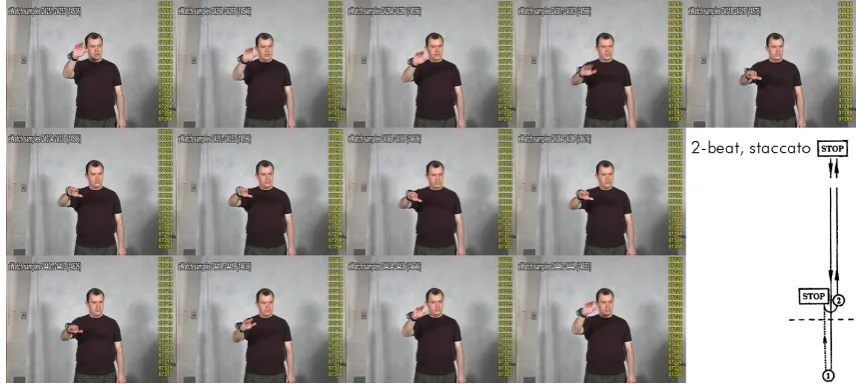
Figure 3.1: Light-staccato conducting gestures [Rudolf, 1950]
Figure 3.2: Conductor Daniel Meyer wearing the eWatch during a rehearsal
+7

References

Related documents

Project Preparation Phase Completed Blueprint Phase Completed Customer Acceptance Final Preparation Phase Completed (Go-Live Readiness) Project Completed (Project

As for trade unions, the proposal is similar: creation of Occupational Health and Safety Board within the union, in order to educate employees from the aspect

Companies that suc- ceed in monetizing online access will be those that develop customers for life online—through a combination of social media, community-based mar-

"Initial payments" means payment or payments which the seller receives before or upon execution of the instrument of sale and payments which he expects or is scheduled

An example of vertical approval facilitating horizontal cooperation is a retailer settling for a somewhat lower service level to enable suppliers or LSPs to optimise the

Note: use back door Note: discussion meetings Meeting Type: Al-Anon Group Focus: Regular Language: English.. Port

When installing the Compressor Module at the rear of the planter (most often on the tongue of the planter in front of the CCS blower or Refuge tank) hydraulic oil will need to

If the study were to be repeated then employing tactics to engage the more disadvantaged and less social active members of society would be beneficial to gaining a