Technology (IJRASET)
Variation of Pressure and Velocity in A 3- D Flow
Through a Plenum
Deepak Kumar1
1
Assistant Professor, Department of Mechanical Engineering, Amity University Gurgaon, India
Abstract: In this study, a plenum box is considered and the fluid is allowed to flow through this plenum box. The three-dimensional flow of the fluid which is not dependent on time has been studied. With the help of FLEX PDE software the governing equations are solved. The variation of pressure and velocity in different directions is analysed.
Keywords: Plenum box, Velocity Vector, FLEX PDE, Three-Dimensional Flow, pressure, Streamlines.
I. INTRODUCTION
Technology (IJRASET)
Technology (IJRASET)
continuity equation as an incompressibility constraint and vorticity – stream function approach. The fluid was allowed to flow in a rectangular channel obstructed by a solid rectangular plate of variable length with uniform incident velocity. The CFD computer code Flex PDE was used to analyze the flow dynamics. It was observed that by increasing the blockage ratio, the maximum values of the stream function as well as the maximum value of the velocity decreased at the obstruction and the size of vortex increased. It was also observed that with the increase in blockage ratio the region of low pressure increased behind the obstruction. Kumar Deepak [12] studied the time independent three dimensional flow of a fluid. The fluid had been allowed to flow through a plenum box with a circular inlet at the bottom and an offset circular outlet at the top. A computer program had been developed to solve the equations. Velocity in different directions and flow pattern had been investigated.
II. GOVERNING MATHEMATICAL FORMULATION
The governing partial differential equations which are used to analyse the pressure and velocity variation by using the computer program are as given below.
div_v = dx(vx) + dy(vy) + dz(vz)
vx: dens*(vx*dx(vx) + vy*dy(vx) + vz*dz(vx)) + dx(p) -visc*div(grad(vx)) = 0 vy: dens*(vx*dx(vy) + vy*dy(vy) + vz*dz(vy)) + dy(p) -visc*div(grad(vy)) = 0 vz: dens*(vx*dx(vz) + vy*dy(vz) + vz*dz(vz)) + dz(p) -visc*div(grad(vz)) = 0 p: div(grad(p)) = PENALTY*div_v
Extrusion z = -high-duct,-high,high,high+duct
III. PROBLEM DESCRIPTION
In this study, a plenum box is being considered and the three-dimensional flow of fluid through this plenum box is studied as shown in Fig. A.
Fig A
IV. NUMERICAL SIMULATION
Technology (IJRASET)
V. RESULTS AND DISCUSSION
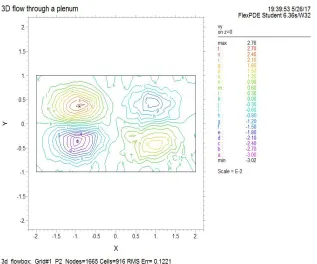
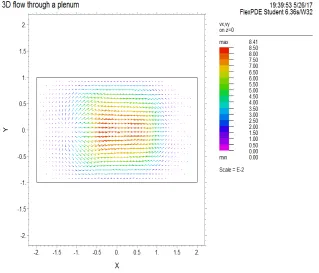
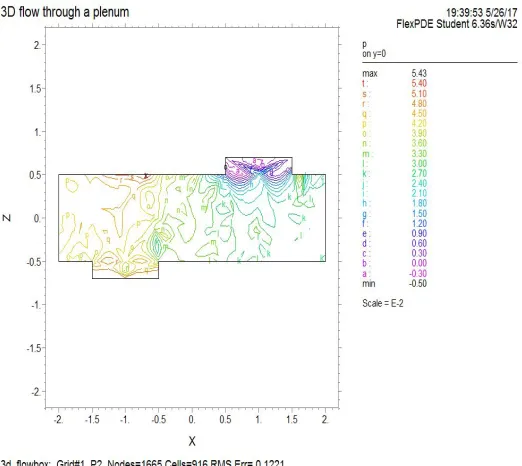
[image:5.612.138.468.126.391.2]With the help of flex pde software the governing mathematical equations are solved and the variation of pressure and velocity is shown as below.
Fig 1 Variation of Velocity
[image:5.612.148.465.426.690.2]Technology (IJRASET)
Fig 3 Variation of Velocity
[image:6.612.147.466.405.678.2]Technology (IJRASET)
Fig 5 Variation of Pressure
VI. CONCLUSION
The variation of pressure and velocity is investigated and studied by the application of a computer program in which the fluid was flowing through a plenum in three dimensions. This software enables us to solve the partial differential equations with the help of initial and boundary conditions.
VII.ACKNOWLEDGMENT
I thank our colleagues from Amity University who provided insight and expertise that greatly assisted the research, although they may not agree with all of the interpretations/conclusions of this paper.
REFERENCES
[1] Borghi, M., Mattarelli, E., and Montorsi, L., "Integration of 3D-CFD and Engine Cycle Simulations: Application to an Intake Plenum," SAE Technical Paper
2001-01-2512, 2001, doi:10.4271/2001-01-2512
[2] Tauveron, N., “Thermal fluctuations in the lower plenum of a high temperature reactor”. Nuclear engineering and design,vol 222(2): 2003,pp. 125-137.
[3] Glenn E. McCreery, Keith G. Condie “Experimental Modeling of VHTR Plenum Flows During Normal Operation and Pressurized Conduction Cooldown” INL
External Report INL/EXT-06-11760, (September 2006).
[4] Richard W. Johnson, Donna P. Guillen, Tara Gallaway “Investigations of the Application of CFD to Flow Expected in the Lower Plenum of the Prismatic VHTR” INL External Report INL/EXT-06-11756, (September 2006)
[5] Richard W. Johnson “Modeling strategies for unsteady turbulent flows in the lower plenum of the VHTR”Nuclear Engineering and Design,Volume 238, Issue
3, March 2008, Pages 482–491.
[6] Hugh M. McIlroy, Jr. Donald M. McEligot Robert J. Pink “Measurement of Flow Phenomena in A Lower Plenum Model of A Prismatic Gas-Cooled Reactor”
Proceedings of the 16th International Conference on Nuclear Engineering ICONE16 May 11-15, 2008, Orlando, Florida, USA.
[7] Chang H. Oh, Eung S. Kim, Hee C. NO, Nam Z. Cho “Experimental Validation of Stratified Flow Phenomena, Graphite Oxidation, and Mitigation Strategies
of Air Ingress Accidents” INL External Report INL/EXT-08-14840, (December 2008)
[8] Richard W. Johnson, Richard R. Schultz “Computational Fluid Dynamic Analysis of the VHTR Lower Plenum Standard Problem” ” INL External Report
INL/EXT-09-16325, (July 2009).
[9] Robert D. Knapke , Mark G. Turner “Detailed Unsteady Simulation of a Counterrotating Aspirated Compressor with a Focus on the Aspiration Slot and
Plenum” IJRM Volume 2013 (2013), Article ID 857616, 17 pages
[10] Hassan Yassin, Anand NK, Wolf James “Experimental and CFD Studies of Coolant Flow Mixing within Scaled Models of the Upper and Lower Plenums of
NGNP Gas-Cooled Reactors” Reactor Concepts Research Development and Demonstration, Texas A&M University, Project No. 12-3759 (March 2016). Kumar Deepak, Malk R.K. “Modelling of Flow Dynamics of an Incompressible Viscous Fluid in a Channelwith Solid Obstruction of Variable Length”IJERGS.3 (1):117-127.2015.