©IJRASET 2015: All Rights are Reserved
138
Non Traditional Optimization Techniques For
Cutting Force Optimization In Milling Process
Based On Machining Parameters
M.S.Aezhisai vallavi1, N.Dhamodharan2,C. Manivelprabhu3
1
Assistant professor, 2P.G Scholer
Department of Mechanical Engineering, Kumaraguru college of Technology, Coimbatore
Abstract-Minimum cutting forces are always gives the better results on response parameters. In this paper describes the nontraditional optimization methods to get the optimum cutting force in milling process. The objective function was consider for minimizing cutting force in milling operations. This paper gives the optimization algorithm based on simulated annealing, pattern search method and genetic algorithm. The results are compared between different optimization techniques .
Key words: cutting force, optimization, simulated annealing, pattern search, genetic algorithm.
I. INTRODUCTION
©IJRASET 2015: All Rights are Reserved
139
operators namely 1) Reproduction 2) Cross over and 3) Mutation. Basker.N et al [10] presents the non-conventional methods such as Genetic Algorithm, Ant Colony Algorithm, Tabu search method and Particle swarm optimization for optimizing machining parameters to maximizing the profit in milling operations. Tandon et al [11] this paper presents about the optimization on feed and speed parameters in CNC end milling process.II. MATHEMATICAL MODEL
Machining parameters are the most influenced parameter to meet the required output responses in all kinds of machining process. The process parameters such as cutting speed, Feed rate, Depth of cut and Nose radius are considered the most influenced parameters in this optimization process. In this paper the mathematical model obtained by S.Jeyakumar et al [12] is taken for the optimization process.
A. Objective Function
The main aim of this optimization is to minimize the cutting forces in end milling operation. The objective function was formulated from the developed mathematical model with considering the four parameters and three levels. Parameters such as cutting speed(s) in m/min, feed rate(f) in mm/min, depth of cut(d) in mm and nose radius(r) in mm with the levels -1 to +1. Cutting forces in x direction and cutting forces in z direction are considered as the objective function to minimize the cutting forces.
B. Optimization
Optimization is the process of maximizing the required things and minimizing the un wanted things. In this study the minimization of cutting forces is the main aim of optimization. The optimum values of cutting forces are obtained based on the three different optimization techniques such as Genetic algorithm, Simulated annealing and pattern search method. The optimization processes are executed in MATLAB software.
C. Genetic Algorithm(GA)
Genetic algorithm is one of the frequently used optimization methods. GA optimization was done with the constrains of sample size, crossover function, mutation function crossover fraction and so on. The search algorithm based in the mechanics of natural selection and natural genetics is known as Genetic Algorithm(GA). They combined survival of the fittest among the string structures with some of the innovative flair of human search. The Genetic algorithm works with the major three process they are as Reproduction, Crossover, Mutation in addition to this major process the sub process like population chromosomes are helps the fitness test.
The following Constrains are considered for the GA
Population size : 50
Elit count : 2.5
Cross over fraction : 0.9
Mutation function : Adaptive feasible
Cross over function : single point
From the results of GA the optimum values of cutting parameters are obtained and mentioned in the table 1 as coded form. For this objective function optimum cutting forces in x direction was obtained for low cutting speed, depth of cut and high feed rate, nose radius. For y direction cutting force optimum values are obtained for cutting speed, depth of cut and low feed rate, nose radius. Fig. 1, fig. 2 shows the best and mean fitness values.
TABLE 1 OPTIMUM VALUES OF GA.
S.No Process
parameter
Optimum
values (x
direction)
Optimum
values (z
1 Cutting speed
-1 1
2 Feed rate 1 -0.999
3 Depth of
cut
-1 0.707
4 Nose
radius
1 -1
D. Simulated Annealing
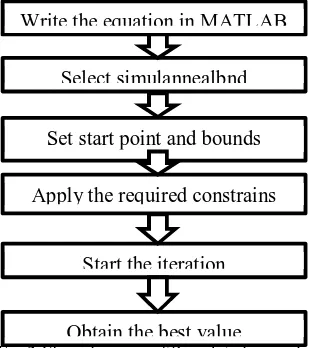
[image:4.612.236.369.299.387.2]Solving unconstraint and boundary constrain problems for optimization the simulated annealing methods is one of the most suitable optimization methods among the other optimization methods. The new point is randomly generated in simulated annealing algorithm for each iteration. The probability distribution along with the scale proportional on temperature used to find the distance of the new point generated from the current point, the simulated annealing algorithm always lower the objective for all new points but some time they may raise the objective with a certain probability points. The simulated annealing optimization procedure is given in the fig. 3. The constrain for this process are given as follows. Annealing function is fast annealing and reannealing interval is 100.
[image:4.612.243.361.417.501.2]Fig. 1 GA graph for x axis cutting force
Fig. 2 GA graph for z direction cutting force
Fig.3 Flow diagram of Simulated annealing
Write the equation in MATLAB Select simulannealbnd Set start point and bounds Apply the required constrains
Start the iteration
[image:4.612.225.381.536.710.2]TABLE 2 OPTIMUM VALUES OF SIMULATED ANNEALING.
S.No Process
parameter
Optimum
values (x
direction)
Optimum
values (z
direction)
1 Cutting
speed
-0.979 0.996
2 Feed rate 0.995 -0.999
3 Depth of
cut
-1 0.728
4 Nose
radius
1 -1
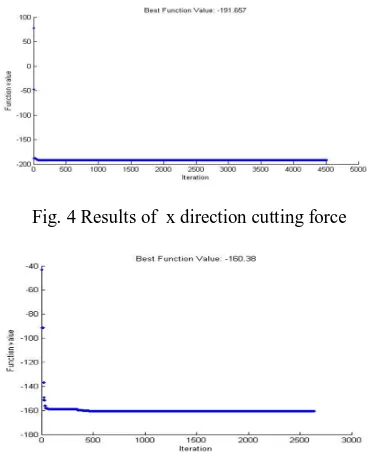
The results obtained based on the simulated annealing process are given in table. 2. very minute deviations are observed between the GA results and simulated annealing results. Low cutting speed, depth of cut gives the optimal x direction cutting force and high feed rate , nose radius gives optimum z direction cutting force. Fig. 4 and fig. 5 shows the best and mean fitness function of simulated annealing .
[image:5.612.200.412.94.227.2]Fig. 4 Results of x direction cutting force
Fig. 5 Results of z direction cutting force
E. Pattern Search Method
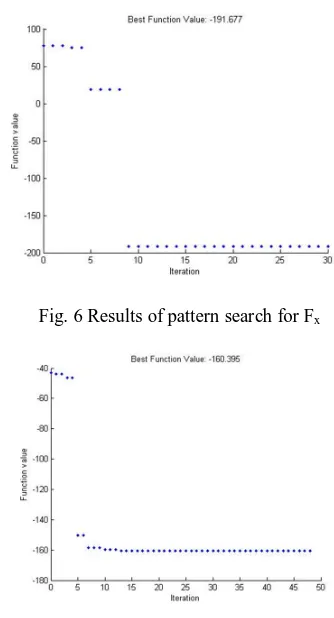
Pattern search methods results are given in the table . 3. these results are also similar to that of GA and simulated annealing. Fig. 6 and fig. 7 gives the mean and best value of fitness function. The pattern search procedure are given in the following steps.
TABLE 3 OPTIMUM VALUES OF PATTERN SEARCH METHOD.
S.No Process
parameter Optimum values (x direction) Optimum values (z direction)
1 Cutting
speed
-1 1
2 Feed rate 1 -1
3 Depth of cut -1 0.707
[image:5.612.211.399.284.517.2]Step 1: write the objective function equation.
Step 2: select the patternsearch silver from the optimization tool.
Step 3: enter the start points and bounds.
Step 4: give the necessary constrains.
[image:6.612.216.383.177.486.2]Step 5: obtain the results after completion of iteration process.
Fig. 6 Results of pattern search for Fx
Fig. 7 Results of pattern search for Fz
III. CONCLUSION
Optimization techniques based on non-traditional methods are obtained for the process of optimizing the cutting forces. While comparing genetic algorithm, simulated annealing and pattern search methods, simulated annealing is most time consuming process and number of iteration also high where as other two methods number of iteration are low as compare with simulated annealing. All these three methods results are obtained most similarly. The optimum values of x direction cutting force are obtained for low cutting speed, depth of cut and high feed rate, nose radius. For z direction cutting force optimum values are obtained for high cutting speed, depth of cut and low feed rate , nose radius.
REFERENCES
[1] M.Subramanian, M.Sakthivel, K.Sooryaprakash & R.Sudhakaran, (2013), “Optimization of Cutting Parameters for Cutting Force in Shoulder milling of Al7075-T6 Using Response Surface Methodology and Genetic Algorithm”, International Journal of design and manufacturing, Vol. 64, pp. 690-700.
[2] P.S.Sivasakthivel, V.Vel Murugan & R.Sudhakaran (2012), “Cutting force prediction depending on process parameters by response surface methodology in milling”, International Journal of machining and machinability of materials, Vol. 11, pp. 137-153.
[3] J.A. Ghani, I.A. Choudhury & H.H. Hassan, (2004), “Application of taguchi method in the optimization of end milling parameters”, Journal of materials processing technology, Vol. 145, pp. 84-92.
[4] F.Cus, U.Zuperl & V.Gecevska, (2007), “High speed end-milling optimisation using Particle Swarm Intelligence”, Journal of Achievements in Materials and Manufacturing Engineering, Vol. 22, pp. 75-78.
©IJRASET 2015: All Rights are Reserved
143
advanced research in engineering and technology,, vol.5, pp. 09-20.
[6] Vikas Pare, Geeta Agnihotri & C.M. Krishna (2011), “Optimization of Cutting Conditions in End Milling Process with the Approach of Particle Swarm Optimization”, International Journal of Mechanical and Industrial Engineering, Vol. 1, pp. 21-25.
[7] H.S.Lua, C.K.Changb, N.C.Hwanga & C.T.Chungc, (2009), “Grey relational analysis coupled with principal component analysis for optimization design of the cutting parameters in high-speed end milling”, Journal of Material processing technology, Vol. 209, pp. 3808-3817.
[8] Ramezan Ali Mahdavinejad, Navid Khani & Mir Masoud Seyyed Fakhrabadi, (2012), “Optimization of milling parameters using artificial neural network and artificial immune system”, Journal of Mechanical Science and Technology vol.26 pp. 4097-4104.
[9] Sudhakaran R., VeL Murugan V, Senthil Kumar K. M, Jayaram R, Pushparaj A, Praveen C & Venkat Prabhu N.(2011), “ Effect of Welding Process Parameters on Weld Bead Geometry and Optimization of Process Parameters to Maximize Depth to Width Ratio for Stainless Steel Gas Tungsten Arc Welded Plates Using Genetic Algorithm”, European Journal of Scientific Research Vol.62, pp. 76-94
[10] Tandon.V, El-mounayri.H, & Kishawy.H (2002), “CNC end mill optimization using evolutionary computation”, International Journal of Machine Tools & Manufacturer, Vol. 42, pp.595-605.