5
X
October 2017
Evaluation of Open Source Markup Validation
Tools
Aparna Gautam1, Anita Ganpati2 1
Research Scholar, Department of Computer science, Himachal Pradesh University, Shimla, India 2
Professor, Department of Computer science, Himachal Pradesh University, Shimla, India
Abstract: The most evident technical developments of recent years is the rapid growth of World Wide Web. Websites can be accessed by a software package named as “browser”. The browser provides the capability of transferring from one website to another through hyperlinks and displays HyperText Markup Language pages. A website is simply a collection of web pages which includes multimedia content with a common domain name. Websites can be published on at least one web server. A web page is a document or information resource that is the part of the World Wide Web and can be accessed through a web browser. Validation is an important step towards the quality of a web page. The validation problem in existing web pages has drawn more attention because of the increasing trend of web communication. In the study, three open source validation tools namely Wave, ATester and AChecker are compared on the basis of markup validation errors namely missing doctype specification, missing required attributes, invalid attributes, wrong placement of elements and wrong value of essential attributes. For the study, top thirty Indian websites were considered for validation errors. These websites are of the Indian domain and mostly are used in day to day life like Facebook, Youtube, irctc and the Hindu etc. It can be concluded on the basis of results that AChecker tool is better validation tool than Wave tool and ATester tool.
Keywords: www, web page, website validation, validation errors, Wave tool, ATester, AChecker.
I. INTRODUCTION
Validation is an assessment of an action, decision plan or transaction to establish that it is correct, complete and is ready to be implemented. Validation can act as a debugging tool, as a future-proof quality check, eases maintenance, helps in teaching good practices and now-a-days validation is a sign of professionalism [11].While currently web browsers are doing an increasingly good job of parsing even the worst HTML tags, but some errors are not always caught gracefully. Very often, different software on different platforms will not handle errors in a similar fashion, making it extremely difficult to apply style or layout consistently. So, validation is necessary. Checking that a page displays fine in several contemporary browsers may be a reasonable insurance that the page will work today, but it does not guarantee that it will work tomorrow. So, again the validation is necessary [12].Whether a web page using a visual web editor like ExpressionWeb, Dreamweaver or Bluegriffon or code is written simply with a simple text editor validation is important afterdesigning is finished [23]. Validating a site is the way toward guaranteeing that the pages on the site comply with the standards or principles characterized by different associations. It will guarantee that website pages are translated by different machines in a similar way [16]. Conforming to standards and regulations is one of the ways to make a website universally understood. All the codes and styles should validate across the board. It means it should meet the strict standards set by the W3C organization and pass a variety of validations for Cascading Style Sheets (CSS) and Extensible HyperText Markup Language (XHTML). It is not necessary that all validating tools should check for the same errors. Some only check CSS, others XHTML, and others for accessibility .This study presents the comparison of markup validation tools. There are three different open source markup validation tools namely Wave, ATester, and AChecker.
II. LITERATURE REVIEW
1) Shan Chen et al. [9] analyzed that there are only 5% of web pages which are valid. In their research, they have worked on 10000 most popular websites and the result was hilarious. It has been found that only 5% of web pages i.e. 500 web pages out of 10000 are valid. They concluded that the validation problems in existing web pages have drawn more and more attention because of the increasing trend of web communications moving from a human-to-computer process to a computer-to-computer process.
3) Edson Rufino de Souza and Claudia Mont Alvao [2] proposed to evaluate a government website with two semiautomatic accessibility evaluation tools namely Hera and DaSilva. The results have demonstrated that the use of more than one semi-automatic assessment tool can provide enhanced results. They analyzed that Hera tool gives a global view of results than the DaSilva tool.
4) Wan Abdul Rahim et al. [3] investigated the accessibility of homestay websites in Malaysia. The evaluation was done from 15th April 2014 to 15th June 2014 by using an automated evaluation tool (AChecker) and Web Content Accessibility Guidelines (WCAG) 2.0.
5) F. Ricca and P. Tonella [4] analyzed tools namely ReWeb and TestWeb to discover many anomalies and failures in Web applications. According to them, these tools offer the most advanced features such as reverse engineering of high-level models and structure-based testing.
6) Archana Pandey focused on the tests carried to verify the accessibility of a web page. In her research, she discussed the areas like an introduction to web accessibility, categories of disabilities, web accessibility standards and guidelines, web accessibility testing techniques and web accessibility tools [5].
7) Melody Y. Ivory and Jenifer Mankoff [10] did a survey of automated tools presented in the context of the user abilities supported by the tools. They also discussed the efficacy of a subset of tools based on the empirical study along with the ways to improve existing tools and future research areas.
8) Ilona Bluemke et al. described the tool namely WSDLTest for automatic testing of web services. They have discussed that the tool can be used for testing of web services for which WSDL 1.1 or WSDL 2.0 documents. WSDLTest parses the WSDL document and also tests the web service by sending automatically generated messages [6].
9) Obinna Okeke and David Izuogu [7] explained that some websites failed to meet the requirements of web accessibility. They assess the barriers and explores the methods of encouraging compliance with accessibility guidelines. They also introduced a fair-trade approach where websites which are certified as accessible are recognized.
III. OVERVIEW OF VALIDATION ERRORS AND VALIDATION TOOLS
Validation of a website needs to be done at different levels of the development. It is important to validate so it can be easily accessible. Here different criteria of errors are discussed. For these error detection, different tools can be used. Here wave, ATester, and AChecker tools are used for the analysis of these validation errors.
A. Markup validation errors
The markup validation errors are the errors which occur during the validation test of the websites. The markup validation errors are described as follows
1) Missing Doctype Specification: The DOCTYPE specification is a machine-readable statement in the HTML document which specifies the structure, elements, and attributes used in that document [22].
2) Missing required attributes: The error occurs when there is no attribute like form, tab-index, and input (id, class) [11]. Since omitting these attributes causes no rendering difficulties for browsers, webpage designers usually neglect to include them [23].
3) Invalid attributes: The attributes like img (src, alt, class), body (div, h1,…,h6) and bgcolor are not available in the coding list. However, when these attributes are used in some elements, it may cause validation errors [22].
4) Wrong placement of elements: Not only do the elements and attributes undefine in the HTML standard cause validation errors, defined elements may also cause errors if placed incorrectly [11]. It includes table, style, and script.
5) Wrong value of essential elements: This type of error includes the wrong value of attributes like onmouseclick, onmouseover, a href, a class and etc [22]. The value of these attributes is given wrong which makes the attributes invalid.
B. Validation tools
There are various open source validating tools used for validation of a website. In the study, a comparison of only three tools i.e. Wave tool, Atester and AChecker is being done.
page with embedded icons and indicators that reveal the accessibility information within your page[13]. Figure1 illustrates the main screen of Wave tool [17].
Figure 1: Wave Tool
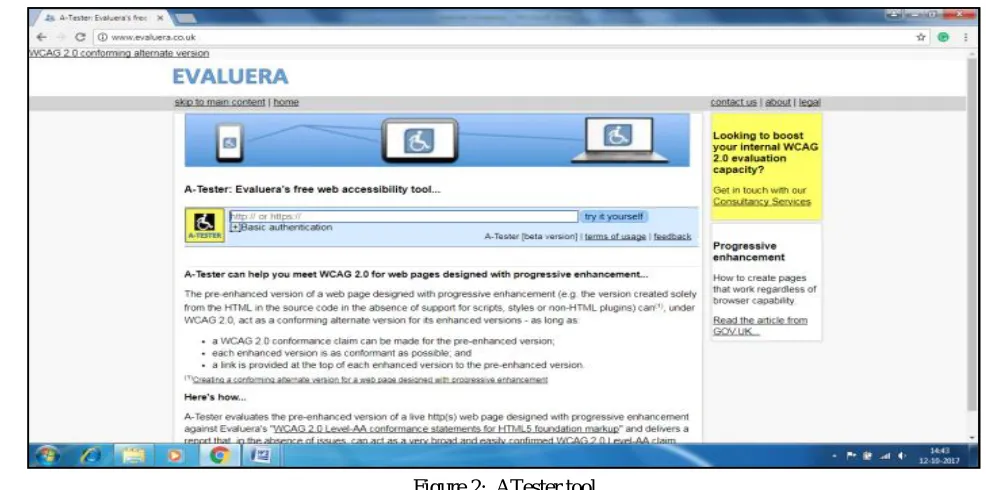
[image:4.612.74.567.416.661.2]2) ATester: ATester [Beta-version] is an open-source tool to validate a website and also can help to meet WCAG 2.0 for web pages designed with progressive enhancement [12]. ATester is designed to tackle the problems related to the requirements of the website. It is an enhanced version which can find various issues related to a website [14]. Figure 2 illustrates the main screen of Atester tool [18].
Figure 2: ATester tool
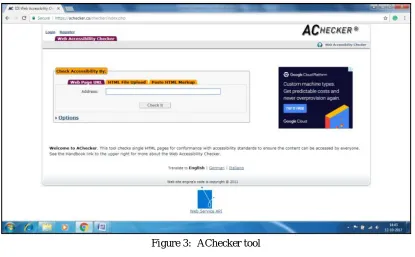
Figure 3: AChecker tool
IV. OBJECTIVES OF THE STUDY
The objectives of the study is to compare different open-source validation tools used to validate websites. However, the specific objectives are
A. To have an understanding of validation errors namely missing doctype specification, missing required attributes, invalid
attributes, wrong placement of elements and wrong value of essential elements.
B. To perform a comparison of open-source validation tools namely Wave, ATester and AChecker tool and analyze their
performance on the basis of different kinds of markup validation errors.
C.
V. ANALYSIS
The World Wide Web is growing at very fast speed and have gone through many technological advancements. The World Wide Web is comprised of a huge number of web pages. So, the quality of web page is major consideration while developing a web page. Validation plays a major role towards the quality of a web page. The validation tools are used for validating the web page. There are many proprietary as well as open-source validation tools available. This study performs a comparison of three open-source validation tools namely wave, atester and achecker. The different markup validation errors are namely missing DOCTYPE specification represented as (1), missing required attributes represented as (2), invalid attributes represented as (3), wrong placement
of elements represented as (4), wrong value of essential elements represented as (5). Table1 represents the common type of markup
validation errors found in the websites considered for the study.
Table 1: Markup validation errors using Wave, ATester and AChecker
Websites Wave ATester AChecker
1 2 3 4 5 1 2 3 4 5 1 2 3 4 5
Google 0 38 9 0 38 0 10 0 50 2 4 20 10 59 70
Youtube 0 1,035 269 124 387 0 154 2 9 360 0 18 299 17 534
Facebook 0 23 6 35 8 0 5 2 26 15 0 23 9 2 107
Yahoo 0 63 57 76 50 15 55 7 30 12 0 0 0 0 0
Onlinesbi 0 3 32 5 34 1 4 4 47 23 40 17 28 25 172
Linkdin 0 25 13 9 11 0 24 3 7 1 3 63 44 57 122
[image:5.612.64.550.593.728.2]Irctc 0 15 16 29 94 5 16 25 144 7 10 28 75 171 388
Hotstar 0 0 2 3 0 0 0 0 8 0 0 0 10 86 0
Stackoverflo w
0 9 168 15 6 7 9 2 0 1 0 39 145 57 1619
Billdesk 0 2 27 5 0 1 0 0 2 0 0 0 65 21 14
Ndtv 0 50 278 70 178 1 3 85 24 20 30 10 317 0 728
Quora 0 10 11 84 22 0 28 2 0 0 0 24 26 27 56
Naukri 0 19 75 471 156 10 14 108 18 15 0 0 0 0 0
Icici Bank 0 39 100 90 141 0 9 49 72 424 0 68 374 93 1078
Cricbuzz 0 4 109 11 95 0 0 2 1 2 0 27 251 27 382
Paytm 0 7 0 3 9 10 22 1 80 10 0 0 88 93 30
Sarkarinaukri 0 14 190 177 124 1 18 6 146 18 5 24 367 66 468
Microsoft 0 20 35 89 31 0 0 2 0 0 0 8 114 63 96
Freejobalert 0 10 4 14 20 0 4 1 135 1 0 28 26 213 76
Ebay 0 184 67 202 134 5 5 77 9 12 0 0 42 66 0
Shaadi 0 44 28 19 30 0 23 9 171 14 5 6 158 93 201
Make My Trip
0 105 117 65 70 - - - 0 134 148 55 155
Tcs 0 99 15 29 20 10 59 1 9 9 0 20 50 30 210
Hdfc Bank 0 15 36 12 123 0 8 15 76 78 0 0 0 0 0
Indian Rail 0 3 300 18 37 9 0 11 53 17 3 16 60 97 76
Timesjobs 0 63 76 38 117 - - - 3 48 66 141 36
The Hindu 0 196 78 43 106 6 35 96 67 13 0 70 377 182 189
Tata Motars 0 79 49 37 54 0 3 19 20 91 0 10 490 21 711
Justdial 0 91 24 30 89 0 2 16 0 72 0 0 0 0 0
[image:6.612.64.552.78.405.2]It is clear from Table 1 that Wave tool detected three errors of missing required attributes in onlinesbi site and Atester detected four errors of same type but AChecker detected more errors of missing required attributes that is seventeen. It can also be seen in the Table 1 that Atester did not detect any errors from the two websites namely makemytrip and timesjobs.
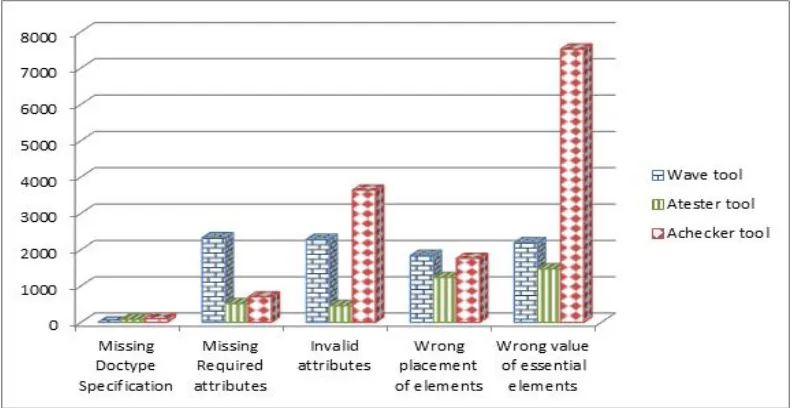
Figure 4: Graph representing markup validation errors by Wave, Atester and Achecker
[image:6.612.129.526.456.660.2]specification. ATester did not detect errors from two websites out of thirty due to parsing techniques used by the website developer. AChecker detected more number of errors than Wave and Atester tools for every website. So, it is concluded that AChecker is the best validation tool than Wave and Atester.
VI. CONCLUSION
Validation of a website is important in terms of deciding quality of a web page. There are various open source website validation tools which can be used to decide the quality of a web page. In this study, three open-source validation tools are compared on the basis of major markup validation errors namely missing doctype specification, missing required attributes, invalid attributes, wrong placement of elements and wrong value of essential elements. The tools which are considered for the study are Wave, Atester and AChecker. From the results, it can be concluded that the Wave tool did not report for an important markup validation error that is missing doctype specification. Also, the tool Atester did not detect any kind of the errors from two websites out of thirty due to parsing techniques used by the website developers. It may be concluded from the results that out of three validation tools AChecker can be considered as a best validation tool as it reported more number of errors as compared to Wave and Atester.
REFERENCES
[1] Baptista, Ana, Jose Martins, Ramiro Goncalves, Frederico Branco, and Tania Rocha. "Web accessibility challenges and perspectives: A systematic
literature review." In Information Systems and Technologies (CISTI), 11th Iberian Conference on. IEEE, 2016.
[2] DeSouza, Edson Rufino, and Claudia Mont Alvao. "Web accessibility: evaluation of a website with different semi-automatic evaluation
tools." Work 41.Supplement 1 (2012): 1567-1571.
[3] Isa, Wan Abdul Rahim Wan Mohd, Ahmad Iqbal Hakim Suhaimi, Nadhirah Ariffrn, Nurul Fatimah Ishak, and Nadilah Mohd
Ralim."Accessibility evaluation using Web Content Accessibility Guidelines (WCAG) 2.0." User Science and Engineering (i-USEr), 2016 4th
International Conference on. IEEE, 2016.
[4] Ricca, Filippo, and Paolo Tonella. "Detecting anomaly and failure in web applications." IEEE MultiMedia 13.2 (2006): 44-51.
[5] Pandey,Archana."Web Application Accessibility Testing." International Journal of Scientific and Research Publications (2015).
[6] Bluemke, Ilona, Michał Kurek, and Małgorzata Purwin. "Tool for automatic testing of web services." Computer Science and Information Systems
(FedCSIS), 2014 Federated Conference on. IEEE, 2014.
[7] Okeke, Obinna, and David Izuogu. "Issues affecting implementation of Web Accessibility Guidelines." Enquiry-The ACES Journal of
Undergraduate Research 3.1 (2013).
[8] Bluemke, Ilona, Michał Kurek, and Małgorzata Purwin. "Tool for automatic testing of web services." Computer Science and Information Systems
(FedCSIS), 2014 Federated Conference on. IEEE, 2014.
[9] Chen, Shan, Dan Hong, and Vincent Y. Shen. "An experimental study on validation problems with existing html webpages." Proceedings of the
2005 International Conference on Internet Computing, ICOMP'05. 2005.
[10] Ivory, Melody Y., Jennifer Mankoff, and Audrey Le. "Using automated tools to improve web site usage by users with diverse abilities."
Human-Computer Interaction Institute (2003): 117.
[11] World Wide Web Consortium, https://www.w3.org/, “The World Wide Web Consortium” Accessed on 15th April 2017 at 3:03 P.M
[12] https://usabilitygeek.com/10-free-web-based-web-site-accessibility-evaluation-tools/ , Accessed on 30th April,2017 at 4:10 P.M
[13] https://www.3pillarglobal.com/insights/accessibility-testing-tools-and-techniques, Accessed on 17th May 2017 at 6:32 P.M [14]
https://www.guru99.com/accessibility-testing.html, , Accessed on 26th May 2017 at 7:38 P.M
[14] http://www.webology.org/2012/v9n2/a98.html, Accessed on 15th June 2017 at 3:15 P.M
[15] https://codex.wordpress.org/Validating_a_Website, Accessed on 17th June 2017 at 4:20 P.M
[16] http://wave.webaim.org/, Accessed on 20th June 2017 at 7:40 P.M
[17] http://www.evaluera.co.uk/ATester, Accessed on 30th June 2017 at 5:10 P.M
[18] https://achecker.ca/checker/index.php, Accessed on 6th July 2017 at 6:00 P.M
[19] http://www.atutor.ca/achecker/, Accessed on 8th July 2017 at 9:47 P.M
[20] https://dzone.com/articles/mama-a-search-engine-for-web-d, Accessed on 10th July 2017 at 3:19 P.M
[21] https://line25.com/articles/10-common-validation-errors-and-how-to-fix-them, Accessed on 12th July2017 at 6:11 P.M