www.ijraset.com Vol. 2 Issue VII, July 2014
ISSN: 2321-9653
I N T E R N A T I O N A L J O U R N A L F O R R E S E A R C H I N A P PL I E D S C I E N C E AN
D E N G I N E E RI N G T E C H N O L O G Y (I J R A S E T)
Performing Adaptive Channel Equalization by
Hybrid Differential Evolution Particle Swarm
Optimization
Shruti Bansal¹, Hamid Ali², Sarbjeet Singh³
¹,² Dept. of Electronics and Communication
Shobhit University Meerut
³ Dept. of Electronics and Communication (SSIET)
Sri Sukhmani Institute of Engg & Tech (PTU)
Chandigarh
Abstract—Inter symbol interference is the main obstacles for reliable communications. To mitigate the effects of ISI and to obtain reliable data transmission, An adaptive equalizer is required at the receiver. Equalizer is used to reduce the effect of this problem and reconstruct the original signal. The adaptive equalizer adapts the coefficients to minimize the noise and ISI. Particle Swarm Optimization (PSO) is a class of stochastic search algorithms based on population. Due to the simplicity of implementation and promising optimization capability, PSO is successfully applied for channel equalization but has some drawbacks such as high computational complexity and premature convergence. In this paper we combined differential evolution (DE) with PSO given name as Hybrid DEPSO for overcome the problems occurred by traditional PSO. Simulated results gave clear evidence for accelerating the convergence and better performance of DEPSO as compared with PSO.
Keywords—MSE; PSO; DE; HDEPSO; Global-best.
I. INTRODUCTION
Adaptive equalization (AE) plays an important role in communication systems. In some applications, the channel characteristics are not known a priory. Moreover, the channel may change from time to time, especially in wireless communication systems [1]. It is, therefore, important to continuously track the channel variations. To do so, adaptive equalization techniques are used, where a certain adaptive algorithm is used to adjust the equalizer’s coefficients. At the receiver, an equalizer is used in order to minimize the effect of inter-symbol interference (ISI) and hence maximize the probability of correct decisions. Many efficient adaptive algorithms like least mean squares (LMS) algorithm [2] have been developed in recent past. Many nonlinear adaptive
convergence. Thus enlarging the probability of global convergence is gained through increasing the diversity of the swarm in evolutionary process. Modification in PSO from this instant moved towards hybridization to improve the diversity of PSO and to keep a balance between the exploration and exploitation factors there by preventing the stagnation of population and preventing premature convergence. PSO moved with hybridization state with many other search techniques like Genetic Algorithm (GA) and Differential Evolution (DE). Hybrid PSO when clubbed with DE gave much favorable results as compared to DE. In 1996 DE got 3rd rank at 1st International Contest held on topic Evolutionary Computation (1stICEO) in Nagoya.
The vital idea behind DE is a scheme of generating trial parameter vectors. In particular taking an example, clustering based on PSO and DE has attracted increasing attention, popularity, and effort from a wide variety of research communities owing to their ease of implementation and demonstrated effectiveness in solving complicated combinatorial optimization problems [14]. Getting inspired by the tradeoff strategy between exploration and exploitation in reinforcement learning, we improve PSO by introducing the hybrid model into the PSO strategy. The effects of pbest and gbest on the particle velocity increase with the number of iterations. Hence diversity of particle can be preserved in the early period of iterations, and local search capability can be enhanced in the later period of iterations. This paper describes the PSO algorithm with differential evolution (DE) operator [15], termed as DEPSO - which provides the population with diversity to guarantee the particles escape from the local minima of the fitness function. The rest of this paper is organized as follows. Section 2 describes DEPSO algorithm, its parameters and enhanced version. PSO, DE then both combined. Section 3 describes Adaptive Channel Equalizer. Section 4 illustrates Simulation Results and then Conclusion.
III. DEPSO
In DEPSO we regard PSO and DE as parents. DEPSO has shown its prominent advantage and prosperity and is witnessed by the diversity of DEPSO variants and by its applications [16]. DEPSO has been further hybridized with other optimizers, giving birth to more highly complicated hybrids [17]–[19]. In the past decade, many scholars have made contributions to DEPSO research.
DEPSOs had been grouped into three categories [20] according to their basic features:
1) collaboration-based DEPSO;
2) embedding-based DEPSO;
3) assistance-based DEPSO.
The Parents of DEPSO; DE algorithm, originated in the same year as that of PSO i.e. in 1995 was proposed by Price and Storn [20] for solving global optimization problem. DE uses the same evolutionary operators (mutation, crossover and selection) as that of GA but it’s the working of these operators that distinct DE from GA.
II. PARTICLE SWARM OPTIMIZATION (PSO)
Particle swarm optimization was first introduced by Kennedy and Eberhart [6]. This new approach features many advantages; it is simple, fast and can be coded in few lines. Also, its storage requirement is minimal. Moreover, this approach is advantageous over evolutionary algorithms in more than one way. First, PSO has memory. That is, every particle remembers its best solution (local best) as well as the group best solution (global best). Another advantage of PSO is that the initial population of the PSO is maintained, and so there is no need for applying operators to the population, a process which is time and memory storage consuming. In addition, PSO is based on“constructive cooperation” between particles, in contrast with the other artificial algorithms which are based on “the survival of the fittest” [21].
The Particle Swarm Optimization algorithm is comprised of a collection of particles that move around the search space influenced by their own best past location and the best past location of the whole swarm or a close neighbor. Each iteration a particle’s velocity is updated using:
V = wV +C rand X(pbest-s )+C rand X(gbest-s )
where
V : velocity of agent i at iteration k,
w : weighting function,
www.ijraset.com Vol. 2 Issue VII, July 2014
ISSN: 2321-9653
I N T E R N A T I O N A L J O U R N A L F O R R E S E A R C H I N A P PL I E D S C I E N C E AN
D E N G I N E E RI N G T E C H N O L O G Y (I J R A S E T)
Rand : random number between 0 and 1,
s : current position of agent i at iteration k,
pbest : pbest of agent i,
gbest : gbest of the group.
The following weighting function is usually utilized as:
w = w ∗ iter
where
W : initial weight,
W : final weight,
iter : maximum iteration number,
iter : current iteration number.
Variants on this update equation consider best positions within a particles local neighborhood at time t. A particle’s position is updated using:
S = S + V
Traditional PSO had some drawbacks like outlying particles and stagnation. If the new gbest particle is an outlying particle with respect to the swarm, then rest of the swarm tends to move toward the new gbest from the same general direction. This normally leaves some critical region around the new minimum excluded from the search.
FIG: 1General flow chart of PSO
B) DIFFERENTIAL EVOLUTION (DE)
Differential Evolution (DE) is a Stochastic Direct Search and Global Optimization algorithm[44], and is an instance of an Evolutionary Algorithm from the field of Evolutionary Computation. It is related to sibling Evolutionary Algorithms such as the Genetic Algorithm, Evolutionary Programming and Evolution Strategies and has some similarities with Particle Swarm Optimization Strategy. The Differential Evolution algorithm involves maintaining a population of candidate solutions subjected to iterations of recombination, evaluation, and selection. The recombination approach involves the creation of new candidate solution components based on the weighted difference between two randomly selected population members added to a third population member. This perturbs population members relative to the spread of the broader population.
Mutation
For the mutation of DE, it separates the individual factor from each dimension. Then, it randomizes the value from each generation by using the mutation equation as shown in equation
)
.(
2 31 r r
r
iG
x
F
x
x
z
The scaling factor F is a positive control parameter for scaling the difference vectors. Hence, x represents a string denoting the vector to be perturbed.
Crossover
To increase the potential diversity of the population, a crossover operation then plays a role. After generating the vector through mutation, it changes the possibility and increases the opportunity to get the best fitness value. Crossover operation is implemented as mentioned below:
}
,
)
1
,
0
(
,
,
{
otherwise
x
CR
rand
if
z
u
iG iG iG
C) Hybrid DEPSO
As argued in the above, DE algorithm has some advantages, such as its ability to maintain the diversity of population, and to explore local search, but it has no mechanism to memory the previous process and use the global information about the search space, so it easily results in a waste of computing power and gets trapped in local optima. The differential information can be helpful for the search ability, but it also leads to
instability of some solutions. Although it has successfully been the global continuous optimization, PSO sometimes easily got stuck in local optima because of lost of diversity of swarm. Inspired by their advantages and disadvantages, a DEPSO is proposed in this section. We incorporated the PSO algorithm into the DE algorithm in order to maintain the diversity. In the DEPSO, particle’ position is updated partly in the DE way, partly in PSO normal updating. This scheme can explore the search space more efficiently.
The Strategy involved in building hybrid is to consider advantaged and disadvantages of both DE and PSO. Taking an example, DE faces problem that its solution always gets out of range and local optima that are partially surrounded by a very flat surface. The only way to quantify the quality of the utions or fit the function is merge with PSO’s problems are easily occurring local minimum, slowing down towards convergence in search stage or weak local search ability. This is the main reasons why DE & PSO make a good
VE CHANNEL EQUALIZER
shows a block diagram of a communication system with an adaptive equalizer. An adaptive equalizer consists of a delay line with variable coefficients that are adjusted by an adaptive algorithm. The adaptive algorithm attempts to minimize a cost function that is designed to provide an line estimate of how closely the adaptive filter achieves a prescribed optimum condition. The most frequently used cost function is the mean-square error (MSE), −y(n) is the difference between and the filter output y(n), and E{•} denotes the statistical expected value. The input vector and the coefficient weight vector of the adaptive filter at the nth
defined, respectively, as:
t
= [ , , …….. ]
where the superscript t denotes vector transpose. The nth output is then given by
= ∗
ijraset.com Vol. 2 Issue VII, July 2014
ISSN: 2321-9653
E R N A T I O N A L J O U R N A L F O R R E S E A R C H I N A P PL I E D S C I E N C E AN
D E N G I N E E RI N G T E C H N O L O G Y (I J R A S E T)
that minimizes the cost function. The most common iterative approach is to update each tap weight according to a steepest descent strategy; i.e., the tap weight vector is incremented in proportion to the gradient of w grad(w):
= w(n)-µ∆(w)
where μ is the step size and (w) is the partial derivative of the cost function with respect to w(n).
Different approaches to estimating the cost function and/or the gradient lead to different adaptive algorithms, such as the LMS algorithm [41]. In this work, PSO will be employed to search for the optimum tap weights so as to minimize the MSE. PSO is most efficient for batch-type optimization. However, due to practical constraints, the entire input data is not available to the equalizer. Therefore, a block, or a window, of the input data is considered in every iteration. Consequently, the objective function considered in every
FIG: 3Block Diagram of Adaptive channel equalizer by
DEPSO
iteration represents an estimate of the MSE over the input window used in that iteration. This estimate of MSE is given by:
=
= −
where N is the length of the window of the input data, n is the iteration number, and i is the particle number. In addition
, and are the kth elements of the error, desired response, and the actual output of the equalizer, respectively, at the nth iteration.
V. SIMULATION AND RESULTS
Equalization is performed by two algorithms. MSE graph comparison would describe how much the algorithms are efficient and how much the mean square error is. Results are based on noise levels in Linear channels:
1. For less noisy conditions, (25dB).
2. Under high noise conditions,( 75dB).
When Noise(dB) = 25dB,
FIG: 4Equalization by DEPSO (Noise –25dB)
In this case when noise is 25dB. Firstly QPSK signal is generated, which is passed on to channel. Later on the output signal is fed with noise of 25dB.
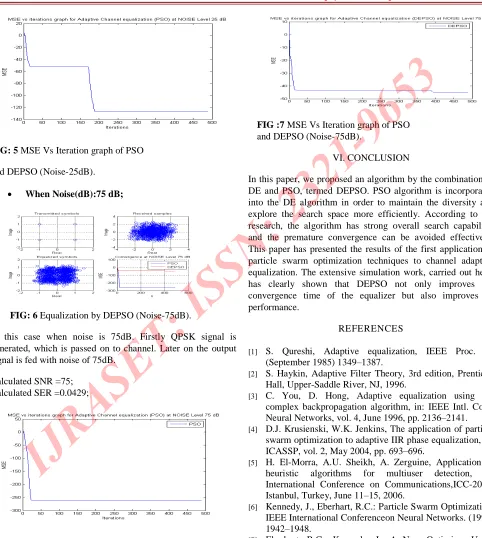
FIG: 5MSE Vs Iteration graph of PSO
and DEPSO (Noise-25dB).
When Noise(dB):75 dB;
FIG: 6Equalization by DEPSO (Noise-75dB).
In this case when noise is 75dB. Firstly QPSK signal is generated, which is passed on to channel. Later on the output signal is fed with noise of 75dB.
Calculated SNR =75; Calculated SER =0.0429;
FIG :7MSE Vs Iteration graph of PSO and DEPSO (Noise-75dB).
VI. CONCLUSION
In this paper, we proposed an algorithm by the combination of DE and PSO, termed DEPSO. PSO algorithm is incorporated into the DE algorithm in order to maintain the diversity and explore the search space more efficiently. According to the research, the algorithm has strong overall search capability, and the premature convergence can be avoided effectively, This paper has presented the results of the first application of particle swarm optimization techniques to channel adaptive equalization. The extensive simulation work, carried out here, has clearly shown that DEPSO not only improves the convergence time of the equalizer but also improves its performance.
REFERENCES
[1] S. Qureshi, Adaptive equalization, IEEE Proc. 73 (September 1985) 1349–1387.
[2] S. Haykin, Adaptive Filter Theory, 3rd edition, Prentice– Hall, Upper-Saddle River, NJ, 1996.
[3] C. You, D. Hong, Adaptive equalization using the complex backpropagation algorithm, in: IEEE Intl. Conf. Neural Networks, vol. 4, June 1996, pp. 2136–2141. [4] D.J. Krusienski, W.K. Jenkins, The application of particle
swarm optimization to adaptive IIR phase equalization, in: ICASSP, vol. 2, May 2004, pp. 693–696.
[5] H. El-Morra, A.U. Sheikh, A. Zerguine, Application of heuristic algorithms for multiuser detection, in: International Conference on Communications,ICC-2006, Istanbul, Turkey, June 11–15, 2006.
[6] Kennedy, J., Eberhart, R.C.: Particle Swarm Optimization. IEEE International Conferenceon Neural Networks. (1995) 1942–1948.
[image:7.612.77.559.130.668.2]www.ijraset.com Vol. 2 Issue VII, July 2014
ISSN: 2321-9653
I N T E R N A T I O N A L J O U R N A L F O R R E S E A R C H I N A P PL I E D S C I E N C E AN
D E N G I N E E RI N G T E C H N O L O G Y (I J R A S E T)
International Symposium on Micro Machine and Human Science.(1995) 39-43
[8] Shi,Y., Eberhart,R.C.: A Modified Particle Swarm Optimizer. IEEE International Conference of Evolutionary Computation. (1998)
[9] Clerc,M.:The Swarm And The Queen: Toward A Determined and Adaptive Particle Swarm Optimization. Proceedings of the Congress on Evolutionary Computation, pp. 1951-1957, 1999.
[10] 5. Tan Ying, Zeng Jianchao, Gao Huimin:Particle Swarm Optimization Analysis Based on Discrete Time Linear System Theory, Proceedings of 5th World Congress on Intelligent Control and Automation, pp. 2210-2213, 2004. [11] Ozcan, E.,Mohan,C.K.: “Analysis of A Simple Particle
Swarm Optimization” System Intelligent Engineering Systems Through Artificial Neural Network, pp. 253-258, 1998.
[12] M. Clerc, J. Kennedy “The Particle Swarm-Explosion, Stability, and Convergence in a Multidimensional Complex Space. IEEE Trans. On Evolutionary Computation, Vol. 6 pp. 58-73, 2006.
[13] Van den Bergh,F.: An Analysis of Particle Swarm Optimizers. Ph.D thesis, University of Pretoria. 2001. [14] Rainer Storn and Kenneth Price, “minimizing the real
functions of the ICEC'96 contest”, Proceedings of IEEE International Conference on Evolutionary Computation, pp. 842 –844, 1996.
[15] R. Poli, S. Cagnoni, “Evolution of pseudo-coloring algorithms for image enhancement,” Univ. Birmingham, Birmingham, U.K., Tech. Rep. CSRP, 1997.
[16] W. J. Zhang and X. F. Xie, “DEPSO: Hybrid particle swarm with differential evolution operator,” in Proc. IEEE Int. Conf. Syst., Man, Cybernetics, Washington, DC, Oct. 2003, pp. 3816–3821.
[17] K. Vaisakh, P. Praveena, and S. Rama Mohana Rao, “DEPSO and bacterial foraging optimization based dynamic economic dispatch with nonsmooth fuel cost functions,” in Proc. World Cong. Natur. Bio. Inspir. Comput., Coimbatore, India, Dec. 2009, pp. 152–157. [18] C. Potter, G. K. Venayagamoorthy, and K. Kosbar,
“MIMO beamforming with neural network channel prediction trained by a novel PSOEA-DEPSO algorithm,” in Proc. Int. Joint Conf.Neur. Netw.,HongKong, China, Jun. 2008, pp. 3338–3344.
[19] C. Potter, G. K. Venayagamoorthy, and K. Kosbar, “RNN based MIMO channel prediction,” Signal Process., vol. 90, no. 2, pp. 440–450, 2010.
[20] Bin Xin,Jie Chen,Juan Zhang, Hao Fang, Zhi-Hong Peng, “Hybridizing Differential Evolution and Particle Swarm Optimization to Design Powerful Optimizers: A Review and Taxonomy”, IEEE Transactions On Systems, Man, And Cybernetics—Part C: Applications And Reviews, Vol. 42, pp. 743- 768, September 2012.