Economic load dispatch problem using
Heuristic gravitational search algorithm
Sachin kumar#1, Shivani mehta#2, Dr. Y.S.Brar#3
M.Tech Department of Electrical Engineering DAVIET Jalandhar#1 Assistant Professor Department of Electrical Engineering DAVIET Jalandhar # 2
Assistant Professor Department of Electrical Engineering GNDEC Ludhiana#3
Abstract: This paper describes gravitational search algorithm for solving the non convex Economic load Dispatch (ELD) problem. The main objective of economic load dispatch problem is to generate the required amount of power so that the total operating cost of system is minimized, while satisfying load demand and system equality and inequality Constraints. Different heuristic optimization methods have been proposed to solve this problem in previous study. So in this paper, gravitational search algorithm (GSA) based on law of gravity and mass interaction is proposed. This proposed approach has been tested on 3, 38 test systems. Simulation results of proposed approach are compared with some well-known heuristic search methods. The obtained results verify the efficiency of the proposed method with minimum computational time in solving various nonlinear functions
Keyword: Economic dispatch, gravitational search algorithm, equality and inequality Constraints.
1. INTRODUCTION
The increasing energy demand and decreasing energy resources have necessitated the optimum use of available resources. Economic load dispatch is optimization scheme intends to find the generation outputs that minimize the total operating cost while satisfying several unit and system constraints. In main aim of economic load dispatch is to schedule the output of all generating units so as to meet total load demand at minimum fuel cost, also subject to equality and inequality constraints on power output. There are many methods developed for solving the economic load dispatch problems which are classified as classical and heuristic methods. In classical method, fuel cost curve is monotonically increasing one and it represented by quadratic function. Most of classical optimization techniques
such as lambda iteration method, gradient method, Newton’s
Economic Load Dispatch. Chao-Lung Chiang proposed Improved Genetic Algorithm for Power Economic Dispatch of Units With Valve-Point Effects and Multiple Fuels.
Recently, a heuristic technique called as gravitational search algorithm (GSA) is proposed. Gravitational search algorithm is inspired by law of gravitational and mass interaction. Gravitational search algorithm has been proposed by Rashedi et al. Gravitational search algorithm gives better performance than other optimization techniques. In this paper, Gravitational search algorithm is applied to non linear economic load dispatch problem with equality and inequality in power systems. The results obtained for proposed technique is compared with other optimized techniques.
2. ECONOMIC LOAD DISPATCH PROBLEM FORMULATION
The main objective of economic load dispatch is to minimize operating cost of thermal power plant while satisfying the operating constraints and meeting the total demand of a power system. The ED problem is to minimize the total fuel cost which can be defined mathematically as the sum of the cost function of each generator. The ED problem mathematically formulated with constraints as following
Min = ( ) = + +
Where
total fuel cost of generation
F =cost function of ith generator ($/hr)
, , = cost coefficients of ith generator
= power outputof ith generator
n = number of generator
Subjected to following equality and equality constraints
1. Power Balance Constraint
= +
P = total load demand P = total transmission loss 2. Generator Constraints
≤ ≤
P And P is minimum and maximum value of ith Generators
3. GRAVITATIONAL SEARCH ALGORITHM
Gravitational search algorithm is first introduced by Rashedi et al. in 2009. This optimization algorithm is based on the gravitational law of physics. In the proposed algorithm, agents are considered as objects and their performance is measured by their masses.[1] All these objects attract each other by the gravity force, and this force causes a global movement of all objects towards the objects with heavier masses. Hence, masses cooperate using a direct form of communication, through gravitational force. The heavy masses – which correspond to good solutions – move more slowly than lighter ones, this guarantees the exploitation step of the algorithm. In GSA, each mass (agent) has four specifications: position, inertial mass, active gravitational mass, and passive gravitational mass. The position of the mass corresponds to a solution of the problem, and its gravitational and inertial masses are determined using a fitness function. In other words, each mass presents a solution, and the algorithm is navigated by properly adjusting the gravitational and inertia masses. By lapse of time, we expect that masses be attracted by the heaviest mass. This mass will present an optimum solution in the search space. GSA algorithm can be summarized by following steps.
Step 1 ) Set up number of masses/agents, N to be processed in GSA and initialize gravitational constant Go.
generators. If there are N generating units, the ith particle is represented as
= ( , , { { . . { { . . ) where i=1,2,3……….N
The d-dimension of the ith particle is allocated a value of as given below to satisfy the constraints.
= + rand ( ˗ )
Step 3) Calculate the gravitational constant G(t) for iteration t
G(t)= exp(-α )
Where is initial value gravitational constant choose randomly,α is a user defined constant, t is current iteration and T is the total number of iteration.
Step 4) Evaluation of Fitness for All Agents in search space. (t) shows the fitness value of the ith agent at time t, and worst(t) and best(t) are defined as
follows:-Best(t)=min( (t))
Worst(t)=max( (t))
Where best(t) and worst(t) is best and worst fitness value of all agents respectively and
(t)= +Ʌ|( − − )|
Where, Ʌ is penalty factor
Step 5) Evaluation of gravitational mass of each agent: In this step mass of each agent is updated. A heavier mass means more efficient agent. This means that better agents have higher attractions and walk more slowly. Therefore, gravitational mass is equal to
(t) = ( ) ( )
( ) ( )
(t)= ( ) ( )
Step5) Evaluation of force between agents: In this step we compute the force acting in d-dimension on ith mass due to mass j at specific time t.
( ) = ( ) ××ɤ ( − )
Where, is the active gravitational mass related to jth agents, is the passive gravitational mass of ith agent, is Euclidian distance between i and j agent
( ) = || ( ), ( )|| And ɤis a small constant
Step6) Determine the total force
In this step find out total force of agent i in dimension d
( ) = ∈ ( )
Where rand is random number and its value lies between (0, 1) and Vbest is the set of first V agents with the best fitness value and biggest mass.
Step 7 Calculate Acceleration and Velocity
By applying law of motion of physics, Acceleration ( ) of ith agent in d-dimension at iteration t is shown as following:
( )= ( ) ( )
Where (t)is inertial mass of ith agent.
And velocity of ith agent in dimension d is equal to
( + 1)= × ( )+ ( )
Where, vary in interval (0, 1) and ( ) is previous velocity of an agent.
Step 8 Update the position of agent: Position of ith agent in d-dimension at iteration t could be calculated as
Step 9) In last step we repeat the 3 to 8 steps until the stop criteria reached.
4. SIMULATION RESULTS
In order to demonstrate the performance of the proposed method, it is tested with 2 system tests with 3 and 38unit system are used to test the proposed approach for solving the ELD problem.
Parameters for proposed approach are shown in table 1which contains number of iteration T, gravitational constant , number
of agents N, and user defined constant α.
Table 1: Parameters used in GSA for different unit system
A. UNIT SYSTEMS DATA FOR 3 GENERATOR SYSTEMS [5]
The system consists of 3 thermal generating units. The total load demand on the system is 850 MW. The parameters of all thermal units are presented in Table 2.The obtained results for the 3-unit system using the GSA method are given in Table 3 and the results are compared with other methods reported in literature
TABLE 2: Cost coefficients and unit operating limits for 3 unit system
Units Pmin Pmax a b C
1 100 600 0.001562 7.92 561
2 50 200 0.004820 7.97 78
3 100 400 0.001940 7.85` 310
TABLE 3: Simulation Results and Its Comparison with Genetic Algorithm (GA)
Generator Generator output of GSA
Generator output of GA
1
398.9907
393.26
2
327.3801
334.67
3
123.6292
122.25
Total demand
850 MW
850
Fuel Cost($/h)
8194.5 8196.5
Figure 1. Convergence graph for 3-units with PD=850 MW
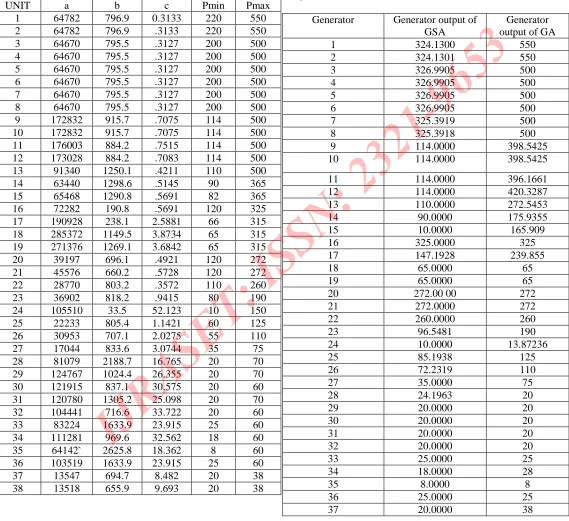
B. UNIT SYSTEMS DATA FOR 38 GENERATOR SYSTEMS [9]
The system consists of 38 thermal generating units. The total load demand on the system is 8600 MW. The parameters of all thermal units are presented in Table 4
The obtained results for the 38-unit system using the GSA method are given in Table 5and the results are compared with other methods reported in literature
Parameters 3unit system 13unit system
38unit system
α 10 10 10
N 30 100 60
100 100 100
TABLE 4: Cost coefficients and unit operating limits for 38 test system
UNIT a b c Pmin Pmax
1 64782 796.9 0.3133 220 550
2 64782 796.9 .3133 220 550
3 64670 795.5 .3127 200 500
4 64670 795.5 .3127 200 500
5 64670 795.5 .3127 200 500
6 64670 795.5 .3127 200 500
7 64670 795.5 .3127 200 500
8 64670 795.5 .3127 200 500
9 172832 915.7 .7075 114 500
10 172832 915.7 .7075 114 500
11 176003 884.2 .7515 114 500
12 173028 884.2 .7083 114 500
13 91340 1250.1 .4211 110 500
14 63440 1298.6 .5145 90 365
15 65468 1290.8 .5691 82 365
16 72282 190.8 .5691 120 325
17 190928 238.1 2.5881 66 315
18 285372 1149.5 3.8734 65 315
19 271376 1269.1 3.6842 65 315
20 39197 696.1 .4921 120 272
21 45576 660.2 .5728 120 272
22 28770 803.2 .3572 110 260
23 36902 818.2 .9415 80 190
24 105510 33.5 52.123 10 150
25 22233 805.4 1.1421 60 125
26 30953 707.1 2.0275 55 110
27 17044 833.6 3.0744 35 75
28 81079 2188.7 16.765 20 70
29 124767 1024.4 26.355 20 70
30 121915 837.1 30.575 20 60
31 120780 1305.2 25.098 20 70
32 104441 716.6 33.722 20 60
33 83224 1633.9 23.915 25 60
34 111281 969.6 32.562 18 60
35 64142` 2625.8 18.362 8 60
36 103519 1633.9 23.915 25 60
37 13547 694.7 8.482 20 38
[image:6.612.6.575.160.681.2]38 13518 655.9 9.693 20 38
TABLE 5: Simulation Results and Its Comparison with Genetic Algorithm (GA)
Generator Generator output of GSA
Generator output of GA
1 324.1300 550
2 324.1301 550
3 326.9905 500
4 326.9905 500
5 326.9905 500
6 326.9905 500
7 325.3919 500
8 325.3918 500
9 114.0000 398.5425
10 114.0000 398.5425
11 114.0000 396.1661
12 114.0000 420.3287
13 110.0000 272.5453
14 90.0000 175.9355
15 10.0000 165.909
16 325.0000 325
17 147.1928 239.855
18 65.0000 65
19 65.0000 65
20 272.00 00 272
21 272.0000 272
22 260.0000 260
23 96.5481 190
24 10.0000 13.87236
25 85.1938 125
26 72.2319 110
27 35.0000 75
28 24.1963 20
29 20.0000 20
30 20.0000 20
31 20.0000 20
32 20.0000 20
33 25.0000 25
34 18.0000 28
35 8.0000 8
36 25.0000 25
38 20.0000 38
Total demand 8600MW 8600MW
Total Cost(Rs/hr) 12295000.0 12320766.9
5. CONCLUSION
In this paper, a novel approach based on the Newton’s laws of gravity and mass interaction GSA has been presented and applied to economic power dispatch optimization problem. Here GSA is applied to 3, 38 test system and effectiveness of GSA was tested. From the simulation results, it can be seen that GSA has better convergence rate and Computational time is also very less when it is compared to other methods.
REFERENCES
[1] E. Rashedi, H. Nezamabadi-pour and S. Saryazdi,
“GSA: A Gravitational Search Algorithm”, Information
sciences, vol.179, no. 13, pp. 2232-2248, 2009."
[2] Hardiansyah, “Solving economic load dispatch problem with valve point effect using modified ABC
algorithm”IJECE vol. no.3,pp.(377-385), 2013
[3] K.Senthil, K.Manikandan , “Economic Thermal Power Dispatch With Emission Constraint And Valve Point Effect Loading Using Improved Tabu Search
Algorithm” International Journal of Computer Applications Volume 3 –No.9 , 2010.
[4] J.Jain, R.Singh,” Biogeographic-Based Optimization Algorithm for Load Dispatch in Power System” International Journal of Emerging Technology and Advanced Engineering, Volume 3, Issue 7, 2013.
[5] M.Sailaja Kumari1, M.Sydulu2,” A Fast
Computational Genetic Algorithm for Economic Load
Dispatch”,Inter national Journal of Recent Trends in Engineering Vol. 1, No. 1, 2009
[6] Neetu Agrawal, Shilpy Agrawal, K. K. Swarnkar,
S.Wadhwani, and A. K. Wadhwani ,” Economic Load
Dispatch Problem with Ramp Rate Limit Using BBO”,
International Journal of Information and Education Technology, Vol. 2, No. 5, 2012
[7] K. Meng, H. G. Wang, Z.Y. Dong, and K. P. Wong,”
Quantum-Inspired Particle Swarm Optimization for Valve-Point Economic Load Dispatch” ieee transactions on power systems, vol. 25, no. 1,pp(215-222) 2010
[8] Chao-Lung Chiang,” Improved Genetic Algorithm For Power Economic Dispatch Of Units With Valve-Point Effects And Multiple Fuels” ieee transactions on power systems, vol. 20, no. 4, pp.(1690-1699), 2005
[9] Dr. M. Sydulu,” A Very Fast And Effective Non -Iterative H - Logic Based Algorithm For Economic
Dispatch Of Thermal Units”ieee transactions on power systems, vol. 6 pp.(1434-1437),1999