6
I
January 2018
Review on Autonomous Car using Raspberry Pi
Supriya K. Kokate 1, Dr. M. H. Nerkar 2
1
P.G. Student, Department of Electronics and Telecommunication Engineering, Government College of Engineering, Jalgaon, India1
2
Associate Professor, Department of Electronics and Telecommunication Engineering, Government College of Engineering, Jalgaon, India2
Abstract: In this paper, we propose an autonomous car (also called robotic car, driverless car, self-driving car) is a vehicle that is capable of sensing its environment and navigating without human input. It consists of three subsystems: (1) Client systems, such as hardware platform; (2) Algorithms for localization, perception, and planning and control; and (3) The cloud platform, which includes data storage. The algorithm of subsystem extracts meaningful information from sensor and to understand its environment and make decisions about its actions. The cloud platform provides offline computing and storage capabilities for autonomous vehicles. The client subsystem integrates several algorithms to meet real-time and reliability requirements. Using the cloud platform, we are able to test and train better recognition, tracking, and decision models. An Autonomous car can be very safe and useful for the entire mankind. Various software applications process data using Artificial Intelligence to recognize and propose a path which an intelligent or Autonomous car should follow. Additionally an autonomous car can detect the distance between the cars, lowering the degree of road loadings, reducing the number of traffic jams, avoiding human errors, and allowing disabled people (even blind people) to drive long distances.
Keywords:Raspberry Pi, Ultrasonic sensor, camera, lane detection, obstacle detection, GPS
I. INTRODUCTION
Google in recent years has developed a highly advanced autonomous car. However, when you begin to take the question what exactly is allowing their car to behave autonomously you begin to realize that under the advanced algorithms exist conceptually simple components to make such a thing possible. For example, object detection can be performed many different ways, through several different types of sensors such as ultrasonic sensors and obtaining images of the road is nothing more than a camera taking a photo and then performing image processing algorithms through software. So, the thought occurs that perhaps something as simple as a Raspberry Pi and some simple sensors can be used to help create, learn and evolve an autonomous car that can detect obstacles, roads and drive along unknown roads on its own. With the intent to help lead to a future where human driving error can be eliminated and avoid deadly accidents, injury or deaths.
II. LITERATURESURVEY
automatic mode, robot tracks, analyses the colour of the picked object and drops the object into the respective coloured container. At the last of the manual mode, robot moves and does the task as desired by the user according to the commands given through the application.
III.FUNCTIONSOFAUTONOMOUSVEHICLES
A vehicle that travels from point A to point B without any human input for a particular duration of time is classified as an autonomous vehicle. Such vehicles employ sensory, control and navigation technologies that respond to the environment accordingly. The U.S. Department of Transportation’s National Highway Traffic safety Administration (NHTSA) has classified autonomous vehicles of five levels. The Society for Autonomous Engineers India (SAE) also has similar classification for autonomous vehicles.
A. Level 0 (No Automation): The human driver is in constant and complete control of the car.
B. Level 1 (Assisted Automation): Only one function can be automated at a time such as either electronic stability control, where the vehicle automatically assists with braking. Cruise control, lane keeping and parking assist are other such common place features found in autonomous car of this level.
C. Level 2 (Partial Automation): More than one function is automated at the same time such as a combination of adaptive cruise control and lane centering. However, the driver must still remain constantly attentive.
D. Level 3 (High Automation): The functions are sufficiently automated, enabling the driver to safely engage in other work or activities. The Google car is an example.
E. Level 4 (Full Automation): The car can completely drive itself without a human operator. The vehicle is designed to perform all driving function and monitor roadway conditions for an entire trip.
IV.SYSTEMARCHITECTUREANDDESCRIPTION
The image was taken by the camera which was placed in the top head of the raspberry pi kit, the camera equipment was connected via USB port. The capturing image from the camera connected executed in the Linux OS/Raspbian OS software. The extracted image taken out from the camera sends to the raspberry pi kit and followed to execution of python coding. In the python coding the signal are generated, these generated signals coming from the execution of kit and sent to car/robot. Robot car and raspberry pi follows and detect object effectively. The SD card is used as fundamental gadget for raspberry pi board like a hard plate of a PC. The bootable Linux working framework is stacked onto the card. The raspberry pi underpins Linux, ARM, and Mac working frameworks. You can choose one OS; you should compose it to a SD card utilizing a Disk supervisor application. You can likewise utilize other capacity system, as USB outside hard drive or USB drive. There are a various brands of SD cards are accessible in various sizes.
A. Raspberry pi
Raspberry Pi is credit card-sized single-board computer. There are currently five raspberry pi models in the market i.e. the model B+, model A+, model B, model A and the compute module. All models use the same SoC (system on chip combined CPU and GPU). Central processing unit speed ranges from 700 MHz to 1.2 GHz for the Pi 3 and on board memory range from 256 MB to 1 GB RAM. The operating systems are stored in secure digital (SD) and program memory in either the SDHC or Micro SDHC sizes. Most boards have one to four USB slots, HDMI and composite video output. Lower level output is provided by a number of General purposes input output pins which support common protocols like I²C. The Pi 3 has on board Bluetooth and Wi-Fi 802.11n.
B. Pi Camera
The Raspberry Pi camera module can be used to capture photograph as well as take high-definition video. The camera module is 5 megapixel fixed-focus camera that supports 1080p30, 720p60 and video modes. We can use the libraries with the camera to create effects. Camera connects via a 15cm ribbon cable to the CSI port on the Raspberry Pi. The camera works with all models of Raspberry Pi 1, Pi 2 as well as Pi 3. It can be accessed through the MMAL (Multi-Media Abstraction Layer), Video for Linux Application Programming Interface and there are numerous third-party libraries built for it, such as the Pi camera Python library. The camera module is used in home security applications but in this project we use camera for capturing images.
C. Motor Driver (L298)
L298 is called as a dual bidirectional motor driver which is based on dual H-Bridge Motor driver IC. The L298 is an integrated monolithic circuit in a 15- lead Multiwatt and PowerSO20 packages. It controls two dc motors independently in either direction and it is easy to use and interface the L298 with an Arduino or a Raspberry Pi. It also provides an onboard 5V regulator. It is a high voltage, high current dual full-bridge driver and designed to accept standard TTL logic levels and drive inductive loads such as DC and stepping motors, relays.
D. Ultrasonic Sensor module
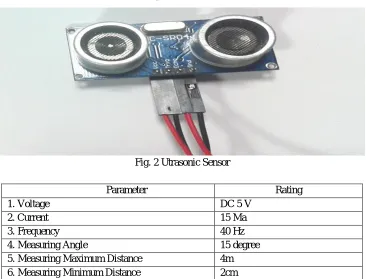
HC-SR04 module is used for non-contact distance measurement for distances from 2cm to 400cm. It uses sonar (like bats and dolphins) to measure distance with high accuracy and stable readings. It consists of an ultrasonic transmitter, receiver and control circuit. The transmitter transmits short bursts which gets reflected by target and are picked up by the receiver. The time difference between transmission and reception of ultrasonic signals is calculated. Using the speed of sound and ‘Speed = Distance/Time' equation, the distance between the source and target can be easily calculated. The working principle of ultrasonic sensor is as follows:
1) High level signal is sent for 10us using Trigger.
2) The module sends eight 40 KHz signals automatically, and then detects whether pulse is received or not.
3) If the signal is received, then it is through high level. The time of high duration is the time gap between sending and receiving
the signal.
4) VCC – 5V, input power
5) TRIG – Trigger Input
6) ECHO – Echo Output
7) GND – Ground
8) VCC -> 5 volt pin on Pi
9) Trig -> Trigger activates the sensor and connect to GIO output pin 10) Echo -> Receives the signal, read by GPIO input pin
11) GND -> GROUND PIN
E. Distance Calculation
Time taken by pulse is for transmission and reception of ultrasonic signals, while we need only half of this. Therefore time is taken as time/2.
Distance = Speed * Time/2 Speed of sound at sea level = 343 m/s or 34300 cm/s
Distance= (Time x Speed of Sound in Air (340 m/s))/2
Fig. 2 Utrasonic Sensor
Parameter Rating
1. Voltage DC 5 V
2. Current 15 Ma
3. Frequency 40 Hz
4. Measuring Angle 15 degree
5. Measuring Maximum Distance 4m
6. Measuring Minimum Distance 2cm Table 1 Specifications of Ultrasonic Sensor
F. Raspbian OS
The operating systems Linux OS or Raspbian available for Raspberry Pi, Raspbian comes out on top as being the most user-friendly, best-looking, has the best range of default software and optimized for the Raspberry Pi hardware. Raspbian is a free operating system based on Debian (LINUX), which is available for free from the Raspberry Pi website.
G. Python
Python was created by Guido van Rossum during 1985- 1990. It is a general-purpose, object-oriented, interactive, and high-level programming language. Its syntax allows the programmers to express concepts in less lines of code when compared with other languages like java, C or C++. It provides high-level dynamic data types and supports dynamic type checking.
H. RPi.GPIO Python Library
In order to control the GPIO pins of the RPi, we use the RPi. GPIO Python library. Starting version 0.5.6, the library has support for RPi model B+ as well. It is very simple library and it allows to read- write from any GPIO pin by various means (like triggers, events).
I. Open CV
It (Open Source Computer Vision) is a library of programming functions mainly aimed at real-time computer vision. This library allows these features be implemented on computers with relative ease, provide a simple computer vision infrastructure to prototype quickly sophisticated applications. It has over 2500 optimized algorithms, including both a set of classical algorithms and the state of the art algorithms in Computer Vision, which can be used for image processing, detection and face recognition, object identification, classification actions, traces, and other functions. It is based on C++ but wrappers are available in python as well. Here it is used to detect the roads and guide the car on unknown roads.
V. CONCLUSIONS
is use for motion detection of various objects. The application of tracking and object detection is farming, military, transportation, civil, security and for commercial use. Autonomous car provide independent mobility to non-drivers, reduce the stress and tedium of driving.
REFERENCES
[1] Johann Borenstein & Yoram Koren, Obstacle Avoidance with Ultrasonic Sensors, IEEE JOURNAL OF ROBOTICS AND AUTOMATION, VOL. 4, NO. 2, APRIL I988, pp. 213-218
[2] Yue Wanga, Eam Khwang Teoha & Dinggang Shenb, Lane detection and tracking using B-Snake, Image and Vision Computing 22 (2004) , available at:www.elseviercomputerscience.com, pp. 269–280
[3] P. Angelov, P. Sadeghi-Tehran, R. Ramezani,'' A Real-time Approach to Autonomous Novelty Detection and Object Tracking" in Video Streams, International Journal of Intelligent Systems, ISSN 0884-8173, 2010, invited paper
[4] “Implementation of Line Tracking Algorithm using Raspberry Pi ''Conference Paper · December 2014Samreen Amir, Bhawani Shankar Chowdhry. , International Journal of Intelligent Systems, ISSN 0884-8173, 2014, invited paper
[5] Global Journal of Advanced Engineering Technologies, Special Issue (CTCNSF-2014) ISSN (Online): 2277-6370 & ISSN (Print): 2394-0921 ''OBJECT DETECTION AND TRACKING USINGIMAGE PROCESSING'' Vijayalaxmi, K.Anjali, B.Srujana, and P.Rohith Kumar.
[6] Indian Journal of Science and Technology, Vol 9(45), DOI: 10.17485/ijst/2016/v9i45/106346, December 2015 ''A Hybrid Approach for Real-Time Object Detection and Tracking’’ Pushkar Protik Goswami and Dushyant Kumar Singh.
[7] Indian Journal of Science and Technology April - May Jun 2016 '' VISION BASED OBJECT DETECTION AND TRACKING USING MULTIROTOR UNMANNED AERIAL VEHICLE '' Sarthak Kaingade, Vikrant More, Dhiraj Dhule, Pradeep Gaidhani, Nitin Gupta
[8] International Journal of Engineering Trends and Technology (IJETT) – Volume 35 Number 4- May 2016 ISSN: 2231-5381 http://www.ijettjournal. ''Object Tracking Robot on Raspberry Pi using Opencv'' Pradeep Kumar.G.H Assistant Professor, Department of CSE, KSIT Rupa Gurram Sweatha Suresh.B. Sneha.B.R. Sushmitha
[9] International Journal of Trend in Research and Development, Volume 3(3), ISSN: 2394-9333 www.ijtrd.com IJTRD May - Jun 2016 Available [email protected] 31 '' Object Tracking Robot by Using Raspberry PI with open Computer Vision (CV)'' M. Karthikeyan,
[10] NavStik Autonomous Systems '' VISION BASED OBJECT DETECTION AND TRACKING USING MULTIROTOR UNMANNED AERIAL VEHICLE ''
SarthakKaingade, Vikrant More, DhirajDhule, PradeepGaidhani, Nitin Gupta.