Technology (IJRASET)
©IJRASET 2015: All Rights are Reserved
492
An Analytical Study of the Remote Sensing Image
Classification Using Swarm Intelligence
Techniques
Shelja Singla 1, Priyanka Jarial 2,Gaurav Mittal 3 1
Research Scholar, 2Assistant Professor, Department of Computer Engineering, Punjabi university, India 3
Assistant Professor, Department of ECE, Bhai Gurdas Institute of Engg. & Tech., India
Abstract— Swarm intelligence is one of the hot nature inspired techniques that is being used in the many areas of research to optimization the solution of computational problems. In this paper, we have considered swarm intelligence based techniques for remote sensing image classification. Remotely Sensed images are the images captured by satellite. The swarm intelligence based techniques considered for the analytical study of the remote sensing image classification are Particle Swarm Optimization (PSO), Artificial Bee Colony Optimization (ABC), Cuckoo Search (CS), Biogeography Based Optimization (BBO), hybrid ACO/BBO, hybrid CS/PSO, hybrid CS/ACO and hybrid ABC/BBO. The accuracy assessment parameter taken for the review results are kappa coefficient, user’s accuracy, producer’s accuracy and overall accuracy. The review is being done on the dataset of Alwar, Rajasthan. The main goal of this paper is to present an analytical review on the existing swarm intelligence based techniques for the classification of remote sensing images.
Keywords— Swarm Intelligence, Remote Sensing, Kappa Coefficient, Optimization.
I. INTRODUCTION
Nature being a source of inspiration plays a clamorous role for the advancement in technology and for the solution of computational hard problems as they provide more emphatic and attractive solutions [1]. A new terminology introduced to encompass these nature inspired computation techniques well famous by “Swarm Intelligence”. Swarm Intelligence (SI), which is an artificial intelligence (AI) discipline, is concerned with the design of intelligent multi-agent systems by taking inspiration from the collective behaviour of social insects such as ants, termites, bees, and wasps, as well as from other animal societies such as flocks of birds or schools of fish [2] [3]. Swarm Intelligence based techniques are Bat Algorithm, Biogeography Based Optimization, Ant Colony Optimization, Cuckoo Search, Particle Swarm Optimization, Artificial Bee Colony Optimization, Firefly Algorithm etc. Swarm Intelligence is a global research area to improve the optimization of various soft computing and nature inspired techniques. In this paper, we are using these swarm intelligence based techniques for the accurately classification of land cover features. For this classification of land cover features, remote sensing data in the form of digital multispectral images is considered. Remote Sensing can be defined as the science or art of getting important information about the surface of earth and its objects without any direct contact with that particular surface/object [4]. Remote sensing image classification is one of the major fields to classify the satellite image obtained [5]. There exist various classifiers that have the capability to classify the land cover features. But the results obtained from those classifiers as not as much accurate as required. So, there is the need of some nature-inspired techniques that should have the capability to classify these natural land cover features with high accuracy value. So, we are presenting a review on the existing swarm intelligence based techniques for the classification of satellite images into accurate land cover features.
In this paper, the main goal is to analyse the existing image classification techniques using swarm intelligence concept. A lot of research is being done on the dataset of Alwar, Rajasthan, INDIA. We are presenting the accuracy of existing algorithm using the accuracy parameters of kappa coefficient, user’s accuracy, producer’s accuracy & overall accuracy.
Rest of the paper is organized in the following manner: Section II briefs about the dataset used, Section III presents the existing swarm intelligence based technique for land cover feature classification of the Alwar area, Section IV gives the comparison of existing algorithm by considering accuracy assessment parameters, and Section V concludes the paper with some future references.
II. DATASETCONSIDERED
Canadian Satellite Radarsat is used to capture RS1 & RS2 satellite digital images. These 7-band images are shown in figure 1.
Figure 1: 7- band satellite images of Alwar
All the seven images are geo-referenced and the image dimension is 472×546 pixels. When all of these images are combined using the ERDAS software, a combined stack image is obtained which is considered as the original Alwar image is shown by figure 2.
Figure 2: Original Alwar Image
III.RELATEDWORK
There exists a lot of work for the Remote Sensing image classification using swarm intelligence techniques on the dataset of Alwar, India. The techniques considered for the image classifications are as below:
A. Particle Swarm Optimization (PSO)
The concept of PSO in the field of remote sensing image classification has been introduced by Panchal et. al. by making the experimentation on the dataset of Alwar [6]. In this paper, the author has presented the concept of PSO to get the optimized results of the land cover features by taking the parameters of local search and global search for the selection criteria. The kappa coefficient value as an accuracy parameter is comes out 0.7033 which is not as much better results to detect the terrain features.
B. Biogeography Based Optimization (BBO)
[image:3.612.206.406.322.458.2]Technology (IJRASET)
©IJRASET 2015: All Rights are Reserved
494
[8]. In Artificial Bee Colony Optimization, there are three types of bees employed bees, onlooker bees and scout bees. In this classification, the image pixels are considered as the employed bees & next pixels are selected by considering the parameters of onlooker bees with the help of Euclidean distance formulation. The result comes out shows a greater value of kappa coefficient (0.917) taken as accuracy parameter.
D. Cuckoo Search (CS)
Bharadwaj et al. has used the Swarm based latest concept Cuckoo Search algorithm for the detection of natural land cover features [9]. The advantage of Cuckoo bird to store his egg in other species’ nest is used to capture the natural terrain features. The cleverness of cuckoo bird can perform better as compare to other swarm based techniques. The dataset used is of Alwar area for image classification. In this proposed algorithm, Cuckoo bird is considered as the pixel value of the image & host nest is taken as the match class (i.e. terrain feature) to store the egg. Different classes are used to store different terrain features as they get detected. The results obtained are accurate as compare to other swarm based algorithm like ABC, BBO, PSO and traditional classifiers. The feature extraction can be obtained from the classified image with their accuracy values.
E. Hybrid CS/ACO
Kundra and Sadawarti has proposed the hybrid algorithm of cuckoo search and ant colony optimization for the classification of natural terrain features. The results obtained from the proposed algorithm are superlative as compare as per the accuracy assessment parameters. The value of kappa coefficient comes out to be 0.9445 which has almost achieved the accuracy assessment [10]. Here, the optimization parameters to find the shortest best solution is obtained by using the algorithm of ACO and to assign the feature class for the pixels algorithm of CS is used.
F. Hybrid ABC/BBO
Arora et al. proposed the hybrid concept of Artificial Bee Colony optimization (ABC) and Biogeography Based Optimization (BBO) for the extraction of natural terrain features extraction [11]. The proposed hybrid concept overcomes the disadvantage of Cluster technique used in the BBO algorithm for the image classification. The main concept of hybridization is that BBO species get the information of HSI index also from the other species of Cuckoo search. Here, food sources and living suitability environment are considered as the land cover features like urbanization, water area, vegetation part, hilly area etc. Image pixels are considered for by the social species of the bees and the HSI index of the band images are calculated for the image classification. The results obtained with this hybrid concept are outstanding as compare to the simple BBO algorithm with high accuracy value.
G. Hybrid ACO/BBO
S. Goel proposed another new concept of hybridization of ACO/BBO [12]. In this algorithm the results obtained are better as compare to BBO and the disadvantage of clustering technique to solve the image classification problem is resolved. In this paper, author compares the proposed hybrid concept with another hybrid technique like Hybrid ACO/SOFM and Hybrid Rough Set /BBO.
H. Hybrid CS/PSO
In 2015, Kundra & Sadawarti has proposed the hybrid algorithm of cuckoo search and particle swarm optimization for the extraction of natural land cover features. The accuracy assessment value is also comes out to be 0.9633 indicated using the kappa measure [13]. The algorithm gives improved results as compare to the individual concepts of CS and PSO.
IV.COMPARISON
For the comparison of all the considered algorithm of swarm intelligence, we are considering the parameters of accuracy assessment. Accuracy assessment plays a vital role to determine the efficiency of an algorithm. The goal of this accuracy assessment is to observe how efficiently the pixels are considered into correct feature classes of the investigation area [14][15]. As in the real world problems not possible to check each and every object for whole accuracy check, in the same manner for the verification of the classified image, we are considering a set of reference pixels that are randomly selected. These reference pixels are the random points of classified image whose terrain features are known to us. The classification accuracy is checked
using the well-accepted Error matrix in the field of Remote Sensing. Error matrices describe a relationship between the
TABLE I. ERROR MATRIX OF BBO
Feature Water Vegetation Urban Rocky Barren Total
Water 70 0 0 0 0 70
Vegetation 0 127 1 1 0 129
Urban 0 1 92 0 39 129
Rocky 0 1 15 175 3 194
Barren 0 21 81 26 128 256
Total 70 150 189 202 170 781
TABLE II. ERROR MATRIX OF PSO
Feature Water Vegetation Urban Rocky Barren Total
Water 59 28 0 0 0 87
Vegetation 47 79 0 0 0 126
Urban 0 4 22 0 7 33
Rocky 0 18 3 286 0 307
Barren 0 1 7 0 24 32
Total 106 130 32 286 31 585
TABLE III. ERROR MATRIX OF ABC
Feature Water Vegetation Urban Rocky Barren Total
Water 68 0 0 0 0 68
Vegetation 0 109 1 0 0 110
Urban 0 0 112 0 4 116
Rocky 0 0 0 96 0 96
Barren 0 0 26 0 59 85
Total 68 109 139 96 63 475
TABLE IV. ERROR MATRIX OF CS
Feature Water Vegetation Urban Rocky Barren Total
Water 68 0 0 0 0 68
Vegetation 0 109 1 0 0 110
Urban 0 0 122 0 3 125
Rocky 0 0 0 96 0 96
Barren 0 0 16 0 60 76
Total 68 109 139 96 63 475
TABLE V. ERROR MATRIX OF HYBRID ACO/BBO
Feature Water Vegetation Urban Rocky Barren Total
Water 70 3 0 1 1 75
Vegetation 0 145 34 4 8 191
Urban 0 0 127 0 26 153
Rocky 0 2 2 168 10 182
Barren 0 0 27 27 125 179
Technology (IJRASET)
©IJRASET 2015: All Rights are Reserved
[image:6.612.125.487.76.446.2]496
TABLE VI. ERROR MATRIX OF HYBRID ABC/BBOFeature Water Vegetation Urban Rocky Barren Total
Water 68 0 0 0 0 68
Vegetation 0 109 1 0 0 110
Urban 0 0 112 0 4 116
Rocky 0 0 0 96 0 96
Barren 0 0 26 0 59 85
Total 68 109 139 96 63 475
TABLE VII. ERROR MATRIX OF HYBRID CS/ACO
Feature Water Vegetation Urban Rocky Barren Total
Water 72 0 0 3 0 75
Vegetation 0 161 1 4 0 166
Urban 0 0 159 0 15 176
Rocky 2 0 0 94 0 94
Barren 0 0 0 0 52 52
Total 74 161 160 101 67 563
TABLE VIII. ERROR MATRIX OF HYBRID CS/PSO
Feature Water Vegetation Urban Rocky Barren Total
Water 74 0 0 0 0 74
Vegetation 0 161 1 0 0 162
Urban 0 0 149 0 5 154
Rocky 0 0 0 101 0 101
Barren 0 0 10 0 62 72
Total 74 161 160 101 67 563
Using the Error Matrix, four parameters of accuracy can be derived as below:
A. Producer’s Accuracy
Producer’s accuracy is a way to extent percentage of properly classified natural terrain features. i.e., how accurately classification is performed by the column wise category. It is calculated by the ratio of correctly classified pixels to total column wise total pixels of each land cover feature. The producer’s accuracy of all the above discussed algorithms can be calculated as below shown by Table IX:
TABLE IX.COMPARISON OF PRODUCER’S ACCURACY
Classifier/Feature Water Vegetation Urban Rocky Barren
BBO 100 84.66 48.67 86.63 75.29
PSO 55.56 60.76 68.75 100 77.41
ABC 100 100 80.57 100 93.65
CS 100 100 87.76 100 95.23
Hybrid ACO/BBO 100 96.67 66.84 84 73.53
Hybrid ABC/BBO 100 100 80.57 100 93.65
Hybrid CS/ACO 97.29 100 99.37 93.06 77.61
[image:6.612.146.467.553.706.2]B. User’s Accuracy
It can be defined as the probability that a pixel labelled as a certain land cover feature is actually availability of that specified class. User’s accuracy is an extent of how well classification is performed by row wise category. It is calculated by the ratio of correctly classified pixels to total row-wise total pixels of each land cover feature. The User’s accuracy of all the above algorithms is calculated as shown below by Table X:
TABLE X.COMPARISON OF USER’S ACCURACY
Classifier/Feature Water Vegetation Urban Rocky Barren
BBO 100 98.44 71.31 90.20 50
PSO 67.81 62.69 66.66 93.15 75
ABC 100 99.09 96.55 100 69.41
CS 100 99.09 97.6 100 78.94
Hybrid ACO/BBO 93.33 75.92 65.80 92.31 69.83
Hybrid ABC/BBO 100 99.09 96.55 100 69.41
Hybrid CS/ACO 96 96.98 90.34 100 100
Hybrid CS/PSO 100 99.38 96.75 100 86.11
C. Overall Accuracy
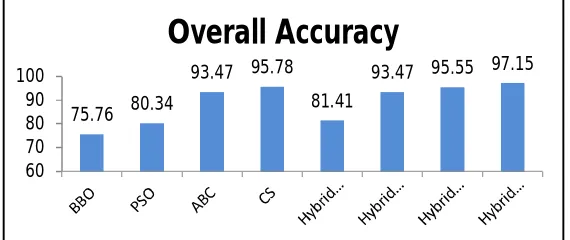
This is a very crude measure of accuracy. Overall accuracy is the measure of ratio of number of correct observations divided by the total number of classifications. The Overall accuracy of the considered algorithms is given by figure 3.
D. Kappa Coefficient
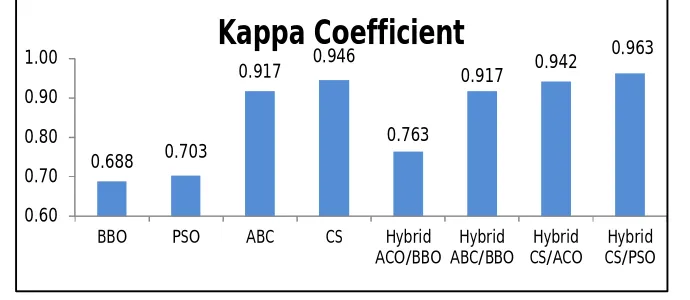
The Kappa Coefficient is considered as a statistical technique to determine the results of error matrix. Cognitive science measures explanation on the knowledge is used to relate the Kappa Coefficient for the indirect measure of the expert’s knowledge. The Formulization of Kappa Coefficient is done by Equation below:
= ∑ − ∑ ( . . )
− ∑ ( . . )
Where,
r = number of rows in the error matrix.
xii = the number of observations in row i and column i (on the major diagonal).
xi+ = total of observations in row i (shown as marginal total to right of the matrix).
x+i = total of observations in column i (shown as marginal total at bottom of the matrix).
N = total number of observations included in matrix.
[image:7.612.164.449.547.667.2]The Comparison of the entire considered algorithm can be shown by figure 4.
Figure 3: Comparison of Overall Accuracy 75.76 80.34
93.47 95.78 81.41
93.47 95.55 97.15
60 70 80 90 100
Technology (IJRASET)
©IJRASET 2015: All Rights are Reserved
[image:8.612.135.480.73.223.2]498
Figure 4: Comparison of Kappa Coefficient
V. CONCLUSION
In this paper, we have compared various swarm intelligence based algorithms in the field of remote sensing image classification. The algorithms considered for the comparison were BBO, PSO, ABC, CS, Hybrid ABC/BBO, Hybrid ACO/BBO, Hybrid CS/PSO and Hybrid CS/ACO. From the comparison table IX & X, we analyzed the feature wise accuracy of each land cover feature. The Kappa Coefficient (figure 4) and Overall accuracy (figure 3) gives the complete accuracy impact of the image classification techniques. The feature wise and complete comparison results show the accuracy upto a great impact, but there is still need of some impactful intelligent algorithm that can increase the accuracy level and reduce the errors values of the classified pixels. The entire results of the accuracy assessment parameters shows the impact of CS algorithm more as compare to some other swarm algorithm. Also the Hybrid CS/PSO & CS/ACO give very impactful results. So, for future reference, we have to hybridize the algorithm of CS with some other algorithm to improve the further results.
REFERENCES
[1] Blum, C., & Li, X. (2008).Swarm intelligence in optimization(pp. 43-85). Springer Berlin Heidelberg. [2] Kennedy, J., Kennedy, J. F., & Eberhart, R. C. (2001).Swarm intelligence. Morgan Kaufmann.
[3] Bonabeau, E., Dorigo, M., & Theraulaz, G. (1999).Swarm intelligence: from natural to artificial systems(No. 1). Oxford university press. [4] Jensen, J. R. (1996).Introductory digital image processing: a remote sensing perspective(No. Ed. 2). Prentice-Hall Inc..
[5] Sabins Jr, F. F. (1978). Remote sensing.Remote sensing.
[6] V.K. Panchal, H. Kundra, and J. Kaur, "Comparative study of particle swarm optimization based unsupervised clustering techniques." International Journal of Computer Science and Network Security 9.10, 132-140, 2009.
[7] V.K. Panchal, Samiksha Goel, and Mitul Bhatnagar. "Biogeography based land cover feature extraction." Nature & Biologically Inspired Computing, 2009. NaBIC 2009. World Congress on IEEE, 2009.
[8] S. Banerjee, A. Bhardwaj, D. Gupta, V.K. Panchal, "Remote Sensing Image Classification usinf Artificial Bee Colony Algorithm."International Journal Of Computer Science And Informatics2.3, 67-72, 2012.
[9] A. Bharadwaj, Daya Gupta, and V. K. Panchal. "Applying nature inspired metaheuristic technique to capture the terrain features."Proceedings of the 2012 International Conference on Artificial Intelligence (ICAI-2012). Vol. 1. 2012.
[10] Kundra, H., & Sadawarti, H. (2013), Hybrid Algorithm of CS and ACO for Image Classification of Natural Terrain Features, IJACSCE,.
[11] Kundra, H., & Sadawarti, H. (2015), Hybrid Algorithm of Cuckoo Search and particle Swarm Optimization for Image Classification of Natural Terrain Features, Research Journal of Information Technology, pp. 58-69.
[12] Arora, P., Kundra, H., & Panchal, V. K. (2012). Fusion of biogeography based optimization and artificial bee colony for identification of natural terrain features. International Journal of Advanced Computer Science & Applications,3(10).
[13] Goel, S., Sharma, A., & Panchal, V. K. (2011). A Hybrid Algorithm for Satellite Image Classification. In Advances in Computing, Communication and Control (pp. 328-334). Springer Berlin Heidelberg.
[14] M.A. Wulder, S.E. Franklin, J.C. White, J. Linke, and S. Magnussen, “An accuracy assessment framework for large-area land cover classification products derived from medium-resolution satellite data”, International Journal of Remote Sensing, 27, pp. 663-683, 2006.
[15] Lucas, L. (1994). Accuracy assessment of satellite derived land-cover data: a review. Photogrammetric Engineering & Remote Sensing, 60(4), 419-426.
0.688 0.703
0.917 0.946
0.763
0.917 0.942
0.963 0.60 0.70 0.80 0.90 1.00
BBO PSO ABC CS Hybrid