A Dual-Iterative Method for Concept-Word Acquisition from Large-Scale
Chinese Corpora
Guogang Tian
Key Laboratory of Intelligent Information Processing,
Institute of Computing Technology, Chinese Academy of Sciences
Graduate University of the Chinese Academy of Sciences
Beijing, China 100080 [email protected]
Cungen Cao
Key Laboratory of Intelligent Information Processing,
Institute of Computing Technology, Chinese Academy of Sciences
Graduate University of the Chinese Academy of Sciences
Beijing, China 100080 [email protected]
Abstract - This paper proposes a dual-iterative method, a hierarchical inner and outer iteration method (HIO), to acquire concept words from a large-scale, un-segmented Chinese corpus. It has two levels of iteration: the EM-CLS algorithm and the Viterbi-C/S algorithm constitute the inner iteration for generating concept words, and the concept word validation constitutes the outer iteration together with the concept word generation. Through multiple iterations, it integrates the concept word generation and validation into a uniform acquisition process. In the process of acquisition, the HIO method can cope with the problem of over-segmentation, over-combination and data sparseness. The experimental result shows that the HIO method is valid for concept word acquisition that can simultaneously increase the precision and recall rate of concept word acquisition.
1. Introduction
Concept word acquisition is an important research in knowledge acquisition from text (KAT) (Cao and Sui, 2003), and it is also the foundation of ontology learning (Maedche, 2002). Its main purpose is to acquire plentiful concept words from text corpora. It is very similar to unknown word recognition (Chen and Bai, 1998), (Feng, Chen, et al., 2004) and term extraction (Bourigault and Jacquemin, 1999). However, there are subtle distinctions among these three researches. Generally, concept word can be classified into three types: proper name, compound word and derived word. Except for these three word types, unknown word recognition also identifies numeric-type compounds, and it does not concern known words listed in a dictionary. Term extraction (Bourigault and Jacquemin, 1999) mainly processes domain texts, and often extracts commonly used professional terms from a specific domain text corpus.
Fu and Luke (2003) proposed a two-stage Chinese
segmentation system. At the first stage, it segmented the input text according to known words on the basis of 2-gram statistical model, and then identified unknown words at the second stage using a hybrid method which consisted of word context, word composition and word juncture model.
Yang and Li (2003) proposed a heuristic method that it generated five rules using mutual information and significance estimation to extract unknown word.
Peng and Schuurmans (2001) proposed an unsupervised training method to build probability models that accurately segmented Chinese character sequences into words. It used successive EM phases to learn a good probability model over character strings, and then prunes the model with a mutual information selection criterion to obtain a more accurate word lexicon.
Lai and Wu (2000, 2002) proposed a likelihood ratio method to extract possible unknown words or phrases defined by PLUs (phrase-like-unit). The final PLU was decided by two principles of overlap competition and inclusion competition.
Nagao and Mori (1994) proposed a rapid n-gram extraction method to extract adjacent substrings with same prefix in an ordered prefix table. It was noted that it was an affix method intrinsically.
limits. For example, it can not deal with unknown words that have not obvious affix features, and it can not use contextual information of unknown words, either.
This paper, motivated by the work of Chang and Su (1997) and Liu, Zhang, et al. (2004) presents a hierarchical inner and outer iteration method to acquire concept words from a large-scale, un-segmented Chinese text corpus. It has two levels of iteration which involves concept word generation and validation. It makes some extension on EM algorithm and Viterbi algorithm which make up the concept word generation. The concept word validation combines mutual information and context entropy into a validation criterion. These two levels of iteration can simultaneously increase the precision and recall rate of concept word acquisition.
The main contribution of this paper is that it proposes a HIO method for concept word acquisition. The HIO method unifies concept word generation and validation into a consecutively iterative process so that it can increase precision and recall simultaneously. The rest of this paper is organized as follows: Section 2 presents the HIO method. Concept word generation is discussed in section 2.1, and concept word validation is discussed in section 2.2. The whole HIO algorithm is presented in Section 2.3. The experiment result and error analysis are provided in section 3. Section 4 concludes this paper and outlines the future work.
2. The HIO Method
The HIO method (a Hierarchical Inner and Outer iteration method) has two levels of iteration, that is, the inner iteration and the outer iteration. The alternation of EM-CLS and Viterbi-C/S algorithm constitutes the inner iteration of the HIO – concept word generation, and concept word validation constitutes the outer iteration of the HIO. The basic structure of the HIO method is illustrated in Fig. 1.
The HIO method can cope with the two primary problems in concept word acquisition: over-segmentation and over-combination. Data sparseness is one of common problems in statistical language processing. Concept word acquisition is not the exception. In the acquisition process, it may produce the sparse data. Katz smoothing is applied in the HIO method to smooth sparse data and reduce their effect on concept word acquisition.
2.1 Concept Word Generation
2.1.1 EM-CLS algorithm
The EM-CLS algorithm, which is based on EM (expectation maximization) algorithm, estimates generated terms’ probability distribution and
identifies their types in a large corpus.
Concept Word Validation
CT: candidate term OST: over-segmented term NT: normal term OCT: over-combined term SC: segmented corpus
CAS: combination-ambiguity sentence NS: normal sentence
OAS: overlap-ambiguity sentence EM-CLS
Viterbi-C/S CT
OST NT OCT
CAS NS OAS
SC
Concept Word Generation
Concept Word Validation
CT: candidate term OST: over-segmented term NT: normal term OCT: over-combined term SC: segmented corpus
CAS: combination-ambiguity sentence NS: normal sentence
OAS: overlap-ambiguity sentence EM-CLS
Viterbi-C/S CT
OST NT OCT CT
OST NT OCT
CAS NS OAS
SC CAS
NS OAS
SC
Concept Word Generation
Fig.1. The Structure of HIO Method
EM algorithm (Figueiredo, 2004), (Prescher, 2003) is a common method for estimating maximum-likelihood when missing data are present. It has two steps: E-step (expectation step) and M-step
(maximization step). Given the observed data x and the current parameter estimation^(t)
θ , E-step computes
the conditional expectation (with respect to the missing data y) of the logarithm of a complete
posteriori probability function, logp(y,θ|x). Usually
E-step is called as Q function, as illustrated in (1). Equation (2) shows the M-step of EM algorithm. M-step chooses the parameters which can maximize Q function as the estimated parameters. Through consecutive iterations of E-Step and M-Step, EM algorithm can get stabilized parameters.
E-Step:
∫
+ =
+ ∝
≡
dy x y p x
y p p
x x y p E p
x x y p E Q
t
t t t
) | , ( log ) , | ( ) ( log
] , | ) | , ( [log ) ( log
] , | ) | , ( [log ) | (
) ( ^
) ( ^
) ( ^ )
( ^
θ θ
θ
θ θ θ
θ θ
θ θ
(1)
M-Step:
) | ( max arg
) ( ^ )
1 (
^ t t
Qθ θ θ
θ
=
+
(2)
An un-segmented corpus is denoted as C={C1,
un-segmented sentence. After segmentation, C is converted into the segmented corpus denoted as S={S1, S2, …, Sn} where Si (1≤i≤n) is a
segmentation of Ci. The generated candidate terms1
are grouped into a set denoted as T={t1, t2, …, tm},
where tj (1≤j≤m) is the generated candidate term.
If Ci is taken as the observed data, Si as the
missing data, we can estimate the maximum-likelihood of term tj with the EM
algorithm which is deemed as its probability distribution in the corpus C. Equation (3) shows the probability estimation of term tj. In (3), Si* denotes
the optimal segmentation of sentence Ci, which can
be achieved by the Viterbi-C/S algorithm (to be discussed in the next section). f(tj, Si) denotes the
frequency of term tj in sentence Si.
} | ) ( { ), ( ^ ^ T t t p T t p
tj = j = j j∈ .
After estimating the probability of term tj, we still
have to judge to which type it belongs. The candidate term has three types that are normal term,
over-segmented term and over-combined term.
∑ ∑
∑
∑ ∑
∑
= = = = = = + × × = × × = m j n i t i i i j n i t i i i j m j n i t i i i j n i t i i i j t j T C S p S t f T C S p S t f T C S p S t f T C S p S t f t 1 1 ) ( ^ * 1 ) ( ^ * 1 1 ) ( ^ * 1 ) ( ^ * ) 1 ( ^ ) | , ( ) , ( ) | , ( ) , ( ) , | ( ) , ( ) , | ( ) , ( (3)If a concept word (or meaningful word) is segmented into several components, it is called
over-segmented term. For example, 高 血 糖
(hyperglycemia) is possibly spitted into 高 (high)
and 血糖 (blood sugar).
If a word is combined with another word, but their combination is not a concept word (or meaningful word), it is called over-combined term, such as 但也
(but also).
Equation (4) can assign a type label to tj, which is denoted by CLS(tj).
| ) ( | | } ) ( | { | max arg ) ( ) ( ) ( j i k j k k H
j Sen t
H S t Sen S S t CLS i ∈ ∧ ∈ = (4)
In (4), Sen(tj)={Si| tj∈Si}, H(i) denotes the sentence
type label.
2.1.2 Viterbi-C/S algorithm
The Viterbi-C/S algorithm dynamically segments a
1 The meaning of “term” here is different from the meaning of “term” in
term extraction. Here term refers to ordinary word.
corpus using the estimated probability of candidate terms and executes combination and segmentation operations on ambiguous terms in order to achieve the optimal segmentation. After completing corpus segmentation, it judges if a sentence contains overlap ambiguity or combination ambiguity.
Given a segmented sentence Si, Si=t1t2…tk (1≤j≤
k,tj∈T), it is assumed that terms are independent
each other, the likelihood of sentenceSiis defined as:
∏
=
= k j
j
i pt
S p 1 ) ( ) ( (5)
Definition 1: It is the optimal segmentation that its
likelihood is maximal among all segmentations of a sentence. The optimal segmentation is denoted as Si*
) | , ( max arg ) , | ( max
arg ^ ^
* p S C T p S C T
S i i
S i i S i i i = = (6)
Like candidate terms, segmented sentences are also classified into three types: normal sentence
(N-Sen), overlap-ambiguity sentence (OA-Sen), and
combination-ambiguity sentence (CA-Sen).
If a segmented sentence contains over-combined terms, it is considered as an OA-Sen.
If a segmented sentence contains over-segmented terms, it is considered as a CA-Sen.
It is observed that there is a direct correspondence between the type of candidate term and segmented sentence: normal term – N-Sen, over-segmented term
– CA-Sen and over-combined term – OA-Sen.
Definition 2: Segmented Density is defined as the
number of segmented term in each length unit. For a sentence Si,
) ( ) ( ) ( ) ( i i i
i length S
S NT S p S
SD = × (7).
For a corpus S,
∑
∑
∑
∈ ∈ ∈ × = × = S S i S S i i S S i i i i i S length S NT S p S length S NT S p S SD ) ( ) ( ) ( ) ( ) ( ) ( ) ( (8).In (7)-(8), NT(X) denotes the number of terms in sentence X, and length(Y) denotes the length of sentence Y.
The type of segmented sentence is measured by (9). Setting a threshold range [r1, r2] (r1<r2), if
CLS(Si)<r1, Si is a OA-Sen, if CLS(Si)>r2, Si is a
CA-Sen, if r1≤CLS(Si)≤r2, Si is a N-Sen.
) ( SD ) ( SD ) ( S S S CLS i
We make an extension to the classical Viterbi algorithm (Rabiner, 1989), thus get the Viterbi-C/S algorithm as illustrated in Fig. 2.
When segmenting a corpus, Viterbi-C/S binds combination and segmentation operations (C/S operation) on the selected terms according to their types. If over-segmented term is selected, combination operation is performed, if over-combined term is selected, segmentation operation is performed. These combination or segmentation operations on candidate term possibly causes data sparseness problem. So we use Katz Smoothing method (Goodman, 2001) as the smoothing strategy to eliminate sparse data.
) ... ( ) ... ( ) ...
(ti n 1 ti 1ti ti n 1 ti 1 pti n 2 ti 1ti p − + − =α − + − − + − (10)
In (10), t’=ti-n+1…ti-1ti doesn’t exist in candidate term
set T, α is a normalization constant.
2.2 Concept Word Validation
The generated candidate terms need to be further validated to filter out ambiguous terms. The validation takes into considerations candidate term’s composition and local context. The former is considered as a cohesion validation which adopts mutual information method (Sproat and Shih, 1990). The latter is considered as an independence validation which adopts context entropy method (Tung and Lee, 1994). So the concept word validation is the combination of mutual information and context entropy method.
Viterbi-C/S Algorithm
Input: un-segmented corpus C, candidate terms’ probability estimation
Output: the optimal segmentation and its type 1. selecting a sentence Cifrom corpus C;
2. selecting all possible candidate terms at the current position of sentence Ci, which constitute a set denoted as Tp={t
1p, t2p,
t3p, …};
3. selecting a candidate term which has maximum-likelihood from the set Tpas a possible segmented term of sentence C
i,
denoted as st;
4. performing the corresponding operation according to the type of term st
a. if an over-segmented term, performing segmenting operation on it and re-estimating the likelihood of new term, goto (3);
b. if an over-combined term, performing combining operation on it and re-estimating the likelihood of new term, goto (3);
c. if a normal term, segmenting the sentence, computing the likelihood of current segmentation and moving the position pointer forwardly
5. repeating step 1-4, until all sentences in corpus are segmented
[image:4.612.315.543.343.632.2]6. computing segmented density for corpus and sentences, and determining the type label of sentence
Fig. 2. The Viterbi-C/S Algorithm
The basic assumptions of concept word validation are that:
If a term is an over-combined term, it contains at least a division point where its cohesion degree must be low.
If a term is an over-segmented term, its local context features in corpus must be weak.
2.2.1 Mutual Information
It is assumed that there is at most two division points in a validating term tv= c1c2…cn.
If tvl=c1c2…cl∈T (1≤l<n) and t’= c1c2…clcl+1∉T,
tvl is called the maximal left substring of tv, and l is
the left division point of tv.
If tvr=crcr+1…cn∈T (1<r≤n) and t’= cr-1cr…cn∉T,
tvr is called the maximal right substring of tv, and r is
the right division point of tv.
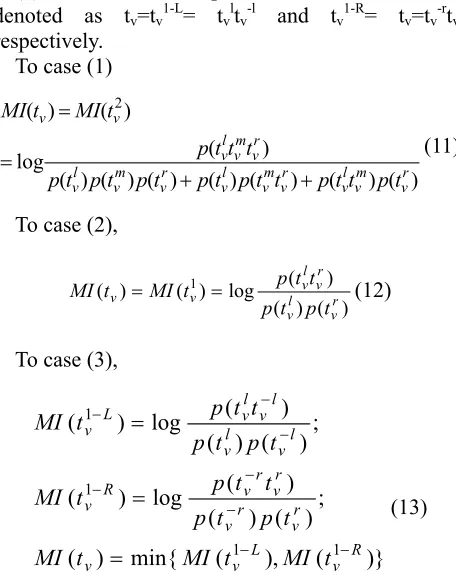
(1) If l<r-1, tv has two division points, which is
denoted as tv=tv2=tvltvmtvr;
(2) If l=r-1, tv has a division point, which is
denoted as tv=tv1=tvltvr;
(3) If l≥r, tv has two possible divisions which are
denoted as tv=tv1-L= tvltv-l and tv1-R= tv=tv-rtvr
respectively. To case (1)
) ( ) ( ) ( ) ( ) ( ) ( ) ( ) ( log ) ( ) ( 2 r v m v l v r v m v l v r v m v l v r v m v l v v v t p t t p t t p t p t p t p t p t t t p t MI t MI + + = = (11)
To case (2),
) ( ) ( ) ( log ) ( )
( 1 r
v l v r v l v v v t p t p t t p t MI t
MI = = (12)
To case (3),
)} ( ), ( min{ ) ( ; ) ( ) ( ) ( log ) ( ; ) ( ) ( ) ( log ) ( 1 1 1 1 R v L v v r v r v r v r v R v l v l v l v l v L v t MI t MI t MI t p t p t t p t MI t p t p t t p t MI − − − − − − − − = = = (13)
Before computing the mutual information of the validating term, we above all identify to which type it belongs among the above case (1) to (3) and then adopt the corresponding equation (11-13). Similarly, we still apply equation (10) to deal with data sparseness problem.
2.2.2 Context Entropy
context is denoted as α={α1, α2, … ,αl}, and its right
context is denoted as β={β1, β2, … , βr}. The left
context entropy, right context entropy and context entropy of the validating term tv is defined in (14).
)} ( ),
( min{
) (
; ) ( log ) ( )
(
; ) ( log ) ( )
(
v R v
L v
i v i
v v
R
v i v
i v
L
t Entr t
Entr t
Entr
t p t
p t
Entr
t p t
p t
Entr
i i
= − =
− =
∑
∑
∈ ∈
β β
α α
β β
α α
(14)
Table 1 lists the joint validation rules combining mutual information and context entropy criterions. thmi and thentr are thresholds we designate to mutual
information and context entropy, respectively.
The wrong candidates are removed from the dictionary. The other three types of terms are saved into the candidate dictionary again. After validating terms, concept word generation is restarted again and the concept word acquisition goes into the next iteration.
2.3 The HIO Algorithm
The HIO Algorithm is illustrated in Fig.3.
HIO Algorithm
Input: un-segmented corpus C, system dictionary, the predefined iteration number (including outer iteration and inner iteration)
Output: concept words set
1. Initialization
a. identifying numeric-type stringand English string;
b. extracting concept words matching with specific
pattern;
c. segmenting corpus C with dictionary and Forward
Maximum Matching algorithm, and estimating initial probability of terms
2. outer iteration
a. concept word generation
I. estimating term probability and identifying
term’s type using EM-CLSalgorithm;
II. achieving the optimal segmentation of sentence
and identifying their type using Viterbi-C/S
algorithm;
III. if the number of iteration < the predefined number, goto (Ⅰ);
b. concept word validation
I. validating normal candidate terms using mutual
information and context entropy, identifying their type and precluding wrong results
II. if the number of iteration < the predefine number, goto (2.a)
3. outputting all normal candidate terms as concept words set
Fig.3. The HIO Algorithm
[image:5.612.330.528.52.125.2]3. Experimental Result and Error Analysis
Table 1. The Joint Validation of MI and Entropy
MI(tv) Entr(tv) Term type(tv)
≥thmi ≥thentr correct candidate
≥thmi <thentr over-segmented
<thmi ≥thentr over-combined
<thmi <thentr wrong candidate
We adopt a 400M Chinese corpus extracted from web pages as the experimental corpus. Before running the HIO method, a series of preprocessing operations are performed, which involve recognizing special unknown words such as numeric-type words, English words, etc., acquiring concept words matching with specific context patterns, using forward maximum matching method to initially segment the corpus and estimating the initial probability of terms.
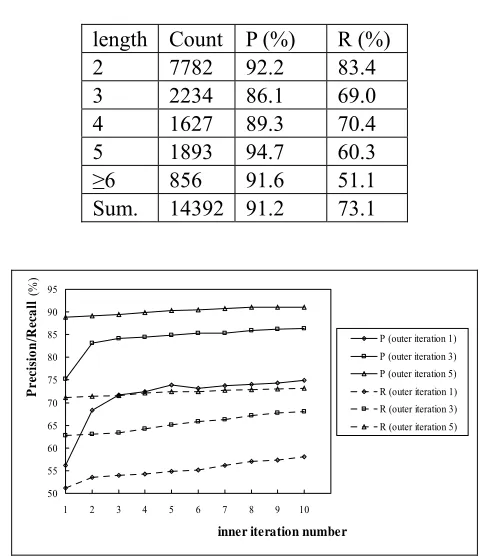
[image:5.612.67.299.365.693.2]We set the inner iteration to 10 times and the outer iteration to 5 times. When completing the HIO operations, we randomly select 2000 sentences from this corpus. After filtering out many common words such as auxiliary words, adjectives and adverbs, we get many concept words which have higher precision and recall rates as listed in Table 2.
Table 2. The Experimental Result
length Count P (%) R (%)
2 7782 92.2 83.4
3 2234 86.1 69.0
4 1627 89.3 70.4
5 1893 94.7 60.3
≥6 856 91.6 51.1
Sum. 14392 91.2 73.1
50 55 60 65 70 75 80 85 90 95
1 2 3 4 5 6 7 8 9 10
inner iteration number
P
re
cisio
n
/R
ec
a
ll
(%
)
P (outer iteration 1) P (outer iteration 3) P (outer iteration 5) R (outer iteration 1) R (outer iteration 3) R (outer iteration 5)
Fig. 4. The Precision and Recall w.r.t. the Inner and Outer Iteration
[image:5.612.307.548.373.651.2]Fig. 4 shows the effect of the inner and outer iteration on the precision and recall rate of concept word acquisition. It is observed that the precision and recall rate are both increased with the increase of iteration times.
There are two types of errors produced in HIO: commission error and omission error (Yang and Li, 2004). A commission error is that an acquired term is actually not a concept word, but the HIO considers it as a concept word. The reason is that every component of this term is common words and often occurs simultaneously. An omission error is that the HIO misses a concept word in the corpus. The reason is that one component of this word is more commonly used than the rest and the statistical feature of their combination is not prominent. However, the error distribution we get is contrary to the result of Yang and Li (2004). The number of omission errors exceeds that of commission errors, especially in tri-gram concept word.
4. Conclusions and Future Work
This paper proposes a hierarchical inner and outer iteration method (HIO) for concept word acquisition. It can deal with the problem of over-segmentation, over-combination and data sparseness produced in the process of acquisition. Its prominent features involve:
(1) The HIO method is the combination of the inner and outer iteration, which can increase the precision and recall rate of concept words acquisition simultaneously.
(2) Concept word generation and validation are uniform and consistent in the HIO method. (3) The EM-CLS algorithm can classify candidate
terms as well as estimate their probability distribution.
(4) The Viterbi-C/S can perform segmenting and combining operations on terms while segmenting corpus.
(5) HIO uses Katz smoothing to lessen data sparseness effect on concept word acquisition. Now we are going on a series of research on knowledge acquisition from text. The acquired knowledge types include concepts and their relations. Concept word acquisition is fundamental, which can provide essential support for other work in KAT research. We are also developing methods for acquiring relations, including isa, part-of and co-title.
Acknowledgement
This work is supported by the Natural Science Foundation (grant no. 60273019 and 60496326), and the National 973 Programme (grant no. 2003CB317008).
References
Christopher C. Yang and K.W. Li. 2003. Segmenting Chinese Unknown Words by Heuristic Method,
ICADL 2003, LNCS 2911, pp 510–520
Christopher C. Yang and K.W. Li. 2004. Error Analysis of Chinese Text Segmentation using Statistical Approach. Proceedings of 2004 Joint ACM/IEEE Conference on Digital Library (JCDL’ 04), Tucson, Arizona, USA, pp256-257
Cungen Cao and Yuefei Sui. 2003. Constructing Ontology and Knowledge Bases from Text. 20th
International Conference on Computer Processing
of Oriental Languages, Shenyang, China, pp
34-42
Detlef Prescher. 2003. A Tutorial on the Expectation-Maximization Algorithm Including Maximum-Likelihood Estimation and EM Training of Probabilistic Context-Free Grammars, Presented at the 15th European Summer School in Logic, Language and Information (ESSLLI 2003), Vienna, Austria, August 18-29, 2003
Didier Bourigault and Christian Jacquemin. 1999. TERM EXTRACTION + TERM CLUSTERING: An Integrated Platform for Computer-Aided Terminology. Proceedings of EACL '99, pp. 15-22 Fuchun Peng and Dale Schuurmans. 2001
Self-supervised Chinese Word Segmentation. In Advances in Intelligent Data Analysis
(Proceedings of IDA-01), pp 238-247
Goodman, J. T. 2001. A Bit of Progress in Language Modeling. Computer Speech and Language, 2001 (10), pp 403-434
Guhong Fu and K.K Luke. 2003. A two-stage statistical word segmentation system for Chinese,
Second SIGHAN Workshop on Chinese Language
Processing, Sapporo, Japan, pp. 156-159
Haodi Feng, Kang Chen, Xiaotie Deng, Weimin Zheng. 2004. Accessor Variety Criteria for Chinese Word Extraction, Computational Linguistics, 30 (1), pp. 75-93
Jing-Shin Chang and Keh-Yih Su. 1997. An Unsupervised Iterative Method for Chinese New Lexicon Extraction, Computational Linguistics
and Chinese Language Processing, 2 (2), pp
97-148
Keh-Jiann Chen and Ming-Hong Bai. 1998. Unknown word detection for Chinese by a corpus-based learning method, International Journal of Computational Linguistics and Chinese
Language Processing, 3(1):27–44
Speech Recognition. Proceedings of the IEEE, 77 (2), pp 257-286
Liu Qun, Zhang Huaping, Yu HongKui, and Cheng Xueqi. 2004. Chinese Lexical Analysis Using Cascaded Hidden Markov Model, Journal of
Computer Research and Development, 41(8), pp.
1421-1429
Maedche. 2002. Ontology Learning for the Semantic Web. Kluwer Academic Publishers
Mário A. T, Figueiredo. 2004. Lecture Notes on the
EM Algorithm, http://www.lx.it.pt/~mtf/learning/aboutEM.pdf
Nagao, M and Mori,S. 1994. A New Method of N-gram Statistics for Large Number of N and Automatic Extraction of Words and Phrases from Large Text Data of Japanese. COLING-94
Sproat, R. and Shih, C. 1990. A Statistical Method for Finding Word Boundaries in Chinese Text,
Computer Processing of Chinese and Oriental
Languages, 1990 (4), pp.336–351
Tung, Cheng-Huang and Hsi-Jian Lee. 1994. Identification of Unknown Words from a Corpus,
Computer Processing of Chinese and Oriental
Languages, Vol. 8, pp. 131-145
Yusheng Lai and ChungHsien Wu. 2000. Unknown Word and Phrase Extraction Using a Phrase-Like-Unit-Based Likelihood Ratio.
International Journal of Computer Processing of
Oriental Languages, 13 (1), pp 83–95
Yu-sheng Lai and Chung-hsien Wu. 2002. Meaningful Term Extraction and Discriminative Term Selection in Text Categorization via Unknown-Word Methodology. ACM Transactions
on Asian Language Information Processing, Vol. 1,
No. 1, March 2002, pp 34-64
Zhang Le, Lv Xue-qiang, Shen Yan-na and Yao Tian-shun. A Statistical Approach to Extract Chinese Chunk Candidates from Large Corpora.