Effect of Submerged ARC Welding Process
Parameters on Micro-Hardness of IS 2062 Grade-B
Steel
Amrut G. Yadav1, Vinayak S. Powar2,Prasad S. Patil3, Amol U. Shirsat4
1,2,3,4
Department of Mechanical Engineering, YBP, Sawantwadi
Abstract: Submerged arc welding (SAW) is one of the oldest automatic welding processes used to provide high quality of weld. The quality of weld in SAW is mainly influenced by independent variables such as welding current, arc voltage and welding
speed. The prediction of process parameters involved in SAW is very complex process. Researchers attempted to predict the process parameters of SAW to get smooth quality of weld. The aim of the present work was to study the effect of various process parameters i.e. current, voltage and travel speed on changes in micro-hardness of the weld bead geometry of IS 2062 Grade B Steel and to optimize the process so that minimal changes occur in the material properties after completion of a submerged arc welding (SAW) process following suitable Taguchi experimental design and multiple regression analysis. Also study is carried out on change in micro-hardness in different zones of weld. In this paper, experiments have been conducted using welding current, arc voltage and welding speed as input process parameters for evaluating multiple responses on micro hardness of weld. Keywords: Submerged Arc Welding, IS 2062, Orthogonal Array, Taguchi, micro-hardness.
I. INTRODUCTION
Welding is a process of joining different materials. It is more economical and is a much faster process compared to both casting and riveting. In industries and research organizations, most widely used welding methods are shield metal arc welding (SMAW), gas metal arc welding (GMAW), gas tungsten arc welding (GTAW), and submerged arc welding (SAW). SAW process is one of the oldest automatic welding processes introduced in 1930s to provide high quality of weld. This process gets its name from the fact that the welding arc, between the ends of a copper-coated bare wire electrode and the work, is actually submerged under a layer of granular fusible flux, which blankets the molten weld metal and the base metal near the joint, and protects the molten weld metal from atmospheric contamination. [3]
[image:2.612.170.475.542.720.2]Submerged arc welding process is most widely used in heavy duty work. Popular areas of application are as ship building, thick structural work, power system, joining of pipe, nuclear and chemical industries, food processing as well as petroleum industries. A strong weld is a must which should be resistant to corrosion, hydrogen induced cracking as well as fatigue failure in all above type of industries. In SAW quality of weld depends upon the selection of welding process parameter along with wire and flux composition along with welding process parameter. [8]
ISSN: 2321-9653; IC Value: 45.98; SJ Impact Factor:6.887 Volume 5 Issue XI November 2017- Available at www.ijraset.com
Quality of welded joint is judged by the weld bead geometry and also the mechanical properties, i.e., weld quality are strongly characterized by the weld bead geometry, which plays an important role in influencing the mechanical properties of welded joints. The quality of weld in SAW is mainly influenced by independent variables such as welding current, arc voltage, welding speed, and electrode stick out. The prediction of process parameters involved in SAW is very complex process. Figure 1 shows the SAW machine setup [3]
Is 2062 Steel is a type of alloy steel that provides better mechanical properties or greater resistance to corrosion than carbon steel. IS 2062 steels vary from other steels in that they aren't made to meet a specific chemical composition, but rather to specific mechanical properties. They have carbon content between 0.15–0.24% to retain formability and weldability. Other alloying elements include up to 1.50% manganese and small quantities of silicon, sulphur, phosphorous, copper, nickel, niobium, vanadium, chromium, molybdenum, titanium, calcium, rare earth elements, or zirconium.
This work focused mainly on the broad area of evaluating the change in micro-hardness that occurred in the weld metal steels after submerged arc welding and change in micro hardness with change in different zones of weld such as fusion zone.
II.PRESENT THEORIES AND PRACTICES
The literature survey shows some research-oriented work on the submerged arc welding out of which the important works are presented below which are in the direction of present work.
Nizamdost et al. discussed numerical and experimental investigation to understand and improve computer methods in application of the Goldak model for predicting thermal distribution in submerged arc welding (SAW) of APIX65 steel. Goldak heat source distribution model for SAW is presented. Both 2D and 3D finite element models are developed using the solution of heat transfer equations in ABAQUS Standard implicit.
Rao et al. worked on Cr-Mo-V steel. Complete experimental analysis is carried out by author on the submerged arc welding of Cr– Mo–V steel. The important input process parameters considered are welding current, voltage, welding speed, and wire feed. The effect of these input parameters is studied on various responses related to weld bead geometry and few mechanical properties. Gowthaman et al. presents paper based on Taguchi technique and regression analysis to determine the optimal process parameters for submerged arc welding (SAW). The planned experiments are conducted in the semiautomatic submerged arc welding machine and the signal-to-noise ratios are computed to determine the optimum parameters. The percentage contribution of each factor is validated by analysis of variance (ANOVA) technique. They worked on optimization of overall welding quality such as weld bead width, weld reinforcement and depth of penetration.
Lijun et al. gives information about influences of Mn and Ni contents on the impact toughness and microstructure in the weld metals of high strength low alloy steels. The objective of paper was to determine the optimum composition ranges of Mn and Ni to develop welding consumables with better resistance to cold cracking. The results indicated that Mn and Ni had considerable effect on the microstructure of weld metal, and both Mn and Ni promoted acicular ferrite at the expense of proeutectoid ferrite and ferrite side plates. Varying Ni content influenced the Charpy impact energy, the extent of which depended on Mn content.
Kumar et al. optimizes impact strength and hardness using taguchi method. Effect of each flux alloying elements was evaluaed for Vickers hardness and impact strength of the weld. This paper shows that that MnO and MgO plays major role in deciding VHN of the weld. Similarly for impact strength MnO and MgO has played a deciding role for impact strength with NiO less effective. Along with flux alloying constituents, voltage was chosen as a noise factor in the experiment, during the experimental design. Impact strength has shown a clear decrement in the value with increase of voltage. Lan et al. studied on microstructural changes submerged arc welded joint of high strength low carbon bainitic steel. He concludes that the welded joint has various microstructures such as acicular ferrite, coarse granular ferrite and fine polygonal ferrite. The base material microstructure has predominantly acicular ferrite after subjected to multi-pass submerged arc welding process. While the HAZ microstructure changes from coarse lath granular bainite to fine polygonal ferrite then to a mixture of original lath bainite and newly formed martensite with the distance far away from the fusion line. Liangyun et al. studied effect of submerged arc welding on microstructural aspects and impact toughness of submerged arc welded HSLA joints. Welded joint strength and hardness are decreased with the increase in heat input. For impact toughness, the WM keeps good toughness and the main mode of fracture is ductile fracture at any a heat input condition, which is mainly attributed to predominantly acicular ferrite formed.
III. DESIGN OF EXPERIMENT AND EXPERIMENTATION
steel plate of dimension 160 x 50 x 12 mm was used as a work material. The experiments have been conducted on Submerged Arc Welding Machine i.e. ESAB Auto weld major (LW) (S), CPRA 800 welding tractor (Make: ESAB INDIA LTD.) available at Advanced Welding Laboratory, RIT Rajaramnagar.
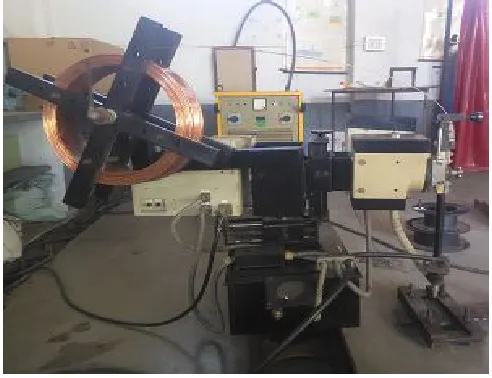
Fig. 2 Submerged Arc Welding Machine
(Courtesy: Advanced welding laboratory, RIT, Rajaramnagar)
[image:4.612.190.436.119.308.2]SAW machine used for the experiments is shown in the Figure No. 2. The main parts of the machine are control box panel, electrode wire, wire spool and flux hopper. Main technical parameters of machine is listed in table 1.The welding current, welding voltage and welding speed can be regulated, displayed and preset on the panel of the tractor for the convenience of the operator. The function of inch wire feeding and withdrawing makes it convenient for the welder to preset the operating position of the welding wire. Control is provided on the machine for the movement of the tractor on the platform. The movement can be manual or can be automatic. There is also welding head site adjustment function it make the gun move horizontally and vertically.
Table I
Main technical parameters of welding tractor Travel speed: 0-150 cm/min
Wire feeding rate:- 50-450 cm/min
Wire diameter range:- 2.4-5.00 mm
A. Selection of Contributing Factors that Affect Welding
The determination of contributing factors which needs to be investigated depends on the responses of interest. Pilot study was carried out to identify the factors that affect the responses. There are three factors to be identified through pilot study that affect the weld characteristics in HAZ of work piece. These are -
1) Welding current
2) Voltage
3) Speed of arc travel
According to the pilot experimentation and literature survey submerged arc welding of metal 12 mm thickness, optimum result will be achieved when welding current varied in between 480-560 Ampere, welding voltage varied in between 28-32 Volt, speed of arc travel varied in between 400-550 mm/min.
ISSN: 2321-9653; IC Value: 45.98; SJ Impact Factor:6.887 Volume 5 Issue XI November 2017- Available at www.ijraset.com
[image:5.612.85.527.527.729.2]Table II
List of input parameters and levels
Sr. No. Contributin
g Factors
Units Lev. 1 Lev. 2 Lev. 3
1 Welding
current
A 480 520 560
2 Voltage V 28 30 32
3 Speed of
arc travel
mm/m 400 475 550
The study is carried out by using available flux i. e. an agglomerated Flux Manufactured by ESAB INDIA LTD.
A. Selection of Orthogonal Array and Factor Assignment
In this experimental study, three factors were varied to three levels each. The degree of freedom (DOF) to a three level parameter is 2 (because DOF= number of levels-1), hence total DOF for the experiment is 06. So the Orthogonal Array (OA) which could be used was L9. Degree of freedom allocated to various factors is given in Table 3. [7]
[image:5.612.81.530.527.728.2]DOF allocated to various factor combinations
Table III
List of Input parameters and Degree of Freedom
Serial No. Parameter Units DOF
1 Welding current Ampere 2
2 Voltage Volt 2
3 Speed of arc travel m/hr 2
B. Experimental Set Up
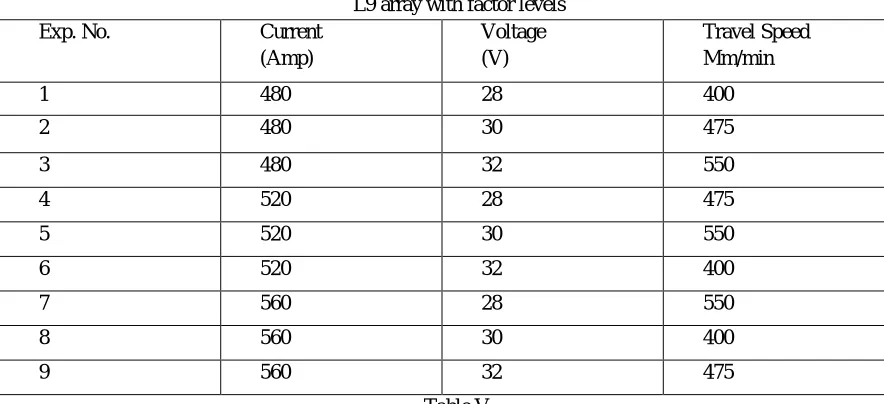
As stated earlier Taguchi L9 array has been selected for the experimentation. The experimental design was completed using the Taguchi’s fractional factorial experiments (FFEs). Welding current, Voltage, Speed of arc travel speed has been chosen as the factors of interest. L9 array with actual factors level is shown in Table 4. Analysis of material is carried out using spectro machine. Two samples used for analysis. Result of chemical composition is listed in table 5.
Table IV
L9 array with factor levels
Exp. No. Current
(Amp)
Voltage (V)
Travel Speed Mm/min
1 480 28 400
2 480 30 475
3 480 32 550
4 520 28 475
5 520 30 550
6 520 32 400
7 560 28 550
8 560 30 400
9 560 32 475
Chemical Composition of Base Metal
C Mn P S Si Cu Fe
0.21 0.25 0.021 0.027 0.37 0.003 97.85
Chemical composition of base metal plate is analyzed using spectro machine and it is compared with standard chemical composition of IS 2062 Grade B steel. It is found that chemical composition of base metal is almost same with IS 2062 grade B steel.
C. Cutting of Steel Plates
The steel plates available for the study were of size 1000x 200 x 12 mm. These were firstly cut in to strip of size 1000 x 160 x 12 mm through oxy-acetylene gas. Then these steel strips were cut to the required size of 160 x 50 x 12 mm with the help of semiautomatic metal cutting machine.
D. Method of Preparation of Steel Plate Specimen and Welding of Plates
In this study L9 was chosen as the preferred array, 24 plates were cut to size of dimension 160 x 50 x 12 mm for experiment because two plates were required for welding in each trial. Edge preparation was completed on each of the 24 plates as per the requirement of 9 trial condition given by taguchi orthogonal array. The edge preparation of 60o was made on 160 mm side.
After tacking using arc welding, the plates were welded by SAW. Plates were placed under the electrode for welding and clamped with base plate using Fixture. The welding was completed on each part as shown in Figure No. 4, 5.
Fig. 3 Mounting of plate in fixture Fig. 4 SAW Welding
IV. MEASUREMENT OF MICRO-HARDNESS
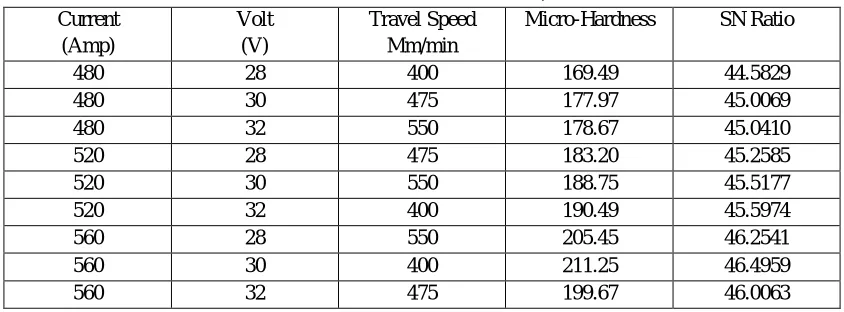
[image:6.612.95.517.563.719.2]One measurement for each run was made for Micro-Hardness. The observed values of the responses are given in Table 6. The characteristics values are selected by Micro-Hardness. Since a good result is obtained by the higher Micro-Hardness hence higher is better S/N ratio is selected for S/N ratio.
Table VI
Result of Micro-hardness with S/N ratio Current
(Amp)
Volt (V)
Travel Speed Mm/min
Micro-Hardness SN Ratio
480 28 400 169.49 44.5829
480 30 475 177.97 45.0069
480 32 550 178.67 45.0410
520 28 475 183.20 45.2585
520 30 550 188.75 45.5177
520 32 400 190.49 45.5974
560 28 550 205.45 46.2541
560 30 400 211.25 46.4959
ISSN: 2321-9653; IC Value: 45.98; SJ Impact Factor:6.887 Volume 5 Issue XI November 2017- Available at www.ijraset.com
A. ANOVA for Micro-hardness
The results of micro hardness are shown in table no. 7. The table consists of values of microhardness for the nine trials. ANOVA table for means is given in table 7. ANOVA table indicates that p value for current is at minimum level when microhardness taken as response. P value for current is 0.038, which is lesser than 0.05. F value for current is also at maximum level, which indicates that is a significant factor contributing to the response, which includes the ranks of contributing factors. In the present study current is most significant factor. Main effect plot showing the variation in the microhardness with change in input factors have been shown table. It is clear from table that microhardness almost linearly with increase in current. Main effect plot showing the variation in the microhardness with change in input factors have been shown in table no 7.
Table VII
ANOVA for Micro-hardness
Source DF Seq. SS Adj. SS Adj. MS F-Value P-Value Contribution
Current 2 1374.46 1374.46 687.23 25.35 0.038 90.26%
Voltage 2 65.67 65.67 32.84 1.21 0.452 4.31%
Speed 2 28.37 28.37 14.19 0.52 0.656 1.86%
Error Error 2 54.22 54.22 27.11 0.1%
Total 8 1522.72
B. Analysis of S/N Ratio for Micro-Hardness
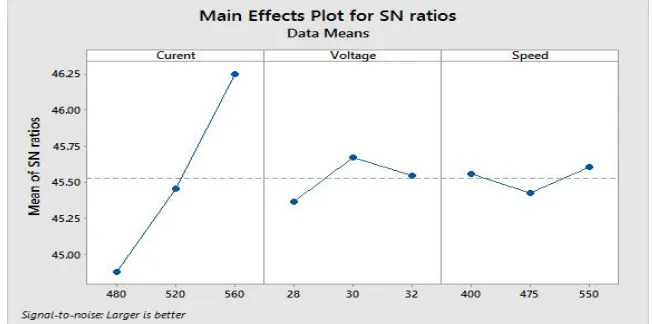
[image:7.612.85.527.429.513.2]Lower Micro-hardness is an undesirable property of weld bed joint, because it does not provide strength to the weld joint. So, higher the better option is chosen for signal to noise ratio calculations. Table shows the response table for S/N ratio. Main effect plots are shown in table 8 and graph 1.
Table VIII
Analysis of S/N Ratio for Micro-Hardness
Level Current Voltage Speed
1 44.88 45.37 45.56
2 45.46 45.67 45.42
3 46.25 45.55 45.60
Delta 1.38 0.31 0.18
Rank 1 2 3
[image:7.612.160.486.555.717.2]From Table optimal parameters setting for higher micro-hardness is at 560 A current, 30 V Voltage and 475 mm/min speed. Figure 5 shows main effect plot for SN ratio.
C. Regression analysis for Micro-hardness
Regression analysis is done to establish the relationship between two variables. Regression analysis indicates the relationship among the dependent variable and independent variables. Value of dependent variable can be predicted only by putting the desired value of independent variable of regression equation. Regression analysis has been done using statistical software MINITAB-16.
The Regression equation is
Micro hardness = -34.5 + 0.3760 Current + 0.89 Voltage + 0.0036 Speed
D. Change in micro hardness with change in zones
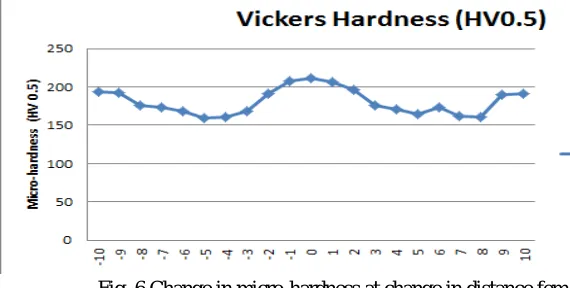
[image:8.612.128.413.235.379.2]Change in micro-hardness with change in length from center of weld zone is shown in figure no. 6. Micro hardness of base material is 190 HV; it decreases at heat affected zone and at maximum level in fusion zone. It also shows that micro-hardness in heat affected zone is at minimum level as compared to base material and fusion zone. Also fusion zone have maximum hardness as compared to base material because of course structure of microstructure in fusion zone.
Fig. 6 Change in micro-hardness at change in distance fem center of weld
V. CONCLUSIONS
Microhardness measurement was taken at the weld pool interface. Four readings at different location were taken and analysis was done at the weld center. After experimentation, it is found that micro hardness increases in fusion zone as compared to the base material but decreases in heat affected zone. Micro hardness of base material is 190 HV 0.5 which decreases to 160 HV0.5 in heat affected zone and increases up to 230 HV 0.5 in fusion zone. The increase in microhardness at the welding interface is generally due to oxidation processes which took place during welding processes. The microhardness would be optimum at 560 A current, 30A voltage and 475 mm/min speed.
REFERENCES
[1] Kumar, S. Maheshwari and K. Sharma, “Optimization of Vickers Hardness and Impact Strength of Silica based Fluxes for Submerged Arc Welding by
Taguchi method” Elsevier: 4th International Conference on Materials Processing and Characterization, Vol. 2, pp. 1092-110
[2] A. Saha and S. Chandra, “Optimization of Process Parameters in Submerged Arc Welding Using Multi-objectives Taguchi Method”, Springer: Advances in
Material Forming and Joining, vol. 11, pp. 221-232, Dec 2016
[3] J. Lau, Y. Dong, L. Longfei and W. Xiaoming, “Microstructure of 2205 duplex stainless steel joint in submerged arc welding by post weld heat treatment’’
Elsevier: Journal of Manufacturing Processes Vol. 16, pp. 144-148, Feb. 2014
[4] K. Gowthaman, J. Saiganesh, and C. Rajamanikam, “Determination of submerged arc Welding process parameters using Taguchi Method and Regression
analysis”, IEEE, pp. 842-847, March 2013
[5] L. Lan, X. Kong, C. Qiu, and D. Zhao, “Influence of microstructural aspects on impact toughness of multi-pass submerged arc welded HSLA steel joints”,
Materials and Design, Vol. 90 pp. 488-498, Feb. 2016
[6] L. Lan, Q. Chunlin and Z. Dewen, “Analysis of microstructural variation and mechanical behaviours in submerged arc welded joint of high strength low carbon bainitic steel’’, Elsevier: Materials Science & Engineering, Vol. 558, pp. 592-601, March 2016
[7] M. Nezamdost, M. Nekouie, S. Hashemi and S. Mirbozorgi, “Investigation of temperature and residual stresses field of submerged arc welding by finite element method and experiments’’ Springer: International Journal of Advanced Manufacturing and Technology, Vol: 25, pp: 90-96 Jan. 201
[8] R. Rao and V. Kalyankar, “Experimental investigation on submerged arc welding of Cr–Mo–V steel”, Springer: International Journal of Advanced
Manufacturing and Technology, Vol.: 69, pp. 93-106, May 2016
[9] S. Kahraman, S. Sule and K. Erdinc, “Influence of the interpass temperature on t8/5 and the mechanical properties of submerged arc welded pipe’’ Elsevier:
Journal of Materials Processing Technology, Vol. 238, pp. 152-159, June 2016
[10] Y. Ligun, W. Huichao, and Z. Zhi, “Effect of Mn and Ni on Microstructure and Impact Toughness of Submerged Arc Weld Metals”, Springer, Vol. 21, pp.
![Fig. 1 SAW Machine Setup [8]](https://thumb-us.123doks.com/thumbv2/123dok_us/8303566.855257/2.612.170.475.542.720/fig-saw-machine-setup.webp)