http://dx.doi.org/10.4236/ica.2015.64026
Interface for Intelligence Computing Design
and Option of Technical Systems
Javanshir Mammadov, Tarana Tagiyeva, Akhmedova Sveta, Aliyeva Arzu
Department of “Information Technology and Programming” of Sumgait State University, Sumqayit, Azerbaijan
Received 14 September 2015; accepted 21 November 2015; published 24 November 2015
Copyright © 2015 by authors and Scientific Research Publishing Inc.
This work is licensed under the Creative Commons Attribution International License (CC BY). http://creativecommons.org/licenses/by/4.0/
Abstract
As a result of analysis of the existent methods and tools of computer aided design of the technical systems of many industrial areas, the primary purpose of the article that consists in the decision of different project problems within the framework of one programmatic system with the use of comfortable programmatic interface is certain. Architecture of the program interface for comput-er designing and option of technical systems of diffcomput-erent industrial areas on the basis of stage-by- stage automated designing principles with using programmatic and informative supports is worked out. In the article, the problem of computer designing, searching and option of elements of mani-pulator for flexible manufacture module is considered. As a method of logical simulation of the problem, production model of designing procedures of the program interface and intelligence op-tion of a manipulator, its technical parameters are developed. On the basis of algorithmic scheme of searching, the option of a manipulator from data base is worked out.
Keywords
Computer-Aided Design, Design Stages, Production Model, Programmatic Interface
1. Introduction
In this connection, decision of problem on development of the intelligence programmatic system of computer- aided design, providing complex approach of realization of the automated procedures and operations on the ba-sic stages of planning from the scientific point of view is an actual and priority problem and direction.
Being base on principles of universality, openness and planning flexibility, as a primary purpose of project is offered software for a complex computer-aided design, where up basis the structure of the stages of planning of the technical systems, programmatic procedures and executive directives, and also interface, takes with the pro-grammatic modules of the database management system, by CAD of circulation of documents, processing of documents, subsystem of computer experiments, system of automation of mathematical calculations and in-plant, global computer system, computer graphics and multimedia.
2. Solution of the Problem
The primary purpose of the project is development of the single intellectually-operating system of designer for complex computer-aided of technical objects of the different setting design. Scheme of interface of the intellec-tually-operating system of designer (IOSD) of the complex designing is offered with the following blocks of menu:
1) Designing stages; 2) Project programs;
3) Programmatic-operating functions.
Work of IOSD is based on stage-by-stage approach since the entry of basic data and application of planning object domain to creation of detail design. IOSD allows controlling the universal programmatic interface on the basis of intellectually-operating functions of complex computer-aided of the technical systems of the different setting design.
In a depended on analyze of progressive status of CAD the following research problems have to solve: 1) Development of the common scheme of computing design with program interface;
2) Development of first panel of “Designing stages” with its menus and program operations; 3) Development of second panel of “Project programs” with its menus and program objects;
4) Development of third panel of “Programmatic-operating functions” with its menus and service operations; 5) Providing cooperation of the system with program functions of a corporate network;
6) Program control of design information of the IOSD on the level of technical provide.
The programmatic package of interface for a complex computer-aided of technical objects design is devel-oped on the base of instrumental programmable environment of Delphi; procedures of logical search and choice of information on the stage of technical suggestion developed on the base of intellectual programmable envi-ronment of Prolog and database management systems, control system of base of the designed data; procedures of engineering design will be realized on the basis of the prepared designer and technological programmatic tool of AutoCAD [5].
The basic idea of project consists in the decision of different project tasks within the framework of one pro-grammatic system with the use of comfortable propro-grammatic interface.
2.1. Architecture of Programmatic Interface for Computer Designing Procedures
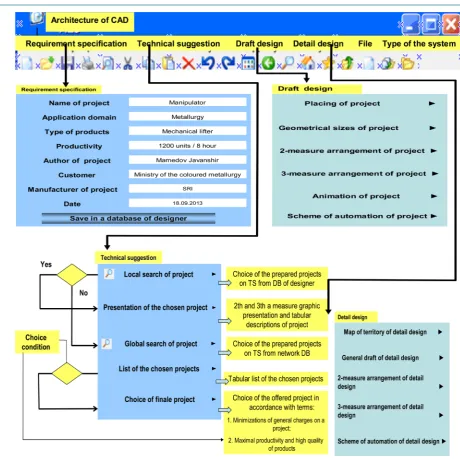
As it is generally known, great number of technical objects of planning, for development of that required appli-cation CAD on the stages of planning exist. In accordance with the stages of planning, the commands of system menu and types of the special programmatic systems are developed the architecture of programmatic interface with the automated procedures on design stages (Figure 1).
On the first stage project procedure of requirement specification will be realized where a standard template is filled depending on an application of technical object domain. The entered data are saved to the database of us-er-designer. For example, on the special system window design object area, a type of design element, characte-ristics of the design element and other parameters are chosen. After inputting all design data they are saved in the system base [6].
On the second stage project procedure of technical suggestion will be realized, where the problems of local (in the database of user-designer) and global search decide.
Figure 1. The architecture of programmatic interface with the programmatic procedures on design stages.
comes true in accordance with terms: applications of innovative technologies; to the high yield; producing qual-ity of products; providing reliable automation of planning object; to minimization of material charges and other. On the third stage procedure of the preliminary planning technical object will be realized. The basic project operations are drafts in two and three projections and 2 and 3-measure images (axonometric presentation of draft) and registration of these (specification and angular stamp of draft) these drafts, animation presentation, and also scheme of automation of planning object [7].
On the fourth stage of the working planning through a menu of final technical documentations get out accor-dingly for unsealing [8]. On the basis of documentations of detail design of technical objects are practically de-veloped in accordance with productive terms of the design object.
2.2. Production Procedures of Program Interface of Designing
design of manipulator of the flexible manufacture module (as shown in requirement specification) will designate as subsystems: Pos—a subsystem of the programmatic-operating system providing functioning of open complex subsystem of computing design of manipulator; Pi—a subsystem of interface including set of menu for activa-tion of commands, corresponding to the blocks of subsystem of computing design of manipulator and auxiliary subsystems providing flexibility on the whole; Pap_i (where i=1, 5)—a subsystem of computing design of manipulator; (Pap_1—a block of computing design of composes structure of manipulator; Pap_2—a block of standard active elements of manipulator; Pap_3—a block of computing design of automation scheme of mani-pulator; Pap_4—a block of computing design of technical control and diagnostic system of manipulator; Pap_5—a block of computing design of non standard elements of manipulator); Psp_i (where i=1, 3)—a sub-system of special packets of the applied software and programming-language sub-systems (Psp_1—a block of con-structor packets on the base of T-FLEX CAD; Psp_2—a block of packets of the applied software for creation of data base and control system of data base; Psp_3—a block of the mathematical packets of the applied software on the base of MathCAD; Psp_4—a block of the applied software on the base of Delphi; Psp_5—a block of the intel-ligence software on the base of PROLOG;); Pbdz_i (where i=1, 4)—a subsystem of data base and knowledge
(Pbdz_1—a block of data base; Pbdz_2—a block of knowledge base); Parm_i –(where i=1, 4)—a subsystem of
al-gorithmically calculation and simulation (Parm_1—a block of algorithmically calculation; Parm_2—a block of si-mulation); Ppv—a subsystem of searching and option; Pqs—a subsystem of global computer network; Pto—a
subsystem of technical support with periphery units of design document printing and connection with Internet. The program operations of interface of computing design of manipulator and its option works are executed as follows:
1) After plugging (t1) of the operating system Pos in the subsystem of hardware of Pto, through a main menu
shell program of the same name of the complex subsystem is opened;
2) Designer using the subsystem of interface of Pi, which works after including ( 1 2
t ), opens the library of subsystem of computer design of Pap_i with the before worked out prepared composes structures, scheme of
au-tomation of every manipulator on the whole, and also data base of these standard active elements of Pap_2 and if necessary edits this file and saves the edited information in computer memory.
3) By means of command ( 2 2
t ) a designer creates files with new developments of layout chart corresponding to the scheme of automation in the subsystem of computer design of composes structure of Pap_1 and scheme of automation of Pap_3 and technical control and diagnostically of manipulator design in the subsystem of computer design of the technical checking and diagnostically of Pap_4, kinematics scheme and construction draft of gripper devices, special manipulators in the subsystem of computer design of non-standard active elements of manipu-lator Pap_5.
On the 3rd stage in the process of new file, subsystem of Pap_1 creation, Pap_2, Pap_3, Pap_4, Pap_5 co-operate with the subsystem of the special application packages and programmatic-language system Psp_1, Psp_2. Thus subsys-tems of Pap_1, Pap_3, Pap_4, Pap_5 co-operate also with the subsystem of algorithmic calculations and design of Par,
Pam. For this purpose in a control of open complex subsystem of computing designing of manipulator panel
commands get ( 3 2
t ) out for drawing of composes scheme or calculation of parameters of non-standard elements and design of scheme of automation of manipulator.
4) On this stage for the wearing-out (t3) of subsystem of search and choice of Ppv of composes structures,
ac-tive elements the commands of subsystem of database of Pbdz_1 and knowledge of Pbdz_2 get out on the basis of terms-queries. At the choice of database the software environment of the system Microsoft Access is opened and a query is set for a search and choice of the prepared types of active elements with their specifications. At the choice of files of base of knowledge the intellectual programmatic system PROLOG (subsystem of Psp_5) is opened where a query is set for a search and choice of elements of control system, worked out non-standard ac-tive elements, composes structures and scheme of automation of manipulator on the basis of algorithms of cal-culation. In case of search of the prepared composes structures of manipulator with standard elements the com-mand of the network including (Pqs-subsystem of global computer network) gets out from menu of search. Thus
choosing the certificate menu (t4) of subsystem of global computer network of Pqs it is possible to get additional
information about open system of the computer designing of manipulator.
2.3. Procedures of Option of Manipulator on a Stage of the Technical Suggestion of the Program Interface of Designing
workstation is worked out. A query for option of a project includes the variants of basic data of the requirement specification, which were before saved in DB1. In accordance with the expressions from the basic data and tech-nical parameters of a manipulator for more exact option, the following function is given: f1, ,f2 , fn are
con-stituents of the function: force of clamping of manipulator F, its geometrical sizes.
Taking into account the values of mass of the manipulated object of mij and predominance of mass of the
ma-nipulator of mgij from mij (coefficients taking into account mass of gripper of cg and taking into account the type
of drive of manipulator (Mi) of cd) by means of the following terms, the manipulator gets out with the required
carrying capacity (Ci):
If
(
[ ]
mi1 ⇒Mi ∪(
Ci =m c ci1 g d)
)
(where mi1→ cg = 1.4 ∧ cd = 1.1 for hydraulic motor),
Then (on the basis of characteristic parameters from a database, the search of the required type of Mi is
rea-lized).
Thus, the following condition of limitation is taken into account:
max,
i
C ≤C
where Cmax—maximal value of carrying capacity of Mi, that gets out from a database. Accordingly depending on
their carrying capacity, type and construction parameters of Mi is got out. Maximal tension in the cross runner of
the manipulated object allows to choose a drive for manipulator. Setting the following condition
If
(
σmo ≤[ ]
sи)
,Then (from the database of the standard drives of gripper of Mi, the most nearby value of forces of clamp of
the manipulated object is got out (F = σmoS), S—area, which exposed to the clamp (mm2)) & ((F – Fst) → min,
where Fст—standard value of clamping Mi).
Summarizing the conclusions of stage-by-stage realization of architecture of interface of the computer de-signing of manipulator and its option it should be noted that taking into account the basic requirements to crea-tion of instrument of the computer design of manipulator, subsystems provide universality, adaptively and flex-ibility of the system at development of manipulator of different areas of metallurgical industry.
The subsystems of the algorithmic, mathematical providing, expert and information retrieval operations used as autonomous blocks provide authenticity, fast-acting and reliability of executable project operations and pro-cedures.
As be obvious from a Figure 1 in a control of computer-aided design panel for creation of new project, open-ing of existent projects, organization of work with the subsystems of architecture of instrument of the computer designing of manipulator is used procedures of programmatic block “File”.
3. Conclusions
The basic results of the article are the following:
1) The worked out architecture of computer design and option of technical systems works by principle of the stage-by-stage designing on the basis of the programmatic interface. It provides the complex decision of plan-ning design operations, since the entry of basic data and application of planplan-ning object domain to creation of detail design [9][10].
2) It was given the logical procedures of production model for designing and option of manipulator which provided operative and flexible designing and searching-option operations on the level of one universal program interface.
3) The programmatic interface has practical application during a computer-aided and option of the technical systems for the different setting design.
The proffered intellectually-operating system of designer will allow in future:
1) To decide the problem of complex computer-aided design and option, since the entry of basic data and ap-plication of planning object domain to creation of detail design;
2) To manage effectively the universal programmatic interface on the basis of intellectually-operating func-tions of complex computer-aided of the technical systems of the different setting design;
lev-el of intlev-ellectuality of this system;
4) To adapt quickly with procedures of the project programs and the operation system;
5) To use the date system in the mode of on-line dialogue with designers for acquisition necessary project in-formation.
References
[1] Bozdoc, M. (2003) The History of CAD.
[2] Cunvu Li Basis CAD of CAD/CAM/CAE. “Peter”, Moscow—Sankt Peterburg, 2004, 560 p.
[3] Voronenco, V.P. (2001) Designing of the Manufacture Systems Is in an Engineer: Studies. Manual. Tiraspol: Rio Psu, 349 p.
[4] Chelishev B.E. (2004) Computer-Aided of Design of Technology in Machine-Building. Electronic Magazine “Science and Education”. Engineering Education of Association of Technical Universities. AL No. FC 77.
[5] Polovincin, A.I. and Bobkov, N.K. (2004) Bush of G.Y. Automation of the Searching Constructing (Artificial Intelli-gence Is in the Machine Constructing). Electronic Journal of “Science and Education”. Engineering Formation of As-sociation of Technical Universities. AL No. FC 77.
[6] Aliyev, R.A., Мammadov, J.F. and Akhmadov, М.А. (2005) Development of Tool of the Automated Planning of Con-trol System of FMS.-М.: Mechatronic, Automation, Management, No. 9, 27-35.
[7] Mammadov J.F. (2002) Problems and Stages of Development of the Automated Choice and Planning of the Flexible Manufacture Systems. The Redaction of Technical Literature “House of Baku University” of Baku, 175 p.
[8] Mamedov, J.F. and Huseynov, A.H. (2011) Algorithmic and Programmatic Providing of the Automated Layout of the Flexible Productive System. In: Design Information Technologies in Planning and Production, Scientific and Technic-al Magazine, Moscow, No. 1, 49-52.
[9] Mamedov J.F. (2013) Development of Structure of Interface of Complex Automated Planning of the Technical Sys-tems Software. Moscow. Announcer of Computer and Informative Technologies, No. 5, 18-21.