(Mis-)Understanding Education
Externalities
Mueller, Normann
University of Tuebingen
November 2007
(Mis-)Understanding Education Externalities
N
ORMANNM
UELLERUniversity of Tuebingen
Chair for Economic History / Tuebingen Graduate School of Economics
Mohlstraße 36
72074 Tuebingen
http://www.uni-tuebingen.de/uni/wwl/mueller/mueller.htm
e-mail: [email protected]
phone: +49-7071-29-72573
ABSTRACT
This article reviews the current state of research on education externalities. It finds that
much of the confusion regarding their magnitude results from conceptual
misunderstandings about their nature. The concepts of 'education', 'teaching', and
'knowledge' need to be distinguished for a better understanding. Whereas pure teaching
yields externalities on the primary and secondary level, only the generation of knowledge
may produce the spillovers which are typically linked to the tertiary level. The
accumulation of education itself does not have such an effect. Education is argued to be a
private good with well defined property rights. Individuals may exploit those and provide
the production sector with the efficient amount of human capital. Following this rationale,
it is demonstrated that empirical studies, contrasting estimates of private and social
returns to education, are unsuitable to substantiate the existence of externalities. As a
consequence, subsidies to tertiary programs are called into question.
JEL Classification: D62, H23, H52, I22, I28, O11, O47
Keywords: Public education finance; Education expenditures; Human capital
externalities; Property rights; Endogenous economic growth; Private and
1. Introduction
The goal of research on education externalities has been stated by Moretti (2003) to
be twofold. "First it should credibly assess the magnitude of spillovers. […] A second
goal should be to empirically investigate the mechanisms that give rise to externalities."
(p.3). It is not last owed to the failure of research to achieve these goals that leads
international governments to follow quite different strategies when it comes to the public
contribution to education finance.1 Even though economists have spent some effort in
quantifying externalities (Heckman and Klenow, 1997; Krueger and Lindahl, 2001;
Gundlach and Woessmann, 2004; Rauch, 1993; Rudd, 2000; Acemoglu and Angrist,
2000; Moretti, 2004; Muravyev, 2006; Ciccone and Peri, 2006), as well as private and
social returns to education (see Harmon, Oosterbeek and Walker, 2003; Sianesi and van
Reenen, 2003), a mutual consent has not yet been achieved. Consequently, there is no
accepted guiding principle pertaining to the optimal scope of public education subsidies.
This is less evident in the case of primary and secondary expenditures, but much more
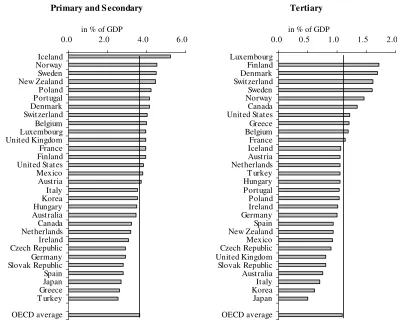
visible when it comes to tertiary spending. Figure 1 depicts international public
expenditures on primary and secondary, respectively tertiary teaching institutions as a
share of GDP. The variation in the right picture is obviously higher. The coefficient of
variance is 18.2 in the case of primary and secondary spending, and 28.5 for tertiary
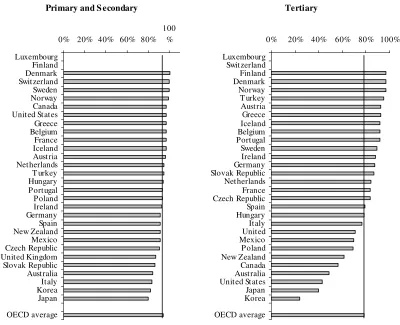
spending. Figure 2 shows public spending as a share of total spending on educational
institutions across OECD countries. The respective coefficients of variation are 6.1 for
primary and secondary spending and 25.2 for tertiary spending.
[Figure 1 about here]
In order to contribute to more unanimity in this matter, it appears vital to first of all
suspend the ongoing quantification efforts for a moment, back-pedal and sum up what has
been achieved so far. This is necessary to make sure that everyone is on the same page
before continuing research. Conversations with fellow researchers have convinced me that
quite a few different perceptions are out there regarding the nature and existence of
education externalities. Not least, my own persistent misunderstandings encouraged me to
make an attempt of bringing more light to the fogginess of the externality debate.
Consequently, this essay critically evaluates the current state of research on
education externalities since their mention by Gary Becker (1964). No other contribution
could be found, which narrows down previous work in a comparably concise manner and
directs attention to the relevant questions, such as: Have we managed to come closer to
the goal of our research? Do we actually understand the mechanisms that give rise to
externalities? And if not, are we actually going where we ought to be going? Are we still
on the right track with our efforts to assess the magnitude of the presumed externalities?
Are our methods suitable after all? Or are we possibly in danger of spending much time
and effort on obsolete analyses? In part, the article may be little more than a summary of
what is written elsewhere in the literature. Nevertheless, in some crucial details it averts
from long-lived thinking! In specific, it suggests that education is a private good with well
defined property rights. Also, it once again emphasizes long-understood facts that have
been repeated many times and are yet largely neglected. More precisely, for the case of
tertiary education it is outlined that not the production of education per se, but its use in
certain production processes, such as idea generation, is what yields externalities. All
together, this article ought to provide an ideal starting point for future investigations in
The essay has the following structure. Section 2 treats the basic concepts of
teaching, education, human capital, and knowledge. It argues that education has the
character of a private good, and it straightens up the common understanding of the
educational production process. Subsequently, section 3 briefly repeats the essence of the
externalities concept and reconsiders the role of potential externalities as the prime, if not
the only, reason for a government to get involved with education finance. In section 4,
potential externalities of education are looked at in greater detail. On the one hand, it
focuses on their nature. The effect of education on economic growth is found to be the
most controversial one. It is closest related to tertiary education. On the other hand, it
contains a summary of the most relevant empirical contributions aimed at assessing the
magnitude of growth externalities. Eventually, a discussion is provided on whether the
latter may be internalized via the labor market (section 5). It is pointed out that the
concept of externalities may well be overemphasized in the context of education. Instead,
idea generation activities yield social benefits, which may indeed remain uncompensated.
Section 6 concludes the paper and makes suggestions for further research.
2. Clarification of concepts: teaching, education, human capital, and knowledge
There has been much contemplation, and also confusion, regarding the issue of what
type of good education actually is. Blaug (1970, p.16-22) argues that it may have
consumption as well as investment characteristics. Also, there is no agreement as to
whether education is a private, public or merit good (e.g. Rosen, 2005, p.70-71). If
undergraduate microeconomic teaching is accepted to reflect the current doctrine, the least
common denominator is that education is not publicly supported because of its potential
public character, but because of its potential externalities (Pyndick and Rubinfeld, 2005,
From my perspective, the challenge to answer these questions arises primarily from
the commingling of two different concepts. On the one hand, one could think of education
as the educational programs provided by public and private educational institutions. I
choose to refer to those as teaching or teaching services. On the other hand education
might refer to the knowledge and skills inherent in a person after completing such a
program of teaching. This is what I will actually call education henceforth. In my
understanding the latter is equivalent to the term human capital as coined by Mincer
(1958), Schultz (1960) and Becker (1964). Both terms will be used interchangeably
throughout the remainder of this work. Of course, there are broader definitions of human
capital. Usually the concept is conceived to include factors such as health and life
expectancy. However, for most macroeconomic applications involving the concept of
human capital, such as growth regressions or growth accounting exercises, it seems more
practicable to think of it solely in terms of education. Health and life expectancy can be
argued to be reflected in the size of the labor force.
Teaching is a service offered for consumption to individuals who decide to get
educated. If it is publicly provided and financed, and every individual has a right to
participate in the programs, it has the character of a public good, being non-excludable
and non-rival. In the case of primary or secondary education, for instance, excludability
does obviously not apply, because schooling is mandatory. Higher education, however, is
partly excludable given the existence of certain entrance requirements, making it at best a
club good. One might argue that teaching is a rival good because a higher demand for
teaching services increases class size and impairs the quality of the provided service. In
the case of university programs, however, this argument is invalid, because the quality of
a lecture does not depend much on the degree of teacher-student interactivity. I am
inclined to reject this view for primary and secondary teaching as well. Empirical research
able to take away from a course (e.g. Hoxby, 2000). Moreover, the service provider is
likely to offer the service to a fixed class size. Of course, in the case of a public provider,
the administration may well have an incentive to reduce the number of teachers per
student to a minimum. So, on average, the number of students in a class may tend to
exceed the optimal size. Nevertheless, a threshold level probably exists beyond which the
loss of teaching efficiency is too high to be tolerable even for a public provider.
Summarizing, depending on its level, teaching is a public, or, at best, a club good. Not per
se, though! Non-excludability is not guaranteed in the case of private provision. Public
provision is what gives it this characteristic.
In order to delimit teaching from education, it is practicable to treat it merely as one
of multiple input factors to the process of personal human capital creation carried out by
each individual student. I refer to the latter as the individual education production
process. In this respect, teaching is just a fairly homogenous production factor in the
production of education. The student's time and effort are additional inputs of this process.
Time is an investment that may be evaluated in terms of foregone income, which could
have been earned on the labor market instead (see Schultz, 1960). Whether the usage of
teaching services reflects consumption or investment is not of importance for the present
analyses. Certainly, Blaug (1970) is right in that it may have both characteristics. In any
case, education is the outcome of this process. Contrary to what is widely believed (e.g.
Rauch, 1993, p.380), it is a private good, for it can obviously not be shared and is
perfectly rival and excludable. Every individual exclusively owns the property rights and
has the ability to sell its personal human capital on the labor market. This is regardless of
whether the teaching input was publicly or privately provided. Completing the production
process analogy, the student may be viewed as the education producer. His/her capability
may be comparable to the production technology or a productivity parameter; the higher
unlike the public good teaching, which is used as input, the final private good education
(or human capital) is of rather heterogeneous quality.2
In empirical macro-economic applications it makes sense to use quantitative
measures as proxies for human capital. For instance, Barro and Lee (1993) suggest using
the percentage of the population who has attained primary, secondary or tertiary degrees
as the highest level of education. They also provide estimates of educational attainment as
figures on years of schooling at all levels of education. It basically combines the three
percentages into one score, making it operable for quantitative analyses. Of course,
international comparability is subject to national differences in the requirements for a
certain type of degree. Recently, however, the OECD Programme for International
Student Assessment (PISA) has made a more direct and internationally comparable
measure of human capital quality available.3 The study, however, only covers children in
school, not those who do not consume teaching services. Additionally, it is limited to the
assessment of compulsory education; voluntary efforts to produce education have not
been evaluated. Hence, in order to estimate an economy's stock of human capital, it seems
most practicable to combine the data with quantitative measures. Alternatively, the index
of labor force quality by Hanushek and Kimko (2000) may prove useful. For historical
analyses, the concept of numeracy, which makes use of the age-heaping phenomenon, has
been of help (A'Hearn, Baten and Crayen, 2006).4
In order to further characterize the concept of education and/or human capital, it
should be delimited from the concept of knowledge. I start by assigning the term
worldwide stock of knowledge to the whole body of information that is available to
mankind in the way that it has been written down and stored. As worldwide knowledge
expands, however, some knowledge or skills may become obsolete. Or, more specifically,
the quantity of information relevant to operate an economy is likely to persist. Eventually,
time. It will always remain accessible, for instance in books or on electronic media, but it
will loose relevance for the operation of the economy. I refer to the fixed quantity of
information and abilities necessary to operate an economy at a certain state of technology
as the relevant stock of knowledge. Hence, the relevant knowledge is directly related to
the current state of technology. It is available to everyone in the world without the
possibility of exclusion and there are no rivalries involved in its usage. Consequently,
teaching curricula are assumed to always be state-of-the-art in the way that they reflect
this relevant body of information. Secondary schools are expected to convey a constant
share of the relevant knowledge, which does not need to be quantified more concretely.
University teaching allegedly covers the full body of relevant knowledge in a specific
field, e.g. mechanical engineering. Current research and new insights presumably enter
the teaching schedules without a time lag. I call the whole stock of knowledge offered
through a specific teaching program the program knowledge. With the exception of
primary programs it always contains a fixed fraction of the relevant stock of knowledge.
Next, in my understanding, education denotes the output of personal knowledge and
abilities a student was capable of creating relative to the potential amount that would be
thinkable if the individual had perfect capability; given the inputs teaching and time. With
perfect capability the student would not forget anything and be able to draw perfectly
logical conclusions from the acquired mass of information, similar to a computer. Such a
student would own the whole stock of knowledge offered through a specific teaching
program. When earning a degree, he or she would deserve the best possible grade in every
subject. Knowing that there are a bunch of other influencing factors determining grades,
this simplification ought to illustrate the concept of a fictitious maximum of education
producible given a certain type of teaching input. Given that the program knowledge is a
fixed fraction of the relevant knowledge, it follows that the concept of education or
intertemporally consistent. If the transmitted knowledge as a fraction of the relevant
knowledge varied from period to period, today's high school degree would constitute a
different amount of human capital than tomorrow's high school degree. Romer (1990)
puts it this way:
"According to this specification, a college-educated engineer working today and one
working 100 years ago have the same human capital, which is measured in terms of
years of foregone participation in the labor market. The engineer working today is
more productive because he or she can take advantage of all the additional
knowledge accumulated as design problems were solved during the last 100 years"
(p.S83-84).
Hence, the assumptions made in this paragraph are crucial to have an operable
concept of human capital at hand.
3. Externalities as a reason for fiscal intervention
3.1 The concept of externalities
The first mention of the externality concept is usually attributed to Alfred Marshall
(1922) whereas the credit and blame for utilizing it to explain government intervention
often goes to Arthur Cecil Pigou (1920). Modern microeconomics textbooks describe
externalities as the costs or benefits of a production or consumption activity that accrue to
another party and are not reflected by the market price (e.g. Pindyck and Rubinfeld, 2005,
p.642). Typically they are thought to be the "consequence of the failure or inability to
establish property rights" (Rosen, 2005, p.82). In this case the market solution is Pareto
inefficient, because individuals who have an interest in the realization or the forbearance
amount produced or consumed is higher or lower than the social optimum. Ronald Coase
(1960, p.7-8, 15-16) has stated that the efficient allocation may be reached independent of
the prior assignment of property rights, if parties are able to negotiate about transactions
at zero cost. Externalities will then automatically be internalized. This is of course under
the premise that property rights do exist. If they don't, non-zero transaction costs are
likely to suppress bargaining activities (Mueller, 2003, p.34-35).
If private bargaining solutions do not work, government intervention can contribute
to correcting the market failure basically via three ways: taxation or respectively
subsidization, regulation (e.g. the setting of limits), and the definition of property rights
(e.g. in the form of certificates). In an insightful working paper, Barnett and Yandle
(2005), however, recognize that there may be "far fewer instances of unaddressed external
costs" (p.2) than is commonly taken for granted. From their point of view, the externality
concept has frequently been misunderstood, which "leads to gross overemphasis on
externalities as sources of 'market failure'" (p.6). They go as far as saying that "our
understanding of the nature and importance of externality has advanced very little over
the last 100 years" (p.3). As a result, they even find that "the externality problem has
disappeared, but it has been replaced by the public goods problem" (p.3). In other words,
any externality problem emerges only if a public good is either exploited or created by
production or consumption activities. Hence, it may be regarded as a public good issue.
Irrespective of whether externalities associated with the production, respectively
consumption, of a good or its public character are the reason for fiscal intervention, it is
difficult for the state to assess the scope of support needed to achieve the Pareto optimal
solution. It has been argued that certain voting rules in a democracy may serve to
automatically generate the optimal level of public spending on a public good. This is a
case related to the median voter argument harkening back to Downs (1957), according to
Politicians are thought to be the marionettes of society; for the sake of staying in power
they adjust their policy proposals to the preferences of the median voter. Additionally, if
votes could be traded, side-payments to voters could "buy" deviations from the socially
optimal decisions. Externalities might then be bargained away in the political process and
the level of government subsidies would reflect the optimal choice of the electorate. The
latter could be guided by many other than just monetary motives. If this was true, further
economic analysis attempting to quantify externalities would become obsolete. For a
number of reasons, however, this is not identical with reality. Politicians and parties do
have some power and offer only a limited range of choices to select from. Moreover,
voters’ behavior is probably far from rational in many cases. It seems that, often, personal
characteristics of politicians or the general ideology of a party are more important for a
voting decision than political agendas. And not rarely a topic completely unrelated to
other agenda points, dominates the election campaigns and thereby the voting decisions.
Also, the specific bundling of public service offers in a political proposal may make it
impossible to achieve a Pareto optimal outcome on every single public good. And finally,
spending on public services could be inefficiently high because of X-inefficiency or
bureaucracy. A more extensive treatment of collective decision making and its role for
public service provision can be found in Mueller (2003), Cullis and Jones (1998, p.45-70)
or Rosen (2005, p.111-140). As a consequence of this policy failure, economists keep
spending much effort assessing the magnitude of externalities to give governments a
guideline for determining the optimal scope of fiscal activities.
3.2 Other reasons for fiscal intervention
At the outset of this article it was argued that the equivocality regarding the
magnitude of externalities is responsible for the irregular patterns of spending on teaching
prime - reason for a state to get involved with the financing of teaching services. But
aren't there other objectives a state might pursue through its financial activities? Musgrave
(1959) names three major functions of fiscal actions: distribution, allocation, and
stabilization. Musgrave and Musgrave (1984, p.7-16) essentially summarize those
functions as follows.
The distribution function justifies fiscal interventions that aim at altering the income
distribution, usually in a progressive way, by channeling resources from the wealthier to
the less wealthy individuals in the population. The question of a just or fair distribution is
subject to philosophical considerations. Certainly the actual scope of redistributive
government spending depends on how the electorate perceives the degree of inequality in
the economy. Meltzer and Richard (1981) argue that voters demand a greater extent of
redistribution activities if the income distribution is less equal. Nevertheless, it is not
obvious that subsidies to teaching institutions serve this purpose well. In general,
redistribution is implemented most directly by a tax-transfer-scheme. Usually, progressive
income taxes or taxes on luxury goods are instruments on the revenue side of the public
fiscal system ensuring that resources for the provision of any public service provision are
mainly derived from the wealthy. Additionally, looking at the expenditure side, public
services or transfers may be targeted at specifically needy groups. It seems, however, that
transfers like social welfare or public housing are much more self-evident instruments in
this respect than publicly provided teaching services. Primary and tertiary programs are
not restricted to the poor and, tertiary teaching has in fact been argued to entail regressive
re-distributive effects (Hansen and Weisbrod, 1969; Blaug, 1982). In other words, if
redistribution is the goal of fiscal activity, there are certainly more efficient ways to
achieve it than financing teaching services. Hence, the redistribution function does not
play an important role in the justification of public education subsidies. If anything, it
requires public subsidies, the entailed re-distributional effects may have to be tolerated; in
fact they may just be interpreted as desirable in this case.
The stability motivation describes the intention to mitigate substantial fluctuations
of the economy and maintain objectives like high employment and price level stability.
No separate activity, however, can be named as an instrument to achieve this goal. Rather,
it is the scope of the whole budget, respectively the budget deficits or surpluses, which
exerts the stabilizing influence. Consequently, thinking of teaching expenditures as a
financial activity that is intended to smooth out the short-term economic development
does not seem plausible.
Finally, the allocation function justifies financial intervention in order to correct
market failure. The latter may be due to the public character of a good or due to
externalities arising from its consumption or production. Because teaching programs are
not per se public goods, but obtain this character only if they are indeed provided
publicly, solely externalities are suitable to validate the allocation function when sorting
out a reason for publicly financing those programs. Or, as Pyndick and Rubinfeld (2005)
put it, "public education is provided […] because it entails positive externalities, not
because it is a public good".
Hence, if there was any reason for the government to get involved with the
financing of teaching institutions, it follows from the discussion that it could only be
potentially existing externalities. In the political discussions centering tuition fees, other
reasons have frequently been exploited as arguments against a private contribution to
university education. Those are primarily the imperfection of credit markets, which
prevents students to borrow money against their human capital, and the principal-agent
problem between parents and children, stating that the former may make decisions that are
disadvantageous to the child. Both cases, however, do not necessarily justify financial
is why externalities are the essential concept when it comes to judging the scope of public
subsidies.
4. Education externalities
4.1 Nature
Section 2 has straightened up the concepts of teaching, education and knowledge.
Obviously, the pure consumption of teaching does not guarantee the successful
production of the good education. With this in mind, the question arises whether potential
externalities are generated from the consumption of teaching services or from the
production of individually bound education. The answer depends on the type of
externality. I distinguish stability externalities and growth externalities.
First consider stability externalities. Educated people are supposed to benefit others
by having a lower probability of performing criminal activities and by making more
informed political decisions. Both effects presumably contribute to the stability of a
society. They are commonly linked to primary and secondary education. The individual
education producers, however, are not compensated for those external benefits, which is
why the produced amount of primary and secondary education is generally thought to be
lower than the social optimum. The Pigouvian way to solve this problem is to subsidize
the production of education. One might go as far as saying that the grants should be bound
to the success of the production process. In practice, however, it is the consumption of
teaching services, which is publicly supported. And indeed, in the case of primary and
secondary programs, even the pure consumption of teaching services may cause the
mentioned externalities. Consider a situation without any fiscal contribution. If families
had to pay for teaching services, there would be no way it could be made mandatory.
Private institutions would emerge, probably offering very diverse and rather expensive
would go to the cheaper public schools. Some, however, would not attend school at all.
Additionally, there are other reasons why parents might not necessarily act in the interest
of their children and send them to school if it was not mandatory. Of course, this can not
be in the interest of a society, because it jeopardizes its stability. Public financing gives
society the possibility to control the curricula and ensure that children receive a social
imprint compatible with the internal institutions (i.e. the values) of the society (Rosen,
2005, p.71). These benefits, however, do not depend on the success of the education
process. The pure presence of children in schools allows exerting some control over their
development. It must be for this reason, why most societies have decided to provide
primary and secondary teaching on a public basis. The literature frequently mentions
other social benefits, such as the reduced likelihood of an educated person to receive
public transfers or the positive environmental effects (Moretti, 2003). Other examples
include longevity, health and fertility. In some cases it is disputable whether those effects
can be internalized or not. Nevertheless, all together it seems to be widely recognized that
public financing of primary and secondary teaching is justified.
The most frequently cited effect of human capital, however, is its important role in
the process of economic development. More specifically, educated individuals drive the
growth of an economy. Endogenous growth theory has been investigating this aspect
since the late 1980s. Deferring the question whether these growth externalities are really
just side-effects that remain uncompensated, the next paragraphs treat two accepted ways
in which human capital influences the growth process.
According to Lucas (1988) it takes on the role of an additional production factor
besides capital and uneducated labor. It augments the productivity of workers. In this
model, enduring economic growth can only be achieved via the growth of the input
factors. For instance a higher amount of human capital takes an economy to a higher level
a way, the model simply splits up the exogenous productivity parameter of the
well-known model by Solow (1965) in an exogenous and an endogenous part. The growth of
the latter is explained by the growth in the human capital stock. Of course, unlimited
growth potential of the human capital stock is the premise for sustainable growth rates
being feasible. This is realized by assuming that the accumulation of human capital in the
education sector is subject to constant marginal returns. The change in the stock of human
capital in each period is proportional to the level of human capital already attained. It
further depends on the fraction of time a worker spends in the education sector as
opposed to the production sector. What follows is a repetition of the cited level effect
taking the economy to ever new levels of output in each period. The growth path is
determined by the fraction of human capital diverged from the production sector in every
period.
Possibly, the characterization of human capital as being able to grow without bound
has its origin in the adaptation of an early endogenous growth model by Uzawa (1965).
Additional to education, Uzawa explicitly considers technological knowledge, health, etc.
as factors that improve labor efficiency; i.e. in other words, everything that is included in
the exogenous productivity parameter in the Solow model. Of course it is plausible to
assume that the sum of these factors can grow boundlessly. Borrowing this assumption
and applying it to his concept of human capital, however, Lucas (1988) disregards the
difference between an economy's aggregated stock of human capital and its knowledge
(also see Romer, 1990, p.S79). Given the grasp of human capital as applied in this article,
human capital cannot grow without bound, because it is defined in terms of skills acquired
by individuals relative to the relevant knowledge. The pure advancement of skills does not
necessarily augment a worker's productivity. It may merely reflect an advancement of
technology and knowledge which requires workers to be more skillful. Only if skills
productivity is carried to a higher level. Hence, instead of thinking about Lucas' model as
explaining lasting growth effects of human capital, I prefer to look at it as attributing
some of the productivity shifts, which were entirely exogenous in Solow's theory, to an
increase in the human capital stock (i.e. skill growth exceeding knowledge growth). Lucas
(1988) distinguishes two different types of the described level effects. He calls the effect
of an individual's human capital on his own productivity the internal effect, but argues
that it may also have a productivity enhancing external effect on all other production
factors that might not be taken into consideration when negotiating the wages of educated
workers.5 Hence, too little human capital may be accumulated. Obviously, potential
externalities related to the level effect of human capital do require that the individuals
successfully produce education. The pure consumption of - or investment in - tertiary
programs does clearly not go along with those type of external benefits. If anything, the
free-rider problem associated with public goods may entail negative externalities from the
consumption activities. For instance, unsuccessful university students harm the economy
by staying away from the labor market and evading their contribution to the fiscal system.
The part of the economic growth, which is based on improvements of production
technologies, remains exogenous in the Lucas (1988) model. It only states that an
economy can adopt the new production technology and move to a higher level if the stock
of human capital is sufficient. Admittedly, this partly makes sense, because technology
(i.e. knowledge) is developed on the world market and a single economy's influence may
be marginal. Nevertheless, to a certain extent, homemade technology may drive growth in
an economy. Romer (1990) explains why even in this respect, human capital plays a
crucial role. After the potential labor force members have decided how much time to
spend in the education sector, the next decision concerns the allocation of human capital
to the research sector and the production sector. The share allocated to the research and
innovations. The fraction allocated to the production sector decides about the level of
technology that may be employed in the production of goods. It is important to note that
research should be understood in a way that includes research activities for the purpose of
technology adoption from abroad. Of course, it is likely that the adoption of existing
technologies requires a lower amount of research activities than generating an innovation
from scratch. Further, just like the education sector, the research sector should not be
defined in terms of institutions such as universities, but rather in terms of activities that
are directed towards the development of designs for producer durables. Those may
include research at universities, at public or private research institutes or the R&D efforts
in private enterprises.
Now, the optimal allocation of the human capital stock to the production and the
research sector is the one that maximizes the total (i.e. present and future) consumption
possibilities. Note that the size of the human capital stock is now exogenously given. It
determines the knowledge growth rate, which is equal to the economic growth rate, and
acts as a scale factor. Hence, according to Romer (1990), education - and tertiary
education is the most relevant in this context - also exerts a growth effect via its
employment in research activities. If both usages of human capital were compensated
according to their marginal productivity, one would not need to worry about externalities.
In Romer's model the price of a design (patent price) does mirror the potential effect of
the according innovation on growth. The same applies for the potential growth effect of
adopting a technology. Hence, one might argue that externalities from applied research
can be internalized and that only basic research is problematic. However, the knowledge
spillovers, which are entailed in idea generation, increase the productivity of every future
researcher in the world. And this fact is not reflected in the patent price, because ideas and
innovations have the character of a public good. This is true for basic research as well as
non-excludable.6 Even though a more or less extensive time lag may be involved, sooner or
later everyone in the world will have access. Romer (1990) himself states that "there is
little doubt that much of the value to society of any given innovation or discovery is not
captured by the inventor […]" (1990, p.S89). Also, he argues that "an additional design
raises the productivity of all future individuals who do research, but because this benefit is
nonexcludable, it is not reflected at all in the market price for designs. […] these effects
cause human capital to be undercompensated" (p.S96). In his model, even if the socially
optimal amount of human capital is accumulated opposite to the suggestion made by
Lucas (1988), the cited effects may get in the way of the socially efficient allocation of
human capital to the research and development sector. Hence, growth externalities may
arise from the production of innovations and ideas (i.e. the use of human capital in the
research sector) rather than from the pure production of education or the consumption of
teaching services. Romer (1990) expects "that too little human capital is devoted to
research" (p.S96). He brings forward that public subsidies can be a way to achieve the
optimal allocation. Unfortunately, Romer (1990) does not make clear what should
actually be subsidized. On the one hand he writes that the "social optimum can be
achieved by subsidizing the accumulation of A" (p.S97), that is knowledge. In different
places, however, he favors to "subsidize the accumulation of human capital" (p.S99) or
advocates "a subsidy to employment in the research sector" (p.S96). According to Barnett
and Yandle (2005, p.11), failure to recognize which is the "asset for which use gives rise
to external effects" is responsible for much disagreement regarding the nature and
existence of externalities. In the present case, this asset is the public good knowledge, and
not education itself or teaching services! Pigou himself mentions scientific research as the
"Lastly and most important of all, it is true of resources and activities devoted
alike to the fundamental problems of scientific research, out of which in
unexpected ways discoveries of high practical utility often grow, and also to the
perfecting of inventions and improvements in industrial processes. These latter are
often of such a nature that they can neither be patented nor kept secret, and
therefore, the whole of the extra reward which they at first bring to their inventor
is very quickly transferred from him to the general public […]" (1920, p.161).
Education, however, remains unnoticed.
In summary, stability externalities are associated with the pure consumption of
primary and secondary teaching services and are in general thought to justify full public
financing of programs on these levels. Further on, growth externalities according to Lucas
(1988) - level effects - concern all levels of education. But because primary and secondary
subsidies are by and large non-controversial, they are most relevant in the context of
tertiary education. Successfully produced education is what generates them. Hence,
strictly speaking, the allocation function of fiscal activity merely serves to justify
subsidies to successful students rather than to anyone who is enrolled at a university. And
finally, growth externalities introduced by Romer (1990) - growth effects - are closest
linked to tertiary programs. Nevertheless, they actually arise from knowledge generation
processes and are neither directly associated with teaching nor with education. In this
respect, it is questionable why university teaching receives considerable subsidies in many
countries.
4.2 Magnitude
In order to assess the scope of public subsidies, education externalities need to be
widely accepted because of stability externalities. In consequence, the empirical attempts
of quantification are limited to the influence of education on economic growth. There is
an extensive body of literature that empirically investigates the role of human capital in
the process of economic development via different methods, such as growth accounting
(e.g. Young, 1995; Hall and Jones, 1996) or growth regressions (e.g. Mankiw, Romer and
Weil, 1992; Benhabib and Spiegel, 1994; Barro, 2001; Pritchett, 2001); Sianesi and van
Reenen (2003) provide an overview over the literature on the macroeconomic effect of
education. The vital question, however, is whether the education owners actually receive
remuneration for this side-effect of deploying their human capital. This aspect has been
the subject of research efforts much less frequently. Two types of studies will be
discussed subsequently. Both focus solely on the Lucasian level effect of human capital.
The principal idea underlying both approaches is to contrast the private return to
education (i.e. the effect of individual education levels on individual income) with the
social return (i.e. the effect of average human capital levels on everyone's income).
The first approach basically aims at reconciling micro-estimates of the private return
to education and macro-estimates of the social return to education. Some endeavors
include the work by Heckman and Klenow (1997), Krueger and Lindahl (2001) as well as
Gundlach and Woessmann (2004). The private return is in line with what Lucas (1988)
calls the internal effect of human capital. Most studies derive it from applying the
standard earnings equation suggested by Mincer (1974) to micro data. It can be
interpreted as the increase in personal income associated with one additional year of
schooling, when experience is controlled for in the equation. For instance, Pscharopoulos
(1973; 1994) has contributed much to the evaluation of private returns to education.
Harmon, Oosterbeek, and Walker (2000) provide a summary of the literature on the
microeconomic returns to education. As an example, one year of schooling in the United
2002, Table A.2). The social return, as estimated by the mentioned studies, includes both
the internal and the external effect of human capital modeled by Lucas (1988). In order to
obtain a coefficient that is comparable to the private return, usually the authors make use
of what Heckman and Klenow (1997) call the macro-Mincer equation. Essentially, this is
a Mincer equation applied to countries instead of individuals. Nevertheless, due to
technical issues there is considerable dissension on the size of the estimated social return.
Comparing this macro estimate with the widely recognized 10%-estimate of the micro
return, Heckman and Klenow (1997) reject the existence of externalities. Gundlach and
Woessmann (2004) instead obtain a figure for the social return in excess of that for the
private return and conclude that externalities do exist. Similarly, Krueger and Lindahl
(2001) estimate a macro effect which is about four times the size of the micro effect. But
it is just this huge difference which makes them suspicious of their own results. They
argue the finding was most likely a result of endogeneity bias, which leads them to
recommend focusing on natural experiments that cause increases in educational
attainment.
A second strand of literature focuses solely on evidence from micro data. Basically,
these studies estimate the effect of the average level of education in a city or a state on
individual wage levels within this regional unit, controlling for individual education.
Observation units are individuals, clustered by cities, states or countries. The estimation
equations could also be interpreted as Mincer equations augmented with the regional
average level of human capital. Important examples include Rauch (1993), Rudd (2000),
Acemoglu and Angrist (2000), Moretti (2004), Muravyev (2006), as well as Ciccone and
Peri (2006). Because individual education is controlled for, the effect of the average
human capital level on individual wages represents the social effect of education that goes
beyond the private return. Hence, the authors typically interpret it directly as the size of
(1988) model are estimated based on a single equation. Given the differing empirical
specifications the findings of the studies are not directly comparable. Rauch (1993) finds
that a one percentage point increase of average education in US cities raises wages by
3-5%. Acemoglu and Angrist (2000) are skeptical in light of their weak evidence for an
effect of compulsory secondary schooling laws on the US state wage levels. Also, Rudd
(2000) finds no support for an effect of average education on individual wages in a panel
analysis for US states. Eventually, Muravyev (2006) exploits a natural experiment
provided by the economic transition process in Russia and concludes that a one percent
increase in the college share in Russian Cities raises residents' wages by 1.5%. A criticism
brought forward against these studies states that the increase of wages in a firm, a region,
or a state may just be due to the imperfect substitutability of uneducated labor, given the
production technology. If a certain state of technology requires a fixed amount of
uneducated labor, an increase in the average share of educated workers will drive up the
wages of uneducated workers and possibly the average wage as well. As long as educated
and uneducated workers are paid according to their marginal productivity, this effect does
by no means indicate an externality. Moretti (2004) attacks this problem by estimating the
effect on the wage levels for three separate groups of workers: high school drop-outs, high
school graduates, and college graduates. He finds that not only wages in the first two
groups rise with a higher share of college graduates in the cluster, but also the salaries of
the latter do react in a positive way. A one percentage point increase in the supply of
college graduates elevates the wage level in the same group by 0.4%; a rather weak effect.
Eventually, Ciccone and Peri (2006) tackle the problem of imperfect substitutability by
what they call the constant-composition approach. This method estimates the effect of
changes in the supply of human capital on the (log-)change in average wages holding the
Summarizing, the empirical evidence on educational growth externalities is limited
to Lucasian level effects. There are (to my best knowledge) no studies, which try to
empirically reconcile the Romer-type growth effects with the private return to researchers.
Typically, the surveys are based on comparisons of the private and the social return to
education. Unambiguous results, however, have not been achieved so far.
5. Discussion
5.1 Internalization of level effects
In light of the ambiguity on potential Lucasian externalities and the lack of
empirical studies on Romerian externalities, it is imperative to ask whether a priori there
is actually a reason to suspect that education owners might not receive the appropriate
compensation for supplying human capital on the labor market. What should prevent the
internalization of external benefits that is expected to take place if property rights are well
defined?
I start my case by introducing the concept of an optimal human capital stock.
Intuitively, most researchers would probably agree that there must be something like an
optimal size of the human capital stock for production purposes. Depending on a country's
state of technology, employers in this country may have a rather well defined need for
educated labor. Neither do they want too little, nor too much of it. In the original Lucas
(1988) model this point does not get clear, because the notion of human capital is one that
incorporates knowledge. Whereas technology remains exogenous, human capital -
including knowledge - is a production factor that may grow without bound and thereby
drive productivity. The Romer (1990) model on the other hand, distinguishes between
knowledge and human capital. It clarifies that technology is equivalent to the knowledge
of an economy and that its growth rate is connected with the level of human capital.
with technology. Merely, the amount of human capital allocated to the production sector
is allowed to adjust endogenously in the process of technological development. Hence,
notwithstanding of both models' strengths in illustrating growth and level effects of
human capital, they fail to capture the fairly intuitive notion of an optimal size of the
human capital stock that is directly associated with the state of technology.
This notion easily applies to a dynamic context. The amount of uneducated labor (or
time respectively) invested in the education sector, determines the rate of change in the
human capital stock. Note, by the way, that this view deviates from Lucas' (1988) model,
where not uneducated, but educated labor is allocated between the education and the
production sector. Much more realistically, however, it ought to be uneducated workers,
who make the decision how to allocate their time. During the production process in the
education sector they create human capital, which ultimately enters the aggregate
production function. The education sector encompasses all types of individual activities
that may lead to an officially accepted educational degree. Now, if much uneducated labor
is diverged from the production sector in order to build human capital, there may be too
little left to pursue the optimal path of output growth. Nothing, however, is said about the
nature of the relationship between the state of technology and the amount of educated
labor needed in the production process. A technological innovation must not necessarily
require more educated labor in relation to uneducated labor. The opposite may well be the
case. Or no change might be needed at all. The amount of human capital produced in each
period ought to be just right to keep the human capital stock at its optimal level! Given the
understanding of education laid out in section 2, the fraction of time an uneducated
worker spends in the education sector until successful completion of a program is a close
proxy for his or her level of education. And assuming that the distributions of individual
capability and students' effort are equal in all countries, "years of schooling" is a very
Krueger and Lindahl (2001) have delivered empirical evidence for the notion of an
optimal human capital stock. They detect a curvilinear relationship between average years
of schooling and GDP growth rates for the OECD countries. In fact, they argue, the
optimum level of education, measured in terms of overall years of schooling, has already
been surpassed in the average OECD country (p.1130).
Not much creativity is needed to reconcile the notion of an optimal stock of human
capital with my adoption of the Lucas model stated in section 4.1: rather than interpreting
the level effect of human capital on the aggregate output as driving productivity growth as
suggested by Lucas (1988), I prefer to look at it as an adjustment reaction of the human
capital stock to its optimal level determined by technological progress. The latter may
either be due to innovations being adopted from abroad, or based on improvements
created by the economy's own research sector.7 Typically, catch-up growth of less
developed countries is explained that way. Because technology is available worldwide, all
that is needed for those countries to catch up is a functioning education sector. As stated
earlier, some applied research activities might also be required to adopt technologies. But
apart from that, it is important that the labor force is skilled to operate this technology.
However, the productivity enhancing effect of human capital in the presence of
technological advancements, and the entailed adjustment of national output levels, is
likely to be compensated on the labor market. Given the notion of an optimal stock of
human capital in the production process, it is hard to think of reasons that could prevent
individuals from exploiting their property rights when offering human capital on the labor
market. After all, employers decide how much a certain type of education is worth to
them. An excess supply of tertiary education in the production sector might beat down its
price. Vice versa, if only few educated workers are available, their ability to negotiate
higher wages rises. A priori, the price mechanism is expected to work and provide for the
differential between educated and uneducated labor would not reflect the differences in
the respective marginal productivities. According to Lucas, educated individuals stimulate
each others' productivity simply by communicating with each other. This seems odd
however. If they occur within a firm, the spillovers are likely to be compensated by the
employer. But that should also remain true for spillovers in cities, or regions arising from
this type of interaction. If educated workers really have a higher probability to learn from
each other, even beyond firms and cities, employers may be very aware of this specific
characteristic of the production factor human capital. At the end of the day it is
implausible to assume that this feature is not recognized and compensated for.
5.2 Criticism of empirical surveys
Based on the previous discussion, some criticism is advisable regarding the method
of comparing private and social returns to education to assess the magnitude of
externalities.9
I start with the studies reconciling micro- and macro-evidence. Whereas this
approach appears rather intuitive and simple at first glance, it is not at all clear why it
should have the ability to testify the existence of externalities. First of all, consider a
given positive social return to education. Say it was estimated from a cross-section of
countries. It states, as a percentage, by how much a relatively poor country's national
income would grow, if the average years of schooling in the population increased by one
year. Note that this shift could either reflect the higher productivity of workers, or the
possibility to employ more advanced technologies in the production process because
workers are better trained to implement those. In both cases, the higher output level is the
result of a more efficient aggregate production process. As previously argued, however,
there is no reason to believe that this increase in worker efficiency would not be
needed as a hint that human capital property rights are not fully owned by the individuals.
So, a priori it is hardly conceivable that workers do not get paid for this. Now assume, the
private return, estimated based on a Mincer-type equation, was zero or at least very low.
This makes a statement about how current labor income differences depend on the level of
individual education. Because those differences reflect the expectations of employers
regarding the future productive value of educated and uneducated labor as well as the
scarcity of educated labor, the low return might just be a hint on an excess supply of
human capital in relation to uneducated labor. And it may well be compatible with the
positive macro return estimated for a cross-section of countries, which reflects the whole
past influence of human capital on the historical development of those economies. If the
private return sags below the social return, this may rather be a reaction of the labor
market to the negative externalities of a human capital surplus. It does not indicate
positive education externalities! Similarly, if the wage differentials were highly dependent
on education and the private return surpassed the social return, this would just illustrate
how much employers value education rather than indicate negative externalities!
Furthermore, the empirically determined wage differentials may be biased by
already existing public subsidies. The flat wage structure may just be an indication of a
potential crowding out. If compensation for growth effects was provided by the market, it
seems plausible that government subsidies replace the market compensation if they are
provided beyond the presence of externalities. The wages of academics might be
substantially higher, if students had to pay for university teaching! If, in the absence of
externalities, the public contribution serves to crowd out private resources that would
have potentially been invested in the production of education, it would also be hard to
judge the potential level of education with no public intervention. Intuitively, it would be
expected to be just as high! Hence, an empirical analysis needs to be based on a real world
come close to this ideal case. In the United States for instance the public contribution to
tertiary teaching is distinctly smaller than in most European countries (see Figure 2).
Now, if positive externalities of education did exist, one would necessarily expect a lower
demand for teaching services in the country with lower teaching subsidies. Nevertheless
the demand for teaching services seems to be higher in the US. Even though they have to
pay for tertiary programs, more students decide to invest in college or university teaching
than anywhere in Europe. Of course, one must regard the fact that the US does not have a
system of vocational training. In European countries the latter soaks up many high school
graduates whose counterparts in the US enjoy college teaching. Nevertheless the high
demand for tertiary teaching suggests that college education pays off for the individuals.
This fact sheds doubt on the existence of educational growth externalities. Much more
likely, young individuals do seem to perceive the manifold benefits from education to
outweigh the cost they need to incur for the teaching program. Hence, not unlikely, public
subsidies in countries with high public contributions serve to crowd out private resources
and flatten the wage structure. This effect can easily be reconciled with the
Krueger-Lindahl finding indicating a schooling surplus in OECD countries: If there was too much
education on the market due to excessive subsidization, it would not be surprising at all to
find flat wage differentials, i.e. private returns lower than the social returns. Consider an
exogenous increment in the time fraction each worker spends in the education sector. Say,
for instance, due to a rise in public subsidies the number of students increases in the
subsequent periods. This entails an increase of the human capital stock. When the first
graduates of this new student generation hit the labor market they will be confronted with
lower than expected wages, because there are more graduates than required by the current
state of production technology. That way public subsidies to teaching programs substitute
Also, the micro-based estimation of social and private returns via one single
equation has a caveat. Admittedly, this approach eliminates some technical problems
associated with the comparison of coefficients from micro and macro regressions.
Moreover, the authors of the surveys discussed in section 4.2 demonstrate creativity in
exploiting natural experiments and utilizing instruments that allow dealing with the
endogeneity problem. But they neglect that educated workers might nevertheless get
compensated for their effect on others' productivity. Even evaluating the effect of average
human capital levels on individual wages for three separate groups of workers (Moretti,
2004) does not imply that wage differentials do not reflect the differences in marginal
productivities of workers. Of course, a higher share of educated labor in a regional unit
may enable employers belonging to this unit to implement a more sophisticated
production technology. The latter might augment the productivity of workers across all
levels of education. Nevertheless, if a technology is available and an employer is waiting
to apply it, he or she would be expected to take into account the productivity enhancing
effect of higher-skilled labor. Again, there is no reason to suspect that he or she would
offer wages to educated workers that do not reflect their marginal productivity in the
renovated production process. Hence, an increase of wages in each of the three groups
may well be in line with a wage differential that serves to compensate educated workers
for their productivity enhancing effects. In other word, it does not indicate externalities.
The same argument applies to the remedy applied by Ciccone and Peri (2006). A positive
reaction of changes in the overall skill level even after a controlling for the
skill-composition may be due to the adoption of a technology that increases the productivity of
all levels of education.
Concluding, apart from the technical deficiencies associated with both the
estimation of the micro-effect and the macro-effect - above all endogeneity problems - the
means provide evidence for the presumption that workers are not compensated
sufficiently for bringing their human capital into the aggregated production process. In
summary, quantification trials to date can not be viewed as successful. Furthermore, the
recorded surveys highlight the Lucas-type level effects of human capital only. As
previously argued, it is most questionable why those should not be internalized on the
labor market.
5.3 Assessing growth effects
All together, human capital does not per se yield externalities. Its level effects can
most likely be internalized and the growth effects arise from idea generation. Hence,
subsidizing its pure accumulation does not make sense. The market is expected to deliver
the optimal solution for the allocation between production and education sector, because it
is likely that employers compensate skilled workers for their ability to meet the demands
associated with complex production technologies. No reason is obvious, why the prices
for human capital in those two sectors should not be optimal. Subsidies may actually be
detrimental, because the overall size of the human capital stock could be pushed to an
inefficiently high level and cause negative externalities. Supporting the idea generation
process in turn, which uses human capital as an input, would make it at the same time
more attractive for individuals to produce education. But what scope of subsidies is
needed to achieve the optimal allocation of human capital to the research and
development sector? And what is the optimal allocation? How do you know how much
more research activity at the expense of production activities a country needs? This
question is not easy to answer.
First bear in mind that national income or its growth rate may not solely determine
the well-being of a nation. What if non-monetary effects are taken into account? After all,