N A N O E X P R E S S
Open Access
Solution-Processed Cu(In, Ga)(S, Se)
2
Nanocrystal as Inorganic Hole-Transporting
Material for Efficient and Stable Perovskite
Solar Cells
Lu Xu
1, Lin-Long Deng
2*, Jing Cao
1, Xin Wang
2, Wei-Yi Chen
2and Zhiyuan Jiang
1*Abstract
Perovskite solar cells are emerging as one of the most promising candidates for solar energy harvesting. To date, most of the high-performance perovskite solar cells have exclusively employed organic hole-transporting materials (HTMs) such as 2,2′,7,7′-tetrakis-(N,N-di-p-methoxyphenylamine)-9,9′-spirobifluorene (spiro-OMeTAD) or polytriarylamine (PTAA) which are often expensive and have low hole mobility. Almost all these HTMs reported needed lithium salt, e.g., lithium bis(trifluoromethylsulfonyl)imide (Li-TFSI) doping, to improve hole mobility and performance. However, the use of Li-TFSI should be avoided because the hygroscopic nature of Li-TFSI could cause decomposition of perovskite and reduce device stability. Herein, we employed solution-processed CuIn0.1Ga0.9(S0.9Se0.1)2(CIGSSe) nanocrystals as a novel
inorganic HTM in perovskite solar cells. A power conversion efficiency of 9.15% was obtained for CIGSSe-based devices with improved stability, compared to devices using spiro-OMeTAD as HTM. This work offers a promising candidate of Cu-based inorganic HTM for efficient and stable perovskite solar cells.
Keywords:Perovskite solar cells, Hole-transporting material, CIGSSe nanocrystals
Background
Nowadays, perovskite solar cells (PSCs) employing organo-lead halide perovskite absorber materials have attracted substantial attention because of their excellent qualities, such as large absorption coefficient [1, 2], direct bandgap [3], high charge carrier mobility [4], and long dif-fusion lengths [5, 6]. Methylammonium lead iodide (CH3NH3PbI3) is a light-harvesting perovskite material with a direct bandgap of 1.55 eV [7], which makes it an ideal light absorber in PSCs [8, 9]. Perovskite films can be prepared by using either one-step or two-step sequential deposition methods [10–12]. To boost the solar cell effi-ciency, various types of solar cell architectures including perovskite-sensitized solar cells, mesoporous PSCs, and planar n-i-p or p-i-n heterojunction solar cells have been
developed [8, 9]. So far, the efficiencies of mesoporous PSCs are higher than those of the planar PSCs. Recent ad-vances in perovskite materials, perovskite film deposition methods, and device structures have been proven to con-tribute to the dramatic progress in PSCs. Thus, the power conversion efficiency (PCE) of PSCs has been increased incredibly from 3.8% to over 20% in the past few years [1, 2, 13–19]. Noteworthy, organic small mol-ecule 2,2′,7,7′-tetrakis-(N,N-di-p -methoxyphenylamine)-9,9′-spirobifluorene (spiro-OMeTAD) [2, 14–16] is the most widely used hole-transporting material (HTM) in these high-performance PSCs with mesoporous or planar n-i-p architectures. Other organic small molecules and polymers are also employed as HTMs in PSCs, such as poly(3-hexylthiophene) (P3HT) [20–22], polyaniline (PANI) [23], polytriarylamine (PTAA) [19, 20], and poly[2,1,3-benzothiadiazole-4,7-diyl-[4,4-bis(2-ethylhexyl)-4H-cyclopenta[2,1-b:3,4-b′]dithiophene-2,6-diyl]] (PCPD TBT) [20]. Despite the high efficiency obtained with these HTMs, the relatively high cost of these HTMs limits fur-ther large-scale production of PSCs because of their
* Correspondence:[email protected];[email protected]
2
Pen-Tung Sah Institute of Micro-Nano Science and Technology, Xiamen University, Xiamen 361005, People’s Republic of China
1State Key Laboratory of Physical Chemistry of Solid Surfaces, Department of Chemistry, College of Chemistry and Chemical Engineering, Xiamen University, Xiamen 361005, People’s Republic of China
complicated synthetic procedures and high-purity require-ment. Besides, almost all these HTMs require lithium salt, e.g., lithium bis(trifluoromethylsulfonyl)imide (Li-TFSI) doping, to improve hole mobility and performance [20]. However, the hygroscopic nature of Li-TFSI could cause decomposition of perovskite and reduce the device stabil-ity [24, 25]. Therefore, it is necessary to develop other HTMs with low cost and high stability.
Compared with organic HTMs, p-type inorganic HTMs have already been employed in PSCs due to their high stability and low cost. CuSCN [26], CuI [27, 28], PbS [29], and Cu-doped NiO [30] have been explored in PSCs with PCEs of 12.4, 6.0, 7.88, and 15.4%, respectively. Inspired from these previous reports about Cu-based inor-ganic HTMs in PSCs with high performance and good sta-bility, in this study, we demonstrate that copper-based inorganic semiconductor CuIn1−xGax(SySe1−y)2(CIGSSe) nanocrystals can act as a new HTM in PSCs.
Cu-based chalcopyrite semiconductors such as CuInS2, Cu(InxGa1−x)Se2 (CIGS), and CIGSSe are promising light-absorbing materials due to their excellent optoelec-tronic properties, good photostability, and long-term sta-bility [31, 32]. Recently, CuInS2 quantum dot was applied as a HTM in conventional PSCs to replace the organic hole conductor spiro-OMeTAD [33]. However, the relatively low PCE of CuInS2suggests that there is still much room for further improvement in perform-ance. Furthermore, the bandgap of CIGSSe can be tuned from 0.98 to 2.40 eV [34], which provides advantageous characteristics such as expanding the photoresponse of perovskite solar cells. Herein, we report the facile syn-thesis and application of solution-processed CIGSSe nanocrystals as a novel copper-based inorganic HTM in PSCs. Perovskite solar cells with mesoporous architec-ture were fabricated, and the CH3NH3PbI3 perovskites were formed by a one-step solvent-engineering technol-ogy [35]. A PCE of 9.15% was achieved by using CIGSSe nanocrystals as a HTM in PSCs with enhanced device stability under ambient conditions, compared to devices employing Li-TFSI-doped spiro-OMeTAD as HTM.
Methods
Synthesis of CIGSSe Nanocrystal
CIGSSe nanocrystals were synthesized using the methods reported in the literatures [34, 36] with some modification. Reactions were performed using a Schlenk manifold under a purified nitrogen atmosphere. In a typ-ical synthesis, 1 mmol of CuCl (0.0990 g), 0.1 mmol of InCl3(0.0221 g), 0.9 mmol of GaCl3(0.159 g), 0.2 mmol of elemental Se (0.0158 g) and 1.62 mmol of elemental sulfur (0.0518 g), 0.09 mmol of 1,2-ethanedithiol (7.5μL), and 25 mL oleylamine were added in a 50-mL three-necked flask. The flask was placed on a magnetic hot plate with continuous stirring and then attached to
the Schlenk line. The temperature was monitored and controlled using a thermocouple and a PID temperature controller through the third neck of the flask. The flask was purged of oxygen and water by pulling vacuum for 1 h, followed by N2bubbling at 130 °C for 1 h while stir-ring. Next, the system was slowly heated to 240 °C and kept for 4 h under vigorous stirring. After reaction, the flask was quenched in a cold water bath to quickly bring the temperature down. The CIGSSe nanocrystal/oleyla-mine mixture was transferred to a 50-mL centrifuge tube. Fifteen milliliters of ethanol was added to the mix-ture and centrifuged at 8000 rpm for 10 min. After such a washing step, the supernatant, containing unreacted precursor and byproducts, was discarded. The CIGSSe nanocrystals were in the precipitate. The nanocrystals were then redispersed in 10 mL of chloroform and cen-trifuged at 7000 rpm for 5 min to remove poorly capped nanocrystals and large particulates. The well-capped nanocrystals remained dispersed in the supernatant. The precipitate was discarded, and a small amount of oleyla-mine (0.2 mL) was subsequently added to the super-natant to ensure complete surface passivation of the nanocrystals. To remove excess capping ligands and remaining impurities, the product was again precipitated using∼5 mL of ethanol and centrifuged at 8000 rpm for 10 min, then redispersed in chloroform. This process was done three times to obtain a high-purity product. The isolated nanocrystals were redispersed in toluene for further characterization.
Preparation of Spiro-OMeTAD HTM
The spiro-OMeTAD solution was prepared by dissolving 72.3 mg of spiro-OMeTAD, 28.8 μL of 4-tert-butylpyridine, and 17.5μL of lithium bis(trifluoromethyl-sulfonyl)imide (Li-TFSI) solution (520 mg Li-TFSI in 1 mL acetonitrile) in 1 mL of chlorobenzene. Spiro-OMeTAD HTM layer was deposited on top of the per-ovskite layer by spin-coating the mixture solution at 4000 rpm for 30 s.
Device Fabrication
washed with deionized water and ethanol. After drying, mesoporous TiO2 (mp-TiO2) film with thickness of ~200 nm was deposited on the compact layer by spin-coating TiO2 paste (Dyesol 18NR-T) diluted in ethanol at 1:5 by weight at 5000 rpm for 30 s. The layer was then sintered in air at 550 °C for 30 min. Four hundred sixty-one milligrams of PbI2, 159 mg of CH3NH3I, and 78 mg of DMSO (molar ratio 1:1:1) was mixed in 600 mg of N,N-dimethylformamide (DMF) solution at room temperature with stirring for 1 h in order to prepare a CH3NH3I•PbI2•DMSO adduct
solution. The completely dissolved solution was spin-coated on the mesoporous TiO2 layer at 4000 rpm for 25 s, and 0.5 mL of diethyl ether was slowly dripped on the rotating substrate in 10 s before the surface changed to be turbid caused by rapid vaporization of DMF. The transparent CH3NH3I•PbI2•DMSO adduct film was heated at 65 °C for 1 min and 100 °C for 2 min in order to obtain a dense CH3NH3PbI3film. After the substrate was cooled down to room temperature, a CIGSSe dispersion (10 mg/mL in toluene) was deposited on top of the per-ovskite layer by spin-coating at 4000 rpm for 30 s, followed by annealing at 100 °C for 5 min. Reference de-vices based on spiro-OMeTAD HTM were also fabricated for comparison. Finally, an 80-nm gold layer was ther-mally evaporated on top of the device to form the back contact. The active area was 0.09 cm2.
Measurements and Characterization
The current density-voltage (J-V) characteristics were re-corded from a solar simulator equipped with a Keithley 2400 source meter and 300-W collimated xenon lamp (Newport) calibrated with the light intensity to 100 mW/ cm2at AM 1.5 G solar light condition by the certified sili-con solar cell. The external quantum efficiency (EQE) measurement was measured using a Newport Oriel QE/ IPCE measurement kit. The light intensity was calibrated using a single-crystal Si photovoltaic cell as the reference.
The surface morphology and cross-section images of the films were acquired using a SEM-4800 field-emission
Fig. 1aTEM images,bSAED pattern,cXRD pattern, anddUV-Vis absorption spectra of CIGSSe nanocrystals
Fig. 2Steady-state photoluminescence (PL) spectra for CH3NH3PbI3,
CH3NH3PbI3/CIGSSe, and CH3NH3PbI3/ spiro-OMeTAD layers deposited
[image:3.595.57.541.87.337.2] [image:3.595.57.290.520.692.2]scanning electron microscope (HITACHI-S4800). Trans-mission electron microscopy (TEM) images were observed with transmission electron microscopy (JEM-1400). The X-ray diffraction (XRD) measurements were carried out by X-ray powder diffraction analysis (Rigaku, RINT-2500) with a Cu Kαradiation source. Ultraviolet-visible (UV-Vis) absorption spectra were measured on a Varian Cary 5000 UV-Vis-NIR spectrometer. The steady-state photolumi-nescence (PL) spectra were measured using an Edinburgh Instruments FLS920 spectrometer. The ultraviolet photo-electron spectroscopy (UPS) spectra were obtained by a Thermo Scientific ESCALAB 250Xi instrument using a HeI (21.2 eV) energy source. The electrochemical imped-ance spectra (EIS) were carried out under 100 mW/cm2at AM 1.5 G simulated solar irradiation with a computer-controlled potentiostat (Metrohm Autolab PGSTAT204) at a bias potential of 0 V. AC 20-mV perturbation was applied with a frequency from 1 MHz to 10 Hz. The spectra were fitted using Z-View software.
Results and Discussion
The size and morphology of as-synthesized CIGSSe nano-crystals were examined by TEM (Fig. 1a). The CIGSSe nanocrystals have an average diameter of 10 nm and a slightly irregular faceted shape. The selected-area electron diffraction pattern (SAED) of a field of nanocrystals (Fig. 1b) shows three main diffraction rings, in agreement with the (112), (220), and (312) of the chalcopyrite phase, respectively. The atomic ratio of Cu:In:Ga:S:Se is nearly
1:0.1:0.9:1.8:0.2, which was determined by energy-dispersive X-ray spectroscopy (EDX) (Additional file 1: Figure S1) of CIGSSe nanocrystals. Figure 1c shows the XRD pattern of the CIGSSe nanocrystals. The diffraction peaks are identified as the tetragonal chalcopyrite struc-ture according to JCPDS 75-0103 and JCPDS 40-1487 data [34]. An intense peak at 29.1° corresponds to the (112) crystal plane. Other prominent peaks correspond to the (204)/(220) and (116)/(312) planes. No other impur-ities were detected, indicating the phase purity of the product. Figure 1d shows the absorption spectra of CIGSSe nanocrystals dispersed in toluene. The optical bandgap of CIGSSe nanocrystals determined by the intercepts of the tangent of the absorption spectra (see Additional file 1: Figure S2 for the details of bandgap determination) is 2.6 eV. In addition, UPS (Additional file 1: Figure S3) was used to determine the valence band of CIGSSe nanocrystals. The valence band energy (EVB) of CIGSSe nanocrystals (−5.15 eV) is slightly higher than the EVB for CH3NH3PbI3 (−5.43 eV) [2], which favors hole transfer from CH3NH3PbI3into the inorganic HTM.
Since the CIGSSe nanocrystals are employed as hole-transporting layers in perovskite solar cells, we conducted steady-state photoluminescence (PL) mea-surements to investigate if CIGSSe film can efficiently extract photo-generated carriers from the perovskite absorber. The carrier extraction efficiency of spiro-OMeTAD was also measured for comparison. As shown in Fig. 2, the steady-state PL intensity of CH3NH3PbI3is
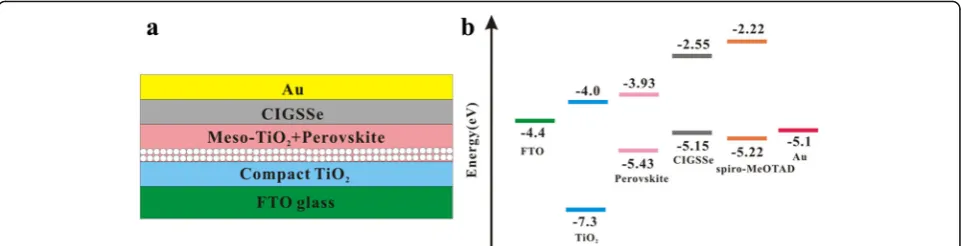
Fig. 3aSchematic structure of FTO/bl-TiO2/mp-TiO2/CH3NH3PbI3/CIGSSe/Au solar cell.bEnergy-level diagram of various device layers
Fig. 4Top view SEM image ofaCH3NH3PbI3andbCH3NH3PbI3/CIGSSe deposited on the surface of FTO/bl-TiO2/mp-TiO2.cCross-sectional SEM
[image:4.595.58.539.88.211.2] [image:4.595.58.539.602.702.2]quenched by nearly 78% after CIGSSe deposition. Such a dramatic PL quenching is particularly interesting in solar cell development because it could be caused by the signifi-cantly enhanced charge carrier extraction arising from the added CIGSSe layer. Notably, while depositing spiro-OMeTAD on CH3NH3PbI3, the PL intensity decreased further (93%), indicating a more efficient charge transfer process between CH3NH3PbI3and spiro-OMeTAD layer.
Perovskite solar cells with the bilayer device structure of FTO/bl-TiO2/mp-TiO2/CH3NH3PbI3/CIGSSe (or spiro-OMeTAD)/Au (Fig. 3a) were fabricated, and the energy level diagram for the corresponding materials was also depicted in Fig. 3b. Perovskite solar cells utilizing either CIGSSe or spiro-OMeTAD HTMs were constructed by a
similar method reported previously in the literature [37]. Briefly, an∼100-nm compact TiO2blocking layer and an ~200-nm mesoporous TiO2 film were deposited on the FTO by spin-coating. The TiO2 films were sintered at 550 °C for 30 min. The CH3NH3PbI3perovskite was de-posited on the mesoporous TiO2 films by one-step method. For the one-step spin-coating procedure of pre-paring CH3NH3PbI3 film, a DMF solution containing PbI2, CH3NH3I, and DMSO (1:1:1 mol %) was prepared and then spin-coated on the mesoporous TiO2 films to form a transparent adduct film. After heating the film at 65 °C for 1 min and 100 °C for 2 min, it was converted to a dark brown CH3NH3PbI3 film. The crystalline qual-ity of the resulting CH3NH3PbI3 film deposited on the FTO substrate was investigated by XRD spectros-copy (Additional file 1: Figure S4). The diffraction peaks at 14.10°, 20.01°, 23.48°, 24.50°, 28.43°, 31.88°, 40.67°, and 43.20° can be assigned as (110), (112), (211), (202), (220), (310), (224), and (314) planes, respectively, of the CH3NH3PbI3tetragonal phase, indicating the fully formed perovskite structure from PbI2 [35, 38, 39]. The morph-ology of the CH3NH3PbI3film was investigated by SEM. As shown in Fig. 4a, the as-formed CH3NH3PbI3 films exhibit full surface coverage and are composed of nanometer-sized grains ranging from tens of nanometers to hundreds of nanometers in size. After deposition of the CIGSSe layer on the perovskite film (Fig. 4b), the film seems homogeneous and the perovskite grains become invisible, suggesting that the perovskite film surface is completely covered by CIGSSe nanocrystals. The cross-sectional SEM image of the FTO/TiO2/CH3NH3PbI3/ CIGSSe film (Fig. 4c) indicates that the perovskite layer is very compact and has a thickness of ~400 nm, and the CIGSSe HTM layer has a thickness of ~50 nm that covers the perovskite layer uniformly. The full coverage of the perovskite film by CIGSSe and the inhibition of direct contact between the CIGSSe HTM layer and the bottom TiO2layer by compact perovskite layer are expected to be beneficial for prohibiting charge recombination [40]. Finally, an 80-nm Au electrode was thermally evaporated to complete the device.
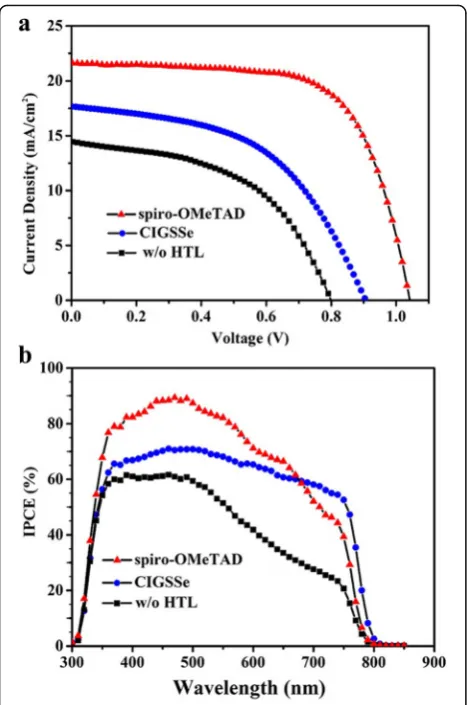
Figure 5a shows the current density-voltage (J-V) curves of PSCs employing CIGSSe or spiro-OMeTAD as HTM under AM 1.5 G illumination at 100 mW/cm2. The photovoltaic parameters of the PSCs are listed in Table 1. A device without HTM was also fabricated for comparison, which exhibited an open-circuit voltage (Voc) of 0.80 V, a short-circuit current density (Jsc) of 14.48 mA/cm2, and a fill factor (FF) of 50.38%, resulting in a best PCE of 5.85%. A device using CIGSSe as HTM displayed a Voc of 0.94 V, aJsc of 17.66 mA/cm2, and a FF of 54.88%, reaching a best PCE of 9.15%. The overall efficiency enhancement mainly resulted from a signifi-cant increase in the Voc, Jsc, and FF values. Compared
[image:5.595.57.291.86.439.2]Fig. 5aJ-Vcurves andbexternal quantum efficiency spectra of perovskite solar cells with different HTMs
Table 1Photovoltaic parameters of PSCs with different HTMs
HTM Voc(V) Jsc(mA/cm2) FF (%) PCE (%)
CIGSSe 0.94 17.66 54.88 9.15
Spiro-OMeTAD 1.04 21.52 67.19 15.08
[image:5.595.56.291.675.732.2]with the commonly used spiro-OMeTAD as HTM, the PCE was still low (9.15 vs 15.08%) but higher than that of CuInS2 quantum dot-based device [33]. The device performance statistics for devices based on CIGSSe, spiro-OMeTAD, and no HTM were obtained on the basis of 10 independent devices (Additional file 1: Figure S5). The average PCE values follow the same tendency to the high-est values discussed above. The external quantum effi-ciency (EQE) spectra of the devices with various HTMs are plotted in Fig. 5b. Compared with the device without HTM, the EQE spectrum of the device employing CIGSSe or spiro-OMeTAD HTM is significantly improved in the range of 350–800 nm, especially in the longer wavelength region. The increased spectral response should be attrib-uted to the improved charge collection in the presence of HTM. The EQE value for the device using CIGSSe HTM is lower than that for the device using spiro-OMeTAD HTM in the region from 350 to 670 nm. However, the EQE for the device employing CIGSSe HTM is slightly higher than that for the device employing spiro-OMeTAD HTM in the region from 670 to 800 nm, which can be
attribute to the smaller bandgap of CIGSSe. Notably, the CIGSSe layer can improve the EQE values of PSCs in the long wavelength region, resulting from photocurrent ori-ginating from the CIGSSe layer, which is similar to previ-ous reports about the extension of the photoresponse toward the longer wavelength by CuInS2 or Cu2ZnSnS4 layer [41, 42]. This indicates that CIGSSe can be used to expand the photoresponse of perovskite solar cells. The integrated current density from the EQE spectra for each device is in agreement with the current density obtained from theJ-Vcurves.
We measured impedance spectra of the devices based on different HTMs to describe the recombination pro-cesses in PSCs. The recombination resistance (Rrec) can be obtained by fitting the impedance spectra using a simplified equivalent circuit. The main arc at middle frequency is related to a recombination resistance Rrec, in parallel with a chemical capacitanceCμ, related to the recombination between TiO2 and HTMs [27, 43, 44]. Impedance spectra for solar cells with CIGSSe and spiro-OMeTAD as HTM and without HTM were re-corded over the frequency range of 10 Hz to 1 M Hz under 100 mW/cm2at AM 1.5 G illumination. There is some disorder in the low-frequency data, a common phenomenon in PSCs [45]. As shown in Fig. 6, Rrec for the device using spiro-OMeTAD or CIGSSe as HTM displays larger value than that for the device without HTM. In addition, Rrec for the spiro-OMeTAD device shows larger value than that for the CIGSSe device. The largerRrec indicates slower recombination in the device, which is an interpretation for the improved efficiency of the CIGSSe and the spiro-OMeTAD device.
The long-term stability of perovskite solar cells is very important for practical applications. Although spiro-OMeTAD has been widely used as a HTM in high-performance PSCs, the use of hygroscopic lithium salt doping is unfavorable for device stability [24, 25]. In this respect, the hydrophobic nature of CIGSSe nano-crystals [34, 36] is beneficial for solar cell application.
Fig. 6Nyquist plots for perovskite solar cells without HTM and with CIGSSe or spiro-OMeTAD as HTM
[image:6.595.58.290.87.257.2] [image:6.595.60.539.567.714.2]To verify this, the air stability of perovskite solar cells without encapsulation was investigated, as shown in Fig. 7b. When stored in air with a relative humidity of ∼45%, the devices with CIGSSe retained 90% of their original efficiency after 5 days, while the cells with spiro-OMeTAD kept only 36% after 5 days. The difference in device stability resulted from different hydrophobicity of the HTM. The CIGSSe film showed a water contact angle of 100° (Fig. 7a), so that the hydrophobic HTM can efficiently prevent the water penetration into the perovskite layer [46]. By contrast, the spiro-OMeTAD film containing Li-TFSI exhibited the smaller water contact angle of around 80°, indica-ting an increased affinity of water caused by Li-TFSI. Such hydroscopic ion additive should be avoided in practical applications because of its negative influence on device stability.
Conclusions
In summary, solution-processed CIGSSe nanocrystals have been successfully applied as a novel Cu-based inor-ganic HTM for PSCs. The best PCE of the CIGSSe HTM-based device reaches 9.15%, which is the highest PCE for conventional PSCs with Cu-based chalcopyrite semiconductor HTMs reported up to now. In addition, the hydrophobic nature of CIGSSe nanocrystals dramat-ically enhanced the stability of perovskite solar cells. This work provides a promising candidate of Cu-based inorganic HTM for stable perovskite solar cells.
Additional file
Additional file 1:The EDX pattern of CIGSSe nanocrystals. Plot of (αhν)2 vs photo energy for the CIGSSe nanocrystals. UPS spectra of CIGSSe nanocrystals. XRD pattern of CH3NH3PbI3film on FTO substrate.
Comparison of the performance distributions of 10 individual devices of the cells. (DOCX 398 kb)
Abbreviations
CIGS:Cu(InxGa1−x)Se2; CIGSSe: CuIn1−xGax(SySe1−y)2;Cμ: Chemical capacitance; EDX: Energy-dispersive X-ray spectroscopy; EIS: Electrochemical impedance spectra; EQE: External quantum efficiency;EVB: Valence band energy;
FF: Fill factor; HTM: Hole-transporting material;Jsc: Short-circuit current density;
J-V: Current density-voltage; Li-TFSI: Lithium bis(trifluoromethylsulfonyl)imide; P3HT: Poly(3-hexylthiophene); PANI: Polyaniline; PCE: Power conversion efficiency; PCPDTBT: Poly[2,1,3-benzothiadiazole-4,7-diyl[4,4-bis(2-ethylhexyl)-4H-cyclopenta[2,1-b:3,4-b’]dithiophene-2,6-diyl]]; PL: Photoluminescence;
PSCs: Perovskite solar cells; PTAA: Polytriarylamine;Rrec: Recombination resistance;
SAED: Selected-area electron diffraction pattern; Spiro-OMeTAD: 2,2’,7,7’ -tetrakis(N,N-di-p-methoxyphenylamine)-9,9′-spirobifluorene; TEM: Transmission electron microscopy; UPS: Ultraviolet photoelectron spectroscopy; Voc: Open-circuit voltage; XRD: X-ray diffraction
Acknowledgements
This work was supported by the National Natural Science Foundation of China (21333008, 21171141, and 51502252).
Authors’Contributions
LX performed the experiments, analyzed the results, and wrote the manuscript. JC, XW, and WYC participated in the sample fabrication and characterizations.
LLD and ZYJ contributed to the data interpretation, manuscript writing, and supervised the research. All authors read and approved the final version of the manuscript.
Competing Interests
The authors declare that they have no competing interests.
Received: 27 October 2016 Accepted: 19 February 2017
References
1. Kojima A, Teshima K, Shirai Y, Miyasaka T (2009) Organometal halide perovskites as visible-light sensitizers for photovoltaic cells. J Am Chem Soc 131:6050–6051 2. Kim HS, Lee CR, Im JH, Lee KB, Moehl T, Marchioro A, Moon SJ,
Humphry-Baker R, Yum JH, Moser JE, Grätzel M, Park NG (2012) Lead iodide perovskite sensitized all-solid-state submicron thin film mesoscopic solar cell with efficiency exceeding 9%. Sci Rep 2:591
3. Yin W-J, Yang J-H, Kang J, Yan Y, Wei S-H (2015) Halide perovskite materials for solar cells: a theoretical review. J Mater Chem A 3:8926–8942 4. Wehrenfennig C, Eperon GE, Johnston MB, Snaith HJ, Herz LM (2014) High
charge carrier mobilities and lifetimes in organolead trihalide perovskites. Adv Mater 26:1584–1589
5. Stranks SD, Eperon GE, Grancini G, Menelaou C, Alcocer MJ, Leijtens T, Herz LM, Petrozza A, Snaith HJ (2013) Electron-hole diffusion lengths exceeding 1 micrometer in an organometal trihalide perovskite absorber. Science 342: 341–344
6. Xing G, Mathews N, Sun S, Lim SS, Lam YM, Grätzel M, Mhaisalkar S, Sum TC (2013) Long-range balanced electron- and hole-transport lengths in organic-inorganic CH3NH3PbI3. Science 342:344–347
7. Grätzel M (2014) The light and shade of perovskite solar cells. Nat Mater 13: 838–842
8. Habibi M, Zabihi F, Ahmadian-Yazdi MR, Eslamian M (2016) Progress in emerging solution-processed thin film solar cells—part II: perovskite solar cells. Renew Sust Energy Rev 62:1012–1031
9. Zuo C, Bolink HJ, Han H, Huang J, Cahen D, Ding L (2016) Advances in perovskite solar cells. Adv Sci 3:1500324
10. Stranks SD, Nayak PK, Zhang W, Stergiopoulos T, Snaith HJ (2015) Formation of thin films of organic-inorganic perovskites for high-efficiency solar cells. Angew Chem Int Ed 54:3240–3248
11. Ahmadian-Yazdi MR, Zabihi F, Habibi M, Eslamian M (2016) Effects of process parameters on the characteristics of mixed-halide perovskite solar cells fabricated by one-step and two-step sequential coating. Nanoscale Res Lett 11:408
12. Zabihi F, Ahmadian-Yazdi M-R, Eslamian M (2016) Fundamental study on the fabrication of inverted planar perovskite solar cells using two-step sequential substrate vibration-assisted spray coating (2S-SVASC). Nanoscale Res Lett 11:71 13. Im JH, Lee CR, Lee JW, Park SW, Park NG (2011) 6.5% efficient perovskite
quantum-dot-sensitized solar cell. Nanoscale 3:4088–4093
14. Lee MM, Teuscher J, Miyasaka T, Murakami TN, Snaith HJ (2012) Efficient hybrid solar cells based on meso-superstructured organometal halide perovskites. Science 338:643–647
15. Liu M, Johnston MB, Snaith HJ (2013) Efficient planar heterojunction perovskite solar cells by vapour deposition. Nature 501:395–398
16. Zhou H, Chen Q, Li G, Luo S, Song TB, Duan HS, Hong Z, You J, Liu Y, Yang Y (2014) Interface engineering of highly efficient perovskite solar cells. Science 345:542–546
17. Chen W, Wu Y, Yue Y, Liu J, Zhang W, Yang X, Chen H, Bi E, Ashraful I, Grätzel M (2015) Efficient and stable large-area perovskite solar cells with inorganic charge extraction layers. Science 350:944–948
18. Nie W, Tsai H, Asadpour R, Blancon J-C, Neukirch AJ, Gupta G, Crochet JJ, Chhowalla M, Tretiak S, Alam MA (2015) High-efficiency solution-processed perovskite solar cells with millimeter-scale grains. Science 347:522–525 19. Yang WS, Noh JH, Jeon NJ, Kim YC, Ryu S, Seo J, Seok SI (2015)
High-performance photovoltaic perovskite layers fabricated through intramolecular exchange. Science 348:1234–1237
21. Di Giacomo F, Razza S, Matteocci F, D’Epifanio A, Licoccia S, Brown TM, Di Carlo A (2014) High efficiency CH3NH3PbI(3-x)Cl x perovskite solar cells with
poly (3-hexylthiophene) hole transport layer. J Power Sources 251:152–156 22. Zhang Y, Liu W, Tan F, Gu Y (2015) The essential role of the poly
(3-hexylthiophene) hole transport layer in perovskite solar cells. J Power Sources 274:1224–1230
23. Xiao Y, Han G, Chang Y, Zhou H, Li M, Li Y (2014) An all-solid-state perovskite-sensitized solar cell based on the dual function polyaniline as the sensitizer and p-type hole-transporting material. J Power Sources 267:1–8 24. Noh JH, Im SH, Heo JH, Mandal TN, Seok SI (2013) Chemical management
for colorful, efficient, and stable inorganic–organic hybrid nanostructured solar cells. Nano Lett 13:1764–1769
25. Niu G, Li W, Meng F, Wang L, Dong H, Qiu Y (2014) Study on the stability of CH3NH3PbI3films and the effect of post-modification by aluminum oxide in
all-solid-state hybrid solar cells. J Mater Chem A 2:705–710
26. Qin P, Tanaka S, Ito S, Tetreault N, Manabe K, Nishino H, Nazeeruddin MK, Grätzel M et al (2014) Inorganic hole conductor-based lead halide perovskite solar cells with 12.4% conversion efficiency. Nat Commun 5:3834 27. Christians JA, Fung RC, Kamat PV (2013) An inorganic hole conductor for
organo-lead halide perovskite solar cells. Improved hole conductivity with copper iodide. J Am Chem Soc 136:758–764
28. Chen WY, Deng LL, Dai SM, Wang X, Tian CB, Zhan XX, Xie SY, Huang RB, Zheng LS (2015) Low-cost solution-processed copper iodide as an alternative to PEDOT:PSS hole transport layer for efficient and stable inverted planar heterojunction perovskite solar cells. J Mater Chem A 3:19353–19359 29. Li Y, Zhu J, Huang Y, Wei J, Liu F, Shao Z, Hu L, Chen S, Yang S, Tang J,
Yao J, Dai S (2015) Efficient inorganic solid solar cells composed of perovskite and PbS quantum dots. Nanoscale 7:9902–9907 30. Kim JH, Liang PW, Williams ST, Cho N, Chueh CC, Glaz MS, Ginger DS,
Jen AK (2015) High-performance and environmentally stable planar heterojunction perovskite solar cells based on a solution-processed copper-doped nickel oxide hole-transporting layer. Adv Mater 27:695–701 31. Chopra K, Paulson P, Dutta V (2004) Thin-film solar cells: an overview.
Prog Photovolt Res Appl 12:69–92
32. Romeo A, Terheggen M, Abou‐Ras D, Bätzner D, Haug FJ, Kälin M, Rudmann D, Tiwari A (2004) Development of thin-film Cu (In, Ga)Se2and CdTe solar
cells. Prog Photovolt Res Appl 12:93–111
33. Lv M, Zhu J, Huang Y, Li Y, Shao Z, Xu Y, Dai S (2015) Colloidal CuInS2quantum
dots as inorganic hole-transporting material in perovskite solar cells. ACS Appl Mater Interfaces 7:17482–17488
34. Chang S-H, Chiang M-Y, Chiang C-C, Yuan F-W, Chen C-Y, Chiu B-C, Kao T-L, Lai C-H, Tuan H-Y (2011) Facile colloidal synthesis of quinary CuIn
1-xGax(SySe1-y)2(CIGSSe) nanocrystal inks with tunable band gaps for use in
low-cost photovoltaics. Energy Environ Sci 4:4929–4932 35. Jeon NJ, Noh JH, Kim YC, Yang WS, Ryu S, Seok SI (2014) Solvent
engineering for high-performance inorganic-organic hybrid perovskite solar cells. Nat Mater 13:897–903
36. Panthani MG, Akhavan V, Goodfellow B, Schmidtke JP, Dunn L, Dodabalapur A, Barbara PF, Korgel BA (2008) Synthesis of CuInS2, CuInSe2, and Cu(InxGa1-x)Se2
(CIGS) nanocrystal“inks”for printable photovoltaics. J Am Chem Soc 130: 16770–16777
37. Ahn N, Son DY, Jang IH, Kang SM, Choi M, Park NG (2015) Highly reproducible perovskite solar cells with average efficiency of 18.3% and best efficiency of 19.7% fabricated via Lewis base adduct of lead(II) iodide. J Am Chem Soc 137:8696–8699
38. Liang K, Mitzi DB, Prikas MT (1998) Synthesis and characterization of organic-inorganic perovskite thin films prepared using a versatile two-step dipping technique. Chem Mater 10:403–411
39. Burschka J, Pellet N, Moon S-J, Humphry-Baker R, Gao P, Nazeeruddin MK, Grätzel M (2013) Sequential deposition as a route to high-performance perovskite-sensitized solar cells. Nature 499:316–319
40. Xiao M, Huang F, Huang W, Dkhissi Y, Zhu Y, Etheridge J, Gray-Weale A, Bach U, Cheng Y-B, Spiccia L (2014) A fast deposition-crystallization procedure for highly efficient lead iodide perovskite thin-film solar cells. Angew Chem Int Ed 53:9898–9903
41. Chen C, Li C, Li F, Wu F, Tan F, Zhai Y, Zhang W (2014) Efficient perovskite solar cells based on low-temperature solution-processed (CH3NH3)PbI3
perovskite/CuInS2planar heterojunctions. Nanoscale Res Lett 9:457
42. Wu Q, Xue C, Li Y, Zhou P, Liu W, Zhu J, Dai S, Zhu C, Yang S (2015) Kesterite Cu2ZnSnS4as a low-cost inorganic hole-transporting material for
high-efficiency perovskite solar cells. ACS Appl Mater Interfaces 7:28466–28473
43. Kim HS, Mora-Sero I, Gonzalez-Pedro V, Fabregat-Santiago F, Juarez-Perez EJ, Park NG, Bisquert J (2013) Mechanism of carrier accumulation in perovskite thin-absorber solar cells. Nat Commun 4:2242
44. Kim HS, Lee JW, Yantara N, Boix PP, Kulkarni SA, Mhaisalkar S, Grätzel M, Park NG (2013) High efficiency solid-state sensitized solar cell-based on submicrometer rutile TiO2nanorod and CH3NH3PbI3perovskite sensitizer.
Nano Lett 13:2412–2417
45. Liu D, Yang J, Kelly TL (2014) Compact layer free perovskite solar cells with 13.5% efficiency. J Am Chem Soc 136:17116–17122
46. Kwon YS, Lim J, Yun H-J, Kim Y-H, Park T (2014) A diketopyrrolopyrrole-containing hole transporting conjugated polymer for use in efficient stable organic-inorganic hybrid solar cells based on a perovskite. Energy Environ Sci 7:1454–1460
Submit your manuscript to a
journal and benefi t from:
7Convenient online submission
7Rigorous peer review
7Immediate publication on acceptance
7Open access: articles freely available online
7High visibility within the fi eld
7Retaining the copyright to your article