N A N O E X P R E S S
Open Access
Embedded Si/Graphene Composite
Fabricated by Magnesium-Thermal
Reduction as Anode Material for
Lithium-Ion Batteries
Jiangliu Zhu
1,2, Yurong Ren
1,2,5*, Bo Yang
1,2, Wenkai Chen
3and Jianning Ding
1,2,4Abstract
Embedded Si/graphene composite was fabricated by a novel method, which was in situ generated SiO2particles on graphene sheets followed by magnesium-thermal reduction. The tetraethyl orthosilicate (TEOS) and flake graphite was used as original materials. On the one hand, the unique structure of as-obtained composite accommodated the large volume change to some extent. Simultaneously, it enhanced electronic conductivity during Li-ion insertion/ extraction. The MR-Si/G composite is used as the anode material for lithium ion batteries, which shows high reversible capacity and ascendant cycling stability reach to 950 mAh·g−1at a current density of 50 mA·g−1after 60 cycles. These may be conducive to the further advancement of Si-based composite anode design.
Keywords:Embedded Si/graphene composite, Magnesium-thermal reduction, Anode material
Background
Anode material plays a significant role in the recharge-able lithium-ion batteries (LIBs). Recently, most people think that the promising candidate for anode material are the silicon-based materials [1–3]. The main reason is that it has high theoretical capacity of 4200 mAh g−1 (about 10 times for the commercial graphite anode, 372 mAh g−1). In addition, there is abundant silicon in nature, and lithium insertion potential is relatively low (< 0.5 V vs. Li/Li+) [4–6].Unfortunately, there are limits to the commercialization of silicon-based anode mate-rials. The reason why is that volumetric expansion of the Si electrode by over 400% can cause a series of problems such as electrode pulverization, poor cycling stability, and seriously irreversible capacity recession [7, 8]. Therefore, to solve the issue of volume expansion, lots of means have been proposed that include obtaining the nano-scale silicon particles, and preparing the
silicon-based composites [9, 10]. For composites, the most effi-cient methods is dispersing the nano-scale silicon into the carbon matrix, where the carbon matrix functioned as buffer system and electroactive material [11]. Xuejiao Feng et al. prepared nano/μ-structured Si/CNT particles via a combination of spray drying and magnesium-thermal reduction with use nano-particles SiO2as both a template and silicon precursor [12]. It exhibited a capacity larger than 2100 mAh g−1 at current density 1 A g−1, and the capacity retention after 100 cycles was 95.5%.
Recently, graphene, an original kind of carbon material, has aroused great concerns in the field of materials science. It has a unique structure with a single-layer sheet-like structure composed of carbon atoms [13]. Demonstrably, it is very promising to prepare some graphene-based materials with remarkable property due to the superior electrical conductivity and high surface [14]. Huachao Tao et al. designed a self-supporting Si/ RGO nano-composite films. The result indicated that the composite had admirable electrochemical performance [15].
In our work, we designed a novel method to synthesize high-capacity magnesium-thermal reduced
* Correspondence:[email protected]
1School of Materials Science and Engineering, Changzhou University,
Changzhou 213000, China
2Jiangsu Province Cultivation Base for State Key Laboratory of Photovoltaic
Science and Technology, Changzhou University, Changzhou 213164, Jiangsu, China
Full list of author information is available at the end of the article
Si/graphene (MR-Si/G) composite, which used the tetraethyl orthosilicate (TEOS) and graphene oxide (GO) as the starting materials, and was in situ generated SiO2particles on graphene sheets followed by magnesium thermal reduction. Compared with the previous prepar-ation method, the synthesis of materials in this experiment is relatively simple. At the same time, silicon and graphene are relatively evenly mixed by in-situ generated SiO2 parti-cles on graphene. Embedded structure of the composite accommodated the large volume change, displayed high specific capacity and cycle stability, and increased the electronic conductivity. Another, the raw materials are cheap. All of these may be conducive to the further advancement of Si-based composite anode design.
Experimental
Graphite oxide (GO) was obtained from flake graphite according to the modified Hummers method in litera-ture [16]. Dispersing graphite oxide in deionized water to obtain 1 mg/ml aqueous solution. Then, take 30 ml anhydrous ethanol and 0.17 g cetyltrimethyl ammonium bromide (CTAB) blended by sonication for 10 min, then add 30 ml above graphite oxide aqueous solution and vigorous stirring to obtained mixture, followed by adding a specific amount tetraethoxysilane (TEOS) and mag-netic stirring 10 min, finally the ammonium hydroxide was used to adjust PH to 10, then continually stirring 2 h. Lastly, the mixture was sealed with the Teflon-lined autoclaves at 180 °C for 10 h. The resulting compound was suction filtration and dried in vacuum at 60 °C for 24 h.
This step is to prepare the Si/G complex by magne-sium thermal reduction. Firstly, the above composite was heated at 550 °C for 3 h at 5 °C/min in an argon atmosphere, and then cool it to room temperature. The weight ratio of as-sample and magnesium powder was 1:1 in an agate mortar and grinding 30 min. Then, the mixture was placed in a tube furnace and heated at 800 °C for 4 h in an argon atmosphere. Finally, the as-composite was soaked by 1 M HCl for 10 h then filtered and dried under vacuum at 60 °C for 8 h. This product is MR-Si/G composite.
The X-ray diffraction (XRD, D/max 2500PC) was used to characterize the phase composition of the materials. The morphology and structure of the products were evaluated by field emission scanning electron
micros-copy (FESEM, SUPRA55), Transmission electron
microscopy (TEM, JEM-2100). Raman spectra and the FTIR Spectra were measured on RM2000 Raman Spectrometer (Renishaw, British) and the NICOLET 560 Fourier transform infrared spectrophotometer, respect-ively. The content of Si in the composite was measured by thermogravimetric analysis (TGA, NETZSCH TG
209F1 Libra), it was from room temperature to 800 °C at a heating rate of 10 °C/min under air.
To test the electrochemical performance, which was carried out in two-electrode 2032 coin-type cells, the ac-tive material (MR-Si/graphene), conducac-tive addiac-tive (Super-P), and sodium carboxymethyl cellulose (CMC) as binder were intermingled at weight ratio of 80:10:10, which was used as the working electrode. The mixture slurry was prepared by using deionized water as a solv-ent, then equably pasted on pure copper foil current col-lector via doctor blade processing, followed by drying under vacuum at 105 °C for 12 h. All the cells were as-sembled in an argon-filled glovebox (ZKX2, Nanjing University Instrument Factory). The metallic lithium foil was used as the counter electrode. The electrolyte was a solution of 1.0 M LiPF6, which dispersed in mixture of EC: DMC: EMC (1:1:1 by volume). The cells were tested in the potential range from 0.01 V to 3 V (vs. Li+/Li) by CT2001A Land battery testing system.
Results and Discussion
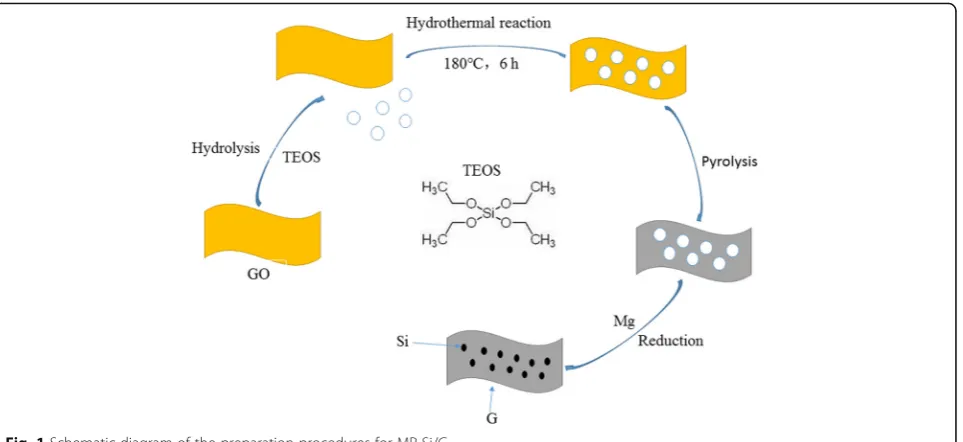
The MR-Si/graphene composite manufactured by in-situ generated SiO2particles on graphene sheets followed by magnesium thermal reduction. Figure 1 illustrates the schematic diagram of the manufacture MR-Si/G com-plex. The SiO2nano-particles were synthesized by modi-fied Stöber process [17]. Subsequently, hydrothermal method was used to in-situ generate the SiO2/graphite
oxide, the final composite was synthesized by
magnesium-thermal reduction.
Figure 2 reveals the XRD pattern of Si, MR-Si/G and GO corresponding to (a), (b), and (d), respectively. Fig-ure 2c is a composite material that has not been acid-treated. The reflection peak at 2 = 10.9° is graphite oxide. The main diffraction peaks at 2 =28.5°, 47.6° and 56.5° corresponding to the planes of (111), (220), and (311) typical of Si, which are distinctly observed in MR-Si/G compound and pure silicon. Compared the pure Si to the MR-Si/G composite in the XRD pattern, which indicated that add the graphite oxide without changing the structure of the compounds. However, the peak of graphite oxide in composite disappears, the rea-son why it may be restored into the graphene. In addition, the magnesium-thermal reduction is a key fac-tor to successfully synthesize the novel compounds. Simultaneously, if Mg is excessive, there will be some side reaction. The reactions are as follows:
2MgþSiO2→2MgOþSi ð1Þ
4MgþSiO2→2MgOþMg2Si ð2Þ
Compared Fig. 2b–c, magnesium and other
by-products are removed by acid treatment.
From the Raman diagram in Fig. 3, MR-Si/G compos-ite, the peaks at approximately 516 cm−1(this peak is ab-sent in the SiO2/GO) is in accordance with the spectrum of Si nano-particle [18], manifesting that the silicon appeared after the magnesium thermal reduction. This result is consistent with the XRD. All the three curves, which the peaks at 1330 cm−1and 1585 cm−1consistent with the D band and the G band, respectively. The G-peak is the feature of the graphite, representing the carbon of the sp2 structure. The D-peak can be ascribed to the existence of a defective hexagonal graphite struc-ture. The ID/IG is the most important parameter, which was related to the graphitization degree of the carbon-aceous material and the defect density in the graphene-based material [19]. Although it has been reported that the degree of ordering of graphene after thermal
reduction is increased, the ID/IG intensity ratios of MR-Si/G composite has increased, which maybe the presence of Si nanoparticles that increases the disorder of the material [20]. After calculation, the ID/IG ratio of GO is approximately 0.93 and the ID/ IGratio of MR-Si / G is about 1.19. In order to further study the changes in chemical structure, we conducted FTIR to analyze the functional groups of sample. Figure 4 shows the FITR spectra of GO, pure Si, and MR-Si/G composite. For the Si and MR-Si/G composite, the peaks at about 468 cm−1, 816 cm−1, and 1087 cm−1are corresponding to the O-Si-O bending vibration, symmetric elastic vibration of Si-O-Si and Si-O-Si asymmetric elastic vibration, re-spectively. The presence of these functional groups is conducive to the formation of a stable structure. And
Fig. 2XRD profiles of graphite oxide, pure silicon, MR-Si/G composite
Fig. 3Raman spectra for graphite oxide, SiO2/GO and MR-Si/G composite
[image:3.595.60.542.87.308.2] [image:3.595.304.539.528.703.2] [image:3.595.58.289.543.716.2]the broad peaks at 3427 cm−1 are related to the O-H stretching vibration.
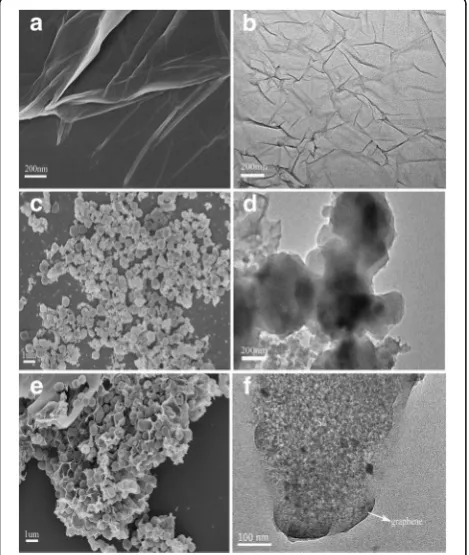
The morphology of all prepared materials was studied by SEM and TEM (Fig. 5). Figure 5a, c, e show the SEM images of the graphene, pure Silicon, and MR-Si/G com-posite, respectively. And the corresponding TEM images is Fig. 5b, d, f, respectively. We could see the morph-ology of graphene has many pleats and wrinkles, and the
surface is relatively flat and smooth (Fig. 5a). TEM results are also matched (Fig. 5b). The nano-scale silicon
particles are clearly seen to be spherical and
dispersed evenly, but there is a ball-crushing
phenomenon (Fig. 5c). The Si nano-particle size is about 500 nm in diameter. In the FE-SEM (Fig. 5e) and TEM images (Fig. 5f ) of MR-Si/G composite, Si nano-particles distributed uniformly on the graphene and they are well embedded into graphene sheets. Comparing Fig. 5d with f, we can see that graphene layers exist at the edges of the composites.
[image:4.595.57.290.87.265.2]The content of the Si in the MR-Si/G composite car-ried by the TGA measurements, which was implemented from ambient temperature to 800 °C with a heating rate of 10 °C/min in the air. As shown in Fig. 6, the start re-action temperature of the composite material is about 450 °C, and the oxidation reaction of the graphene oxide is completed at 600 °C. The weight loss of the composite represents the content of graphene, that is to say, the content of silicon in the complex also can be deter-mined. From the picture, the weight percentages of Si is calculated to be about 70%. And in the complex, the curve increased above 600 °C, mainly due to the reaction of silicon with oxygen in the air to produce silica.
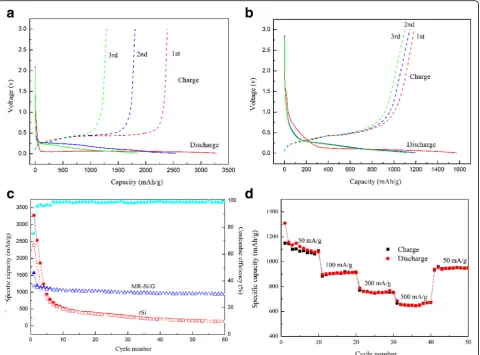
Figure 7a, b depicts the first three times discharge-charge profiles of the pure Si and the MR-Si/G composite electrode, respectively. The current density is 50 mA·g−1 and voltage range of 0.01–3.0 V vs Li/Li+. For the pure Si, the initial discharge capacity is 3279 mAh·g−1, while the first charge capacity is only 2391 mAh·g−1(Fig. 7a).
For the MR-Si/G composite, the initial discharge cap-acity and charge capcap-acity is 1570 and 1178 mAh·g−1, re-spectively (Fig. 7)b, and revealing coulombic efficiency of 75.5%. The large irreversible capacity may be put down to a solid electrolyte interface (SEI) film is formed on the electrode surface. The initial discharge curve demon-strates a long discharge flat curve with a plateau below Fig. 4FITR spectra of the GO, pure Si, and MR-Si/G composite
Fig. 5a,c,eshows the SEM images of the graphene, pure Silicon, and MR-Si/G composite, respectively.b,d,fis the corresponding
TEM images, respectively Fig. 6TGA curves of MR-Si/G composite and pure Si
[image:4.595.57.292.416.694.2] [image:4.595.304.539.542.715.2]0.15 V. It can be attributed to the delithiation process from amorphous LixSi phase [21]. As the number of cy-cles increase, the capacity continued to decline, but the decay rate is slower relative to pure silicon.
Figure 7c shows the cycle performance and the cou-lombic efficiency of the MR-Si/G composite compared to the pure Si at a current density of 50 mA·g−1 after 60 cycles. For the pure Si, the cycle performance is highly bad at the first 10 cycles, which the discharge capacity quickly dropped from 3279 to 528 mAh·g−1. After 60 cycles, the capacity was reduced to about 125 mAh·g−1. At the same times, the MR-Si/G compound has superior cycling properties, which the discharge cap-acity is 1570 mAh·g−1 and the reversible capacity is about 1055 mAh·g−1 in the initial 10 cycles. And the coulombic efficiency is achieved 99% and kept steady in a subsequent loop. It is noted that the specific capacity of complexes has been maintained at about 950 mAh·g−1 after 60 cycles. The results indicate that the graphene layers act as a significant role in the cycling performance
of the compound electrode, which due to stabilizes the structure of the electrode and increases the electric con-ductivity. The rate capability of the MR-Si/G composite at different current densities is displayed in Fig. 6d. It is noted that the specific capacity of 1087,915,753 and 671 mAh·g−1 correspond to at the current densities of 50, 100, 200, 500 mA·g−1, respectively. In an addition, the capacity value is only 950 mAh·g−1as the current density back to 50 mA·g−1.
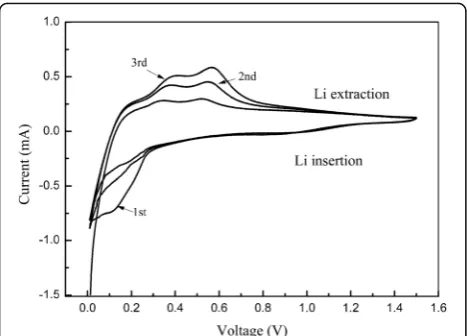
Figure 8 shows the cyclic voltammetry of MR-Si-G composite from 0.01 V to 1.5 V at a scan rate of 0. 1 mV s−1. In the first cycle, the peak at 0.75 V during the cath-odic sweep relates with the formation of SEI layer, which disappears in the next cycle. It matches the composite discharge curve (Fig. 7b). The peak at 0.16 V are related with the alloying reaction of Si and Li during the lithia-tion. Two anodic peaks at 0.31 and 0.50 V were ob-served during the delithiation, which could be attributed to the reaction between amorphous LixSi and amorph-ous silicon.
[image:5.595.59.540.88.443.2]Figure 9 shows the electrochemical impedance spec-troscopy (EIS) of the MR-Si/G and the pure Si. The downwardly diverging semicircle appearing in the high frequency region is related to the SEI impedance layer, and the oblique lines appearing in the low frequency re-gion are related to the diffusion process of the lithium ions in the composite. In the figure, the impedance of MR-Si/G is lower than that of pure Si, indicating that the graphene significantly improves the conductivity of composite. The reason why is that not only the graphene has good conductivity, but also it can inhibit the cycle of SEI membrane changes, so as to promote the transfer of charge in the battery.
Conclusions
Embedded Si/graphene nano-composite was successfully synthesized via combined with the hydrothermal process and Mg-assisted reduction. The Si nano-particles were
fabricated by the magnesium-thermal reduction of amorphous silica nanoparticle, which were uniformly ad-hered on the graphene. The unique structure of the composite eases the volume expansion and manifests ex-cellent electrochemical properties. The MR-Si/G com-posites exhibited high reversible capacity, which can be up to 950 mAh·g−1 at a current density of 50 mA·g−1 after 60 cycles. The methodology employed in this study produced a promising unique MR-Si/G composite, which for the next generation of high-capacity lithium-ion battery anode material, provides a reliable basis.
Acknowledgements
The study supported by the National Natural Science Foundation of China (51304077 and 51374175); the Science and Technology Department of Science and Technology of Project in Jiangsu Province (BY2014037-31); the Opening Project of State Key Laboratory of Alternate Electrical Power System with Renewable Energy Sources (No.LAPS15001); the Privileged Development Program of Jiangsu High Education on New Energy Material Science and Engineering, and the Material Corrosion and Protection Key Lab oratory of Sichuan Province (2014CL15) are acknowledged.
Availability of Data and Materials
All data are fully available without restriction.
Authors’Contributions
YR conceived and designed the experiments. JZ and BY performed the experiments. JZ and BY analyzed the data. JD and WC contributed reagents/ materials/analysis tools. LZ wrote the paper. All authors read and approved the final manuscript.
Competing Interests
The authors declare that they have no competing interests.
Publisher’s Note
Springer Nature remains neutral with regard to jurisdictional claims in published maps and institutional affiliations.
Author details 1
School of Materials Science and Engineering, Changzhou University, Changzhou 213000, China.2Jiangsu Province Cultivation Base for State Key
Laboratory of Photovoltaic Science and Technology, Changzhou University, Changzhou 213164, Jiangsu, China.3College of Chemical and Chemical
Engineering, Fuzhou University, Fuzhou 350002, Fujian, China.4Micro/Nano Science and Technology Center, Jiangsu University, Zhenjiang 212013, China.
5Department of Chemical and Biomolecular Engineering, University of
California at Los Angeles, Los Angeles, CA 90095, USA.
Received: 5 September 2017 Accepted: 4 December 2017
References
1. Qiu DF, Bu G, Zhao B, Lin ZX (2015) Mesoporous silicon microspheres fabricated via in situ magnesiothermic reduction of silicon oxide as a high-performance anode material for lithium–ion batteries. J Solid State Electrochem 19:935–939
2. Tao HC, Yang XL, Zhang LL, Ni SB (2014) Chemically activated graphene/ porous Si@SiOx composite as anode for lithium ion batteries. Mater Chem Phys 147:528–534
3. Chen DY, Mei X, Ji G, Lu MH, Xie JP, Lu JM, Lee JY (2012) Reversible lithium-ion storage in silver-treated nanoscale hollow porous silicon particles. Angew Chem Int Ed 51:2409–2413
4. Fang S, Shen LF, Tong ZK, Zheng H, Zhang F, Zhang XG (2015) Si nanoparticles encapsulated in elastic hollow carbon fibres for Li-ion battery anodes with high structural stability. Nano 7:7409–7014
Fig. 8Cyclic voltammetry of MR-Si-G composite from 0.01 V to 1.5 V at a scan rate of 0. 1 mV s−1
Fig. 9Electrochemical impedance spectroscopy (EIS) of the MR-Si/G and the pure Si
[image:6.595.57.291.87.255.2] [image:6.595.58.291.534.702.2]5. Kim YM, Ahn J, SH Y, Chung DY, Lee KJ, Lee JK, Sung YE (2015) Titanium silicide coated porous silicon nanospheres as anode materials for lithium ion batteries. Electrochim Acta 151:256–262
6. Favors Z, Wang W, Bay HH, Mutlu Z, Ahmed K, Liu C, Ozkan M, Ozkan CS (2014) Scalable synthesis of Nano-silicon from beach sand for long cycle life Li-ion batteries. Sci Rep 4:5623
7. Li Q, Yin LW, Ma JY, Li ZQ, Zhang ZW, Chen AL, Li CX (2015) Mesoporous silicon/carbon hybrids with ordered pore channel retention and tunable carbon incorporated content as high performance anode materials for lithium-ion batteries. Energy 85:159–166
8. Wang H, Wu P, Shi HM, Lou FJ, Tang YW, Zhou TG, Zhou YM, TH L (2014) Porous Si spheres encapsulated in carbon shells with enhanced anodic performance in lithium-ion batteries. Mater Res Bull 55:71–77
9. Gua M, He Y, Zheng JM, Wang CM (2015) Nanoscale silicon as anode for Li-ion batteries: the fundamentals, promises, and challenges. Nano Energy 17: 366–383
10. Chen YF, Du N, Zhang H, Yang DR (2015) Facile synthesis of uniform MWCNT@Si nanocomposites as high-performance anode materials for lithium-ion batteries. J Alloys Compd 622:966–972
11. Li Q, Yin LW, Gao XP (2015) Reduction chemical reaction synthesized scalable 3D porous silicon/carbon hybrid architectures as anode materials for lithium ion batteries with enhanced electrochemical performance. RSC Adv 5:35598–35607
12. Feng XJ, Yang J, Bie YT, Wang JL, Nuli YN, Lu W (2014) Nano/micro-structured Si/CNT/C composite from nano-SiO2 for high power lithium ion batteries. Nano 6:12532–12539
13. Peres NMR (2009) The electronic properties of graphene and its bilayer. Vacuum 83:1248–1252
14. Stankovich S, Dikin DA, Dommett GHB, Kohlhaas KM, Zimney EJ, Stach EA, Piner RD, Nguyen ST, Ruoff RS (2006) Graphene-based composite materials. Nature 442:282–286
15. Tao HC, Fan LZ, Mei YF, XH Q (2011) Self-supporting Si/reduced Graphene oxide nanocomposite films as anode for lithium ion batteries. Electrochem Commun 13:1332–1335
16. Chen J, Yao BW, Li C, Shi GQ (2013) An improved hummers method for eco-friendly synthesis of graphene oxide. Carbon 64:225–229 17. Gholami T, Salavati-Niasari M, Bazarganipour M, Noori N (2013) Synthesis
and characterization of spherical silica nanoparticles by modified Stoer process assisted by organic ligand. Superlattices Microst 61:33–41 18. He DF, Bai FJ, Li LX, Shen LM, Kung HH, Bao NZ (2015) Fabrication of
sandwich-structured Si nanoparticles-graphene nanocomposites for high-performance lithium-ion batteries. Electrochim Acta 169:409–415 19. YJ D, Zhu GN, Wang K, Wang YG, Wang CX, Xia YY (2013) Si/graphene
composite prepared by magnesium thermal reduction of SiO2 as anode material for lithium-ion batteries. Electrochem Commun 36:107–110 20. Zhu SM, Zhu CL, Ma J, Meng Q, Guo ZP, ZY Y, Lu T, Li Y, Zhang D, Laud
WM (2013) Controlled fabrication of Si nanoparticles on graphene sheets for Li-ion batteries. RSC Adv 3:6141–6146