Published Online September 2013 in SciRes (http://www.scirp.org/journal/ce) http://dx.doi.org/10.4236/ce.2013.49089
Teachers’ Use Intention of Multimedia Instruction Resources
among Rural Primary Schools in China
*
Chun Mao
1, Xiao Hu
21Southwest University, Chongqing, China
2Chongqing Youth Vocational and Technical College, Chongqing, China
Email: [email protected], [email protected]
Received May 11th, 2013; revised June 11th, 2013; accepted June 18th, 2013
Copyright © 2013 Chun Mao, Xiao Hu. This is an open access article distributed under the Creative Commons Attribution License, which permits unrestricted use, distribution, and reproduction in any medium, provided the original work is properly cited.
Based on Technology Acceptance Model (TAM), this research imports the degree of Computer Self-Ef-ficacy, Resource Appropriateness, Superior Support and Convenience to Use into TAM, constructs Structural Equation Model to study the factors of teachers’ use intention of multimedia instruction re-sources among rural primary schools in Chongqing China. Structural Equation Modeling reveals that teachers’ resource using doesn’t follow the TAM exactly. On one hand, the influence of Perceived Ease of Use is not notability, on the other hand, the Superior Support, Perceived Usefulness and Resource Ap-propriateness are very significant. Especially, the degree of Superior Support is the most important.
Keywords: Teacher of Rural Primary School; Multimedia Instruction Resources; Use Intention; TAM
Introduction
With the advent of the information age, the application of information technology in educational field brings the innova- tion of education. In 2012, the Ministry of Education of the People’s Republic of China released Education Informatization
Ten Year Development Plan. Teacher is the key and main prac-titioner of education informatization in China, especially in rural primary schools. Teachers’ use intention of multimedia instruction has an appreciable effect on the quality of teaching in rural primary schools in Chongqing.
Chongqing is the fourth municipality directly under the Cen- tral Government in China. It’s an extra large city in southwest of CHINA, whose territory area is about 82,400 square kilome- ters, total population is 33,298,100. The effective use of multi- media instruction resources is significant for promoting the balanced development of compulsory education and improving rural school conditions in Chongqing.
This study based on the Technology Acceptance Model (TAM), proposes 8 hypotheses, constructs the model of teach- ers’ use intention of multimedia instruction resources among rural primary schools in China, adopts the structure of close ended questionnaire, surveys 18 rural primary schools in Chongqing, hands out 300 questionnaires , adopts SPSS for reliability analysis and validity analysis, AMOS for model evaluation and validation, discusses the factors which impact teachers’ use intention of mul- timedia instruction among rural primary schools in China.
Theoretical Foundations
TAM
“Technology Acceptance Model” which put forward by
Davis in 1989 is used for predicting and explaining the use action of information systems. The investigation focuses on two theoretical constructs, perceived usefulness and perceived ease of use, which are theorized to be fundamental determinants of system use. This model believes people tend to use or not use an information technology to the extent they believe it will help them perform their job better and the given systems are hard or easy to use.
The research about education technology which basis on the TAM is seldom seen in Chinese Mainland (Chen, 2005), but the TAM has been proved to be a credible model in many re- search in HONGKONG or other countries (Stoel, 2003; Hua, 2008). Most of the research of explain the distance education systems use is not only explain by TAM alone, but also com- bine TAM with other theories. (Gong, 2004).
We assume that the acception and use of multimedia instruc- tion resources among rural primary schools in China can be explained by TAM. So we use the same define of perceived usefulness and perceived ease of use as David used. Perceived usefulness is defined here as “the degree to which a person be- lieves that using the Multimedia Instruction Resources would enhance his or her job performance”.
Perceived ease of use, in contrast, refers to “the degree to which a person believes that using Multimedia Instruction Re- sources would be free of effort”. This follows from the defini- tion of “ease”: “freedom from difficulty or great effort”.
Theory of Reasoned Action
In 1985, Ajzen put out the theory of planned behavior, which postulated three conceptually independent determinants of in- tention: Attitudes, Subjective Norms, and Perceived Behavioral Control. The more subjective norm with respect to a behavior the stronger should be an individual’s intention to perform the
*Supported by “the Fundamental Research Funds for the Central
behavior under consideration (Ajzen, 1985). The Subjective Norm refers to the perceived social pressure to perform or not to perform the behavior.
In our research, Subjective Norm mainly reflects in Superior Support, which is defined as the perceived encouragement and pressure of the school leader about use or not to use the Multi-media Instruction Resources.
Social Cognitive Theory and Self-Efficacy
Self-efficacy is the core-concept of social cognitive theory (Bandura). It refers to people’s judgments of their capabilities to organize and execute courses of action required to attain designated types of performances. It is concerned not with the skills one has but with judgments of what one can do with whatever skills one possesses (Bandura, 1986).
Some of the researchers believe that the higher the individ- ual’s computer self-efficacy, the lower his/her computer anxiety (Compeau, 1995). Almost all the Multimedia Instruction Re- sources is used through computers. At present, to enhance the teachers’ ability of operating computer is a very important part of the teacher information technology training in CHINA. So we assume that Computer Self-Efficacy is positive correlated with Perceived Usefulness and Perceived Ease of Use.
Computer self-efficacy, refers to a judgment of one’s capa- bility to use a computer. It is not concerned with what one has done in the past, but rather with judgments of what could be done in the future. Moreover, it does not refer to simple com- ponent subskills, like formatting diskettes or entering formulas in a spreadsheet. Rather, it incorporates judgments of the ability to apply those skills to broader tasks (e.g., preparing written reports or analyzing financial data). Below, the dimensions are defined further in the context of computer self-efficacy (Compeau, 1995).
Resource Appropriateness
A good teaching system should provide good resource that corresponds to the textbooks. The lower relations between in- struction resource and textbooks which the teachers use, the less teachers willing to use the resources. So we take the Re- source Appropriateness into account. It refers to the degree to which the Multimedia Instruction Resources match with the textbooks that the teachers use.
Research Model and Hypotheses
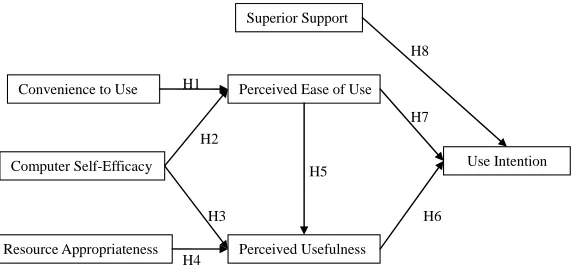
The research model tested in this study (Figure 1) was de-
veloped with reference to all the theories mentioned above. According to the present situation of computer based education (CBE) among rural primary schools in China, we propose 8 hypotheses influence teachers’ use intention of multimedia ins- truction resources.
H1: Convenience to use is positive correlated with Perceived Ease of Use;
H2: Computer Self-Efficacy is positive correlated with Per- ceived Ease of Use;
H3: Computer Self-Efficacy is positive correlated with Per- ceived Usefulness;
H4: Resource Appropriateness is positive correlated with Perceived Usefulness;
H5: Perceived Ease of Use is positive correlated with Per- ceived Usefulness;
H6: Perceived Usefulness is positive correlated with Use In- tention of multimedia instruction resources;
H7: Perceived Ease of Use is positive correlated with Use Intention of multimedia instruction resources;
H8: Superior Support is positive correlated with Use Inten- tion of multimedia instruction resources.
Methodology of the Study
Questionnaire
This study adopts the structure of close-ended questionnaire, adopts the Likert-Scale five-point measure questionnaire to explore Teachers’ Use Intention of Multimedia Instruction Re- sources among rural primary schools in China. There were 22 items of teachers’ use intention asked. The items are measured on a 5-point scale with 1 = strongly disagree, 2 = disagree, 3 = slightly agree, 4 = agree, and 5 = strongly agree. Each ques- tionnaire took 15 - 20 minutes to complete. The questionnaire was developed in Chinese.
Procedure
Test InvestigationAfter we finished the original questionnaire, we sent the questionnaires to 30 teachers of a middle school in Yongchuan Chongqing for a preliminary investigation and analysised the Validity and Reliability of the test paper. According to the re- sults, we deleted some items, and revised statement of some items and layouts of the paper, then we got the formal ques- tionnaire. The measure items was provided in the formal ques-
Superior Support
Perceived Usefulness Perceived Ease of Use
Resource Appropriateness Computer Self-Efficacy
Convenience to Use
[image:2.595.157.446.578.714.2]Use Intention H8 H1 H3 H6 H7 H5 H2 H4 Figure 1.
tionnaire as appendix.
Formal Investigation
The target population for the validation study was rural pri- mary school teachers in Chongqing.
We selected the samples by stratified random sampling. First, There are 19 Districts, 17 Counties and 4 Minority Autono- mous Counties. We numbered the districts and counties, then sample 4 Districts, 3 Counties and 1 Minority Autonomous County by systematic sampling. Second, we randomly selected 18 rural primary schools in the districts and counties, and then hand out the paper to the teachers at these schools.
Data for the investigation were collected for three months, from October 2012 to December 2012. We totally hand out 300 questionnaires, recall 263 questionnaires. The response rate was 88%, 234 questionnaires were available. There are 125 males and 109 females. The respondents for teaching years are presented in
Table 1 while for the teaching discipline shown in Table 2.
Data Analysis
Reliability and Validity Analysis
In result of reliability analysis, CITC (Corrected Item-Total Correlation) of each item is big than .5, and Cronbach’s Alpha is big than .7, According to Anne M. Smith, the internal con- sistency of items meet the reliability requirements.
Construct validity contains convergent validity and discri- minant validity.
According to Fornell and Larcker, convergent validity must come up to three standards: 1) factor loading > 5; 2) composite reliability (CR) > 8; 3) average variance extracted (AVE) > 5. In our vestigation, the data meet the convergent validity. Ac-
cording to Fornell and Larcker, if average variance extracted (AVE) of factor itself is big than AVE of factors between each other, it is shown that the data meet the discriminant validity.
In summary, the study meets the convergent validity and dis- criminant validity, in other word, has good construct validity.
Model Evaluation and Explanation
In order to evaluation the model shown in Figure 1, it is es- sential to examine the goodness of fit between model and data. We use AMOS7.0 to implement structural equation analysis, all fit indexes shown in Table 3.
According to Table 3, fit indexes of the model are meet the requirement, in other word, the model can be used to verify hy- pothesis.
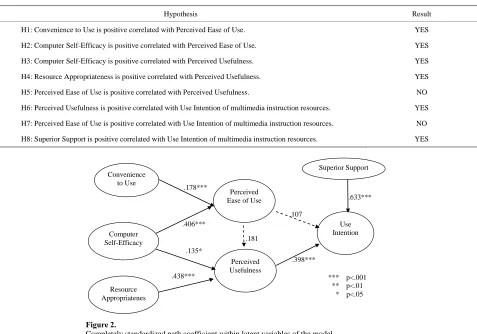
Based AMOS, we get Figure 2, which shows completely standardized path coefficient within latent variables of the mo- del.
According to Figure 2, the result of the hypothesis verifica- tion as follows in Table 4.
Conclusions
There are 4 factors affect teachers’ use intention of multime- dia instruction resources among rural primary schools in China, including Superior Support, Perceived Usefulness, Resource Ap- propriateness and Computer Self-Efficacy. Superior Support and Perceived Usefulness have direct influence on Use Inten- tion, also Resource Appropriateness and Computer Self-Effi- cacy have indirect influence on Use Intention.
It is a cheering thing that the Chinese government has been paying more and more attention on education informatization.
Table 1.
Respondents for teaching years.
Teaching Years 1 - 5 6 - 10 11 - 15 16 - 20 21 - 25 26 and more Total
Number of Pepole 63 56 55 40 14 6 234
Table 2.
Respondents for teaching discipline.
Discipline Chinese Math English Art Music Social Science Sport
Number of Pepole 83 76 22 14 11 10 10 8
Table 3.
Fit indexes of the model.
Fit Index Recommended Value The Model’s Value
χ2
/df χ2/df < 3 2.903
Normal Fit Index (NFI) >9 .848
Incremental Fit Index (IFI) >9 .925
Comparative Fit Index (CFI) >9 .924
Goodness-of-Fit Index (GFI) >8 .804
Adjusted Goodness-of-Fit Index (AGFI) >8 .783
Table 4.
Result of the hypothesis verification.
Hypothesis Result
H1: Convenience to Use is positive correlated with Perceived Ease of Use. YES
H2: Computer Self-Efficacy is positive correlated with Perceived Ease of Use. YES
H3: Computer Self-Efficacy is positive correlated with Perceived Usefulness. YES
H4: Resource Appropriateness is positive correlated with Perceived Usefulness. YES
H5: Perceived Ease of Use is positive correlated with Perceived Usefulness. NO
H6: Perceived Usefulness is positive correlated with Use Intention of multimedia instruction resources. YES
H7: Perceived Ease of Use is positive correlated with Use Intention of multimedia instruction resources. NO
H8: Superior Support is positive correlated with Use Intention of multimedia instruction resources. YES
Perceived Ease of Use
Perceived Usefulness Convenience
to Use
Computer Self-Efficacy
Resource Appropriatenes
Superior Support
Use Intention .178***
.181
.107
.633***
.398*** .406***
.135*
.438*** *** p<.001
[image:4.595.147.460.250.433.2]** p<.01 * p<.05
Figure 2.
Completely standardized path coefficient within latent variables of the model.
We should develop multimedia instruction resources based on needs of rural teachers and help teachers sharpen up their com- puter skills. Although there is a long way to go, we have good faith in that rural teachers are ready to contribute our wisdom and diligence to create a new education prospect in the infor- mation era.
REFERENCES
Ajzen, I. (1985). From intentions to actions: A theory of planned be- havior. In: J. Kuhl, & J. Beckman (Eds.), Action control: From cog- nition to behavior (pp. 11-39). Heidelberg: Springer.
Bandura, A. (1986). Social foundations of thought and action: A social cognitive theory. Englewood Cliffs, NJ: Prentice Hall.
Chau, P. Y. (2001). Influence of computer attitude and self-efficacy on IT usage behavior. Journal of End User Computing, 13, 26-33.
Chen, Y. (2005). The usage of technology acceptance model in web-
based education. The Chinese Journal of ICT in Education, 2, 72-73. Chongqing statistical year book 2012.
http://www.cqtj.gov.cn/tjnj/ 2012/indexch.htm
Compeau, D., & Higgins, C. (1995). Computer self-efficacy: Develop- ment of a measure and initial test. MIS Quarterly, 19, 189-211.
Davis, F. D. (1989). Perceived usefulness, perceived ease of use, and user acceptance of information technology. MIS Quarterly, 13, 319-
340.
Gong, M., Xu, Y., & Yu, Y. C. (2004). An enhanced technology ac- ceptance model for web-based learning. Journal of Information Sys- tems Education, 15, 365-374.
Hua, Y.-D. (2008). Using TAM to explore children’s moodle learning behavior-taking an issue of computing education as example. Tai- chung: TungHai University.
Stoel, L., & Lee, K. H. (2003). Modeling the effect of experience on student acceptance of web-based courseware. Internet Research, 13,
Appendix
Questionnaire of Teachers’ Use Intention of Multimedia Instruction Resources
附录 农村小学教师多媒体教学资源使用意愿调查问卷
尊敬的老师:
您好!为了解教师对多媒体教学资源的使用意愿,我们特进行这次调查。
所有回答无关对错,您只需要按照您的真实感受填写即可。本次调查结果仅用于学术研究并一律匿名,对于您提供的信 息我们绝对保密。衷心感谢您的支持!
第一部分:基本信息。请在符合您情况的选项后[ ]中打“√”,或在须填写的地方填写。
1. 您的性别: (A) 男 [ ] (B) 女 [ ]
2. 您所在学校位于重庆市_______区/县_______镇/乡,全称是_____________________。
3. 您所在学校的级别是:(A) 九年制学校 [ ] (B) 初级中学 [ ] (C) 完中[ ]
4. 您任教的时间:
(A) 1 - 5年 [ ] (B) 6 - 10年 [ ] (C) 11 - 15年 [ ]
(D) 16 - 20年 [ ] (E) 21 - 25年 [ ] (F) 26年及以上 [ ] 5. 文化程度:
(A) 小学 [ ] (B) 初中 [ ] (C) 技校 [ ] (D) 高中 [ ] (E) 中专/中师 [ ] (F) 大专 [ ] (G) 本科 [ ] (H) 硕士 [ ] (I) 博士 [ ]
6. 您执教的科目(请注明):[ _______________ ] 7. 您曾经使用过多媒体教学资源进行教学吗?
(A) 使用过 [ ] (B) 从未使用过 [ ]
第二部分:请根据对题目陈述观点的认同程度,在相应的题号[ ] 内打“√”(单选)。 1 = 完全不同意、2 = 不太同意、3 = 不能确定、4 = 基本同意、5 = 完全同意。
说明:多媒体教学资源指在教学中使用的基于计算机的各种资源,如课件、动画、视频、网络内容、课堂实录等。
第一组 (Perceived Usefulness) 完全不同意 不太同意 不能确定 基本同意 完全同意
1. 我认为使用多媒体教学资源对提高我的教学效率有帮助。……… [1] [2] [3] [4] [5]
2. 我认为使用多媒体教学资源可以改善我的教学方法。……… [1] [2] [3] [4] [5]
3. 我认为使用多媒体教学资源能提高我班学生学习成绩。……… [1] [2] [3] [4] [5]
4. 我认为使用多媒体教学资源对提高我的教学效率没有帮助。……… [1] [2] [3] [4] [5]
第二组 (Perceived Ease of Use) 完全不同意 不太同意 不能确定 基本同意 完全同意
1. 对我而言,熟练使用多媒体教学资源很容易。……… [1] [2] [3] [4] [5]
2. 对我而言,多媒体教学资源的使用很简单……… [1] [2] [3] [4] [5]
3. 我认为,多媒体教学资源容易使用。……… [1] [2] [3] [4] [5]
第三组 (Computer Self-Efficacy) 完全不同意 不太同意 不能确定 基本同意 完全同意
1. 我自信能够顺利的运行、退出 Windows 环境下的各种应用程序和上因特网。 [1] [2] [3] [4] [5]
2. 我自信能够使用计算机收发邮件、使用QQ 或 MSN 交流。……… [1] [2] [3] [4] [5]
3. 我自信能够在网上搜索需要的信息和下载自由软件。……… [1] [2] [3] [4] [5]
4. 我自信能够使用计算机进行文字处理和图形图像处理。……… [1] [2] [3] [4] [5]
第四组 (Resource Appropriateness) 完全不同意 不太同意 不能确定 基本同意 完全同意
1. 在多媒体教学资源中能找到与我目前教学进度相同的教学素材。……… [1] [2] [3] [4] [5]
2. 多媒体教学资源提供的素材配套教材与我使用的教材相同。……… [1] [2] [3] [4] [5]
3. 进行简单的编辑后,多媒体教学资源的素材可以很好地运用到我的教学中。 [1] [2] [3] [4] [5]
Continued
第五组 (Superior Support) 完全不同意 不太同意 不能确定 基本同意 完全同意
1. 学校领导支持我们使用多媒体教学资源备课或教学。……… [1] [2] [3] [4] [5]
2. 学校政策鼓励我们使用多媒体教学资源备课或教学(如与评奖评职称挂钩等)。 [1] [2] [3] [4] [5]
3. 上级领导曾来校检查我校使用多媒体教学资源教学的情况。………. [1] [2] [3] [4] [5]
第六组 (Convenience to Use) 完全不同意 不太同意 不能确定 基本同意 完全同意
1. 学校设备充足,能随时满足我的使用需要。……… [1] [2] [3] [4] [5]
2. 学校农远设备运行正常,能够满足我的使用。……… [1] [2] [3] [4] [5]
3. 学校多媒体教学资源有专人下载整理以满足教学需要。……… [1] [2] [3] [4] [5]
4. 学校给我充分的权限使用教学需要的多媒体教学资源。……… [1] [2] [3] [4] [5]
第七组 (Use Intention) 完全不同意 不太同意 不能确定 基本同意 完全同意
1. 我打算开始使用或继续使用多媒体教学资源。……… [1] [2] [3] [4] [5]
2. 我愿意在教学中尝试更多的多媒体教学资源使用方式。……… [1] [2] [3] [4] [5]
3. 我愿意经常使用多媒体教学资源。……… [1] [2] [3] [4] [5]
问卷填写日期:_______年_____月_____日