Early versus Late Tracheostomy for Ventilator
Dependence after Cardiovascular Surgery:
Long-Term Results
Joseph M. Ladowski*, Hannah E. Downey, Bennet J. Ladowski, Joseph S. Ladowski Lutheran Hospital of Indiana, Fort Wayne, USA
Email: *[email protected], [email protected], [email protected]
Received June 11, 2013; revised July 11, 2013; accepted July 18, 2013
Copyright © 2013 Joseph M. Ladowski et al. This is an open access article distributed under the Creative Commons Attribution
Li-cense, which permits unrestricted use, distribution, and reproduction in any medium, provided the original work is properly cited.
ABSTRACT
Although concerns exist about the possibility of infecting a sternotomy wound by performing a tracheostomy early after cardiac surgery, it has been shown that tracheostomy performed before postoperative day 10 can improve outcomes for cardiovascular surgery patients who require long-term ventilation. We retrospectively reviewed all charts for patients who underwent cardiovascular surgery and required tracheostomy at a single-institution site from January 2005 to July 2012. Patients were divided into two groups based upon whether their tracheostomy was performed less than 10 days after their initial operation (early tracheostomy) or ≥10 days after their initial operation (late tracheostomy). Preopera- tive demographics and postoperative complications were studied. There were no new mediastinitis episodes following tracheostomy. Early tracheostomy was associated with higher 90-day (74.4% vs 56.8%) and 180-day (47.4% vs 28.7%, p < 0.047) survival when compared to late tracheostomy. Early tracheostomy after cardiovascular surgery does not seem to be associated with an increased rate of mediastinitis but is associated with improved survival.
Keywords: Surgery Cardiovascular; Injury Lung; Intensive Care; Mediastinitis
1. Introduction
Long-term ventilator dependency following cardiovascu- lar surgery occurs in up to 20% of all patients [1]. For patient comfort and to facilitate ease of mechanical ven- tilation, tracheostomy is commonly performed upon ven- tilator-dependent patients. The timing of tracheostomy is open to debate. Some investigators have indicated that patients who undergo earlier tracheostomy (less than ten days postoperatively) have decreased length of stay, morbidity and mortality [2]. Others have found that ear- lier tracheostomy in noncardiovascular surgery patients is associated with shorter times on mechanical ventilation and lower costs [3]. This study is a retrospective analysis of 137 consecutive patients who underwent cardiovascu- lar surgery and required tracheostomy for long-term ven- tilator dependence. We analyzed these patients’ records to determine whether early or late tracheostomy would affect development of sternotomy wound infections and whether a strategy of early sternotomy would allow for improved survival.
2. Materials and Methods
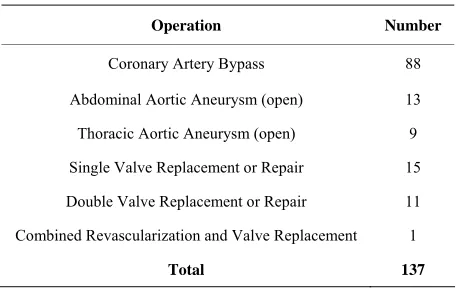
We retrospectively reviewed the charts of 137 consecu- tive patients who underwent cardiovascular surgery and subsequent tracheostomy from January 2005 to July 2012 at Lutheran Hospital of Indiana. The types of initial op- erations are summarized in Table 1.
[image:1.595.309.539.592.737.2]The time interval from initial operation to tracheo- stomy was decided clinically based upon the surgeon’s
Table 1. Types of operations.
Operation Number
Coronary Artery Bypass 88
Abdominal Aortic Aneurysm (open) 13
Thoracic Aortic Aneurysm (open) 9
Single Valve Replacement or Repair 15
Double Valve Replacement or Repair 11
Combined Revascularization and Valve Replacement 1
Total 137
impression, aided by pulmonary consultation, that the pa- tient would require prolonged ventilation. Tracheostomy was performed surgically with standard transverse neck incision and cephalocaudad tracheal incision followed by insertion of a tracheostomy appliance under direct vision. During this period, none of our tracheostomy procedures were done in a percutaneous fashion.
Statistical analysis of data was performed by subject- ing survival data to Kaplan-Meier analysis. Significance was determined if p was <0.05 by Mantel-Cox log rank analysis.
Sixteen variables were studied for their univariate (Fisher’s exact test for frequencies and analysis of vari- ance for comparison of means) influence upon mortality. These variables are summarized in Table 2. All patient data was kept anonymous for reporting purposes.
3. Results
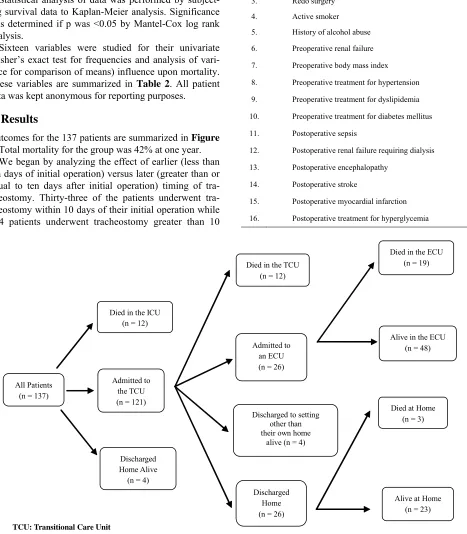
Outcomes for the 137 patients are summarized in Figure 1. Total mortality for the group was 42% at one year.
We began by analyzing the effect of earlier (less than ten days of initial operation) versus later (greater than or equal to ten days after initial operation) timing of tra- cheostomy. Thirty-three of the patients underwent tra- cheostomy within 10 days of their initial operation while 104 patients underwent tracheostomy greater than 10
days following their initial operation. Those patients who
Table 2. Variables studied for their possible association with mortality.
1. Gender
2. Age
3. Redo surgery
4. Active smoker
5. History of alcohol abuse
6. Preoperative renal failure
7. Preoperative body mass index
8. Preoperative treatment for hypertension
9. Preoperative treatment for dyslipidemia
10. Preoperative treatment for diabetes mellitus
11. Postoperative sepsis
12. Postoperative renal failure requiring dialysis
13. Postoperative encephalopathy
14. Postoperative stroke
15. Postoperative myocardial infarction
16. Postoperative treatment for hyperglycemia
Died in the ICU (n = 12)
Admitted to the TCU (n = 121)
Discharged Home Alive
(n = 4)
Died in the TCU (n = 12)
Admitted to an ECU (n = 26)
Discharged to setting other than their own home
alive (n = 4)
Died in the ECU (n = 19)
Alive in the ECU (n = 48)
Died at Home (n = 3)
Alive at Home (n = 23) All Patients
(n = 137)
Discharged Home (n = 26)
TCU: Transitional Care Unit
ECU: Extended Care Unit
[image:2.595.68.535.176.710.2]underwent tracheostomy within ten days of their initial Importantly, the early and late tracheostomy groups w
uire tracheostomy for failure to wean
[image:3.595.59.538.496.738.2], other investigations have found that pa- tie
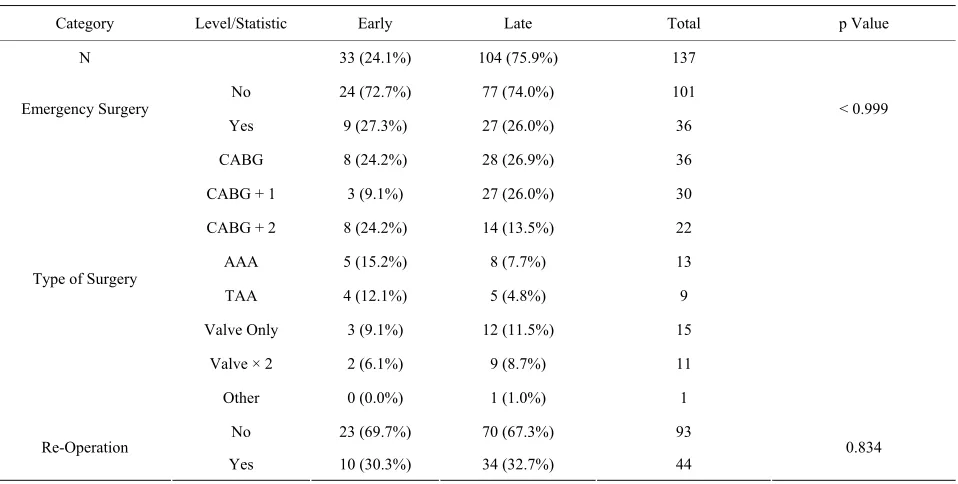
Table 3. Comparison of types of initial operations in early and late tracheostomy groups.
Category p Value
procedure had 90- and 180-day survivals of 74.4% and 74.4% respectively while patients who underwent tra- cheostomy greater than ten days following their initial procedure had 90- and 180-day survivals of 56.8% and 28.7% respectively (p < 0.047).
We next attempted to analyze whether or not the 33 patients who had early tracheostomy were similar in de- mographic makeup to the 104 patients who had late tra- cheostomy. The two groups were not significantly dif- ferent in terms of gender, history of alcohol abuse, height, weight, body mass index (BMI), or preoperative presence of diabetes, hypertension, dyslipidemia, or renal failure. The two groups did differ regarding smoker status as 50% of the late tracheostomy group had never smoked compared to 39.4% of the early tracheostomy group (p = 0.034). The late tracheostomy group was also older than the early tracheostomy group with 70.2% of the former being greater than 69 years while only 54.6% of the latter were older than 69 (p = 0.012). Additionally we analyzed the type of initial surgical procedures that the patients had undergone. The early and late tracheostomy groups did not differ in type of initial operation (Table 3).
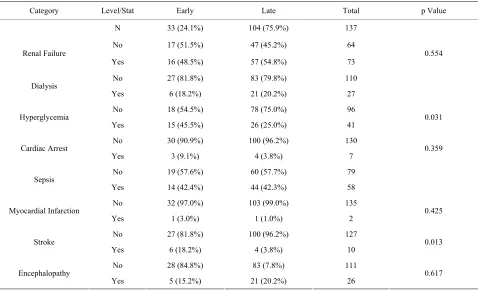
We then attempted to analyze whether the early versus late tracheostomy groups differed in incidences of post- operative complications. Table 4 summarizes these data. The late tracheostomy group had a lower incidence of
postoperative stroke and a lower incidence of significant
hyperglycemia. The incidence of dialysis-dependent re- nal failure, cardiac arrest, sepsis, myocardial infarction, and encephalopathy was not different between the two groups.
ho had undergone sternotomy for initial operation did not have a significant difference in incidence of devel- oping sternal wound complications following their tra- cheostomy (none in each group).
4. Discussion
Patients who reqfrom a ventilator after major cardiovascular surgery are known to have a markedly increased likelihood of mor- tality with hospital mortality as high as 49% [4]. It has been suggested that earlier tracheostomy might lead to better survival [2] for these patients.
Early tracheostomy after sternotomy has been found to be associated with increased risk of mediastinitis by one investigator [5]. This finding was not confirmed by sub-sequent studies [6-8]. We found no mediastinitis that developed after tracheostomy in the early or late group and were reassured that early tracheostomy does not necessarily increased the incidence of mediastinitis after sternotomy.
As expected
nts who require tracheostomy after major cardiovas- cular surgery suffer increased mortality if they have sig- nificant preoperative renal failure or stroke morbidity present [9]. Similarly, patients who experience worsen- ing organ function after cardiovascular surgery are at increased risk for death [10]. Although our late tracheo- stomy group was older, they had fewer smokers and ex- perienced a lower incidence of postoperative stroke and a lower incidence of postoperative hyperglycemia. Despite
Level/Statistic Early Late Total
N 33 (24.1%) 104 (75.9%) 137
No
Emergency Surgery < 0.999
CABG
CABG + 1
Valve Only 1
Type of Surgery
2 7
24 (72.7%) 77 (74.0%) 101
Yes 9 (27.3%) 27 (26.0%) 36
8 (24.2%) 28 (26.9%) 36
3 (9.1%) 27 (26.0%) 30
CABG + 2 8 (24.2%) 14 (13.5%) 22
AAA 5 (15.2%) 8 (7.7%) 13
TAA 4 (12.1%) 5 (4.8%) 9
3 (9.1%) 2 (11.5%) 15
Valve × 2 2 (6.1%) 9 (8.7%) 11
Other 0 (0.0%) 1 (1.0%) 1
No 3 (69.7%) 0 (67.3%) 93 Re-Operation
Table st-operati tions in us late tracheostomy groups.
Category p Value
4. Po ve complica early vers
Level/Stat Early Late Total
N 33 (24.1%) 104 (75.9%) 137
No 17 (51.5%) 47 (45.2%) 64
Renal Failure 0.554
Dialysis
Hyperglycemia 0.031
Cardiac Arrest 0.359
1 6
Sepsis
Myocardial Infarction 0.425
2 1 127
Stroke 0.013
Encephalopathy 0.617
Yes 16 (48.5%) 57 (54.8%) 73
No 27 (81.8%) 83 (79.8%) 110
Yes 6 (18.2%) 21 (20.2%) 27
No 18 (54.5%) 78 (75.0%) 96
Yes 15 (45.5%) 26 (25.0%) 41
No 30 (90.9%) 100 (96.2%) 130
Yes 3 (9.1%) 4 (3.8%) 7
No 9 (57.6%) 0 (57.7%) 79
Yes 14 (42.4%) 44 (42.3%) 58
No 32 (97.0%) 103 (99.0%) 135
Yes 1 (3.0%) 1 (1.0%) 2
No 7 (81.8%) 00 (96.2%)
Yes 6 (18.2%) 4 (3.8%) 10
No 28 (84.8%) 83 (7.8%) 111
Yes 5 (15.2%) 21 (20.2%) 26
a higher prevalence of these latter three risk factors, the
ire tracheostomy following cardiovas-
sis, data acquisition,
manu-script.
ES
[1] S. C. Murthy, A. C. Arroliga, P. A. Walts, et al., “Venti-
latory Depend ar Surgery,” Jour-
early tracheostomy group was found to have improved survival compared to the late tracheostomy group.
Limitations of this study include the fact that this was a retrospective analysis with no attempt to randomize patients to early or later tracheostomy. None of the tra- cheostomies were performed with percutaneous tech- niques, which actually serves to provide standardization of technique throughout this study. Although the decision to perform early or later tracheostomy was made based upon subjective criteria of whether or not the patient could be weaned from mechanical ventilation, there does not seem to be a deliberate effort to perform later tra- cheostomy on the sicker patients, as evidenced by the lower incidence of postoperative complications (stroke and hyperglycemia) in the late tracheostomy patients.
5. Conclusion
Patients who requcular surgery have significant risk of death with one year mortality of 42%. A strategy of early tracheostomy, within ten days of the initial cardiovascular procedure, does not lead to an increase in risk of mediastinitis and seems to be associated with better chance for survival.
6. Acknowledgements
J. M. Ladowski—data analyH. E. Downey—data acquisition and analysis and ma- nuscript preparation.
B. J. Ladowski—data acquisition and manuscript pre- paration.
J. S. Ladowski—original concept, data analysis, manu- script review, guarantor of paper.
REFERENC
ence after Cardiovascul
nal Thorac Cardiovasc Surgery, Vol. 134, No. 2, 2007,
pp. 484-490. doi:10.1016/j.jtcvs.2007.03.006
[2] J. Devarajan, A. Vydyanathan, M. Xu, et al., “Early Tra-
cheostomy Is Associated with Improved Outcome in Pa- tients Who Require Prolonged Mechanical Ventilation after Cardiac Surgery,” Journal of the American College of Surgeons, Vol. 214, No. 6, 2012, pp. 1008-1016.
doi:10.1016/j.jamcollsurg.2012.03.005
[3] A. O. Brook, C. S. Sherman, J. Moley, et al., “Early Ver-
sus Late Tracheostomy in Patients Who Require Pro- longed Mechanical Ventilation,” American Journal of Critical Care, Vol. 9, No. 5, 2001, pp. 352-359.
[4] H. Ballota, T. Kandil, L. Generali, et al., “Tracheostomy
[image:4.595.59.537.100.391.2]cheostomy: A Risk Factor for Mediastinitis after Cardiac Operations,” The Annals of Thoracic Surgery, Vol. 72, No. 3, 2001, pp. 731-734.
doi:10.1016/S0003-4975(01)02835-1
[6] S. A. Stamenkovic, I. S. Morgan, D. R. Pontefract and C. Campanella, “Is Early Trache
tients with Median Sternotomy Incisioostomy Safe in Cardins?” The Annals of
ac Pa-
Thoracic Surgery, Vol. 69, No. 4, 2000, pp. 1152-1154. [7] P. B. Rahmanian, D. H. Adams, J. G. Castillo, et al.,
“Tracheostomy Is Not a Risk Factor for Deep Sternal Wound Infections after Cardiac Surgery,” The Annals of Thoracic Surgery, Vol. 84, No. 6, 2007, pp. 1984-1991.
doi:10.1016/j.athoracsur.2007.07.024
[8] S. D. Force, D. L. Miller, R. Petersen, et al., “Incidence of Deep Sternal Wound Infections after Tracheostomy in
Cardiac Surgery Patients,” The Annals of Thoracic Sur- gery, Vol. 80, No. 2, 2005, pp. 618-621.
doi:10.1016/j.athoracsur.2005.02.056 [9] M. Engoran, N. F. Buderer and A. Zacharia
Survival and Health Status after Prolonged Mechanical s, “Long Term Ventilation after Cardiac Surgery,” Critical Care Medi- cine, Vol. 28, No. 8, 2000, pp. 2742-2749.
doi:10.1097/00003246-200008000-00010 [10] P. A. Walts, S. C. Murthy, A. C. Arroliga,
cheostomy after Cardiovascular Surgery: A
et al., “Tra-