Munich Personal RePEc Archive
Risk components in UK cross-sectional
equities: evidence of regimes and
overstated parametric estimates
Rossi, Francesco
30 November 2011
Modelling systematic and non-systematic risk in U.K. cross-sectional equities:
evidence of regimes and overstated parametric estimates
Francesco Rossi
UCD Michael Smurfit Graduate Business School
Banking & Finance
Dublin, Ireland
DUBLIN, IRELAND
NOVEMBER 2011 Abstract
We study the behavior and interaction of systematic and idiosyncratic components of risk in a
cross-section of U.K. stocks. We find no clear evidence of a trend in any component of total risk,
but we document different “regimes” in the behavior of each component of total risk, in their
correlation patterns and thus in their contribution to aggregate risk. Comparing parametric and
non-parametric estimates of residual risk, we find the former to significantly overstate
diversifiable risk, opposite to some previous findings for the U.S. market, with the difference
Contents
1. Introduction ...3
1.1 Modelling the behaviour and role of idiosyncratic risk ...3
1.2 Contribution ...5
2. Methodology and results ...5
2.1 Dataset ...5
2.2 Non-parametric volatility measures ...6
2.3 Comparison of parametric and non-parametric measures ... 13
3. Conclusions ... 18
1.
Introduction
1.1
Modelling the behaviour and role of idiosyncratic risk
Traditional asset pricing frameworks distinguish the determinants of the risk of assets between
systematic components, i.e. those driven by common, explicit risk factors, and “residual”,
“non-systematic” or “idiosyncratic” components. The idiosyncratic component can be thought of as
the component of returns that is specific of each single security – but also as the residual
component from a model that is by nature incomplete.
Within a broader stream of literature that looks to identify empirical pricing “anomalies”,
several researchers have studied the behaviour and role of the idiosyncratic component of
stock returns volatility, often documenting aggregate or cross-sectional effects partly
incompatible with the assumptions of traditional models. For instance, the CAPM assumption
that idiosyncratic risk should not be priced has been challenged both theoretically and
empirically, although with mixed results. But from a modelling standpoint, the behaviour of
idiosyncratic risk and its interaction with other risk sources is important for a number of
reasons. Firm-level volatility accounts for a large share - over sixty-percent according to some
estimates - of total volatility and volatility variation; in addition, asset holders and portfolio
managers are exposed to idiosyncratic risk because of portfolio or wealth constraints,
transaction costs, regulation, informational differences and explicit choice. As a result,
improving the knowledge of the determinants of such risk will bear consequence on asset
allocation decisions and from a risk-management standpoint improve the assessment of
portfolio risk exposures, in terms of breaking down the overall risk into factor exposures and
evaluating scenarios for the movement and correlation between them.
Idiosyncratic risk is defined as the risk that is unique to a specific firm, and it unobservable,
decomposition techniques to isolate it from systematic components of risk. Our analysis starts
from the results of papers such as Malkiel and Xu (1997), Campbell et al. (2001), Xu and
Malkiel (2003), that have measured and modelled idiosyncratic risk as part of an effort to
model the behaviour of total volatility, seen as the sum of market, sector and stock
components, revealing important features of the size, variation and trends of each component
that have important implication in a pricing framework. These papers using U.S. samples have
documented a strong correlation between the components, a particularly high variability of the
idiosyncratic one and its apparent upward trend - not accompanied by a rise in market
volatility. Although the finding of rising idiosyncratic risk has been questioned by more recent
papers (Bekaert, Hodrick, and Zhang (2008); Brandt, Brav, Graham, and Kumar (2010);
Bartram et al. (2009), Guo and Savickas (2008)) that have shown it is a product of a particular
sample, ending with the nineties, Campbell et al. (2001) also present evidence on the
characteristics and movement of the components of average volatility: firm-level volatility
accounts for the largest share of total volatility and volatility variation over time; the three
components of volatility move together and are countercyclical; market volatility tends to lead
the other volatility series. Moving away from U.S. samples, the results for international markets
are mixed. Bekaert et al. (2008) show that idiosyncratic risk has a large common component
across countries, which has gained importance over time. But the findings of Hamao et al.
(2003) for the post-crash Japanese market - a reduction in firm-level volatility in the context of
rising market volatility and equity co-movement – show clearly that the different micro and
1.2
Contribution
In our analysis of a U.K. sample, we apply the aggregate volatility decompositions of Malkiel
and Xu (1997) and Campbell et al. (2001), but we find no clear evidence of a trend in any
component of total risk; instead we find the idea of “regimes” emerging in Bekaert et al. (2008)
applicable and useful not only in modelling the pattern of each of the sub-components of total
risk, but also in modelling correlation patterns between each of them, and thus their
contribution to aggregate risk. This implies that the relative importance, variability and
co-variation of the components of total risk change significantly over time.
Comparing direct and indirect estimates of residual risk, we find the former to significantly
overstate diversifiable risk; this is the opposite of the findings of Xu and Malkiel (2003),
although they operate on a U.S. sample, use conditional estimates of both measures, and
obtain a moderate difference, while our difference is very large especially when we include the
industry component.
2.
Methodology and results
We estimate aggregate measures of volatility using both non-parametric and parametric
techniques.
2.1
Dataset
Our starting universe includes all stocks listed on the London stock exchange from January
1990 until December 2009, for which we collect monthly data from Datastream (prices,
returns, volume, outstanding shares and classification tags). A key issue emerging from the
literature on residual risk is the importance of controlling for the cross-sectional impact of
outliers, in the form of small and illiquid stocks. Bali et al. (2005) and Wei and Zhang (2005)
influenced by outliers. We deal with this issue, and with data-related problems in general,
using a combination of rigorous data-quality and investability filters, detailed fully in Rossi
(2011), including an in-depth cross-check and correction of the Datastream sample using a
second data source, Bloomberg. As a result, we are confident that our results are not
influenced to any significant degree by data errors or liquidity issues.
2.2
Non-parametric volatility measures
First, we compute the volatility of the market, as the standard deviation of the value-weighted
average of all single stock returns in our filtered sample1, over a twelve-month rolling window.
Second, we calculate the value-weighted sum of the volatilities of all stocks over time; this
corresponds to the “aggregate” volatility measure of Malkiel and Xu (2003), is of course higher
than the market volatility due to the correlation effect, and can be viewed as the overall
volatility of a typical stock. Then we take the difference between the two measures to obtain the
portion of idiosyncratic volatility of the stocks in the index, which is diversified away in the
value-weighted portfolio. This idiosyncratic risk component is found to be trending up in Xu
and Malkiel (1997), Malkiel and Xu (2003) and Campbell et al. (2001) for a sample of U.S.
stocks; Campbell et al. (2001), for instance, report that while market volatility has no
significant trend, firm-level variance displays a large and significant positive trend, more than
doubling between 1962 and 1997, with a corresponding decrease in correlations and in the
explanatory power of the single factor model. But later studies, such as Bekaert et al. (2008),
have questioned the existence of such trend, showing it is highly dependent on the specific
sample cut-off; Frazzini and Marsh (2003) find no trend on the idiosyncratic volatility
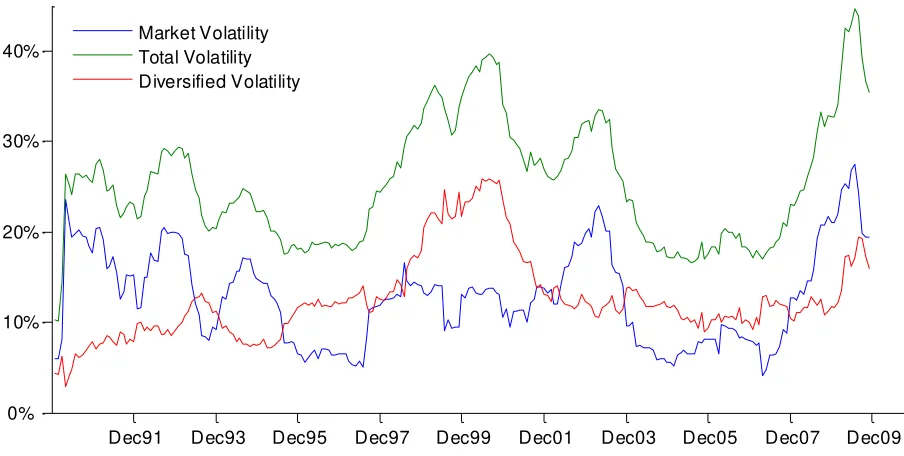
component for the U.K. market. In our sample, the existence of a trend is anything but evident,
with the idiosyncratic component oscillating around a level of 10%; graphical analysis points to
different “regimes” or periods of increased firm-specific risk, followed by phases of
normalization, implying that a trend could be detected if the end-point of a specific sample falls
during such episodes, but not otherwise. Two phases of marked increases in firm-level variance
can be observed in coincidence with the tech bubble and with the financial crisis at the end of
the sample. In contrast to the firm-specific component, the market component is much more
volatile around its mean, with multiple sharp increases corresponding to periods of turbulence
or recessions; the two components are comparable in average size, and one can graphically
spot that how they seem to move pretty independently of one another, often exhibiting a
negative correlation, except during the 2008 financial crisis. For example, it is evident that
while the volatility spikes of 1999 and 2002 are driven by only one component while the other
remains fairly stable, the 2008 spike is driven by increases in both components.
Dec91 Dec93 Dec95 Dec97 Dec99 Dec01 Dec03 Dec05 Dec07 Dec09 0%
10% 20% 30% 40%
Average Volatility Measures, %
[image:8.612.77.529.382.610.2]Market Volatility Total Volatility Diversified Volatility
Figure 1 - Aggregate volatility measures, % - The figure shows Total, Market and Diversified aggregate
volatility, computed as in Malkiel and Xu (2003). The values are annualized, estimated with a rolling window of twelve
We then perform a second non-parametric variance decomposition using the methodology of
Campbell et al. (2001), decomposing aggregate variance into market, industry, and
idiosyncratic components. The average variance of a randomly drawn stock is split into market
volatility2 2
mt
(called MKT), average industry volatility
2t (IND) and average firm-levelvolatility
2t (FIRM), without requiring any beta-estimation3.2 2 2
)
(
jit mt t ti j
jt i
it
Var
R
[1]
Dec91 Dec93 Dec95 Dec97 Dec99 Dec01 Dec03 Dec05 Dec07 Dec09 0% 4% 8% 12% A n n u a li ze d V a ri a n ce
Average variance components, %
[image:9.612.76.533.211.565.2]MKT IND FIRM
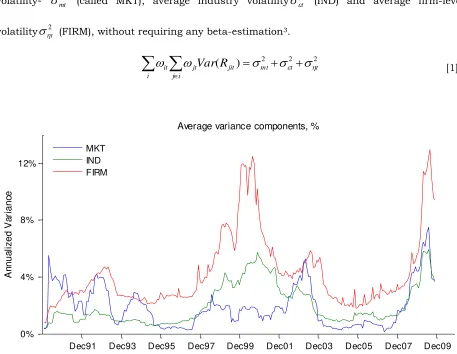
Figure 2 - Average variance components, %- The figure shows the components of the average variance of
a random stock: the market component (MKT), the industry-level (IND) and the firm-level component (FIRM). Data are
annualized and estimated with a rolling window of twelve monthly returns
The industry and firm components show a high degree of co-variation throughout the entire
sample. The market component, on the other hand, is fairly de-correlated with the other two at
least until the start of the last decade. Compared to the previous decomposition, which
separated systematic from the diversified component of volatility, this more granular
disaggregation into three components allows a better characterization of the volatility spike
corresponding to the 2008 financial crisis. Not only has the size of the increase in aggregate
total volatility been exceptional, but remarkably all three components moved up at the same
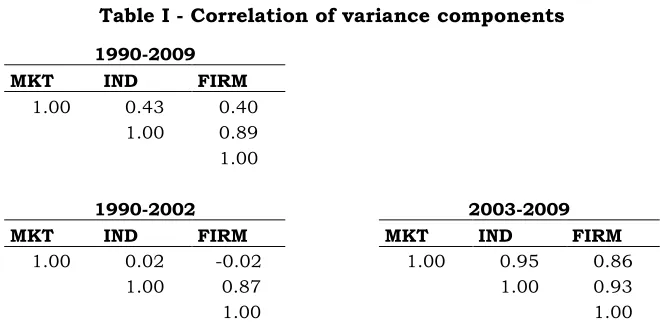
time, which had not been the case in the 1999 episode. Table I shows the correlation between
the three components of variance for the whole sample and for the sub-periods 1990-2002 and
2003-2009. While the correlation between the IND and the FIRM components remains always
very high, the correlation between the MKT component and the other two drops to zero to
slightly negative for the period up and including 2002, but becomes as high as 0.95 for the
second part of the sample from 2003 to 2009. To our knowledge, these distinctly different
[image:10.612.140.471.482.644.2]correlation “regimes” have not been previously documented.
Table I - Correlation of variance components
1990-2009 MKT IND FIRM
1.00 0.43 0.40 1.00 0.89 1.00
1990-2002 2003-2009
MKT IND FIRM MKT IND FIRM
1.00 0.02 -0.02 1.00 0.95 0.86
1.00 0.87 1.00 0.93
1.00 1.00
We now turn to examine how important the three volatility components are relative to the total
volatility of an average firm, in terms of mean and variation. Campbell et al. (2001) had found
firm-level volatility to be on average the largest portion of total volatility, accounting for over
70%, followed by marked volatility at 16% and firm-level volatility at 12%. Or results, shown in
Table II, are broadly consistent with Campbell et al. (2001), although they paint a somewhat
more balanced picture: the largest component is indeed FIRM, which accounts on average for
over 50% of total variance, with the rest evenly split between MKT and IND. The importance of
the industry-specific component is higher in our sample. However, the most striking result is
that, if we split again the sample in two around 2002, the relative contributions to the average
[image:11.612.134.479.399.453.2]total variance vary very little over the two selected sub-periods.
Table II - Decomposition of Mean of total variance, % values
MKT IND FIRM
1990-2009 0.23 0.25 0.52
1990-2002 0.23 0.25 0.53
2003-2009 0.24 0.24 0.52
Campbell et al. (2001) had shown, through a variance decomposition, that most of the
time-series variation in total volatility was due to variation in MKT and FIRM, with FIRM variance
and the covariation of MKT and FIRM being the two largest components; together they
accounted for about 60 percent of the total time-series variation in volatility, while the market
component alone contributed just by 15 percent. Relative to its mean, however, MKT showed
the greatest time-series variation, while the volatility of IND was more stable over time. To
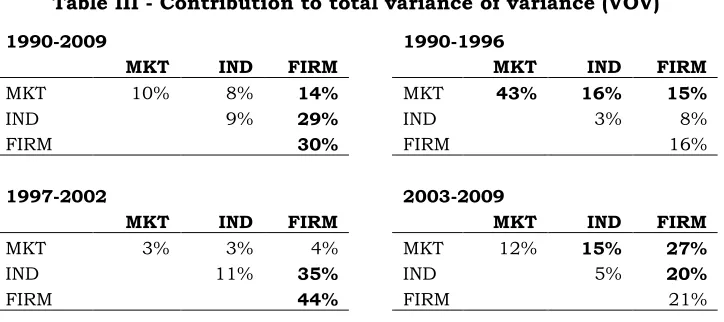
perform a decomposition4 of the variance of variance (VOV), we split our sample in three
periods of roughly equal length: 1990-1996, 1997-2002 and 2003-2009. Table III shows the
4In this paragraph we are discussing the “variance of variance” (VOV), thus terminology becomes slightly cumbersome
contribution to total VOV by the three components and their covariance terms. Similar to the
results of Campbell et al. (2001), the variance of FIRM is often a key driver of total VOV, but in
fact we can identify distinctively different “regimes” corresponding to our sub-sample periods.
In the 1990-1996 period, MKT is the primary driver, accounting alone for 43% of total VOV,
and totalling 75% with the added impact of its covariation with IND and FIRM; this was a
period of fairly low aggregate volatility, the variability of which was thus driven by market-wide
movements, with no industry-specific shocks. During the following period, 1997-2002, total
VOV is instead driven almost entirely by FIRM (44%) and by its covariation with IND (35%),
while the importance of MKT is negligible. This period, leading to and including the tech bubble
and its eventual burst, captures a regime dominated by stock-specific and industry-specific
volatility. The final period, 2003-2009, shows a more balanced contribution, in line with the
high correlations between the three components documented in Table I: the co-variation terms
[image:12.612.128.490.434.595.2]make up the bulk of total VOV.
Table III - Contribution to total variance of variance (VOV)
1990-2009 1990-1996
MKT IND FIRM MKT IND FIRM
MKT 10% 8% 14% MKT 43% 16% 15%
IND 9% 29% IND 3% 8%
FIRM 30% FIRM 16%
1997-2002 2003-2009
MKT IND FIRM MKT IND FIRM
MKT 3% 3% 4% MKT 12% 15% 27%
IND 11% 35% IND 5% 20%
FIRM 44% FIRM 21%
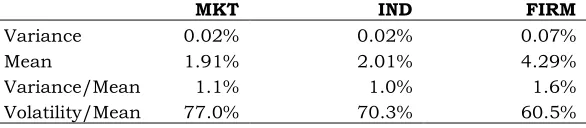
To describe the time-series variation of the variance components, we show in Table IV that
FIRM has the largest variance and mean, which explains its significant contribution to total
volatility; MKT and IND have lower values, similar to each other. Campbell et al. (2001) had
found MKT to have the highest variance relative to its mean; this is not true for our sample,
although both MKT and IND show a greater volatility relative to their means than FIRM5.
Overall, we can say that the contribution of FIRM to total VOV is expected to be always high,
given its high mean and variance. The contribution of MKT and IND is more variable with time,
but we can state that the contribution of MKT is the least predictable, as it shows the weaker
correlation with the other two components and a high volatility around its mean; IND shows
[image:13.612.161.454.387.451.2]instead a more slow-moving nature, and often mirrors FIRM, as can be seen easily in Figure 2.
Table IV - Time-series variation of variance components
MKT IND FIRM
Variance 0.02% 0.02% 0.07%
Mean 1.91% 2.01% 4.29%
Variance/Mean 1.1% 1.0% 1.6%
Volatility/Mean 77.0% 70.3% 60.5%
The Table shows the means, variance and volatility for the three components of total variance
Summarizing, we have the following results:
i. The correlation between the three components of total variance varies substantially over
time, although they tend to move together and experience periods of strongly positive
co-variation. The exception is the relationship between FIRM and IND, which is always very
strong: this implies that the joint contribution of the FIRM and IND (the stock-specific
and industry-specific components) to total variance is substantial, and very frequently a
large portion of that comes through the covariance terms. In contrast, the MKT
5 The inconsistency is only apparent here, as we are in fact showing that the results vary significantly with the selected
component shows periods of high correlation with the other two components, but also
periods of very weak or near zero correlation
ii. In terms of relative contribution to total variance, FIRM explains on average (including the
impact of half of its covariance terms) 52% of the total, followed by IND and MKT with
28% and 21% respectively, roughly a quarter each. However, although those
contributions to the level of overall variance appear quite stable, looking at the drivers of
changes in volatility we find the contributions of each component to the variance of
variance to vary greatly in different sub-periods, identifying distinctly different regimes
iii. In terms of time-series variation, FIRM has the largest absolute variance and mean; yet
MKT and then IND show the greatest volatility relative to their means. The contribution of
FIRM to total variation is expected to be always high, while the share of MKT and IND
changes more over time. Correlation analysis tells us that the contribution of MKT in
particular is more uncertain and difficult to predict, as it is more weakly correlated with
the other two components
2.3
Comparison of parametric and non-parametric measures
2.3.1Parametric estimation of risk factor loadings and residual risk
We obtain parametric estimates of systematic and idiosyncratic risk exposures running two
alternative regressions
ri,t= αi,t + βi,t rM,t + εi,t [2]
ri,t= αi,t + βi,t rM,t + hi,t HMLt + si,t SMBt + εi,t [3]
The first one is the market model, while the second one controls for the two additional
points, expanding from a minimum of 12 observations6. The monthly returns for the HML
factor is obtained from Kenneth R. French’s website7, while we compute the SMB factor by
sorting our filtered sample into ten size deciles.
We collect the series of β, s, h, estimated from the above regressions as our (contemporaneous)
estimates of systematic risk exposures. We also collect the series of the residuals εt to generate
estimates of the idiosyncratic risk σ2. We then build σ2 using the two alternative approaches
most common in the literature:
i. as the rolling standard deviation of the (rolling) series of εt over the 24 months window8
ii. fitting a GARCH(1,1) model to the series of the variance of εt over the 24 months window,
and generating on each period a forecast for the conditional volatility of εt . The model is
σt2= k + g σt-12+ a εt-1 [4]
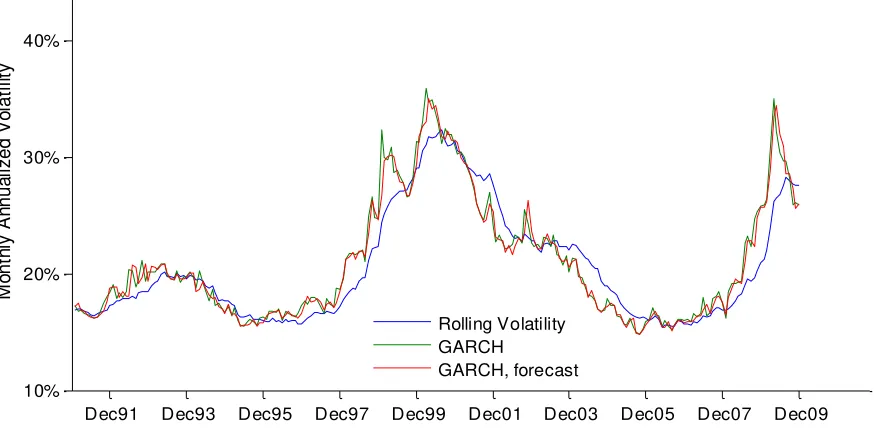
The results of the two estimation procedures are shown in Figure 3, where we display
aggregate, value-weighted measures of σt2across the entire sample.
6 Empirical methods to obtain estimates of risk premia vary, and should be considered carefully for their econometric
implications. For insance, OLS estimation over a rolling window assumes there is sufficient structure on the temporal variation in the parameters that OLS estimates may reasonably be interpreted as estimates of their mean values
7 http://mba.tuck.dartmouth.edu/pages/faculty/ken.french/data_library.html#International
8 The most commonly used procedure to estimate idiosyncratic volatility is to use the standard deviation of residuals
Dec91 Dec93 Dec95 Dec97 Dec99 Dec01 Dec03 Dec05 Dec07 Dec09 10%
20% 30% 40%
M
o
n
th
ly
A
n
n
u
a
lize
d
V
o
la
ti
lit
y
Aggregate Average Idiosyncratic Volatility, %
Rolling Volatility GARCH
[image:16.612.76.513.135.350.2]GARCH, forecast
Figure 3 - Average idiosyncratic volatility, % - The figure shows average (value-weighted) idiosyncratic
volatility measures, in annualized % terms, built from the residuals series from the cross-sectional single factor model regression. For each month t, we show three alternative volatility estimates: the simple standard deviation of the residual series, the conditional GARCH(1,1) volatility, and the conditional GARCH(1,1) volatility forecast for month t+1
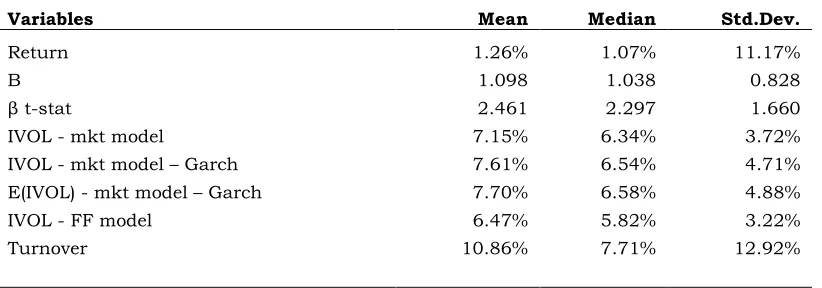
Having obtained estimates of risk-factor exposures, Table V presents the variable descriptive
Table V - Variable descriptive statistics for the pooled sample
Variables Mean Median Std.Dev.
Return 1.26% 1.07% 11.17%
Β 1.098 1.038 0.828
β t-stat 2.461 2.297 1.660
IVOL - mkt model 7.15% 6.34% 3.72%
IVOL - mkt model – Garch 7.61% 6.54% 4.71%
E(IVOL) - mkt model – Garch 7.70% 6.58% 4.88%
IVOL - FF model 6.47% 5.82% 3.22%
Turnover 10.86% 7.71% 12.92%
Descriptive statistics for the pooled sample - monthly data from January 1990 to December 2009.
The “Mean” values are not market-value weighted but equally weighted. The first 12 months (January-December 1990) have been excluded to allow for estimation of betas and volatility terms.
“IVOL” is the cross-sectional idiosyncratic volatility, obtained regressing stock returns on a constant and the market return; “IVOL - mkt model”, “IVOL - mkt model – Garch” and “E(IVOL) - mkt model - Garch” are obtained from the residuals of a single factor model regression, and are respectively a rolling 24-month average, a GARCH(1,1) term and its 1-period-ahead forecast. “IVOL - FF model” is
instead obtained from a 24-month average of residuals from a Fama-French regression.
2.3.2Comparing parametric and non-parametric residual risk measures
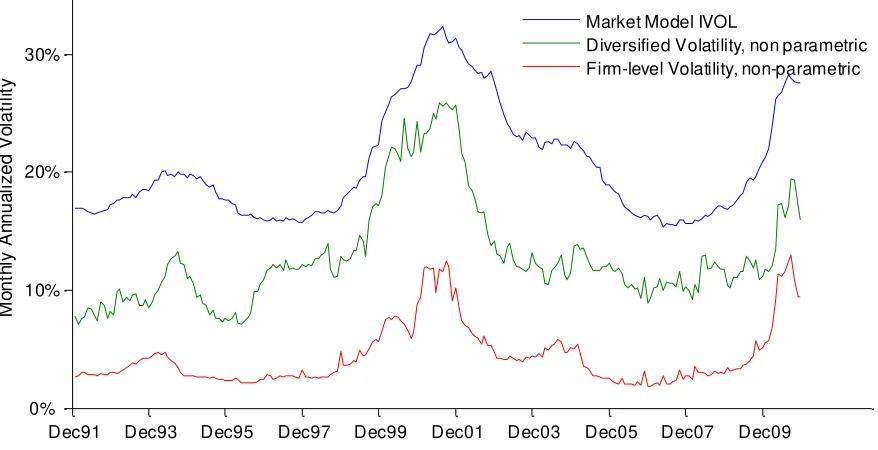
Comparing the average measure of residual risk built from the factor model regression
residuals to the non-parametric estimates of residual risk of Section 2.2, as we do in Figure 4
and Table VI, it is evident how either the single factor model or the Fama-French model do a
pretty poor job in capturing all sources of systematic risk. The single factor model parametric
measure is on average 1.6 and up to 2.5 times higher that the “diversified“ non-parametric
measure (5.4 and up to 9 times higher than the “firm-level” measure built using the
methodology of Campbell et al. (2001), which obtains as the component of average total risk
not driven by market or industry risk). The comparison does not improve much using the
parametric measure obtained from the Fama-French regression, as shown in Table VI . In
annualized volatility terms, this translates into a gap of 7.6% (16%) on average - and up to 15%
implies that idiosyncratic risk measures built from standard regressions reflect a substantial
amount of risk that, in reality, is systematic. It is worth noting that this result is the opposite
of the findings of Xu and Malkiel (2003), although they employ conditional estimates of both
measures, their sample is U.S.-based and their difference between the two measures is smaller
(the non-parametric measure is 0.1 times larger on average).
Dec91 Dec93 Dec95 Dec97 Dec99 Dec01 Dec03 Dec05 Dec07 Dec09 0% 10% 20% 30% M o n th ly A n n u a li ze d V o la ti lit y
Parametric and non-parametric measures of Idiosyncratic Volatility, %
Market Model IVOL
Diversified Volatility, non parametric Firm-level Volatility, non-parametric
Figure 4 - Parametric and non-parametric measures of Idiosyncratic Volatility, % - The
figure shows in blue the average (value-weighted) idiosyncratic volatility from the single factor model cross-sectional regression, together with the two non-parametric measures described in section Error! Reference source not found.:
[image:18.612.89.528.246.471.2]Table VI - Ratio of parametric estimates of average idiosyncratic volatility to
non-parametric estimates of diversified or stock-specific risk
Parametric Estimates
Single Factor Model
Fama-French Model
Non-parametric measures
Max
Average
Max
Average
Malkiel's "diversified" volatility
2.43
1.67
2.19
1.51
Campbell's firm-specific volatility
9.05
5.43
8.46
4.94
The table shows the ratio of parametric estimates of average idiosyncratic volatility (obtained with a single factor model regression or with a Fama-French regression) to non-parametric estimates of diversified or stock-specific
risk (the average “diversified” volatility built as in Xu and Malkiel (2003) or the firm-specific average volatility as in Campbell et al. (2001) )
The extent of this over-estimation of the idiosyncratic component, of extremely large
proportions in comparison to the measure of Campbell et al. (2001), suggests considerable
caution towards results claiming to find a significant cross-sectional price for residual risk;
they likely point to structural issues with the pricing model or with the systematic factor
exposures estimation procedure.
3.
Conclusions
We have reviewed and expanded some results on the behaviour of idiosyncratic risk and its
interaction with systematic components of total risk. Our analysis of a U.K. sample has
confirmed the idea that the components of total risk, including the idiosyncratic one, exhibit no
time trend, but we show that they are subject to regimes affecting substantially the pattern of
their movement and correlation and thus their contribution to aggregate risk. This implies that
the relative importance, variability and co-variation of the components of total risk change
significantly over time. We would stress two results. First, the Industry component and the
firm-specific (or idiosyncratic) component are always highly correlated, while the market
contribution of the three components to total risk is quite stable (with the firm-specific
component accounting for over half of the total), the drivers of changes in total risk are not. We
obtain another important result comparing parametric and non-parametric estimates of
residual risk, and finding that parametric measures greatly overstate diversifiable risk; this
implies that a large portion of parametric estimates of residual risk are likely to be in fact
References
Amihud, Yakov, 2002, Illiquidity and stock returns: cross-section and time-series effects,
Journal of Financial Markets, 5, 31-56.
Ang, Andrew, Robert J. Hodrick, Yuhang Xing, and Xiaoyan Zhang, 2009, High idiosyncratic
volatility and low returns: International and further U.S. Evidence, Journal of Financial
Economics 91, 1-23.
Ang, Andrew, Robert J. Hodrick, Xing Yuhang, and Zhang Xiaoyan, 2006, The cross-section of
volatility and expected returns, Journal of Finance 61, 259-299.
Arena, Matteo P., K. S. Haggard, and Xuemin Sterling Yan, 2008, Price momentum and
idiosyncratic volatility, FinancialReview 43, 159-190.
Bali, Turan G., Nusret Cakici, Zhang Zhe, and Y. A. N. Xuemin, 2005, Does idiosyncratic risk
really matter?, Journal of Finance 60, 905-929.
Bartram, Söhnke M., Gregory Brown and Rene M. Stulz, 2009, Why Do Foreign Firms Have
Less Idiosyncratic Risk than U.S. Firms?, Working Paper.
Basu, Devraj, and Lionel Martellini, 2007, Total volatility and the cross section of expected
stock returns, EFMA Working Paper, Draft.
Bekaert, Geert, Campbell R. Harvey and Christian Lundblad, 2007, Liquidity and Expected
Returns: Lessons from Emerging Markets, Review of Financial Studies 20, 1783-1831.
Bekaert, Geert, Robert J. Hodrick, and Xiaoyan Zhang, 2008, Is there a trend in idiosyncratic
volatility?, Working Paper.
Boyer, Brian H., Todd Mitton, and Keith Vorkink, 2008, Expected idiosyncratic skewness,
Brandt, Michael W., Alon Brav, John R. Graham and Alok Kumar, 2010, The Idiosyncratic
Volatility Puzzle: Time Trend or Speculative Episodes?, Review of Financial Studies 23,
863-899.
Brockman, Paul, Maria Gabriela Schutte and Wayne Yu, 2009, Is Idiosyncratic Risk Priced?
The International Evidence, Working Paper.
Campbell, John Y., Martin Lettau, Burton G. Malkiel, and Xu Yexiao, 2001, Have individual
stocks become more volatile? An empirical exploration of idiosyncratic risk, Journal of
Finance 56, 1-43.
Carhart, Mark M., 1997, On persistence in mutual fund performance, Journal of Finance 52,
57-82.
Chen, Joseph S., 2002, Intertemporal capm and the cross-section of stock returns, SSRN
eLibrary.
Chua, Choong Tze, Jeremy Goh, and Zhe Zhang, 2006, Idiosyncratic volatility matters for the
cross-section of returns - in more ways than one!, Working Paper.
Cremers, K. J. Martijn, and Jianping Mei, 2002, A new approach to the duo-factor-model of
return and volume, New York University, Working Paper.
Cremers, K. J. Martijn, and Jianping Mei, 2007, Turning over turnover, The Review of Financial
Studies 20, 1749.
Epstein, Larry G., and Martin Schneider, 2008, Ambiguity, information quality, and asset
pricing, Journal of Finance 63, 197-228.
Fama, Eugene F. 1968a, Risk, Return and Equilibrium, Center for Mathematical Studies in
Business and Economics, University of Chicago, Report No. 6831.
Fama, Eugene F., 1968b, Risk, Return, and Equilibrium: Some Clarifying Comment, Journal of
Fama, Eugene F., and Kenneth R. French, 1992. The cross-section of expected stock returns.
Journal of Finance 48, 427–465.
Fama, Eugene F., and Kenneth R. French, 2008, Dissecting anomalies, Journal of Finance 63,
1653-1678.
Frazzini, A., and L. Marsh, 2003, “Idiosyncratic Volatility in the US and UK Equity Markets,”
Unpublished Working Paper, Yale University.
French, K., G. Schwert, and R. Stambaugh, 1987, Expected stock returns and volatility,
Journal of Financial Economics.
Fu, Fangjian, 2009, Idiosyncratic risk and the cross-section of expected stock returns, Journal
of Financial Economics 91, 24-37.
Garcia, René, Daniel Mantilla-Garcia and Lionel Martellini, 2009, Idiosyncratic Risk and the
Cross-Section of Realized Returns: Reconciling the Aggregate Returns, Working Paper.
Guo, Hui and Robert Savickas, 2008, Average Idiosyncratic Volatility in G7 Countries, Review
of Financial Studies 21, 1259-1296.
Guo, Hui, and Robert Savickas, 2004, Idiosyncratic volatility, stock market volatility, and
expected stock returns, Working Paper.
Hamao, Yasushi, Jianping Mei, and Yexiao Xu, 2003, Idiosyncratic risk and the creative
destruction in Japan, NBER Working Paper.
He, Zhongzhi, Sahn-Wook Huh and Bong-Soo Lee, 2008, Is Dynamic Factors and Asset Pricing,
Working Paper.
Ince, Ozgur S., and Burt R. Porter, 2006, Individual equity return data from Thomson
Datastream: handle with care!, Journal of Financial Research 29, 1475-6803.
Jacobs, Kris, and Kevin Q. Wang, 2004, Idiosyncratic consumption risk and the cross section
Jegadeesh, Narasimhan, and Sheridan Titman, 2001, Profitability of momentum strategies: An
evaluation of alternative explanations, Journal of Finance 56, 699-720.
Jensen, Michael C., Fischer Black and Myron Scholes, 1972, The Capital Asset Pricing Model:
Some Empirical Tests, Studies in the theory of capital markets 81, 79-121.
Lehmann, Bruce N., 1986, Residual risk revisited, NBER Working Paper.
Lehmann, Bruce N., 1992, Empirical testing of asset pricing models, NBER Working Paper.
Li, Xiafei, Joëlle Miffre, Chris Brooks, and Niall O'Sullivan, 2008, Momentum profits and
time-varying unsystematic risk, Journal of Banking & Finance 32, 541-558.
Malkiel, B. G., and Yexiao Xu, 2002, Idiosyncratic risk and security returns, Working Paper.
Malkiel, Burton G., and Yexiao Xu, 1997, Risk and return revisited, Journal of Portfolio
Management 23, 9.
Merton, Robert C., 1987, A simple model of capital market equilibrium with incomplete
information, Journal of Finance 42, 483-510.
Rossi, Francesco, 2011, U.K. cross-sectional equity data: do not trust the dataset! The case for
robust investability filters, MPRA
Ruan, Tony, Quian Sun an Yexiao Xu, 2010, When Does Idiosyncratic Risk Really Matter?,
Working Paper.
Spiegel, Matthew, and Xiatong Wang, 2005, Cross-sectional variation in stock returns:
Liquidity and idiosyncratic risk, Yale School of Management, Working Paper.
Wei, Steven X., and Chu Zhang, 2005, Idiosyncratic risk does not matter: A re-examination of
the relationship between average returns and average volatilities, Journal of Banking &
Finance 29, 603–621
Xu, Yexiao, and Burton G. Malkiel, 2003, Investigating the behavior of idiosyncratic volatility,