I f A I æ s SiiwíÉFlEaP itmBSmmßm"wß tøW «HBS' » ■<
m
6 7 1
3 c mïKI'i4j!i
e
EGAL NOTICE
lii
This document was prepared under t h e sponsorship of t h e Commission of the European Communities.
Neither the Commission of t h e European Communities, its contractors
nor any person acting on their behalf :
lian
make any warranty or representation, express or implied, with respect to the accuracy, completeness, or usefulness of the information contained in this document, or that the use of any information, apparatus, method or process disclosed in this document may not infringe privately owned
ri6hb;or
i^lliiiSiffliliSiSi
assume any liability with respect to the use of, or for damages resulting from the use of any information, apparatus, method or process disclosed in this document.
føl
•AtófciéllwiS
• — i L .rt
sana
This report is on sale at the addresses Usted on cover page 4
at the price of F.Fr. 13.08 B.Fr. 125,
MM,
»lip«
Wgtøfflti
DM 9.20 It.Lire 1.560 Fl.9.-When ordering, please quote the E U R n u m b e r a n d the title which are indicated o n the cover of each report.
Ill
m
Jm
All
KMIPÍ
I
5rinted b y Guyot s.a., Brussels JH> i'· P¿»tfiinf'MitlLfahi i
EUR 4673 e
COSTANZA (R, Ζ) by E. VINCENTI and A. CLUSAZ
Commission of the European Communities
Joint Nuclear Research Centre - Ispra Establishment (Italy) Nuclear Studies Division
Luxembourg, July 1971 - 78 Pages - 7 Figures - B.Fr. 125,—
The code Costanza (R, Z) written in Fortran for IBM 360/65 solves the kinetic diffusion equations in two groups and two dimensions (radial and axial for a cylindrical reactor). The neutronic calculation is coupled with the calculation of the heat transmission from the fuel to the cladding and to the coolant, and with the thermohydraulics of channels with forced circulation of a single phase coolant.
Fuel elements of prismatic shape are considered. Up to 6 groups of delayed neutrons are allowed.
Temperature feedback of fuel and coolant are considered independently and affect the nuclear constants. Control rod movement or diffused poison
EUR 4673 e
COSTANZA (R, Ζ) by E. VINCENTI and A. CLUSAZ
Commission of the European Communities
Joint Nuclear Research Centre - Ispra Establishment (Italy) Nuclear Studies Division
Luxembourg, July 1971 - 78 Pages - 7 Figures - B.Fr. 125,—
The code Costanza (R, Z) written in Fortran for IBM 360/65 solves the kinetic diffusion equations in two groups and two dimensions (radial and axial for a cylindrical reactor). The neutronic calculation is coupled with the calculation of the heat transmission from the fuel to the cladding and to the coolant, and with the thermohydraulics of channels with forced circulation of a single phase coolant.
Fuel elements of prismatic shape are considered. Up to 6 groups of delayed neutrons are allowed.
Temperature feedback of fuel and coolant are considered independently and affect the nuclear constants. Control rod movement or diffused poison
EUR 4673 e
COSTANZA (R, Ζ) by E. VINCENTI and A. CLUSAZ
Commission of the European Communities
Joint Nuclear Research Centre - Ispra Establishment (Italy) Nuclear Studies Division
Luxembourg, July 1971 - 78 Pages - 7 Figures - B.Fr. 125,—
The code Costanza (R, Z) written in Fortran for IBM 360/65 solves the kinetic diffusion equations in two groups and two dimensions (radial and axial for a cylindrical reactor). The neutronic calculation is coupled with the calculation of the heat transmission from the fuel to the cladding and to the coolant, and with the thermohydraulics of channels with forced circulation of a single phase coolant.
Fuel elements of prismatic shape are considered. Up to 6 groups of delayed neutrons are allowed.
concentrations are simulated by externally imposed variations of the thermal absorption cross section in the different regions of the reactors.
Inlet temperatures and mass flow in the coolant channels may be varied according to any externally given time table.
Before starting the transient initial calculations put the reactor in criticality conditions at a given power level in equilibrium with the temperature feedback.
concentrations are simulated by externally imposed variations of the thermal absorption cross section in the different regions of the reactors.
Inlet temperatures and mass flow in the coolant channels may be varied according to any externally given time table.
Before starting the transient initial calculations put the reactor in criticality conditions at a given power level in equilibrium with the temperature feedback.
concentrations are simulated by externally imposed variations of the thermal absorption cross section in the different regions of the reactors.
Inlet temperatures and mass flow in the coolant channels may be varied according to any externally given time table.
E U R 4 6 7 3 e
COMMISSION OF THE EUROPEAN COMMUNITIES
COSTANZA (R,2)
by
E. VINCENTI and A. CLUSAZ
1971
Joint Nuclear Research Centre Ispra Establishment - Italy
A B S T R A C T
The code Costanza (R, Z) written in Fortran for IBM 360/65 solves the kinetic diffusion equations in two groups and two dimensions (radial and axial for a cylindrical reactor). The neutronic calculation is coupled with the calculation of the heat transmission from the fuel to the cladding and to the coolant, and with the thermohydraulics of channels with forced circulation of a single phase coolant.
Fuel elements of prismatic shape are considered. Up to 6 groups of delayed neutrons are allowed.
Temperature feedback of fuel and coolant are considered independently and affect the nuclear constants. Control rod movement or diffused poison concentrations are simulated by externally imposed variations of the thermal absorption cross section in the different regions of the reactors.
Inlet temperatures and mass flow in the coolant channels may be varied according to any externally given time table.
Before starting the transient initial calculations p u t the reactor in criticality conditions at a given power level in equilibrium with the temperature feedback.
KEYWORDS
FORTRAN
2-DIMENSIONAL CALCULATIONS CYLINDERS
PROGRAMMING
NEUTRON DIFFUSION EQUATION HEAT TRANSFER
CANNING
COOLANTS FUEL PINS
FORCED CONVECTION
TEMPERATURE COEFFICIENT DOPPLER REACTIVITY
3
-Contents:
Purpose
Subdivision of the reactor Control rods
Neutronic initialization Criticality search
Dynamic Calculations Method
Thermal calculation Temperature reaction Programme composition First overlay
Second overlay Input instructions
Restart and interrupted calculation Sample problem input
Sample problem output Appendix A
Appendix Β
page 5
II II II II II II π II II II II II II II II II II
5 9 10 10 11 13 17 19 21 21 22 27 44 4θ
57
Purpose *)
The code COSTANZA (R,Z) treats the dynamics of a
cylindrical nuclear reactor. Two geometrical dymensions: radius R and hight Ζ are considered, in the supposition that there is an axial symmetry.
The nuclear time dependent diffusion equations, in two energy groups are solved numerically with the finite-difference approxiamtion.
The heat transfer equation from heating element to coolant in the channel are also solved numerically. The geometry of the heating element can be of any type, because the element is characterized by thermal resistances and thermal capacities given in input. Flow rates and inlet temperatures of coolant are externally imposed as input function of time. The coolant is a single phase fluid which may be
liquid or gas, and is not supposed to boil or condense during the transient.
This code has been developed to treat accidents of intermediate gravity in which detailed spatial aspects of the phenomena are essential, but which are not so grave as to produce alterations or damages of the core lattice, or changements of the state in the coolant.
Subdivision of the reactor
The reactor is supposed to be cylindrical with axial symmetry. Therefore only a vertical section of it
6
-will be considered. (Fig.1). This section is a rectangular surface limited by the axis of the ' cylinder at one side and by the extrapolated
boundary of the reactor at the other three sides. This area is subdivided with a cartesian point-lattice. In the radial direction the points
may be arbitrarily spaced. In the axial direction the points are located at equal intervals within the core and they may be arbitrarily distributed in the upper and lower reflector. Within the core the axial point lattice is the same for neutronic and thermal calculations.
The outer points are located at the extrapolate boundaries of the reactor. The first two vertical arrays of points are located simmetrically to the axis of the cylinder to obtain the condition of zero space derivative at the axis. The lattice may have a maximum of 400 points, product of the radial and axial points. The radial and axial points cannot be more than 40 each. In Fig. 1 is
Each region contains a uniformly distributed poison, whose concentration may be varied for criticality search to obtain the initial equilibrium condition, but will remain constant during the transient.
The core is also subdivided in vertical control zones. There can be a maximum number of 10 control zones. They have the same height of the reactor, including top and bottom reflectors if existing. Each zone contains control rods which move in vertical direction independently from the rods of the other zones. Each zone is also characterized by a certain type of cooling channel which may be different from those of the other zones. The coolant and the rods may enter into the core from apposite sides (rod from top and coolant from bottom or viceversa) or they may enter from the same side. Conventionally we assume that the coolant inlet is at the top and the points of the lattice are numerated starting from the top left along the radii down to the bottom right. The entrance side of the rods will be indicated in input.
The vertical boundaries of the control zones are defined by points of the lattice. They may not coincide with the vertical boundaries of the composition regions.
8
--1
■cao t A-lit
y ν ψ *
Λ' — A - ■vè
ti fi
lt χ
'li χ
31Χ
4i?<
<i »5
•C o o-t-ft'it C"
v v i- v
ι5 Η r> Λ Y
9
A ^
■\V/\\
¿ i /
-SIX"
\ \
40lX
1ΉΛ
-rf
o
I* fciäiilMit
I
Λ
V
i"
1
9 -/.
ϋ 7-7
1
IL
I
■ito
Fig.
1Fac simile of a core subdivision with a 10 χ 12 = 120 point-lattice
5 composition regions (1;reflector; 2,3,4,5:core) Two vertical control zones I and II
Control rods inserted from bottom
9 Control rods
4 χ S χ
é /
\ \~Λ~ Χ /Γ "\Ç
Λ
¡>
Fig. 2 In each control zone the rods move as a bank all
together. They are' represented by a diffused
equivalent poison.The fast and thermal macroscopic
cross sections of this equivalent poison are given
in input. The poisoned part of the zone is limited
by a movable boundary AB of ι χ
Fig. 2. When the movable
boundary lay between two
points of the vertical
array, a linearly interpo
lated value of poison is
assigned to the space
between the two points.
The initial insertion of the rods in each zone is
given in input. However,in all the zones choosen
for criticality search the depth of insertion will
be determined by the programme and will be the same
for all these zones.
In all other zones not choosen for criticality search,»
the rods maintain their initial insertion.
During the transient the rods can be moved in any zone
arbitrarily chosen. The movement will be specified
by a tabulation of insertions versus times given.in
input for each chosen zone separately. For intermediate
times a linear interpolation will be made. To obtain
a stepwise movement two tabulated values must be
10
-If the time of the transient overtakes the last tabulated time, the rods will maintain the last tabulated position.
In all other zones the rods will maintain their initial positions or the positions determined by the criticality search.
Neutronic initialization
The flux calculation starts with flat fluxes. A fixed number of calculations are made (Sub. INIZ) and at every step the fluxes are normalized with the factor
Total Power
in order to obtain a wanted value of total power. Although the reactor is not critical the distribution of fluxes, thus obtained, is very close to the
static distribution.
Criticality search
11
-rods in any wanted vertical contxOl zone. The calculation is repeated until the reciprocal of the period of the average thermal flux differs
from zero by less than a fixed amount. To accelerate the convergence, only prompt neutrons are considered during this process. The delayed neutron precursor concentrations will be calculated at their
equilibrium values once obtained the critical condition.
After every iteration the fluxes are normalized at a wanted power and the temperatures and corres-ponding feed back on neutronic are calculated. Once obtained the equilibrium condition at the wanted power the physical constants of the regions may be different from their initial values given
in input.
Dynamic Calculations
Starting from the initial equilibrium conditions the code calculates the dynamic behaviour of the reactor in time.
The calculations of the flux distributions and delayed neutrons precursor concentrations will be repeated at every time step of constant length At·
12
-During the transient the power level and flux distributions evolve freely according to the reactivity introduced by any perturbation and to the temperature feed-back. The perturbations may be given by varying the depth of insertion of the rods, or the mass flow, or the inlet temperature in any wanted zone independently. The variation of these parameters as functions ο Ρ time are given in input in tabular form. A convenient value of the time interval Δ-fc is given in Appendix Β as ratio At/T\where J is the shortest reactor period in the transient to be studied.
13
-Method
The two-groups time-dependent diffusion equations and the equation of the delayed neutron precursors are:
ι) Pi?
2ψ -Σ«ΐ
+t
1-pK
zhi
ilhf) *ty< ■-
4 7Γ
*
*
,
ι í'f
3) | ^
=^ ( v Z
f ly w r
f^ ) - k C.
As the reactor is cylindrical, with axial symmetry a calculation of the fluxes and other physical magnitudes made in a vertical section delimited by the axis and outer boundaries, as shown in fig.3,
describes completely the behaviour of the whole reactor.
'J
This section is covered with a point lattice. The reactor volume is subdivided into cylindrical annuii each of which is delimited by four points of the lattice.
j = is the radial index increasing from the axis outwards
i = is the axial index increasing from the upper boundary
downwards
fig. 4
14
The physical constants of the equations 1 ) 2 ) 3 ) , generally indicated with Aij, may have different values for each annular part of the space, but are constant within the annulus.
There is a correspondabce of indexes between the part of the space and the lower left of the four points which delimit it.
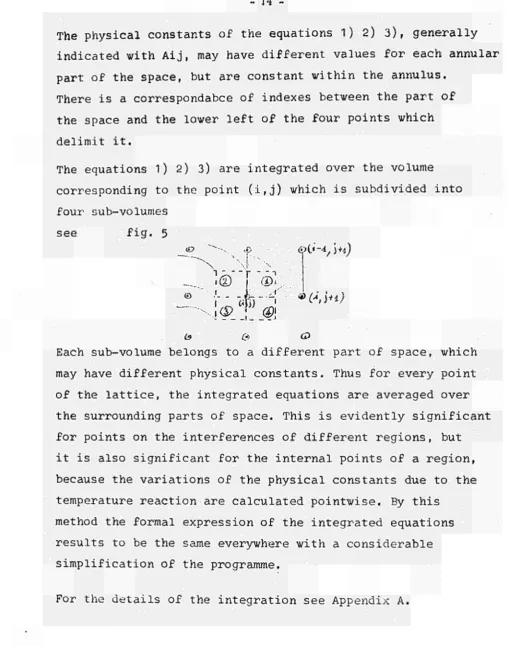
The equations 1) 2) 3) are integrated over the volume corresponding to the point (i,j) which is subdivided into four subvolumes
see fig. 5
je> '""--, >£> <·>(<-■*, ) + * )
ι©
®'
V
i"
± H
■■*(',M
Each subvolume belongs to a different part of space, which may have different physical constants. Thus for every point of the lattice, the integrated equations are averaged over the surrounding parts of space. This is evidently significant for points on the interferences of different regions, but it is also significant for the internal points of a region, because the variations of the physical constants due to the temperature reaction are calculated pointwise. By this
method the formal expression of the integrated equations results to be the same everywhere with a considerable simplification of the programme.
[image:18.595.49.559.49.696.2] 15
The general form of the integrated equation for the generic point (i,j) is:
4)
'%
ψ'«,) 'A'i
fø4
"
*<i
^'
+vj" ^
$ > h
+^ j tfi»
l*'i Vvi " W
This is the eq. corresponding to the thermal flux and contains, in the. known term of the right side the source term b< .' tV,·· with the fast flux l|¿,· ; . The equation corresponding to
the fast flux ψ is formally the same and contains a source term with the thermal flux \S> ·
There are two systems of n. linear equations, one for each energy group; Ti is the number of the points of the lattice.
Note
The boundary condition ~L oat the axis of the cylindrical
i j l
core, is obtained by putting all the points (i,1) and (i,2) of the first two vertical columns, symmetrically to the axis. i.e. r(l) = r(2) ( r (j) being the radial distance of the point (i,j) from the axis), and by imposing tø l * ƒ*,£ '
This is obtained by putting tí¿ 4 = o . I n fact the equation corresponding to the first point of each radius is of the type:
8
) -«*',*
f.',
Ι ~β*·,ΐ V,i
-ft>
«f-Ujà -
Ui %l+Ul fr,Z ' hi
Wl *
t;
zif iKrtø· ¿then the equation can be written:
as A,'ois also contained in ¿(-? with the + sign the equation 9)
can be obtained from 8) by simply putting (i\ 1- 0.
The outer boundary conditions are obtained by imposing <J> = o
16
In a first version of the code we have used the GaussSeidel iterative method with overrelaxation factor for the
solution of each groups separately, using than the obtained solution as source for the other groups and iterating
between the groups.
This way of proceeding has been abandoned for a much faster method in part direct and in part iterative. In eq. Λ) the f luxes y,.^ ¡ andif;+L j correspond to points
belonging to the radius (i1) above and to the radius (i+1) below the point (i,j).
Let us consider the valuesi/>lH ¡and tø+i : as already known.
th 'J
All the equations of the i radius foim a system of JMAX equations (JMAX = number of points of the radius), which has a tridiagonal matrix of coefficients. In fact each equation contains only three incognita. This could be solved with the well known method of forward elimination and backward substitution, for each group separately. However by intercalating the equation of the fast with those of the thermal group and rearranging the terms, it is possible to obtain a system of 2 χ (IMAX) equations
for both groups, with a pentadiagonal matrix of coefficients. This can be partitioned into (2x2) submatrices and
considered as a tridiagonal matrix with entries consisting of (2x2) submatrices. The method of forward elimination on backward substitution can be applied operating on
these (2x2) submatrices and the direct solution can be obtained for both groups at the same time. (See: Finite Difference Method for solving the SpatioTemporal Diffusion Equation in the Twogroup Approximation EUR 596 by
17
-All the point lattice has to be scanned by repeating this
ι
direct calculation at each radius. For ü)· . \ will be
.71-1, th
used the value obtained in the calculation of the (i-1)
radius, in the actual iteration, and for tø'+^.j will be used the value obtained in the preceeding iteration. The
scanning of the lattice will be repeated alternatively
downard and upward until convergence is reached. This method which is direct in radial direction and
iterative in axial direction eliminates the iterations between
the groups and in the normal cases reduces the computing
time of a factor 3 compared to the usual overrelaxation
method.
Thermal calculation
The reactor is subdivided in a number of vertical zones
(max. 10). Each zone contains many vertical cooling
channels of the same type. Channels belonging to different zones may however be of different types. For channel is
meant here a fuel rod with the corresponding coolant.
The channels go through the reactor from top to bottom including the reflectors, but only the part contained
in the active core is considered for thermal calculation.
The part is subdivided with a point-lattice of constant mesh Δ Ε , which coincide^with the axial lattice for
18
To determine the power developped in a fuel rod, in any zone, in a part Δ Ζ between the (i1) and
th
the (i) level, the power is integrated in the
volume A (Fig.6) of the zone between (i1) and (i) and this is divided by the number of rods of the zone.
„ to· °
1 χ
l >
it' - 1 Ì 4 ·* (■i· » Γ >"
6 ν 7 *
> ? ,
ì>
it»
I / y
a*
Χ
s
t(¿iu
τ*
Uitj}**-number of r o d s i n t h e zone
Fig. 6
k
d
h.
Ai 'fi
ι ι ι Ι
ι ι ι
The heat is generated in the rod and propagates to the coolant into which it is injected at the point (i). The fuel rod is subdivided in a number of concentrical shells (5 10). The relative distribution of power among the shells is given in input and remains constant
during the transient, although the total power varies with time. The timedependent heat balance equation,
transformed with the finitedifference method, is
solved in implicit way at each level (i) and gives the temperature distribution at a given instant in the shells of the fuel and in the coolant. The results obtained at level (i) will be used as input for the calculation at level (i+1). A complete description of this procedure is in the report EUR 3171 by A.Agazzi, G.Forti,
19
Temperature reaction
Eight physical constants are allowed to vary with the
temperature, i . e . :
Σ
er- η ¿Λ. ¿ ι ι λ ,, i o Z - o ·
·
η ..»Ρ (-reserve prob.)
removal
νfission fast
r
y
thermal'"' th. ' ^""fission t h . '
poison
this temperature dependence has been expressed in the form of a Taylar expansion:
where
Cc?= initial value of the physical constant
fl(;/3 v;¿ = temperature coefficients
Jp andX, = Reference temperatures of fuel and moderator corresponding to the initial value u
All these
magnitutes are given in input region wise.
T~J? and Γ^ = New values of the fuel and moderator temperatures. (1)
(1) Note This version of the code is made for pressurized water reactors where the moderator and coolant
20
-Although all other values, including the reference
temperatures Ί' and Τ , are given for each composition
1 fo mo 3
region, the temperatures Tp and Τ are calculated in
each vertical control zone. The calculation is made at
every thermal time step. Τ and Τ are values of temperatures averaged over that part of the radius within the control
zone, they have however distinct values at every axial level. The temperature reaction is therefore made
21 -Programme Composition
The code consists of a Main and 19 Subroutines of which 5 belong to the first Overlay and the remaining 14 belong to the second Overlay.
The 5 routines of the first group are called only once. They calculate all the coefficients which will not be changed anymore and will be transfered to the second overlay in order to make available the rest of the memory.
First overlay :
1) MAIN - Calls the first routines of the first group and PRINC 2, control routine of the second group. 2) INPUT - Reads the vector DATA from cards or tape. 3) PRINC - It takes the data which are read region-wise
in Input and transforms them into point-wise data , Calls GEOM and DCAN.
4) DCAN - Calculates all the thermohydraulic coefficients which will remain unchanged during the transient.
5) GEOM - Calculates all the coefficient depending from the geometry of the core and the point lattice.
22
-Second Overlay :
7) PRINC-2 - In its first partfbefore label 1000,this
routine determines the initial conditions. It calls AZER 2 to put equal zero all the commons belonging only to the second Overlay. Puts the control rod in the initial position. Calls TNIZ to give a first approximate distribution of the fluxes. Calls CRITIC to calculate the initial equilibrium distributions of fluxes and températures.
In the second part after the label 1000 it determines the transient behaviour.
At every time step it calls BARRE to determine the rod position; it calls Flussi to calculate the flux distribution; optionally it calculates the accumulated
3
energy per cm at every point; it calculates the delayed neutrons precursors concentrations at every point.
At every KPC (see input key) time steps it calls the thermal routines CANPALL and CØVAR to determine the temperature reactions.
Calls STAMPA to print according to the orders given in input.
Controls the restart operations to store on tape the results at the end of a calculation and to start from tape an interrupted calculation (see Restart Instructions).
23
-9) INIZ - It calls FLUSSI a number of times specified
in input. Starting from and initial flat distribution
determines a first approximate distribution of the
fluxes. In these calculations the delayed neutrons
are not consideredi It normalizes the fluxes at a
given initial power level. Uses a neutronic time
Step DELTI which may be différent from DELTC used
in CRITIC, and from DELT used for the transient
calculation.
10) FLUSSI - It solves directly along each radius the
two-group system of linear equations, (see Method).
It scans axially the point lattice, in alternate
directions, until the residuals of each group
^
ΙΔΨ,Ι
ΛΣ :
ΐΔψ,ι
Σ ^
LV
are smaller of the quantities EP1 and EP2 given in input.
It calculates the fast and thermal flux average values and the reciprocal of the period.
11) MAT1 - It calculates the coefficients of the system of linear eq. to be solved by Flussi. This
calculation is made using the invariant coefficients transfered from the first overlay and variable
physical magnitudes depending from the temperature reaction and the rod position.
This routine will be called at every thermal calculation, from Prine 2 and from Critic.
24
-12) STAMPA - It prints the output. Any wanted result may be printed in several optional types of print (see input instructions).
13) CRITC - searches the criticality by varying iteratively either the concentration of poison in any wanted region, or the insertion of the rod in any wanted zone. In the first part of this iterative method, from two values of poison and the corresponding values of reciprocal
period,it determines, by extrapolation, the next value of poison and so on. When the reciprocal period is below a given value it variates the poison at each iteration of one thausand of the last concentration, until the convergency criterium is satisfied or the reciprocal of period changes of sign.
The same proceeding is followed when the criticality is searched with rod movement. After a first part with the extrapolation method, the rod are displaced of 1 millimeter at each iteration.
In both cases at each iteration the thermohydraulic routines are called to determine the temperature reaction.
The calculation is made without considering the delayed neutrons.
14) BARRE - This routine calculates the new coefficients of the system of linear equations only where a new
condition of poison was determined by the displa-cement of the rods e.g. see M and N of Fig.7....
25
and backword substitution method however are calculated by BARRE in all the points of the region A B C D of Fig. τ determined by the rods displacement and the outer boundary.
I
- &
Η
?
It is called from Critic and Princ 2. When called from Princ 2 it determines the rod position by interpolation of .the tabulation given in input.
15) TEST - This is a dummy routine which contains all the commons and may be used to introduce any new
statement in the programme. It is called at every time step from Princ 2.
16) CANPAL - This routine calculates from each channel the temperature distribution in the fuel rod and in
the coolant at all axial levels (see thermal calculation) It is called during the transient from Princ 2 at
26
-17) VINIZ - Determines for each channel the coolant inlet temperatures and mass flow at every time step,
interpolating the values given in input as function of time in tabulated form.
18) INTEGR - Calculates for each channel independently at every axial level the fuel and coolant average temperatures.
19) COVAR - calculates the new values of the physical
constants given by Integr. (See temperature reaction). 20) RESTAR - stores on tape the results at a given time.
27 -Input Instructions
A title card is the first input card of each problem. A vector of 10000 memory positions : DATA (1)
DATA (10000) contains all the data.
Since entire groups of memory positions are zero, it is possible to read separate sets of significant data; each set bf data must be preceeded by a card containing the integers Ki.. , Ki-, Ki , written in Format (216, 112) where Ki.. is normally zero, Ki and Ki are the indexes of the first and last datum of the set.
Only in the last set of a problem Ki must be any
positive integer number. The data are in floating form, six per card (Format 6 E 12,8).
Any number of problems may be run in sequence', for all the subsequent problem only the data different from the corresponding data of the first problem need to be given. The vector DATA of the first problem must be memorized on an auxiliary tape. (See Restart Instructions).
Input Key
DATA Number
Variable
Name DESCRIPTION Allowable
Values NOTES
TEMAC Computer time (min.)
DELT Neutronic time step A t for transient calculation (sec.) DELTC Neutronic time step Δ ι for
criticality search (sec.)
IMAX Number of axial mesh points JMAX " " radial " "
NREG Number of regions with different composition
■^40 ^ 4 0 $ 3 0
Only i f t h e f i r s t t h r e e columns of t h e t i t l e c a r d c o n t a i n a number s e e
R e s x a r t I n s t r u c t i o n s .
(IMAX * JMAX,) $ 400
to
OD
•O ta
υ
■d
ö o υ
OJ co
Í7
8
<
10 11 12
NRIT Number of delayed neutron groups ITMAX Maximum allowable number of axial
iterations
IDST Number of initial iterations before criticality search
blank blank
DELTI N e u t r o n i c t i m e s t e p ΔΧ f o r t h e
initial iterations before criticality
suggested value = 30
DATA
Number Variable Name DESCRIPTION Allowable Values NOTES
χ}
u υ
*d u
•H +J
π 3
1415 16 17
18
V.
EP1
EP2 SI KPC
NCAN
Blank
Convergence criterium for the fast group
Same for the thermal group Initial reactor power (Watts) The thermal calculation is done every KPC neutronic steps
Number of radial zones containing channels
S.v.=0,01
s.v.=0,01
to CD
19 20 21
22
23 24
25
KTE
ICA
ICB JCI
JCE
Blank Blank
If KTE>0 Subroutine TEST will be called.
Axial index of the points laying on the upper core boundary.
(Reflector excluded)
Same for the lower boundary
Radial index of the points laying on the inner core boundary
Radial index of the points laying on the outer boundary of the core.
(Radial reflector excluded)
Usually the central part of the reactor belongs
DATA Number
26 27 28
29
30
Variable
Narr, e
W V SPRG
DAPF
LF
ribL/itlx- i J. u INI Allowable
values NOTES
31
32
33
IDIR
IBCR
NZB
Fast group neutron velocity vsëcv
Thermal " " " " First guess of control poison
concentration
Convergence criterion for reciprocal of period in criticality search
Maximum allowable number of criticality iterations
= 1 if the control rods enter into the core at the same side as the coolant.
= 2 if they enter at the opposite side
'= 0 criticality search made with diffused poison
= 1 criticality search made with rod movement
Number of the vertical zones
S.v.=0.1 s.v.=30
<10
Blank if critically search is made with rod movement
CO
o
υΆΙΆ
variable
Ä D-Namé "''
DESCRIPTION
values fïi^SÜ
34
35 201206 211216
231
232
233242
301
302
303
304 305 306 307312 375480
SPB1 Microscopic control poison (barn) cross section for the fast groups. SPB2 Same for the thermal group
BETA 3¿delayed neutrons yield per fission DL ^fcdelayed neutrons precursors decay
constants
= 1 The power will be integrated in the time at every mesh
INTG < point
= 0 No integration will be effectuated
NUSO Number of thresholds of integrated energies
SØLEN Thresholds of the integrated
energies in increasing order from the lower to the higher
11 Index of the upper boundary of the first region
12 Index of the lower boundary of the first region
J1 Index of the left (inner) boundary of the first region
J2 Index of the right (outer) ■ boundary of the first region blank
blank
for the second region for the 30th region
¿10
Lem
3.I
they are multiplied by SPR in each region to obtain the correspondin macroscopic cross
section
C O
I
only if INTG =1 (See printing
order N° 8 and 9.)
This group of data for energy regions is included in one card. For the region bounded by the axis of cylinder
DATA Number
Variable
Fame DESCRIPTION
Allowable
values NOTES
1001
1002
1003
1004
1005
1006
10071012 11751180
D1
SR
SF1
ρ
Diffusion coefficient fast group
Removal cross section
Resonance escape probability
blank
blank
Second region 30th region
u
o ß
CM Ο
Η
•ö Cr;
ÍH α) fö u
υ α> u
c to ο ω
co to
1601 1602 1603 1604
1605 1606
1 6 0 7 -•1612
D2 SA SF2 SPR
·—
-Diffusion coefficient thermal group thermal absorption cross-section Poison concentration; it is multi plied by SPB1=Data (34) and
SPB2=Data (35) blank blank Second region
u o
CM
X)
f-\
fO
o
ω c o
c o
- Η CD
α>
u
Ä
u
(0 CL)
DATA Number
2201
2202
2203
2204
2205 2206
2207-2212
2375-2380
Variable
Name DESCRIPTION
EQUÌ1
E QUi 2
FNU
KV
TRU
TMU
Allowable
values NOTES
Thermal equivalent of fission (fast) [watt-secl
Thermal equivalent of fission (thermal) [Watt-sec]
V Neutron yield Pe r fission
XV = order number of the region, then
in that region SPR will be varied for criticality search
ki/= Zero . SPR will not change
The initial values of the physical constants given in input were
calculated according to a fuel temperature = TRU and a moderator temperature = TMU for each
composition region.
for the second region th
for the 30 region
Only if IBCR=0
CO co
2801
2802
KB
KBC
K&= order number of the zone, this zone contains control rods
Kß= 0, no rods
KßC= order number of the zone, the rods of the zone are used for criticality search
kßC= zero, no movement of rod for criticality search
Only if IBCR=1
See note of Data (33)
DATA
Number Variable Name DESCRIPTION Allowable values NOTES
2803 2804
2805 2806
2807-2812 2 855-2 860
J1B J2B
KCA
Index of the left (inner) boundary of the zone
Index of the right (outer) boundary of the zone
KCA= order number of zone; the zone contains channels
j(Cj4= zero, no channel blank
Second zone .^th
10 zone
For the region bounded
by the axis of cylinder J1B = 1
CO
2861 2862 · 2863 2864 2865 2866
2867-2872 2915-2 920
VEBA1 Macroscopic cross section of the rod equivalent poison (fast) VEBA2 Macroscopic cross section of the
rod equivalent poison (thermal) - blank - blank - blank - blank
DATA Number
Variable
Name DESCRIPTION
Allowable
values NOTES
30013030
30313060
ΓΟΒΑ
PRI Ν
3061-3090
3091-3120
4001-4040
4101-4140
X(J)
Y ( I )
Times of the rod movement tabulation for the first zone sec
Corresponding depth of rod insertion in the tabulation for the first
zone cm
Same for the second zone etc.
Distance of mesh points from the axis
Distance of mesh points from the upper boundary.
DATA (3001) must always be zero
DATA (3061) = DATA (Ξ341) =
on
is for ¿efi:.iti:.r. the s u e from which the ccolant enters. The first distance
DATA Number
Variable
Name DESCRIPTION Allowable values NOTES
CHANNEL DATA
CO
en
5001
5003
5004 5005 5006
D Ζ SET
Constant axial mesh cis t ance cm Section of channel en
(Coolant corresponding to a fuel rod^
joule
Coolant specific heat q °C
Coolant density blank
blank
DATA Number 5007 5008 5009 5010 5011 5012
Variable Name N' (KC)
PALW< (KC)
0SE1
— _
DESCRIPTION Allowable values NOTES
Number of shells in the fuel rod
Number of fuel rods in the zone KC
blank
Outer surface of a part cf rod of height DZ
blank blank
N1 $ 9
CO - 0
5013-5018
5013 5014 5015 5016
RESI CPT1 V0S1 PZ01
These six DATA contained in one card correspond to the first shell of the rod.
Thermal resistence between the
shell and the next one £°C/Wattl Thermal capacitv of the shell
poules/0cj
Shell volume £cm J
Power fraction corresponding to
the shell Relative values are significant.
DATA
Number Variable Name DESCRIPTION
Allevai Ii values
r r p -* c c Γ - } /
5061-5066
•ar.e data for the second shell
etc
jame data for the nineth shell
51 Q0 ΛΤΕΤ
51 91
51 92
5193
51 94
5195
RAl·
STEF°0 RAMI 3
Inlet temperature of coolant
at equilibrium i n i t i a l condi=
tions (Put
zero i f inlet
tempe=
rature i s tabulated as function
of
time)
[ ° c j
Step of coolant inlet
temperature
Value of 4Tj4ef or ramps in
coolant inlet temperature j^C/secJ Iniatial value of coolant mass-flow (put zero if tabulated)
jg/secl
Step of coolant mass flow Value of ΤΓ for ramp m mass flow fg/sec2~j
00 CO
CnlV i f VITE F 0
DATA
Number
Variable
Name DESCRIPTION
Al'liOjsj^fei
V a l u e s NOTES'
5 2 0 1 - 5 3 2 9 SECOND CHANNEL DATA
6801-6999 TENTH CHANNEL DATA
NOTE: All the cards must be repeated for every channel. The order number of the existent channel must be the same of the order number of the radial zone in which the channel is contained.
(Ex. Suppose that zone one and three contain channel and zone two do not contain any channel, then the channel of zone three must be considered as the third andits data are in the group Data (5401) ....(5599).)
7001-7060
7001 7002 7003 7004 7005 7006
TOTE TENT TOPO PENT PENT PENT
Tabulation of inlet temperatures and mass flow for the first
channel. Each point of the tabu-lation for both magnitudes is contained in one card (4 data), as follows:
Time of the temperature tabulation (Zero in the first card)
Value of the corresponding tempera-ture
Time of the mass-flow tabulation (zero in the first card)
Value of the corresponding mass flow
b l a n k b l a n k
DATA Number
Variable
Name DESCRIPTION
Allowable
values NOTES 70077012
70617120 75417600
Second card of the tabultation etc. Same for the second channel etc.
th
Same for the 10 channel
TEMPERATURE COEFFICIENTS (8001—»8960)
The temperature dependence of the physical constants is expressed in the form of a Taylor expansion
C~' Cc
■+
*L(!f'TÌ-)
+ ^ ( T ^ k
6j
+0 ( 3 ( T
rT
f cf 4 ^ ( u . T ^ /
The variable physical constants are 8 in the following order : 1 D1 ="pi
2
4 5 6 7 P
SR = I a
SF1 =
vift
Ρ = ~ .
D2 = Dz
SA = 2 α a SF2 = V ¿ f a
SPR = 2_ p o i s o n
o
• π Allowable , ^ _,
DATA Variable _______,_„„ _ NOTES
DESCRIPTION values
Number · Name
where Κ (1,...8) = order number of the physical constant L (1....4) = order number of P¿¿in the Taylor series Ν (l,...30)= order number of the composition region
PRINTING ORDERS ^
ι
99019960 It is possible to give in input up to 5 different printing orders.
Each order is contained in two cards (12 data)
99019912 First order
99139924 Second "
99499960 Fifth
In each group of 12 data (two cards) corresponding to an order the first datum = n1 indicates that the prin ting order is valid up to the 711t
DATA Variable ^_ „ „ _ „ _ . _ „ Allowable „«„„„
„ , „ DESCRIPTION η NOTES
Number Name values
The other data of the group y\_ ¿ ^ΊΙ1 (i= 2,3,...12) indicate that the corresponding type of printing will be made at every Ήj_ time-step.
If some of the data = Ή χ are left blank the corresponding type of printing will not be made.
Ex. For the first order : M
9901 ni The first printing order will be performed up to the Tt 1t h time step.
9902 η2 Flux core average, reciprocal period
and total power , rd
u
9903 η 3 Flux map £
9904 , n4 Map of rod i n s e r t i o n s
9905 η 5
9906 η 6 Map of the concentrations of the
delayed neutron precursors
υ
-p
DATA
Number Variable Name DESCRIPTION
Allowable
values NOTES
9907
9908 9909
9910
9911 9912
n7
n8
mo
Maximal fuel temperature, max. cladding temperature, max. heat flux, inlet and
outlet temperature, mass flow. Map of temperatures
Percent of core (in volume) below a given integrated energy threshold
Map of integrated energies
nothing
1
Ό
SH
ttì U
Ο U 01 co
4^ co
44 Restart an interrupted calculation
Two dimensional calculations require long computer time. It may be interesting to have the possibility of restarting an
interrupted calculation, without repeating it from the beginning. In particular it may be interesting to have the possibility
to initiate again a calculation from the equilibrium condition, without repeating the criticality search. For this purpose it is necessary to store on tape the results already obtained.
It is possible after a restart to change the printing orders. The first card of the new printing orders must contain in the first twelve columns the number IT of the time steps at which the calculation was interrupted; this card is blank in all other columns. A second blank card must follow, then groups of two cards must follow containing the new printing orders. It is also possible to change the tabulations given in input for the rod movements, inlet temperatures, and mass flow. Of course only changements after the instant ■tof restart have a meaning.
The new tabulations must contain a first point at time zero, with any value of the variable, the second point will be at the instant t and the value of the variable (insertion of rod, inlet temperature, mass flow) must be that indicated in the output of the results which were stored on tape. From ¿ o n any new point may be introduced in the tabulation.
At any subsequent restart after having changed the original tabulation, it is necessary to use the cards of the new
45
-to the original one which remains s-tored on tape.
It is also possible in a restarted calculation to introduce a new value of the time step Data (2).In this case a new prin-ting order must be given, as described in the preceeding page. The original vector Data is stored on tape, only the new
changed values must be given by cards.
The orders of restart are given in the fisrt three columns of the title card:
Titel Card:
Blank = Input data read from card, no storing of results on tape
001 = Input data read from cards, three files are stored on tape
file 1 input data
file 2 results of criticality search file 3 results of instant t.
002 = Only if more than one problem is. treated. Input data corresponding to the first problem are read from tape, file 1. Only those input data of the new problem which differ from those of the first problem are read from cards. At every new restart of the problem the cards corresponding to changement of the input data must be introduced, because on tape will always remain stored the input of the first problem.
46
restart from results stored on file (n-1) and store results-on file n.
-03 -04 -05
-On
Restart from the results stored in any file without destroying the subsequent files. This in case of temp t ative changements of rods, inlet temperature, mass flow tabulation and time step in any part of the transient.
/
First data card:
Tn addition to the titel card the first data card, containing DATA (1) to (6) must always be present.
In DATA (1) = TEMAC is indicated the computer time (minutes). At every thermal calculation the programme will compare the remaining computer time with the computer time necessary to make a thermal time step. If it will not be possible to make the next thermal calculation, then the results will be stored on tape.
47
-In the control cards are DD statements. At every file stored on tape corresponds a DD statement. When in the third column of the title card there 1 or 2 or 3 the DD statements are three, otherwise the number of the DD statements is the same as the number contained in column three of the Title card.
ATOM - CETIS
DATA (Zones de 10 colonnes)
" . O L . E v , DATE PAGE
— — Τ | ι j - I — ; ■ ι : ! !" I"1]
; : . Γ. C - ε S'10 Ï l l ' l 2;1 3 ! l 4 I i *.E 17l8i19 20|21 22^23 2Í:25¡26!27|28¡29|30¡31J32J33
: I : i ! ; . , : ¡ i i i
; ; I . : i ■ : Utfsrt
:'· Γ ι rt£ ·
'- i t ι
Al 9 IO 11 12 13 Η /
'51
16 )
17 /
18 /
19 y 2 0 J
2' /
22 23 24 /
2 5
t i
i !
• I ' i
L>HES.
i \t\À?Ef
'>
Ldfø;
/ ÎEx
' / L K ¿fr i^yp J
j^Xfifikkv' ¡A i M M '! |
^ ¿ R
/JÓJ-J
/ /
IG d
i 'I / ¿ £
/2
LL
¿
i
\ r' - 1 «ι ^
t 4 ¥ ¡
W-1 /
1 tfiAi/i Î T Fr
=r
»Y. / 0 <P 0 i i 1 19 Fe
?/=«
9 f c
/ Ν . \
—
-j£!c ;
Ï! U
iifi^3/i
F ^ ,
! L '
: ' I
OF
j i ! ' ! ' I l i 1 ! ! ί i i :
34 35!36¡37 38¡39 40 41 42¡43 44 45 46 47 48 49 50 51' 52153(54155 56 57 58 59 60 61 62 63 64 65 66 67 68 69¡70 71 72I7374 75 7G'77I7S!75 Η
I t ! ' I I ι
i ί ι I ι I M ι l i l i I I ¡ n i l ! !
\hKJL -Ι loAsXjÌAVt l/irljQstl
' -ί" /*~· ' r\ τ4 - ' ! VÌA : r - 1 1 j ! ! j ; ; 1 j ^ —
- - ' t> rt,<w/ i
p^fivLy i ;
i ;
ι : ; : : ι
?sßl)
^ i '■+i¿L
^ — ^lüg)
Γ
-. 1 ι L 15 ) Γ) ι_ ρ
Φ»
I 45 ι D 4 i I> A i rçfi ™L™ > r> β % ϊ> ß > I υΕ
¡t-ι F Ρ £ Ρ If 1/
κ
— υι
ι i
; ! ι ; ¡ :
' » , ' ■ ' , i
N I
1 V=
*
ΊΕ
JiL = ((/U
#7
5
/Jl τ 1 Ττ
r <? F L ¿ i/. X ¿ 3 f 3 ^ : ι?■ L D 9 i. D 9 2. Γ I
í i ) 1 E I I y t. J ; / E j > ; L ( / L ! • £ E V C E V
ι
F f ¿ Τ φ h τ Φ <■ τ; ■ Ι ¡ |
! ; ! : ! ! j | |
j f ! : ' ■ Ι '
! Μ Μ ; ' ί ι ' ι ' :
, : ί ; : ' ¡
i ' ! ' !
' ; i ' ' '
; : ί . ' : I
Ν E L H E L· H £ f f l ! B:
Λ 1 T υ 6 1 0 β,
d
j i\ rt n ñ¿-£ = F -Ez í;
! ·' I
|
=/F37/4
' ¡ « f i t ^ f fa^p^plC (
^ w i ]
!
! i ! ! ! ' ι
*π*ίφί ΊΜ*ύ ¥*Mt>* tku^
1 i ! M ; — ¡ - - i — | | \'\ '—
i !
ί ! 'ι
1 j
I
ί ί ! i l ι ¡ι ι
ΓΕ Í£9 = TO314¡ÍJ
: E U ¿ ? 4 ¿ d i . ' ^ L / #
=_/J:Bll^^
^γ -r
rie SE**tV¿*J¿¡ .
= ƒp« »^4
" /
TFJ 3 E Í ? = E T > ¿ ^<¿ ¿ /
íFl!¿£¿^Sl_L
>—f '
I ί
¡ ί ! i l (
1
' ι ' ί
! ! ; ¡ ; :
Ι Μ ί ί Μ
! ' ' ' ■
ι ι ι . . . ,
i l l ί
! . t j , ; j ¡ ; ; , , ! Ι ί ! i ! ' : ; : ' i
j I ¡ j ! ■ . ; . : ι ι
Ι i i i ι ! ι : I ' '■ i i l i . ■ ι
I 1 i 1 i i 11 ί
! Ici I i ι I ! I !■ ! I ' ] · ■ i ; :
i q ; . ι 'ί ' i ;
Ι Ι ι
Ι ί!
i <À ci j
<■ 1
q
I ! j ;
! I '
i I J Ι ι, I I ί
i Ι M ! i
i 1 ι! ; : '
ι i 1
1 | ;
_ ^ _|_ I i i I \
i
ι I1
¡,
co
CM
O o
P R O B I
» 2 3 4 .
..'
4
2 3 Ii
5 & \ 8 1 9'Q o. 21
11
'2 6 · 1 i
13
14
_- í.
15
«6 / / ,
17 £ , 18 $ ,
19 í> . 20 ζ .
21
«
¿.Ja 4,\
*
¿, ï
Ä ΛΛ
«—
C E T I S / C A D l ( E U R A T O M )
-EM l/\ ΛΑ^£ΑΛΗΚ' D A T E P A Q E i O F S 6 7 8 9 10
£
" . *
• fi
. <?
f. 0
l
i
-Ζ
15'
-i
Ό 1 0 cc
c
- f i
¿£
ί-
4-ií
\5
?T
11 12 1
1
0 i
oí
Η
oí 3 1 01oi
3 14 15
(7. 0. β. 0, c. 0 0 '9 ? 16 0 0 i 0 1 3 / 4
U
f
* • ι . 17 Ό3
¿ , 1 y ι 26
f
ρ
0j
£î
δ
18 19
ί ¿?. 0
U
1
fl . (? / c ■ 0. ΰ
• C
i
38
W
k
20 2122 2
S Ό fi It -c f i - ί
«s
3'
» 4«^ - ί - ί - * - (3 24 25
S ί ö )(,
t
U li '3io
io
'?
ι
>î
η
26h
Ό 0 υ o D 27 M • . t ι β 28 29 PL 60ι
oi 2ζ. Ζ.-ñ?
41
/ A4
ê
ί
4
_^Χ 31
£
i
0. 0 ?3
0» . 0. û
. 0
, <7
. 0
, 32 0 0 33 34 ? ■+ i 35 η 0 0 0 36
4
6 3 ¿Ρ 37δ
38ι
Ι
Γ 0 0 0 : 394y
SÍ 0*t '
. ί
' t
4.
4. 4.4.
0 4) \ 1 IQ Q 2 / Ρ 0 0 0 42 2 •3
Sι
0 •sS
4-?
43 t σ «?
. ' 1 β * ; 44 0 ¿? --0 ί Ρ C 2 45 46+
+
-f47 4
Oi
ii
o,
0 s
8 49 ■ l 50 0 0 0
51 52 53 54
-/¿> 10 0 t . * S .._
H i> ¿? -Γ f 55 > . -56 D 0 0 -57 58
-59 60 61
-
i-1 L k :
f
--ila
!
I 1
-1
... 62 0 ! 63 64 O! i
• ¡M
65
3
66 67
Γ
L
2
o.
Nil
'
>
y.Ms's
t
i i i !
c?.lf
!^.
! M
\ "1 ' i ί
! ; ί ! ι
* 68 Ρ 0 0
ψ
:69 70 71 72 73
■Ij-i
i 1 !
1 : !
IJ...- , · '
1 :
j i :
-—
i i ; ■ ;
■i j ! I
74:7.
i
! ι
j
1
>76 77
l
78 79 80
1 I
i ¡ ι i 1 !
: 1 ; i
... ...
■'t!:'!|r|'
! ' ' | | '.
• i"-1 j
; l :
. : i. : j . .
; .
i
ι ¡
i i
\ "> i . · ; / ; ■
ι ; |
1 : ;
I
;
'·■■: ■■■
i l 'i ! i !
: I I !ÍP
V I "
-r-rjv—r-1
H)
y-es o o
CETIS/CADi
( E U R A T O M ^ '
5?Û
αϊ o
CETIS/CADI (EURATOM)
PROBLEM
—ι —
1 2 3 4 5 6 7 8 9 10 Π 12 13 14 15 16 17
ï ou
2
Ι ο .
ο
H
3
Γ
k» oil
ί I
4
-
J L ^ ' Í
I î
5 l&o^o I 2*
44ψ
; © » e te
8
J _ p £ i · *
4-42
._ £?£L¿
U-o
L
Co
im
12 0.Q.17S' i l i ? . ¿?
13 ΰ . o 2 8 2 j D - o
M
T-fi/^? i g.3
15
J 2
■ ö^S23
0- ?
16 0 . 0O¿g6 ■?, 9
17 o.ûDlli \-Q--M
18
¿"¿2.0
Ί
αι» tfyo.O I
30 £ I 2 ¿
» £6 · £> 1 V ·
«
1 £.«? I ¿/£
23 o . o l i i [ Ö . C
34 o «o¿S3 y· o
25
°'01UI
o-o
DATE
18I9 20 212223 24 2 5 2 6 2 7 2 8 2 9 3 C 3 1 3 2 3 3 3 4 3 5 3 6
3 ? ^ > j
5
o\
I lit ¿.o
¿0* Ρ
Ί
0 » ¿> &0 > 0
O.O ta.0 ■ 0
¿Ht
I
_L
0.0 uo ■ a
0 · 0 ,{f.$¿. 0
Lou
4_
s
1
s
.
k
*·*■-
—+
X
-Wfl
44* 13*3
k'*l
e-Wß.
UT-
TT/KnSs
ait?
it'î^hJ
UI
M .<\Úl
?H
—
IZ.&IU__
L
rm
Htf
I
_
_ _ _
>~
LU
_.
tf.ø
T
å Æ ÍLL418.1
átfc¿
lL-$llZ
.-^ï
± 1 l'élis
37 38 39
i ¡ •
i
! i40 41 42 43 44 45 46 47 48 4
øj?
.0
uso.
3_ j
Ή Λ
0
ç?z
.*
L ^ ' C ?
?¿° r
ok?
β . î
t· i
-
-»·2
3 - 2 0 . 0
5 S 5 . C
C ' a
^S_¿ · 0
°>L
Õ.1.I
ΰ· 1.
PAGE _ J OF
950 51525354555657585960 61626364656667686970 717:73 74 75 76 77787980
*£¿^¿
.
m- 0
Ί
wP-Å
--.
4èo . O
Ve?. 0
_.
é
5 ·_*._.!_.
— _
ι
ι
ί
•
^Í"" - b .
1 '· *-l
/ ■ " " ' s '
^ > ' ]