http://www.scirp.org/journal/jcc ISSN Online: 2327-5227 ISSN Print: 2327-5219
Statistical Analysis of Network Based Issues
and Their Impact on Social Computing
Practices in Pakistan
Zahoor Hussain
1*, Zulfiqar Ali Bhutto
1, Gulab Rai
2, Majid Hussain
3, Kashif Zaheer
41Institute of Information and Communication Technology, University of Sindh, Jamshoro, Pakistan 2Education & Literacy Department, Government of Sindh, Karachi, Pakistan
3Bahria University, Karachi Campus, Pakistan
4Department of Computer Science, Karachi University, Karachi, Pakistan
Abstract
Social computing and online groups have accompanied in a new age of the network, where information, networking and communication technologies are enabling sys-tematized human efforts in primarily innovative ways. The social network communi-ties working on various social network domains face different hurdles, including various new research studies and challenges in social computing. The researcher should try to expand the scope and establish new ideas and methods even from other disciplines to address the various challenges. This idea has diverse academic associa-tion, social links and technical characteristics. Thus it offers an ultimate opportunity for researchers to find out the issues in social computing and provide innovative so-lutions for conveying the information between social online groups on network computing. In this research paper we investigate the different issues in social media like users’ privacy and security, network reliabilities, and desire data availability on these social media, users’ awareness about the social networks and problems faced by academic domains. A huge number of users operated the social networks for retriev-ing and disseminatretriev-ing their real time and offline information to various places. The information may be transmitted on local networks or may be on global networks. The main concerns of users on social media are secure and fast communication channels. Facebook and YouTube both claimed for efficient security mechanism and fast communication channels for multimedia data. In this research a survey has been conducted in the most populated cities where a large number of Facebook and You-Tube users have been found. During the survey several regular users indicate the certain potential issues continuously occurred on these social web sites interfaces, for
How to cite this paper: Hussain, Z., Bhut-to, Z.A., Rai, G., Hussain, M. and Zaheer, K. (2016) Statistical Analysis of Network Based Issues and Their Impact on Social Compu-ting Practices in Pakistan. Journal of Com-puter and Communications, 4, 23-39. http://dx.doi.org/10.4236/jcc.2016.413003
Received: August 20, 2016 Accepted: October 15, 2016 Published: October 18, 2016
Copyright © 2016 by authors and Scientific Research Publishing Inc. This work is licensed under the Creative Commons Attribution International License (CC BY 4.0).
example unwanted advertisement, fake IDS, uncensored videos and unknown friend request which cause the poor speed of channel communication, poor uploading and downloading data speed, channel interferences, security of data, privacy of users, in-tegrity and reliability of user communication on these social sites. The major issues faced by active users of Facebook and YouTube have been highlighted in this re-search.
Keywords
Computer Networks, Categories of Social Computing Application, Facebook and YouTube, Potential Issues, Statistical Analysis
1. Introduction
A number of social computing technologies are motivating an intense progress of the social networks. All of these social networks share a larger amount of community de-velopment, subscriber level satisfaction foundation, and a diversity of additional fea-tures. Social computing is a medium where researcher found various issues complained by the users. It is necessary for researcher to understand the significant impact of social media in users’ privacy, basic communication shifts, others collaboration with social computing, security issues and commerce and business trends [1]. A huge amount of latest software applications and services that enable social computing networks to take mutual action and online social contact with rich exchange of interactive program, data information and advancement of comprehensive awareness have originated by these Web domains, for instance, Facebook, Twitter, LinkedIn, Wikipedia, peer to peer net-works, research gates, Google scholar, WhatsApp, Skype, IMO, YouTube, daily mo-tions, open source groups and online business networks. Many of the popular online social and academic networks have been rising intensely like YouTube and Facebook
complaints by the users. In Pakistan, a huge number of subscribers use theses web sites for acquiring the data and accessing multimedia information on daily bases. Even these social sites have been used for commercial and non-commercial proposes. Many social applications and services facilitate the user for collecting available online information and interaction between database domains. Facebook and YouTube have investigated and highlighted the potential issues on these social network sites. Facebook and You-Tube are the most widespread applications used throughout the world where users re-ceive and disseminate their important information. Billions of users have observed on social networks and a vast number of users choose Facebook and YouTube for obtain-ing and transmittobtain-ing their data and multimedia services. Both social web sites provide user friendly interfaces to share their information among various social groups and so-cieties on Internet. These social networks provide many benefits to their users for ex-ample easy interface, fast data transmission, vast bandwidth, vast coverage and unin-terrupted communication channels. On the other sites user faced some serious issues on these social web sites. The rest of this paper is planned as follows: Section 2 offers an overview of computer networks; Section 3 classifies the usage of social computing ap-plication; Section 4 gives a brief overview of the Facebook and YouTube; Section 5 sta-tistically analyzes the potential issues related with social computing application and Section 6 draws the conclusion.
2. Computer Networks
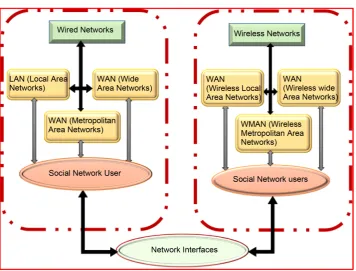
Computer and communication mediums are essential networks for social application such as connecting societies, folks, students and corporate sector, universities and var-ious social application globally [6]. A number of social organizational structure should not be prominent without integration of social medium as a basic communication ent-ity. The computer networks play a very important role in connectivity among those ap-plication. These network facilitated network communication mediums to users, sub-scribers and active participants to share the knowledge, acquired the knowledge, run businesses, increase incomes and generate more revenue for their communities [7]. The new tool have been integrated with computer internet to connecting societies, fragment composite networks to help the unfamiliar computer users. Figure 1 shows the various wired and wireless networks used by the users’ active on social application.
Figure 1. Wired and wireless networks for social applications.
have wired and wireless connectivity. A number of social application are being running on these networks for sharing information and operating the individual, corporate and industrial businesses. Several corporations are has their remote offices in different places with multiple employees with multiple nature of task including multiple heads. The tree of organizational worker is divided into multiple shifts. Before communication networks the heads and supervisor of organization has physically presences relation-ship. Now the trend is completely changed by computer networks and particular by the social networking.
3. Categories of Social Computing Applications
Social computing transform the trend of computer networking and strength individual subscriber relatively the advancement of technologies. Through the available economi-cal web application and social networking the users are apparently shows their abilities, creativity, social activities, and social interactions with the other societies on the other end of network [8]. The users easily retrieved and disseminated their information glo-bally via social media. Social media act as a fast tool for sharing information, multime-dia data, voice, photographs and text. The available social networking application also changed the preferences of people regarding their priorities, likes and dislikes and even daily routines [9]. Figure 2 demonstrated the types of social network.
3.1. Daily Motion
Figure 2. Number of social networks.
get, dissemination, share and engage the other users globally through online video. It is a power social application where user can upload and share personal, commercial and non-commercial videos with the other social groups in social media [10]. Daily motion is the top one of the social multimedia communication network throughout the globe. It provide best quality video for active users.
3.2. WhatsApp
With the invention of messaging on mobile communication network the subscribers feel about the security of their instant messages to other regions. The traditional offline messages are in dangers of their locations [11]. The users need an application where they know about the status of their instant messages sending to other networks. That’s why, WhatsApp application is developed by developer, it allows mobile subscribers to send their real time SMS to various groups of individuals [11]. WhatsApp support the real time text, videos, audio and group on its interface and provide a fast communica-tion medium to active users. Both facilities online and offline are available on WhatsApp interface.
3.3. Blogs
be-cause it provide easy web interface to authors and allow to create a groups, communities for online discussion. It is also used for public campaigns such as politician run their campaigns via online speeches.
3.4. Twitter
Twitter is also a new developed social application for disseminating the information on social networks. It is new born Microblogging application on social media but it is fast and growing application. The twitter subscribers tweet about news, topic and highlight within limit of 140 words and monitor the others to receive their tweet topics, news and highlights [13]. It is also a social web site it is emerged as a new communication social channel for network users. In twitter subscribers follow the others subscribers are called followed. Being a follower on twitter the users send and received the messages called as tweet [14].
3.5. Wikipedia
Wikipedia is most referencing social web site for every kind of human being either, they are students, teachers, researchers, industrialist, business man, journalist and authors. Wikipedia is itself an online encyclopedia available on internet [15]. It used a stranded data base and web browser that facilitate to create and edit the articles, topics and news. It was introduced in 2001 and from its day one it has been a very popular social appli-cation for information sharing. 64,000 active authors with different languages handover their services to Wikipedia. The quantity of English articles in this social web applica-tion is around 1.9 million and nearly 19,000 addiapplica-tion of new articles on daily basis [16].
3.6. Bit Torrent
Bit Torrent is also a kind of social network, it is a peer to peer delivery social site. It cannot allow to single peer to retrieve information and also do not allowed to share its bandwidth while another user downloading information from another site [17]. This behavior make it ineffective and listed in non-corporative social medium for I forma-tion sharing. Maximum P2P data distribuforma-tion organisms are planned to be exposed, some peer can link and one peer can possibly interconnect to other peer in the organ-ism. The accurate operation of any Peer to peer arrangement depend on assistance be-tween the nodes. But in bit torrent do not provide both options at the same time for example, if any one select to download data records cannot upload any type of data to preserve bandwidth.
3.7. Myspace
3.8. LinkedIn
LinkedIn social network site is design for business men, researcher, professionals and individuals. It has gaining popularity and repaid growth from its beginning. It is also social online network where allows professional users, businessmen and researcher create their own profile and invite other to join or be a part of social network [19]. With the rapid of social network the users are also grow up quickly by endorsing each other’s. The LinkedIn social media become enhanced the users profiles, users curricu-lum vita and create industrial links to career developments [20].
3.9. Research Gate
Research Gate is important social network for academic researchers and scholars, it al-lows users to create their profile and published their research work on interface. It pro-vide innovate way for research scholars to disseminate their research and linked it to globally to other scholars [21]. It also changes the communication methods of re-searcher and provide an open access to various articles. The research articles in Re-search Gate has broadly reflect existing reRe-search areas by different reRe-searchers. It has also a good ranking position in academia research social sites [22].
4. Overview of YouTube and Facebook
4.1. YouTube
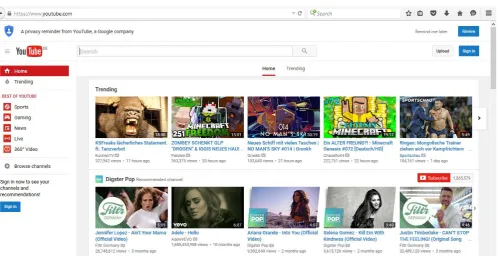
YouTube is one of the top recognized public software platforms. Planned for common internet operators to upload and download high and low-resolution videos and audios. it has seen outstanding development, and has advanced into social culture paradigm. That energies quick distribution of famous multimedia application worldwide. Substi-tute platforms for upload and dissemination of video and audio be present in Google and several offshore social sites. However, none of them has become as resilient trade-mark like as YouTube. This achievement ultimately led to Google procuring it rather than challenging with YouTube [23]. it is currently a platform not only for common video and audio clips but it is also have been used for commercial video application produced by commercial industry for example, games software application, musical application, academia video, online video lectures, political activity video, ceremony videos, products videos and guiding videos. In the previous era, the use ability of the Internet beyond domestic limitations and as well for the global connectivity between nations [24]. Now present era has social computing application that permit to discon-tinuity of the numerous obstacles [25]. Figure 3 represent the interface of YouTube.
Figure 3. YouTube interface.
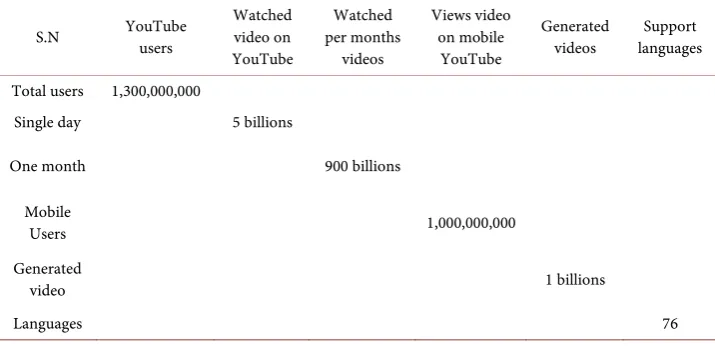
over 1 billion viewers. The total number from 80% of YouTube viewers are from out-side of the United States of America. A huge number of mobile user also views the vid-eo clips on YouTube by their smart cell phones. Table 1 shows the statistics of You-Tube users, watched video on YouYou-Tube, uploaded videos, watched per months videos, generated videos, mobile YouTube videos clips. Hours on YouTube per month is around 900 million and 10,113 YouTube video clips produced over 1 billion viewers. The total number from 80% of YouTube viewers are from outside of the United States of America. A huge number of mobile user also views the video clips on YouTube by their smart cell phones. Table 1 shows the statistics of YouTube users, watched video on YouTube, uploaded videos, watched per months videos, generated videos, mobile YouTube videos clips.
4.2. Facebook
Table 1. YouTube statistics.
S.N YouTube users Watched video on YouTube
Watched per months
videos
Views video on mobile
YouTube
Generated
videos languages Support
Total users 1,300,000,000
Single day 5 billions
One month 900 billions
Mobile
Users 1,000,000,000
Generated
video 1 billions
Languages 76
audio conversion, video clips and online face to face chatting. Figure 4 shows the pro-posed interface of Facebook application.
Social network offers the significant environment for the social, sensitive, and intel-lectual growth of adults and also used in secretarial for a huge slice of their time. One kind of online network service that has grown-up quickly in popularity and acceptance in current years is social computing networks on the Internet. Social networks websites, such as Facebook, LinkedIn, twitter, YouTube, and daily motions are member-based Internet societies that permit operators to post summery material, user profile data such as a user name, user Id, User cell phone and pictures, and to interconnect with others in modern means such as transfer online messages on private inbox or publically
[28]. The indicator shows the active timeline Facebook users monthly in the rest of the world from 2008 to 2016 are 1.71 billion. Figure 5 shows the 4th quarters of year’s ac-tive user participation on Facebook. Figure 5 demonstrated the active users on Face-book.
5. Statistical Analysis of Issues on Facebook and Youtube
Figure 4. Facebook interface.
Figure 5. Active user statistics on Facebook.
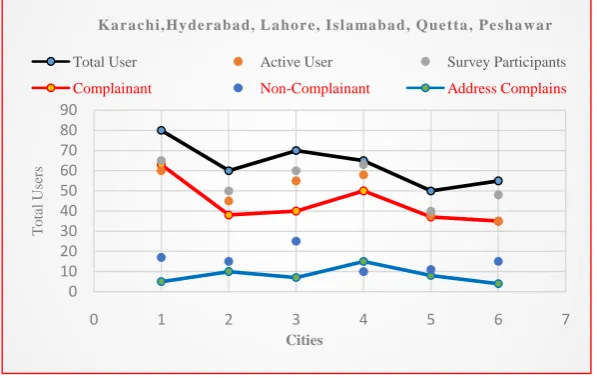
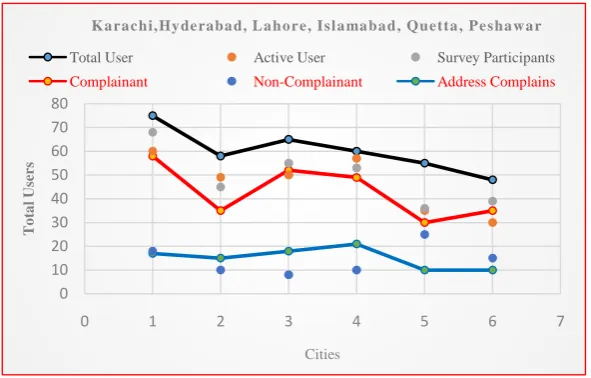
Lahore, Islamabad, Quetta and Peshawar have been selected for leading survey. During a survey number of user participated and give their inputs regarding the potential is-sues on Facebook and YouTube. Survey method is comprised with Total users, Active users, Surveys participant, Complainant users, Non-Complainant users and Address complains. A survey form had been distributed among 55% to 80% users in different cities. The active users were 35% to 60% and participant users were up-to 48 to 65. From total users’ different question have been asked through questioner forms such how much users faced the privacy and security issues, controversial multimedia issues, unwanted advertisement content, and desire data availability on time and fake accounts IDs issues. The result was from 30% to 50% users, put complains and 11% to 30% users, do not registered complains even though they were faced some issues but only few complains had been addressed by the social network administrators. This survey is conducted on the bases of qualitative and quantitative methods where some profession-al institutes have been selected for indicating the issues and some other generprofession-al users
30 13
8 48
1
55
0
47
4
49 26
5 485 501 449
52
36
1 495 474 463
67
40
8 533 501
40
9
1 2 1 3 1 4 1 5 1 6
YEARS USERS
IN
M
IL
LIO
N
S
participated on this process.
5.1. Privacy and Security Issues
[image:11.595.193.550.324.691.2]The variation in behavior impact on the privacy and security of personal data on an open interface. In this research we conducting a survey from the users of Facebook and YouTube and obtaining a concrete statistic from different cities of Pakistan. The open interface must have the ability to control and monitor the injecting and ejecting infor-mation from these social sites [29]. However the statistic are different from the reality.
Table 2 shows the statistical number of user taken from the various cities of Pakistan. Where number of users shows their grievance regarding the privacy and security issues on Facebook and YouTube [30]. A survey form had been distributed in most populated cities of Pakistan where active user, how much users participated in survey, how much users registered their complaint, how much silent users and how much complaint have been address by the social network experts. Figure 6 shows the statistical variation of Facebook and YouTube users.
Table 2. Users on Facebook & YouTube.
Cities Total user Active user participants Complainant Non-complainant Survey complains Address
Karachi 80 60 65 50 20 25
Hyderabad 60 45 50 38 22 15
Lahore 70 55 60 40 30 20
Islamabad 65 58 63 45 25 19
Quetta 50 38 40 39 11 12
Peshawar 55 35 48 30 25 15
Figure 6. Security and privacy statistics.
0 10 20 30 40 50 60 70 80 90
0 1 2 3 4 5 6 7
T
o
tal
U
ser
s
Cities
Ka ra c h i , Hyd era b ad, La h ore, Isla ma b a d , Qu et t a , Pesh a wa r
Total User Active User Survey Participants
5.2. Controversial Multimedia Services Issues
[image:12.595.224.523.195.384.2]Another issue raised by the users is upload and posted a multimedia services without any authentication. Whether these multimedia services create a conflict between users, societies, families and individual self-respect. The strength of social media is as a com-munication medium to foster multimedia information, videos, discussion to their users. Two of the most popular social media managed by the white house such as Facebook and YouTube [31]. See Figure 7.
Figure 7. Controversial multimedia services issues statistics.
5.3. Advertisements Content Issues
Social media provide an easy interface to users for interactive communication and data dissemination to other communities on internet. Different organization preferred social media to lunch their product online not only lunching but also used for advertisement of many products [32]. Sometimes the users found unnecessary advertisement on their timeline or during uploading and downloading of any multimedia services. The social media has huge amount of unnecessary advertisements on Facebook and YouTube which caused the more utilization of bandwidth and slow the browsing speed and throughput of network. Figure 8 shows the complained statistics of unnecessary adver-tisement during our surveys in various cities.
5.4. Data Availability Issues
The topical introduction of social media networks sites have caused in a larger internet bandwidth utilization for distribution of interactive program content via social websites for example Facebook and YouTube. Travelling a huge amount of multimedia informa-tion through restricted social network means remains a practical task nowadays [33]. Currently large number of Facebook and YouTube subscribers has complains against availability of desire and meaningful data on these social websites. Figure 8 represent the survey result graphs taken from various cities in Pakistan. Social websites contain
0 10 20 30 40 50 60 70 80 90
0 1 2 3 4 5 6 7
To
ta
l U
se
rs
Cities
Ka r a c hi, Hy de raba d, L a ho r e , Isl a ma ba d, Que tta , P e sha w a r
Total User Active User Survey Participants
Figure 8. Advertisements content issues statistics.
web presented multimedia services, like video, audio, textual, graphics and other in-formation, in entrance of burdens within a quite tiny interval of time when every ob-server broadcasts it to their nodes, who start additional spreads multimedia services to others down channels. The social site like as YouTube, which contains this multimedia information requisite to be able to adjust this outburst of access demand of information for avoiding unnecessary interruption. Figure 9 present the statistical data of various users in Facebook and YouTube.
Figure 9. Data availability issues statistics.
5.5. Fake Accounts and Multimedia Information
The major issues faced by social media users in Pakistan has fake Facebook IDs and fa-bricated multimedia videos on YouTube. Mainstream users of theses social websites bear the moral and ethical irritation from the uploaded multimedia services from un-identified IDs and sources [34]. Figure 10 demonstrate the large number of internet
0 10 20 30 40 50 60 70 80 90
0 1 2 3 4 5 6 7
To
ta
l U
se
rs
Cities
Ka r a c hi, Hy de raba d, L a ho r e , Isl a ma ba d, Que tta , P e sha w a r
Total User Active User Survey Participants
Complainant Non-Complainant Address Complains
0 10 20 30 40 50 60 70 80
0 1 2 3 4 5 6 7
T
o
ta
l U
sers
Cities
Ka r a c hi, Hy de raba d, L a ho r e , Isl a ma ba d, Que tta , P e sha w a r
Total User Active User Survey Participants
[image:13.595.225.521.408.597.2]Figure 10. Fake IDS and fabricated videos statistics.
has users complains to social sites admin against these fabricated videos, audios and textual information.
6. Conclusion
Social media, mostly Facebook and YouTube are used as social online networks for in-formation retrieval and dissemination. In Pakistan a huge number of users used social networks as a communication tool for their educational, commercial and non-com- mercial purposes. The other communities also used these social networks for their own interest. For example politicians used social networks for their election campaigns; film industry used for industrial promotion and banking sector also used for their adver-tisements. These social networks provide a fast communication channel for their users to share multimedia information despite the fact that these networks have some limita-tions regarding data security, user privacy, data integrity, fake accounts, fabricated vid-eos, unauthenticated information, un-necessary advertisements, data availability and interface inter-operability issues. In Pakistan a maximum number of users on theses social networks complained some serious issues and challenges regarding their data. We explore some potential issues occurred in various cities of Pakistan where users put their inputs about security and other threats in social sites. Meanwhile the internet us-ers also indicate some other challenges on social media such as cyber blackmailing, un-ethical data material, cybercrimes and personal identity issues. The users also registered their complaints to social network administration. However, the social network admin-istration took some serious action against the challenging issues but mostly ignored the users’ complaints. The statistics shows the percentage of, total, active, survey partici-pant, complainants, and non-complainants users on social networks respectively.
References
[1] Acquisti, A. and Gross, R. (2006) Imagined Communities: Awareness, Information Sharing,
0 10 20 30 40 50 60 70 80 90
0 1 2 3 4 5 6 7
T
o
ta
l U
sers
Cities
Ka r a c hi, Hy de raba d, L a ho r e , Isl a ma ba d, Que tta , Pe sha w a r
Total User Active User Survey Participants
and Privacy on the Facebook. Springer Berlin, Heidelberg, 36-58.
http://dx.doi.org/10.1007/11957454_3
[2] Almadhoun, N. and Dominic, P. (2011) Perceived Security, Privacy, and Trust Concerns within Social Networking Sites: The Role of Information Sharing and Relationships Devel-opment in the Malaysian Higher Education Institutions’ Marketing. IEEE International Conference on Control System, Computing and Engineering, 25-27 November 2011.
http://dx.doi.org/10.1109/iccsce.2011.6190564
[3] Capocci, A., Servedio, V., Colaiori, F. and Buriol, L. (2006) Preferential Attachment in the Growth of Social Networks: The Internet Encyclopedia Wikipedia. Physical Review E, 74, Article ID: 036116. http://journals.aps.org/pre/abstract/10.1103/PhysRevE.74.036116
http://dx.doi.org/10.1103/physreve.74.036116
[4] de Castro, L. (2007) Fundamentals of Natural Computing: An Overview. Physics of Life Reviews, 4, 1-36. http://www.sciencedirect.com/science/article/pii/S1571064506000315
http://dx.doi.org/10.1016/j.plrev.2006.10.002
[5] Chakraborty, N. (2012) Activities and Reasons for Using Social Networking Sites by Re-search Scholars in NEHU: A Study on Facebook and ReRe-search Gate.
http://ir.inflibnet.ac.in/handle/1944/1666
[6] Church, K. and de Oliveira, R. (2013) What’s up with Whatsapp? Comparing Mobile In-stant Messaging Behaviors with Traditional SMS. 15th International Conference on Hu-man-Computer Interaction with Mobile Devices and Services, 352-361.
http://dl.acm.org/citation.cfm?id=2493225
[7] Daily Motion. http://knowem.com/websites/DailyMotion
[8] Galuba, W., Aberer, K. and Despotovic, Z. (2010) Leveraging Social Networks for Increased Bittorrent Robustness. 7th IEEEConsumer Communications and Networking Conference.
http://ieeexplore.ieee.org/xpls/abs_all.jsp?arnumber=5421823
[9] Halpern, D. and Gibbs, J. (2013) Social Media as a Catalyst for Online Deliberation? Ex-ploring the Affordances of Facebook and YouTube for Political Expression. Computers in Human Behavior, 29, 1159-1168.
http://www.sciencedirect.com/science/article/pii/S0747563212002762
http://dx.doi.org/10.1016/j.chb.2012.10.008
[10] Hansen, S., Berente, N. and Lyytinen, K. (2009) Wikipedia, Critical Social Theory, and the Possibility of Rational Discourse 1. The Information Society.
http://www.tandfonline.com/doi/abs/10.1080/01972240802587562
[11] Hinduja, S. and Patchin, J. (2008) Personal Information of Adolescents on the Internet: A Quantitative Content Analysis of MySpace. Journal of Adolescence, 31, 125-146.
http://www.sciencedirect.com/science/article/pii/S0140197107000541
http://dx.doi.org/10.1016/j.adolescence.2007.05.004
[12] Hookway, N. (2008) “Entering the Blogosphere”: Some Strategies for Using Blogs in Social Research. Qualitative Research, 8, 91-113. http://qrj.sagepub.com/content/8/1/91.short
http://dx.doi.org/10.1177/1468794107085298
[13] Java, A., Song, X., Finin, T. and Tseng, B. (2007) Why We Twitter: Understanding Micro-blogging Usage and Communities. Workshop on Web Mining and Social Network Analy-sis, 56-65. http://dl.acm.org/citation.cfm?id=1348556
http://dx.doi.org/10.1145/1348549.1348556
[14] Kwak, H., Lee, C., Park, H. and Moon, S. (2010) What Is Twitter, a Social Network or a News Media? Proceedings of the 19th International Conference on World Wide Web, 591- 600. http://dl.acm.org/citation.cfm?id=1772751
http://www.insna.org/PDF/Connections/v22/1999_I-1-4.pdf
[16] Matthews, J. and Macaskill, L. (2015) Engaging the YouTube Learner: Promoting Home Economics through Videos. International Journal of Home Economics, 8, 53-63.
https://search.informit.com.au/documentSummary;dn=542633519397031;res=IELHSS
[17] Memon, S., Mahar, S., Das Dhomeja, L. and Pirzado, F. (2015) Prospects and Challenges for Social Media in Pakistan. 2015 International Conference on Cyber Situational Awareness, Data Analytics and Assessment (CyberSA), London, 8-9 June 2015, 1-5.
http://dx.doi.org/10.1109/CyberSA.2015.7166124
[18] Messinger, P., Stroulia, E., Lyons, K. and Bone, M. (2009) Virtual Worlds—Past, Present, and Future: New Directions in Social Computing. Decision Support, 47, 204-228.
http://www.sciencedirect.com/science/article/pii/S016792360900061X http://dx.doi.org/10.1016/j.dss.2009.02.014
[19] Montgomery, J. (1991) Social Networks and Labor-Market Outcomes: Toward an Econom-ic Analysis. The American Economic Review, 81, 1408-1418.
http://www.jstor.org/stable/2006929
[20] Nov, O. and Wattal, S. (2009) Social Computing Privacy Concerns: Antecedents and Ef-fects. The SIGCHI Conference on Human Factors in Computing, Boston, 4-9 April 2009, 333-336. http://dl.acm.org/citation.cfm?id=1518754
http://dx.doi.org/10.1145/1518701.1518754
[21] Parameswaran, M. and Whinston, A. (2007) Research Issues in Social Computing. Journal of the Association, 8, 336-350.
http://search.proquest.com/openview/89b0cf3f4fd60f335ed84c4aa60303f5/1?pq-origsite=gs cholar
[22] Parameswaran, M. and Whinston, A. (2007) Social Computing: An Overview. Communica-tions of the Association for Information Systems, 19, 762-780.
http://aisel.aisnet.org/cgi/viewcontent.cgi?article=2680&context=cais
[23] Pempek, T.A., Yermolayeva, Y.A. and Calvert, S.L. (2009) College Students’ Social Net-working Experiences on Facebook. Journal of Applied Developmental Psychology, 30, 227- 238. http://dx.doi.org/10.1016/j.appdev.2008.12.010
[24] Rader, E. (2014) Awareness of Behavioral Tracking and Information Privacy Concern in Facebook and Google. Symposium on Usable Privacy and Security (SOUPS), Menlo Park, 9-11 July 2014, 51-68.
https://www.usenix.org/sites/default/files/soups14_proceedings.pdf#page=58
[25] Russell, M. (2013) Mining the Social Web: Data Mining Facebook, Twitter, Linked In, Google+, GitHub, and More.
https://books.google.com.pk/books?hl=en&lr=&id=_VkrAQAAQBAJ&oi=fnd&pg=PR4&d
q=linkedIn+&ots=JqpsrFUwgK&sig=JIyDEfzwHHLeh227cmfORa6AGTw
[26] Shah, C. (2008) Tubekit: A Query-Based Youtube Crawling Toolkit. Proceedings of the 8th ACM/IEEE-CS Joint Conference, Pittsburgh, 16-20 June 2008, 433-433.
http://dl.acm.org/citation.cfm?id=1378980
http://dx.doi.org/10.1145/1378889.1378980
[27] Skeels, M. and Grudin, J. (2009) When Social Networks cross Boundaries: A Case Study of Workplace Use of Facebook and Linkedin. Proceedings of the ACM 2009 International Conference on Supporting Group Work, Sanibel Island, 10-13 May 2009, 95-104.
http://dl.acm.org/citation.cfm?id=1531689
http://dx.doi.org/10.1145/1531674.1531689
Content Differ across YouTube, Facebook, and Twitter? Journal of Interactive Marketing, 26, 102-113. http://www.sciencedirect.com/science/article/pii/S1094996812000059
http://dx.doi.org/10.1016/j.intmar.2012.01.002
[29] Snelson, C., Rice, K. and Wyzard, C. (2012) Research Priorities for YouTube and Video- Sharing Technologies: A Delphi Study. British Journal of Educational, 43, 119-129.
http://onlinelibrary.wiley.com/doi/10.1111/j.1467-8535.2010.01168.x/full http://dx.doi.org/10.1111/j.1467-8535.2010.01168.x
[30] Soysa, D., Chen, D. and Au, O. (2013) Predicting YouTube Content Popularity via Face-book Data: A Network Spread Model for Optimizing Multimedia Delivery. 2013 IEEE Symposium on Computational Intelligence and Data Mining (CIDM), Singapore, 16-19 April 2013, 214-221. http://ieeexplore.ieee.org/xpls/abs_all.jsp?arnumber=6597239
http://dx.doi.org/10.1109/CIDM.2013.6597239
[31] Spartz, J., Su, L., Griffin, R. and Brossard, D. (2015) YouTube, Social Norms and Perceived Salience of Climate Change in the American Mind. Environmental Communication, 1-16.
http://www.tandfonline.com/doi/abs/10.1080/17524032.2015.1047887 http://dx.doi.org/10.1080/17524032.2015.1047887
[32] Thelwall, M. andKousha, K. (2015) Research Gate: Disseminating, Communicating, and Measuring Scholarship? Journal of the Association for Information Science and Technolo-gy, 66, 876-889. http://onlinelibrary.wiley.com/doi/10.1002/asi.23236/full
http://dx.doi.org/10.1002/asi.23236
[33] Wellman, B. (2001) Computer Networks as Social Networks. Science, 293, 2031-2034.
http://science.sciencemag.org/content/293/5537/2031.short http://dx.doi.org/10.1126/science.1065547
[34] Zimmer, C. (1986) Entrepreneurship through Social Networks. The Art and Science of En-trepreneurship. Ballinger.
http://www.academia.edu/download/32500636/Aldrich_and_Zimmer_entshp_thru_social_
networks_1986.pdf
Submit or recommend next manuscript to SCIRP and we will provide best service for you:
Accepting pre-submission inquiries through Email, Facebook, LinkedIn, Twitter, etc. A wide selection of journals (inclusive of 9 subjects, more than 200 journals)
Providing 24-hour high-quality service User-friendly online submission system Fair and swift peer-review system
Efficient typesetting and proofreading procedure
Display of the result of downloads and visits, as well as the number of cited articles Maximum dissemination of your research work
Submit your manuscript at: http://papersubmission.scirp.org/