B É . . J É ^
E U R
-Oe-liS I U P $
I l i
nuij/' ívM'PpJllft!! S i v '·'. ¡L: >« 11 Tu' ι l i i t i w™ pir UU, -at L i x u t j i s ' "t1·.· l > ΊΗΠΗΒΜΗΠ Ii TOUW
"\ Mimmi Su'*!
■ >i!*H«f-i'· fc'iiíiluli m1*i"Un!fc.!V'!!iil fili > i <ι· ' On riff ti faI l
MmBSHÊBea
COMMISSION OF T H E E U R O P E A N COMMUNITIES
iPlWT ·'""i. ΐ%·£ >L ijibi.t'MlJLn 'VJK*''JA'./I WW'S * ' '
■KU
1'
liiii
THORIUM
INTEGRAL BLOCK HTR FUEL ELEMENT'Μ'*
TO;SÍÍ^^IÍ^É»íH*Í!lHiÌl§51^U"irμ !J§§
' S * ' "
! ' l»»iJ
i
f?
This document was prepared under the sponsorship of the Commission of the European Communities. * f f i | ^ ^
Neither the Commission of the European Communities, its contractors nor any person acting on their behalf:
make any warranty or representation, express or implied, with respect to the accuracy, completeness, or usefulness of the information contained in this document, or that the use of any information, apparatus, method or process disclosed in this document may not infringe privately owned rights; or
p
assume any liability with respect to the use of, or for damages resulting from the use of any information, apparatus, method or process disclosed in this document.
Η
Κ
st··
1
m
ϊ>.Γμιm
at the price of B.Fr. 50.—
NIP
European Communities D.G. XIII - C I D .
29, rue Aldringen L u x e m b o u r g
August 1973 ÊMtëfii
This document was reproduced on the basis of the best available copy.
EUR 5020 e
PLUTONTUM AS A MAKE-UP IN T H E THORIUM INTEGRAL BLOCK H T R F U E L ELEMENT by H. BAIRIOT**, G. GRAZIANI*, C. RINALDINI* and E. TRAUWAERT**
** (BelgoNucléaire, Bruxelles) * (Euratom)
Commission of the European Communities
Joint Nuclear Research Centre - Tspra Establishment (Italy) Luxembourg, August 1973 - 34 Pages - 12 Figures - B.Fr. 50.—
An analysis was performed in order to investigate the perspectives of using Plutonium as a make-up instead of U-235 for a Thorium c}rcle in a High
Temperature Gas Cooled Reactor. A number of physical and economical parameters were varied. In particular : — type of fuel particles (three degree of dilution of Pu into the graphite within the fuel kernels); — heavy metal density in the fuel pin; — Pu enrichment of the fresh fuel or, alternatively, the fuel discharge burn-up (between 40 and 100 GWD/t). Two types of fuel-cycle scheme, namely once-through and recycle of the bred fuel were considered.
EUR 5020 e
PLUTONIUM AS A MAKE-UP IN T H E THORIUM INTEGRAL BLOCK H T R F U E L ELEMENT by H. BAIRIOT**, G. ORAZIANI*, C. RINALDINI* and E. TRAUWAERT**
** (BelgoNucléaire, Bruxelles) * (Euratom)
Commission of the European Communities
Joint Nuclear Research Centre - Ispra Establishment (Italy) Luxembourg, August 1973 - 34 Pages - 12 Figures - B.Fr. 50.—
An analysis was performed in order to investigate the perspectives of using Plutonium as a make-up instead of U-235 for a Thorium cycle in a High Temperature Gas Cooled Reactor. A number of physical and economical parameters were varied. In particular : — type of fuel particles (three degree of dilution of Pu into the graphite within the fuel kernels); — heavy metal density in the fuel pin; — Pu enrichment of the fresh fuel or, alternatively, the fuel discharge burn-up (between 40 and 100 GWD/t). Two types of fuel-cycle scheme, namely once-through and recycle of the bred fuel were considered.
EUR 5020 e
PLUTONIUM AS A MAKE-UP IN T H E THORIUM INTEGRAL BLOCK HTR F U E L ELEMENT by H.BAIRIOT**, G. ORAZIANI*, C. R I N A L D I N I * and E. T R A U W A E R T * * '
** (BelgoNucléaire, Bruxelles) * (Euratom)
Commission of the European Communities
Joint Nuclear Research Centre - Ispra Establishment (Italy) Luxembourg, August 1973 - 34 Pages - 12 Figures - B.Fr. 50.—
The following economical hypotheses were also parametrically varied : the U-233 credit, the Pu price and the fabrication cost.
The calculations showed that it is possible to design integral block fuel cycles in which plutonium is the feed fuel. If not exceeding the reference age-factor of the uranium-thorium cycle is assumed as feasibility criterion, only once-through cycles will economically be acceptable (with a U233 credit of 14 $/gr).
By parametrically changing the value of the fissile plutonium and imposing the fuel cycle costs to be equal to the cost of the reference uranium-thorium cycle, an equivalent plutonium value was deduced. The fissile value was found to be in the range between 8.4 and 9.5 $/gr, depending on the values adopted for the fabrication cost corresponding to the different degrees of plutonium dilution in the kernels. These values are almost independent of the burn-up and of the U233 credit value.
The following economical hypotheses were also parametrically varied : the U-233 credit, the Pu price and the fabrication cost.
The calculations showed t h a t it is possible to design integral block fuel cycles in which plutonium is the feed fuel. If not exceeding the reference age-factor of the uranium-thorium cycle is assumed as feasibility criterion, only once-through cycles will economically be acceptable (with a U233 credit of 14 $/gr).
By parametrically changing the value of the fissile plutonium and imposing the fuel cycle costs to be equal to the cost of the reference uranium-thorium cycle, an equivalent plutonium value was deduced. The fissile value was found to be in the range between 8.4 and 9.5 $/gr, depending on the values adopted for the fabrication cost corresponding to the different degrees of plutonium dilution in the kernels. These values are almost independent of the burn-up and of the U233 credit value.
The following economical hypotheses were also parametrically varied : the U-233 credit, the Pu price and the fabrication cost.
The calculations showed t h a t it is possible to design integral block fuel cycles in which plutonium is the feed fuel. If not exceeding the reference age-factor of the uranium-thorium cycle is assumed as feasibility criterion, only once-through cycles will economically be acceptable (with a U233 credit of 14 $/gr).
E U R S 0 2 0 e
COMMISSION OF THE EUROPEAN COMMUNITIES
PLUTONIUM AS A MAKE-UP IN THE THORIUM
INTEGRAL BLOCK HTR FUEL ELEMENT
by
G. GRAZIANI, C. RINALDINI (Euratom)
H. BAIRIOT and E. TRAUWAERT (BelgoNucléaire, Bruxelles)
1973
ABSTRACT
An analysis was performed in order to investigate the perspectives of using Plutonium as a make-up instead of U-235 for a Thorium cycle in a High Temperature Gas Cooled Reactor. A number of physical and economical parameters were varied. In particular : — type of fuel particles (three degree of dilution of Pu into the graphite within the fuel kernels); — heavy metal density in the fuel pin; — Pu enrichment of the fresh fuel or, alternatively, the fuel discharge burn-up (between 40 and 100 GWD/t). Two types of fuel-cycle scheme, namely once-through and recycle of the bred fuel were considered.
The following economical hypotheses were also parametrically varied : the U-233 credit, the Pu price and the fabrication cost.
The calculations showed that it is possible to design integral block fuel cycles in which plutonium is the feed fuel. If not exceeding the reference age-factor of the uranium-thorium cycle is assumed as feasibility criterion, only once-through cycles will economically be acceptable (with a UB8S credit of 14 t/gr).
By parametrically changing the value of the fissile plutonium and imposing the fuel cycle costs to be equal to the cost of the reference uranium-thorium cycle, an equivalent plutonium value was deduced. The fissile value was found to be in the range between 8.4 and 9.5 $/gr, depending on the values adopted for the fabrication cost corresponding to the different degrees of plutonium dilution in the kernels. These values are almost independent of the burn-up and of the U288 credit value.
KEYWORDS
HTGR FUEL CYCLE
INTRODUCTION
A considerable irradiation and operation experience in power reactors is going to be built up in the next future for the integral block HTGR fuel element of GGA. This block has been optimised for a reference
U235 - Th cycle.
However, as highly enriched uranium is an expensive material, an alter-native feed material might be provided by the plutonium that will become available from the light water reactors and which is not yet used in fast reactors.
To investigate the performance of a fuel cycle with plutonium feed, a physics and an economical analysis is needed that would allow the reoptimisation of the fuel element, taking into account the characteris-tics of the four isotopes contained in the plutonium.
However, as the experience gained with the integral block design is limited to one fixed geometry, it was felt that changing some dimensions of the block could jeopardize the confidence in this design. Hence it was decided to freeze it to the geometry of Fort St Vrain. The only possible variations left are thus at the fuel pin level.
- 4
2. CALCULATION METHOD
The physics calculations for the survey were performed with a 20 group, zero dimension scheme, taking the leakage into account with a group inde-pendent buckling. One dimensional details of power and burn-up distribution should not change the conclusions of the comparison of different types of cycle. The same can be said for the loading scheme : a continuous charge-discharge equilibrium cycle was considered, taking into account-by poison (Boron) absorption - the loss of neutrons due to control rods inserted into the core for full Xe-override requirements. For the spectrum, the fuel evolution, the reactivity calculations and the search for the equi-librium conditions the programme MOGA was used (Ref. 1).
The calculation of the multigroup cross sections and of the resonance integral were performed employing the General Atomic Cross-section library and the codes GAM II and GATHER II (Ref. 2).
The effects of heterogeneity on the effective cross-sections are taken into account by means of self-shielding factors, which are previously fitted to the average cell macroscopic cross-section. The self-shielding factors were evaluated by DSN method, using the programme WRETCH (Ref. 3).
This method can lead to a certain error when Plutonium fuel is fed into the core, as this fuel is heavily absorbing and the macroscopic cross-sections can perceptibly change during the life. In order to assess the magnitude of this error, a typical case with high initial Pu feed has been chosen and a multi-step burn-up calculation was performed. For each step of burn-up the fuel burns with its average spectrum and the self-shielding are calculated with the average composition of the step consi-dered. The result of this calculation has been compared with the usual one-step calculation, where the average core spectrum and average self-shielding constant during the life are employed. The difference between the two types of calculations exaggerates the error introduced, as the real situation lies somewhere in between. A fuel element, in fact, will burn with a spectrum which is intermediate between the average core spectrum and its own spectrum.
It has been found that the discrepancy in the average core reactivity due to the two types of approach is acceptable for values of burn-up up to 80 MWd/kg (fig 1).
5
-\8 for the economical assessment, the method employed was the one followed Dy the code COFFEE (Ref. 4).
ks the approach to equilibrium period is not known, the assumption made Ln this code is that the capital invested in building up the equilibrium ;harge of the core can be assessed as a "core value", attributing to each fuel element a worth equal to the average between the fresh and the spent fuel.
4AIN REACTOR AND FUEL CHARACTERISTICS
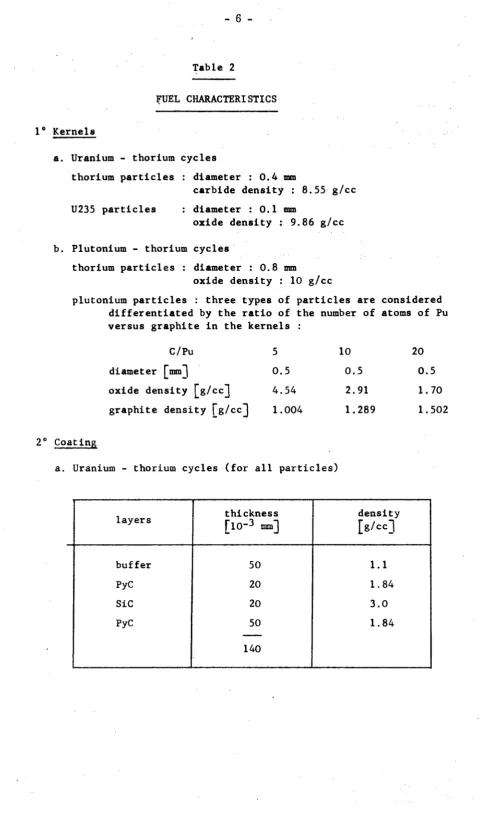
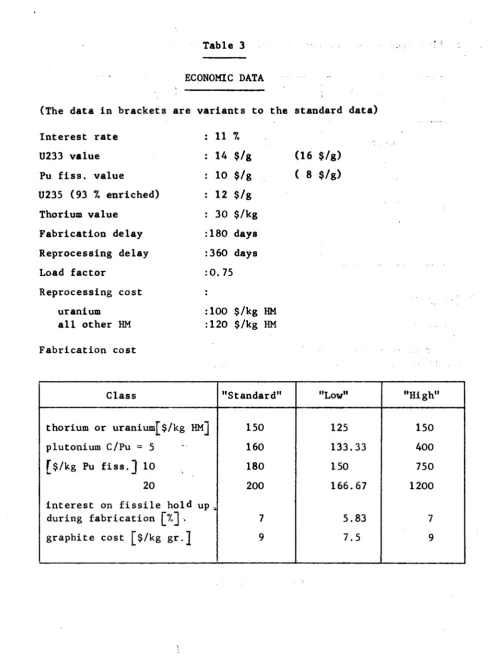
The main reactor physics characteristics that have been kept constant in all the calculations are given in table 1. Table 2 is a compilation of the nost relevant data with regard to the fuel elements for the different :ycles considered. The different sets of economical data are given in table 3.
Table 1
MAIN REACTOR AND PHYSICS CHARACTERISTICS L. Electrical power :
Ì . Thermal efficiency : }. Power density : +. Buckling :
5. Control rod investment : 3. Type of refuelling :
7. Feed plutonium composition
1000 MW 0.40 8 W/cc
5.5 7.10"5 cm-2
1007o Xe override requirement continuous
Magnox or first charge LWR discharge Pu
- 6
Table 2
FUEL CHARACTERISTICS
Io Kernels
a. Uranium - thorium cycles
thorium particles : diameter : 0.4 mm
carbide density : 8.55 g/cc U235 particles diameter : 0.1 mm
oxide density : 9.86 g/cc
b. Plutonium - thorium cycles
thorium particles : diameter : 0.8 mm
oxide density : 10 g/cc
plutonium particles : three types of particles are considered differentiated by the ratio of the number of atoms of Pu versus graphite in the kernels :
C/Pu diameter [mm |
oxide density ¡"g/cc] graphite density fg/cc]
5
0.5
4.54 1.004
10 0.5
2.91 1.289
20 0.5
1.70 1.502
2° Coating
a. Uranium - thorium cycles (for all particles)
layers buffer PyC SiC PyC
thickness [IO"3 mm]
50 20 20 50 140
density [g/cc]
- 7
b. Plutonium - thorium cycles (for all particles) layers
buffer seal PyC SiC PyC
thickness flO-3 mm]·
35 20 30 35 30 150
1
density [g/cc]
1.0 1.5 1.7: 3.2 1.7
Fuel pins Rod diameter Length
Number of rods per block channel Height of channel plugs
Heavy metal loading Graphite matrix density
12.7 mm 36.5 cm
2 3 cm variable 1.7 g/cc, Hexagonal block
Graphite density Distance across flats Height
Fuel holes : number diameter Coolant holes : number
diameter Burnable poison holes: number
diameter Block handling hole: length
equivalent diameter
1.8 g/cc 360 mm 790 mm 210 12.7 mm 108 15.9 mm 6
12.7 mm 395 mm
8
[image:12.595.51.541.40.700.2]-Table 3
ECONOMIC DATA
(The data in brackets are variants to the standard data)
Interest rate U233 value Pu fiss. value
U235 (93 7o enriched) Thorium value
Fabrication delay Reprocessing delay Load factor
Reprocessing cost uranium
all other HM
11 7„ 14 $/g 10 $/g 12 $/g 30 $/kg 180 days 360 days 0.75 100 $/kg 120 $/kg HM HM
(16 $/g) ( 8 $/g)
Fabrication cost Class
thorium or uranium[$/kg HM] plutonium C/Pu = 5
[$/kg Pu fiss.] 10
20
interest on fissile hold upa
during fabrication [7»] . graphite cost [$/kg gr.]
"Standard" 150 160 180 200 7 9
"Low" 125 133.33 150 166.67
5.83 7.5
ï, URANIUM - THORIUM REFERENCE CYCLES
4.1. Specific fuel cycle characteristics
The geometry of the fuel element was in all points similar to the current GGA design (see table 2 and ref 5). The thorium loading was chosen to be 0.48 gr/cc. This leads to a moderation ratio of
226 (NC/Nth).
Considering the questionableness of an early reprocessing of U233, three different cycles have been calculated, all of the segregated type :
Ie ORce through cycles,
2° cycles with recycling of the bred fuel in the breed particles, 3° cycles with recycling of the bred fuel in the feed particles. The irradiation time for all these cycles was identical and fixed at 1050 full power days.
4.2. Physics results
The resonance integral was calculated to be 48 barns. Considering the different cycles and particles the following enrichments », burn-ups, conversion ratios and age factors have been calculated
(Table 4).
Table 4
Type of cycle
[GWD/t]
BU initial Enrichment Feed Breedù
[7]
final
Feed Breed
Conver-sion ratio
Age factor Once through
Recycling in-to breed part Recycling in-to feed part.
67.8 68.2 68.4
5.65 2.29 4.86
2.85
0.65 0.30 0.55
2.31 2.90 2.32
0.685 0.766 0.760
1.372 1.336 1.387
* The enrichment is defined as the percent ratio of the weight of the
- 10
4.3. Cost calculation results
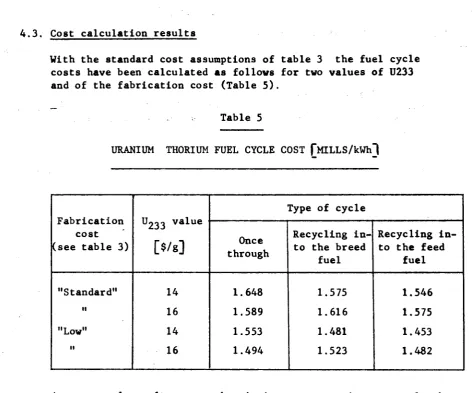
[image:14.595.50.526.50.443.2]With the standard cost assumptions of table 3 the fuel cycle costs have been calculated as follows for two values of U233 and of the fabrication cost (Table 5).
Table 5
URANIUM THORIUM FUEL CYCLE COST fMELLS/kWh"!
Fabrication cost (see table 3)
"Standard"
II
"Low"
II
^233 v a^u e
14 16 14 16
Type of cycle
Once through
1.648 1.589 1.553 1.494
Recycling in-to the breed
fuel
1.575 1.616 1.481 1.523
Recycling in-to the feed
fuel
1.546 1.575 1.453 1.482
As a general result we see that it is more economic to recycle the bred fuel in the feed particles than in the breed particles. This is mainly due to a slightly worse neutronic performance of the latter cycle resulting from the build up of U23C in the continuously recycled bred uranium. This economic advantage is however obtained at the cost of a somewhat higher age factor (Table 4).
Considering the influence of the cost of U033 we see that an increase in this cost influences differently the once through cycles and the recycle cycles. The equivalence value of U2oo for both types of
- 11 Table 6
U2 3 3 EQUIVALENCE VALUE [$/gr]
" -—■—_____^Fabrication cost Type of cycle — · .
Once through versus recycling in breed part
Once through versus recycling in feed part
"High" 15.46 16.31
"Low" 15.43 16.26 As the fuel cycle cost for the case with recycling in the feed particle is lower than for the case with recycling in the breed particle, it is obvious that the equivalence U033 value must be lower for the latter than for the former. No wonder either that the equivalence value is only slightly influenced by the variation in fabrication cost : it results from the very small part taken by the fabrication cost in the difference between the once through and the recycle fuel cycle cost.
PLUTONIUM - THORIUM CYCLES
5.1. Degrees of freedom for the survey
With a given reactor and fuel element geometry and with a fixed power, the freedom for optimisation of the fuel cycle is reduced to the following parameters :
Ie the type of fuel particles
2° the amount of heavy metal in a fuel pin
12
-5.1.1. Ty£e_of fuel particles
As can be seen from the data in table 2, three different plutonium particles have been considered according to the degree of dilution of the plutonium into the graphite within the fuel kernels. A high degree of dilution may be desirable to withstand high internal stresses due to solid swelling and fission gas pressure after irradiation. On the other hand it is clear that at constant kernel diameter the fabri cation cost per unit amount of plutonium will be higher for the more diluted particles, due to the higher number of particles needed to contain the same amount of plutonium.
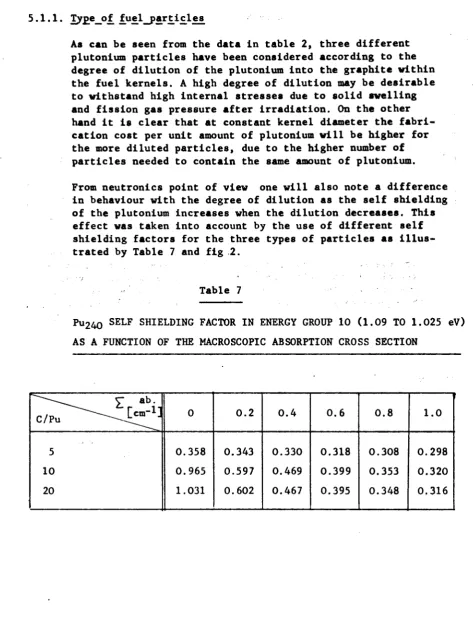
From neutronics point of view one will also note a difference in behaviour with the degree of dilution as the self shielding of the plutonium increases when the dilution decreases. This effect was taken into account by the use of different self shielding factors for the three types of particles as illus trated by Table 7 and fig 2.
Table 7
PU240 S E L F SHIELDING FACTOR IN ENERGY GROUP 10 (1.09 TO 1.025 eV)
AS A FUNCTION OF THE MACROSCOPIC ABSORPTION CROSS SECTION
r~-~---_ Τ a b .
C/Pu ^ ^ J > ^
5
10
20
0
0.358
0.965
1.031
0 . 2
0.343
0.597
0.602
0 . 4
0.330
0.469
0.467
0.6
0.318
0.399
0.395
0 . 8
0.308
0.353
0.348
1.0
[image:16.595.67.541.66.688.2]13
-These self shielding factors have been calculated in the thermal energy groups. They are the smallest (highest self shielding effect) in the energy group around 1.06 eV i.e. around the resonance absorption peak of PU240· There le a marked difference between the self shielding factors of the more diluted (C/Pu » 20,10) and of the less diluted kernels
(C/Pu - 5) . In the first case the self shielding varies considerably with the macroscopic absorption cross section whereas in the second case the self shielding factor Is about constant, but lower.
5.1.2. Thorlum loading^
In a fuel pin the heavy metal particles are dispersed in a matrix of graphite. For a block of fixed geometry and gra-phite density a higher heavy metal loading in the fuel pins corresponds to a lower moderation ratio of the core and vice-versa. The heavy metal loading is also related to the packing fraction, i.e. the relative volume occupied by the fuel particles compared with the total volume of a pin. Table 8 gives the relatione between the thorium loadings
(ThL), the packing fractions (Pf) and the moderation ratios (NC/Nth).
Table 8
ThL [gr/cc]
Pf
NC/Nth
0.486 0.1328
250
0.539 0.1473
225
0.569 0.1557 212.5
0.604 0.1652
200
0.688 0.1882
175
0.799 0.2185
150
5.1.3. PjLutonium e_nr_i£hment_ and burn-up
A certain amount of fissile isotopes is needed to maintain the reactor critical up to a given burn-up or during a given time. The determination of the actual values of the Pu
enrichment as a function of the burn-up is the object of the physics calculations and will be reported below.
14
The burn-ups considered in these calculations range between 40 and 100 GWD/tHM. No higher values have been adopted as it is felt that, with the present fuel characteristics,
100 GWD/tHM is approximatively an upper confidence limit. However no attempt has been made so far to relate this limit to the type of fuel nor to the moderation ratio, although one knows that these parameters are linked.
5.2. Further fuel cycle characteristics
As in the uranium - thorium case different types of cycles have been considered according to the use of the irradiated fuel. However in order to reduce the amount of calculations, only two types of cycles were initially considered for the whole survey :
Io the once through cycle ;
2° the cycle with recycling of the bred fuel in the breed particles.
As all the cycles of this second type appeared to have a very high age factor one physical calculation has also been performed for a cycle with recycling of the bred fuel in the feed particles, but the results have not been much more encouraging and this calculation was not extended to the rest of the survey.
5.3. Physics results
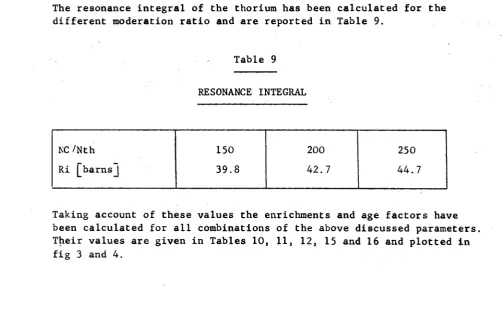
[image:18.595.56.559.420.745.2]The resonance integral of the thorium has been calculated for the different moderation ratio and are reported in Table 9.
Table 9
RESONANCE INTEGRAL
NC /Nth Ri [barns]
150 39.8
200 42.7
250 44.7
- 15
5.3.1. Once through cycles (Tables 10, 11 and 12)
Considering the initial enrichments there is a marked difference between the lower and higher moderation ratio. At high mode-ration ratio (NC/Nth = 250) the enrichment is in the order of 6 to 8 percent and is increasing with increasing burn-up as in the uranium cycle.
For low moderation ratio (less than 200) the enrichments are markedly higher and they decrease with increasing burn-up. The higher enrichment level is due to the shift in spectrum towards the epithermal energies. This shift increases the resonance absorption in PU^AQ. This resonance absorption decreases the
efficiency of the Pu as a fissile make-up, therefore calling for higher feed enrichments. This trend towards higher feed enrichments is somewhat moderated by an increasing self shielding of the fuel and by a higher PU241 production.
The self shielding mainly reduces the influence of P ^ / Q as it Is in its 1.06 eV resonance energy group that the self shielding coefficients are the smallest. Moreover the self shielding is different for the different Pu particles. With the lowest C/Pu in the kernel (C/Pu = 5) the self shielding coefficient in the 1.06 eV group is very low (0.35) and only slightly influenced by the macroscopic absorption cross section (fig 2). For the higher C/Pu (10 to 20) the self shielding coefficients of the same energy group are higher and very sensitive to the macroscopic cross section. This explains the trend towards higher enrichments-and thus higher macroscopic
absorption cross sections - for the Pu particles with C/Pu » 10.20 than for C/Pu = 5.
The higher Pu 241 production of the less moderated fuel cycle increases the reactivity of the averaged burnt Pu. As this Pu 241 production reaches its full importance only after some burn-up of the fuel, it will influence slightly more the cycles with higher burn-up (Table 13). However the variation of feed
16
-Taal« 10
Pu/Thorit» cycles 1* C/ru intanai - 5
Once through cycles
HC/RTh 150 175 200 212.5 225 250 BO GWd/tHM 49.48 66.50 83.45 41.60 50.47 59.51 68.56 86.13 53.04 71.26 88.36 45.16 54.36 63.30 72.07 89.09 54.98 72.58 89.55 55.50 73.05 90.01
I a i t i a l aar. Pu fisa. 14.87 14.32 14.07 14.28 13.49 12.74 12.15 11.78 9.87 9.33 9.94 8.22 7.98 8.13 8.42 9.27 7.12 7.89 8.89 6.36 7.36 8.47 Fitta fa fisa. 10.30 8.37 6.88 10.43 8.92 7.45 6.18 4.51 5.11 3.15 2.50 4.06 3.10 2.58 2.22 1.83 2.19 1.66 1.42 1.38 1.10 0.95 L ear. °233 2.51 3.08 3.53 2.11 2.45 2.75 3.02 3.44 2.50 2.99 3.33 2.20 2.48 2.72 2.92 3.24 2.44 2.85 3.16 2.36 2.73 3.01
r a t i ·
17
Tabla 11
2a C/Tv lateraal 10
eafta through cycles
K / R h
150 175 200
212.5
-225 250 'fö
OM/tBM4 9 . 0 1
«5.85 82.73 40.77 49.35 «7.07 85.15 50.1« 70.11 88.10 41.49 51.40 «2.33 71.67 89.0« 54.17 72.45 89.55 55.38 73.09 90.10 ι
I n i t i a l aar. Ta f l a a .
15.51 15.02 14. «7 15.68 15.09 13.73 1 2 . «2 1 3 . 9 « 10.54 10.17 1 4 . 4 «
12.17 9.31 8.85 9.29 8 . 2 6 8.02 8.89 8.53 7.33
8.40
r i a a l Ta f l a a .
10.98 9.13 7.55 11.94 10.65 7.92 5.47 9.57 4.53 2.79 10.78 7.67 3.91 2.74 1.90 3 . 4 9 1.86 1.46 1.63 1.11 0.89 aar. D33 2.48 3.05 3 . 5 0 2.04 2.37 2.96 3 . 4 2 2.33 2.97
3.33 1.95 2.34
2 . 7 0 2.93 3.2« 2.43 2.87 3 . 1 8 2.37 2 . 7 4 3.03
Couvera. rat l a
18
Taala 12
3* «/Ta lateraal 20
Ont» through eye!*·
■C/BTh 150 200 225 250 BV OM/tBM 49.03 65.87 82.74 50.14 70.06 88.10 54.05 72.45 89.55 55.37 73.09 90.10
l ù l t l a l aar. Pa f l e s .
15.51 14.97 14.67 14.02 10.62 10.17 8.42 8.02 8.88 6.54 7.32 8.39 Pinal Pa f l e s .
10.98 9.14 7.55 9.57 4.60 2.79 3.66 1.87 1.44 1.64 1.11 0.89 ■ aar. Ü33 2.48 3.05 3.50 2.33 2.96 3.35 2.42 2.87 3.18 2.37 2.74 3.03 Couver·. ratio 0.813 0.805 0.796 0.797 0.773 0.752 0.763 0.741 0.725 0.737 0.720 0.705 Aft« factor 1.024 1.029 1.039 1.034 1.134 1.275 1.210 1.447 1.560 1.513 1.707 1.822
Other important results of the physics calculation are the age factors (tables 10, 11 and 12). They are always increasing with increasing burnups, either because the initial fissile content is increasing (for higher moderation ratioa) or because the average fissile content is decreasing (for the lower mode ration ratios) (Table 14). The age factors are also increasing with Increasing moderation ratio : this is due to the reduction in average fissile content for the softer spectra. Comparing the age factors for the different plutonium dilution degrees, the cycle most submitted to self shielding (C/Pu 5) has the highest relative power variation. This also results from the lower average fissile content as a consequence of the lower resonance absorption in the better shielded Pu 240 (Table 14).
If we consider the age factor of the reference uranium
19
-Tabla 13. TBACTIOKaL ABSORPTIO·» Il 80MB HEAVY ISOTOPIS
Once through plutonio». thoriua cycle«
1 · BO/lth - 175 C/Pa - 5
2* Κ / I t a - 175 C/Pa - 10
J* HC/Nth « 250 C/Pa - 10
BU
1
[oM/tejQ
4 1 . 6 0
50.47 59.51 68.56 86.13 40.77 49.35 67.07 85.15 55.38 73.09 90.10 PD239
M
3 7 . 4
3 5 . 8 34.1 32.5 29.9
3 7 . 8 36.1
33.1 30.3
3 0 . 4 27.5 26.1
Ta240
W
n.o
2 0 . 2 19.3 18.5 17.1 21.9 21.3 19.8 18.1
1 7 . 0 15.8 1 5 . 2
Pa241
M
1 1 . 3 1 1 . 7 12.1 1 2 . 4 1 3 . 0
1 1 . 4 1 1 . 8 1 2 . 4 1 3 . 0
15.1 1 5 . 8 1 6 . 0
Pa242
M
0 . 5 0 . « 0 . 8 0 . 9 1 . 2
0 . 3 0 . 6 0 . 8 1.1 1.1 1.6 1.9 1233
M
4 . 3
5.3 6.3 7.3 8.9
4 . 0 4 . 8 6.« 8 . 4
« . 9 8 . 6 9.5
Tabla 14
Once through plutoniun thoriua cycle
Âvarage atóale éaasltles
NC/NTh 175 ι 175 250 C/Pu/k 5 10 10 BU (CWeVtUj 41.60 50.47 59.51 68.56 86.13 40.77 49.35 67.07 85.15 55.38 73.09 90.10 Tv239 l O ^ a t / e «
44.3 38.7 33.3 28.8 23.6 51.1 4 6 . 2 36.1 27.5 6.33 5.65 5.77 Bu240 £ l 01 8a t / c c ]
9.68 8.60 7.61 6.80 5.92 10.77 9.72 7.53 5.78 2.15 2.01 2.02 Pu241 [ W ^ a t / e c ]
11.8 1 1 . 4 1 1 . 0
10.6 10.2 13.04 12.92 12.32 11.46 3.86 4.01 4.34 Pa242 [ l O ^ a t / e o ]
0.68 0.7 0 . 8 1.0 1.3
0 . 6 0 . 7 1.0 1.2
0 . 8 1.2
1.5
0233 [ I 0l fa t / e e ]
4 . 9 5 . 8 6.6 7.4 8.7
4 . 8 5.7 7.3 8.7
20
5.3.2. Çyclesjwith recycling of_the_bred fuel
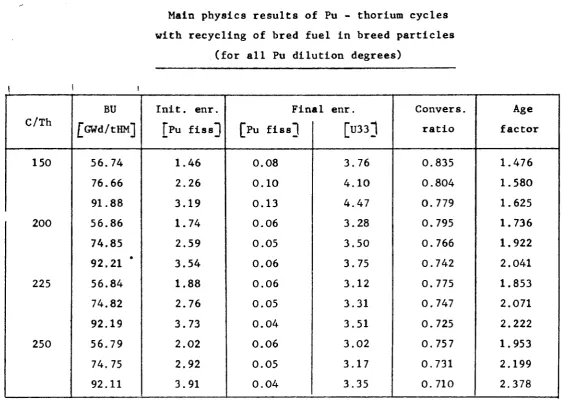
When the bred fuel (mainly U233) is recycled in breed particles, the plutonium make-up is very much reduced
(1.5 to 4 7o enrichment) (Table 15). We see that the plutonium enrichment increases with increasing moderation ratio as there is less neutron absorption by the thorium In a softer spectrum and hence less U233 production. The enrichment is also increasing with increasing burn-up but this is coherent with the low enrichment cycles and with the once through plutonium cycles with high moderation ratios.
The reason why the enrichment was never decreasing with in-creasing burn-up, as for the low moderation ratios of the once through plutonium cycles is to be found in the small amount of Pu involved in these cycles, thus leaving the flux spectrum almost unaffected. Similarly there was practically no influence of the type of Pu-particle on the physics results.
The major drawback for this type of cycle are the high age factors. In fact when comparing with the corresponding reference uranium - thorium cycle, all the considered cycles have a
higher age factor and should therefore be discarded according to the above used criterion.
An attempt to reduce the age factor by recycling the bred fuel in the feed particles was not more successful as can be seen from Table 16.
21
-Table 15
Main physics results of Pu - thorium cycles
with recycling of bred fuel in breed particles
(for all Pu dilution degrees)
1
C/Th
150
200
225
250
Ι ιBU
£GWd/tHM]
56.74
76.66
91.88
56.86
74.85
92.21 '
56.84
74.82
92.19
56.79
74.75
92.11
Init. enr.
[Pu fiss]
1.46
2.26
3.19
1.74
2.59
3.54
1.88
2.76
3.73
2.02
2.92
3.91
Final enr.
[Pu fiss]
0.08
0.10
0.13
0.06
0.05
0.06
0.06
0.05
0.04
0.06
0.05
0.04
[U33]
3.76
4.10
4.47
3.28
3.50
3.75
3.12
3.31
3.51
3.02
3.17
3.35
Convere.
ratio
0.835
0.804
0.779
0.795
0.766
0.742
0.775
0.747
0.725
0.757
0.731
0.710
Age
factor
1.476
1.580
1.625
1.736
1.922
2.041
1.853
2.071
2.222
1.953
2.199
2.378
Table 16
Main physics results of plutonium - thorium cycles
with recycling of bred fuel in feed particles
(for all Pu dilution degrees)
[image:25.595.7.571.94.500.2]- 22
5.4. Fuel cycle cost
The above physics results have been used as a basis for a broad parametric survey of the economics of the different fuel cycles.
A reference fuel cycle cost with standard cost data (cfr. Table 3) has been calculated for all cross variations of :
4 moderation ratios 3 burn-ups
3 plutonium dilution factors 2 types of cycle.
All these calculations have been repeated with slightly different cost data so as to measure the sensitivity of the fuel cycle cost to these cost data : a higher U233 credit, lower Pu price and global fabrication cost have been used.
A last serie of calculations have been performed for a set of new fabrication costs whereby a much higher weight has been given to the plutonium fabrication penalty and to its variation with the plutonium dilution in the kernels. The main results of all these calculations are given in Tables 17 and 18 and in figs 5 to 10.
These results show a wide variation in fuel cycle cost for different moderation ratios, burn-ups and plutonium dilutions in the kernels. However if we consider the age factor of the reference uranium -thorium cycle as an upper limit, we see for the once through cycle that this limit defines a fairly invariable fuel cycle cost. With the standard cost data (Table 3) this cost is approximatively
1.8 milis/kWh (fig 5). It la slightly lower for the higher dilution degrees (C/Pu - 10,20) than for the lower (C/Pu = 5 ) . It also decreases slightly with increasing burn-up. The limit moderation ratio is a
function of the burn-up and the dilution degree.
Changing the U233 or the plutonium value does not change fundamen-tally these results. It is mainly the level of fuel cycle cost that is influenced (fig 6, 7).
23
-Tabla 17
PLUTOMIDM THOBIÜM CYCLE : FUEL CYCLE COST
°233 ▼*!«· LVsO
Pu f i a s , v a l a a [ $ / g r ] F a b r i c a t i o n c o a t C/Pu Β /Hth
2 0 150
200
225
250
■
1 0 150
200
225
250
BU 4 9 . 0 3 6 5 . 8 7 8 2 . 7 4 5 0 . 1 4 7 0 . 0 6 8 8 . 1 0 5 4 . 0 5 7 2 . 4 5 8 9 . 5 5 5 3 . 3 7 7 3 . 0 9 9 0 . 1 0 9 9 . 0 1 6 5 . 8 5 8 2 . 7 3 5 0 . l i 7 0 . 1 1 8 8 . 1 0 5 4 . 1 7 7 2 . 4 5 8 9 . 5 5 5 5 . 3 8 7 3 . 0 9 9 0 . 1 0
One« through c y c l e s [ n i l l e / k W h ]
14 10 "Standard"
3 . 5 4 0 3 . 0 4 8 2 . 7 5 0 2 . 8 9 1 2 . 0 2 7 1 . 7 8 5 1 . 9 8 4 1 . 6 6 2 1 . 5 9 6 1 . 7 3 4 1 . 5 6 9 1 . 5 2 1 3 . 5 4 0 3 . 0 4 8 2 . 7 5 0 2 . 8 9 1 2 . 0 2 7 1 . 7 8 5 1 . 9 8 4 1 . 6 6 2 1 . 5 9 6 1 . 7 3 4 1 . 5 6 9 1 . 5 2 1
14 1 0 "Low"
3 . 3 9 0 2 . 9 3 0 2 . 6 5 2 2 . 7 4 8 1 . 9 2 6 1 . 7 0 2 1 . 8 6 2 1 . 5 6 8 1 . 5 1 5 1 . 6 1 9 1 . 4 7 6 1 . 4 4 1 3 . 3 9 0 2 . 9 3 0 2 . 6 5 2 2 . 7 4 8 1 . 9 2 6 1 . 7 0 2 1 . 8 6 2 1 . 5 6 8 1 . 5 1 5 1 . 6 1 9 1 . 4 7 6 1 . 4 4 1
14 8 "Standard"
2 . 9 0 2 2 . 4 9 0 2 . 2 4 6 2 . 3 8 7 1 . 6 6 9 1 . 4 6 8 1 . 6 5 7 1 . 3 7 8 1 . 3 1 7 1 . 4 6 0 1 . 3 0 7 1 . 2 6 0 2 . 9 0 2 2 . 4 9 0 2 . 2 4 6 2 . 3 8 7 1 . 6 6 9 1 . 4 6 8 1 . 6 5 7 1 . 3 7 8 1.317 1 . 4 6 0 1 . 3 0 7 1 . 2 6 0
14 8 "Low"
2 . 7 6 3 2 . 3 8 1 2 . 1 5 4 2 . 2 5 3 1 . 5 7 3 1 . 3 8 8 1 . 5 4 1 1 . 2 8 8 1 . 2 4 0 1 . 3 4 8 1 . 2 1 7 1 . 1 8 2 2 . 7 6 3 2 . 3 8 1 2 . 1 5 4 2 . 2 5 3 1 . 5 7 3 1 . 3 8 8 1 . 5 4 1 1 . 2 8 8 1 . 2 4 0 1 . 3 4 8 1 . 2 1 7 1 . 1 8 2
16 10 "Standara"
3 . 4 7 4 2 . 9 9 6 2 . 7 1 0 2 . 8 2 5 1 . 9 7 2 1 . 7 4 1 1 . 9 1 8 1 . 6 0 8 1 . 5 5 2 1 . 6 7 0 1 . 5 1 6 1 . 4 7 8 3 . 4 7 4 2 . 9 9 6 2 . 7 1 0 2 . 8 2 5 1 . 9 7 2 1.741 1 . 9 1 8 1 . 6 0 8 1 . 5 5 2 1 . 6 7 0 1 . 5 1 6 1 . 4 7 8
14 10 " S i g h "
24
-ÖJ33 ▼»lua C$/e*3
Fabrication cost
C/Pu se/Htb
5- 150
-
25Tabla 18
PLUTONIUM THORIUM CYCLE : FUEL CYCLE COST
Bredfuel recycling [allle/kWh]
ü233 v e l u·
■
Pu f i s a , valua
Fabrication c o s t
C/Pu BB/Nth BU
20 150 56.74 74.64 91.86 200 56.85 74.83 92.18 225 56.84 74.81 92.17 250 56.78
74.73 92.09 10 150 56.74 74.64 91.86
200 56.85 74.83 92.18 225 56.84
74.81 92.17 250 56.78
26
-Tabla 18 (continuad)
Ü233 value
Pu f i s « , value
Fabrication cost
cy
Pu ffC/Mth BU27
The cycles with recycling of the bred fuel all have too big an age factor, according to the uranium thorium reference cycle. Lower age factors would only be reached with lower moderation ratios, but fig 9 and 10 show that these cycles would than reach a fuel cycle cost of about 1.9 or 2.0 milis/kWh and hence become more expensive than the once through cycles. Consequently if the age factor criterion is valid it does not seem very attractive to recycle the bred fuel in a plutonium thorium cycle.
5. CONCLUSIONS
The calculations have shown that it is possible to design integral block fuel cycles in which plutonium is the feed fuel. If the reference age factor of the uranium - thorium cycle is a feasibility criterion, only once through cycles will economically be acceptable (with a U233 credit of 14 $/gr).
By parametrically changing the value of the fissile plutonium and imposing the fuel cycle costs to be equal to the cost of the reference uranium -thorium cycle, an equivalent plutonium fissila value can be deduced fig 11 and 12.
28
-REFERENCES
[l] Zanantoni C. et al :
[2] Joanou et al : GAM - GATHER combined. GA 4265 and 4132 ; 1963
[3] Zanantoni C. et al :
£4] Zanantoni C. et Paruccini M. : COFFEE, a code for the assessment of fuel cycle costs. DPR 584, TCP. 100.8.1,
D.
(7)0ne-ätep bur nup cale.
© Moiti ■ ¿iep burnup cate
Average core reactivity variation betv/etn a multi-step and a
one- step burnup calculation
l\3 CD
FIG.1.
Self schielding factor for Pu **" in energy group 1'090 to 1.026 e V ■
W % J THORIUM. Pu cycle. Once through.C/Pukernel; s FISSILE Pu ENRICHMENT
« O ,
He/Nth
/
—τ- — ι —
βο — ιgo m-ΒΛ
AGE FACTOR
Reftrence age factor
soo
_J2S
lewo/tl
is
10 30
F/6.3.
£*,[%}
THORIUM. Pu cyc.lt, Once through, C ¡Pu kernet -.«JO
7/C7T
FISSILE £NfílCHM£NT
\ \
\
\ \
- 5
He/Mth
150
■175
Nc/NthtZoo
¿U.S
F/6A.
Hu-Th Fuel Cycle Co&t Ua value : H fjgr Pu fissile value : 10$¡ar. Once through cycle.
^ ^ T ^ — — C/ThZOO
C/TrhZÜ
ç/rh,2so
ψ
2fi-
40-Ρυ-Th Fuel Cycle Cost U. ¿53 value . 16 }jqr Pu-fiss value 10 f/gr Onee through cycle.
—~ \c/n»x»»
Agm factor ¿imit CaweJrì
Flû 5. eo
Í6W4J) Flù.6
ι Inviti/kWh]
IP-[mills/Kwh]
Pu-Th Fuel cycle cost Uaa value : i4 $Jqr
Pu A * · valu» : 6^ ¡gr. Once through
(c¡Po)k
20.10
. _ 5
C)Th. 150
Ç/Th:2O0
SC
τ
—Γ-—r-60 lOWdjti
F/6-t.
40-Pu-Th feel cycle cost
£ƒ» value « H φ/gr
pu fiss. vol: to fly
Once through high Puf¡„ fabrication coat.
(e/Pu)„ PuFC06t
20 1*0 flkg
» MO
5 kOO
Uwo/rJ
Ίο~
IO
2.0
[miUijkWh]
1.9
16
if
1.6
ii
Pu. Th fuel cycle cost
60
U2ÌS value ·. 1A φ/gr. Pu fissile value = lof>)qr. Urn recycled
(C/p0)K, 20,10,6
io
fk/Nth iso
[GWD/T] 90
FIGS.
zo
19 ia If 16 15
[miltä/kWh ]
-SO 60 I
Pu.Th fuel cycle, coat U-233 valeur= 16 f/gr Pu faille value z10f/gr U-Sàò recycled.
(ft)* ¿0,10,5
flc/lllh -.100
zoo
~-~^ΖΓ 225
" ÌSQ
[6WcL/T]
I
to
I I
βΟ 90
0 0 0 0
Pu.VALUE,
íbu. of the reference cycle (uSJTh) 6eM*d¡Kg)
¿0-u\-—
?
20 _ 'pjel cycle cost /mils/kWh-1.9
IB
-if _
1.6
Ifi
-1.Ί
High fahr. C (1900,1000) J/kg Pu.
Lowfabr.C(170,13i) φ I kg Pu
Reference cost.
Pv fissile Cj/grJ
Pu.value
(bu of the reference cycle (uSJTh) BOMwd )k¿)
[Puh
2.0
-1.9
1.β
if
1,6
1.5
1A
fuel cycle cost (mills) Mh)
ZO 10
δ
High fabr C(1900,1000 f/k3?u) lawfabr.cÇwSòfyfon,
fíeftrtnce clot
Pu fissilt C f f gr]
io
co
it»
l/fr. n
m
:i
fifi!
•i™ > Í J M Í nef 5MCÍ'
' S S
J a 3
#
Spill;
m
m
f i i i lii»
«»> ^ w r J l ï r ï · ' · ' ' * ' ' ' ! ' '1' 'Li Fi''!!. * '
i
LOw
Pi
irti*
1
iKlIÉlli
i .
Iiii
li
A p i
NOTICE TO THE READER
AU scientific and technical reports published by the Commission of
t\n auieii uiiu ajiu. Lcciiiiicai icpuiLS puuubueu uy m e v^uimiiissiuu ui
the European Communities are announced in the monthly periodical "euro-abstracts". For subscription (1 year: BF.1025) or free specimen copies please write to :
Äffl^5
S;!
äS $ P l ^ ^ w ! r ø infria
iPiilMiiliiiil
Office for Official I
•irai
ions
rønBiifll!
É l ;
Iffpl SÈI
iiXttfci'ititiaiHIt Luí lu i f 'ïHiBltiS li
fsSíW
ik'fTií ML· «wlS-iBtff»
Publications of the European Communities
Case postale 1003 Luxembourg 1
(Grand-Duchy of Luxembourg)
mm
mmm
■
M
1'
WE
SALES OFFICES
The Office for Official Publications sells all documents published by the Commission of the European Communities at the addresses listed below, at the price given on cover. When ordering, specify clearly the exact reference and the title of the document.
UNITED KINGDOM
HM. Stationery Office
P.O. Box 569
London S.E. 1 — Tel. 01 -928 69 77. ext. 365
ITALY
Libreria dello Stato
Piazza G. Verdi 10
00198 Roma — Tel. (6) 85 08 CCP 1/2640
¡,<:μ,Η
Ml
BELGIUM
Moniteur belge — Belgisch Staatsblad
Rue de Louvain 40-42 — Leuvenseweg 40-42 1000 Bruxelles — 1000 Brussel — Tel. 12 00 26 CCP 50-80 — Postgiro 50-80
Agency :
Librairie européenne — Europese Boekhandel Rue de la Loi 244 — Wetstraat 244 1040 Bruxelles — 1040 Brussel
DENMARK
J.H. Schultz — Boghandel
Montergade 19
DK 1116 Kobenhavn K —Tel. 14 11 95
NETHERLANDS
Staatsdrukkerij- en uítgeverl/bedríjf
Christoffel Plantijnstraat
's-Gravenhage —Tel. (070) 81 45 11 Postgiro 42 53 00
UNITED STATES OF AMERICA
European Community Information Service
2100 M Street, N.W. Suite 707
Washington, D.C., 20 037 — Tel. 296 51 31
mw
FRANCE
Service de vente en France des publications des Communautés européennes — Journal officiel
26. rue Desaix — 75 732 Paris - Cedex 15· Tel. (1 ) 306 51 00 — CCP Paris 23-96
SWITZERLAND
Librairie Payot
6, rue Grenus
1211 Genève — Tel. 31 89 50 CCP 12-236 Genève
GERMANY (FR)
Verlag Bundesanzeiger
5 Köln 1 — Postfach 108 006 Tel. (0221) 21 03 48
Telex: Anzeiger Bonn 08 882 595 Postscheckkonto 834 00 Köln
SWEDEN
Librairie CE. Fritze 2, Fredsgatan Stockholm 16
Post Giro 193, Bank Giro 73/4015
GRAND DUCHY OF LUXEMBOURG
O/fice for Official Publications of the European Communities
Case postale 1003 — Luxembourg Tel. 4 79 41 —CCP 191-90
Compte courant bancaire: BIL 8-109/6003/200
IRELAND
Stationery Off'ce — The Controller
Beggar's Bush Dublin 4 — Tel. 6 54 01
SPAIN
Libreria Mundi-Prensa
Castello 37
Madrid 1 —Tel. 275 51 31
OTHER COUNTRIES
Office for Official Publications of the European Communities
Case postale 1003 — Luxembourg Tel. 4 79 41 — CCP 191-90
Compte courant bancaire: BIL 8-109/6003/200
OFFICE FOR OFFICIAL PUBLICATIONS OF THE EUROPEAN COMMUNITIES Case postale 1003 — Luxembourg 6151
![UTable 6 2 3 3 EQUIVALENCE VALUE [$/gr]](https://thumb-us.123doks.com/thumbv2/123dok_us/7794318.727408/15.595.70.506.75.289/utable-equivalence-value-gr.webp)