0095-1137/06/$08.00⫹0 doi:10.1128/JCM.44.2.536–546.2006
Copyright © 2006, American Society for Microbiology. All Rights Reserved.
Use of PCR-Restriction Enzyme Pattern Analysis and Sequencing
Database for
hsp65
Gene-Based Identification of
Nocardia
Species
Vero
´nica Rodrı´guez-Nava,
1Andre
´e Couble,
1Gregory Devulder,
2Jean-Pierre Flandrois,
2Patrick Boiron,
1and Fre
´de
´ric Laurent
1*
UMR CNRS 5557, Center for Microbial Ecology, Opportunistic Pathogens and Environmental Research Group, French Observatory for Nocardiosis, Laboratoire de Mycologie Fondamentale et Applique´e aux Biotechnologies Industrielles, UFR de Pharmacie,
Universite´ Claude Bernard Lyon I, Lyon, France,1and UMR CNRS 5558, Laboratoire de Bacte´riologie, UFR de Me´decine Lyon-Sud, BP 12, 69921 Oullins Cedex, France2
Received 6 October 2004/Returned for modification 30 November 2004/Accepted 22 November 2005
Nocardiaidentification required laborious and time-consuming phenotypic and chemotaxonomic methods
until molecular methods were developed in the mid-1990s. Here we reassessed the capacity of PCR-restriction
enzyme pattern analysis (PRA) of thehsp65gene to differentiateNocardiaspecies, including 36 new species.
Our results confirm thathsp65PRA must no longer be used forNocardiaspecies identification, as many species
have the same restriction pattern. We then compared sequencing-based strategies using anhsp65database and
a 16S rRNA database and found that thehsp65region contained sufficient polymorphisms for comprehensive
Nocardiaspecies identification.
Nocardiaspecies are gram-positive, weakly acid-fast, strictly aerobic bacteria that form filamentous branched cells which fragment into pleomorphic rod-shaped or coccoid elements.
Nocardia species are essentially soil saprophytes involved in the decomposition of plant material (12, 16, 18). However, some species can infect both immunocompromised and immu-nocompetent individuals (18). Genus and species identification is necessary to predict antimicrobial susceptibility and for ep-idemiological purposes and also for environmental investiga-tions (biodiversity, ecological niches, etc.).
Nocardia identification used to be based on laborious and time-consuming phenotypic and chemotaxonomic methods. Molecular methods were developed in the 1990s, including a 16S rRNA gene PCR-based method capable of distinguishing
the genusNocardiaamong aerobic actinomycetes (15).
PCR-restriction enzyme pattern analysis (PRA) of a 441-bp
frag-ment of the 65-kDa heat shock protein (hsp65) gene was
de-veloped to identify individualNocardiaspecies (28, 29). Sequential
use of the two techniques provided rapid and simplified
iden-tification of Nocardia isolates from molecular dichotomous
decision trees based on amplification/no amplification and the number and size of restriction fragments.
The genusNocardiahas undergone a taxonomic revolution
during the last 10 years. Only 12 species were described be-tween 1888, when the genus was first isolated by Nocard (20), and 1996, whereas more than 40 species are now recognized to exist. Some have been collected from clinical specimens; other have been isolated only from environmental specimens. PCR methods developed during the last decade have not yet been
tested on the full range of knownNocardiaspecies. For
exam-ple, no data are available on thehsp65-PRA patterns of the 36
new species. Moreover, sequencing methods are increasingly important identification tools, and those based on 16S rRNA
gene polymorphism have been applied toNocardia(7, 19, 21).
The MicroSeq 500 16S rRNA gene kit (PE Applied Biosys-tems) and the RIDOM database and BIBI database based on this methodology have recently been applied to the species
identification ofMycobacteriumandNocardiaisolates (6, 7, 9,
19, 21, 32). These approaches proved to be as efficient as conventional methods (biochemical tests, high-pressure liquid chromatography, and molecular probes) for many but not all
Nocardiaspecies (7). The latter authors underlined that public databases which are not monitored (no standard annotation, no control of strain identification, etc.) should be used with caution. Moreover, in order to overcome the strong similarity
of 16S rRNA gene sequences within the genusMycobacterium
(e.g.,M. gastriandM.kansasii) and microheterogeneity within
a given species (e.g.,M. gordonae), the study of other genes
such ashsp65(23),rpoB(13),sod(35),recA(1), and 16S-23S
ITS(24) may be used. Similar problems arise with Nocardia
(19, 21).
Here we reevaluated the accuracy of thehsp65-PRA method
and compared it with an alternative strategy based on partial
hsp65gene sequences forNocardiaspecies identification.
MATERIALS AND METHODS
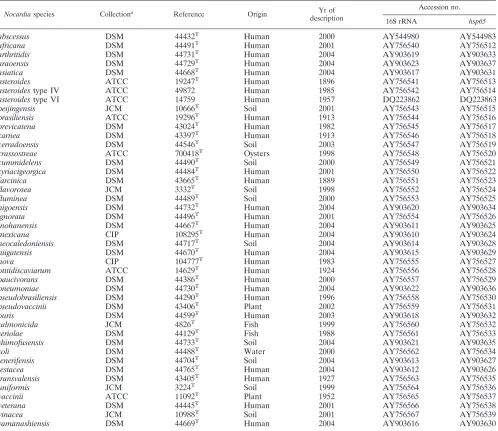
Type and reference strains.Forty-four strains corresponding to 44 species of
Nocardiawere studied (Table 1).N. asteroidesATCC 49872, representative of
“N. asteroidestype IV,” was also included, as it corresponded to clearly
individ-ualized clusters (which have not yet been named) (4, 17). The strain ATCC 19247T
, previously used as a representative ofN. asteroides, was included in this study. The taxonomic position of this strain has given rise to much controversy. This strain was in fact representative only of a rare unnamed subgroup of the formerN. asteroidescomplex (21). In the same way, the strain ATCC 14759 was proposed as the reference strain for the type VI drug susceptibility pattern. But some authors indicated thatN. cyriacigeorgicamay be the same as the major group of isolates (i.e., type VI) within theN. asteroidescomplex (21, 25). In the absence of information (especially DNA-DNA homology and decision by taxo-nomic committees) (21) allowing a definitive conclusion, we decided to include the two species in our study and to present separately the data for the two
* Corresponding author. Mailing address: UMR CNRS 5557, Labo-ratoire de Mycologie Fondamentale et Applique´e aux Biotechnologies Industrielles, UFR Pharmacie, UCB Lyon I, 69373, Lyon Cedex 08, France. Phone: (33) (0) 4 78 77 70 00. Fax: (33) (0) 4 78 77 72 12. E-mail: [email protected].
536
on May 16, 2020 by guest
http://jcm.asm.org/
representative strains.Streptomyces somaliensisDSM 41612Twas used as the
outgroup for phylogenetic analysis. The strains were obtained from international collections and grown on Bennett agar at 37°C for 3 to 15 days.
Clinical isolates.We also studied 21 clinical isolates sent for identification to
the Observatoire Franc¸ais des Nocardioses (Lyon, France). We confirmed that they belonged to the genusNocardiaby analyzing basic phenotypic characteris-tics such as culture morphology, mesodiaminopimelic acid, lysozyme resistance, substrate use (2), and also PCR (15).
DNA extraction.DNA was extracted with achromopeptidase. Colonies were
picked off with a loop, and one loopful was suspended in 250l of sterile pyrolyzed water and vortexed for 1 minute. The bacterial filaments were crushed manually with conical plastic crushers. The mixture was then incubated for 15 min at 70°C. Fifty microliters of the suspension plus 1.5l of achromopeptidase (10 U/ml; Sigma, Steinheim, Germany) was incubated at 55°C for 15 min. The suspensions were then centrifuged for 3 min at 13,000 rpm. The supernatants were stored at⫺20°C until use.
hsp65amplification and PRA identification ofNocardia species.A 441-bp
fragment of thehsp65gene encoding the 65-kDa heat shock protein was ampli-fied with primers described by Telenti et al. (TB11, 5⬘-ACCAACGATGGTGTG
TCCAT-3⬘; TB12, 5⬘-CTTGTCGAACCGCATACCCT-3⬘) (30). Amplification was carried out in packaged PCR tubes (Ready-to-Go PCR Beads; Amersham Biosciences, Piscataway, N.J.) in a final volume of 25l (2.5 U ofTaqpolymerase puRe Taq, 10 mM Tris-HCl [pH 9], 50 mM KCl, 1.5 mM MgCl2, 200M each
deoxynucleoside triphosphate) with 10l of DNA extract. Amplification was carried out in a thermal cycler (PTC-100; MJ Research, Boston, Mass.). Ampli-fication runs included a 5-min initial denaturation step at 94°C, followed by 35 cycles (94°C for 60 s, 55°C for 60 s, and 72°C for 60 s), and a 10-min final extension step at 72°C.
Ten microliters of amplification product was digested with BstEII, MspI, and HinfI according to the manufacturer’s instructions (New England Biolabs, Saint Quentin en Yvelines, France) and then electrophoresed in a 3% agarose gel (Agarose 3:1; Eurobio, Les Ulis, France) containing 0.5g/ml ethidium bromide (Sigma) at 90 V for 6 h. A 50-bp DNA ladder (Sigma) was used to interpret restriction patterns. The results were analyzed and included in a dichotomous decision tree based on the number and size of restriction fragments obtained with each enzyme, in the following order: BstEII, MspI, and HinfI.
hsp65and 16S rRNA gene sequencing and analysis.A 606-bp fragment of the
[image:2.585.45.543.81.512.2]16S rRNA gene was amplified with primers Noc1 (5⬘-GCTTAACACATGCAA
TABLE 1. Strains ofNocardiastudied
Nocardiaspecies Collectiona
Reference Origin Yr of
description
Accession no.
16S rRNA hsp65
abscessus DSM 44432T Human 2000 AY544980 AY544983
africana DSM 44491T Human 2001 AY756540 AY756512
arthritidis DSM 44731T Human 2004 AY903619 AY903633
araoensis DSM 44729T Human 2004 AY903623 AY903637
asiatica DSM 44668T Human 2004 AY903617 AY903631
asteroides ATCC 19247T Human 1896 AY756541 AY756513
asteroidestype IV ATCC 49872 Human 1985 AY756542 AY756514
asteroidestype VI ATCC 14759 Human 1957 DQ223862 DQ223863
beijingensis JCM 10666T Soil 2001 AY756543 AY756515
brasiliensis ATCC 19296T Human 1913 AY756544 AY756516
brevicatena DSM 43024T Human 1982 AY756545 AY756517
carnea DSM 43397T Human 1913 AY756546 AY756518
cerradoensis DSM 44546T Soil 2003 AY756547 AY756519
crassostreae ATCC 700418T Oysters 1998 AY756548 AY756520
cummidelens DSM 44490T Soil 2000 AY756549 AY756521
cyriacigeorgica DSM 44484T Human 2001 AY756550 AY756522
farcinica DSM 43665T Human 1889 AY756551 AY756523
flavorosea JCM 3332T Soil 1998 AY756552 AY756524
fluminea DSM 44489T Soil 2000 AY756553 AY756525
higoensis DSM 44732T Human 2004 AY903620 AY903634
ignorata DSM 44496T Human 2001 AY756554 AY756526
inohanensis DSM 44667T Human 2004 AY903611 AY903625
mexicana CIP 108295T Human 2004 AY903610 AY903624
neocaledoniensis DSM 44717T Soil 2004 AY903614 AY903628
niigatensis DSM 44670T Human 2004 AY903615 AY903629
nova CIP 104777T Human 1983 AY756555 AY756527
otitidiscaviarum ATCC 14629T Human 1924 AY756556 AY756528
paucivorans DSM 44386T Human 2000 AY756557 AY756529
pneumoniae DSM 44730T Human 2004 AY903622 AY903636
pseudobrasiliensis DSM 44290T Human 1996 AY756558 AY756530
pseudovaccinii DSM 43406T Plant 2002 AY756559 AY756531
puris DSM 44599T Human 2003 AY903618 AY903632
salmonicida JCM 4826T Fish 1999 AY756560 AY756532
seriolae DSM 44129T Fish 1988 AY756561 AY756533
shimofusensis DSM 44733T Soil 2004 AY903621 AY903635
soli DSM 44488T Water 2000 AY756562 AY756534
tenerifensis DSM 44704T Soil 2004 AY903613 AY903627
testacea DSM 44765T Human 2004 AY903612 AY903626
transvalensis DSM 43405T Human 1927 AY756563 AY756535
uniformis JCM 3224T Soil 1999 AY756564 AY756536
vaccinii ATCC 11092T Plant 1952 AY756565 AY756537
veterana DSM 44445T Human 2001 AY756566 AY756538
vinacea JCM 10988T Soil 2001 AY756567 AY756539
yamanashiensis DSM 44669T Human 2004 AY903616 AY903630
a
ATCC, American Type Culture Collection, Manassas, VA; DSM, Deutsche Sammlung von Mikroorganismen und Zellkulturen GmbH, Braunschweig, Germany; JCM, Japan Collection of Microorganisms, Wako-Shi, Saitama, Japan; CIP, Collection Institut Pasteur, Paris, France.
on May 16, 2020 by guest
http://jcm.asm.org/
on May 16, 2020 by guest
http://jcm.asm.org/
GTCG-3⬘) (positions 46 to 64,Escherichia colinumbering system) and Noc2 (5⬘-GAATTCCAGTCTCCCCTG-3⬘) (positions 663 to 680,E. colinumbering system). After 40 cycles of denaturation at 94°C for 60 s, primer annealing at 58°C for 60 s, and primer extension at 72°C for 60 s, followed by postamplifica-tion extension at 72°C for 5 min, PCR products were purified with the EZNA gel extraction kit (EAZY Nucleic Acid Purification; Omega Bio-Tek, Vaulx-en-Velin, France). Forhsp65gene sequencing, the amplification protocol was the same as that used forhsp65PRA. Sequencing was performed with fluorescence-labeled dideoxynucleotide terminators implemented with the ABI PRISM Big Dye terminator cycle sequencing reaction kit (PE Applied Biosystems, Foster City, CA) and primers Noc1 and Noc2. Thehsp65gene was amplified and sequenced with primers TB11 and TB12 as described below. Nucleotide sequences were determined with an ABI 377 automated sequencer according to the manufacturer’s instructions (PE Applied Biosystems). Each sequence was manually aligned and analyzed to ensure a high quality of sequence data. According to the 441-bp fragment of thehsp65gene, we achieved an in silico restriction analysis by using DNAStrider software. We tried to select new en-zymes allowing a better differentiation ofNocardiaspecies.
Moreover, the target 16S rRNA gene andhsp65nucleotide sequences were aligned with the Clustal W program (31). Phylo_win software (10) was used to infer evolutionary trees according to neighbor-joining methods (26) using the Kimura two-parameter model (14). Tree robustness was assessed by bootstrap resampling (1,000 replicates each).
Analysis of sequences from clinical strains.Thehsp65and 16S rRNA
se-quences of the 21 clinical strains were determined as described above. They were then compared to theNocardiaentries in thehsp65and 16S rRNA databases that included only the sequences obtained in this study. The database comparison, using Bibi software (9), generated a list of the closest matches with pairwise distance scores indicating the percent difference between the unknown sequence and the database sequences.
RESULTS
Reference strains. Primers TB11 and TB12 amplified the
expected 441-bp fragment of thehsp65gene for all the
refer-ence strains. The restriction patterns obtained for the species previously included in decision trees (Fig. 1, species indicated by arrows) conformed to those described by Steingrube et al. (28, 29). The restriction patterns of the 36 species not previ-ously tested with this method (Fig. 1) were added to the pre-viously published patterns. The new decision tree was much
more complex. Thirteen species (N. arthritidis,N. beijingensis,
N. cerradoensis, N. crassostreae, N. farcinica, N. ignorata, N. mexicana,N. pseudobrasiliensis,N. pseudovaccinii,N. seriolae,N. tenerifensis,N. testacea, andN. transvalensis) each had a unique restriction pattern. Conversely, a significant number of species had identical patterns that formed six clusters (Fig. 1), as
follows: cluster 1,N. asteroidestype IV (ATCC 49872) andN.
vaccinii; cluster 2,N. flumineaandN. salmonicida; cluster 3,N. carnea,N. flavorosea, andN. uniformis; cluster 4,N. abscessus,
N. araoensis,N. asiatica,N. asteroidestype VI (ATCC 14759),
N. asteroidesATCC 19247T,N. brevicatena,N. cyriacigeorgica, N. higoensis,N. neocaledoniensis, N. paucivorans,N. puris,N. vinacea; cluster 5,N. brasiliensis,N. inohanensis,N. niigatensis,
N. otitidiscaviarum, N. shimofusensis, andN. yamanashiensis;
cluster 6,N. africana,N. cummidelens,N. nova,N. pneumoniae,
N. soli, andN. veterana.
Surprisingly, theN. cerradoensis andN. ignorata
amplifica-tion products had a BstEII restricamplifica-tion site, which is character-istic of mycobacteria (29).
According to these first results, we decided to generate a
new decisional dichotomous tree with additional discriminat-ing enzymes. More than 550 enzymes were tested in silico on the hsp65 sequences of the 44 reference strains. Although some combinations of restriction enzymes provided better dif-ferentiation within a few clusters, none discriminated among all the species (data not shown). Importantly, the undifferen-tiated clusters included the species most commonly identified in clinical samples.
We then created two databases, one based on thehsp65gene
sequence (401 bp) and the other based on the 16S rRNA gene sequence (569 bp) (excluding primer sequence regions), and
compared their discriminatory power. Alignment of thehsp65
sequences revealed a large number of variable nucleotide po-sitions bearing at least one substitution in all species. The
hsp65interspecies dissimilarity ranged from 12% betweenN. fluminea and N. transvalensis to 0% between N. soli and N. cummidelens and between N. flavorosea and N. uniformis
(Table 2). By comparison, the interspecies dissimilarity based
on the 16S rRNA fragment ranged from 9.5% between N.
flumineaand N. testaceato 0% betweenN. soliandN. cum-midelensand betweenN. cyriacigeorgicaandN. asteroidestype VI (Table 2). The number of variable sites was higher in the
hsp65gene than in the 16S rRNA gene (26.4% versus 14.6%). Moreover, when we analyzed each pair of species individually (Table 2), 71% of pairwise distances (672/946) were higher withhsp65than with 16S rRNA.
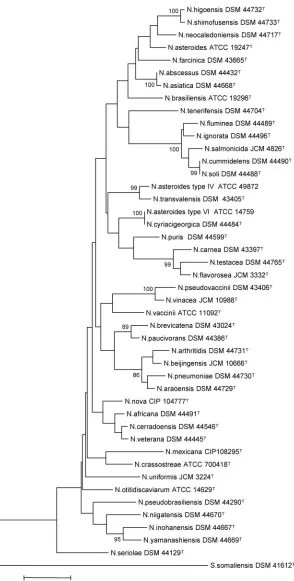
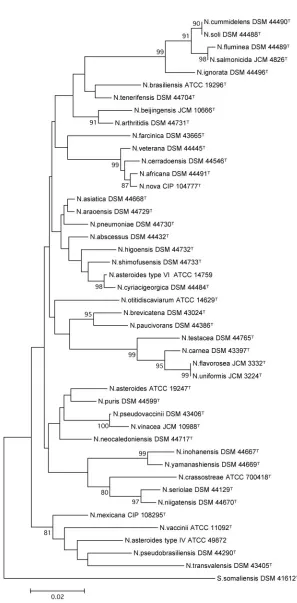
Two phylogenetic trees were then generated from thehsp65
and 16S rRNA gene sequences of the 44 species studied (Fig. 2
and 3). TheS. somaliensisDSM 41612Tsequence was used to
root both trees.
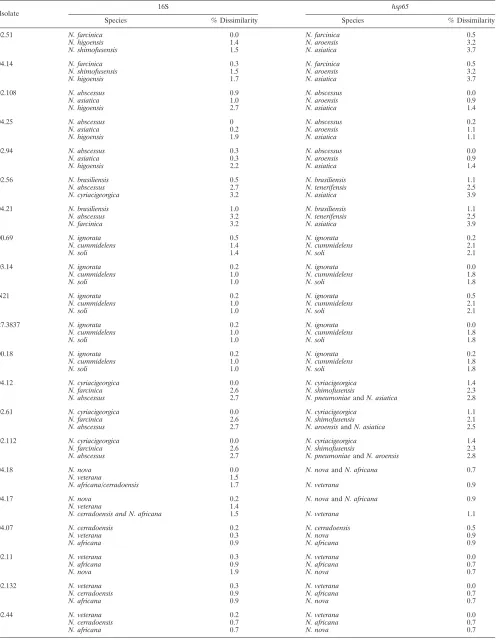
Clinical strains.Twenty-one isolates were submitted to 16S
rRNA and hsp65sequence analysis using our own nocardial
databases and Bibi software (http://pbil.univ-lyon1.fr/bibi/). For each clinical isolate and each fragment (16S rRNA and
hsp65), we searched for the three closest species in the data-bases, e.g., the three species showing the lowest dissimilarity (Table 3). For 19 of the 21 isolates, the closest species were the
same whether thehsp65 or 16S rRNA sequences were used
(Table 2). For the two remaining isolates (04.17 and 04.18), the
hsp65-based analysis was inconclusive: the pairwise distances fromN. novaandN. africanawere equal, while those based on the 16S rRNA sequences were identical (isolate 04.18) or very
close (isolate 04.17, 0.2% dissimilarity) toN. nova. In contrast,
the two species were much more remote from N. africana,
which was only the third most closely related species. The 16S rRNA sequence was thus more discriminatory.
For the other isolates, thehsp65gene was more
discrimina-tory than the 16S rRNA gene. Indeed, the closest species were
more distant (higher dissimilarity differences with hsp65
se-quences than with 16S rRNA sese-quences). For instance, the 16S rRNA sequence of isolate 04.07 showed 0.2% dissimilarity to
N. cerradoensis, 0.3% dissimilarity to N. veterana, and 0.9%
dissimilarity to N. africana. On the basis of the hsp65
se-quences,N. cerradoensiswas the closest species (0.5%
dissim-FIG. 1. Steingrube’s decision tree for the identification ofNocardiaspecies byhsp65PRA (29), based on reference strains. The previously tested species are indicated by arrows.a, reclassified asN. abscessusby Roth et al. (25);b, reclassified as aNocardiasp. by Roth et al. (25); *, results from the work of Steingrube et al. (29).
on May 16, 2020 by guest
http://jcm.asm.org/
TABLE 2. 16S rRNA and hsp65 gene sequence dissimilarities, with evolutionary distances, of 44 species of Nocardia , determined with ClustalW and Mega software Strain no. a Species % D ivergence in the 16S rRNA or hsp65 gene of strain b: 123456 7 8 9 1 0 1 1 1 2 1 3 1 41 5 1 6 1 7 1 81 9 2 0 2 1 2 2 2 3 2 4 2 5 2 6 2 7 2 8 2 9 3 0 3 1 3 2 3 33 4 3 5 3 6 3 7 3 83 9 4 0 4 1 4 2 4 3 4 4 1 N. abscessus DSM 44432 T 4.6 2.8 2.3 0.2 2.5 3.5 2.6 2.3 2.6 4 4.4 4.2 5.6 6.2 2.6 2.3 4.9 6 2.3 5.8 5.3 6.5 2.8 6.2 4.8 5.3 4.2 3.5 6.3 6.5 3.3 5.6 6.7 2.3 6.2 3.7 5.8 3 4.9 5.1 4.6 5.6 5.3 2 N. africana DSM 44491 T 4.5 4 5.1 4.8 4.2 2.5 3.5 5.1 5.1 3.5 5.5 1.2 3.2 6.2 3.5 4.6 5.3 5.6 6 6.3 5.1 4.9 4.8 4.8 1.8 2.5 2.8 4.8 4.4 4.2 4.2 6.5 4.9 6 6.2 6.5 6.5 3.2 4.2 2.3 0.7 3.7 4.6 3 N. araoensis DSM 44729 T 1 4 1.2 3 4.6 4.4 4.7 1.6 4.6 2.8 6 4.2 5.6 6.2 4.8 4.4 6 6 4.9 5.8 6 4.6 5.3 5.6 3.9 4.8 2.8 1.1 5.6 5.5 4.9 6.2 5.5 4.9 6.2 3.9 7.2 4.4 6 4.4 4.4 4.4 5.1 4 N. arthritidis DSM 44731 T 3.2 4.5 2.5 2.5 4.8 5.5 4.9 1.1 4.9 3.5 5.8 5.1 6.3 7.2 4.9 4.6 6.3 7 4.6 6.9 5.5 5.3 5.1 6.3 4.9 5.8 3.7 1.9 6.5 6.3 5.6 6.7 6.2 4.6 7.2 4.6 7.2 5.1 6.2 4.9 5.5 5.5 5.5 5 N. asiatica DSM 44668 T 1.5 4 0.5 3 2.6 3.7 2.8 2.5 2.8 4.2 4.6 4.4 5.8 6.3 2.8 2.5 5.1 6.2 2.5 6 5.5 6.5 3 6.3 4.9 5.5 4.4 3.7 6.5 6.7 3.5 5.8 6.9 2.5 6.3 3.7 6 3.2 5.1 5.3 4.8 5.8 5.5 6 N. asteroides ATCC 19247 T 4.2 6.5 3.2 5.2 2.7 4 3.9 4.4 3.5 5.3 5.1 4.4 5.6 4.9 3.9 3.5 5.8 5.5 2.5 4.4 6.3 7.4 1.4 6.3 4.4 5.8 5.3 4.6 5.5 4.6 4 5.1 6.5 2.5 4.9 5.1 5.8 4 5.3 4.6 4.4 3.9 5.3 7 N. asteroides type IV ATCC 49872 T 5.5 5.7 5.5 5.7 5 5.5 3.2 5.8 4.2 4.9 5.6 3 4 5.5 3.2 3.5 5.1 4.9 5.1 5.6 6.2 4.9 4.8 5.8 3.5 3.9 4.2 5.1 5.6 5.5 4.2 6 6.2 5.1 5.5 5.5 6 0.9 5.3 4.8 2.5 4.9 5.8 8 N. asteroides type VI ATCC 14759 2.5 5.2 2 4 2 3.7 6 4.6 3 3.7 4 3.5 4 6.9 0 2.5 3.7 6.3 4.2 6.5 5.1 6.3 4.2 5.3 3.3 3.9 3.2 5.6 5.4 6.3 3 6.3 5.8 4.2 6.9 5.1 4.4 3 3.7 4.6 3.5 5.4 5.6 9 N. beijingensis JCM 10666 T 4.2 5 3.5 1.7 3.7 6 7 5 3.9 3.5 5.6 5.1 5.3 6.2 4.6 4.6 6.2 6 4.6 5.8 5.5 4.2 4.8 5.6 3.9 5.5 3.7 2.3 5.5 5.6 5.6 5.6 5.8 4.6 6.2 3.7 7 5.3 5.1 4.9 5.5 4.8 5.5 10 N. brasiliensis ATCC 19296 T 4.2 6.2 4.5 4.5 4.2 4 6.7 5 5 5.6 5.6 5.1 4.2 5.5 3 3 5.8 4.9 3.5 4.8 6 6 4 5.5 4.8 5.6 5.8 5.1 5.5 6 4.4 5.3 6.2 3.5 5.5 3.9 6.3 4.2 4.9 5.6 5.3 5.3 5.6 11 N. brevicatena DSM 43024 T 4.5 5.2 3.5 5.5 3.5 5 7 4.5 6 6.2 4.2 3.3 4.9 8.1 3.7 5.8 3.7 7.7 6 7.6 6 5.6 5.6 5.6 4.2 4.6 1.1 2.8 5.6 5.8 2.8 8.1 5.3 6 8.1 6.3 4.9 4.8 4.9 3 3.9 4.8 5.3 12 N. carnea DSM 43397 T 6 8.7 5.5 6.5 5.5 7.2 8.5 7 7.2 7.2 6 5.8 6.5 8.3 4 6.2 1.6 8.3 5.6 8.1 7.4 8.6 5.1 7.7 6.5 6.5 4.6 6.2 7.2 7.2 3.5 7.6 7 5.6 8.3 7.4 2.1 5.6 6.3 5.6 6.2 6.7 6.7 13 N. cerradoensis DSM 44546 T 4.5 1 4 4.5 4 6.5 6.2 5.2 4.7 6.2 5.7 8.7 3.9 6.5 3.5 4.9 5.3 6 6.2 6.7 4.8 5.8 5.1 4.9 1.9 2.3 2.6 4.6 4.8 4.9 4 6.9 5.1 6.2 6.5 6.5 6.5 3.5 4 2.1 0.5 4.2 4.4 14 N. crassostreae ATCC 70418 T 6.7 7.7 6 6.5 5.5 6.7 8.2 7 7.2 7.5 7.5 9.2 7.7 6.7 4 5.5 6 6.7 6.5 6.7 4.9 3.5 6.3 3.9 3.2 3.2 4.4 6 3.7 5.3 5.5 7.4 4.2 6.5 6.7 5.8 6.5 4.2 4.2 4.8 3.3 4.8 5.8 15 N. cummidelens DSM 44490 T 6.7 8.5 6.7 5.7 7 6.5 10.2 8 5.5 5.7 7.7 8.5 8 10 6.9 6.9 9 1.4 6.7 0.9 6.7 6.7 5.8 6.7 4.9 7 7.4 6.5 6 5.8 7 1.1 7 6.7 0 5.1 9.3 5.8 6.3 6.7 6.3 5.6 5.8 16 N. cyriacigeorgica DSM 44484 T 3 5.7 2.5 4.5 2.2 4 6.2 0.5 5 5 5 7.2 5.7 7.2 8 2.5 3.7 6.3 4.2 6.5 5.1 6.3 4.2 5.3 3.3 3.9 3.2 5.6 5.5 6.3 3 6.3 5.8 4.2 6.9 5.1 4.4 3 3.7 4.6 3.5 5.5 5.6 17 N. farcinica DSM 43665 T 4 4.7 3.5 4.5 4 6.2 6.5 4.5 5.5 6.2 4.5 7.5 5.2 7 8.7 5 5.5 6.3 1.8 6.5 6.5 6.7 2.5 6.3 5.1 5.6 5.3 5.3 7.2 5.6 3.7 6.3 7 1.8 6.9 5.1 6.2 3.3 5.8 5.6 4.6 6.2 7 18 N. flavorosea JCM 3332 T 6.2 9 5.7 7.5 5.7 7.5 8.7 6.7 8.2 8.5 6.5 1.5 9 9.5 9.5 7 7.7 7.9 6.2 8.1 7.9 8.1 5.5 7 5.6 6 4 6.3 7.7 7.4 3.3 9 7 6.2 9 7.2 1.6 5.1 6.2 5.6 5.6 7 7.6 19 N. fluminea DSM 44489 T 7.2 9.7 7.2 6.2 7.5 6.7 10.5 8.2 6.5 6 8 8.7 9.2 10 1.2 8.2 9 9.7 7.2 1.1 7.2 6.5 6 6.2 4.6 6.7 7.4 6.5 6.9 6.7 7 1.9 6.5 7.2 1.4 4.9 9.5 5.6 6.3 6.9 5.8 6.3 6.3 20 N. higoensis DSM 44732 T 2 5.2 2.5 4.5 2.5 4.7 6.5 2.5 4.7 4.7 5 6.5 5.2 7 7.2 2.7 5 6.7 7.5 6.3 6.7 7.9 1.9 7 6.7 7.2 6.2 5.1 7 5.5 3.3 6.9 7.6 0.4 6.7 5.8 6.3 4.8 6.7 6 6.2 6.2 6.3 21 N. ignorata DSM 44496 T 6.5 8 6 6.7 6.2 6.2 10 7.7 6.2 6.7 7.5 7.7 7.5 10.2 2 7.7 8.2 8.7 3.2 7.5 6.9 6.9 5.3 6 4.8 7.2 7.2 6.2 6.2 6 6.5 1.6 6.7 6.3 0.9 4.8 8.8 5.8 6.5 6.5 6.5 5.5 6 22 N. inohanensis DSM 44667 T 6.2 8.2 6.5 7.5 6.7 5.7 8.7 4.7 7 5.7 7.5 9 7.7 5.7 6.2 8 7.5 9.2 6.5 6.2 7 6.2 6.9 3 4.6 4 5.3 6 4.6 7.9 6.3 6.7 4.8 6.7 6.7 5.6 7.9 6 4.8 5.5 5.1 7.4 1.8 23 N. mexicana CIP 108295 T 4.2 5.5 3.7 5.5 3.2 4.5 3 3.5 5.2 6.5 5.2 6.7 6 6.5 8.5 5 5.7 7 9.2 5.2 7.7 6.7 7.9 6.2 4.4 4.9 5.3 5.3 5.1 6.7 7.7 7.2 6.2 7.9 6.7 5.3 9.2 4.9 5.5 6 5.3 6.2 7.2 24 N. neocaledoniensis DSM 44717 T 3.5 5.2 2.5 4.5 2 2.7 5.5 6.2 5.7 4.2 4.7 7 4.7 6 7.2 3.7 5 7.2 7.5 4 6.5 6.7 4.7 6.5 5.1 6.5 6 5.3 6.7 4.4 2.8 5.3 7 1.9 5.8 5.6 5.8 4.6 5.6 4.4 5.1 5.1 6.2 25 N. niigatensis DSM 44670 T 5.5 7.5 5.7 6.2 5.2 5.2 7 5.2 7.5 5.7 7.2 9 7.5 4 9.2 6.5 6.7 9.2 9.2 5.2 10 5 6.7 4.7 3.3 3.7 5.5 5.6 3.5 6.5 5.6 7 4 7 6.7 5.1 7.6 6.2 5.5 4.9 4.8 6.5 3 26 N. nova CIP 104777 T 4.5 0.5 4 4.5 4 6.5 5.7 4.5 5 6.2 5.2 8.7 1 7.7 8.5 5.7 4.7 9 9.7 5.2 8 8.2 5.5 5.2 7.5 2.8 3.2 4.4 3.2 4.4 4.9 5.5 5.3 6.7 4.9 4.9 6.9 4 3.7 3.3 1.8 3.9 4.4 27 N. otitidiscaviarum ATCC 14629 T 3.5 5.7 3.2 4.2 3.2 5.5 6.2 4.7 5.7 6 4.2 7.2 5.7 6.2 8.7 5 5.2 7.5 9.2 5 8.2 7.2 5.5 4.7 5.5 5.7 3.5 5.5 3.5 5.8 5.6 7.6 4 7.2 7 5.1 7.2 4.6 3.5 4 2.1 5.3 4 28 N. paucivorans DSM 44386 T 4.2 5.5 3.7 5.5 3.7 5.5 6.7 2 6.5 6.2 2.2 5.7 6 7 8.2 5.2 5.2 6.2 8.5 5.7 8 8 5 5.2 6.7 5.5 4.7 3 5.3 5.5 3.5 7.7 4.8 6.2 7.4 6.5 4.9 4.2 4.2 2.6 3.2 4.8 4.9 29 N. pneumoniae DSM 44730 T 2.2 4.2 1.2 3.2 1.2 4 5.7 5.7 3.7 5 3.7 6.2 4.2 6.2 7 2.5 4.2 6.2 8 3.2 6.7 7.2 3.5 3.2 5.5 4.2 3.5 4 5.8 5.6 4.9 6.7 5.5 5.1 6.5 4.9 7.2 5.3 6.3 4.2 5.1 4.8 5.1 30 N. pseudobrasiliensis DSM 44290 T 5.2 5.7 5.7 7.7 5.7 6 4.2 3.5 7.7 7.5 5.7 8.7 6.2 8.5 9.7 6.2 7 8.5 10 6.2 8.5 7 3.5 7.2 8.7 5.7 7 6 6.2 5.1 5.8 6.9 6.2 7 6 5.3 7.7 5.8 4.8 4.9 4.6 4.9 3.7 31 N. pseudovaccinii DSM 43406 T 3.5 6.2 3 5.5 2.7 3.5 6.2 3.2 6 5 5.2 7.7 6.2 6.2 7.5 3.5 6 8 7.2 4.2 6.7 6.5 5 3.2 6.7 6.2 5.7 5.7 3.7 6.7 5.3 6.7 6.3 5.5 5.8 7 7 5.8 6 3.7 4.4 1.2 7 32 N. puris DSM 44599 T 3.2 6 2.7 4.2 2.5 2.2 6.5 8 5 3.7 4.5 7 6 6.5 5.2 3.2 5.2 7.2 5.5 4 6 5.7 5.2 2.5 5.2 6 5 5 3.5 7 2.7 6.9 6.7 3.3 7 6.2 4.2 4 5.3 3.7 4.6 5.6 5.5 33 N. salmonicida JCM 4826 T 7 9.5 7 6 7.2 6.5 10.2 6 6.2 5.7 7.7 8.5 9 9.7 1 8 8.7 9.5 0.2 7.2 3 6.2 9 7.2 9 9.5 9 8.2 7.7 9.7 7 5.2 7.4 6.9 1.1 4.9 9.2 6 6.5 6.7 6.9 6 6.2 34 N. seriolae DSM 44129 T 5.2 7.7 5.5 7 5 5 7.2 1.5 8.2 6.2 7.5 9.2 7.7 4.2 10 6.2 7 9.5 10 5.5 9.7 5.7 7 5 1.2 7.7 5.2 7 5.7 8 7 5.5 9.7 7.6 7 7.2 7.6 6.9 6.2 4.8 5.1 6.3 4.4 35 N. shimofusensis DSM 44733 T 2.5 5.7 2 4.5 2 4 6 8 5.2 5.7 5 6.5 5.7 7 8.2 1.7 4 6.7 8.5 2 7.5 7.5 4.2 3.5 6 5.7 5 5.2 2.7 6.2 3.7 4 8.2 5.7 6.7 5.8 6.3 4.8 6.7 6 6.2 6.2 6.3 36 N. soli DSM 44488 T 6.7 8.5 6.7 5.7 7 6.5 10.2 3.7 5.5 5.7 7.7 8.5 8 10 0 8 8.7 9.5 1.2 7.2 2 6.2 8.5 7.2 9.2 8.5 8.7 8.2 7 9.7 7.5 5.2 1 10 8.2 5.1 9.3 5.8 6.3 6.7 6.3 5.6 5.8 37 N. tenerifensis DSM 44704 T 3.5 5.5 2.7 2.2 3.2 3.5 6.5 6.7 3.2 2.2 4.7 5.7 5.5 6.2 4.5 4.2 4.7 6.7 4.7 4.2 5.2 5.2 5.2 4.2 6 5.5 5 4.7 3.5 6.7 4.2 3.5 4.5 6.7 4.2 4.5 8.5 4.6 4.8 7.2 6.5 5.8 5.5 38 N. testacea DSM 44765 T 6.5 7.7 6.2 6 5.7 7.5 9 7.7 6.7 7.2 5.7 2.7 7.7 9 9.2 7 7.7 3.7 9.5 7 8.5 9.7 7.2 7.2 8.7 7.7 6.7 5.7 6.5 8.2 7.5 7.2 9.2 9.2 6.7 9.2 5.7 5.6 7 5.8 6.9 7 7.9 39 N. transvalensis DSM 43405 T 7 7.5 7.5 8.5 7.7 9 4.7 6.7 8.2 9.7 9.2 11 8 10.5 11 7.7 8.7 11.2 12 7.5 10.2 9.7 5 9.2 10.2 7 8.7 9 7.2 5 8.2 9.5 11.7 10 7 11 8.7 11 5.1 4.6 3.2 4.9 6 40 N. uniformis JCM 3224 T 6.2 9 5.7 7.5 5.7 7.5 8.7 5.7 8.2 8.5 6.5 1.5 9 9.5 9.5 7 7.7 0 9.7 6.7 8.7 9.2 7 7.2 9.2 9 7.5 6.2 6.2 8.5 8 7.2 9.5 9.5 6.7 9.5 6.7 3.7 11.2 4.6 4.6 5.3 5.6 41 N. vaccinii ATCC 11092 T 5.7 8.5 5.7 7.2 6.2 7.7 5.7 5.2 8 9.5 8.2 9.7 8.5 10.2 10.7 6.2 7.5 9.5 11.2 6.7 10.5 9.5 5.7 8.2 9 8.5 7.2 8.5 5.7 5.7 7.2 7.7 11 9.2 5.7 10.7 8 9.7 6.7 9.5 2.6 3.7 4.9 42 N. veterana DSM 44445 T 3.7 0.7 3.2 3.7 3.7 6.5 5.7 4.2 4.2 6.2 5.2 8.2 1.2 7.7 8.2 5.7 4.2 8.5 9.2 4.7 7.7 7.7 5.5 5.2 7.5 0.7 5.5 5.5 4 5.7 6.2 6 9 7.7 5.2 8.2 5 7.7 7 8.5 7.7 3.9 4.8 43 N. vinacea JCM 10988 T 4.2 7 3.7 6.2 3.5 3.7 6.5 6.5 6.7 5.2 6 8.5 7 6.7 8.2 4.2 6.5 8.7 8 5 7 7.2 5.7 3.5 6.7 7 6.5 6.5 4.5 7.5 0.7 3.5 7.7 7 4.5 8.2 5 8.2 9 8.7 8 7 6.7 44 N. yamanashiensis DSM 44669 T 5.2 8.2 6 7 6.2 5.2 7.7 8 7 5.7 7.5 8.5 8.2 6.2 7.2 6.5 7 8.7 7.5 6.2 8 1.5 6.2 6.7 5 8.2 6.7 7.5 6.7 7 5.5 4.7 7.2 5.7 6.5 7.2 5.2 9 9.2 8.7 8.5 7.7 6.2 aStrain numbers were assigned arbitrarily. bValues above the diagonal line indicate divergence in the 16S rRNA gene, and values below the diagonal line indicate divergence in the hsp65 gene.
on May 16, 2020 by guest
http://jcm.asm.org/
FIG. 2. Phylogenetic tree based on 16S rRNA sequencing of collection strains belonging to the genusNocardia. The tree was constructed by using the neighbor-joining method, based on a 569-nucleotide stretch. Bootstrap values are expressed as a percentage of 1,000 replications. The scale bar represents 0.02 substitutions per nucleotide position.
on May 16, 2020 by guest
http://jcm.asm.org/
FIG. 3. Phylogenetic tree based uponhsp65sequencing of collection strains belonging to the genusNocardia. The tree was constructed by using the neighbor-joining method, based on a 401-nucleotide stretch. Bootstrap values are expressed as a percentage of 1,000 replications. The scale bar represents 0.02 substitutions per nucleotide position.
on May 16, 2020 by guest
http://jcm.asm.org/
TABLE 3. List of the three closest species obtained by using Bibi software applied to the 16S andhsp65
databases for 21 clinicalNocardiaisolates
Isolate 16S hsp65
Species % Dissimilarity Species % Dissimilarity
02.51 N. farcinica 0.0 N. farcinica 0.5
N. higoensis 1.4 N. aroensis 3.2
N. shimofusensis 1.5 N. asiatica 3.7
04.14 N. farcinica 0.3 N. farcinica 0.5
N. shimofusensis 1.5 N. aroensis 3.2
N. higoensis 1.7 N. asiatica 3.7
02.108 N. abscessus 0.9 N. abscessus 0.0
N. asiatica 1.0 N. aroensis 0.9
N. higoensis 2.7 N. asiatica 1.4
04.25 N. abscessus 0 N. abscessus 0.2
N. asiatica 0.2 N. aroensis 1.1
N. higoensis 1.9 N. asiatica 1.1
02.94 N. abscessus 0.3 N. abscessus 0.0
N. asiatica 0.3 N. aroensis 0.9
N. higoensis 2.2 N. asiatica 1.4
02.56 N. brasiliensis 0.5 N. brasiliensis 1.1
N. abscessus 2.7 N. tenerifensis 2.5
N. cyriacigeorgica 3.2 N. asiatica 3.9
04.21 N. brasiliensis 1.0 N. brasiliensis 1.1
N. abscessus 3.2 N. tenerifensis 2.5
N. farcinica 3.2 N. asiatica 3.9
00.69 N. ignorata 0.5 N. ignorata 0.2
N. cummidelens 1.4 N. cummidelens 2.1
N. soli 1.4 N. soli 2.1
03.14 N. ignorata 0.2 N. ignorata 0.0
N. cummidelens 1.0 N. cummidelens 1.8
N. soli 1.0 N. soli 1.8
N21 N. ignorata 0.2 N. ignorata 0.5
N. cummidelens 1.0 N. cummidelens 2.1
N. soli 1.0 N. soli 2.1
27.3837 N. ignorata 0.2 N. ignorata 0.0
N. cummidelens 1.0 N. cummidelens 1.8
N. soli 1.0 N. soli 1.8
00.18 N. ignorata 0.2 N. ignorata 0.2
N. cummidelens 1.0 N. cummidelens 1.8
N. soli 1.0 N. soli 1.8
04.12 N. cyriacigeorgica 0.0 N. cyriacigeorgica 1.4
N. farcinica 2.6 N. shimofusensis 2.3
N. abscessus 2.7 N. pneumoniaeandN. asiatica 2.8
02.61 N. cyriacigeorgica 0.0 N. cyriacigeorgica 1.1
N. farcinica 2.6 N. shimofusensis 2.1
N. abscessus 2.7 N. aroensisandN. asiatica 2.5
02.112 N. cyriacigeorgica 0.0 N. cyriacigeorgica 1.4
N. farcinica 2.6 N. shimofusensis 2.3
N. abscessus 2.7 N. pneumoniaeandN. aroensis 2.8
04.18 N. nova 0.0 N. novaandN. africana 0.7
N. veterana 1.5
N. africana/cerradoensis 1.7 N. veterana 0.9
04.17 N. nova 0.2 N. novaandN. africana 0.9
N. veterana 1.4
N. cerradoensis and N. africana 1.5 N. veterana 1.1
04.07 N. cerradoensis 0.2 N. cerradoensis 0.5
N. veterana 0.3 N. nova 0.9
N. africana 0.9 N. africana 0.9
02.11 N. veterana 0.3 N. veterana 0.0
N. africana 0.9 N. africana 0.7
N. nova 1.9 N. nova 0.7
02.132 N. veterana 0.3 N. veterana 0.0
N. cerradoensis 0.9 N. africana 0.7
N. africana 0.9 N. nova 0.7
02.44 N. veterana 0.2 N. veterana 0.0
N. cerradoensis 0.7 N. africana 0.7
N. africana 0.7 N. nova 0.7
on May 16, 2020 by guest
http://jcm.asm.org/
ilarity) andN. veteranadid not appear among the three closest species.
As it was the first description of clinical isolates belonging to
N. cerradoensisandN. ignorata(03.14, N21, 27.3837, 00.18, and 04.07), we have confirmed species identification by an exten-sive phenotypic and chemotaxonomic analysis for all isolates (data not shown).
DISCUSSION
In the mid-1990s, Wallace et al. (33), Steingrube et al. (28,
29), and Laurent et al. (15) described new approaches to
No-cardia genus and species identification. Here, when we
in-cluded the restriction profiles of the 36 newNocardiaspecies
in the decision tree described in 1997 by Steingrube et al., a significant number of species had identical profiles (Fig. 1).
Thus, the “N. asteroidestype VI” pattern (corresponding to
drug susceptibility types) (34) according to the work of
Stein-grube et al. (28, 29) was identical to the pattern obtained forN.
abscessus, N. asteroides (ATCC 19247T), N. brevicatena, N. cyriacigeorgica,N. paucivorans, andN. vinacea.This pattern is also obtained for 60% of French clinical isolates (F. Laurent, personal data). On the other hand, it was not possible to
distinguishN. africana,N. cummidelens,N. nova,N. soli,and N.
veterana. These results confirmed that PRA is unsuitable for delineating the new nocardial taxonomic background (8, 22).
Moreover, we found that the PRA pattern for N. abscessus,
previously included in theN. asteroidestype I subspecies,
dif-fered from the profile reported by Steingrube (Fig. 1). This was
confirmed according to 21 clinical isolates ofN. abscessus/N.
asiatica(unpublished data).
Thus, the use of PRA can lead to erroneous species
identi-fication of both clinical and environmentalNocardiaisolates.
Pottumarthy et al. (22) recently reported that theN. veterana
hsp65PRA profile was identical to that ofN. nova(22). The
absence of the newly describedNocardiaspecies in the PRA
tree inevitably leads to an overestimation of the prevalence of infections due to the species included in the tree and to an underestimation of infections due to species that are missing from the tree. For instance, in our large collection of clinical
strains, for whichhsp65PRA was used for species
identifica-tion, a recent reexamination based on 16S sequence analysis
demonstrated that 34% and 26% of strains with anN.
aster-oidestype VI PRA pattern in fact belonged to the speciesN. cyriacigeorgicaandN. abscessus, respectively (the other isolates
belonged toN. transvalensis,N. paucivorans,N. brevicatena, or
N. asteroidesor were identified asNocardiasp.) (F. Laurent, personal data).
BstEII enzyme restriction provides rapid and simple
sepa-ration ofMycobacteriumwith PRA (28, 29). Other
actinomy-cetes, including Nocardia, were reported to have no BstEII
restriction site. However, we found that theNocardiaspecies
ignorataand cerradoensishad a BstEII restriction site.
More-over, Brunello et al. (3) showed that several Mycobacterium
species (M. confluentis,M. gilvum,M. tusciae,M. brumae, M.
pulveris,M. duvalii,M. szulgai, andM. gadium) had no BstEII restriction site and had a BstEII restriction profile identical to
that ofNocardiastrains. This underlines the importance of the
Nocardia-specific 16S rRNA PCR method (15), which is the
only approach currently capable of offering rapid and accurate
identification of the genusNocardia(15).
hsp65PRA has been shown to be unreliable for
identifica-tion ofNocardiaspecies before (8, 22). Our results confirm and
extend these findings. The use of new restriction enzymes to-gether with a new dichotomous decision tree failed to improve
Nocardia species identification, and the inseparable clusters included the most common clinical species. PRA explores only the polymorphism of a few bases present at the restriction site of each enzyme, and it would be difficult to differentiate more than 40 species on the basis of such a small region of an amplified fragment.
Advances in DNA sequencing and the increasing number of sequences available in databases have greatly improved the
molecular identification of various bacteria. For Nocardia,
tools such as the Ribosomal Differentiation of Medical Micro-organisms (RIDOM) database (19) and the MicroSeq kit (Per-kin-Elmer Applied Biosystems) (7) are based on the 16S rRNA gene. The latter authors highlighted the value of such an ap-proach but stressed that (i) interspecies heterogeneity of closely related nocardial species is very low, (ii) results for a given isolate are not always congruent and conclusive when using different databases of a given gene (7, 19, 25), and (iii) the most important component for successful identification of bacterial isolates is an accurate and complete database (7). But at present, validated databases for the molecular identification of Nocardia isolates are available with a commercial kit (MicroSeq; Applied Biosystems, Foster City, Calif.) or are not freely accessible (RIDOM). Moreover, these databases
com-prise fewer than 30 validatedNocardiaspecies. This is why we
decided to develop specific databases ofhsp65and 16S rRNA
sequences for all validated and putativeNocardiaspecies (as of
31 October 2004, except forN. alba,N. pigrifrangens, andN.
caishijiensis) and compared their performance.
The sequenced 16S rRNA region corresponds to bases 64 to
663 of theE. coli16S rRNA gene. It is very close to the region
used in the RIDOM database (bases 54 to 510) and the MicroSeq 500 database (bases 4 to 532) and includes the most variable regions of the nocardial 16S rRNA gene. We observed a higher average dissimilarity among the different species with thehsp65sequence (mean, 6.3%; range, 12 to 0%) than with the 16S rRNA sequence (mean, 5.2%; range, 9.5 to 0%). In addition, the distances between each pair of species were three
to four times larger withhsp65than with 16S rRNA. Likewise,
the number of variable sites was larger in the hsp65 gene
sequence (26.4% versus 16.5%). Whereas variable sites are confined to certain areas of the 16S rRNA gene, they are
dispersed throughout thehsp65gene and show a higher
fre-quency in two regions (positions 624 to 664 and positions 683 to 725), as previously reported for mycobacteria by Ringuet
et al. (23). Most substitutions in thehsp65gene are confined to
the third position of each codon (the wobble position), ensur-ing that the resultensur-ing amino acid sequence is preserved across the genus (data not shown), together with the crucial function of Hsp65 protein in resistance to environmental stress (23).
The relative positions of each species were similar in the
hsp65and 16S rRNA phylogenetic trees when bootstrap values higher than 80% were examined. However, the tree based on
hsp65was more discriminatory and more robust. Respectively, 23 nodes (55%) and 17 nodes (41%) were supported by
on May 16, 2020 by guest
http://jcm.asm.org/
strap values greater than 50% and 80% in the hsp65 tree, compared to only 21 (50%) and 11 (26%) nodes in the 16S rRNA tree.
Some species that were not clearly distinguished by their 16S
rRNA sequences were clearly distinguished by theirhsp65
se-quences; this was the case forN. shimofusensisversusN.
higo-ensisandN. abscessusversusN. asiatica, for example. In
con-trast, N. flavorosea and N. uniformis had identical hsp65
sequences but very different 16S rRNA sequences.N. soliand
N. cummidelenscould not be separated by using either
data-base. ForN. cyriacigeorgicaandN. asteroidestype VI (ATCC
14759), 16S rRNA sequences andhsp65 sequences revealed
0% and 0.5% dissimilarity, respectively. These data reinforced the idea that these two species form in fact a single taxon as recently suggested by Roth et al. and Patel et al. (21, 25).
Analysis of the clinical isolates indicated that (i) species
discrimination was better with hsp65 than with 16S rRNA
(larger distances between the closest species pairs) and (ii) combined analysis of the two databases resolved some incon-clusive results obtained with only one database. How “similar” or “close” a strain must be to the reference strain before it can be considered a species is controversial, as is the choice be-tween similarity (or dissimilarity) and phylogenetic analysis for species designation. Some authors answer this question by statistical analysis. For instance, Cloud et al. used a reporting
criterion of ⱖ99% similarity (or ⱕ1% dissimilarity) and a
statistical error probability of 3% to separate two species with the MicroSeq 500 kit, according to the normal distribution of pairwise distances (7). Meanwhile, Mellmann et al. chose a
reporting criterion ofⱖ99.12% similarity (orⱕ0.88%
dissim-ilarity) to define a distinct species and calculated an error probability of 1% with the RIDOM database (19). Whatever the criterion and the database, the choice is arbitrary and will likely change as new species are added to the database. It is interesting that, according to the chosen statistical approach, it is possible to define, from a threshold, a residual error to attribute a strain to a given species although it does not belong to this species. However, in the absence of data on intraspecies variability, Mellmann et al. and Cloud et al. cannot quantify the probability of not rightfully attributing a strain to a given species. In a recent review (5), Clarridge stated that no simi-larity or dissimisimi-larity value could be assigned to a defined species on the basis of its 16S rRNA sequence. This is partly because different values are generated by the use of different databases and different methods (5) and emphasizes the need for clean, updated, and controlled reference databases.
Nocardiataxonomic studies must allow new bona fide spe-cies to be identified on the basis of morphological, biochemi-cal, physiologibiochemi-cal, and chemotaxonomic properties coupled with genomic and phylogenetic analyses (27), while species identification of clinical isolates must be based on conformity to the phylogenically closest known species contained in up-dated and comprehensive databases. The latter task is greatly facilitated by new bioinformatics tools based on simplified analysis of sequence similarities (or dissimilarities) within an accepted and updated bacterial framework. One such tool, named Bibi, was recently described by Devulder et al. (9), but it requires complete and accurate sequence data on relevant
genes if it is to be used forNocardiaidentification.
The choice of genes is indeed crucial. According to the work
of Goebel and Stackebrandt (11), 16S rRNA dissimilarity of
ⱖ3% always clearly separates isolates belonging to different
species; in other words, a strain does not belong to a given species if its 16S rRNA sequence differs by more than 3%.
However, some species of Nocardia have identical 16S
se-quences (Fig. 2), as is the case for many other taxa. As
ex-pected for a protein-encoding gene, theNocardia hsp65gene is
less conserved than the 16S rRNA gene.
In conclusion, our results suggest thathsp65sequencing has
the potential for providing a reliable means of identifying clin-icalNocardiaisolates to the genus and species level. Thehsp65
sequences presented here can be used to establish a new data-base, analogous to the 16S rRNA gene datadata-base, containing type strain sequences that serve as standards for identification.
In addition, combining thehsp65 and 16S rRNA sequences
could form the basis for a newNocardiaspecies identification
system, particularly for species with similar 16S rRNA se-quences. A multilocus sequencing strategy, including a specific, clean, and controlled database containing all validated type
strains belonging to the genusNocardiaand to closely related
genera (Mycobacterium, Rhodococcus, Tsukamurella, Gordonia,
etc.), would answer the new taxonomic background of the actinomycetes family.
ACKNOWLEDGMENTS
We are grateful to Xavier Nesme for his help during the preparation of the document and for interesting discussions on bacterial phylogeny and bacterial identification. We thank Catherine Pichat for her tech-nical assistance; Brigitte Lamy and Marie-Laure Muller-Delignette for their help with statistical analysis; and C. Friedman, N. Kinoshita, L. Maldonado, and A. Yassin for providing strains.
V. Rodrı´guez-Nava is grateful to the Consejo Nacional de Ciencia y Tecnologia (CONACYT), Mexico City, Mexico, and the Socie´te´ Fran-c¸aise d’Exportation des Ressources Educatives (SFERE), Paris, France. This work was supported by a grant from Institut Fe´de´ratif de Recherche 41 (IFR41), Universite´ Claude Bernard Lyon 1, CNRS, Lyon, France.
REFERENCES
1.Blackwood, K., C. He, J. Gunton, C. Y. Turenne, J. Wolfe, and A. Kabani.
2000. Evaluation ofrecAsequences for identification ofMycobacterium spe-cies. J. Clin. Microbiol.38:2846–2852.
2.Boiron, P., F. Provost, and B. Dupont.1993. Technical protocols, p. 107–126.
InMethodes de laboratoire pour le diagnostic de la nocardiose. Institut Pasteur, Paris, France.
3.Brunello, F., M. Ligozzi, E. Cristelli, S. Bonora, E. Tortoli, and R. Fontana.
2001. Identification of 54 mycobacterial species by PCR-restriction fragment length polymorphism analysis of thehsp65gene. J. Clin. Microbiol.39:2799– 2806.
4.Butler, W. R., J. O. Kilburn, and G. P. Kubica.1987. High-performance
liquid chromatography analysis of mycolic acids as an aid in laboratory identification ofRhodococcusandNocardiaspecies. J. Clin. Microbiol.25: 2126–2131.
5.Clarridge, J. E., III.2004. Impact of 16S rRNA gene sequence analysis for
identification of bacteria on clinical microbiology and infectious diseases. Clin. Microbiol. Rev.17:840–862.
6.Cloud, J. L., H. Neal, R. Rosenberry, C. Y. Turenne, M. Jama, D. R. Hillyard,
and K. C. Carroll.2002. Identification ofMycobacteriumspp. by using a
commercial 16S ribosomal DNA sequencing kit and additional sequencing libraries. J. Clin. Microbiol.40:400–406.
7.Cloud, J. L., P. S. Conville, A. Croft, D. Harmsen, F. G. Witebsky, and K. C.
Carroll.2004. Evaluation of partial 16S ribosomal DNA sequencing for
identification ofNocardiaspecies by using the MicroSeq 500 system with an expanded database. J. Clin. Microbiol.42:578–584.
8.Conville, P. S., S. H. Fischer, C. P. Cartwright, and F. G. Witebsky.2000.
Identification ofNocardiaspecies by restriction endonuclease analysis of an amplified portion of the 16S rRNA gene. J. Clin. Microbiol.38:158–164.
9.Devulder, G., G. Perriere, F. Baty, and J.-P. Flandrois.2003. BIBI, a
bioin-formatics bacterial identification tool. J. Clin. Microbiol.41:1785–1787.
10.Galtier, N., M. Gouy, and C. Gautier.1996. SeaView and Phylo_win, two
on May 16, 2020 by guest
http://jcm.asm.org/
graphic tools for sequence alignment and molecular phylogeny. Comput. Appl. Biosci.12:543–548.
11.Goebel, B. M., and E. Stackebrandt.1994. Cultural and phylogenetic analysis
of mixed microbial populations found in natural and commercial bioleaching environments. Appl. Environ. Microbiol.60:1614–1621.
12.Goodfellow, M.1983. Ecology of actinomycetes. Annu. Rev. Microbiol.37:
189–216.
13.Kim, B. J., K. H. Lee, B. N. Park, S. J. Kim, G. H. Bai, S. J. Kim, and Y. H.
Kook. 2001. Differentiation of mycobacterial species by PCR-restriction
analysis of DNA (342 base pairs) of the RNA polymerase gene (rpoB). J. Clin. Microbiol.39:2102–2109.
14.Kimura, M.1980. A simple method for estimating evolutionary rates of base
substitutions through comparative studies of nucleotide sequences. J. Mol. Evol.16:111–120.
15.Laurent, F., F. Provost, and P. Boiron.1999. Rapid identification of clinically
relevantNocardiaspecies to genus level by 16S rRNA gene PCR. J. Clin. Microbiol.37:99–102.
16.Maldonado, L., J. V. Hookey, A. C. Ward, and M. Goodfellow.2000. The
Nocardia salmonicidaclade, including descriptions ofNocardia cummidelens
sp. nov.,Nocardia fluminea sp. nov. andNocardia solisp. nov. Antonie Leeuwenhoek.78:367–377.
17.McNabb, A., R. Shuttleworth, R. Behme, and W. D. Colby.1997. Fatty acid
characterization of rapidly growing pathogenic aerobic actinomycetes as a means of identification. J. Clin. Microbiol.35:1361–1368.
18.McNeil, M. M., and J. M. Brown.1994. The medically important aerobic
actinomycetes: epidemiology and microbiology. Clin. Microbiol. Rev.7:357– 417.
19.Mellmann, A., J. L. Cloud, S. Andrees, K. Blackwood, K. C. Carroll, A.
Kabani, A. Roth, and D. Harmsen.2003. Evaluation of RIDOM, MicroSeq,
and GenBank services in the molecular identification ofNocardiaspecies. Int. J. Med. Microbiol.293:359–370.
20.Nocard, M. E.1888. Note sur la maladie des boeufs de la guadeloupe connue
sous le nom de farcin. Ann. Inst. Pasteur.2:293–302.
21.Patel, J. B., R. J. Wallace, Jr., B. A. Brown-Elliott, T. Taylor, C. Imperatrice,
D. G. Leonard, R. W. Wilson, L. Mann, K. C. Jost, and I. Nachamkin.2004.
Sequence-based identification of aerobic actinomycetes. J. Clin. Microbiol. 42:2530–2540.
22.Pottumarthy, S., A. P. Limaye, J. L. Prentice, Y. B. Houze, S. R. Swanzy, and
B. T. Cookson.2003.Nocardia veterana, a new emerging pathogen. J. Clin.
Microbiol.41:1705–1709.
23.Ringuet, H., C. Akoua-Koffi, S. Honore, A. Varnerot, V. Vincent, P. Berche,
J. L. Gaillard, and C. Pierre-Audigier.1999.hsp65sequencing for
identifi-cation of rapidly growing mycobacteria. J. Clin. Microbiol.37:852–857.
24.Roth, A., M. Fischer, M. E. Hamid, S. Michalke, W. Ludwig, and H. Mauch.
1998. Differentiation of phylogenetically related slowly growing
mycobacte-ria based on 16S-23S rRNA gene internal transcribed spacer sequences. J. Clin. Microbiol.36:139–147.
25.Roth, A., S. Andrees, R. M. Kroppenstedt, D. Harmsen, and H. Mauch.2003.
Phylogeny of the genusNocardiabased on reassessed 16S rRNA gene se-quences reveals underspeciation and division of strains classified asNocardia
asteroidesinto three established species and two unnamed taxons. J. Clin.
Microbiol.41:851–856.
26.Saitou, N., and M. Nei.1987. The neighbor-joining method: a new method
for reconstructing phylogenetic trees. Mol. Biol. Evol.4:406–425.
27.Stackebrandt, E., W. Frederiksen, G. M. Garrity, P. A. D. Grimont, P.
Kampfer, M. C. J. Maiden, X. Nesme, R. R. Mora, J. Swings, H. G. Truper,
L. Vauterin, A. C. Ward, and W. B. Whitman.2002. Report of the ad hoc
committee for the re-evaluation of the species definition in bacteriology. Int. J. Syst. Evol. Microbiol.52:1043–1047.
28.Steingrube, V. A., B. A. Brown, J. L. Gibson, R. W. Wilson, J. Brown, Z.
Blacklock, K. Jost, S. Locke, R. F. Ulrich, and R. J. Wallace, Jr.1995. DNA
amplification restriction endonuclease analysis for differentiation of 12 spe-cies and taxa ofNocardia, including recognition of four new taxa within the
Nocardia asteroidescomplex. J. Clin. Microbiol.33:3096–3101.
29.Steingrube, V. A., R. W. Wilson, B. A. Brown, K. Jost, J. L. Gibson, J. Brown,
Z. Blacklock, J. L. Gibson, and R. J. Wallace, Jr.1997. Rapid identification
of clinically significant species and taxa of aerobic actinomycetes, including
Actinomadura,Gordona,Nocardia,Rhodococcus,Streptomyces, and
Tsuka-murellaisolates, by DNA amplification and restriction endonuclease analysis.
J. Clin. Microbiol.35:817–822.
30.Telenti, A., F. Marchesi, M. Balz, F. Bally, E. C. Bottger, and T. Bodmer.
1993. Rapid identification of mycobacteria to the species level by polymerase chain reaction and restriction enzyme analysis. J. Clin. Microbiol.31:175– 178.
31.Thompson, J. D., D. G. Higgins, and T. J. Gibson.1994. CLUSTAL W:
improving the sensitivity of progressive multiple sequence alignment through sequence weighting, position-specific gap penalties and weight matrix choice. Nucleic Acids Res.22:4673–4680.
32.Turenne, C. Y., L. Tschetter, J. Wolfe, and A. Kabani.2001. Necessity of
quality-controlled 16S rRNA gene sequence databases: identifying non-tu-berculousMycobacteriumspecies. J. Clin. Microbiol.39:1–12.
33.Wallace, R. J., Jr., B. A. Brown, Z. Blacklock, R. Ulrich, K. Jost, J. M. Brown,
M. M. McNeil, G. Onyi, V. A. Steingrube, and J. Gibson.1995. NewNocardia
taxon among isolates ofNocardia brasiliensisassociated with invasive disease. J. Clin. Microbiol.33:1528–1533.
34.Wallace, R. J., Jr., L. C. Steele, G. Sumter, and J. M. Smith.1988.
Antimi-crobial susceptibility patterns ofNocardia asteroides. Antimicrob. Agents Chemother.32:1776–1779.
35.Zolg, J. W., and S. Philippi-Schulz.1994. The superoxide dismutase gene, a
target for detection and identification of mycobacteria by PCR. J. Clin. Microbiol.32:2801–2812.