Copyright © 2004, American Society for Microbiology. All Rights Reserved.
Distribution of Insertion Sequences Associated with Tn
1546
-Like
Elements among
Enterococcus faecium
Isolates
from Patients in Korea
Ji Young Huh,
1Wee Gyo Lee,
1* Kyungwon Lee,
2Wan Shik Shin,
3and Jin Hong Yoo
3Department of Laboratory Medicine, Ajou University School of Medicine, Suwon,1and Department of
Laboratory Medicine, Yonsei University School of Medicine,2and Department of Internal Medicine,
Catholic University School of Medicine,3Seoul, Korea
Received 23 September 2003/Returned for modification 15 December 2003/Accepted 27 January 2004
ThevanA gene cluster is carried as a part of Tn1546-like elements. The genetic diversity in Tn1546-like elements has been documented previously. The differences described thus far have included the integration of insertion sequence (IS) elements IS1216V, IS1251, IS1476, and IS1542. Among these, IS1216V has been reported to be widespread in VanA enterococci of diverse geographic areas, whereas IS1542and IS1476have been reported only in the United Kingdom and Canada, respectively. We investigated the distribution of ISs among 20 vanA-containing Enterococcus faecium isolates from human patients in nine different university hospitals in Korea. Pulsed-field gel electrophoresis (PFGE) was performed to identify the clonality of the isolates. Moreover, PCR amplification of the internal regions of Tn1546was performed for structural analysis of the van gene, and both DNA strands of the PCR amplicons were directly sequenced by the dideoxy termination method. The PFGE patterns revealed a high degree of clonal diversity. Structural analyses of the
vangene detected IS1542and IS1216Vin the genomes of all 20 isolates, whereas it did not detect IS1476or IS1251in the genomes of any of the isolates. In addition, IS19was detected in thevanS-vanHintergenic region of one isolate. These data indicate that identification of the IS within avanAgene cluster could be a useful tool in epidemiological investigations. In addition, the distribution of ISs associated with Tn1546-like elements among the Korean isolates is therefore similar to that among European vancomycin-resistant enterococci.
Recently, vancomycin-resistant enterococci (VRE) contain-ing the vanAgene have been isolated from humans and ani-mals worldwide (21). Epidemiologic studies of VRE indicate that there are geographic differences. In Europe, the evolution of VRE is related to the use of avoparcin, which has been used to promote animal growth, and this is consistent with the po-tential spread of VRE from animals to humans (16, 19). In contrast, in the United States, where avoparcin has not been approved for use, VRE have been isolated only from hospital-ized patients and not from healthy individuals or animals.
In Korea, VRE were first detected in 1992 (10). Until 1997, the prevalence of VRE in Korea was low; however, it rapidly increased thereafter. Shin et al. (15) reported that only 8 VRE isolates among 5,275 enterococci were detected from 1995 to 1997. In contrast, from 1998 to 2000 the number of VRE significantly increased to 325 isolates among 5,705 enterococci. Moreover, until 1998 avoparcin had been used in Korea, as it had in Europe, to enhance animal growth. In this context, VRE in Korea have been isolated not only from hospitalized patients but also from animal feces and raw meat (23). Thus, it is important to understand the underlying molecular mecha-nisms for the dissemination of VRE in Korea.
Generally, the main mechanism for the dissemination of the
vangene in enterococci could be the clonal dissemination of
VRE. Recently, the horizontal transfer of a resistance gene cluster has also been regarded as an important mechanism in this. Pulsed-field gel electrophoresis (PFGE) has been widely carried out to obtain an understanding of the clonal dissemi-nation of VRE, and recently, structural analyses of the van
gene have been introduced to obtain an understanding of the horizontal transfer of the resistance gene cluster. It has been known that the vanA gene cluster is carried as a part of Tn1546-like elements, and this indicates that the horizontal transfer of Tn1546-like elements plays an important role in the spread ofvanA-type VRE. Therefore, investigation of the ge-netic variations among Tn1546-like elements would be essen-tial to providing an understanding of the mechanism of spread of VRE, particularly in the case of horizontal gene transfer. The majority of the variations comprise integration of insertion sequences (ISs) with or without a deletion at the insertion site, point mutations, and deletions (2). In this study, we therefore analyzed vanA-containing enterococci isolated from diverse geographic areas in Korea by PFGE and molecular analysis of the Tn1546-like elements to elucidate the mechanism of spread of VRE.
MATERIALS AND METHODS
Bacterial strains.From 2000 to 2002, 20 clinical isolates ofvanA-containing
Enterococcus faeciumwere collected from nine different university hospitals in
diverse geographic areas in Korea. Previously characterized VRE strainE.
fae-ciumBM4147 served as a control (1). Organisms were identified by conventional
biochemical reactions, with the Vitek identification system (bioMe´rieux, Hazel-wood, Mo.), and with the API 20 Strep system (bioMe´rieux).
* Corresponding author. Mailing address: Department of Labora-tory Medicine, Ajou University Hospital, San 5, Wonchun-Dong, Paldal-Gu, Suwon 442-749, South Korea. Phone: 82-31-219-5785. Fax: 82-31-219-5778. E-mail: [email protected].
1897
on May 15, 2020 by guest
http://jcm.asm.org/
PFGE.PFGE was performed on a CHEF-DR III apparatus (Bio-Rad Labo-ratories, Richmond, Calif.), as described previously (11). After digestion with SmaI, genomic DNA was separated by electrophoresis, with ramped pulse times beginning with 5 s and ending with 30 s at 6 V/cm for 20 h. The banding patterns were interpreted by Dice analysis and analysis by the unweighted pair group method with arithmetic averages with Bio-Gene software (Vilber Lourmat Inc., Marne-la-Valle´e, France).
DNA extraction and PCR.Extraction of bacterial DNA was performed with a
Qiagen DNeasy kit (Qiagen GmbH, Hilden, Germany), according to the instruc-tions of the manufacturer. The vancomycin resistance genotypes were
deter-mined by PCR with primers specific for thevanA,vanB,vanC1, and
vanC2-vanC3gene sequences, as described previously (3, 6). For structural analysis of
Tn1546-like elements, overlapping PCR amplification of internal regions of
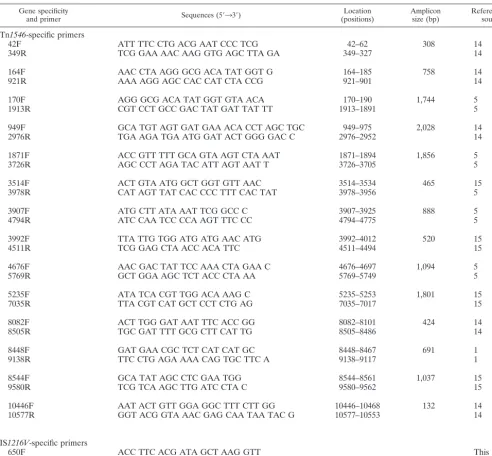
Tn1546was performed. The primer sequences and target locations for specific
Tn1546regions are listed in Table 1. Primers ISV650F and ISV132R were
designed according to the published sequence of IS1216Vwith the OLIGO
program (version 6.0; National Biosciences Inc., Plymouth, Minn.). The melting temperatures of the individual primers were calculated by using the OLIGO program (National Biosciences Inc.). To determine the exact left end of the
truncated Tn1546-like elements, genomic DNA from all isolates was amplified
with a combination of Tn1546-derived primer 4511R and IS1216V-specific
prim-ers (primprim-ers ISV650F and ISV132R).
Sequence analysis.PCR amplicons larger than that of the prototypevanA
gene cluster were purified with GeneClean kits (Qbiogene Inc., Carlsbad, Calif.). The purified PCR products were directly sequenced by using an ABI Prism 3100 DNA sequencer (Applied Biosystems, Foster City, Calif.). DNA fragments
am-plified with a combination of a Tn1546-specific primer and IS1216V-specific
primer were also purified and subsequently sequenced to determine the exact
integration site and orientation of the IS1216Vinsertion. The DNASIS program
[image:2.603.45.538.80.536.2]for Windows (version 2.6; Hitachi Software Engineering, South San Francisco, Calif.) was used for sequence analysis.
TABLE 1. Nucleotide sequences of PCR primers used in this study
Gene specificity
and primer Sequences (5⬘33⬘) (positions)Location Ampliconsize (bp) Reference orsource
Tn1546-specific primers
42F ATT TTC CTG ACG AAT CCC TCG 42–62 308 14
349R TCG GAA AAC AAG GTG AGC TTA GA 349–327 14
164F AAC CTA AGG GCG ACA TAT GGT G 164–185 758 14
921R AAA AGG AGC CAC CAT CTA CCG 921–901 14
170F AGG GCG ACA TAT GGT GTA ACA 170–190 1,744 5
1913R CGT CCT GCC GAC TAT GAT TAT TT 1913–1891 5
949F GCA TGT AGT GAT GAA ACA CCT AGC TGC 949–975 2,028 14
2976R TGA AGA TGA ATG GAT ACT GGG GAC C 2976–2952 14
1871F ACC GTT TTT GCA GTA AGT CTA AAT 1871–1894 1,856 5
3726R AGC CCT AGA TAC ATT AGT AAT T 3726–3705 5
3514F ACT GTA ATG GCT GGT GTT AAC 3514–3534 465 15
3978R CAT AGT TAT CAC CCC TTT CAC TAT 3978–3956 5
3907F ATG CTT ATA AAT TCG GCC C 3907–3925 888 5
4794R ATC CAA TCC CCA AGT TTC CC 4794–4775 5
3992F TTA TTG TGG ATG ATG AAC ATG 3992–4012 520 15
4511R TCG GAG CTA ACC ACA TTC 4511–4494 15
4676F AAC GAC TAT TCC AAA CTA GAA C 4676–4697 1,094 5
5769R GCT GGA AGC TCT ACC CTA AA 5769–5749 5
5235F ATA TCA CGT TGG ACA AAG C 5235–5253 1,801 15
7035R TTA CGT CAT GCT CCT CTG AG 7035–7017 15
8082F ACT TGG GAT AAT TTC ACC GG 8082–8101 424 14
8505R TGC GAT TTT GCG CTT CAT TG 8505–8486 14
8448F GAT GAA CGC TCT CAT CAT GC 8448–8467 691 1
9138R TTC CTG AGA AAA CAG TGC TTC A 9138–9117 1
8544F GCA TAT AGC CTC GAA TGG 8544–8561 1,037 15
9580R TCG TCA AGC TTG ATC CTA C 9580–9562 15
10446F AAT ACT GTT GGA GGC TTT CTT GG 10446–10468 132 14
10577R GGT ACG GTA AAC GAG CAA TAA TAC G 10577–10553 14
IS1216V-specific primers
650F ACC TTC ACG ATA GCT AAG GTT This study
132R AGG ATT ATA TAA GAA AAC CCG This study
on May 15, 2020 by guest
http://jcm.asm.org/
RESULTS
PFGE. All isolates were largely heterogeneous in nature. The isolates formed only one cluster when a similarity cutoff of 85% was used (Fig. 1).
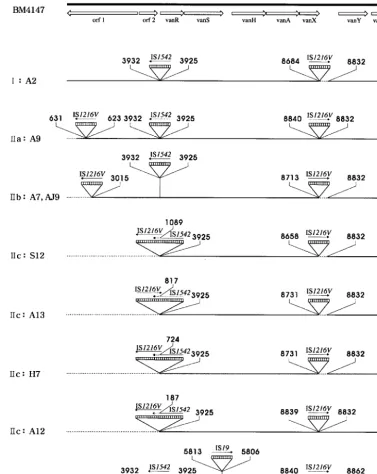
Structural analysis of Tn1546-like elements by PCR map-ping and sequence analysis. All isolates were divided into three main types according to the distribution of ISs integrated into Tn1546elements (Table 2 and Fig. 2). Type I was char-acterized by an IS1542 insertion in the orf2-vanR intergenic region and an IS1216Vinsertion in the vanX-vanYintergenic region. Type II was characterized by two copies of IS1216Vat the left ends of Tn1546-like elements and in thevanX-vanY
intergenic region as well as IS1542in theorf2-vanRintergenic region. Type III was characterized by the presence of IS19in thevanS-vanHintergenic region, in addition to IS1542in the
orf2-vanR intergenic region and IS1216V in the vanX-vanY
intergenic region. No isolates were identical to the prototype strain.
IS1216Vwas present in thevanX-vanYintergenic regions of the genomes of all 20 isolates, but at various points of integra-tion. Among these 20 isolates, the insertions in 15 isolates were accompanied by small deletions adjacent to the insertion site (Fig. 2). Also, IS1216Vwas present at the left ends of Tn1546 -like elements of 12 isolates (type II), with or without large deletions encompassing theorf1and/ororf2region. IS1542was detected in theorf2-vanRintergenic regions of all 20 isolates. The location of the IS1542insertion in this region was identical to that described previously (4, 14, 22), corresponding to nu-cleotide 3932 of Tn1546with an 8-bp duplication of the target sequence (CTATAATC). In type IIc isolates (Fig. 2), the 3⬘
end of IS1542 was deleted at various points by an IS1216V
insertion. IS19was detected in only one isolate and was inte-grated at nucleotide 5813 with an 8-bp duplication of the target sequence (GATGTATA).
DISCUSSION
[image:3.603.47.283.70.218.2]After the first identification of VRE in Korea in 1992, sev-eral outbreaks of VRE associated with clonal spread were observed. Recently, however, the horizontal transfer of the resistance gene cluster has also been regarded as the main
FIG. 1. Dendrogram produced following Dice analysis and analysis by the unweighted pair group method with arithmetic averages of the PFGE patterns ofE. faeciumisolates from hospitals.
TABLE 2. Structural analysis of Tn 1546 -like elements by overlapping PCR Tn 1546 -like element type No. of isolates PCR product with the following primer pairs a : 42 –349 164 –921 170 –1891 949 –2976 1871 –3726 3514 –3978 3907 –4794 3992 –4511 4676 –5769 5735 –7035 8082 –8505 8448 –9138 8544 –9580 10446 –10577 BM4147 0 ⫹ ⫹ ⫹ ⫹ ⫹ ⫹⫹ ⫹⫹⫹⫹ ⫹ ⫹ ⫹ I7 ⫺ ⫹ ⫹ ⫹ ⫹ ⫹ ⫹ ⫹ ⫹ ⫹⫹⫹⫹ ⫹ ⫹ ⫹ ⫹ IIa 1 ⫺ ⫹ ⫹ ⫹ ⫹ ⫹ ⫹ ⫹ ⫹ ⫹ ⫹ ⫹⫹⫹⫹ ⫹ ⫹ ⫹ ⫹ IIb 7 ⫺ ⫺ ⫺ ⫺ ⫺ ⫹ ⫹ ⫹ ⫹ ⫹⫹⫹⫹ ⫹ ⫹ ⫹ ⫹ IIc 4 ⫺ ⫺ ⫺ ⫺ ⫺ ⫺⫺ ⫹⫹⫹⫹ ⫹ ⫹ ⫹ ⫹ III 1 ⫺ ⫹ ⫹ ⫹ ⫹ ⫹ ⫹ ⫹ ⫹ ⫹⫹⫹⫹ ⫹ ⫹ ⫹ ⫹ a ⫹ and ⫹⫹ ,amplicons the same size as and larger than those obtained for E. faecium BM4147, respectively; ⫺ ,absence of an amplicon with the particular pair of primers. The numbers in each primer pair correspond to the first numbers of the positions listed in Table 1.
on May 15, 2020 by guest
http://jcm.asm.org/
[image:3.603.365.473.85.724.2]mechanism in the dissemination of thevangene (11, 15). VanB VRE were predominantly isolated in Korean hospitals in the initial years, whereas recent isolates (those recovered from 1998 to 2000) were mostly of the VanA type (11, 15). There-fore, structural analysis of thevanA gene cluster is critical to investigations of the epidemiology ofvanA-containing entero-cocci from Korean hospitals.
ThevanA gene cluster is carried as a part of Tn1546-like elements. The heterogeneity of Tn1546 has previously been reported and comprises point mutations, deletions, and the
integration of IS elements. Among these variations, the pres-ence of IS elements accounts for much of the heterogeneity. Until recently, IS1216V, IS1542, IS1251, and IS1476were re-ported in VanA VRE. IS1216Vis known to be ubiquitous in
[image:4.603.103.480.73.547.2]vanA elements (9, 20), whereas the other three IS elements appear to be geographically restricted. For example, IS1542is frequently found in clinical and poultry VRE isolates from the United Kingdom and Ireland (14, 22). IS1251and IS1476have been reported in the vanAelements of enterococci from the United States (5, 7) and Canada (12), respectively.
FIG. 2. Genetic maps of Tn1546types ofE. faeciumisolates from Korean hospitals. The positions of genes and open reading frames (orf1and orf2) and the direction of transcription are marked by open arrows at the top. Boxes with vertical lines represent IS elements. The positions of the first nucleotide upstream and the first nucleotide downstream from the IS insertion sites are depicted. Solid arrows indicate the transcriptional orientation of the inserted IS elements. Deletions are indicated by dotted lines.
on May 15, 2020 by guest
http://jcm.asm.org/
In this study we characterized the structures of the Tn1546 -like elements amongE. faeciumisolates from patients admit-ted to hospitals in different parts of Korea and typed the strains by PFGE. By using a combination of overlapping PCR and sequencing analysis, three main types of vanA gene clusters were identified according to the distributions of ISs, i.e., IS1216V, IS1542, and IS19, in the Tn1546-like elements. In contrast, IS1476and IS1251were not detected in the Korean isolates. IS1216Vand IS1542were identified in the genomes of all isolates from Korean hospitals. In type IIb and IIc isolates, IS1216Vwas inserted at the left ends of thevanA elements, with a deletion that included the orf1 and/or orf2 regions. IS1542 was found in the Tn1546-like element at exactly the same position described previously (4, 14, 22). Interestingly, the 3⬘end of IS1542belonging to type IIc isolates was deleted at various points by the IS1216Vinsertion. This finding sug-gests that IS1216Vat the left end of Tn1546was acquired later than IS1542. Moreover, importantly, to our knowledge, our study is the first to demonstrate the presence of IS19in the
vanS-vanH intergenic region of thevanA gene cluster. Peri-chon et al. (13) reported that IS19was inserted in theD-Ala– D-Ala ligase gene of VanD strainE. faeciumBM4416, resulting
in inactivation of theddlligase. However, IS19has never been documented in Tn1546-like elements.
The movement of ISs frequently causes structural alter-ations in Tn1546-like elements. Furthermore, several investi-gators have documented the functional changes associated with IS integration with or without the adjacent deletion, as in the loss of VanY activity by an IS1476 insertion (12) and inactivation of theddlligase by IS19(13). In our study, it was unlikely that the integration of an IS would affect the function of thevanAgene cluster.
The genetic differences among Tn1546-like elements have been investigated in several previous studies (2, 8, 9, 17, 18, 20, 22). However, the Tn1546subtypes of the enterococci investi-gated were not comparable, since various molecular tech-niques were used. Before the use of overlapping PCR in order to analyze the structures of Tn1546-like elements, we per-formed long-PCR amplification with subsequent restriction fragment length polymorphism (RFLP) analysis, as described previously (17). Eleven of the 20 isolates failed to yield a product by long PCR, since they were types IIb and IIc by the overlapping PCR. Failure of long-PCR amplification was ex-plained by deletions in the proximalorf1primer binding region of the vanA gene cluster. This result suggests that the long PCR with RFLP analysis is not suitable for typing of the VanA transposons of Korean isolates. By using overlapping PCR and sequencing analyses, the Tn1546subtypes could be compared with those described previously. To our knowledge, type I in this study likely corresponds to type B of the European isolates reported by Willems et al. (20), except for the IS1542insertion. Type II corresponds to type E. In particular, type IIc appears to be identical to subtype E13 (14, 20). All types of the Tn1546 -like elements in this study harbored IS1542, which is restricted to Europe, mainly the United Kingdom. Thus, the distribution of ISs in Tn1546-like elements among Korean VRE isolates is similar to that among European VRE isolates rather than to that among American VRE isolates. The identification of ISs within thevanAgene cluster to analyze and compare the
struc-tures of Tn1546-like elements could be a useful tool in epide-miological studies.
ACKNOWLEDGMENT
This work was supported by grant KRF-2001-042-F00025 from the Korea Research Foundation.
REFERENCES
1. Arthur, M., C. Molinas, F. Depardieu, and P. Courvalin.1993.
Character-ization of Tn1546, a Tn3-related transposon conferring glycopeptide
resis-tance by synthesis of depsipeptide peptidoglycan precursors inEnterococcus
faeciumBM4147. J. Bacteriol.175:117–127.
2. Brown, A. R., A. C. Townsley, and S. G. B. Amyes.2001. Diversity of Tn1546
elements in clinical isolates of glycopeptide-resistant enterococci from
Scot-tish hospitals. Antimicrob. Agents Chemother.45:1309–1311.
3. Dahl, K. E., G. S. Simonsen, Ø. Olsvik, and A. Sundsfjord.1999.
Hetero-geneity in thevanBgene cluster of genomically diverse clinical strains of
vancomycin-resistant enterococci. Antimicrob. Agents Chemother.43:1105–
1110.
4. Darini, A. L. C., M. I. Palepou, and N. Woodford.1999. Nucleotide sequence
of IS1542, an insertion sequence identified within VanA glycopeptide
resis-tance elements of enterococci. FEMS Microbiol. Lett.173:341–346.
5. Donabedian, S., E. Hershberger, L. A. Thal, J. W. Chow, D. B. Clewell, B.
Robinson-Dunn, and M. J. Zervos.2000. PCR fragment length
polymor-phism analysis of vancomycin-resistantEnterococcus faecium. J. Clin.
Micro-biol.38:2885–2888.
6. Dutka-Malen, S., S. Evers, and P. Courvalin.1995. Detection of
glycopep-tide resistance genotypes and identification to the species level of clinically
relevant enterococci by PCR. J. Clin. Microbiol.33:24–27.
7. Handwerger, S., and J. Skoble.1995. Identification of chromosomal mobile
element conferring high-level vancomycin resistance inEnterococcus
fae-cium. Antimicrob. Agents Chemother.39:2446–2453.
8. Hashimoto, Y., K. Tanimoto, Y. Ozawa, T. Murata, and Y. Ike.2000. Amino
acid substitutions in the VanS sensor of the VanA-type vancomycin-resistant Enterococcus strains result in high-level vancomycin resistance and low-level
teicoplanin resistance. FEMS Microbiol. Lett.185:247–254.
9. Jensen, L. B., P. Ahrens, L. Dons, R. N. Jones, A. M. Hammerum, and F. M.
Aarestrup.1998. Molecular analysis of Tn1546inEnterococcus faecium
iso-lated from animals and humans. J. Clin. Microbiol.36:437–442.
10. Kim, J. M., and Y. G. Song.1998. Vancomycin-resistant enterococcal
infec-tions in Korea. Yonsei Med. J.39:562–568.
11. Lee, W. G., J. A. Jernigan, J. K. Rasheed, G. J. Anderson, and F. C. Tenover.
2001. Possible horizontal transfer of the vanB2gene among genetically
diverse strains of vancomycin-resistantEnterococcus faeciumin a Korean
hospital. J. Clin. Microbiol.39:1165–1168.
12. Mackinnon, M. G., M. A. Drebot, and G. J. Tyrrell.1997. Identification and
characterization of IS1476, an insertion sequence-like element that disrupts
VanY function in a vancomycin-resistantEnterococcus faeciumstrain.
Anti-microb. Agents Chemother.41:1805–1807.
13. Perichon, B., B. Casadewall, P. Reynolds, and P. Courvalin.2000.
Glyco-peptide-resistantEnterococcus faeciumBM4416 is a VanD-type strain with
an impairedD-alanine:D-alanine ligase. Antimicrob. Agents Chemother.44:
1346–1348.
14. Schouten, M. A., R. J. L. Willems, W. A. G. Kraak, J. Top, J. A. A.
Hoogkamp-Korstanje, and A. Voss.2001. Molecular analysis of Tn1546-like
elements in vancomycin-resistant enterococci isolated from patients in Eu-rope shows geographic transposon type clustering. Antimicrob. Agents
Che-mother.45:986–989.
15. Shin, J. W., D. Yong, M. S. Kim, K. H. Chang, K. Lee, J. M. Kim, and Y.
Chong.2003. Sudden increase of vancomycin-resistant enterococcal
infec-tions in a Korean tertiary care hospital: possible consequences of increased
use of oral vancomycin. J. Infect. Chemother.9:62–67.
16. Simonsen, G. S., H. Haaheim, K. H. Dahl, H. Kruse, A. Lovseth, Ø. Olsvik,
and A. Sundsfjord.1998. Transmission of VanA-type vancomycin-resistant
enterococci and vanA resistance elements between chicken and humans at
avoparcin-exposed farms. Microb. Drug Resist.4:313–318.
17. Simonsen, G. S., M. R. M. Myhre, K. H. Dahl, Ø. Olsvik, and A. Sundsfjord.
2000. Typeability of Tn1546-like elements in vancomycin-resistant
entero-cocci using long-range PCRs and specific analysis of polymorphic regions.
Microb. Drug Resist.6:49–57.
18. Stobberingh, E., A. van den Bogaard, N. London, C. Driessen, J. Top, and R.
Willems.1999. Enterococci with glycopeptide resistance in turkeys, turkey
farmers, turkey slaughterers, and (sub)urban residents in the south of The Netherlands: evidence for transmission of vancomycin resistance from
ani-mals to humans? Antimicrob. Agents Chemother.43:2215–2221.
19. van den Bogaard, A. E., R. Willems, N. London, J. Top, and E. E.
Stobber-ingh.2002. Antibiotic resistance of faecal enterococci in poultry, poultry
farmers and poultry slaughterers. J. Antimicrob. Chemother.49:497–505.
20. Willems, R. J. L., J. Top, N. van den Braak, A. van Belkum, D. J. Mevius, G.
on May 15, 2020 by guest
http://jcm.asm.org/
Hendriks, M. van Santen-Verheuvel, and J. D. A. van Embden.1999.
Mo-lecular diversity and evolutionary relationships of Tn1546-like elements in
enterococci from humans and animals. Antimicrob. Agents Chemother.43:
483–491.
21. Woodford, N.1998. Glycopeptide-resistant enterococci: a decade of
experi-ence. J. Med. Microbiol.47:849–862.
22. Woodford, N., A. M. A. Adebiyi, M. I. Palepou, and B. D. Cookson.1998.
Diversity of VanA glycopeptide resistance elements in enterococci from
human and nonhuman sources. Antimicrob. Agents Chemother.42:502–508.
23. Yu, H. S., S. Y. Seol, and D. T. Cho.2003. Diversity of Tn1546-like elements
in vancomycin-resistant enterococci isolated from humans and poultry in
Korea. J. Clin. Microbiol.41:2641–2643.