International Journal of Emerging Technology and Advanced Engineering
Website: www.ijetae.com (ISSN 2250-2459, ISO 9001:2008 Certified Journal, Volume 8, Issue 1, January 2018)
250
Stable Heterogeneous Energy Efficient Cluster Based Protocol
(SHEEP) For Application-Specific WSNs
Mohammed Moyed Ahmed
1, D. Sreenivasa Rao
2Department of ECE, College of Engineering Hyderabad, Jawaharlal Nehru Technological University Hyderabad, Hyderabad, India
Abstract:--Wireless Sensor Networks have inspired many applications, especially applications involving sensing of seismic events, for monitoring of the Landslides and underground mining, active volcanoes etc., These sensor networks have to deal with the heterogeneous sensor nodes in terms of energy, where some of the sensors consumes more power in sensing activity and have to be equipped with the additional energy source. Since all the sensors are battery powered, the goal of WSN is to achieve as long network lifetime as possible by efficient optimization methods. In this paper, we propose an energy efficient cluster-based routing protocol for heterogeneous networks with optimal utilization of energy resources. Stable Heterogeneous Energy Efficient Protocol has been proposed, where the stability period is increased by making use of Energy Heterogeneity, electing the higher residual energy nodes as CHs and reducing the setup time. It also helps to achieve improved Throughput, End to End delay and packet delivery ratio. The proposed routing protocol yields better performance when compared to existing cluster based routing protocols.
Keywords:-- Wireless sensor networks; stability period; Clustering algorithm; Energy Heterogeneity; Energy-efficient
I. INTRODUCTION
One of the main characteristics of a Wireless Sensor Networks (WSNs) is its ability to operate in harsh environments and can be kept unattended. A large number of sensor nodes are used to monitor a selected area by collecting and sending the sensed parameters to the base station or the sink node through wireless transmission.
Wireless sensor network usually composed of a large number of heterogeneous or homogeneous sensor nodes, each tiny node is equipped with a limited energy source, processing power, communication capacity and sensing ability. Hence designing a routing protocol is a challenging task for these type of networks. WSN technology is finding a range of applications[1]~[3] in diverse areas such as battlefield surveillance, animal habitat monitoring, healthcare applications and disaster prediction and monitoring. In order to achieve effective communication within the sensor network, it is very much required a reliable message delivery, aggregation/fusion of the data.
And to minimize energy consumption, processed concise information should be transmitted, thus enhancing the lifetime of the network.
Designing an energy-efficient routing protocol for an application specific wireless sensor network is a challenging task. To improve the lifetime of the sensor network, which mainly depends on the life of the nodes, an efficient transmission strategy has to be developed. In order to maximize the lifetime of the sensor network, the death rate of sensor nodes to be minimized. The main cause of the death of nodes is exhaustion of energy due to unbalanced transmission strategy. Clustering mechanisms are more effective in enhancing the lifetime of a sensor network as well as scalability. The clustering mechanisms can be categorized to two, one is considering all the nodes have identical energy, processing power and communication capability known as homogeneous clustering, and the other one is the heterogeneous clustering where the sensor nodes are different in battery energy, processing capability, and communication system.
A cluster-based hierarchical routing protocol is considered a most effective way of utilizing the available resources in energy efficient manner. In this technique, Cluster heads send only the useful information to sink node by removing the redundant data from a large amount of sensed data received from all the sensor nodes in a cluster. Most cluster-based routing protocols in WSNs have been designed for homogeneous sensor networks, and thus not suitable for applications where heterogeneous sensor nodes are used.
The basic mechanism of clustering protocols is as follows, Advertisement state, Setup state, and steady state. In the advertisement state number of clusters are formed on the basis of the parameter such as initial energy, residual energy, and the total network energy. Election of cluster heads is carried out after the election status of cluster head is advertised to the member nodes to form the clusters i.e., nodes in the network associate themselves with their respective cluster heads, selection of cluster members will be based on the Received Signal Strength Indicator RSSI.
International Journal of Emerging Technology and Advanced Engineering
Website: www.ijetae.com (ISSN 2250-2459, ISO 9001:2008 Certified Journal, Volume 8, Issue 1, January 2018)
251
In Steady State sensed information from the nodes will be transmitted to the cluster head, during the allocated TDMA time slot by the cluster head. The Cluster Head then aggregates the information received from the nodes and transmits to the Sink node(Base Station).WSN Model for heterogeneous networks:
We refer to resource heterogeneity in nodes of WSN, basically energy heterogeneity among three common types namely computational, link and energy. We mean by energy heterogeneity in WSN nodes, it is either powered by the battery which is rechargeable through solar cells or the node is line powered.
Wireless sensor network in which the nodes are heterogeneous in terms of their initial energy is considered. Therefore setting out the energy model and computing the optimal number of cluster is considered. We will consider in the WSN model some percentage of nodes are equipped with additional energy than the rest of the nodes say p percent nodes where the total number of nodes are n which are equipped δ times more energy than the rest of the nodes, we denote them as advance nodes, and normal nodes will be ( ) . Assuming WSN field is uniformly distributed.
II. PREVIOUS WORK
Hierarchical routing protocols:
While considering heterogeneous network [4]~[9] model we deploy different types of sensors having higher power levels considering energy heterogeneity. While grouping into clusters higher energy level nodes always has the opportunity to become cluster heads(CHs), energy-aware routing protocol keeping application priorities into consideration extend the lifetime of the network. The very first proposed cluster-based protocol for WSN is LEACH[10] and later many protocols have been developed inspired by LEACH. The energy load is balanced by dynamically switching the cluster head according to optimal probability and guarantees that all the nodes equally becomes cluster-head. Cluster heads transfer the data to Sink after aggregating the received data from the cluster members. The assumption made in LEACH is the nodes are capable of transmitting with variable transmission power, and they can be capable supporting different MAC protocols and computational power to perform signal processing functions. And also it is assumed that all the nodes can reach Sink node if needed.
In setup phase cluster formation takes place and cluster heads are elected, cluster heads change in every cycle in order to balance the energy over the nodes, selection of cluster head done by choosing a random number between 0 and 1 by the each node let us say node S. If the number is less than the threshold value the node becomes the cluster head.
i.e., ( ) { ( ( ))
Where G denotes the set of nodes which have not been cluster heads in the last rounds, p is the desired
percentage of cluster heads and r is the current round. All the nearby nodes in the cluster head send the willingness to join the cluster using CSMA, the cluster head assigns TDMA slot for each node for data transmission. In the steady state data transmission from each node take place to the respective cluster head in the allocated slots. Aggregation of data is done at the cluster head before transmitting the sink node.
Hierarchical routing protocol for heterogeneous networks: One of the routing protocol developed for heterogeneous networks is SEP protocol, it is an improved version of LEACH protocol. It is more suitable for wireless sensor networks using heterogeneous sensors (in terms of energy heterogeneity). Operation of SEP protocol is similar to LEACH except it has two different energy levels. Election of cluster heads based on the weighted probabilities of WSN nodes according to their respective energy. There are two types of nodes considered in SEP protocol with two different energy level, normal and advanced nodes. According to the residual energy of each node, a cluster head is selected randomly based on weighted probabilities. Hence in SEP protocol two different threshold formulae are given as follows,
( ) {
( ( ))
( ) {
( ( ))
International Journal of Emerging Technology and Advanced Engineering
Website: www.ijetae.com (ISSN 2250-2459, ISO 9001:2008 Certified Journal, Volume 8, Issue 1, January 2018)
252
Where r denotes current round, and is the set of normal and advanced nodes respectively that have not become cluster heads within the previousand
rounds of the cycle and ( ) and ( ) are the threshold for the normal and advanced nodes. assuming the there are ( ) normal energy nodes, m is the fraction of advanced nodes and α is the additional energy fraction between advanced and normal nodes.
In order to maintain the balanced energy consumption in the SEP protocol, cluster head selection is chosen among the advanced nodes, fairness constraint on part of the energy is to give the opportunity to the advanced node to become cluster head than the normal nodes. How often a node becomes a cluster head, the Probability(opt) can be given as:
where √ √
( assuming the area of
the network M X M , d is the distance of the node to Base station and , are the parameters for transmitter amplifier used considering free space & multipath).
The energy required to transmit L bit of message over a distance of d is given by the equations below:
( ) {
Where represents energy required by the circuit(transmitter and receiver) to transmit one bit. The energy required by the cluster head in one round is given by the formula,
( )
k represents the number of cluster and , is energy required for data processing.
and energy expended by cluster member node is given by the equation,
L .
Total energy consumed by the network is given by,
( + ( ) ) III. RELATED WORK
We proposed and evaluated a new stable heterogeneous energy efficient cluster-based protocol SHEEP and compare with existing cluster based protocols.
The proposed cluster-based SHEEP protocol has stable cluster formation by choosing cluster head having the higher energy level and reducing setup cycle resulting in an improved lifetime of the network.
Fig: 1 WSN model for SHEEP protocol
We assume that our proposed WSN model shown in Fig.1 is having the following properties: WSN model is having heterogeneous sensor nodes, some percentage of sensor nodes are equipped with more energy than the rest of the nodes, all WSN nodes are static and most of the nodes are having limited energy. The Sink node is having enough resources in terms of energy memory and processing power, Cluster Heads can perform data fusion and aggregation, the parameter RSS(radio signal strength) is considered to measure the distance of the nodes from sink and for the purpose of cluster formation, all the nodes will have the ability to change their transmitting power according to the requirement,
Cluster Formation In SHEEP protocol:
Proposed routing scheme is different from LEACH and other clustering schemes in terms of energy level determination of sensor nodes, we are assuming the sensor nodes know their maximum energy , residual energy , and threshold energy . While forming the clusters the nodes with the highest energy level are given an opportunity to become the CHs, to ensure stability and longer lifetime of the network. Let us assume be the fraction of the total nodes which are equipped with , and be the fraction of the total nodes equipped with next higher level , and the rest are the normal nodes
International Journal of Emerging Technology and Advanced Engineering
Website: www.ijetae.com (ISSN 2250-2459, ISO 9001:2008 Certified Journal, Volume 8, Issue 1, January 2018)
253
The total energy of the WSN network is given by:( )
Total number of nodes
( )
where ( ), and ( ), where fraction of nodes equipped with times more energy than normal node and fraction of nodes equipped with times more energy than normal nodes.
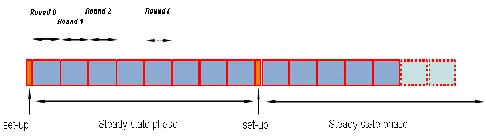
The basic functioning of the proposed protocol SHEEP is shown in the Fig.1. Sensor nodes send the collected data to their respective cluster head, data collected by the Cluster Head will be aggregated and transferred the information to the Sink node (base station). The protocol follows the sequence starting with set-up phase then the steady-state phase as shown in the Fig. 2.
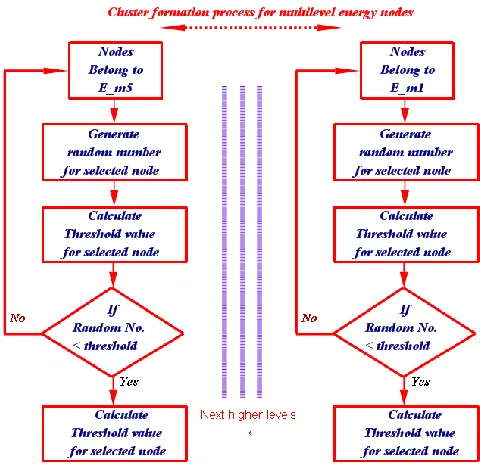
In the set-up phase, the cluster formation occurs and the Cluster Head is selected using the Cluster Head selection algorithm followed by cluster formation algorithm as shown in the Fig. 4.
[image:4.612.332.572.139.375.2]The steady-state phase where the data transmission takes place from nodes to the cluster head and cluster head to base station after data aggregation. In the steady-state phase, the time duration is more than set-up phase as the nodes are assigned time slots for their data transmission as shown in the Fig.3.
Fig: 2 Time slots Showing Set-up Phase for SHEEP protocol
Fig: 3 Time slots Showing Set-up & Steady-state Phase for SHEEP protocol
Fig: 4 Flowchart for cluster head selection for SHEEP protocol
Proposed routing protocol SEEP is different from LEACH where the energy level determination of node in a WSN and cluster head selection, as well as the initiation of set-up phase, will not be initiated in every round of data transmission (set-up and steady-state process) as we aware set-up phase consumes a lot of energy during the control message transmission.
[image:4.612.95.242.485.571.2]Assuming the network to be heterogeneous in terms of energy, as the sensor nodes know their maximum, threshold and residual energy, all the nodes are grouped into different energy levels based upon their residual energy and then sensor nodes elect themselves as a cluster head by the cluster head election algorithm as shown in the Fig. 4.
Energy of sensor nodes are segregate into n levels by using the formula
⌈
⌉
For each level, L the energy range is denoted as the difference between the upper and lower value of energy level and being the maximum and minimum values of the energy.
We define the energy level as the :
[image:4.612.60.287.609.681.2]International Journal of Emerging Technology and Advanced Engineering
Website: www.ijetae.com (ISSN 2250-2459, ISO 9001:2008 Certified Journal, Volume 8, Issue 1, January 2018)
254
During the cluster forming process the sensor nodes with the highest energy level are given the opportunity to be the CH, in order to ensure the longer cluster lifetime, and if the nodes with next higher energy level be given the opportunity to become CH if the highest energy nodes are exhausted, similarly the next energy level nodes takes the initiative to for CHs if the higher energy nodes are exhaustedThe process of cluster formation and size of the cluster is determined by the energy level of cluster head and the AMRP value, AMRP is defined as average minimum power level of nodes required to communicate with the Cluster Head [11] given by
∑
Where , is the power required to communicate with the CH by the node and is a number of nodes in the vicinity of the CH.
The cluster formation starts after selection of CH based on their energy level as given in the flowchart Fig.4. Cluster Head broadcasts the message to its surrounding nodes using maximum power ( ), Advertised message received by the nodes decide to join cluster head based on the energy level of CH and communication power of the node, and send the request for joining message to the selected cluster head, during this process cluster head node waits for joining request from all the nodes.
[image:5.612.319.571.199.315.2]After formation of clusters, cluster heads create a schedule for all the nodes in a cluster. Once the schedule is received by the nodes, all the nodes transmit the information to the CH in the allotted time slot known as a steady-state phase. Received data from the nodes will be aggregated by the CH and transmitted to the sink node. Steady-state phase will continue for certain number of rounds and it goes back to the set-up phase, in this protocol setup phase will be initiated either when the cluster head fails or after certain number of rounds, this concept is avoiding setup phase in certain number will results in the saving of considerable amount of energy in the network, as the setup phase consumes much energy during transmission of control messages for the purpose of cluster formation.
Fig: 5 Set-up and Steady-state cycle in SHEEP protocol
IV. SIMULATION RESULTS
[image:5.612.50.293.627.696.2]We have used MATLAB for analyzing the performance of existing protocols and the developed protocol, Following parameters, have been set for the simulation;
Table 1: Simulation Parameters
Description Value
N, Number of sensors 100
Area (meter square) 100 x 100
, Initial energy 0.5 J
, Electronics energy 50 nJ/bit
, Energy of data aggregation 5 nJ/bit
K, Data packet size 500 bytes
, Broadcast packet size 25 bytes
Performance metrics considered are the following:
The total number of nodes that are alive (not exhausted its energy) during the number of rounds is considered as Alive nodes.
In the simulation process time lapse between the start of simulation to the death of the first node is considered as the Stability Period.
The time lapse between the death of the very first sensor node and the very last sensor node is considered as the Instability Period.
The duration between the starting to the expiry of very last sensor node is known as the Network Lifetime.
The number of nodes which can have the capability to send the information from the cluster nodes to the sink node by aggregating the data is the Cluster Heads.
The rate at which the data is being transmitted from the nodes to Cluster head and the Cluster head to the sink is the Throughput.
The time taken the data packet to travel from source to the sink is known as an End-to-End delay.
Packet delivery ratio: The ratio of total packets received at the sink successfully to the total packets transmitted from the source node is the Packet delivery ratio.
The amount of energy remaining by all alive nodes after each round is known as the Residual Energy.
International Journal of Emerging Technology and Advanced Engineering
Website: www.ijetae.com (ISSN 2250-2459, ISO 9001:2008 Certified Journal, Volume 8, Issue 1, January 2018)
[image:6.612.325.581.128.334.2]255
Network lifetime in terms of percentage of dead nodes is compared in the Fig. 7 it is observed the stability period of SHEEP protocol outperforms SEP and LEACH, hence longer lifetime can be achieved using SHEEP protocol in WSNs.Fig.6 Comparison of network life (No. of dead nodes VS simulation time) with LEACH, SEP & SHEEP.
Fig.7 Comparison of network life (simulation time VS Node death %) with LEACH, SEP & SHEEP.
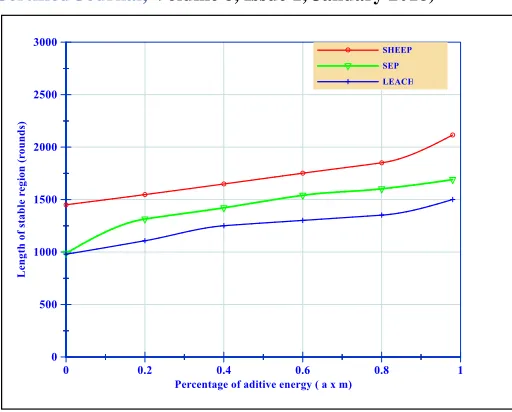
[image:6.612.49.300.201.398.2]It has also been observed from Fig.8 for different values of energy heterogeneity, length of the stable region varies in WSNs, SHEEP has extended the length of the stable region when compared to LEACH and SEP for different values of heterogeneity in terms of energy.
Fig.8 Length of the stable region for different values of heterogeneity with LEACH, SEP & SHEEP.
A total number of bits received at the sink node in a unit time is the throughput, Fig 9 shows the throughput analysis, from the results it is clear that the proposed SHEEP protocol provides stable throughput compared to existing protocols LEACH and SEP.
Fig.9 Throughput vs Simulation time for LEACH, SEP & SHEEP.
[image:6.612.324.581.425.622.2] [image:6.612.50.304.431.635.2]International Journal of Emerging Technology and Advanced Engineering
Website: www.ijetae.com (ISSN 2250-2459, ISO 9001:2008 Certified Journal, Volume 8, Issue 1, January 2018)
256
Fig.10 End to End delay vs Simulation time for LEACH, SEP & SHEEP.
The greater the Packet delivery ratio the better is the performance of the system, Fig.11 shows the PDR comparison of proposed protocol with the existing protocol. From the simulation results, it is clear that the proposed protocol can perform better than existing protocol.
Fig.11 Packet Delivery Ratio vs different values of Simulation time for LEACH, SEP & SHEEP.
Finally, the residual energy analysis is done for the proposed SHEEP protocol with existing LEACH and SEP, Fig.12 shows proposed protocol is more energy efficient compared to existing due to improvement in setup cycle energy wastage in transmitting overhead message has been reduced.
Fig.12 Residual Energy analysis for LEACH, SEP & SHEEP.
V. CONCLUSION
In this paper, a new cluster based protocol is proposed and an overview of the existing protocols LEACH and SEP protocols presented. Improvement in the stability region and energy efficiency is obtained in the proposed protocol by selection of cluster heads from higher energy nodes, the limitation of setup cycles and the total energy of the sensor network is being evenly distributed among the different nodes. Finally, we can conclude that the proposed SHEEP protocol achieves better performance compared to existing LEACH and SEP protocols in a heterogeneous environment.
REFERENCES
[1] Akyildiz, Ian F, Weilian Su, Yogesh Sankarasubramaniam, and Erdal Cayirci. “A survey on sensor networks.” IEEE communications magazine 40, no. 8 (2002): 102-114.
[2] Akkaya, Kemal, and Mohamed Younis. “A survey on routing protocols for wireless sensor networks.” Ad hoc networks 3, no. 3 (2005): 325-349.
[3] Pantazis, Nikolaos A., Stefanos A. Nikolidakis, and Dimitrios D. Vergados. “Energy-efficient routing protocols in wireless sensor networks: A survey.” IEEE Communications Surveys & Tutorials 15, no. 2 (2013): 551-591.
[4] Vivek P. Mhatre, and Catherine Rosenberg, “Homogeneous vs heterogeneous Clustered Sensor Networks: A Comparative Study”, IEEE International Conference on Communications (ICC 2004), vol. 27, no. 1, pp. 3646-3651, June 2004.
International Journal of Emerging Technology and Advanced Engineering
Website: www.ijetae.com (ISSN 2250-2459, ISO 9001:2008 Certified Journal, Volume 8, Issue 1, January 2018)
257
[6] Vivek P. Mhatre, Catherine Rosenberg, Daniel Kofman, and NessShroff, “A Minimum Cost Heterogeneous Sensor Network with a Lifetime Constraint” IEEE Transactions on Mobile Computing, Vol. 4, No. 1, pp. , January/February 2005.
[7] Enrique J. Duarte-Melo, and Mingyan Liu, “Analysis of Energy Consumption and Lifetime of Heterogeneous Wireless Sensor Networks”, Proceedings of IEEE Globecom, Taipei, Taiwan, November 2002.
[8] Wei-Peng Chen, Jennifer C. Hou, and Lui Sha, “Dynamic Clustering for Acoustic Target Tracking in Wireless Sensor Networks”, Proceedings of the 11th IEEE International Conference on Network Protocols (ICNP), Vol oo., No., pp. 284, 2003.
[9] Lihua Yuan, and Chao Gui, “Applications and Design of Heterogeneous and/or Broadband Sensor Networks”, Proceedings of IEEE First Workshop on Broadband Advanced Sensor Networks (Basenets), October 2004.
[10] W Heinzelman, A Chandrakasan, H Balakrishnan, Energy-efficient communication protocol for wireless microsensor networks, in Proceedings of the 33rd Annual Hawaii International.