comm
en
t
re
v
ie
w
s
re
ports
de
p
o
si
te
d r
e
se
a
rch
refer
e
e
d
re
sear
ch
interacti
o
ns
inf
o
rmation
PhyloFacts: an online structural phylogenomic encyclopedia for
protein functional and structural classification
Nandini Krishnamurthy, Duncan P Brown, Dan Kirshner and
Kimmen Sjölander
Address: Department of Bioengineering, 473 Evans Hall #1762, University of California, Berkeley, CA 94720, USA.
Correspondence: Kimmen Sjölander. Email: [email protected]
© 2006 Krishnamurthy et al.; licensee BioMed Central Ltd.
This is an open access article distributed under the terms of the Creative Commons Attribution License (http://creativecommons.org/licenses/by/2.0), which permits unrestricted use, distribution, and reproduction in any medium, provided the original work is properly cited.
PhyloFacts: a phylogenomic resource
<p>PhyloFacts, a structural phylogenomic database for protein functional and structural classification, is described.</p>
Abstract
The Berkeley Phylogenomics Group presents PhyloFacts, a structural phylogenomic encyclopedia containing almost 10,000 'books' for protein families and domains, with pre-calculated structural, functional and evolutionary analyses. PhyloFacts enables biologists to avoid the systematic errors associated with function prediction by homology through the integration of a variety of experimental data and bioinformatics methods in an evolutionary framework. Users can submit sequences for classification to families and functional subfamilies. PhyloFacts is available as a worldwide web resource from http://phylogenomics.berkeley.edu/phylofacts.
Rationale
Computational methods for protein function prediction have been critical in the post-genome era in the functional annota-tion of literally millions of novel sequences. The standard pro-tocol for sequence functional annotation - transferring the annotation of a database hit to a sequence 'query' based on predicted homology - has been shown to be prone to system-atic error [1-3]. The top hit in a sequence database may have a different function to the query due to neofunctionalization stemming from gene duplication [4], differences in domain structure [5,6], mutations at key functional positions, or spe-ciation [1]. Annotation errors have been shown to propagate through databases by the application of homology-based annotation transfer [7-9]. While the exact frequency of anno-tation error is unknown (one published estimate is 8% or higher [7]), the importance of detecting and correcting exist-ing errors and preventexist-ing future errors is undisputed.
An additional complicating factor in annotation transfer by homology is the complete failure of this approach for an
aver-age of 30% of the genes in most genomes sequenced: in some cases no homologs can be detected within a particular signif-icance threshold, for instance, a BLAST [10] expectation (E) value (that is, the number of hits receiving a given score expected by chance alone in the database searched) of 0.001 or less, while in other cases database hits may be labeled as 'hypothetical' or 'unknown'.
With the huge array of bioinformatics software tools and resources available, it might seem unthinkable that func-tional annotation accuracy would be so difficult to ensure. Rather like the parable of the blind men and the elephant, each tool used separately provides a partial and imperfect pic-ture; taken as a whole, the probable molecular function of the protein, biological process, cellular component, interacting partners, and other aspects of a protein's function can often come into better focus. For instance, annotation transfer from the top BLAST hit may suggest a protein is a receptor-like protein kinase, while domain structure prediction reveals
Published: 14 September 2006
Genome Biology 2006, 7:R83 (doi:10.1186/gb-2006-7-9-r83)
Received: 8 May 2006 Revised: 12 July 2006 Accepted: 14 September 2006 The electronic version of this article is the complete one and can be
that no kinase domain is present; the two orthogonal analyses prevent mis-annotation of the unknown protein.
In this paper we present PhyloFacts, an online structural phy-logenomics encyclopedia containing almost 10,000 'books' for protein families and domains, designed to improve the accuracy and specificity of protein function prediction [11]. PhyloFacts integrates a wide array of biological data and informatics methods for protein families, organized on the basis of structural similarity and by evolutionary relation-ships. This enables a biologist to examine a rich array of experimental data and bioinformatics predictions for a pro-tein family, and to quickly and accurately infer the function of a protein in an evolutionary context.
Annotation accuracy requires data and method
integration
PhyloFacts is motivated by two of the biggest lessons of the post-genome era - the power of integrating data and inference tools from different sources, and improved prediction accu-racy using consensus approaches in bioinformatics. For instance, protein structure prediction 'meta-servers' making predictions based on a consensus over results retrieved from several independent servers typically have lower error rates than any one server used separately [12]. In the case of pro-tein structure prediction, we can also take advantage of the fact that members of a large diverse protein family tend to share the same three-dimensional structure even when their primary sequence similarity becomes undetectable. This ena-bles us to use another type of consensus approach involving the application of the same method to several different mem-bers of the family to boost prediction accuracy (for example, [13]).
We employ the same basic principles in this resource, by inte-grating many different prediction methods and sources of experimental data over an evolutionary tree. In cases where attributes are known to persist over long evolutionary dis-tances (such as protein three-dimensional structure), we can integrate predictions over the entire tree to derive a consen-sus prediction for the family as a whole. In cases where attributes are more restricted in their distribution in the fam-ily (for example, ligand recognition among G-protein coupled receptors), inferences will be more circumspect, potentially restricted to strict orthologs. Evolutionary and structural clustering of proteins enables us to integrate these disparate types of data and inference methods effectively, to identify potential errors in database annotations and provide a plat-form to improve the accuracy of functional annotation overall.
In addition to new methods developed by us for phyloge-nomic inference, PhyloFacts includes a number of standard bioinformatics methods available publicly. To motivate the need for protein functional classification integrating diverse
methods and data in an evolutionary framework, we examine the major classes of bioinformatics methods in turn, and dis-cuss their different pros and cons. Methods designed for pre-dicting the biological process(es) in which a protein participates (for example, bioinformatics approaches such as Phylogenetic Profiles [14] and Rosetta Stone [15], analysis of DNA chip array data, and proteomics experiments such as pull-down experiments, yeast two-hybrid data, and so on) are clearly complementary, and will be included in future releases of the PhyloFacts resource.
Database homolog search tools
Database homolog search tools (for example, BLAST, FASTA [16], and so on) can be blindingly fast, but do not distinguish between local matches and sequences sharing global similar-ity; they report a score or E-value measuring the significance of the local match between a query sequence and sequences in the database. This can lead to errors when annotations are transferred in toto based on only local similarity. These pair-wise sequence comparison methods of homolog detection have also been shown to have limited effectiveness at recog-nizing remote homologs (distantly related sequences) [17].
Iterated homology search methods
Iterated homology search methods such as PSI-BLAST [10] have been developed in recent years. These methods enable larger numbers of sequences to be annotated functionally, albeit with a potentially higher error rate due to divergence in function from their common ancestor.
Domain-based annotation and protein structure prediction
Domain-based annotation and protein structure prediction libraries of profiles or hidden Markov models (HMMs) for functional or structural domains (PFAM [18], SMART [19], or Superfamily [20]) are particularly helpful when a homolog search fails. There are two primary limitations of this approach to functional annotation. First, these statistical models of protein families and domains are typically designed for sensitivity rather than specificity, and thus afford a fairly coarse level of annotation. For example, the PFAM 7TM_1 HMM recognizes a variety of G-protein coupled receptors, irrespective of their ligand specificity. Second, a protein's function is a composite of all its constituent domains; thus, even in cases where each of a protein's domains can be iden-tified, the actual function of the protein may not be elucidated.
Phylogenomic inference
comm
en
t
re
v
ie
w
s
re
ports
refer
e
e
d
re
sear
ch
de
p
o
si
te
d r
e
se
a
rch
interacti
o
ns
inf
o
rmation
Several attempts at identification of orthologs (for example, Orthostrapper [24] and RIO [25]) and at automating phylog-enomic inference of molecular function [26] have been pre-sented, and may lead to more widespread application of this approach.
Prediction of protein localization
Prediction of protein localization is enabled by resources such as the TMHMM [27] transmembrane prediction server, the TargetP [28] cellular component prediction server, and the PHOBIUS [29] integrated signal peptide and transmembrane prediction server. These provide another perspective on a protein's function, and can suggest participation in biological pathways when other data are lacking. Because these meth-ods can rely on fairly weak and non-specific signals (for exam-ple, hydrophobic stretches as indicators of membrane localization), both false positive and false negative predic-tions are not uncommon [30].
The PhyloFacts phylogenomic encyclopedia
As of 11 July 2006, the PhyloFacts encyclopedia contains 9,710 'books' for protein superfamilies and structural domains. Each book in the PhyloFacts resource contains het-erogeneous data for protein families, including a cluster of homologous proteins, multiple sequence alignment, one or more phylogenetic trees, predicted three-dimensional struc-tures, predicted functional subfamilies, taxonomic distribu-tions, Gene Ontology (GO) annotations [31], PFAM domains, hyperlinks to key literature and other online resources, and annotations provided by biologist experts. Residues confer-ring family and subfamily specificity are predicted using alignment/evolutionary analyses; these patterns are plotted on three-dimensional structures. HMMs constructed for each family and subfamily enable classification of novel sequences to different functional classes. Details on each aspect of the resource construction are available in the 'Details on Library Construction and Software Tools' section.
Slightly more than half of the books in the PhyloFacts resource represent experimentally determined structural domains; the remaining fraction is divided between global homology groups (GHGs: globally alignable proteins having the same domain structure), conserved regions, motifs, and 'Pending', a label for those books that have not passed the stringent requirements for global homology and must be manually examined. Each book is labeled with the book type ('domain', 'global homology', and so on) to enable appropriate functional inferences. These labels are based primarily on multiple sequence alignment analysis. See Table 1 for the number of books within each class.
The PhyloFacts phylogenomic resource can be used in several ways: sequences can be submitted for protein structure pre-diction or functional classification, protein family books can be browsed, and data of various types (multiple sequence
alignments (MSAs), phylogenetic trees, HMMs, and so on) can be downloaded from the resource.
Browsing PhyloFacts
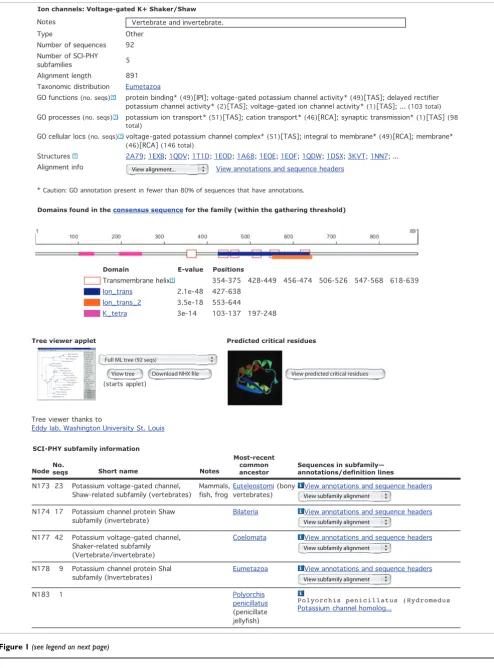
Each of the books in the library has a corresponding web page [32] for viewing the associated annotation and experimental data, MSA, trees, predicted domain structures, and so on (Figure 1).
Sequence analysis
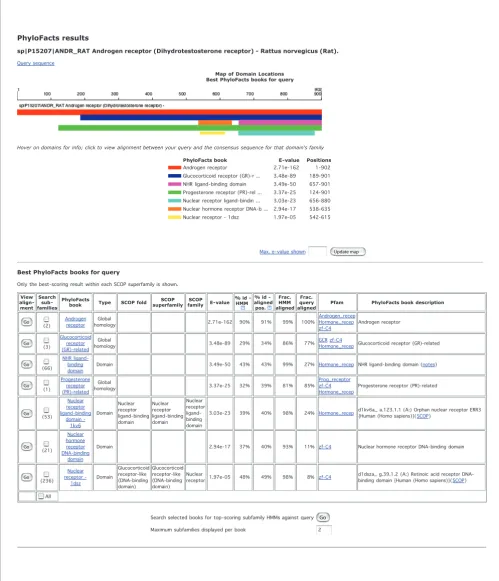
Classification to a protein family is enabled by HMM scoring. Biologists can submit either nucleotide or amino acid sequences in FASTA format; nucleotide sequences are first translated into all six frames and analyzed separately. Batch mode submission of up to five sequences is enabled. Results are returned by e-mail, and allow users to select families for more detailed classification of sequences to functional sub-families based on scoring against subfamily HMMs (Figure 2). This functionality is available online [33].
PhyloFacts includes books focusing on specific protein fami-lies or classes. The largest of these series is the PhyloFacts 'Protein Structure Prediction' library, with 5,328 books, each representing either a structural domain from the Astral data-base [34] or protein structures from the Protein Data Bank (PDB [35]). This series enables biologists to obtain predicted structures for submitted proteins. The books in the Protein Structure Prediction library were created using individual structural domains as seeds, gathering homologs from the NR [36] database using PSI-BLAST or the UCSC SAM [37] soft-ware tools.
The second major book series in PhyloFacts is the 'Animal Proteome Explorer' library, containing 4,226 protein families in the human genome, expanded to include additional homologs from other organisms. Specialized sections of the Animal Proteome Explorer series are devoted to protein fam-ilies of particular biomedical relevance: G-Protein Coupled Receptors (65 books), Ion Channels (50 books), and Innate Immunity (52 books). The Animal Proteome Explorer series has been constructed using GHGCluster (see section 'Details on Library Construction and Software Tools'). The GPCR library includes books for protein families based on the clas-sification of the GPCRDB [38].
The 'Plant Disease Resistance Phylogenomic Explorer' forms the third main series of specialized books in PhyloFacts, devoted to protein families involved in plant disease resist-ance and host-pathogen interaction (105 books). Families in this series include the canonical plant R (resistance) genes, proteins involved in defense signaling and effector proteins from plant pathogens.
bpg002615) is placed in the Protein Structure Prediction library (due to the presence of a solved structure for this fam-ily) as well as in the Innate Immunity and Plant Disease Resistance libraries (since TIR domains are found in both plant and animal proteins involved in eukaryotic innate immunity).
Because our recommended protocol for protein function pre-diction starts with transfer of annotation from globally align-able orthologs (see section 'Functional annotation using PhyloFacts'), a large number of books in PhyloFacts are des-ignated as type Global Homology, and subjected to rigorous quality control (see section 'Details on Library Construction and Software Tools, Defining Book Type'). Standard protein clustering tools typically ignore the issue of global sequence similarity, so that even resources intending to cluster proteins based on global similarity can occasionally fail (for example, the Celera Panther resource [39] class Leucine-Rich Trans-membrane Proteins [PTHR23154] contains proteins with diverse domain structures; Additional data file 1). By con-trast, most web servers for protein functional classification provide primarily domain-level analyses (for example, SMART and PFAM). To supplement these analyses, Phylo-Facts also provides books for different types of structural sim-ilarities across sequences, including short conserved motifs and structural domains.
PhyloFacts has other distinguishing features relative to other online resources. In contrast to model organism databases that are restricted to a single species (for example [40-43]) sequences in PhyloFacts are clustered into protein families with potentially diverse phylogenetic distributions, enabling biologists to benefit from experimental studies in related spe-cies. GO annotations and evidence codes are provided for each subfamily separately as well as for the family as a whole. Phylogenetic trees are constructed for each protein family, using Neighbor-Joining, Maximum Likelihood and Maxi-mum Parsimony methods. Analysis of the full phylogenetic tree topology, along with GO annotations and evidence codes, allows biologists to avoid the systematic errors associated
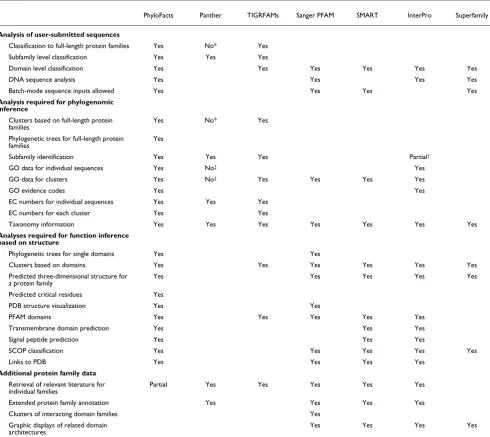
with annotation transfer from top database hit. Protein struc-ture prediction and domain analysis are presented to enable biologists to take advantage of the unique information pro-vided by protein structure studies. Simultaneous evolution-ary and structural analyses enable us to predict enzyme active sites and other types of key functional residues. HMMs for each family and subfamily provide functional classification of user-submitted sequences at different levels of a functional hierarchy. This enables functional annotation that can be far more specific than what is provided by typical protein family or domain classification web servers. A detailed comparison of PhyloFacts with some of the standard functional classifica-tion servers is presented in Table 2.
PhyloFacts currently includes almost 10,000 books providing pre-calculated phylogenomic analyses for protein super-families and structural domains, and over 700,000 HMMs enabling classification of user-submitted sequences to fami-lies and subfamifami-lies. Between 64% and 82% of genes encoded in different model organism genomes can be classified at least at the domain level to one or more books in the PhyloFacts resource (Table 3). PhyloFacts coverage is constantly increas-ing. We have currently completed clustering and expansion of the human genome, resulting in 10,163 global homology group clusters. Of these, approximately 3,969 clusters (repre-senting 38% of human genes) have been installed in the Phy-loFacts resource (although not all of them have passed the stringent GHG requirements); remaining books are in vari-ous stages of completeness.
Functional annotation using PhyloFacts
In an ideal scenario, annotation transfer between a query and homolog would meet three criteria [22]: first, global homology; second, orthology [44]; and third, supporting experimental evidence for the functional annotation being transferred. In practice, confirming agreement at all three cri-teria is not always straightforward. Very few sequences have experimentally solved structures; satisfaction of the first condition is, therefore, typically determined by comparison of
Table 1
Distribution of various book types in PhyloFacts
Book type No. of books in PhyloFacts
Global homology group 2,567
Domain 5,363
Conserved region 72
Motif 29
Pending 1,679
comm
en
t
re
v
ie
w
s
re
ports
refer
e
e
d
re
sear
ch
de
p
o
si
te
d r
e
se
a
rch
interacti
o
ns
inf
o
[image:5.612.56.550.85.752.2]rmation
Figure 1 (see legend on next page)
Ion channels: Voltage-gated K+ Shaker/Shaw
Domains found in the consensus sequence for the family (within the gathering threshold)
Domain E-value Positions
Tree viewer applet Predicted critical residues
Download NHX file
SCI-PHY subfamily information
Node No.
seqs Short name Notes
Most-recent common ancestor
Sequences in subfamily— annotations/definition lines
View tree Full ML tree (92 seqs)
View subfamily alignment
View subfamily alignment View subfamily alignment View subfamily alignment View alignment...
their predicted domain structures using, for example, PFAM or Conserved Domain [45] analysis, or by pairwise alignment analysis. Automated determination of orthology is compli-cated due to incomplete sequencing, gene duplication and loss, errors in gene structure and other issues; for a review see [46]. Satisfying the last condition is equally difficult due to the paucity of sequences with experimentally determined function; our analysis of GO annotations and evidence codes for over 370,000 sequences in the UniProt database [47] shows <3% to have experimental evidence supporting a func-tional annotation. (This statistic is based on the analysis of 372,448 UniProt sequences present in the PhyloFacts resource as of June 2005. Two-thirds of these (248,152) had GO annotations, but only 3% of this smaller set had evidence codes indicating experimental support: IDA (inferred from direct assay), IGI (inferred from genetic interaction), IMP (inferred from mutant phenotype), IPI (inferred from physi-cal interaction), and TAS (traceable author statement).)
Books in the PhyloFacts resource are labeled by the level of structural similarity across members (that is, global homol-ogy, domain, and so on), and include phylogenetic trees, inferred subfamilies, and GO annotations and evidence codes to enable a biologist to check for agreement at the three crite-ria for transferring annotations. In cases where a protein of unknown function is placed in a global homology group with an ortholog having experimentally determined function, annotation transfer can proceed with high confidence. In other cases, the biologist can check for experimentally deter-mined function in paralogous genes (bearing in mind that functions may have diverged), or at domain-based clusters, to obtain clues to the molecular function for different regions of a protein of interest. We attempt to accommodate all of these possibilities; a sequence search against the resource may match books representing global homology groups, structural domains, conserved regions, or even short motifs, all of which are presented to the user (Figure 2).
We note that while domain-based annotation is inherently less precise, PhyloFacts does provide predicted functional subfamilies within domain-based books as well as within books representing global homology groups. While annota-tion transfer across proteins having different overall folds is prone to systematic error, previous results suggest that sub-family classification of sequences aligned along a single com-mon domain can be consistent with the overall domain structure and molecular function of sequences [48]. Our
experiments using SCI-PHY to analyze proteins with different overall domain structures also support the same conclusion (unpublished data, Brown DP, Krishnamurthy N, Sjölander K).
In addition to the value PhyloFacts presents to a human investigator, it also provides a framework for the develop-ment of a fully automated functional inference system. A new generation of probabilistic methods for inferring molecular function automatically has arisen in recent years (for exam-ple, [26,49,50]). For instance, SIFTER uses a Bayesian approach to infer a distribution over possible functions in a phylogenetic tree, taking as input a cluster of sequences, a phylogenetic tree, and GO annotations and evidence codes, all of which PhyloFacts collects and integrates in one resource. SIFTER integration is to be available in our next release.
However, technical issues present barriers to the goal of fully automated function prediction (see [51] for a review). Sequences in a cluster may have different descriptors based on the species of origin; for example, the Drosophila commu-nity is likely to use different names for a gene to that used by the Caenorhabditis elegans community, and both are likely to use different terms to those used by investigators working in mouse genomics. The value of a standardized nomencla-ture, such as that being developed by GO, is obviously impor-tant, but significant work remains in this area. An exhaustive thesaurus of equivalent biological terms would be valuable. The sparse nature of experimentally supported molecular functions provides an additional barrier to automated approaches. We discuss these issues further in the section 'Challenges to phylogenomic inference'.
Clustering together proteins based on predictable global homology enables us to analyze a cluster of homologs as a unit and detect potential errors in annotation; database annota-tion errors tend to stand out as anomalous against a backdrop of otherwise consistent annotations (unless, of course, anno-tation errors have percolated through the database).
For instance, the Oryza sativa GenBank protein AAR00644 is labeled as a 'putative LRR receptor-like protein kinase'. The canonical structure of receptor-like kinases (RLKs) consists of an extracellular leucine-rich repeat (LRR) region, a trans-membrane domain, and a cytoplasmic kinase domain; AAR00644 contains no kinase domain. On the other hand,
PhyloFacts book: Voltage-gated K+ channels, Shaker/Shaw subtypes Figure 1 (see previous page)
comm
en
t
re
v
ie
w
s
re
ports
refer
e
e
d
re
sear
ch
de
p
o
si
te
d r
e
se
a
rch
interacti
o
ns
inf
o
[image:7.612.54.553.90.671.2]rmation
Figure 2 (see legend on next page)
Go Update map
Go
Go
Go
Go
Go
AAR00644 does match the canonical structure of closely related receptor-like proteins (RLPs), which are structurally very similar to RLKs, except that they terminate with a short cytoplasmic tail, and do not contain a kinase domain [52]. In the PhyloFacts resource, this protein is classified as a member of the global homology group book 'Plant LRR proteins (puta-tive RLPs)' (PhyloFacts book ID: bpg005632), where PFAM domain analysis of the cluster shows no detectable kinase domains.
For a second example, the GenBank sequence AAF19052 labeled as 'neutral human sphingomyelinase' [53] appears to be neither human nor a sphingomyelinase. Instead it appears to encode a bacterial isochorismate synthase protein. This sequence is classified to the PhyloFacts book 'Isochorismate synthase-related' (Phylofacts book ID: bpg004927), in which this purportedly 'human' sequence is the only representative eukaryote. (Note that even the translated BLAST search of this sequence against the human genome finds no matches.) In this case, both domain structure analysis and analysis of the taxonomic distribution of the globally homologous mem-bers of the family help identify the probable error.
Lastly, G-protein coupled receptor (GPCR) classification is notoriously difficult, with many receptors having no known ligand (termed 'orphan receptors'). One such orphan, a GPCR from river lamprey (UniProt: Q9YHY4), is annotated as 'Putative odorant receptor LOR3', based on its expression in the olfactory epithelium [54]. Standard profile/HMM-based analyses (for example, PFAM, SMART and the NCBI CDD) only match this protein to the PFAM 7TM_1 class, containing dozens of subtypes. BLAST analysis shows other putative odorant receptors from river lamprey (submitted by the same authors) as top hits, followed by trace amine receptors. How-ever, analyses of phylogenetic trees containing this sequence show it (and the other putative odorant receptors detected by BLAST) to be located within subtrees containing trace amine receptors (see PhyloFacts books bpg004950, bpg000525 and bpg000543) and to be quite different from experimentally confirmed odorant receptors (Additional data file 2).
Anomalous annotations such as these are often signs that annotation transfer has gone wrong. In other cases, anoma-lies may be quite real and provide new insights into the evo-lution of novel functions in a family. Automated anomaly detection faces the same technical barriers as automated functional annotation, including the need for probabilistic inference of gene function, standardized nomenclatures and exhaustive synonym tables of biological terms. At present, these anomalies - whether true functional differences or data-base annotation errors - are detected manually. In the future we expect automated function prediction methods will enable anomalous annotations to be flagged for expert examination. Protocols will then need to be established by the biological community to correct any errors and to ensure that sequence databases receive corrected annotations.
Details on resource construction and software
tools
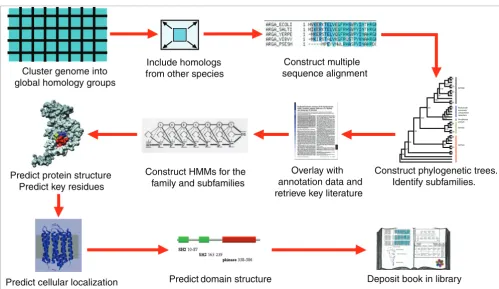
Construction of the PhyloFacts resource required the devel-opment of a computational pipeline (shown in Figure 3), soft-ware for classifying user-submitted sequences, and graphical user interfaces. These are outlined briefly below.
Clustering sequences for PhyloFacts books
Sequences for structural domain books were gathered using PSI-BLAST and UCSC SAM Target-2K (T2K) [37]. Sequences retrieved for global homology group books are required to share the same overall domain structure (global alignment). We have two tools for this process: FlowerPower (NK, Brown D, KS, unpublished data) and GHGCluster.
FlowerPower
FlowerPower is an iterative homolog detection algorithm like PSI-BLAST that retrieves homologs to a seed sequence (or query) and aligns sequences using profile methods. However, instead of using a single profile to identify and align new sequences, FlowerPower uses subfamily identification and subfamily HMM construction to expand the homology cluster in each iteration. Alignment analysis is used to restrict the
PhyloFacts search results for ANDR_RAT, androgen receptor from Rattus norvegicus
Figure 2 (see previous page)
comm
en
t
re
v
ie
w
s
re
ports
refer
e
e
d
re
sear
ch
de
p
o
si
te
d r
e
se
a
rch
interacti
o
ns
inf
o
rmation
cluster to match user-specified criteria (for example, global alignment for protein function prediction using phyloge-nomic inference, and global-local alignment (global to the seed, local to the database hit) for domain-based clustering). Experimental validation of FlowerPower shows it has greater selectivity than BLAST, PSI-BLAST and the UCSC SAM-T2K methods of homolog detection at discriminating sequences
with local similarity from those with global similarity. The FlowerPower server is available online [55].
GHGCluster
[image:9.612.57.547.116.553.2]The Global Homology Group (GHG) Cluster program enables us to cluster a selected sequence database (for example, a
Table 2
Comparison of PhyloFacts with other functional classification resources
PhyloFacts Panther TIGRFAMs Sanger PFAM SMART InterPro Superfamily
Analysis of user-submitted sequences
Classification to full-length protein families Yes No* Yes Subfamily level classification Yes Yes Yes
Domain level classification Yes Yes Yes Yes Yes Yes
DNA sequence analysis Yes Yes Yes Yes
Batch-mode sequence inputs allowed Yes Yes Yes Yes
Analysis required for phylogenomic inference
Clusters based on full-length protein families
Yes No* Yes
Phylogenetic trees for full-length protein
families Yes
Subfamily identification Yes Yes Yes Partial†
GO data for individual sequences Yes No‡ Yes
GO data for clusters Yes No‡ Yes Yes Yes Yes
GO evidence codes Yes Yes
EC numbers for individual sequences Yes Yes Yes EC numbers for each cluster Yes Yes
Taxonomy information Yes Yes Yes Yes Yes Yes Yes
Analyses required for function inference based on structure
Phylogenetic trees for single domains Yes Yes
Clusters based on domains Yes Yes Yes Yes Yes Yes Predicted three-dimensional structure for
a protein family
Yes Yes Yes Yes Yes
Predicted critical residues Yes
PDB structure visualization Yes Yes
PFAM domains Yes Yes Yes Yes Yes
Transmembrane domain prediction Yes Yes Yes Signal peptide prediction Yes Yes Yes
SCOP classification Yes Yes Yes Yes Yes
Links to PDB Yes Yes Yes Yes
Additional protein family data
Retrieval of relevant literature for individual families
Partial Yes Yes Yes Yes Yes Extended protein family annotation Yes Yes Yes Yes Clusters of interacting domain families Yes
Graphic displays of related domain
architectures Yes Yes Yes Yes
This table compares the functionalities provided by PhyloFacts with those of standard functional classification resources for structural phylogenomic analysis. PhyloFacts is the only online resource that enables structural phylogenomic inference of protein function, including clustering of sequences into structural equivalence classes (that is, containing the same domain architecture), construction of phylogenetic trees, identification of functional subfamilies, subfamily hidden Markov models and structure prediction. This differentiates PhyloFacts from other resources that almost exclusively enable domain prediction (for example PFAM, Superfamily) and those such as TIGRFAMs that cluster full-length protein sequences but do not integrate structural and phylogenomic analysis. Reported as of May 2006. *Although Panther asserts that its families contain globally alignable sequences, this is not always the case (see additional data file 1 for details). †InterPro has defined parent/child relationships between some entries that
are considered equivalent of family/subfamily relationships. But these are not defined for every cluster. ‡Panther provides its own ontology terms
genome) into global homology groups, while also including homologs from a second, generally larger, database.
GHGCluster takes two inputs: a set of sequences Q, contain-ing the sequences to be clustered, and a database D to use for expanding the clusters to include globally alignable homologs from other organisms. A superset of sequences, the expansion database E, is created by merging Q and D. To improve run time, E is partitioned into overlapping bins based on sequence length. A seed sequence (query) is chosen from Q
and homologs are gathered from its corresponding bin in E, using PSI-BLAST (E-value < 1e-5; user-specified number of
[image:10.612.56.556.118.205.2]iterations). Each hit is assessed for global homology to the query, based on percent identity (≥20%), and bi-directional alignment coverage, that is the fractional aligned length of both seed and hit (ranging from 60% for sequences <100 res-idues to 85% for sequences of >500 resres-idues). In some cases, PSI-BLAST returns multiple short aligned regions, none of which is long enough to pass the above requirements. In these cases, the failing hits are realigned to an HMM built from the seed, followed by alignment analysis. The seed and any accepted sequences are defined as a cluster and removed from Q (but not E). A new seed is then chosen from Q and the process is iterated until Q is empty.
Table 3
Fractional coverage of genomes
Model organism Number of sequences Fractional coverage
Homo sapiens 27,960 0.82
Escerichia coli 4,237 0.70
Arabidopsis thaliana 26,207 0.75
Caenorhabditis elegans 26,032 0.64
Drosophila melanogaster 19,178 0.74
The fraction of sequences from different model organisms that can be functionally classified by PhyloFacts to one of the books in the resource, based on BLAST search against PhyloFacts training sequences, using an E-value cutoff of 0.001.
PhyloFacts whole-genome library construction pipeline Figure 3
PhyloFacts whole-genome library construction pipeline. This figure represents our protocol for building global homology group protein family books. The pipeline starts with clustering a target genome into global homology groups (GHGs; sequences sharing the same overall domain structure), and proceeding through various stages of cluster expansion, multiple sequence alignment, phylogenetic tree construction, retrieval of experimental data, a variety of bioinformatics methods for predicting functional subfamilies, key residues, cellular localization, and so on, and quality control assessment.
Cluster genome into global homology groups
Predict protein structure Predict key residues
Predict domain structure.
Include homologs from other species
Construct HMMs for the family and subfamilies
Construct multiple sequence alignment
Construct phylogenetic trees. Identify subfamilies.
Deposit book in library Overlay with
annotation data and retrieve key literature
Predict cellular localization
5HT2A 5HT2C Anopheles protein Nematode serotonin/ octopamine receptors 5HT2B
100 100
100 100
100 100 100 100
100 100 100 100
100 100
100 100 100 94
93 93
66 88 95
87 55
83 96
91
51 79
[image:10.612.57.556.235.524.2]comm
en
t
re
v
ie
w
s
re
ports
refer
e
e
d
re
sear
ch
de
p
o
si
te
d r
e
se
a
rch
interacti
o
ns
inf
o
rmation
This procedure results in a set of clusters, some of which may contain the same sequence(s). At this stage we merge compatible overlapping clusters. We rank all pairs of clusters by the number of sequences they have in common and attempt to merge pairs in order. For each pair, we choose the alignment with the greater number of aligned columns and designate this as cluster A; the other cluster becomes B. We build an HMM from the cluster A alignment and use the COACH algorithm [56] to align the entire cluster B alignment to this HMM (and therefore to cluster A). If the total fraction of gap characters in the merged alignment (that is, no. of gaps/(no. of sequences × no. of columns)) is less than 20%, and the mean percent identity is greater than 20%, the merge is accepted. Otherwise, if the alignment fails based on gap content alone, we trim columns with >30% gaps from the amino and carboxyl termini and reassess: the merge is accepted if cluster sequences align at least 70% of their resi-dues, on average, within the trimmed 'core' alignment and if the core alignment contains >50% of the columns from the merged alignment and <10% gaps. Note, this procedure is computationally efficient, but can produce clusters that fail to meet the criteria set for global homology group books. In these cases, books are flagged for additional automated anal-ysis and manual inspection in order to maintain quality control.
GHGCluster was used to cluster the human genome in the construction of the PhyloFacts Animal Proteome Explorer, including homologs from NR, using three iterations of PSI-BLAST.
Note on clustering splice and allelic variants
Our atomic unit in PhyloFacts clustering is the protein sequence, independent of its origin. Consequently, splice and allelic variants of a gene are not handled differently to genes from entirely different species during clustering, alignment and tree construction (although they would be interpreted differently during a subsequent phylogenomic analysis using the resource). If the variant retains the same domain struc-ture and is globally alignable to other isoforms, it will be included in the global homology group cluster for those genes, otherwise it may end up in a different book in the resource. It should be noted that the presence of different iso-forms for a gene can cause difficulties in phylogenomic infer-ence if their common genome locus is not evident. Future releases of PhyloFacts will display this information and create links between different gene isoforms present in different books.
Multiple sequence alignment
The alignment method is selected based on the type of book. For alignments of global homology group proteins, we nor-mally use the MUSCLE software [57] to realign sequences obtained in clustering; in some cases, we use the SATCHMO software [58]. Both methods have outstanding performance evaluated on benchmark datasets. Alignments of structural
domains are taken directly from the clustering algorithm (PSI-BLAST or T2K). The method used is indicated in the 'Book Details' section at the bottom of each book page, under 'Build method notes'. Multiple sequence alignments for all books (except those constructed to model solved three-dimensional structures) are masked to remove columns with >70% gaps prior to phylogenetic tree construction. Align-ments are available for the family as a whole and for each sub-family; these can be downloaded or viewed using the Java-based Jalview software [59]. An annotated alignment, indi-cating SCI-PHY subfamily membership, is also available for viewing and download. Alignment statistics are provided, including average, minimum and maximum percent identity, fraction of gap characters in the MSA, and other relevant measurements.
Defining book type
To be defined as a 'Global Homology' book, a multiple sequence alignment must meet the following criteria: first,
≤15% gap characters over the multiple sequence alignment; second, ≤30% columns with BLOSUM62 [60] sum-of-pairs scores < 0; third, difference between the longest and the shortest sequence in the alignment <150 amino acids; and fourth, all sequences align over ≥75% of their length. Books of type 'Domain' were required to match a structural domain (as determined by SCOP) or to correspond to a PDB structure. Books labeled as 'Conserved Region' required global-local alignment of sequences to the HMM (generally matching over 70% of the HMM match states). Most books labeled as 'Pend-ing' are those that were produced by the GHGCluster pro-gram, but which failed the stringent 'Global Homology Group' alignment quality control tests; the final classification of these books to the different structural types is in progress.
Subfamily identification
Subfamily identification is provided using the SCI-PHY (Sub-family Classification In Phylogenomics) software [61]. SCI-PHY is an automatic subfamily identification algorithm; given an input MSA, SCI-PHY uses Dirichlet mixture densi-ties [62] and relative entropy to construct a hierarchical tree, and cuts the tree into subtrees to identify subfamilies using minimum-description-length principles. Extensive studies show SCI-PHY subfamilies correspond closely to both expert-identified subtypes and to conserved clades in phylogenetic trees (unpublished data, Brown DP, Krishnamurthy N, Sjö-lander K). The SCI-PHY server is available online [63].
HMM construction for the family and individual subfamilies
unique SCOP folds comparing subfamily and family HMMs show SHMMs to have high specificity in detecting function-ally similar sequences and to improve the range of homolog detection with significant scores (unpublished data, Brown DP, Krishnamurthy N, Sjölander K).
Protein structure and domain prediction
PFAM domains are identified using the consensus sequence for the family as a query using the PFAM gathering threshold as a cutoff. Matches to PDB structures are predicted by BLAST analysis of the family consensus sequence, using an E-value cutoff of 0.001 (that is, protein structure prediction based on inferred homology). Any putative homologous structures were aligned to the family HMM using local-local alignment (SAM parameter - sw 2). Transmembrane domains and signal peptides are predicted using the PHOBIUS server [29], selected due to its ability to differentiate between signal peptides and transmembrane domains.
Phylogenetic tree construction and visualization
Because many of the protein superfamilies in the PhyloFacts resource span extremes of evolutionary divergence (for exam-ple, with pairwise identities <20%), tree topologies produced by different methods can often disagree. For this reason, most of the protein families in the resource contain several phylo-genetic trees built using different algorithms, enabling biologists interested in these families to examine the differ-ences and commonalities between the trees.
Neighbor-Joining trees are constructed using the PHYLIP software [66], using the default parameters for 'protdist' and 'neighbor' (JTT model [67] and no variation of rates). Maxi-mum Likelihood trees are estimated using the PHYML soft-ware [68], also using the JTT model, four substitution rate categories, and a gamma-distributed model of rates (gamma = 1), and are set to optimize tree topology only. Maximum Parsimony trees are estimated using the PAUP* software [69], by taking an extended majority rule consensus of the most parsimonious trees obtained via ten repetitions of heu-ristic tree search. All trees are rooted using the midpoint method. As of 4 July 2006, of the 9,707 books in the library, 8,511 have at least one true phylogenetic tree constructed, and 3,613 have NJ, ML and MP trees. All books have had SCI-PHY subfamily analyses completed, and will eventually include Neighbor-Joining (including bootstrap values), Maximum Likelihood and Maximum Parsimony trees.
Phylogenetic trees are displayed using ATV, a Java-based tree viewer [70]. Users can view any of the standard trees pre-esti-mated for the family or subtrees corresponding to SCI-PHY subfamilies. Phylogenetic trees can also be downloaded in NHX format. To facilitate a comparison with SCI-PHY sub-families, the nodes in the phylogenetic trees containing sequences from a single SCI-PHY subfamily are annotated with the SCI-PHY subfamily number and annotation (Figure 4).
Predicted critical residues
Residues appearing to be important based on analysis of con-servation patterns across the family as a whole, or within SCI-PHY subfamilies, are displayed under the header 'Predicted critical residues'. Key functional residues for the family as a whole are determined by multiple sequence alignment analy-sis. For each column c, we compute the log-odds of the posi-tional conservation and the background conservation in the MSA: log (Fc/F). Here, Fc is the frequency of the most fre-quent amino acid at column c, and F is the average value of Fc
over the multiple alignment. Subfamily-defining positions are computed similarly, based on a cut of the MSA into sub-families using the SCI-PHY algorithm, and then averaging log-odds values across the subfamilies at each position. Posi-tive log-odds values indicate higher-than-average conserva-tion at a posiconserva-tion, whereas log-odds values below zero reflect conservation that is lower than average; the magnitude of the log-odds gives a measure of the significance of the result. Computing the log-odds instead of the conservation per se
enables us to differentiate truly informative positions from those that only appear conserved due to limited sequence divergence in the multiple alignment. Our default cutoffs for coloring residues based on this analysis are 0.7 for family con-servation and 0.07 for subfamily concon-servation; cutoffs can be adjusted by the user. Conservation patterns are plotted on protein three-dimensional structures for the family using an interactive Java-based structure viewer, Jmol (Figure 5) [71].
Novel sequence classification
Classification to a protein family is enabled by HMM scoring. Since HMM scoring is computationally intensive and the Phy-loFacts resource contains almost 10,000 books (each contain-ing a family HMM and potentially dozens of subfamily HMMs), we provide heuristic approaches enabling rapid clas-sification of user-submitted sequences. For computational efficiency, we select books for HMM scoring via BLAST anal-ysis of the submitted query against a dataset of over 2.5 mil-lion PhyloFacts training sequences using an E-value cutoff of 10; this significantly reduces the number of HMM scores required without affecting sensitivity. Users can override this 'BLAST pre-screen' protocol using the 'Advanced' settings page. Books retrieved based on either protocol can then be selected for scoring the submitted sequence(s) against subfamily HMMs for additional specificity of functional classification.
Future work
comm
en
t
re
v
ie
w
s
re
ports
refer
e
e
d
re
sear
ch
de
p
o
si
te
d r
e
se
a
rch
interacti
o
ns
inf
o
rmation
[image:13.612.55.551.84.679.2]SCI-PHY subfamilies correspond closely to conserved phylogenetic clades Figure 4
SCI-PHY subfamilies correspond closely to conserved phylogenetic clades. Shown here is the Maximum Likelihood (ML) tree and SCI-PHY subfamilies for the PhyloFacts book 'Voltage-gated K+ channels, Shaker/Shaw subtypes'. A branch of the ML tree is displayed, labeled with the corresponding SCI-PHY subfamilies. Subtrees containing sequences from a single subfamily are colored to show the correspondence between the SCI-PHY subfamilies and the ML tree.
N174
N173
N178
Node No.
seqs Short name Notes
Most-recent common ancestor
Sequences in subfamily— annotations/definition lines
View subfamily alignment
View subfamily alignment
View subfamily alignment
common domain or a predicted common ancestor, splice var-iation, and so on). Users will be able to navigate between pro-teins in the same pathway using the Cytoscape software, in which links to PhyloFacts books will be embedded. Users will be able to retrieve comparative (homology) models for selected proteins from the ModBase resource [72] through hyperlinks on book pages. Literature will be retrieved auto-matically for sequences in a book, and natural language processing software will be used to summarize the key points. We will expand the resource for improved coverage of key (animal) model organisms (human, mouse, C. elegans, D. melanogaster), and to keep our protein structure prediction library current. We plan to reduce redundancy in the library by combining books with significant sequence overlap. We will develop software tools to identify and include new family members as well as new experimental data (for example, the availability of solved structures, results from site-directed mutagenesis, protein-protein interactions, and so on). We will also include extensions to the subfamily HMM scoring protocol to differentiate between sequences representing a
novel subtype and those that can be classified to the top-scor-ing subfamily (based on logistic regression analysis). Phylo-genetic trees for each family will be extended to include strict consensus trees across two or more methods, and bootstrap analysis will be provided for Neighbor Joining trees. Finally, we plan to provide community annotation tools to enable biologists to upload their data, commentaries and hyperlinks to experimental data for members of protein families.
Challenges to phylogenomic inference
Phylogenomic analysis of protein function is known to improve the accuracy of functional annotation, but has had restricted application due to its technical complexity. The PhyloFacts resource enables biologists who may have limited bioinformatics expertise to take advantage of pre-computed phylogenomic analyses for hundreds of thousands of pro-teins. New sequences can be classified to families and sub-families using over 700,000 hidden Markov models, for increased functional specificity. The resource as a whole
[image:14.612.54.560.78.400.2]Key residue prediction using SCI-PHY subfamily-specific and family-wide conservation patterns Figure 5
Key residue prediction using SCI-PHY subfamily-specific and family-wide conservation patterns. Shown above is the PDB structure for the Pyrococcus furiosus Argonaute protein (PDB structure 1Z26A), from the PhyloFacts book Argonaute III (Archaea-Eukarya). The structure has been colored to predict functional residues. Residues colored yellow are conserved within both subfamilies and across the family as a whole. Positions conserved only within individual subfamilies but not across the family are colored dark blue. Positions having sufficient conservation across the family, but potentially variable within one or more subfamilies are colored light blue. These conservation patterns are predicted for each book in the PhyloFacts resource; where homologous PDB structures can be identified, these patterns are plotted on the structure. Users can modify cutoffs for determining significance using the boxes at right. Most of the residues highlighted automatically by our conservation analyses, based on the default cutoffs, have been determined
experimentally to be part of the active site [80-82] (labeled manually for this figure): R627, D628, G629, D558, Y743, H745). Y221 and W222 represent a prediction by this server. Structure viewing and interaction is enabled by the Jmol software.
Y221
W222
H745
Y743
A744
D558
R627
D628
G629
*1Z26:A, E=0; Pyrococcus Furiosus Argonaute W...
INTREPID Calculate/display
comm en t re v ie w s re ports refer e e d re sear ch de p o si te d r e se a rch interacti o ns inf o rmation
brings together many different types of bioinformatics analy-ses and data; the integration of these data and improved orthology determination enables biologists to avoid making new annotation errors at the outset, and to detect, and possi-bly correct, existing annotation errors.
Phylogenetic uncertainty and ambiguity remain significant challenges to phylogenomic inference of molecular function. Consensus analysis can be used to detect clades with support across two or more tree methods, but this approach could inadvertently be misleading if inherent biases in the methods are not taken into account. It is critical that the computational biology community and the systematics community work together to develop methods to assess the expected accuracy of phylogenetic methods for protein superfamily reconstruc-tion; new simulation studies should be developed that model the kinds of structural and functional changes observed in protein superfamily evolution.
Other challenges to automating functional annotation through phylogenomics methods include: the lack of a standardized nomenclature for gene names across different model organisms, although the GO consortium efforts are making progress in this respect; natural structural and sequence divergence among family members causing difficul-ties in clustering; ensuring multiple sequence alignment accuracy when divergently related sequences are included in a cluster; and the persistence of database annotation errors. Database annotation errors should be correctable at the source, so that the primary sequence repositories (GenBank, UniProt, and so on) can be kept current.
One of the fundamental questions in phylogenomic inference of protein function is determining the evolutionary distance within which annotations may be transferred. Given the pau-city of sequences with experimentally determined function, if annotations can only be transferred between orthologs (and are also restricted to annotations having experimental sup-port), the vast majority of unknown sequences will remain without predicted function. Is this necessary or overkill? Analysis of different types of 'function' associated with pro-teins show that some types of attributes (for example, cata-lytic activity) persist over large evolutionary distances, while in other cases (for example, substrate specificity), functions can diverge extremely rapidly. Moreover, the degree to which different types of function persist over evolutionary distance can vary from one family to another. One intriguing possibil-ity for the next generation of phylogenomic inference methods involves identifying attribute-specific evolutionary distances over which attributes may percolate.
Finally, assessing annotation accuracy is a very labor-inten-sive practice. Biological curators can spend days analyzing and annotating a single gene; to do this in high-throughput for thousands of sequences is clearly not feasible. An addi-tional complication is that definitions of molecular 'function'
or 'subfunction' are not at all standardized within biology. Instead, some biologists use the term 'function' very specifi-cally (see for example, [3]) while others may use the term more loosely. Assessing annotation accuracy, and comparing the relative effectiveness of different function prediction pro-tocols, also requires judgment calls regarding definitions of correctness. An annotation may be technically correct, but at such a high level that it is minimally helpful. For instance, a novel gene may be labeled as 'putative membrane protein', 'putative GPCR' and 'putative chemokine receptor'. If experi-mental studies show the protein to be a chemokine receptor, then only the third annotation would be particularly helpful to biologists, although all annotations would be technically correct. In other cases, an annotation may be technically incorrect, although quite close, due to annotation transfer from a paralog with a slightly different functional specificity (for example, Serotonin receptor type 1 versus Serotonin receptor type 2). Critically, there is also no community-accepted benchmark dataset or scoring function to evaluate methods of protein functional classification. These need to be developed to enable computational biologists to determine what types of inference methods are robust under what con-ditions, and where our methods fail. Efforts to develop true de novo function prediction efforts, analogous to the biennial CASP protein structure prediction experiments, are under-way [73], and are likely to play an important role in improving our understanding of method accuracy in this important area.
Additional data files
The following additional data files are available with the online version of this paper. Additional data file 1 provides a brief comparison of the Panther resource with PhyloFacts. Additional data file 2 is an illustration of detection of poten-tial annotation errors using PhyloFacts analyses.
Additional data file 1
Brief comparison of the Panther resource with PhyloFacts Brief comparison of the Panther resource with PhyloFacts Click here for file
Additional data file 2
Illustration of detection of potential annotation errors using Phylo-Facts analyses
Illustration of detection of potential annotation errors using Phylo-Facts analyses
Click here for file
Acknowledgements
This work was supported by a Presidential Early Career Award for Scien-tists and Engineers (PECASE) from the National Science Foundation, and by an R01 from the National Human Genome Research Institute of the NIH. Neither funding source was involved in: the study design; the collection, analysis, and interpretation of data; the writing of the manuscript; or the decision to submit the manuscript for publication. The authors wish to thank several anonymous reviewers for very helpful comments and suggestions.
References
1. Bork P, Koonin EV: Predicting functions from protein sequences - where are the bottlenecks? Nat Genet 1998, 18:313-318.
2. Galperin MY, Koonin EV: Sources of systematic error in func-tional annotation of genomes: domain rearrangement, non-orthologous gene displacement and operon disruption. In Sil-ico Biol 1998, 1:55-67.
3. Gerlt JA, Babbitt PC: Can sequence determine function? Genome Biol 2000, 1:REVIEWS0005.
4. Fitch WM: Distinguishing homologous from analogous proteins. Syst Zool 1970, 19:99-113.
12:1642-1650.
6. Rajalingam R, Parham P, Abi-Rached L: Domain shuffling has been the main mechanism forming new hominoid killer cell Ig-like receptors. J Immunol 2004, 172:356-369.
7. Brenner SE: Errors in genome annotation. Trends Genet 1999, 15:132-133.
8. Gilks WR, Audit B, De Angelis D, Tsoka S, Ouzounis CA: Modeling the percolation of annotation errors in a database of protein sequences. Bioinformatics 2002, 18:1641-1649.
9. Gilks WR, Audit B, de Angelis D, Tsoka S, Ouzounis CA: Percola-tion of annotaPercola-tion errors through hierarchically structured protein sequence databases. Math Biosci 2005, 193:223-234. 10. Altschul SF, Madden TL, Schaffer AA, Zhang J, Zhang Z, Miller W,
Lip-man DJ: Gapped BLAST and PSI-BLAST: a new generation of protein database search programs. Nucleic Acids Res 1997, 25:3389-3402.
11. PhyloFacts Resource [http://phylogenomics.berkeley.edu/phylo facts/]
12. Moult J, Fidelis K, Zemla A, Hubbard T: Critical assessment of methods of protein structure prediction (CASP)-round V. Proteins 2003, 53(Suppl 6):334-339.
13. Bradley P, Chivian D, Meiler J, Misura KM, Rohl CA, Schief WR, Wedemeyer WJ, Schueler-Furman O, Murphy P, Schonbrun J, et al.: Rosetta predictions in CASP5: successes, failures, and prospects for complete automation. Proteins 2003, 53(Suppl 6):457-468.
14. Pellegrini M, Marcotte EM, Thompson MJ, Eisenberg D, Yeates TO: Assigning protein functions by comparative genome analy-sis: protein phylogenetic profiles. Proc Natl Acad Sci USA 1999, 96:4285-4288.
15. Marcotte EM, Pellegrini M, Ng HL, Rice DW, Yeates TO, Eisenberg D: Detecting protein function and protein-protein interac-tions from genome sequences. Science 1999, 285:751-753. 16. Pearson WR, Lipman DJ: Improved tools for biological sequence
comparison. Proc Natl Acad Sci USA 1988, 85:2444-2448. 17. Park J, Karplus K, Barrett C, Hughey R, Haussler D, Hubbard T,
Cho-thia C: Sequence comparisons using multiple sequences detect three times as many remote homologues as pairwise methods. J Mol Biol 1998, 284:1201-1210.
18. Bateman A, Coin L, Durbin R, Finn RD, Hollich V, Griffiths-Jones S, Khanna A, Marshall M, Moxon S, Sonnhammer EL, et al.: The Pfam protein families database. Nucleic Acids Res 2004:D138-141. 19. Schultz J, Milpetz F, Bork P, Ponting CP: SMART, a simple
modu-lar architecture research tool: identification of signaling domains. Proc Natl Acad Sci USA 1998, 95:5857-5864.
20. Gough J, Karplus K, Hughey R, Chothia C: Assignment of homol-ogy to genome sequences using a library of hidden Markov models that represent all proteins of known structure. J Mol Biol 2001, 313:903-919.
21. Eisen JA: Phylogenomics: improving functional predictions for uncharacterized genes by evolutionary analysis. Genome Res 1998, 8:163-167.
22. Sjölander K: Phylogenomic inference of protein molecular function: advances and challenges. Bioinformatics 2004, 20:170-179.
23. Brown D, Sjölander K: Functional classification using phyloge-nomic inference. PLoS Comput Biol 2006, 2:e77.
24. Storm CE, Sonnhammer EL: Automated ortholog inference from phylogenetic trees and calculation of orthology reliability. Bioinformatics 2002, 18:92-99.
25. Zmasek CM, Eddy SR: RIO: Analyzing proteomes by auto-mated phylogenomics using resampled inference of orthologs. BMC Bioinformatics 2002, 3:14.
26. Engelhardt BE, Jordan MI, Muratore KE, Brenner SE: Protein molecular function prediction by Bayesian phylogenomics. PLoS Comput Biol 2005, 1:e45.
27. Krogh A, Larsson B, von Heijne G, Sonnhammer EL: Predicting transmembrane protein topology with a hidden Markov model: application to complete genomes. J Mol Biol 2001, 305:567-580.
28. Emanuelsson O, Nielsen H, Brunak S, von Heijne G: Predicting sub-cellular localization of proteins based on their N-terminal amino acid sequence. J Mol Biol 2000, 300:1005-1016.
29. Kall L, Krogh A, Sonnhammer EL: A combined transmembrane topology and signal peptide prediction method. J Mol Biol 2004, 338:1027-1036.
30. Chen CP, Kernytsky A, Rost B: Transmembrane helix predic-tions revisited. Protein Sci 2002, 11:2774-2791.
31. Ashburner M, Ball CA, Blake JA, Botstein D, Butler H, Cherry JM, Davis AP, Dolinski K, Dwight SS, Eppig JT, et al.: Gene ontology: tool for the unification of biology. The Gene Ontology Consortium. Nat Genet 2000, 25:25-29.
32. Browse PhyloFacts Universe [http://phylogenomics.berke ley.edu/cgi-bin/listbooks/listbooks.py]
33. PhyloFacts Search [http://phylogenomics.berkeley.edu/phylo facts/search.php]
34. Brenner SE, Koehl P, Levitt M: The ASTRAL compendium for protein structure and sequence analysis. Nucleic Acids Res 2000, 28:254-256.
35. Berman HM, Westbrook J, Feng Z, Gilliland G, Bhat TN, Weissig H, Shindyalov IN, Bourne PE: The Protein Data Bank. Nucleic Acids Res 2000, 28:235-242.
36. Wheeler DL, Barrett T, Benson DA, Bryant SH, Canese K, Chetvernin V, Church DM, DiCuccio M, Edgar R, Federhen S, et al.: Database resources of the National Center for Biotechnol-ogy Information. Nucleic Acids Res 2006:D173-180.
37. Karplus K, Karchin R, Barrett C, Tu S, Cline M, Diekhans M, Grate L, Casper J, Hughey R: What is the value added by human inter-vention in protein structure prediction? Proteins 2001, 45(Suppl 5):86-91.
38. Horn F, Weare J, Beukers MW, Horsch S, Bairoch A, Chen W, Edvardsen O, Campagne F, Vriend G: GPCRDB: an information system for G protein-coupled receptors. Nucleic Acids Res 1998, 26:275-279.
39. Mi H, Lazareva-Ulitsky B, Loo R, Kejariwal A, Vandergriff J, Rabkin S, Guo N, Muruganujan A, Doremieux O, Campbell MJ, et al.: The PANTHER database of protein families, subfamilies, func-tions and pathways. Nucleic Acids Res 2005:D284-288.
40. Drysdale RA, Crosby MA: FlyBase: genes and gene models. Nucleic Acids Res 2005:D390-395.
41. Jaiswal P, Ni J, Yap I, Ware D, Spooner W, Youens-Clark K, Ren L, Liang C, Zhao W, Ratnapu K, et al.: Gramene: a bird's eye view of cereal genomes. Nucleic Acids Res 2006:D717-723.
42. Kent WJ, Sugnet CW, Furey TS, Roskin KM, Pringle TH, Zahler AM, Haussler D: The human genome browser at UCSC. Genome Res 2002, 12:996-1006.
43. Rhee SY, Beavis W, Berardini TZ, Chen G, Dixon D, Doyle A, Garcia-Hernandez M, Huala E, Lander G, Montoya M, et al.: The Arabidop-sis Information Resource (TAIR): a model organism data-base providing a centralized, curated gateway to Arabidopsis biology, research materials and community. Nucleic Acids Res 2003, 31:224-228.
44. Zmasek CM, Eddy SR: A simple algorithm to infer gene dupli-cation and speciation events on a gene tree. Bioinformatics 2001, 17:821-828.
45. Marchler-Bauer A, Anderson JB, Cherukuri PF, DeWeese-Scott C, Geer LY, Gwadz M, He S, Hurwitz DI, Jackson JD, Ke Z, et al.: CDD: a Conserved Domain Database for protein classification. Nucleic Acids Res 2005:D192-196.
46. Koonin EV: Orthologs, paralogs, and evolutionary genomics. Annu Rev Genet 2005, 39:309-338.
47. Wu CH, Apweiler R, Bairoch A, Natale DA, Barker WC, Boeckmann B, Ferro S, Gasteiger E, Huang H, Lopez R, et al.: The Universal Protein Resource (UniProt): an expanding universe of pro-tein information. Nucleic Acids Res 2006:D187-191.
48. Eisen JA, Sweder KS, Hanawalt PC: Evolution of the SNF2 family of proteins: subfamilies with distinct sequences and functions. Nucleic Acids Res 1995, 23:2715-2723.
49. Shakhnovich BE, Harvey JM, Comeau S, Lorenz D, DeLisi C, Sha-khnovich E: ELISA: structure-function inferences based on sta-tistically significant and evolutionarily inspired observations. BMC Bioinformatics 2003, 4:34.
50. Levy ED, Ouzounis CA, Gilks WR, Audit B: Probabilistic annota-tion of protein sequences based on funcannota-tional classificaannota-tions. BMC Bioinformatics 2005, 6:302.
51. Friedberg I: Automated protein function prediction - the genomic challenge. Brief Bioinform 2006, 7:225-242.
52. Fritz-Laylin LK, Krishnamurthy N, Tor M, Sjölander KV, Jones JD: Phylogenomic analysis of the receptor-like proteins of rice and Arabidopsis. Plant Physiol 2005, 138:611-623.
53. Chatterjee S, Han H, Rollins S, Cleveland T: Molecular cloning, characterization, and expression of a novel human neutral sphingomyelinase. J Biol Chem 1999, 274:37407-37412.
54. Berghard A, Dryer L: A novel family of ancient vertebrate odor-ant receptors. J Neurobiol 1998, 37:383-392.