International Journal of Emerging Technology and Advanced Engineering
Website: www.ijetae.com (ISSN 2250-2459, ISO 9001:2008 Certified Journal, Volume 5, Issue 3, March 2015)
An Agent Based Mobile Transaction and Disconnection
Management System
Vivek N. Waghmare
1, Snehal D. Patkar
2, Pranali B. Patil
3 1,2,3Information Technology, SITRC, Nasik, India. Abstract— Replication is one of the most widely studiedphenomena in a distributed environment. It is a strategy in which multiple copies of same data are stored at multiple sites. As every coin has two sides, replications do come with overheads of creating, maintaining and updating the replicas. In this paper we will seek to gain a deep knowledge about understanding of a mobile computing system which has become ubiquitous on daily lives. Here, we propose a system which extracts data from different database system through mobile agents using natural language rather than SQL queries. This system has found out the solutions on the problems mainly occurs in traditional distributed system such as disconnection management and mobility management. Creating same copy of data at different sites makes easy accessibility for users and increases performance.(Abstract)
Keywords- Database Application, Disconnection Management, Fault Tolerance, Mobile Computing, Mobility Management, Replication. (key words)
I. INTRODUCTION
Mobile computing is an emerging technology in advance wireless communication networks and hardware. e.g. laptop, PDA, and cell phone. It is the wide area of work of research in the environment of database. Mobile phones increasingly and progressively using database applications such as product inventory tracking, sales order entity, airline booking etc. Mobile clients or a host retrieves the required information from the database server via wireless channel.
Mobile database become deliberately popular, as the wide use of mobile computing devices. Some author describes the mobile database is distributed database in which accessing mode is mobile rather than the database stored in mobile devices are said to be mobile database. Few Authors defines that it is the combination and merging of ad-hoc database, distributed database and disconnected database. This rapidly growing technology occurs some new challenges and problems.
Wireless networks can be thought as an extension of wired network for expansion of communication area. As we can see, the requirements of applications in mobile computing devices are increasing day by day.
With wireless connection, the mobile hosts such as any employee can request for required information by sitting in his office or work place or at public area such as shopping mall or somewhere in car or on plane. It was assumed that over the years, many people are performing mobile applications such as electronic mails, file transfer and other database applications. Moreover, the mobile hosts use it for personal applications such as message delivery, calendar and directory services. The remaining users uses it for transportation, field service and field sales purpose.
Some author stated that the suggested preemption in traditional distributed system is not reasonable in mobile computing system. The location of various hosts is predefined and well known to server and the cost of hosts is also balanced. The connection established between mobile hosts and server is usually of light bandwidth, consequently the latency in process decreases and performance improves. Thus, it can be say that there is huge data storage space on host and no power restrictions. In mobile computing system, due to mobility, the location of mobile user is dynamically changes. For communication in wireless network, mobile clients have limited bandwidth and high latency. The consumption of battery power of mobile devices is high. It is not necessarily restricted to keep the same data on data storage of mobile client. While introducing replica strategy in mobile computing system with clients, these challenging issues are encountered.
International Journal of Emerging Technology and Advanced Engineering
Website: www.ijetae.com (ISSN 2250-2459, ISO 9001:2008 Certified Journal, Volume 5, Issue 3, March 2015)
530 Moreover, in such sharing and communication environment, we provide a replica control strategy, so that mobile client can continuous access and process on his required data even though he is disconnected from the network.
In mobile computing system, replica strategy cannot be directly applied with distributed system. Due to mobile clients frequently disconnected from network because of out of radio coverage and power saving, a weak signal or poor reception. Therefore disconnection is a major factor in mobile computing system rather than failure of system. When mobile clients cache or store the useful database properly in their local memory, they can continuously access and operate on local cache data, which results more work can be done though mobile clients are disconnected from the network.
The communication cost of wireless link between mobile client and database server is saved in following case : Example : A subset of available tickets is allocated to each client. Thus, they can independently sale the tickets to the customer under some local available tickets constraints rather than global available tickets constraints. It satisfies the customer with good service when it is disconnected from server. The disconnection operation satisfies the requirement of mobile clients. The replication data often used in mobile clients and it is local satisfaction. Therefore the possibilities in data confliction are less.
The replica control strategy can be done in two ways, optimistic and pessimistic. These strategies are used in disconnection operation. A pessimistic replica control strategy is lock-based replication. In this, the replication done at all nodes is synchronized and then all the replicas are updated as a atomic and united pat. Whereas, an optimistic replica control strategy is asynchronous replication. In this, the transaction which is updated is committed first. Then the updating is applied to other corresponding nodes. In this paper, implementation of optimistic replica strategy is discussed. The major issue during applying the replication technique is that it is needed to modify the database interface after addition or insertion of data at different servers.
This replication scheme is called as three-copy replication scheme, because three copies are generated due to applying of replication technique; primary copy, secondary copy and mobile copy. These multiple copies are generated to deal with the possible disconnection of mobile clients with server. When the mobile client is disconnected from network, they have their own cache memory where they preserves data (i.e. mobile copy) and continuous operation.
II. LITERATURE SURVEY
Over the past 20 years, mobile computing infrastructures and various network application technologies are leading with enhanced reliability.
In [1], states that “Disjoint Data Partition” scheme disallows any data replication. That is each data item is stored on only one server. That means a data item has exactly one primary copy on server. In this paper the replication scheme is allowing to keep copy of a single data item on several servers. However, all copies of data item are distinguished as primary and secondary.
The commitment is must to ensure the successful transaction between client and server. In [4, 13], has introduced 2 phase commit protocol (2PC) to terminate distributed transaction. It allows the involvement of both parties to agree on a common decision to commit or abort the transaction even in the presence of failure.
In [3], has mentioned the example is to describe the system works in replicated environment. In it multiple sites are located in different locations and connected through a middleware where it does not matter what the middleware consist of. Data stored at one site is replicated to other sites, so that the user trying to access that file from particular site is denied then he can deal with this problem by accessing the replica of that file from another site.
Changing nature of mobile computing has introduced different models by different developers. In “Report and Co-transaction model” allows hierarchy of transaction levels and obeys the bottom up approach by the root. “Two transaction Model was proposed by Gary to specify the two types of transactions in mobile computing. I.e. Base and Tentative.
In [5], the Report and Co-transaction Model which is specifically used for multi database system is introduced by P K Chrysan. It is used where multiple type of databases are used for different domains. Nested transaction is also possible in this model.
The mobile computing environment requires the approach where the efficient access of shared data from any point or location. In [6], address the problem of query processing and data replication.
The narrow bandwidth of wireless channels is determined by keeping mind to reduce the efforts of communication between client and server. Haroon Shahzad and Xiang Li have changed the way of accessing database at a time among multiple users. The data storage is done at several nearby servers with the same copy instead storing it at centralized location.
International Journal of Emerging Technology and Advanced Engineering
Website: www.ijetae.com (ISSN 2250-2459, ISO 9001:2008 Certified Journal, Volume 5, Issue 3, March 2015)
III. PROPOSED WORK
A.Module:
Mobile computing represents the most consistent approaches for multiple machines connected in a network, with the help of software agents (client agent and server agent). The multi-agent system controls the agent‟s lifecycle and provide them necessary environment for executing their tasks.
Fig1: An Agent based Architecture
This work proposed a model that is based on area of mobile computing. This concept is used in order to build a system that would be able to extract data from heterogeneous database system, with the help of mobile agents. In the existing system we use SQL query for retrieving data from database instead of that our product provide the natural language input facility. The main objective of this project is to provide maximum details about the data to the client on their mobile phone, when client is away from office / goes out station.
B.Pseudo code:
1)Get request R from User U
2)For every R, CA will make entry in log of client agent database (CADB).
3)Initially status for R will be No answer (NA).
4)Forward request R to SA.
5)SA will make entry in server agent database (SADB).
6)Status will be No Answer (NA). 7)Retrieve result A from SADB. 8)Status of request R will be answer A. 9)Forward answer A to CADB.
10) Status of R in CADB will be answer A. 11) Forward answer A to client.
12) Go to (1)
C. Problem Definition :
Let „ S ‟ be a New Replication Strategy for A
Disconnection Under Agent-Based on Mobile
Computing System.
S={R, U, Q, L, B, C, D, A/ for all S}
R Represent request R= {r0, r1… rn / for all R}
U Represent User
U= {u0, u1… un / for all U}
Q Represent the query, Q= {q0, q1... qn / for all Q}
L Represent Local agent L= {l0, l1… ln / for all L}
B Represent Base station B= {b0 / for all B}
C Represent Co-agent, C= {c0 / for all C}
D Represent Domain D= {d0, d1... dn / for all D}
A Represent Result A= {a0, a1... an / for all A}
D. Activity:
a) Let Ƒu be a rule of U into B such that for given Base station there is User…
Ƒu (u0, u1… un / ---> {B}) € B
b) Let Ƒb be a rule of B into C such that for given co-agent there is Base station…
International Journal of Emerging Technology and Advanced Engineering
Website: www.ijetae.com (ISSN 2250-2459, ISO 9001:2008 Certified Journal, Volume 5, Issue 3, March 2015)
532
c) let Ƒc be a rule of C into T such that for search the dictionary words there is co-agent…
Ƒc (c / ---> {t0, t1 ….tn}) € T
d) Let Ƒq be a rule of Q into L such that the query goes to the local agent
Ƒq (q0, q1….qn / ---> {l0, l1 ….ln}) € L
e) Let Ƒl be a rule of L into D such that local agent search the query from domain
Ƒl (l0, l1 ….ln / ---> {d0, d1… dn}) € D
f) Let Ƒd be a rule of D into A such that domain gives the Result
Ƒd (d0, d1 ….dn / ---> {a0, a1… an}) € A
[image:4.612.330.557.132.409.2]IV. RESULT SET
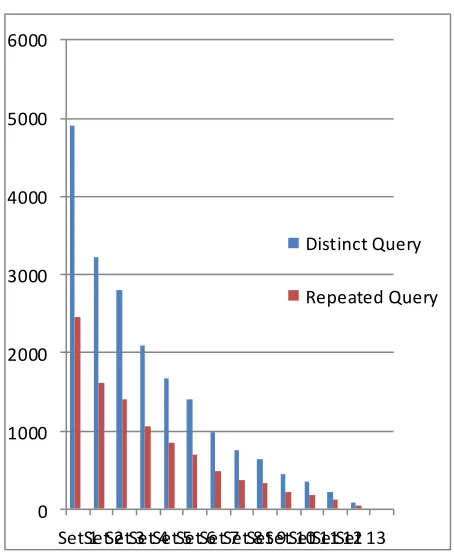
Table 1:
Queries and its Response time
0 1000 2000 3000 4000 5000 6000
Set 1 Set 2Set 3Set 4Set 5Set 6Set 7Set 8Set 9Set 10Set 11Set 12Set 13 Distinct Query
Repeated Query
Fig 2: graph of result set verses time in second
V. CONCLUSION
[image:4.612.53.284.323.582.2]International Journal of Emerging Technology and Advanced Engineering
Website: www.ijetae.com (ISSN 2250-2459, ISO 9001:2008 Certified Journal, Volume 5, Issue 3, March 2015)
REFERENCES
[1] S. Y. Hwang, Keith K. S. Lee, and Y. H. Chin, “Data Replication in a Distributed Database Systems: A Performance Study,” Lecture Notes in Computer Science, number 1134. Editors: R. R. Wanger and H. Thoma. Springer Verlag, pages 708--717, September 1996. [2] Salman Abdul Moiz, Mohammed Khaja Nizamuddin,” Concurrency
Control without Locking in Mobile Environments”, IEEE, 2008, pp. 1336- 1339.
[3] G. Sushant, and R. Buyya, (2006). "Data replication strategies in wide-area distributed systems", Chapter IX of Enterprise Service Computing: From Concept to Deployment, IGI Global, pp. 211-241. [4] Vijay Kumar, “Mobile Database Systems”, Wiley-Interscience, John
Wiley & Sons, Inc. Publication, New Jersey, 2006.
[5] Prasanta Kumar Panda Sujata Swain P. K. Pattnaik, “Review of Some Transaction Models used in Mobile Databases”, International Journal of Instrumentation, Control & Automation (IJICA), Volume 1, Issue 1, 2011. Computing (SCC‟04), IEEE Computer Society, 2004.
[6] A. Ahmed, D. D. Dominic, and A. Abdullah, “A NOVEL REPLICATION STRATEGY FOR LARGE-SCALE MOBILE
DISTRIBUTED DATABASE SYSTEMS,” Science And
Technology, vol. 6, no. 3, pp. 268 - 299, 2011.
[7] T. Connolly and C.E. Begg, (2004) "Database systems: a practical approach to design, implementation and management", 4th edition, Addison-Wesley.
[8] T. Ozsu and Valduriez, 1999, “Principles of Distributed Database Systems”, Englewood Cliffs, NJ: Prentice Hall.
[9] Borr, 1988, “High Performance SQL through Low Level System Integration,” in Proc. ACM SIGMOD International Conference. [10] Victor C.S., Kwok-wa Lam and Sang H. Son, 2002, “Concurrency
Control Using Timestamp Ordering in Broadcast Environments”, The Computer Journal, Vol. 45, No. 4, pp. 410-422.
[11] Philip A. Bernstein, Vassos Hadzilacos and Nathan Goodman, 1987, “Concurrency control and Recovery in Database Systems”, Addison – Wesley.
[12] V. Kumar, 1996, “Performance of concurrency control mechanisms in Database Systems”. Englewood Cliff, NJ: Prentice Hall. [13] Yixiu Huang, Prasad Sistla, and Ouri Wolfson, “Data Replication for