R E S E A R C H
Open Access
Reduction in hospital-wide mortality after
term cohort study
Jeremy R Beitler
1*, Nate Link
2, Douglas B Bails
2, Kelli Hurdle
3and David H Chong
4Abstract
Introduction:Rapid response teams (RRTs) have been shown to reduce cardiopulmonary arrests outside the intensive care unit (ICU). Yet the utility of RRTs remains in question, as most large studies have failed to demonstrate a significant reduction in hospital-wide mortality after RRT implementation.
Methods:A cohort design with historical controls was used to determine the effect on hospital-wide mortality of an RRT in which clinical judgment, in addition to vital-signs criteria, was widely promoted as a key trigger for activation. All nonprisoner patients admitted to a tertiary referral public teaching hospital from 2003 through 2008 were included. In total, 77, 021 admissions before RRT implementation (2003 through 2005) and 79, 013 admissions after RRT implementation (2006 through 2008) were evaluated. Thea prioriprimary outcome was unadjusted hospital-wide mortality. A Poisson regression model was then used to adjust for hospital-wide mortality trends over time. Secondary outcomes defineda prioriwere unadjusted out-of-ICU mortality and out-of-ICU cardiopulmonary-arrest codes.
Results:In total, 855 inpatient RRTs (10.8 per 1, 000 hospital-wide discharges) were activated during the 3-year postintervention period. Forty-seven percent of RRTs were activated for reasons of clinical judgment. Hospital-wide mortality decreased from 15.50 to 13.74 deaths per 1, 000 discharges after RRT implementation (relative risk, 0.887; 95% confidence interval (CI), 0.817 to 0.963;P= 0.004). After adjusting for inpatient mortality trends over time, the reduction in hospital-wide mortality remained statistically significant (relative risk, 0.825; 95% CI, 0.694 to 0.981;P= 0.029). Out-of-ICU mortality decreased from 7.08 to 4.61 deaths per 1, 000 discharges (relative risk, 0.651; 95% CI, 0.570 to 0.743;P< 0.001). Out-of-ICU cardiopulmonary-arrest codes decreased from 3.28 to 1.62 codes per 1, 000 discharges (relative risk, 0.493; 95% CI, 0.399 to 0.610;P< 0.001).
Conclusions:Implementation of an RRT in which clinical judgment, in addition to vital-signs criteria, was widely cited as a rationale for activation, was associated with a significant reduction in hospital-wide mortality, out-of-ICU mortality, and out-of-ICU cardiopulmonary-arrest codes. The frequent use of clinical judgment as a criterion for RRT activation was associated with high RRT utilization.
Introduction
Adverse events are estimated to occur in 3% to 18% of hospitalizations in the United States, Canada, Europe, and Australia [1-9]. The degree to which these adverse events, including cardiopulmonary arrest and unex-pected death, are preventable remains unclear. Clinical signs of deterioration, including vital-sign derangements
and mental-status changes, are present at least 8 hours before most inpatient cardiopulmonary arrests [10-12]. Despite the ubiquity of cardiopulmonary-arrest teams, survival to discharge after in-hospital cardiopulmonary resuscitation remains only 7% to 26% [13-17]. This has led to attempts to identify early premonitory signs of arrest and to intervene promptly to prevent such adverse outcomes during hospitalization.
In response, the Institute for Healthcare Improvement in the United States [18], Department of Health in the United Kingdom [19], Commission on Safety and * Correspondence: [email protected]
1
Pulmonary and Critical Care Unit, Massachusetts General Hospital, 55 Fruit Street, BUL-148, Boston, Massachusetts 02114, USA
Full list of author information is available at the end of the article
© 2011 Beitler et al.; licensee BioMed Central Ltd. This is an open access article distributed under the terms of the Creative Commons Attribution License (http://creativecommons.org/licenses/by/2.0), which permits unrestricted use, distribution, and reproduction in any medium, provided the original work is properly cited.
long-Quality in Health Care in Australia [20], and several other national patient-safety organizations have recom-mended adopting rapid response teams (RRTs) to reduce inpatient morbidity and mortality. The RRT, also known as a medical emergency team or critical care outreach team, is a multidisciplinary group of hospital personnel that responds promptly to acutely deteriorat-ing inpatients outside the intensive care unit (ICU).
RRTs are typically activated once predefined vital-sign derangements are met. Such RRTs previously have been shown to reduce out-of-ICU cardiopulmonary arrests [21-25]. Given the low probability of survival to dis-charge after inpatient cardiopulmonary arrest, the potential impact of RRTs on hospital-wide mortality would seem great. Yet several previous studies have failed to demonstrate a significant reduction in adult hospital-wide mortality after RRT implementation [23,26-28], including three of the four largest studies evaluating hospital-wide mortality to date, with between 25, 000 and 68, 000 patients in the postintervention group [23,27,28]. Moreover, a recent meta-analysis of 17 studies, including more than 400, 000 patients, failed to find a reduction in overall hospital-wide mortality or adult mortality, although a significant reduction in pediatric mortality was observed [29]. Although one recent large study [30], including 73, 000 patients in the postintervention group, and few small short-term stu-dies [21,22,24,31] have found a significant reduction in hospital-wide mortality after RRT implementation, little consensus exists on the true mortality benefit, if any, afforded by RRTs.
Failure of most RRTs to reduce hospital-wide mortal-ity is often attributed to underutilization and delays in activation of the RRT once predefined vital-sign derangements are met [26,27,32-35]. We postulated that an RRT emphasizing clinical judgment, in addition to vital-signs criteria as a key trigger for activation, may increase RRT utilization and thus more effectively iden-tify early the patients who are clinically deteriorating, leading to timelier interventions and improved outcomes.
To assess the impact of an RRT in which clinical judg-ment was widely promoted as an additional central cri-terion for activation, we conducted one of the largest and longest studies to date of hospital-wide mortality after RRT implementation. Additionally, we examined the impact of the RRT on out-of-ICU mortality and out-of-ICU cardiopulmonary-arrest codes.
Materials and methods
Study design
A cohort design with historical controls was used to determine the effect of the RRT on hospital-wide mor-tality at Bellevue Hospital Center, an 809-bed tertiary
referral public teaching hospital in New York City. The distribution of hospital beds includes 246 medical beds, 72 surgical beds, 49 adult ICU beds, 37 pediatric beds, 20 pediatric ICU beds, 26 obstetrics beds, 46 rehabilita-tion beds, and 313 psychiatric beds.
Patients were included if admitted to any nonprisoner inpatient service between 2003 and 2008, regardless of their advanced-directive status. Prisoners were excluded to comply with Institutional Review Board requirements. In total, 77, 021 admissions before RRT implementation (January 1, 2003, through December 31, 2005) and 79, 013 admissions after RRT implementation (January 1, 2006, through December 31, 2008) were evaluated. Although RRTs were activated in both inpatient and outpatient settings during the postintervention period, only those RRTs activated for inpatients were considered.
Data on mortality, demographic characteristics, and case-mix index were collected prospectively in the hos-pital core patient database and retrieved for the study. (The case-mix index is a standardized measure of illness severity based on diagnosis, which is commonly used to determine insurance reimbursement for inpatient stays in U.S. hospitals.) Cardiopulmonary-arrest code and RRT data were collected prospectively for a quality-improvement initiative. After discharge, charts were reviewed to identify the diagnosis attributed by the pri-mary medical team as prompting RRT activation and to identify advanced-directive status. The study was approved by the New York University School of Medi-cine and Bellevue Hospital-Health and Hospitals Cor-poration Institutional Review Boards, which waived the need for informed consent.
Intervention
The RRT was led by the medical consult resident, a senior (postgraduate year 3) medical house officer who also led the cardiopulmonary-arrest code team, was cer-tified in advanced cardiac life support, and typically had 4 to 6 months of prior critical care training. The team, which also included an ICU nurse, respiratory therapist, and patient transporter, was activated via the hospital page operator to report immediately to the bedside to direct management of the unstable patient. On nights and weekends, a nursing administrator joined the team for further support. Although not formal team members, additional medical house officers also frequently responded to RRT activations.
minute, systolic blood pressure less than 90 mm Hg, heart rate less than 40 or greater than 140 beats per minute, or change in heart rate greater than 30 beats per minute. However, staff were explicitly instructed to activate the RRT without hesitation for any appropriate degree of clinical concern without threat of repudiation or reprisal, regardless of whether the reviewed vital-signs criteria were met.
The RRT was first introduced in January 2006 to the medicine service through multidisciplinary sessions led jointly by senior physician and nurse members of the RRT development committee and attended by nurses, respiratory therapists, and medicine house staff on ser-vice. The RRT was expanded to all other adult inpatient, outpatient, testing, and administrative services between February and June 2006. Additional introductory ses-sions were held throughout the study period during new-staff orientations and at nursing leadership, patient safety, and quality improvement meetings. The RRT development committee reviewed monthly all out-of-ICU arrests and gave direct feedback to involved nurses and staff regarding use of the RRT. No additional staff were hired nor work hours extended to implement the new program.
Main outcomes
Thea prioriprimary outcome was hospital-wide mortal-ity, defined as death before discharge. Secondary
out-comes defined a prioriwere out-of-ICU mortality and
out-of-ICU cardiopulmonary-arrest codes. A cardiopul-monary-arrest code was defined as active or impending cardiopulmonary arrest resulting in activation of the hospital-wide code team. Within-ICU cardiopulmonary-arrest codes were not included because ICU teams often handled cardiopulmonary arrests without activating the code system. These arrests were not captured in any hospital database.
Statistical analysis
Demographic characteristics were analyzed by using the
c2
test for categoric variables and the Studentttest for continuous variables. To determine whether RRT imple-mentation correlated with reductions in mortality and cardiopulmonary-arrest codes, the relative risk (RR) and 95% confidence intervals (CIs) were calculated by using Poisson regression. The difference in the absolute num-ber of deaths was estimated by subtracting the observed number of postintervention deaths from the expected number of postintervention deaths (preintervention mortality rate multiplied by postintervention discharge volume). To adjust for year-to-year improvement in hos-pital-wide mortality that may have occurred indepen-dent of the intervention, a second Poisson model was constructed by including a linear term for time. For all
analyses, the null hypothesis was evaluated by using a two-sided significance level of 0.05.
Results
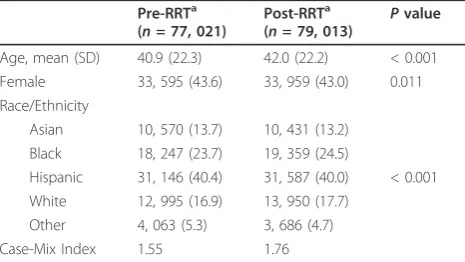
Small but statistically significant differences in demo-graphic characteristics were found between the preinter-vention and postinterpreinter-vention groups (Table 1). Patients in the postintervention group on average had a higher acuity of illness, as measured by the case-mix index.
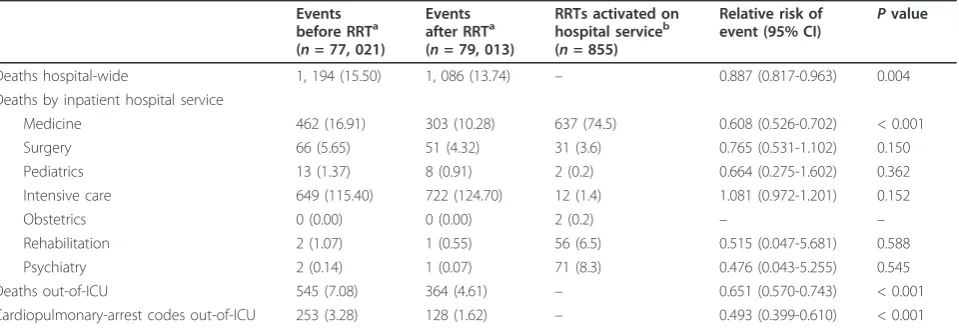
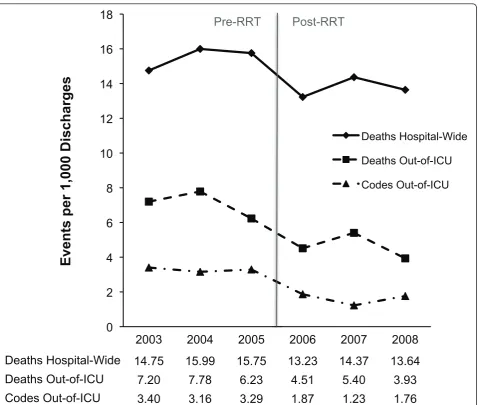
Hospital-wide mortality significantly decreased from 15.50 to 13.74 deaths per 1, 000 discharges after RRT
implementation (RR, 0.887; 95% CI, 0.817 to 0.963;P=
0.004) (Table 2, Figure 1). In absolute terms, the num-ber of hospital deaths decreased by 139 after RRT implementation (from 1, 225 expected to 1, 086 observed deaths; 95% CI, 68 to 210). Adjusting for mor-tality trends over the 3-year period immediately before RRT implementation, hospital-wide mortality remained significantly lower after the intervention (RR, 0.825; 95% CI, 0.694 to 0.981; P= 0.029), translating to an adjusted estimate of 264 fewer hospital deaths (from 1, 350 expected to 1, 086 observed deaths; 95% CI, 1 to 598). Out-of-ICU mortality significantly decreased from 7.08 to 4.61 deaths per 1, 000 discharges (RR, 0.651; 95% CI, 0.570 to 0.743;P< 0.001).
Out-of-ICU cardiopulmonary-arrest codes signifi-cantly decreased from 3.28 to 1.62 codes per 1, 000 discharges after RRT implementation (RR, 0.493; 95% CI, 0.399 to 0.610; P < 0.001). Survival to discharge was able to be determined for 87% of patients who experienced an out-of-ICU cardiopulmonary-arrest code. Among these patients, a nonsignificant trend was noted toward increased post-code survival after RRT implementation (22.5% before implementation versus
41.4% after implementation; P = 0.13). As a result,
[image:3.595.305.538.581.712.2]out-of-ICU code-related mortality (defined as death before discharge after experiencing an out-of-ICU arrest code) significantly decreased from 2.55 to 0.95
Table 1 Demographic characteristics of study population before and after rapid response team implementation
Pre-RRTa (n= 77, 021)
Post-RRTa
(n= 79, 013) P value
Age, mean (SD) 40.9 (22.3) 42.0 (22.2) < 0.001
Female 33, 595 (43.6) 33, 959 (43.0) 0.011
Race/Ethnicity
Asian 10, 570 (13.7) 10, 431 (13.2) Black 18, 247 (23.7) 19, 359 (24.5)
Hispanic 31, 146 (40.4) 31, 587 (40.0) < 0.001 White 12, 995 (16.9) 13, 950 (17.7)
Other 4, 063 (5.3) 3, 686 (4.7)
Case-Mix Index 1.55 1.76
RRT, rapid response team.a
deaths per 1, 000 discharges after RRT implementation (P < 0.001). In absolute terms, the number of out-of-ICU code-related deaths decreased by 126 (from 201 expected to 75 observed deaths; 95% CI, 99 to 154) after RRT implementation. Adjusting for time trends in mortality over the 3-year period before the interven-tion, out-of-ICU code-related deaths decreased by 217 (from 292 expected to 75 observed deaths; 95% CI, 99 to 431).
Considering outcomes across hospital services, mortal-ity significantly decreased among patients admitted to the medicine service, from 16.91 to 10.28 deaths per 1, 000 medicine discharges after RRT implementation (RR,
0.608; 95% CI, 0.526 to 0.702; P < 0.001) (Table 2).
Mortality in the ICU substantially increased from 115.40 to 124.70 deaths per 1, 000 ICU discharges, although this increase did not reach statistical significance (RR, 1.081; 95% CI, 0.972 to 1.201;P= 0.152). No other sig-nificant changes were found in service-specific mortality during the study period.
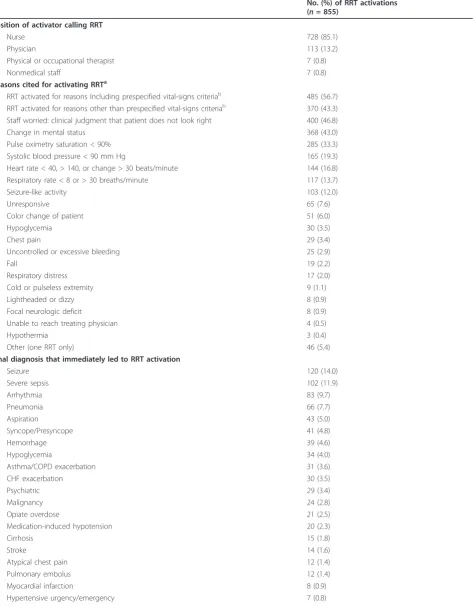
In total, 855 RRTs were activated for 740 inpatients during the postintervention period. Nearly three fourths of all RRTs were activated for inpatients on the medi-cine service (637 activations, 74.5%; Table 2). Nurses activated 728 RRTs (85.1%), followed by physicians (113 activations, 13.2%) and ancillary staff (14 activations, 1.6%) (Table 3). Forty-three percent of RRTs were acti-vated for reasons other than prespecified vital-signs cri-teria. The leading reasons cited for RRT activation were “staff worried: clinical judgment that patient does not look right”(400 activations, 46.8%) and change in men-tal status (368 activations, 43.0%). Ninety-six RRTs (11.2%) were activated for patients with advanced direc-tives specifying do-not-resuscitate (DNR) at the time of activation.
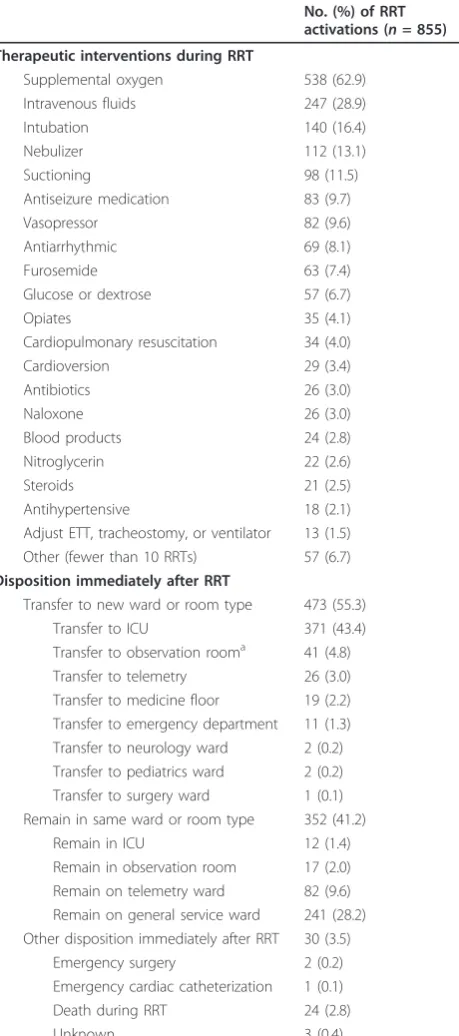
The most common diagnoses that immediately led to RRT activation were seizure (120 activations, 14.0%), severe sepsis (102, 11.9%), arrhythmia (83, 9.7%), pneu-monia (66, 7.7%), aspiration (43, 5.0%), and syncope/pre-syncope (41, 4.8%) (Table 3). The most common documented therapeutic interventions performed during RRTs were airway, respiratory, and cardiovascular sup-port (Table 4). After RRT activation, 473 (55.3%) patients were transferred to a more highly monitored setting, including 371 (43.4%) to the ICU (Table 4). Three hundred fifty-two (41.2%) patients remained in the same room, two (0.2%) underwent emergency sur-gery, and one (0.1%), emergency cardiac catheterization. Twenty-four (2.8%) patients died during the RRT.
Among patients for whom an RRT was activated, 540 (73.0%) survived to discharge, including 36 (4.9%) with an advanced directive specifying DNR at the time of at least one RRT activation. One hundred seventy-seven (23.9%) patients receiving an RRT died before discharge, including 60 (8.1%) patients for whom advanced direc-tives were for full resuscitation at death, and 117 (15.8%) who were DNR at death. Seventy patients who were DNR at death had advanced directives specifying full resuscitation at the time of RRT activation. For 23 (3.1%) patients, their status at discharge was unknown.
Discussion
[image:4.595.60.540.100.264.2]Implementation of the RRT was associated with a signif-icant reduction in hospital-wide mortality. In the 3-year postintervention period, 139 fewer deaths occurred than would be expected from the preintervention mortality rate. Additionally, 132 fewer out-of-ICU codes and 126 fewer out-of-ICU code-related deaths were found after RRT implementation than would be expected from pre-intervention rates.
Table 2 Mortality and cardiopulmonary arrest codes before and after rapid response team implementation
Events before RRTa (n= 77, 021)
Events after RRTa (n= 79, 013)
RRTs activated on hospital serviceb (n= 855)
Relative risk of event (95% CI) P
value
Deaths hospital-wide 1, 194 (15.50) 1, 086 (13.74) – 0.887 (0.817-0.963) 0.004
Deaths by inpatient hospital service
Medicine 462 (16.91) 303 (10.28) 637 (74.5) 0.608 (0.526-0.702) < 0.001
Surgery 66 (5.65) 51 (4.32) 31 (3.6) 0.765 (0.531-1.102) 0.150
Pediatrics 13 (1.37) 8 (0.91) 2 (0.2) 0.664 (0.275-1.602) 0.362
Intensive care 649 (115.40) 722 (124.70) 12 (1.4) 1.081 (0.972-1.201) 0.152
Obstetrics 0 (0.00) 0 (0.00) 2 (0.2) – –
Rehabilitation 2 (1.07) 1 (0.55) 56 (6.5) 0.515 (0.047-5.681) 0.588
Psychiatry 2 (0.14) 1 (0.07) 71 (8.3) 0.476 (0.043-5.255) 0.545
Deaths out-of-ICU 545 (7.08) 364 (4.61) – 0.651 (0.570-0.743) < 0.001
Cardiopulmonary-arrest codes out-of-ICU 253 (3.28) 128 (1.62) – 0.493 (0.399-0.610) < 0.001
CI, confidence interval; RRT, rapid response team.a
Events refer exclusively to deaths or cardiopulmonary-arrest codes, as specified. Values are expressed as
number (events per 1, 000 discharges).b
Attributing the reduction in hospital-wide mortality to the RRT is strongly supported by the concurrent 51% decrease in out-of-ICU cardiopulmonary arrest codes and 35% decrease in out-of-ICU mortality (Table 2). Despite a substantial increase in the case-mix index, which indicated a secular trend toward increasing sever-ity of illness among admitted patients, hospital-wide mortality decreased by 1.76 deaths per 1, 000 discharges. This mortality reduction remained statistically signifi-cant after adjusting for trends over time, and it was dri-ven by a 39% decrease in mortality on the medicine service, where 75% of the RRTs took place. A commen-surate reduction of 1.66 out-of-ICU cardiopulmonary-arrest codes and 1.60 out-of-ICU code-related deaths
per 1, 000 discharges occurred, supporting attribution of the hospital-wide mortality reduction to the prevention of out-of-ICU arrests. The decreases in hospital-wide mortality, out-of-ICU mortality, and out-of-ICU cardio-pulmonary-arrest codes all coincided temporally with introduction of the RRT in 2006 (Figure 1).
Moreover, the reduction in hospital-wide mortality was nearly fully matched by a commensurate decrease in out-of-ICU codes and code-related mortality. The slightly greater reduction in hospital-wide mortality may be accounted for by additional lives saved during RRTs activated for patients with advanced directives specifying DNR. Any improvement in mortality among DNR patients due to the RRT would not be reflected by
0
2
4
6
8
10
12
14
16
18
2003 2004 2005 2006 2007 2008
Deaths Hospital-Wide 14.75 15.99 15.75 13.23 14.37 13.64
Deaths Out-of-ICU
7.20 7.78 6.23 4.51 5.40 3.93
Codes Out-of-ICU
3.40 3.16 3.29 1.87 1.23 1.76
Events per 1,000 Discharges
Deaths Hospital-Wide
Deaths Out-of-ICU
Codes Out-of-ICU
[image:5.595.61.540.86.491.2]Pre-RRT Post-RRT
Table 3 Triggers for rapid response team activation
No. (%) of RRT activations (n= 855)
Position of activator calling RRT
Nurse 728 (85.1)
Physician 113 (13.2)
Physical or occupational therapist 7 (0.8)
Nonmedical staff 7 (0.8)
Reasons cited for activating RRTa
RRT activated for reasons Including prespecified vital-signs criteriab 485 (56.7)
RRT activated for reasons other than prespecified vital-signs criteriab 370 (43.3)
Staff worried: clinical judgment that patient does not look right 400 (46.8)
Change in mental status 368 (43.0)
Pulse oximetry saturation < 90% 285 (33.3)
Systolic blood pressure < 90 mm Hg 165 (19.3)
Heart rate < 40, > 140, or change > 30 beats/minute 144 (16.8)
Respiratory rate < 8 or > 30 breaths/minute 117 (13.7)
Seizure-like activity 103 (12.0)
Unresponsive 65 (7.6)
Color change of patient 51 (6.0)
Hypoglycemia 30 (3.5)
Chest pain 29 (3.4)
Uncontrolled or excessive bleeding 25 (2.9)
Fall 19 (2.2)
Respiratory distress 17 (2.0)
Cold or pulseless extremity 9 (1.1)
Lightheaded or dizzy 8 (0.9)
Focal neurologic deficit 8 (0.9)
Unable to reach treating physician 4 (0.5)
Hypothermia 3 (0.4)
Other (one RRT only) 46 (5.4)
Final diagnosis that immediately led to RRT activation
Seizure 120 (14.0)
Severe sepsis 102 (11.9)
Arrhythmia 83 (9.7)
Pneumonia 66 (7.7)
Aspiration 43 (5.0)
Syncope/Presyncope 41 (4.8)
Hemorrhage 39 (4.6)
Hypoglycemia 34 (4.0)
Asthma/COPD exacerbation 31 (3.6)
CHF exacerbation 30 (3.5)
Psychiatric 29 (3.4)
Malignancy 24 (2.8)
Opiate overdose 21 (2.5)
Medication-induced hypotension 20 (2.3)
Cirrhosis 15 (1.8)
Stroke 14 (1.6)
Atypical chest pain 12 (1.4)
Pulmonary embolus 12 (1.4)
Myocardial infarction 8 (0.9)
changes in code-related deaths, as DNR patients were explicitly excluded from the cardiopulmonary-arrest code response. Alternatively, this difference may be due to confounding influences that the study was not designed to capture.
The descriptive findings of RRT activations further support attribution of the reduction in hospital-wide mortality to the RRT. The most common diagnoses that immediately led to RRT activation–seizure, severe sepsis,
arrhythmia, pneumonia, and aspiration–are high-acuity
conditions that often require ICU-level care. The most common therapeutic interventions performed by the RRT centered on airway, respiratory, and cardiovascular support (Table 4). Furthermore, no other concomitant patient-safety or quality-improvement interventions were introduced during the study period to account for the improved clinical outcomes. Although introducing hospitalists and intensivists previously was shown to reduce inpatient mortality [36-39], no substantial changes in hospital staffing or work hours occurred dur-ing the study period.
Previously, most large studies assessing hospital-wide mortality failed to demonstrate reduced mortality after RRT implementation [23,27,28], as did a recent meta-analysis evaluating hospital-wide mortality of more than 400, 000 patients [29]. Two likely explanations exist for the mortality reduction seen here, but not in most pre-vious RRT studies.
First, this RRT was widely used, with 10.8 activations per 1, 000 hospital-wide discharges and 21.6 activations per 1, 000 medicine service discharges. A comparable hospital-wide activation rate of 9.3 RRT activations per 1, 000 admissions was observed in the only other large study to date to find a significant reduction in postinter-vention hospital-wide mortality [30]. By contrast, two of the three previous largest negative studies reported lower RRT utilization of 2.5 [28] and 8.7 [27] activations per 1, 000 admissions. In the MERIT trial [27], the only large cluster-randomized study to date, just 41% of patients who had RRT-activation criteria present more than 15 minutes before an adverse event actually had an
RRT activated. Yet, a subsequent post hoc analysis of
MERIT [40] demonstrated a significant dose-response
relation between rate of RRT activation and incidence of cardiac arrests and deaths.
Underutilization is commonly reported in other RRT studies and may minimize improvements in clinical out-comes gained with adopting an otherwise effective RRT [26,32,33,40]. Delayed activation similarly has been asso-ciated with increased mortality [34,35,40]. Whereas fail-ure to activate an RRT promptly may reflect insufficient staff awareness, most studies highlight the great lengths taken to promote their system. Thus, failure of prompt activation may instead reflect reluctance by nurses, junior physicians, and allied health professionals to go outside the traditional hierarchic model for referrals of clinical management (that is, junior nurse to senior nurse to junior physician to senior physician), even for acutely decompensating patients who meet criteria for RRT activation [21,41].
In this case, several features of RRT design and hospi-tal culture promoted greater utilization. First, the RRT was run by the medical consult resident, who was already widely recognized by nurses as leader of the car-diopulmonary-arrest code team. Conversely, introduc-tion of a new and unfamiliar staff member, such as a senior attending or intensivist, to lead the team might have introduced a psychological barrier to nurses acti-vating the RRT in borderline cases. Second, as a public teaching institution staffed by house-officer trainees and salaried teaching attending physicians, the hospital had a preexisting culture of shared responsibility for patient care, leading to wide acceptance of the RRT model by the physician and nurse staffs. Third, the training of hospital staff explicitly encouraged heavy use of the RRT with a low threshold for activation and emphasized clin-ical judgment of nurses as a key activation criterion, creating an avenue for nursing empowerment. As a result, nurses took ownership of the RRT, accounting for 85% of all RRT activations and a higher rate of hos-pital-wide utilization than found in most other studies.
[image:7.595.63.544.101.165.2]A second plausible explanation for the reduction in hospital-wide mortality is the emphasis that was placed on clinical judgment as a key criterion for RRT activa-tion during staff training sessions, which may have prompted earlier RRT activations before intractable Table 3 Triggers for rapid response team activation(Continued)
ETT, tracheostomy tube, or ventilator dysfunction 7 (0.8)
Medication-induced mental-status change 7 (0.8)
Dementia 6 (0.7)
Other (fewer than five RRTs) 70 (8.2)
Unknown 14 (1.6)
CHF, congestive heart failure; COPD, chronic obstructive pulmonary disease; ETT, endotracheal tube; RRT, rapid response team.a
Does not add to 100% because
more than one reason could be cited as rationale for RRT activation.b
clinical deterioration. Although most previous studies have included clinical judgment as an activation criter-ion, the RRT in these studies was only infrequently acti-vated for this reason [22-24,26,27,31]. By contrast, 43%
of RRTs in the present study were activated for reasons other than vital-sign derangements. Furthermore, vital signs–and in particular respiratory rate–are often inac-curately measured and recorded [42], which may lead to further underutilization of the RRT. Potential failures to trigger RRT activation through vital-signs criteria may have been circumvented by emphasizing clinical judg-ment, as reflected in the high rate of RRT activation for “staff worried: clinical judgment that patient does not look right.”
Interpretation of these findings shares limitations simi-lar to those of most other RRT studies. Common to any cohort study with historical controls, it is possible that improvements in mortality and code rates were due to differences in the preintervention and postintervention populations rather than to the RRT itself. However, the trend toward increased severity of illness throughout the study period, as measured by the case-mix index, likely would have increased the risk of death during the post-intervention period. Also considered was whether improvements in mortality reflected a secular downward trend that predated the RRT, yet the mortality rate actu-ally trended upward during the 3-year preintervention period, coinciding with the increasing case-mix index. Adjusting for this time trend thus increased the esti-mated postintervention mortality improvement. How-ever, the adjusted results had much wider confidence intervals and therefore provide a less reliable point esti-mate, compared with the unadjusted results, of the decreased mortality after RRT implementation. Regard-less, hospital-wide mortality remained significantly lower after RRT implementation after controlling for underly-ing trends in mortality over time.
Several outcomes measures, including out-of-ICU mortality and cardiopulmonary-arrest codes, could be favorably biased by excluding mortality of patients trans-ferred to the ICU. This study instead focused on hospi-tal-wide mortality, which avoids this bias by counting all deaths regardless of where they occur in the hospital. Still, other unmeasured confounders, which our study was not designed to capture, may have favorably biased the study results. For example, it is possible that the transfer of patients to outside hospice or other long-term care facilities increased during the study period. Yet, no changes to palliative care services occurred throughout the study period, and the improvement in overall mortality was nearly completely accounted for by the decrease in out-of-ICU codes and associated deaths.
[image:8.595.60.290.112.631.2]The low rate of RRT activation and low baseline mor-tality among nonmedical services may limit generaliz-ability of these results to hospitals with a large nonmedical patient composition or differences in ser-vice-specific mortality. Additionally, these findings reflect a single tertiary referral public teaching hospital’s Table 4 Interventions performed by the rapid response
team
No. (%) of RRT activations (n= 855)
Therapeutic interventions during RRT
Supplemental oxygen 538 (62.9)
Intravenous fluids 247 (28.9)
Intubation 140 (16.4)
Nebulizer 112 (13.1)
Suctioning 98 (11.5)
Antiseizure medication 83 (9.7)
Vasopressor 82 (9.6)
Antiarrhythmic 69 (8.1)
Furosemide 63 (7.4)
Glucose or dextrose 57 (6.7)
Opiates 35 (4.1)
Cardiopulmonary resuscitation 34 (4.0)
Cardioversion 29 (3.4)
Antibiotics 26 (3.0)
Naloxone 26 (3.0)
Blood products 24 (2.8)
Nitroglycerin 22 (2.6)
Steroids 21 (2.5)
Antihypertensive 18 (2.1)
Adjust ETT, tracheostomy, or ventilator 13 (1.5) Other (fewer than 10 RRTs) 57 (6.7)
Disposition immediately after RRT
Transfer to new ward or room type 473 (55.3)
Transfer to ICU 371 (43.4)
Transfer to observation rooma 41 (4.8) Transfer to telemetry 26 (3.0) Transfer to medicine floor 19 (2.2) Transfer to emergency department 11 (1.3) Transfer to neurology ward 2 (0.2) Transfer to pediatrics ward 2 (0.2) Transfer to surgery ward 1 (0.1) Remain in same ward or room type 352 (41.2)
Remain in ICU 12 (1.4)
Remain in observation room 17 (2.0) Remain on telemetry ward 82 (9.6) Remain on general service ward 241 (28.2) Other disposition immediately after RRT 30 (3.5)
Emergency surgery 2 (0.2)
Emergency cardiac catheterization 1 (0.1)
Death during RRT 24 (2.8)
Unknown 3 (0.4)
ETT, endotracheal tube; RRT, rapid response team.a
experience and may not be generalizable to nonteaching or lower-acuity hospitals. Finally, difficulty in standardiz-ing clinical judgment as a criterion for RRT activation may limit generalizability across institutions with differ-ent levels of staff experience and out-of-ICU monitoring. It may be precisely this flexibility, to activate an RRT for any reasonable clinical judgment without threat of repu-diation or reprisal, that resulted in high RRT utilization and led to the mortality reduction observed.
Conclusions
To our knowledge, this is the largest study to date to demonstrate as its primary outcome a reduction in hos-pital-wide mortality associated with RRT implementa-tion. An estimated 139 fewer deaths occurred hospital-wide over the 3-year period immediately after adoption of the RRT. In contrast to most other large studies, which have not demonstrated reduced mortality, this RRT was commonly activated for reasons of clinical judgment, in addition to vital-signs criteria, and featured a high rate of RRT activation. Additional studies are needed to confirm the effect of similarly designed and implemented RRTs in hospitals with different staffing models, staff cultures, and patient populations, and to identify the optimal team composition, activation cri-teria, and implementation strategy for RRTs.
Key messages
•Implementation of a rapid response team (RRT) in
which clinical judgment, in addition to vital-signs criteria, was widely cited as a rationale for activation was associated with an 11% decrease in hospital-wide mortality.
• In contrast to those in other published reports,
46.8% of RRTs in this study were activated for rea-sons of clinical judgment. Most previous studies have included clinical judgment as a criterion for activation, but the RRT in these studies was only infrequently activated for this reason.
•The regular use of clinical judgment as a criterion for RRT activation was associated with higher rates of RRT activation than found in other published reports of RRTs.
Additional information
The findings of this study were presented in part at the American Thoracic Society International Conference, May 18, 2010, in New Orleans, Louisiana, USA.
Abbreviations
CHF: congestive heart failure; CI: confidence interval; COPD: chronic obstructive pulmonary disease; DNR: do-not-resuscitate; ETT: endotracheal tube; ICU: intensive care unit; RRT: rapid response team.
Acknowledgements
We thank Ira Bader, PhD (Department of Quality Management, Bellevue Hospital Center, New York, New York, USA) for his assistance in obtaining data from the hospital core patient database. We also thank G Craig Wood, MS (Center for Health Research, Geisinger Clinic, Danville, Pennsylvania, USA) for his assistance in statistical analysis. Neither Dr Bader nor Mr Wood received compensation for their contributions.
Author details
1
Pulmonary and Critical Care Unit, Massachusetts General Hospital, 55 Fruit Street, BUL-148, Boston, Massachusetts 02114, USA.2Department of
Medicine, New York University School of Medicine, 550 First Avenue, NBV 16N1, New York, New York 10016, USA.3Faculty Group Practice, New York
University Langone Medical Center, 1 Park Avenue, 10thFloor, New York,
New York 10016, USA.4Division of Pulmonary, Allergy, and Critical Care
Medicine, Columbia University College of Physicians and Surgeons, 622 West 168thStreet, New York, New York 10032, USA.
Authors’contributions
JRB, NL, DBB, KH, and DHC designed the study. JRB collected the data. JRB and NL completed the data analysis. JRB, NL, DBB, KH, and DHC interpreted the results. JRB drafted the manuscript. JRB, NL, DBB, KH, and DHC critically reviewed the manuscript. JRB and NL completed revisions. All authors read and approved the final manuscript.
Competing interests
The authors declare that they have no competing interests.
Received: 21 March 2011 Revised: 18 October 2011 Accepted: 15 November 2011 Published: 15 November 2011
References
1. Thomas EJ, Studdert DM, Burstin HR, Orav EJ, Zeena T, Williams EJ, Howard KM, Weiler PC, Brennan TA:Incidence and types of adverse events and negligent care in Utah and Colorado.Med Care2000, 38:261-271.
2. Brennan TA, Leape LL, Laird NM, Hebert L, Localio AR, Lawthers AG, Newhouse JP, Weiler PC, Hiatt HH:Incidence of adverse events and negligence in hospitalized patients: results of the Harvard Medical Practice Study I.N Engl J Med1991,324:370-376.
3. Andrews LB, Stocking C, Krizek T, Gottlieb L, Krizek C, Vargish T, Siegler M: An alternative strategy for studying adverse events in medical care. Lancet1997,349:309-313.
4. Soop M, Fryksmark U, Köster M, Haglund B:The incidence of adverse events in Swedish hospitals: a retrospective medical record review study.Int J Qual Health Care2009,21:285-291.
5. Zegers M, de Bruijne MC, Wagner C, Hoonhout LHF, Waaijman R, Smits M, Hout FAG, Zwaan L, Christiaans-Dingelhoff I, Timmermans DRM, Groenewegen PP, van der Wal G:Adverse events and potentially preventable deaths in Dutch hospitals: results of a retrospective patient record review study.Qual Saf Health Care2009,18:297-302.
6. Aranaz-Andrés JM, Aibar-Remón C, Vitaller-Murillo J, Ruiz-López P, Limón-Ramírez R, Terol-García E:Incidence of adverse events related to health care in Spain: results of the Spanish National Study of Adverse Events.J Epidemiol Community Health2008,62:1022-1029.
7. Vincent C, Neale G, Woloshynowych M:Adverse events in British hospitals: preliminary retrospective record review.BMJ2001,322:517-519. 8. Baker GR, Norton PG, Flintoft V, Blais R, Brown A, Cox J, Etchells E, Ghali WA, Hébert P, Majumdar SR, O’Beirne M, Palacios-Derflingher L, Reid RJ, Sheps S, Tamblyn R:The Canadian adverse events study: the incidence of adverse events among hospital patients in Canada.CMAJ2004,170:1678-1686. 9. Wilson RM, Runciman WB, Gibberd RW, Harrison BT, Newby L, Hamilton JD:
The quality in Australian health care study.Med J Aust1995,163:458-471. 10. Schein RM, Hazday N, Pena M, Ruben BH, Sprung CL:Clinical antecedents
to in-hospital cardiopulmonary arrest.Chest1990,98:1388-1392. 11. Hillman KM, Bristow PJ, Chey T, Daffurn K, Jacques T, Norman SL, Bishop GF,
Simmons G:Antecedents to hospital deaths.Intern Med J2001, 31:343-348.
or unplanned admission to intensive care: a pilot study in a tertiary-care hospital.Med J Aust1999,171:22-25.
13. Ehlenbach WJ, Barnato AE, Curtis JR, Kreuter W, Koepsell TD, Deyo RA, Stapleton RD:Epidemiologic study of in-hospital cardiopulmonary resuscitation in the elderly.N Engl J Med2009,361:22-31. 14. Tresch D, Heudebert G, Kutty K, Ohlert J, VanBeek K, Masi A:
Cardiopulmonary resuscitation in elderly patients hospitalized in the 1990s: a favorable outcome.J Am Geriatr Soc1994,42:137-141. 15. Warner SC, Sharma TK:Outcome of cardiopulmonary resuscitation and
predictors of resuscitation status in an urban community teaching hospital.Resuscitation1994,27:13-21.
16. Ebell MH, Becker LA, Barry HC, Hagen M:Survival after in-hospital cardiopulmonary resuscitation: a meta-analysis.J Gen Intern Med1998, 13:805-816.
17. Peberdy MA, Kaye W, Ornato JP, Larkin GL, Nadkarni V, Mancini ME, Berg RA, Nichol G, Lane-Trultt T:Cardiopulmonary resuscitation of adults in the hospital: a report of 14720 cardiac arrests from the National Registry of Cardiopulmonary Resuscitation.Resuscitation2003,58:297-308. 18. Berwick DM, Calkins DR, McCannon CJ, Hackbarth AD:The 100, 000 lives
campaign: setting a goal and a deadline for improving health care quality.JAMA2006,295:324-327.
19. United Kingdom Department of Health:Comprehensive Critical Care: A Review of Adult Critical Care ServicesLondon: UK DH; 2000. 20. Australian Commission on Safety and Quality in Health Care:National
Consensus Statement: Essential Elements for Recognising and Responding to Clinical DeteriorationSydney, Australia: ACS/QHC; 2010.
21. Buist MD, Moore GE, Bernard SA, Waxman BP, Anderson JN, Nguyen TV: Effects of a medical emergency team on reduction of incidence of and mortality from unexpected cardiac arrests in hospital: preliminary study. BMJ2002,324:387-390.
22. Bellomo R, Goldsmith D, Uchino S, Buckmaster J, Hart GK, Opdam H, Silvester W, Doolan L, Gutteridge G:A prospective before-and-after trial of a medical emergency team.Med J Aust2003,179:283-287.
23. Chan PS, Khalid A, Longmore LS, Berg RA, Kosiborod M, Spertus JA: Hospital-wide code rates and mortality before and after implementation of a rapid response team.JAMA2008,300:2506-2513.
24. Sharek PJ, Parast LM, Leong K, Coombs J, Earnest K, Sullivan J, Frankel LR, Roth SJ:Effect of a rapid response team on hospital-wide mortality and code rates outside the ICU in a children’s hospital.JAMA2007, 298:2267-2274.
25. DeVita MA, Braithwaite RS, Mahidhara R, Stuart S, Foraida M, Simmons RL, members of the Medical Emergency Response Improvement Team (MERIT): Use of medical emergency team responses to reduce hospital cardiopulmonary arrests.Qual Saf Health Care2004,13:251-254. 26. Bristow PJ, Hillman KM, Chey T, Daffurn K, Jacques TC, Norman SL,
Bishop GF, Simmons EG:Rates of in-hospital arrests, deaths and intensive care admissions: the effect of a medical emergency team.Med J Aust 2000,173:236-240.
27. Hillman K, Chen J, Cretikos M, Bellomo R, Brown D, Doig G, Finfer S, Flabouris A, MERIT Study Investigators:Introduction of the medical emergency team (MET) system: a cluster-randomised controlled trial. Lancet2005,365:2091-2097.
28. Kenward G, Castle N, Hodgetts T, Shaikh L:Evaluation of a medical emergency team one year after implementation.Resuscitation2004, 61:257-263.
29. Chan PS, Jain R, Nallmothu BK, Berg RA, Sasson C:Rapid response teams: a systematic review and meta-analysis.Arch Intern Med2010,170:18-26. 30. Konrad D, Jäderling G, Bell M, Granath F, Ekbom A, Martling C-R:Reducing
in-hospital cardiac arrests and hospital mortality by introducing a medical emergency team.Intensive Care Med2010,36:100-106. 31. Priestley G, Watson W, Rashidian A, Mozley C, Russell D, Wilson J, Cope J,
Hart D, Kay D, Cowley K, Pateraki J:Introducing Critical Care Outreach: a ward-randomised trial of phased introduction in a general hospital. Intensive Care Med2004,30:1398-1404.
32. Winters BD, Pham JC, Hunt EA, Guallar E, Berenholtz S, Pronovost PJ:Rapid response systems: a systematic review.Crit Care Med2007,35:1238-1243. 33. Foraida MI, DeVita MA, Braithwaite RS, Stuart SA, Brooks MM, Simmons RL:
Improving the utilization of medical crisis teams (Condition C) at an urban tertiary care hospital.J Crit Care2003,18:87-94.
34. Downey AW, Quach JL, Haase M, Haase-Fielitz A, Jones D, Bellomo R: Characteristics and outcomes of patients receiving a medical emergency
team review for acute change in conscious state or arrhythmias.Crit Care Med2008,36:477-481.
35. Quach JL, Downey AW, Haase M, Haase-Fielitz A, Jones D, Bellomo R: Characteristics and outcomes of patients receiving a medical emergency team review for respiratory distress or hypotension.J Crit Care2008, 23:325-331.
36. Winters BD, Pham J, Pronovost PJ:Rapid response teams: walk, don’t run. JAMA2006,296:1645-1647.
37. Auerbach AD, Wachter RM, Katz P, Showstack J, Baron RB, Goldman L: Implementation of a voluntary hospitalist service at a community teaching hospital: improved clinical efficiency and patient outcomes. Ann Intern Med2002,137:859-865.
38. Aiken LH, Clarke SP, Sloane DM, Sochalski J, Silber JH:Hospital nurse staffing and patient mortality, nurse burnout, and job dissatisfaction. JAMA2002,288:1987-1993.
39. Pronovost PJ, Angus DC, Dorman T, Robinson KA, Dremsizov TT, Young TL: Physician staffing patterns and clinical outcomes in critically ill patients: a systematic review.JAMA2002,288:2151-2162.
40. Chen J, Bellomo R, Flabouris A, Hillman K, Finfer S:The relationship between early emergency team calls and serious adverse events.Crit Care Med2009,37:148-153.
41. Buist M, Bellomo R:MET: the medical emergency team or the medical education team?Crit Care Resusc2004,6:88-91.
42. Krieger B, Feinerman D, Zaron A, Bizousky F:Continuous noninvasive monitoring of respiratory rate in critically ill patients.Chest1986, 90:632-634.
doi:10.1186/cc10547
Cite this article as:Beitleret al.:Reduction in hospital-wide mortality after implementation of a rapidresponse team: a long-term cohort
study.Critical Care201115:R269.
Submit your next manuscript to BioMed Central and take full advantage of:
• Convenient online submission
• Thorough peer review
• No space constraints or color figure charges
• Immediate publication on acceptance
• Inclusion in PubMed, CAS, Scopus and Google Scholar
• Research which is freely available for redistribution