Media impact on diplomatic practice: An
evolutionary model of change
Archetti, Cristina
Title
Media impact on diplomatic practice: An evolutionary model of change
Authors
Archetti, Cristina
Type
Conference or Workshop Item
URL
This version is available at: http://usir.salford.ac.uk/12444/
Published Date
2010
USIR is a digital collection of the research output of the University of Salford. Where copyright
permits, full text material held in the repository is made freely available online and can be read,
downloaded and copied for noncommercial private study or research purposes. Please check the
manuscript for any further copyright restrictions.
1
Paper presented at the
American Political Science Association (APSA) Annual Convention
Washington, DC
September 2-5, 2010
Media Impact on Diplomatic Practice:
An Evolutionary Model of Change
Cristina Archetti
Lecturer in Politics and Media
School of English, Sociology,
Politics and Contemporary History (ESPaCH) University of Salford
Crescent House, Salford Manchester,
M5 4WT UK
2
Abstract
Based on a range of interviews with foreign diplomats in London, the paper explains the considerable variation in the way communication technologies both affect diplomatic practices and are appropriated by diplomats to pursue the respective countries‟ information gathering and outreach objectives. The study shows that London, as an information environment, is experienced differently by each of the diplomats and embassy actors. The analysis elaborates an explanatory model of the “communication behaviour” of foreign diplomats in London based on an evolutionary analogy: foreign diplomats in the context of the British capital, within their respective embassy organizations, can each be compared to the members of a species attempting to survive in a natural environment. The nuances highlighted by the model challenge the largely homogeneous and generalized nature of current debates about media and diplomacy, as well as public diplomacy.
Keywords
Theory/Context: Internet/New Technology; Governments/State; News, Journalism Method: Qualitative – Interviewing
Introduction
Communication is essential to diplomacy. It always has been. As Nicolson (1954:2) wrote ‗The origins of diplomacy lie buried in the darkness preceding what we call ―the dawn of history.‖ There came a stage when the anthropoid apes inhabiting one group of caves realised that it might be profitable to reach some understanding with neighbouring groups regarding the limits of their respective hunting territories.‘ Information gathering, reporting, and sharing have been across the centuries the staple diet of diplomats. In ancient Egypt, the Amarna Letters, a collection of cuneiform tablets written in the fourteenth century BC, contain references to Egypt‘s need for intelligence to maintain control of its Asian empire (Jönsson and Hall 2003: 197). The Byzantines also saw information gathering as the purpose of all diplomatic exchanges (ibid.: 197). In more recent times the UN Vienna Convention of Diplomatic Relations (1961) still emphasizes such functions. Besides the immunity of the diplomat‘s person, the document grants protection to the mission‘s communications: ‗The receiving State shall permit and protect free communication on the part of the mission for all official purposes. In communicating with the Government and the other missions and consulates of the sending State, wherever situated, the mission may employ all appropriate means, including diplomatic couriers and messages in code or cipher‘ (Art. 27.1; see also the other commas of Art. 27 and Art. 40.3).
3 The last significant ethnographic study about the impact of the media in international diplomatic negotiation was conducted by Davison (1974) in the early 1970s. By interviewing diplomats and journalists across the US and Western Europe he observed that the media played a crucial role: ‗the press serves as the eyes and ears of diplomacy. Diplomatic reporting and national intelligence services play a significant supporting role, but most of the information reaching governments about developments throughout the world comes from the wire services, newspapers, news magazines, radio, and television. Furthermore, mass media reports come in first; supplementary information via diplomatic or intelligence channels arrives hours, days, or even weeks later. And it is often maintained that much of the information flowing through official channels is originally culled from the press in any case‘ (Davison 1974: 177).
Over forty years later, new communication technologies like the internet, mobile phones, and more recently social media applications, especially social networking platforms like Twitter or Facebook, are regarded by many as drivers of revolutionary changes in our societies. If the speed at which information travels today might not be radically new (Neumann 1996), the ubiquity of information, its digital sharing across platforms, ease of storage, the possibility of communicating at very low if not virtually no-cost with wide audiences across borders are redesigning the scope and patterns of social interactions, as well as of political processes. Communities of interest, as in the case of advocacy networks, form across national borders among individuals who might have never met (Keck and Sikkink 1998). The distinction between domestic and international politics is increasingly blurring. If the transformation of communication has such a deep reaching impact on our lives, what are its effects on diplomacy?
As previously in history, when a revolution was claimed virtually any time a new communication technology made its appearance (Neumann 1996: 111), assertions are being made about the current development of a new kind of diplomacy. Some of the terms used are ‗virtual diplomacy‘ (Smith 2000; Brown and Studemeister 2001, for instance), ‗cyberdiplomacy‘ (Potter 2002), ‗media diplomacy‘ (Karl 1982; Gilboa 1998 and 2002, for example). Grant (2005) talks about a ‗democratization of diplomacy.‘ He particularly refers the increasing influence of non-state actors, the creation of new community of interests, and the growing relevance of freedom of information legislation brought about in the domain of international relations by the Internet. The opportunities offered by social networking media to connect governments to worldwide audiences bypassing the mainstream media also lead to a blurring of the distinction between diplomacy, in its strict sense the negotiation among official actors, and public diplomacy, the communication between governments and foreign publics.1 Melissen (2005), in this respect, talks about a ‗new public diplomacy.‘ Former US Undersecretary for Public Diplomacy Glassman refers to a ‗public diplomacy 2.0‘ (Glassman 2008).
While there seems to be little doubt that some kind of transformation is occurring within diplomatic practices, how can the impact of new technological developments on diplomacy be theorized? How can we conceptualize the transformation of diplomatic practices? How is change produced? Can its extent be assessed and measured? Do different technologies lead to different kinds of change? Which forms do they take? And do they affect all diplomatic actors in the same way?
These are the questions addressed by the paper on the basis of a range of interviews with foreign diplomats in London. Although both limited in scope and exploratory in nature, the study firmly points at diversified patterns of both impact by technologies on diplomatic activities and appropriation of such technologies by diplomats depending on the foreign country considered. It also shows that London, as an information environment, is experienced differently by each of
1 Nicholson (1939: 15-16), for example, defined diplomacy as ‗the management of international
4 the diplomats and embassy actors. The analysis elaborates an explanatory model of the ―communication behaviour‖ of foreign diplomats in London based on an evolutionary analogy: foreign diplomats in the London context, within their respective embassy organizations, can each be compared to the members of a species attempting to survive in a natural environment. The nuances highlighted by the model challenge the largely homogeneous and generalized nature of current debates about media and diplomacy, as well as public diplomacy.
The argument will unfold by first examining the scope and limitations of the literature about the connection between communication, media, and diplomacy. After a brief methodological note, it will move on to the interview findings. They will be illustrated through the evolutionary model and supported be the evidence of numerous interview excerpts. The conclusions show the crucial importance of ethnographic and comparative research if any of the current analysis about media and diplomacy in the 21st century has to have any real-world relevance.
Diplomacy, media, and public diplomacy: The unaddressed problems
Although there is no lack of research on the relationship between media and diplomacy, current literature is not successful in theorizing the change that the development of communication technologies really produces on diplomatic practices. This is surprising, given that most of the literature appears to engage precisely in this endeavour and largely consists in theoretical analyses that often take the form of modelling and conceptual categorization. Such inability in truly explaining change is due to the fact that, as it will be illustrated in a moment, each stream of the debate is one-sided in three respects: it tends to concentrate either on structural explanations or on agency (although mainly as governmental and institutional action rather than individual); it is grounded in the perspective of single countries, mainly the US; and, possibly as a consequence of this last single vintage point, tends to homogenize and generalize. A comprehensive explanation of change, instead, should illuminate both how technological structures constrain and enable practices, but also how at the same time individuals appropriate that technology. It should also be able to explain variation of change across different political, social, and media contexts. These aspects will now be illustrated in turn, starting from a brief discussion of the very notion of change, then moving on to a review of the literature.
What is change? How does change happen? Hölsti (1998) points out that, despite its ‗critical importance,‘ the notion of change in Politics and International Relations ‗remains undertheorized‘ (1). In fact, as he continues, there is ‗not even the beginning of a consensus‘ when it comes to define what change is, how we identify it, let alone how we measure it (2). He raises the questions, for example, of whether change should be conceptualized as a replacement of the old with something new (whatever ―old‖ and ―new‖ are) (7-8), as an addition of complexity to what exists (so that old and new coexists) (8); a new synthesis of the old and new creating something ―higher‖ in a Hegelian sense (8-9); or a transformation of the old (9). While this paper acknowledges that there are different possible ways of understanding change and does not even attempt to resolve the thorny question of which should be the best definition, it is based on a specific ontology of the world that implicitly contains an explanation of how change is socially produced.
5 be shaped by structures. The repetition of the same behaviour would keep on reinforcing those structures, making the possibility of deviation from that course of action (possibly yet another definition of change) increasingly remote. Change, instead, lies in the slight disconnection between agency and structures within the process of their dynamic unfolding over time: structures pose a constraint on individual action, but do not entirely determine it.
In this perspective, and going back to explaining the effects of communication transformations on diplomacy, change cannot be explained only through the impact of technology on social practice—a view which would privilege structural constraints over individual agency and which is called elsewhere technological determinism—but it is also about the appropriation of technological tools by individuals, both as people and institutions. This paper is precisely about explaining the changing proportions—and differing relative outcomes—in the dynamic mixture of agency and structures in the London diplomatic environment.
The analysis aims at filling gaps in the literature, where two main trends can be identified: the first focuses on the impact of communication technologies on diplomacy (privileging technological constraints on political action); the second is about the exploitation of technology, mainly by governmental and institutional actors, to pursue their interests, goals and objectives (therefore emphasizing agency at the expense of structure). They will now be reviewed in turn.
Media impact on diplomacy
Within Political Communication literature, there has been a growing realization that the media have an impact on the practice of diplomacy. This has largely led to theoretical discussions including modelling and categorizations of the different ways in which the media can affect diplomatic activity, either supporting or preventing negotiation (Gilboa 2000; Naveh 2002, for instance). Gilboa (2001), among the most elaborate analyses, distinguishes for instance three models of ‗uses and effects‘ about the way the media are used as a tool of foreign policy and international negotiation: ‗public diplomacy,‘ where state and nonstate actors use the media to influence public opinion abroad; ‗media diplomacy,‘ where officials use the media to communicate with actors and promote conflict resolution; ‗media-broker diplomacy,‘ where journalists serve as temporary mediators in international negotiations. The empirical studies in this area tend to address the way media, especially live TV news, affects foreign policy making (for example Seib 1996; ―CNN effect‖ literature and its critiques: Livingston 1997; Strobel 1997, Robinson 2002) and mostly involve international crises as case studies.
The problem with this literature is not so much the inability to explain some kind of transformation technologies lead to in the political process. The argument here is not that it is not rigorous or does not contribute to our understanding. It does illuminate the complex relationship between media and political processes in the context of instantaneous global communication. It does not, however, explain contingent change: how technology affects diplomatic practices of specific countries in specific political, social, and media environments. Even the literature that attempts defining the conditions of validity of a working hypothesis, for example establishing in which circumstances the CNN effect materializes (or doesn‘t), end up in general statements about the relationship between governments, publics and media. The studies that look at specific case studies tend to examine different crises (time points) within one country only (mainly the US). To what extent do existing analyses apply to other countries? Through which micro-interactions between politicians, journalists, members of the public do the processes described by the CNN effect work (or don‘t)?
6 Exploitation of technology to advance institutional goals
A second strand of research is represented by the ever-growing literature about public diplomacy, whose focus is the analysis of how the use of global communication technologies can contribute to improved communication across borders. This focus has consolidated after 9/11 through the research of a large number of American scholars and is strategically aimed at addressing the ―gulf of misunderstanding‖ that appears to fuel extremism against the West, particularly the US, in some quarters of the Muslim world. The ultimate goal of the debate is identifying ways in which public diplomacy can become more effective. Most analyses are based on extrapolations made on the basis of medium characteristics, as well as sensible assumption about sending and receiving messages. Less attention is given to the complexity of conditions a successful communication strategy needs to deal with. Corman (2009), in this respect, points out that US public diplomacy efforts, which should communicate American values and contribute to winning hearts and minds in the global war against terrorism, are based on the notion that ‗messages‘ are transmitted by an Information Source through a Transmitter (via a Signal) to a Receiver, which will then convey the message to the desired Destination. The implications are that communication occurs only when messages are sent; that successful communication can be achieved by improving the skill of the communicator; by reducing the ‗noise‘ in the system; by carefully planning the content of the message and carefully transmitting it. This model of communication is outdated. As he puts it: it was ‗cutting-edge at the time of Eisenhower‘ (ibid).
Despite the differing levels of sophistication (Entman 2008, for example), this branch of literature tends to neglect the experience of actual diplomats and embassies in foreign countries. The result is that most of this literature is constituted by theoretical and speculative analyses. What is the perspective of the practitioners of diplomacy? Most of the contributions also come from US-based scholars. Given that the US is the most powerful country on Earth, it is not unreasonable to hypothesize that the point of view of smaller and less influential countries—what about Belgium, for example, or an obscure African state?—is going to be extremely different. What is the perspective of other countries? Would the recommendation elaborated for a more effective American public diplomacy also apply to them?
This literature also tends to talk about audiences in general terms: ‗European publics,‘ ‗the Arab world,‘ ‗world audiences.‘ There are huge cultural differences between people living in Iceland and Cyprus (Europe), as there are between citizens of Turkey and Saudi Arabia (the Arab world), and between those who live in the Tirol region of Northern Italy and those living in Sicily, to consider variation within a single country. How can any analysis of the effectiveness of the communication with audiences have any practical relevance if local differences are not taken into consideration?
The study presented in this paper aims to address at least some of these gaps by exploring local specificity and variation through ethnographic interviews. It particularly it addresses: 1) the way communication technologies both constrain and enable the activities of foreign diplomats; 2) how diplomats appropriate communication technologies to pursue their own duties and advance the interests of the governments they represent.
Methodology: The London case
The study is based on 16 interviews conducted with foreign diplomats in London over the period 12 July and 18 August 2010.2 They involved mostly face-to-face conversations (12) but also phone interviews (4). The researcher spoke with 16 sources (4 women, 12 men) from 14 countries: Australia, Brazil, Canada, Denmark, Germany, Egypt, Greece, India, Japan, Malta, Russia, Sweden, Syria, US. Over thirty countries were initially approached for an interview. Their range was designed to cover variation in world geographical location, form of government of the home country, economic resources, level of influence in world affairs, membership of international alliances and organizations, foreign policy agenda, closeness of historical ties to the UK (former colonies, for example), tradition of journalism in the home country (objective vs.
7 commentary-oriented, for example, or press freedom vs. varying degree of state control). The final sample of countries, which was largely shaped by the diplomats‘ availability despite the fact that up to two e-mails and letter reminders were sent, appears to meet these criteria.
The interviews lasted between 21 minutes and just over an hour (61 minutes). Most of the interviews lasted around 40 minutes. The roles of the diplomats ranged from Political Counsellor, First Secretary, Press Officer, to Head of the Press Office, Head of the Information and Culture Department, Deputy High Commissioner, and High Commissioner. The sources had spent between 12 months and 13 years in London and between 14 months and 31 years in the diplomatic service of their respective country, with several of the interviewees having over than 20 years experience. Given the fact that London occupies one of the highest levels in the ranking of assignments within a diplomat‘s career, almost all interviewees had been posted to other foreign capitals and had covered diplomatic assignments before. Their previous postings covered Washington, New York, Ankara, Beirut, Amman, Tripoli, Brussels, Geneva, Madrid, Brasilia, Moscow, Cairo, Dubai, Damascus, Wellington, Hong Kong, Jakarta, Delhi, and countries like Bhutan, Portugal and Bolivia. The most senior interviewee had been posted to six previous locations. The sources were therefore in the position to confidently compare their current activities within the London diplomatic and information environment to their previous experiences in other countries. They were able to comment about the changes they had witnessed in the diplomatic practices of their respective countries since the advent of the internet, mobile phones, and e-mails. Some even remembered the introduction of fax machines and the computer. Most of the interviewees had also covered a variety of diplomatic responsibilities over their career: different portfolios, administrative tasks (like that of translator), involvement as representatives of their countries in UN and WTO negotiations in Geneva, or with EU countries in Brussels. They were thus able to elaborate on the role of communication technologies and the media in the fulfilling of diplomatic functions at different levels and in a variety of contexts.
The questions of the semistructured interviews are available in the Appendix at the end of the paper. They reflect the exploratory nature of the investigation. They covered three main areas, corresponding to three distinct sections: 1) Personal background of the interviewee; 2) Media consumption and media use; 3) Political and information environment.
The sources were assured of their complete anonimity in exchange for greater openness and frankness. This is why all identifiers have been removed from the interview excerpts. The interviewees will be refereed at as ‗sources‘ or ‗diplomats.‘ Only their country of origin will be indicated.
Explaining the relationship between communication technologies and diplomacy
The interviews with foreign diplomats in London suggest that the relationship between communication technologies and diplomacy cannot be explained in general terms. In fact, it is characterized by an extreme level of nuance when it comes to describing the extent to which communication technologies might constrain or enable a diplomat‘s activities in any given posting, the extent to which diplomats take advantage of available technology, and their choice of the most appropriate platforms to achieve the political and administrative goals of the countries they respectively represent. The impact of communication technology on diplomatic practice, in fact, is not an undifferentiated or homogeneous process. To be more precise, it is not only communication technologies ―having an impact,‖ but diplomats adapting to technologies and selectively using them, often creatively, to face the challenges posed by the political, social, and media environment in which they operate.
The impact of communication technology on the life and practice of diplomats
8 news sources he [sic] usually followed. So many sources were mentioned by the first few respondents that the investigator became sceptical of the claims. Therefore, prior to later interviews, he purchased a number of papers at newsstands in order to be able to inquire about specific news items. The claims appear to be valid. In no case did a diplomat prove to be ignorant about the contents of a paper that he [sic] mentioned as a regular source‘ (175n.1).
A first way in which the advances in communication technologies affect the diplomatic routine of today‘s diplomats is offering even greater access to sources of information. Huge volumes of information are easily and cheaply available—and more quickly. A statement by the German interviewee well represents the spectrum of media consulted on a daily basis by foreign diplomats in London:
‗In my particular field I rely mostly on the media and first of all the print media and their online editions. So [in terms of] print media, I get several newspapers every day. I look at The Times, The Independent, The Guardian, The Daily Telegraph, and The Financial Times, so with The Financial Times I am not really reading it. And I look at the online editions. I use several…I am using the BBC website, the news website. I am using BBC radio and TV a lot. Then I am getting a lot of news briefs by e-mail. There is DODS3 [...]- they issue a number of bulletins daily (2) [...] [in terms of weekly publications] we have all the usual stuff. The Spectator, The New Statesman, The Economist and so forth. I use them for background information but I don‘t read everything (4).‘
The sources consulted might change in other embassies, also depending on the portfolio of the interviewee. For example the Syrian source would consult, among the rest, the Jewish Chronicle (http://www.thejc.com/) (1) and the blog Syria Comment (http://www.joshualandis.com/blog/) (6). The Egyptian diplomat would read the Arab newspapers published in London: Asharq al-Awsat4 and Al-Hayat5 (2). The Greek source would also follow ethnic local media like London Greek Radio, Eleftheria6 and Parikiaki (Cypriot weekly newspaper)7 (at the time of the interview at the Greek embassy a TV was on and set on a Greek channel). Several embassies like that of Greece, Japan, India would also routinely monitor tabloids. The Egyptian press office would include, occasionally, also the free press.
Extremely high media consumption, however, is not a simple result of information availability. Diplomats do not consume just any information because it is there. They need reliable and accurate information. The media environment in London, they find, is characterized by high quality sources. This is the outcome of a strong tradition of objective journalism. The Russian diplomat, for example, said that the British press ‗is not only very open and encompassing all the sides of the social life in the United Kingdom, but also is very astute and, capable of digging for the information‘ (1), ‗The tradition of journalism here is very strong. Sometimes it is biased but in a very obvious way and so you can easily sort it out‘ (6). This situation is very different from what was experienced by the same source in one of his previous postings: ‗In Ethiopia you had to take most of the material with a great pinch of salt, understanding that this [information] is poor government propaganda mainly, or a very cheap opposition assault on the government and nothing in the middle, usually. So well-thought-through, balanced analysis for assessment was very rare there‘ (5).
The development of communication technologies over time, as all interviewees confirm, appears to have changed diplomatic activities and routines. The experience of the Egyptian
3
DODS (http://www.dods.co.uk/) is a public affairs and political communication company that provides, among the rest, information about the debates taking place in the British House of Parliament. The company was mentioned by several of the interviewees.
4
http://www.aawsat.com/english/
5
http://international.daralhayat.com/
6
http://www.eleftheria.co.uk/
7
9 source is presented here as an example of the range of transformations. The diplomat, for example, talks about the greater ease in communicating with large numbers of interlocutors than in the past: ‗if I get something that I want to distribute to everybody else, what do I do? I just put it [...] in an email and we distribute it. By a touch of a button you can send it to 160 people; or 200 people. Before... I mean our ancestors used to use the pigeons. Remember? Later on we have the postal service and [now] we have the internet‘ (6). It is also easier to communicate with the broader public : ‗we [at the embassy] do not have the capacities of producing short films...but for example if I go on air we sort of put it on YouTube. If I go on Sky, BBC you put it on YouTube, and we create a link so now it is much, much easier [to communicate with the public]. If we want to go and speak to the broader public we send it over there‘ (10-11).
As the source points out, the interaction with a greater number of contacts also has its downsides: ‗it [development of new technologies] puts pressure on us. I told you the workload has increased. It‘s a known thing. You have, instead of getting two questions [...] one question a day, you have, 125 letters.‘ However, overall, the duties of the diplomats have become more manageable, increasing their efficiency: ‗before [in the past] you used to get a letter. You would be fundamentally lazy to reply to that letter. Okay? It happens. You‘re lazy. You don‘t want to write a letter. You need to do sixty letters but then, oh God, I‘ll do two. Now with the internet, tch, tch, tch, and that‘s it; that‘s all you need to do, literally. So the intake [of work] is way higher than it was before‘ (9).
The global availability of media cross borders also affects the kind of information that diplomats report back to their home governments. As the basic facts among current developments in the host country (at least in the UK) are largely available back home through TV reporting or the internet, diplomats can concentrate on their analyst function and managerial as well as networking activities. The Syrian diplomat, for example, comments:
‗A cultural diplomacy needs a cultural attaché who is on top of everything, organising, coordinating, conveying messages. The way you do that, technology will help you out. The technology will make your job easier because sometimes you don‘t need to send everything because they [Foreign Ministry] are already informed, not via me, via the usual chain of information technology so the job remains the same but it will, you know, be quicker, more efficient. This is it. You have more access to sources. I mean, when I read something in the British press I can quickly see if it‘s making the debate in the States. I can go onto the Washington Post or New York Times to see if they are talking about it, you know‘ (8-9)
A similar view was shared by a Maltese source:
‗I don‘t need to say what‘s happening in the UK and I don‘t send a report anymore. [...] In Malta they know exactly what‘s happening and they can see it on TV live or on the internet. So why would we waste our time doing a summary of what‘s happening in the UK? Until 10 years ago when I was at the Ministry actually we were obliged every day to send a page. Nowadays it‘s considered [...] a waste of time because they [Foreign Ministry] can get the information, so that has changed greatly.‘ (10)
10 ‗Because if you are working in a bureaucracy, like a foreign ministry, it‘s not so much important what is really going on. It‘s important what your superiors have read. You have to respond to their perception of what is happening, not to what is really happening. I mean if they are convinced there is a war going on between Denmark and Britain and I know quite well there is no war going on it‘s no good saying, no, there is no war going on. I have to say yes, that is a terrible thing, and we have to do the utmost to reconcile the two countries. If everybody is convinced the war is going on I can‘t come up and say, no it‘s not going on, because, you know, we have to react to the information that lands with the perception of our government, of our superiors, and not to the world as we personally may perceive it, as a specialist. So forget about specialist thinking. You have to react to the world that is created by the media and the world in which our politicians live; not the real world, ha. That‘s if it exists‘ (8-9).
This trend, which the source had been able to witness over more than 20 years of diplomatic service, ‗has become worse, yes. The virtual world created by the media [...] is making a bigger impact than before‘ (9).
Another challenge of our 24/7 media saturated society is for the diplomat being able to navigate the ever-increasing volume of available information and select what is important. As the Greek source put it:
‗the number one issues of today, the huge volume of information that you need to control […] when you have five articles [news stories] about the same thing you need to choose. You need to see what is the most important and to react on that, you know; not to read everything because it‘s impossible.
This bunchI showed you [28 pages of article clippings for that day]…it was…well there‘s more. I mean during the [reporting of the Greek financial crisis] we had, the financial crisis in the last six months, it was like three or four bunches every day. It was impossible to read all of it. We just tried to homogenize or put some articles together and say, ―This article says this and the same thing is written also in that, that and that article‖… it was very tough‘ (13)
To this we can add an increasing diversity of the issues diplomats need to deal with. According to the Japanese diplomat this is explained by the fact that advances in technologies, not only communication but also transportation technologies, facilitate the direct contact between leaders. Better contact and communication means a decreased risk of misunderstanding and misperception (in the past communication with Russia or China was ‗cumbersome and time consuming‘). Now communication is ‗less and less difficult.‘ However, ‗leaders are very busy‘ and the time they allocate to diplomacy is quite limited. The daily work of the diplomats that constitutes the background to high-level summits is therefore very important. ‗Any aspect of domestic policy can now be on the negotiating table.‘ So the daily work of the diplomat is now ‗more diverse, heavier and important.‘
The use of communication technologies by diplomats
Having said that, all interviewees did not regard these challenges as real problems in the sense that they posed unsurmountable obstacles to the fulfilling of their diplomatic functions. Even the German source who had mentioned the increasing extent to which diplomats need to respond to a reality manufactured by the media, when confronted with the question of whether this made the job more difficult, replied that it did not. The diplomat had to ‗fight on both fronts [what really happens in negotiations and what is reported by the media].‘ As the source continued: ‗Yeah, there is a world created by the media and sometimes you‘re an insider in a particular field, you see that there is also another world. So, one is just changing focus‘ (10).
11 comes up and adds value, I‘ll use it,‘ ‗At the end your briefing is to produce a report. How you do it is your business.‘ As the conversations with the other interviewees reveal, apart from the obvious use of the internet and e-mail, most of them use gadgets like Blackberries, iPhones and—one of the sources was planning to buy one soon—iPads to navigate the information tide and manage their contacts. The Syrian diplomat, for example, said that he accesses his Twitter and Facebook accounts, as well as emails via his iPhone (10) (‗I check it every minute‘, 2). Also the Indian source commented that Twitter ‗is always on‘ to check ‗things as they happen.‘
The increasing speed introduced by news technologies in the diplomatic tempo is also an advantage in communicating with officials back home and in making diplomacy ‗more capable.‘ This can be illustrated through an exchange with the Russian diplomat:
‗Q: You have been in diplomacy for a long time. You‟ve seen for example, the arrival of the internet, the development of mobile phones [...]. What difference do you think they make to your activity?
These things help tremendously. It requires a diplomat to react and respond to events far more quickly, quicker, than we used to do before. It helps us to streamline the communication between the Embassy and the home base in order to seek instructions to do this or that. Sometimes instructions would come directly via text on the mobile phone, even though we prefer a more classical way of communicating, er, instructions, through telegrams, ciphered telegrams, and secret cables. But sometimes, if the matter is open, why not. You can directly communicate to your Foreign Minister or Deputy Foreign Minister in charge of the United Kingdom and get instructions from him. And, to put it shortly, everything has been accelerated since the introduction of the internet and the reaction required also needs to be very prompt.
Q: Some say that because of this speed sometimes diplomats don‟t have enough time to think. Would you agree?
Well some say, necessity sharpens the mind and in many cases this is true. But I could agree partly to what you‘re saying. I think being overwhelmed with the flood of events and the sequence of events, sometimes a diplomat has very little time to think through and think ahead, ... mainly react than dictate the course of the events, and that is one of the challenges of our time. And that‘s why it is very important that we have, not only very speedy means of gathering information but also speedy means of delivering your analysis to your superiors, to the home base, for them to have at least some leeway of time to think it through and confirm your instructions.
Q: So where do you think diplomacy is going in the future?
Well I think diplomacy will remain as important as ever, especially the personal contacts would be the key element of diplomatic activities, because nothing can substitute the personal rapport between the two presidents, for example, or the foreign ministers. Sometimes, erm, a smile of a president can go a long way and vice versa. Frowned eyebrows can, well, sign a death sentence to, er, some initiative. So it is going to be very important but at the same time the more effective the information gathering is the more capable diplomacy is becoming‘ (4)
Also according to the Syrian diplomat the world is becoming ‗smaller.‘ While the diplomat needs to act more quickly, s/he has ‗the tools‘:
12 know what‘s going on, to establish an opinion just in case you‘re asked. Because we are living in a small world and if you ask me what‘s the change, the world is getting smaller; smaller and smaller [...] so as a diplomat you have to be well informed and [act] quickly. So traditionally you have to be well informed. What has changed is ―quickly,‖ and you have the tools.‘ (8)
Even the Greek source who had mentioned the Press Office of the embassy being in a ‗tough‘ situation to cope with the amount of coverage of the Greek financial crisis disagrees that the high volume of reporting represents a problem. If media are becoming more important in society, then their management becomes more important for the embassies, which simply need to work at it systematically:
‗The role of the diplomat now is not what we had in mind some years ago, and it‘s good for the diplomats to do everything. I mean they should, go on a rotational basis from various sections of the embassy: the political section, the financial section. The press office is very important […] because if you do something very important and you don‘t present it to the media it‘s lost. If you do something that doesn‘t work and you present it very well to the media it‘s, you know, getting the whole attention. It‘s very important the image you create. It‘s very important and it‘s something that you cannot do it from one day to another; you need time, you need persistence, you need strategy. It‘s not something very simple, it is very important.‘ (14)
Against those who predict the disappearance of diplomats (Ross 2009) on the ground that they become redundant in a world where all information is instantly accessible across borders, the sheer volume of information available makes them even more needed: their added value consists in interpreting the information, in knowing where to look for clues and understanding what it means. As the US diplomat succinctly puts it: ‗The vast amount of information both current and historical won‘t analyze itself.‘
While the interviews confirm that, in explaining what difference communication technologies make to diplomatic practice, no generalization can be made, and despite the extreme nuance and differentiation, it is still possible to discern patterns. They are illustrated in the next section within an explanatory model based on an evolutionary analogy.
An evolutionary analogy: Survival strategies in an information environment
The explanatory model presented here is inspired by Ronald Deibert‘s (1997, Chapter 1) notion of Ecological Holism. In Parchment, Printing, and Hypermedia: Communication in World Order Transformation Deibert sets off to explain the changes that communication technologies have produced in Western societies over history—as the title suggest, from the ancient time when the Romans started writing on parchment, to today‘s age of the information superhighway. More specifically, he uses a modified version of Medium Theory8 and a Darwinist analogy to describe ‗the processes by which marginal forces on the borders of society are brought into the center by the unintended consequences of technological innovation‘ (30). He explains, for example, how in XVI century Europe the Protestant Reformation raised from being a marginal to a mainstream religious movement. According to him, all social forces, like animal species, live within an environment and changes in this environment, as in Darwin‘s thought, affects their chances of survival. The mechanism explaining why certain social forces or ideas either flourish or perish is a ‗―fitness‖ or match with the new communications environment‘ (31, my emphasis). The fitness consists in the ‗interests, goals, and logic of organization‘ (32) of a social force being met by a technology within the existing repertoire of communication modes available. The success of the
8
13 previously mentioned Protestant Reformation movement over the Roman Catholic Church can be explained through the appearance of the printing press in the XIV century communications environment. The new technology happened to match the needs of grassroot religious heretical groups who rejected the authority of the Catholic roman Church. The printing press enabled them to publicize their believes through religious texts in vernacular, which could be produced faster and in greater numbers than handwritten manuscripts. These groups had therefore the opportunity to thrive at the expense of other groups, like bishops and monks—who, instead, communicated in Latin and had established their power on the monopoly of the written word— whose needs were not served as well by the new technology.
While the model presented in this paper borrows the idea of social actors—in this case foreign diplomats—operating within an environment in which, like natural species, they compete to survive, my explanation also takes considerable distance from Deibert‘s. The model presented here rejects the idea that a technological innovation simply ―appears‖ in an information environment and that the match between a technology and the needs of a social group is accidental. While it is true that some consequences of technological innovation might have ‗unforeseen effects‘ (29), the interviews confirm that diplomats do not either thrive or perish at the hand of technological innovation alone. On the contrary, they show considerable entrepreneurship in the way they adapt to changing conditions and manage to ―survive‖ despite unfavourable circumstances. This aspect will be illustrated in detail and through concrete examples. In fact, although Deibert aims to overcome the monocausal reductionism of Medium Theory—the idea that technological structures rigidly determine ideas and behaviours (26-31)— his stance it is still too much oriented towards the prevalence of structures. In my model agency and structural components, being mutually constitutive, are more balanced.
The environment in which the struggle for survival of the diplomats takes place is also different from both a natural environment and Deibert‘s communication environment. The environment is not just one but multidimensional. An extremely interesting finding emerging from the interviews is that the very environment in which the foreign diplomats operate—London, which should be the same for all—is, instead, perceived and ―lived‖ entirely differently by each of them.
For example some diplomats comment about the ‗sheer vibrancy‘ of the London environment, which has no equal in the rest of the world‘s capitals (Indian source). For the Egyptian diplomat London is the ‗world‘s epicentre‘ (2), ‗the media hub of the world‘ because ‗it‘s very international.‘ The source particularly praises the balance in journalistic reports. As he puts it, in Britain a media outlet can‘t get away with a ‗character assassination‘ because it would loose credibility with its readers (12). This adds to a ‗high sense of public awareness,‘ actually the ‗highest public awareness‘ the source has encountered than in any other country (12-14). This positive assessment is not entirely surprising, given that it appears to favour coverage of the debate about the Middle East, a key policy issue for the Egyptian embassy, whose different voices can be represented in the media. In this respect, the Egyptian source regards British coverage ‗slightly less‘ unbalanced than in the US.
The Japanese source underlines the number of media sources (‗I wish they could decrease those numbers [of media sources]!‘) and the international outlook of the press, as exemplified by the Economist magazine: ‗In the Times magazine you would not expect that wide attention.‘ This is for the source so ‗stimulating and enlightening‘ that being posted in London can be compared to ‗Enjoying your view from the upper deck of a double decker.‘ The Swedish source also several times praises the ‗extraordinary journalists..., very interesting people and sources of knowledge‘ (10) a diplomat has the opportunity to meet in London.
14 example the Brazilian diplomat observes a limited interest by British media in the foreign world—a stark contrast with news in Brazil:
‗the media in the UK is very inward looking. I think for instance the Guardian has some exceptional material on things that happened inside this country; exceptional coverage. But it engages in the same kind of odd behaviour, let‘s say, [...] when we‘re talking about other countries. And I don‘t have to go very far. I have never read something about Mr. Silvio Berlusconi [Italy‘s Prime Minister], for example, who is a partner and a leader at the same level as the Prime Minister here, I have never read something about him that did not try to downgrade him as a comic figure [...] I don‘t see how the British can have any impression of Italy beyond the wines, the sun, Tuscany and whatever...But the politics... and nothing good comes in terms of Italy or even other countries. So the media is terribly biased, terribly... to read only these, the papers here, would be, you know, it‘s...You don‘t give a good view of what‘s going on in the world. It‘s important, if you want to know about France you have to read French newspapers; if you want to know about Italy you have to read Italian newspapers and you have to go on and on and on looking for whatever it is because if you stay just with what you get here you have a very distorted vision of the rest of the world. And I think that‘s one of the reasons why its [British] foreign policy making becomes a little difficult, and that‘s it. Because if I contrast it with the news in Brazil it is quite extensive. It covers a lot of things that have apparently no relevance to us. You know, ‗Oh, the small village in China where they have a drought,‘ and then you read about it and you see in the news... So I think the coverage in terms of how it treats the world is less biased and more encompassing than it is here. And I‘m sure these articles have a consequence for the public and foreign policy here.‘
The German source also shares the assessment that the focus of British media is mainly domestic:
‗I think it‘s the same all over Europe. I mean you find the same phenomenon. I mean Britain is very much centred on itself, like other European countries. The proportion of reporting on domestic events is enormous compared to international coverage.
I mean there is, in the British media there is almost, it‘s very limited interest in global news. I mean I‘m glad I don‘t have to rely on British media for covering international affairs because, ha, if you follow BBC News they have three of four news items. If you don‘t have stations like Al-Jazeera you would probably be ignorant of what is going on in the world. I mean it‘s an island which is only interested in itself, ha, but that is not very much different in other European countries; they are normally not interested in the outside world.
Whereas if you are in a country in Africa or Asia the focus is much more international news. You get much better information from the local media in Egypt about what is going on in the world than you get here. On the other hand in Egypt you don‘t get much out of the media for what is really going on in Egypt, but it‘s easy for them to report about the elections in Paraguay, about a political scandal in (s.l. 0.19.30) Mauritius and so on. That‘s, that‘s... And it is being reported. Whereas here in England, unless you make a real effort, you don‘t get much international news.
I mean if you subscribe to a cable network, BT or Sky, the number of non-English media is ridiculous. At least in Germany you get Turkish, French, Spanish, Italian channels. Here if you subscribe to any cable TV you will probably end up with a lot of completely useless British film channels and you don‘t get any Arab, Turkish, German, French, Chinese, Japanese channels at all. You need a satellite to really get information about things outside Britain. The BBC has no international coverage at all. It‘s just very much focussed on the UK. But that is not affecting my work if I am dealing with British domestic politics‘ (6)
15 diplomatic actor. It could be said that that environment is indeed different, as if each diplomatic actor inhabited a parallel dimension even if operating in the same physical space. This is because the geometry of the environment is shaped by media access, availability of social contacts, and structure of political opportunities. The features of the environment for each actor, in other words, are defined by multiple networks. Given the importance of the communication and information gathering function of diplomats, here I am particularly concentrating on the information dimension. I will call the networks of contacts spanning both the offline and online dimensions across which information is accessed, gathered, processed, and distributed in official, media, and public domain the ―information environment.‖
The scope of the information environment for each diplomatic actor can vary considerably, being shaped by the objectives and interests of the diplomats and embassies. For example, Egypt‘s interests involve not only Egyptian politics but also the wider Middle East and, partly as consequence of this, US foreign policy including the conflicts in Afghanistan and Iraq (sources from Egyptian embassy). Greece, instead, focuses more on the Mediterranean area. Apart from pressing economic issues at home, the attention is directed at Cyprus, Turkey, the broad community of Greek expatriates in London and a fundamental source of revenue for the Greek economy—tourism. These interests are reflected in the embassies‘ respective press monitoring and information gathering. Comparing the ―press clippings‖9 produced by the Egyptian and Greek embassies it is really possible to grasp the notion of living in parallel worlds while always being based in London. The Egyptian clippings dated 21st July contain: in the section ―Egypt‖ a Financial Times piece about the killing of a young man by a policeman in Alexandria (―Youth‘s killing shocks Egyptians‖, FT.com); in the section ―British PM visit to USA‖ several articles about British PM Cameron‘s statements about UK forces leaving Afghanistan (from The Telegraph, Guardian, The Independent) as well as about the UK-US controversy over the release of the Lockerbie bomber Abdelbaset al-Megrahi (The Independent, The Guardian); in the section ―UK‖ a piece about former MI5 former chief expressing the view in the Chilcot enquiry that the Iraq war ‗created terrorist threat and radicalised young British Muslims‘ (―Why did all these sceptical officials go along with the Iraqi invasion?‖, The Guardian); comment articles about the conflict in Afghanistan in the omonymous section (The Telegraph, The Independent, The Guardian); the article ‗Deplorable and reprehensible‘ UN boss savaged by outgoing aide‖ (The Independent) in the UN section; the announcement of fresh sanctions against North Korea in the US section. Although produced two days earlier, 19th July, the Greek clippings present a completely different focus—one could say, beyond the simple issue of timing, a completely different view of the world. Although the range of newspapers for that clippings‘ issue10 is almost identical to that of the Egyptian one, here the attention is on Greek economic consolidation and European financial news (for example it is possible to notice articles like ―Greece makes ‗strong start‘ on reforms‖ FT.com; ―IMF pulls out of Hungary loan talks‖, The Wall Street Journal; ―Stress-testing Europe‘s banks won‘t stave off a deflationary vortex,‖ The Telegraph). Another main focus is tourism. The articles cover: the collapse of the holiday company Goldtrail (several stories); ―Turkey‘s tourist resort threatened with terrorist campaign‖ from The Telegraph; small cut outs from a ―Travel Special‖ of News of the World (the Sunday edition of the tabloid the Sun) about Turkey (―Turk a look‖) and the Greek Islands (―Get on the right Rhodes with Greek island break‖).
9 The ―press clippings‖ refer here to the summary of daily news produced by the embassies‘ press
offices. The sources called them ‗clippings‘ because that is what they traditionally used to be: clippings from the daily newspapers hard copies. The ―clippings‖ accessed by this study were printouts of electronic files containing news stories mostly copied and pasted from websites (mainly newspapers available online).
10
16 The ―struggle for survival‖ of the diplomats consists in their attempt to carry out their functions of representation, information gathering, and reporting back to their respective countries in the most effective manner. These objectives do not necessarily lead to competition with one another. Diplomats and embassies, however, do compete for visibility and for the attention of the local (British) media, officials, and members of the public. The London environment, in this respect, appears to present unique features in comparison to other diplomatic postings that encourage this competition. As it was put by more than one source, there is simply ‗a lot going on‘ (Brazil, Sweden). There are so many events and such a great selection of them that it is difficult to cultivate friendships and contacts by attending events. Because London is an important hub, embassies tend to be allocated more resources and staff. This makes it unlikely to meet the same people at official events. In addition to this, as English is the lingua franca, the community is not as closely knit as when the language is a barrier (as it could be in Moscow, in the example provided by the Brazilian diplomat) or in a crisis- or war-torn area. The Maltese source also adds that most of the diplomats live outside the centre of London, so receptions tend to finish early to allow the commuting. This limits the contacts at receptions in comparison to, for example, the Madrid environment.
In cases in which the environment changes, as it might happen with the introduction of a new technology, the species (diplomats and embassies) have to adapt their behaviour in order to survive (i.e. keep on carrying out their functions effectively). If a country‘s society becomes media saturated and dominated by a 24/7 news cycle, diplomats‘ and embassies‘ competition for attention from the public in that context might become even more intense. They might feel that they need to pursue new strategies than, for example, merely issuing press releases in order to reach out to the local national public. This process of adaptation presents both constraints and elements of both innovation and flexibility. The range of actions available to some countries in order to carry out their functions in conditions that have turned unfavourable might be broader than those of others because of structural reasons: their position within the international system—the media and the public will always be interested in the US or China because of their status of world powers—or their economic resources. One can think, for example, about how the resources embedded within the networks available to the diplomats a world superpower like the US appear in comparison to those at the disposal of the representatives of a small country like Malta.
Embassies and diplomats who find themselves operating in constrained conditions, like limited financial resources, can still, however, use their options creatively. In fact, they implement very different solutions to their communication needs by selecting among the available technological platforms. Among the embassies who do not gain satisfactory attention in mainstream media some can decide, for example, to use a Facebook page to reach out to an online audience. Others, instead, might use face-to-face networking to communicate with British stakeholders. New communication technologies, in this respect, can open up new ways of compensating structural and financial limitations, although they do not come free from costs, as the examples in the following section will show.
An evolutionary model
17
Australia
Canada
India
Russia
Japan
Egypt
Syria
Greece
Germany
Brazil
Denmark Sweden
Malta US
Level of political interest towards a
foreign country in the UK
Extent of the development of alternative communication channels to mainstream media
[image:18.595.68.558.67.441.2]for communication and outreach
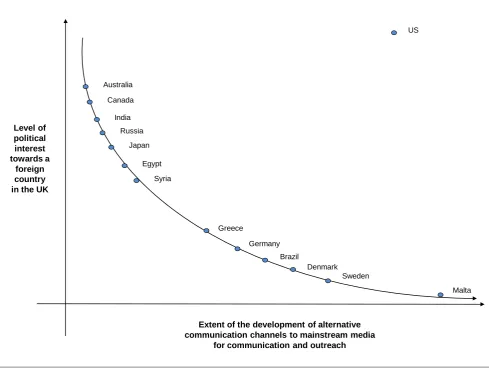
Figure 1. The position of diplomatic actors in the London information environment.
The variation of the extent to which the activities of diplomats from various countries are affected by communication technologies and the extent to which they appropriate communication tools to pursue their own interests define the position of each diplomatic actor within the London information space. Two interrelated dimensions appear to explain each actor‘s position. My argument is that the first dimension, the level of political interest in the UK towards foreign countries (in turn shaped by a range of factors which will be illustrated in detail in the following section), affects the second dimension, the extent to which the diplomats and embassies of those countries develop alternative communication channels to mainstream media for their communication and outreach purposes.
Level of political interest towards a foreign country in the UK
18 The position of the countries in the chart is based on the evidence gathered through the interviews. For example Canada is placed higher than Russia, which in turn is above Japan, because statements made during the interviews emphasized both a greater possibility for the diplomats of the former countries to access high level government officials and a greater relevance of information-gathering through personal contacts than, for instance, through the media than during the interview with the Japanese counterpart. The Canadian source, for example, stated: ‗We speak to Members of Parliament, Members of the House of Lords. We talk to Ministers and Junior Ministers and their staff in authority. I think that‘s how we would sort of get first-hand knowledge and experience [about the political situation]‘ (1). The Russian source stated that the task for any diplomat is ‗to use intellect and tact in maintaining official relations between independent states and our primary source of information is of course official sources‘ (1). The mass media was presented by that source as an additional source helping making sense of the domestic political situation. The Japanese diplomat, instead, although always mentioning official sources, remarked that ‗we are all eyes and ears‘ and that ‗most information, more than 90%, is in the public domain.‘ The highest position of the US along the vertical axis is explained by the exceptional extent of its diplomats‘ access to the host government officials: the US diplomat emphasized the importance of personal contacts in the Home Office, FCO and the Cabinet Office. According to the source ‗being close allies does mean that we talk about almost everything.‘
This does not intend to suggest that the Japanese diplomats do not have high level access to officials or that they have ―less‖ access. The researcher is aware that the different mention of high level official contacts in different interviews might be related, beyond the actual reality of it, to several possible reasons. They could include simple omission or the attempt to emphasize access to positively promote the image of a country; different levels of resources allocated to media monitoring within the embassies‘ Press Offices (as in the case of Malta, if the Press Office is not developed most of the information gathering is done through face-to-face contacts); the fact that a diplomatic role does not lead the interviewee to meet official interlocutors (a press officer, for example, would tend to meet more journalists than government authorities), the issue at hand (a Political Counsellor will most likely meet high-level officials more frequently than somebody from the embassy‘s Cultural Department). The ranking of the embassies in the chart, however, does appear to largely reflect the level of closeness that UK foreign policy currently presents towards the respective countries (Carter 2005, 14).
Egypt and Syria were placed higher than Germany or Greece despite the fact that the latter are members of the EU. Again, this does not mean that Germany or Greece do not receive any high-level attention. Egypt and Syria, however, tend comparatively to attract more attention because of their involvement in the debate surrounding Middle Eastern issues, especially the Israelo-Palestinian conflict and, particularly in the post 9/11 context, concerns about political and religious extremism. The point here is that, although the relative position of the countries might vary, the chart wants to reflect the fact that some of the countries whose diplomats were interviewed tend to receive greater official attention and better access to high level officials than others. This is also reflected by a greater newsworthiness, volume of media coverage, and consequently visibility in the mainstream media.
It is not surprising that Australia, Canada, India, do tend to receive extensive coverage because of their membership of the Commonwealth, their historical ties to the UK and status of former colonies. Beyond these reasons the US receives even greater attention because of its ―special relationship‖ with the UK and its superpower status. Attention towards the US is so ―natural‖ and almost taken for granted that the US diplomat would start the daily routine by checking the New York Times and the Washington Post to see ‗what the matters are in Washington‘ before reading the British press.
19 Despite the availability of information across borders, in fact, English journalists cannot read Greek. The few stories that filter from Greece into British media are those picked up by British journalists in Greece (14).
Among the countries that tend to receive less coverage are Germany, Sweden or Denmark. Sweden offers a very good example of a small country that experiences difficulties in attracting the attention of the mainstream media unless officials of the calibre of the country‘s PM are involved:
‗We‘ve tried to do it [organizing press conferences] a few times when we have had visiting ministers, from Sweden and we thought there might be an interest on some issues, but it is a bit difficult because [...] some journalists say, oh they‘re interested but then they don‘t show up or very few come in the end. And, you know, there‘s too much going on in London and journalism is too fast. So, you know, people may pop up for a press conference or they may not. But, I think, experience has shown that the very few occasions where they‘re interested, [...] the Prime Minister, yes, then, you know, then journalists want to talk to him but there are quite few visits that we have [in that respect] [...] [that] would generate such a big interest from the media‘ (3).
But there are other structural reasons why these countries might get less access to officials. The German source talks about an increase, over the past thirty years of a ceremonial role of European embassies at the expense of their traditional hardcore and ―messenger‖ role. This is due to both the consolidation of the EU, particularly the fact that political leaders tend to meet regularly within its institutional structures and bodies, and the technical possibility of communicating directly:
‗if Germany has a problem with Paraguay, the foreign ministry would probably ask our ambassador in Ascension to see the foreign minister or to see the president or prime minister or whatever of that country and to deliver a strong message or to sit with him and to explain our position and to find a solution. If we, if the German government had, would have a problem with the UK government, what would happen is the head of the Chancellor‘s office would call the head of Downing Street, Number 10, and would say, look, Angela [Merkel] has to talk to David [Cameron]. Could we fix a phone call for two o‘clock in the afternoon? And the embassy would perhaps not be even aware of it. No? Within partners like Germany and the UK a lot of business is being conducted directly between the governments themselves, between capitals, not using the embassy as a messenger or as a player, and apart from that, of course 30 years ago people didn‘t meet so much, didn‘t phone directly so much to... because of the lack of technology. Now air travel has become more intense; telephone, SMS, computer more intense; language capabilities are more readily available.
Plus you have [...] the EU in Brussels where leaders, politicians meet regularly, so... and I mean leaders between major partners or between EU partners. So the role of the ambassador and of the Embassy has very much diminished over the past 30 years in these countries.‘ (12)
According to the source, a possible explanation for the increase in outreach activity, especially in the form of public diplomacy through various communication platforms, is the attempt by European embassies in London at balancing the loss of representative functions: ‗we are compensating for the diminishing role of traditional diplomacy by talking about our role in public diplomacy‘ (11).