1
The role of advanced practice nurses in knowledge brokering as a means of
promoting evidence-based practice among clinical nurses
Kate Gerrish, Mike Nolan, Marilyn Kirshbaum, Ann McDonnell, Angela Tod, Louise Guillaume , Louise Guillaume
Accepted for publication in Journal of Advanced Nursing Jan 2011
ABSTRACT
Aim: To identify approaches used by advanced practice nurses to promote evidence-based practice among clinical nurses.
Background: Barriers encountered at individual and organizational levels hinder clinical nurses in their ability to deliver evidence-based practice. Advanced practice nurses are well placed to promote evidence-based practice through interactions with clinical nurses. However, little is understood about how advanced practice nurses might realise this potential.
Method: A multiple instrumental case study of 23 advanced practice nurses from hospital and primary care settings across seven Strategic Health Authorities in England was undertaken in 2006. Data collection comprised interviews and observation of advanced practice nurses and interviews with clinical nurses and other healthcare professionals. Data were analysed using the Framework approach.
2
Advanced practice nurses promoted the uptake of evidence by developing the knowledge and skills of clinical nurses through role modeling, teaching, clinical problem-solving and facilitating change. Conclusion: Advanced practice nurses’ knowledge brokering role is complex and multi-faceted. It extends beyond the knowledge management, linkage and capacity building identified in the literature to include active processes of problem solving and facilitating change.
3 SUMMARY STATEMENT
What is already known about this topic
• Although there is an expectation that advanced practice nurses should facilitate evidence-based practice among clinical nurses, little is known about how they might fulfill this aspect of their role.
• Knowledge brokering is an active process that seeks to facilitate linkages between the research, policy and practice communities. Research on knowledge brokering has focused primarily on persons with formal responsibility for the role that are external to the care setting.
• It is proposed that advanced practice nurses act as informal knowledge brokers, however there is limited understanding of what this activity involves and how it is undertaken.
What this paper adds
• Advanced practice nurses’ expertise in their clinical specialty and their credibility with clinical nurses means that they are uniquely placed to act as knowledge brokers in facilitating the link between evidence and practice.
• Knowledge management and promoting the uptake of knowledge were key components of the knowledge brokering undertaken by advanced practice nurses
• The complex and multifaceted role that advanced practice nurses occupy as knowledge brokers extends beyond the knowledge management, linkage and capacity building identified in the literature to include active processes of problem solving and facilitating change
Implications for policy and practice
4
• In order to be effective in promoting evidence-based practice among clinical nurses, advanced practice nurses need to be equipped with appropriate knowledge and skills to undertake their knowledge brokering role.
5 INTRODUCTION
Until recently much of the responsibility for achieving evidence-based practice (EBP) in nursing rested with individual practitioners. Clinical nurses (CNs) involved in patient care were expected to posses the knowledge and skills to identify, appraise and implement research findings in practice. However, this position fails to recognize the complexity of the process and the broad range of factors which may facilitate or inhibit EBP (Rycroft-Malone 2008). CNs are often hindered in their ability to implement research findings because of organizational constraints including a lack of autonomy to change practice, inadequate support from managers, insufficient resources and lack of time to devote to EBP (Hutchinson & Johnston 2006; Gerrish et al 2008). It is also recognised that active
facilitation is more likely to lead to successful uptake of evidence than if CNs are unsupported (Kitson et al 1998). The context in which CNs practice and facilitation of the process are therefore important influences on EBP.
One aspect of context that is gaining interest is the role of clinical opinion leaders in influencing the practice of CNs. Davies et al (2006) identified the contribution that advanced practice nurses
(APNs), as opinion leaders, make to facilitating CNs to provide evidence-based care, but acknowledged that little is understood about how APNs might realise this potential. The study reported in this paper sought to address this knowledge gap by examining how APNs promote EBP amongst CNs. Although the research focused on APNs in the United Kingdom, APNs’ responsibility for engaging in EBP is highlighted in the international literature (Schober & Affara 2006).
BACKGROUND
6
care, during face-to-face consultations involving CNs and to develop evidence-based policies which inform the practice of CNs (Gerrish et al 2007; Profetto-McGrath et al 2010). Thompson et al
(2001a) identify that APNs act as conduits for disseminating information to CNs. Others propose that APNs engage more actively in promoting EBP by acting as change agents. Heitkemper and Bond (2004) assert that APNs, if equipped with appropriate skills, are well placed to help CNs translate research findings into improved patient care. APNs’ leadership role, clinical credibility, physical presence in practice settings, face-to-face contact with CNs and expert knowledge of the specialty facilitate their ability to exert a positive influence on CNs’ practice (Thompson et al 2001a; Profetto-McGrath et al 2010). However, although APNs have an important role as change agents little is known about exactly how APNs facilitate the link between evidence and practice.
There is an emerging literature in the field of EBP examining strategies aimed at increasing linkages between research and decision-making processes. It is recognised that passive models of research dissemination are not particularly effective in promoting EBP (Grimshaw et al 2001) with growing evidence of the benefits of facilitation (Dogherty et al 2010). The term ‘knowledge brokering’ is used to refer to an active process aimed at facilitating linkages between the research, policy and practice communities (Schryer-Roy 2005). Knowledge brokering is defined as the ‘the human force that makes knowledge transfer (the movement of knowledge from one group of people to another) more effective’ (CHSRF 2003).
Knowledge brokering is a new and evolving concept. Most literature focuses on knowledge
brokering between researchers and policy makers, facilitated by someone with formal responsibility for the role (Ward et al 2009). However, knowledge brokering can occur without individuals
dedicated solely to the task and it is often an unrecognized and unplanned activity (CHSRF 2003). It is important, therefore, to gain more understanding of how informal knowledge brokers facilitate links between evidence and practice.
7
research communities. Their analysis, together with Thompson et al (2001b), focuses on APNs’ brokering role in facilitating the dissemination of research findings and evidence-based guidelines with the intention of promoting EBP. Little consideration, however, is given to other types of evidence, for example organisational information such as clinical audit findings, policy directives and that derived from professional experience and gaining the patient’s perspective – which are all considered to be components of EBP (Rycroft-Malone et al 2004; Gerrish et al 2008). Moreover, there is a lack of research examining the processes whereby APNs manage the evidence they use in their interactions with CNs and how they seek to promote EBP.
THE STUDY
Aim
To identify approaches used by APNs to promote EBP among clinical nurses.
Design
A multiple instrumentation case study approach (Stake 1995) of 23 APNs working in hospital and primary care settings across seven Strategic Health Authorities (SHAs) in England. Each APN formed the focus of an individual case study.
Sample
The case studies built upon an earlier survey of 851 APNs which examined their role in promoting EBP among CNs (in press). Survey respondents were asked to indicate whether they were interested in participating in the case studies. For the purpose of this study an APN was defined as a nurse whose role involved an element of clinical practice requiring expert knowledge and skill and might include, but not be confined to, clinical nurse specialists (CNS), matrons, nurse consultants (NC), nurse practitioners, practice development nurses.
A sampling strategy was developed using information gathered in the survey. A sampling matrix was designed which considered the following information drawn from questionnaire responses:
8 • Clinical specialty
• Focus of role, e.g. clinical specialty, organisational focus
• Organisational responsibilities e.g. single department, whole organisation
• Ways of working with CNs
• Examples of innovative approaches to promoting EBP
• Type of organisation: hospital or primary care trust (PCT)
• Geographical location across the seven SHAs
APNs were selected to achieve maximum variation across the criteria identified above. Twenty five APNs were approached: two declined due to workload pressures and 23 APNs were recruited. The rationale for the number of case studies was based on the need to capture breadth of APN roles in a range of specialties across hospital and primary care settings. APNs were asked to identify healthcare professionals whom the researchers could invite to participate in the case studies.
Data collection
Eighteen case studies involving the APN and up to five healthcare professionals with whom they worked were undertaken in 2006. A further five extended case studies which included a broader range of healthcare professionals (10 per case) were undertaken to provide a more in-depth account. Extended case studies were selected to represent variation in the sampling criteria identified above. In-depth interviews were undertaken with APNs to explore the approaches they used to promote EBP among CNs. In extended case studies, APNs were shadowed for a day in order to gain more insight into their role in promoting EBP and a follow-up interview undertaken to reflect upon the
9 Ethical considerations
Ethical approval was obtained from an NHS Research Ethics Committee. Research governance approval was obtained from each participating organisation. Participants were provided with an information sheet outlining the purpose of the study and given assurances that data would be treated confidentially. Written consent was obtained from participants prior to interview.
Data analysis
Interviews were audio-recorded and transcribed. Fieldnotes were recorded of periods of observation and analysed alongside interview transcripts. Data analysis drew upon the Framework approach outlined by Ritchie et al (2003). A thematic coding framework based on topics from interview agendas was developed. This was modified following preliminary analysis of initial transcripts. The revised thematic coding framework was used to analyse all data. Within-case analysis was
undertaken for each of the 23 case studies. Data from participants was systematically coded and drawn together into a matrix relating to each case study. Cross-case analysis was undertaken by mapping the relationship between different themes across the complete data set. This enabled common themes which were shared across case studies to be identified as well as differentiating the contextual issues which related to individual case studies.
Rigour
The process of within and cross-case analysis allowed for inconsistencies in data to be examined and any negative cases to be identified. During data analysis regular meetings of the research team were held to confirm shared understanding and ensure that interpretation of themes was consistent. An audit trail of all research activity was maintained throughout the study.
RESULTS
Sample
10 Knowledge brokering
Although participants did not use the term ‘knowledge brokering’ it was evident that APNs engaged in knowledge brokering activities:
I’m a resource for nurses in terms of facilitating EBP. I’ve the information, the evidence if you like, I make it available and help them apply it in practice. Research can be difficult to understand, so it’s about making it accessible, helping them see the implications for practice, incorporating it into guidelines they can use. (CNS CS1)
This view was reflected in comments from CNs:
We rely on (tissue viability nurse) to keep us up-to-date with best practice. We don’t have the time or skills to be on top of the latest research, so she shares that with us. She helps us understand it, what’s relevant, what’s not. (staff nurse CS5)
Senior managers perceived that APNs had a role in developing of evidence-based policy within the organisation which subsequently influenced CNs’ practice:
(APNs) use research knowledge from different disciplines and bring it together in terms of practical application. ‘How are we going to do this?’ ‘How am I going to support people change their practice’. It’s about bridging that gap between the theoretical and the practical in developing policy and practice. (director of nursing CS18)
There were two aspects to knowledge brokering undertaken by APNs: managing knowledge and promoting the uptake of knowledge. Although APNs occupied different roles, knowledge brokering activities were common to all participants.
Knowledge management
11 Generating
APNs generated different types of evidence. Research activity was limited with few APNs
undertaking research. However, most APNs undertook clinical audit and evaluation activities which provided data that could be used to improve the standard of care provided by CNs. For example, a clinical nurse specialist in pain management regularly audited patients’ experience of postoperative pain management by CNs. The findings were used to identify training needs and monitor
improvements in care.
APNs also generated knowledge through their experience of caring for patients:
It’s through the experience you gain, being in a situation over and over again and having to deal with it. The amount of observation and contact with patients in terms of seeing what you do and what happens as a result of that. Providing care, evaluating what happens, seeing the effect. It is about length of time, experience and exposure. (NC CS18)
Knowledge generated through experience was not taken at face value but was refined through reflection on practice and interactions with experienced colleagues:
I’ve talked through lots of cases with more senior people in order to understand what’s happening. My work crosses over into medical work, prescribing and therapeutic advice. I talk through what can be done, checking out ‘Well, I was going to do this, would you have done that?’ The feedback gives you confidence so that next time you are more sure of what to do, feedback is more knowledge gained. (NC CS18)
Accumulating
12
They’re (APNs) a great source for information to help me in my job. They’ve up-to-date knowledge, they’re aware of things that I’m not aware of as they’re experts in their field. (community nurse CS10)
APNs acquired evidence through actively seeking it out and acting as a conduit for evidence disseminated by others. They kept a ‘watching brief’ on their specialty, ‘scanning the horizon’ for relevant information, such as guidelines and research papers. For example, during observation:
The specialist breast care nurse identified a media report on research identifying the benefits of Herceptin in reducing the risk of tumours returning in women with early-stage breast cancer. In anticipation of questions that patients and nurses might ask, she collated information on research from scientific journals and via the internet. (CS7)
APNs relied on senior medical staff to act as conduits for research information. In addition, they accumulated evidence through networking with APNs outside their organisation. APNs also received information cascaded down through their organisation, especially national guidelines. This
information was pivotal to their role and they, in turn, cascaded information to others.
Synthesising
Different types of knowledge were brought together to present a composite picture of the evidence-base to inform practice. This involved synthesising research evidence with professional expertise and patient experiences during day-to-day practice. Synthesised knowledge was used to endorse research evidence in support of a particular course of action. For example, when a breast care nurse discussed treatment options with patients and CNs, she was observed to use research evidence and blended this with information gained from her involvement with other patients.
Various forms of knowledge were synthesised in interactions with CNs:
13
local best practice guidelines. This was augmented with illustrations from her experience of working with frail older people and staff within residential care. She showed a video recording of a television documentary programme on the care of older people in residential homes in order to facilitate discussion. On the day of observation, the national media had featured a report identifying concern with the standard of care received by some frail older people in residential homes. Broadsheet newspaper cuttings were used to illustrate the vulnerability of older people and the professional responsibility of healthcare staff within the context of national guidance. Thus different types of evidence were brought together to support the need to instigate adult protection measures and to provide guidance on what these measures should be. (CS10)
Many APNs synthesised evidence through developing guidelines and protocols which were used by CNs. This entailed bringing together research findings with considered best practice. Where research evidence was lacking the focus was on drawing together expert opinion, from within the organisation and externally.
Translating
The process of translating knowledge involved evaluating, interpreting and distilling. Research findings were not taken at face value but appraised regarding applicability in local contexts:
14
APNs interpreted research for different audiences and presented it in ways that were understandable and the implications for practice made clear:
(APN) obtains information to use in training in nursing homes and passes information on to managers. She presents information in a user-friendly format. She makes sure they’ve relevant information and they understand it. (PCT manager CS11)
It was recognised that evidence needed to be interpreted in different ways for different audiences. CNs were interested in the implications for practice whereas managers needed to know the implications for organisational policy and risk management.
APNs distilled evidence by bringing together similar types of evidence to present it in a more concise format. This was valued highly by CNs:
We don’t have time to keep up-to-date with everything, so she’ll summarise the research we need to know about. (ward manager CS5)
Distilling evidence involved sifting through the detail in order to highlight relevant information and make it available:
The national guidance on TB management is detailed and covers different aspects. My job’s to provide a succinct summary of information relevant to particular groups of nurses. So for school nurses, I’ll sift through the information and present a summary of key aspects of the guidance relevant to their role. (CNS CS6)
Disseminating
15
nurses from different clinical areas was convened and these individuals acted as a conduit for information exchange between the APN and other CNs:
I’m the tissue viability link nurse for the district nursing team. We meet regularly with the tissue viability specialist nurse to talk about developments in wound care based on research. My job’s to disseminate information to the rest of the team and promote its uptake. (communitynurse CS5)
Other APNs used multi-disciplinary team meetings for dissemination purposes. On a less formal basis, APNs frequently seized upon impromptu encounters with CNs to share knowledge.
Promoting the uptake of knowledge
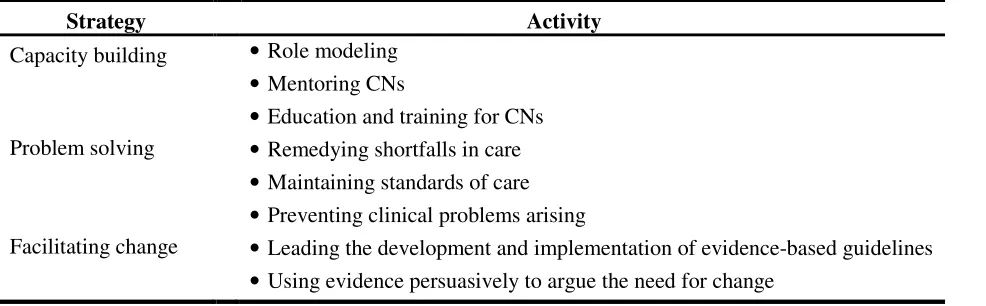
There were three dimensions to the APN’s role in promoting the uptake of knowledge: activities focused on capacity building of CNs, clinical problem solving and facilitating change (See Table 3).
Capacity building
APNs and other participants identified role modeling as a valuable means of developing the capacity of CNs to provide EBP:
(APNs) should be role models, it isn’t just be about saying ‘here’s this research, this is what we need to be doing, go away and do it’. They need to be in there, working with people, talking it through, facilitating change from within, being the people who are most up-to-date and able to promote EBP by working closely with ward sisters. (matron CS13)
Opportunistic, informal opportunities for role modeling were used. APNs often invited CNs to accompany them when providing care and took the opportunity to discuss the evidence-base
16
I work with senior nurses on the Intensive Care Unit to give them some practical advancement of care, to identify the contemporary research that’s available. I use it as a way of updating their skills and challenging them about patient care. (practice development nurse CS23)
Many APNs were involved in mentoring CNs and this provided the opportunity to engender a critical and questioning approach to practice. For example, a student nurse spoke of his placement with a community matron:
Being with her has impacted on me in that it strengthens and validates the evidence-based teaching I’ve received at university, how it can be applied and how community matrons provide care based on evidence. I was always asked (by the community matron) ‘how would you approach this’, ‘why would you approach it like this’. I wasn’t sitting there passively. I had to participate. The questions were mostly about my understanding of evidence-based guidelines. (Student nurse CS15)
APNs engaged in education activities with CNs through which they promoted EBP. They provided study days and taught in clinical settings. This was generally in response to new policy initiatives or in support of service developments that APNs were leading.
Clinical problem solving
APNs were frequently involved with CNs in solving clinical problems and they used these
opportunities to promote EBP. Several instances were identified whereby APNs had intervened in order to address a shortfall in the standard of care provided by CNs, as a nurse consultant in palliative care explained:
17
analysis with the district nurses. I was able to give structure to the review, look at what went on, and they were able to discuss what had gone wrong from their different perspectives. We talked about changes they were going to make in terms of proactive prescribing. I was able to ensure they understood the palliative care guidelines, and identify any teaching they needed on the latest best evidence. (NC CS18)
In other situations, the APN’s intervention was linked to the failure of CNs to implement an evidence-based guideline appropriately:
A patient arrived in clinic with compression therapy applied by a community nurse to treat his leg ulcer. The patient hadn’t been assessed properly or an ankle brachial pressure index recorded prior to these bandages being applied. This contravenes national and local guidelines and is a clinical risk to the patient. I used this as an example of unsafe practice to the clinic nurses. I completed a clinical incident report to raise the profile of this risk and allow an action plan to be formulated to reduce risks to future patients. I visited the community team and discussed the importance of adhering to guidelines. (nurse practitioner CS21)
APNs were also proactive in intervening to prevent problems arising:
My role is as much about ensuring that CNs manage the patient’s pain so it’s not a problem in the first place, than actually dealing with patients whose pain is not controlled. It’s about working with CNs to ensure that they have the knowledge and skills to do this. (CNS CS1)
Facilitating change
18
I had to provide evidence to convince staff why we needed to change practice. Patients who walked into the department as opposed to arriving by ambulance would queue to see the triage nurse and after waiting 30 minutes would say ‘I’ve got chest pain’ so they’d get brought round to resuscitation and eventually an ECG would be done 40 minutes down the line. I provided evidence to show that we needed a triage system so that patients had an ECG within 5 minutes of arrival in accordance with guidelines. … I then supported the staff to introduce this change. (CNS CS2)
As mentioned earlier, APNs collated data on the extent to which evidence-based standards were being achieved and used this information as part of the audit cycle to facilitate changes in practice.
She’s supported me implementing change. An audit showed that we weren’t doing as well as we should in relation to some of the stroke standards, so she worked with me to plan and implement the changes we needed to make. (Ward manager SC20)
Many APNs were responsible for leading or contributing towards the development of local evidence-based guidelines and care pathways which influenced the practice of CNs. Several APNs led the implementation of national evidence-based guidelines. This involved educating CNs about new requirements, developing their skills, setting up new structures and processes to oversee the implementation of change and subsequently monitoring and evaluating the impact.
At times APNs initiated and led changes which impacted directly on CNs themselves, on other occasions, they supported senior clinical nurses such as ward sisters to initiate change.
DISCUSSION
Limitations
The case studies provided insight into APNs’ knowledge brokering activities. Whereas APNs
19
EBP. Although observation data collected during extended case studies substantiated interview findings, a degree of caution needs to be exercised in assuming that self-reported behaviour equates to actual behaviour. Further research should build upon the concept of knowledge brokering and examine the extent to which it features more widely in the work of APNs.
Discussion of findings
There is global recognition that as opinion leaders APNs have responsibility for providing
organizational leadership for adopting EBP, working with staff to promote ongoing use of evidence and acting as change champions to facilitate adoption of best practice (Kleinpell & Gawlinski 2005). The findings therefore have relevance beyond the UK.
Despite knowledge brokering being part of the APN’s role (Milner et al 2005; Profetto-McGrath 2010) little is known about how they perform this function. This study has provided insight into this important activity of APNs. They actively brokered different forms of knowledge, making links between sources of evidence (e.g. research community or considered experts) and the practice community of CNs. Knowledge management and promoting uptake of knowledge were key components of APNs’ knowledge brokering activity.
Knowledge management involved processes whereby APNs generated different types of evidence, accumulated evidence in order to act as a repository for CNs, synthesized different forms of
evidence, translated evidence by evaluating, interpreting and distilling it for different audiences and disseminated evidence by formal and informal means. APNs actively sought to promote EBP by using different approaches to promote CNs’ use of evidence. This included developing the knowledge and skills of CNs to provide evidence-based care through role modeling and teaching, clinical problem solving and facilitating change.
Ward et al (2009) identify three different approaches to knowledge brokering evident in the
20
managers’ who instigate mechanisms for disseminating evidence through training, using electronic and print communication, and face-to-face interactions. The second approach focuses on the
interface between those who create knowledge and those who use it. Knowledge brokers are seen as linkage agents, acting as intermediaries who use interpersonal contacts and networks to facilitate the transfer and uptake of knowledge. The third approach is designed to increase access to knowledge by providing training. It addresses shortcomings in the ability of knowledge users to interpret and apply research. Knowledge brokers are seen as capacity builders who undertake education outreach, fostering the development of analytical and interpretive skills in the end user. According to Ward et al (2009), there is a lack of knowledge about which approaches are most effective in different circumstances.
The findings from the current study suggest that APNs draw upon each of these approaches, rather than preference one above the others. APNs were actively involved in knowledge management by generating, accumulating, synthesizing, interpreting and disseminating knowledge through a variety of means. However, they also acted as linkage agents by employing relational strategies in which they relied on interpersonal interactions to promote EBP. They used professional networks to access evidence, offered themselves as role models in order to demonstrate how evidence could be used in practice, and by engaging CNs in problem solving they were able to assist CNs link evidence to practice. APNs also employed capacity building strategies. These were largely focused on ensuring that CNs were able to use relevant evidence, but also contributed towards developing a critical and questioning approach to practice among CNs thereby promoting an evidence-based culture among CNs.
21
is meaningful for different end users, and developing trusting relationships with end users to assist them incorporate evidence into practice decisions. According to Dobbins et al (2009) the skills that are required for this role include advanced interpersonal skills, motivational skills, expertise in gathering, critically appraising evidence, synthesisng information and interpreting it in terms of the bigger picture, together with skills in mediating and team-building. Additionally, this study has indentified that APNs need skills in change management in order to fulfill their knowledge brokering role. It is also apparent that APNs’ insider status as skilled expert practitioners, their in-depth
knowledge of the field and their clinical credibility with CNs enhanced their ability to facilitate EBP. Whereas APN’s knowledge brokering activities were perceived to be beneficial by participants, this study has focused on processes rather than outcomes. There remains a need to examine the impact that APNs have on influencing the practice of CNs. Capturing such impact and attributing it directly to APNs is inherently difficult. Many APNs are members of a multi-disciplinary team so there are a broad range of factors which influence patient outcomes (Guest et al 2004). Although, the current study suggests that APNs have a positive impact on CNs through knowledge brokering the precise nature of this impact merits further investigation.
CONCLUSION
APNs actively promote EBP among CNs by acting as knowledge brokers. APNs’ knowledge brokering role is complex and multi-faceted. It extends beyond models of knowledge management, linkage and capacity building identified in the literature to include problem solving and facilitating change. Whereas the literature focuses primarily on knowledge brokers as ‘outsiders’ to the practice community they are seeking to influence (Ward et al 2009), APNs are positioned as ‘insiders’. APNs’ clinical expertise and credibility with CNs mean that they are uniquely placed to facilitate the link between evidence and practice. However, APNs need to be equipped with appropriate
22 REFERENCES
Canadian Health Services Research Foundation (2003) The theory and practice of knowledge
brokering in Canada’s health system. CHSRF, Ottawa (retrieved 24 April 2010 from www.chrsf.ca) Davies B, Edwards N, Ploeg J, Virani T, Skelly J, Dobbins M (2006) Determinants of sustained use of research evidence in nursing. Final report. Canadian Health Services Research Foundation and Canadian Institutes for Health Research. Ottawa (retrieved 24 April 2010 from www.chrsf.ac )
Dogherty E, Harrison M, Graham I (2010) Facilitation as a role and process in achieving evidence-based practice in nursing: a focused review of concept and meaning. World Views on Evidence-Based Nursing, 7 76-89
Dobbins M, Robeson P, Ciliska D, Hanna S, Cameron R, O’Mara L, DeCorby K, Mercer S (2009) A description of a knowledge broker role implemented as part of a randomized controlled trial
evaluating three knowledge translation strategies. Implementation Science 4:23 doi: 10.1186/1748-5908-4-23
Gerrish K, Guillaume L, Kirshbaum M, McDonnell A, Nolan M, Read S (2007) Empowering from line staff to deliver evidence-based care: the contribution of nurses in advanced practice roles. Report submitted to the Department of Health Policy Research Programme. Sheffield Hallam University: Sheffield (retrieved 24/04/2010 from http://www.shu.ac.uk/_assets/pdf/hsc-EmpoweringFrontlineStaffReport.pdf)
Gerrish K, Ashworth P, Lacey A, Bailey J (2008) Developing evidence-based practice: experiences of senior and junior clinical nurses. Journal of Advanced Nursing 62 62-73
Grimshaw J, Shirran L, Thomas R, Mowatt G, Fraser C, Bero L (2001) Changing provider
23
Guest D, Peccei R, Rosenthal P, Redfern S, Wilson-Barnett J, Dewe P, Coster S, Evans A, Sudbury A (2004) An evaluation of the impact of nurse, midwife and health visitor consultants. King’s College, London
Heitkemper MM, Bond EF (2004) Clinical nurse specialists: state of the profession and challenges ahead. Clinical Nurse Specialist 18(3) 135-140
Hutchinson AM, Johnston L (2006) Beyond the BARRIERS Scale: commonly reported barriers to research use. Journal of Nursing Administration 36(4) 189-99
Kitson A, Harvey G, McCormack B (1998) Enabling the implementation of evidence-based practice: a conceptual framework. Quality in Health Care 7 149–158.
Kleinpell R, Gawlinski A (2005) Assessing outcomes in Advanced Practice Nursing practice the use of quality indicators and evidence-based practice. AACN Clinical Issues 16(1) 43-57
Lincoln Y.S. & Guba E. (1985) Naturalistic Inquiry. Sage, NewburyPark, CA.
Milner M, Estabrooks C & Humphrey C (2005) Clinical nurse educators as agents for change: increasing research utilization. International Journal of Nursing Studies 42 899-914
Profetto-McGrath J, Smith KB, Hugo K, Taylor M, El-Hajj H (2007) Clinical nurse specialists’ use of evidence in practice: a pilot study. Worldviews on Evidence-Based Nursing 4 86-96
Profetto-Mcgrath J, Negron K, Hugo K Smith KB (2010) Clinical nurse specialists’ approaches in selecting and using evidence to improve practice. Worldviews on Evidence-Based Nursing 7 36-50 Ritchie J, Spencer L, O'Connor W (2003) Carrying out qualitative analysis. In: Ritchie J, Spencer L, eds. Qualitative research practice. Sage, London pp 219-62
Rycroft-Malone J (2008) Leadership and the use of evidence in practice. Worldviews on Evidence-Based Nursing 5 1-2
24
Schober M, Affara F (2006) Advanced Nursing Practice. Blackwell, Oxford
Schryer-Roy AM (2005) Knowledge translation: basic theories, approaches and applications. Research Matters International Development Research Centre (retrieved 24/04/2010 from
http://www.idrc.ca/uploads/user-S/11473620631Knowledge_Translation_-_Basic_Theories,_Approaches_and_Applications_-_May_2006.pdf
Spenceley S, O’Leary K, Chizasky L, Ross A & Estabrooks C (2008) Sources of information used by nurses to inform practice: an integrative review. International Journal of Nursing Studies 45 954-970 Stake R (1995) The art of case study research. Sage, Thousand Island
Thompson C, McCaughan D, Cullum N, Sheldon T, Mulhall A & Thompson D (2001a) The accessibility of research-based knowledge for nurses in the United Kingdom acute care settings. Journal of Advanced Nursing 36 11-22
Thompson C, McCaughan D, Cullum N, Sheldon T, Mulhall A, Thompson D (2001b) Research information in nurses' clinical decision-making: what is useful? Journal of Advanced Nursing 36 376-388
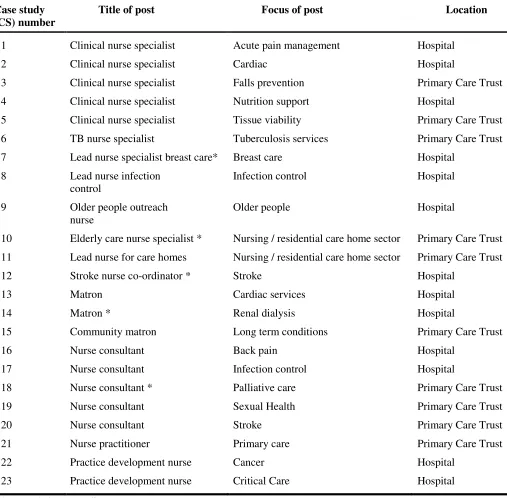
25 Table 1: Characteristics of the APN sample
Case study (CS) number
Title of post Focus of post Location
1 Clinical nurse specialist Acute pain management Hospital
2 Clinical nurse specialist Cardiac Hospital
3 Clinical nurse specialist Falls prevention Primary Care Trust
4 Clinical nurse specialist Nutrition support Hospital
5 Clinical nurse specialist Tissue viability Primary Care Trust
6 TB nurse specialist Tuberculosis services Primary Care Trust
7 Lead nurse specialist breast care* Breast care Hospital
8 Lead nurse infection
control
Infection control Hospital
9 Older people outreach
nurse
Older people Hospital
10 Elderly care nurse specialist * Nursing / residential care home sector Primary Care Trust
11 Lead nurse for care homes Nursing / residential care home sector Primary Care Trust
12 Stroke nurse co-ordinator * Stroke Hospital
13 Matron Cardiac services Hospital
14 Matron * Renal dialysis Hospital
15 Community matron Long term conditions Primary Care Trust
16 Nurse consultant Back pain Hospital
17 Nurse consultant Infection control Hospital
18 Nurse consultant * Palliative care Primary Care Trust
19 Nurse consultant Sexual Health Primary Care Trust
20 Nurse consultant Stroke Primary Care Trust
21 Nurse practitioner Primary care Primary Care Trust
22 Practice development nurse Cancer Hospital
23 Practice development nurse Critical Care Hospital
26
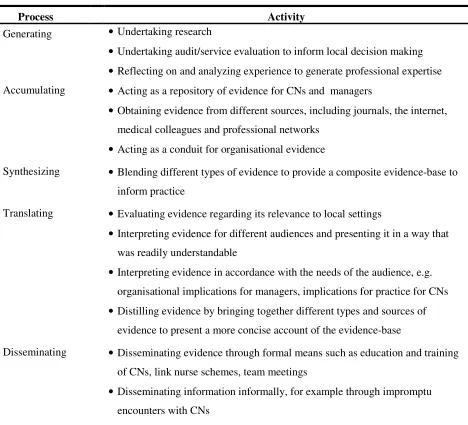
Table 2: Processes involved in knowledge management
Process Activity
Generating • Undertaking research
• Undertaking audit/service evaluation to inform local decision making • Reflecting on and analyzing experience to generate professional expertise Accumulating • Acting as a repository of evidence for CNs and managers
• Obtaining evidence from different sources, including journals, the internet, medical colleagues and professional networks
• Acting as a conduit for organisational evidence
Synthesizing • Blending different types of evidence to provide a composite evidence-base to
inform practice
Translating • Evaluating evidence regarding its relevance to local settings
• Interpreting evidence for different audiences and presenting it in a way that was readily understandable
• Interpreting evidence in accordance with the needs of the audience, e.g. organisational implications for managers, implications for practice for CNs
• Distilling evidence by bringing together different types and sources of evidence to present a more concise account of the evidence-base
Disseminating • Disseminating evidence through formal means such as education and training
of CNs, link nurse schemes, team meetings
27
Table 3: Strategies for promoting the uptake of knowledge
Strategy Activity
Capacity building • Role modeling
• Mentoring CNs
• Education and training for CNs
Problem solving • Remedying shortfalls in care
• Maintaining standards of care • Preventing clinical problems arising