2017 2nd International Conference on Artificial Intelligence and Engineering Applications (AIEA 2017)
ISBN: 978-1-60595-485-1
Research on Image Preprocessing Based on
Mathematical Morphology Filtering
CHENYUAN ZHENG, YUANZENG CHENG and QIANG FU
ABSTRACT
In order to improve the detection effect of the weak small infrared targets, we present an improved morphological filtering algorithm based on the classical mathematical morphology filtering. In the algorithm, the combination of morphological operations, multi - scale and multi - structure elements are used to filter the image. The experiments are simulated on the MATLAB platform, and the results evaluate the effectiveness of the improved algorithm.
KEYWORDS
morphological filtering, multi-scale and multi-structure elements, infrared image preprocessing.
INTRODUCTION
With the progress of science and technology, image processing and computer vision technology have been rapidly developed. As an important part of image processing technology and computer vision technology, object detection and tracking technology have attract people’ attention. In recent years, infrared thermal imaging system has been widely used in military field and civil area because of its long distance, strong concealment, strong penetrating ability, all-weather work ability, anti-glare interference and able to identify hidden targets [1]. On the one hand, in the monitoring, processes, the sooner we find the target, the more favorable for us to react. On the other hand, the infrared imaging system forms the infrared image by collecting the heat of the target and the background radiation. The farther the target distance, the lower the energy of the target radiation is received by the imaging system. So the target in the infrared image is low signal to noise ratio and small size. Except these, the system noise caused by the sensor and background clutter, all of the above are extremely unfavorable to the detection and tracking of the target [2]. So it is necessary to pre-process the image, remove the interference of the high-frequency components on the background edge and the high-frequency noise in the image.
_________________________________________
At present, the image is usually preprocessed by median filtering, mean filtering, mathematical morphology filtering and wavelet transform. In this paper, the improved mathematical morphology is used in the image processing, and it has been evaluated that the improved method is effectively improve the accuracy of target detection. The content structure is as follows: Part 2 introduces the principle of mathematical morphology; Part 3 introduces the improved algorithm; Part 4 is the simulation experiment result under MATLAB platform.
CLASSICAL MORPHOLOGICAL FILTERING
Mathematical morphology is an image analysis tool based on morphological. Using the set theory as the theoretical basis, the morphological filtering is used to measure and extract the corresponding shape in the image through the elements with certain morphological structure, so as to achieve the goal of identifying the target. Morphological filtering has four basic operations: expansion (enlarged image), corrosion (shrink image), open operation, and closed operation. In the grayscale image, assuming that the input image is
A
(x, y)
, the structure element isB
(x, y)
, and the definition fields of A and B areDA andDB, then the four basic operations can be defined as follows[2,3]:Definition 1 If image A is expanded by structure element B, it can be written asAB, and the expression is:
AB
( , ) maxs t
A s
x t, y
B x y
, | sx
, ty
DA; ,
x y DB
Definition 2 If image A is corroded by structure element B, it can be written as
A B , and the expression is:
A B
( , ) mins t
A s
x t, y
B x y
, | sx
, ty
DA; ,
x y DB
Definition 3 If image A is opened with structure element B, it can be written as
A B , and the expression is:
( ) A B A B B
Definition 4 If image A is closed with structure element B, it can be written as
A B , and the expression is:
[image:2.612.100.501.517.666.2]( ) A B A B B
In the morphological filtering, the essence of the opened operation is that the image is expanded by the structure element after corroded by the structure element. And the essence of the closed operation is that the image is corroded by the structure after expanded by the structure element. In this, the open operation can be used to filter out the bright noise in the image, while the dark noise in the image can be eliminated by the close operation. Therefore, the open operation and the close operation are often combined to construct an effective filter.
OUR WORK
All morphological filtering problems can be summed up as two basic problems: the combination of the morphological operations and the selection of the structural element. While morphological computing has been clearly defined and standardized, we only need to decide the combination of operations based on the actual requirements. The [4] shows that for small infrared targets, the opening operation can improve the contrast of the image, and the contrast of the image will have a certain degree of decline after the closed operation. Therefore, we use the open operation and closed operation respectively to deal with the image, thereby get the relevant differential image, so as to get the desired image.
For the infrared target from far to near, the target shape is gradually specific from the point. The gradual changes of the size, the target flickering, and the affect of the external conditions for observation, all of the above will result problems such as bright and dark mutations in the target image observed. In the structural element selecting process, if we only use one structure, then we can only extract the object whose size and shape are same as the structural element, so the results are often unsatisfactory. The [4] shows that the disc structure and the square structure are better performed when dealing with the infrared small target treatment is better. So we select the disc structure and square structure when the images are processed.
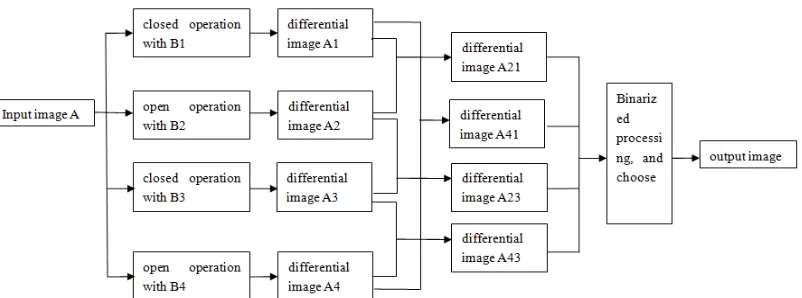
In the filter process, we select a structural element as the main structure element, and use the different size of the main structure elements to open and close the image separately, so that we can extract the target and eliminate the potential target. In addition, a sub-structural element of the same size is selected to open the image again to eliminate the potential target [5]. In this, we can obtain the target by further filter. However, the disc structure and the square structure are all have a good effect in the process of the small infrared target. Therefore, we regard the disc structure and the square structure as the main and sub-structure elements for each other. Processing the image by filter with these structural elements, the expected image is obtained. Assuming that A is the infrared image to be detected; B1 and B2, B3 and B4 are all the structural elements with the same model and different size; B1 and B3, B2 and B4 are all the structural elements with the same size and different model. The operation steps are as follows:
① The input image is closed with the operator B1 to obtain the first difference image A1;
② The input image is open with the operator B2 to obtain the second difference image A2;
④ The input image is open with the operator B4 to obtain the forth difference image A4;
⑤ The image A2 is subtracted from the image A1, The image A2 is subtracted from the image A3, The image A4 is subtracted from the image A1, The image A4 is subtracted from the image A3;
⑥ Binarized the subtractive image respectively, and then we can get the final output image by compare the targets in the four images.
The improved morphology filter block diagram is shown in figure1.
EXPERIMENTS
In this paper, we obtain the infrared weak target image, and use the improved filtering to deal with an image, the simulation results in MATLAB are as follows:
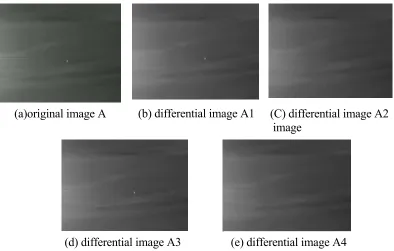
[image:4.612.103.497.326.577.2]Input an infrared image A, then select 2 * 2 and 9 * 9 two scales of the disk structure and square structure respectively as B1, B2, B3, B4. The original image, differential image after B1 closed operation, differential image after B2 open operation, differential image after B3 closed operation, differential image after B4 open operation are all shown in Figure (2).
Figure 2. The images in orders from left to right, from top to bottom represent: the original image, the image respectively operate with B1, B2, B3, and B4.
(a)original image A (b) differential image A1 (C) differential image A2 image
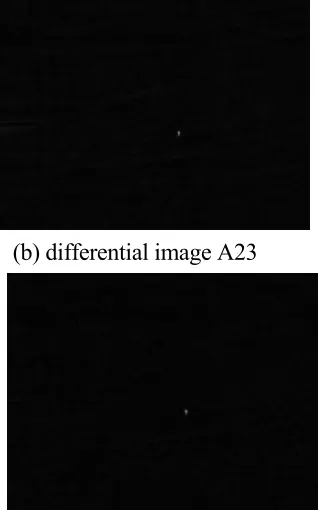
Figure 3. The differential images obtained by performing the differential operation on the A1, A2, A3, A4 again.
(a) improved filter output (b) classical output
Figure 4. The improved filter output and the classical output images.
The differential images A21, A23, A41, A43 obtained by performing the differential operation on the A1, A2, A3, A4 again is shown in the Figure (3)
The obtained differential images A21, A23, A41, A43 are processed by threshold segmentation, and the best-performing image is selected and output. The improved filter output and the classical output are compared and shown in Figure (4).
SUMMARY
Based on the characteristics of open operation and closed operation, we present a method to improve the morphological filter by using multi-scale multi-structure elements and the combination of morphological operations. In order to verify the effectiveness and reliability of the improved algorithm, the MATLAB simulation is
(a) differential image A21 (b) differential image A23
[image:5.612.126.471.372.501.2]improved. Noticeably, the combination of operations and the comparison between the choices of images will increase the amount of calculation of the system, so that the system hardware requirements are higher.
REFERENCES
1. Thesis: (Gang Lu: Research on Infrared Weak Target Detection Algorithm Based on Image Fusion. (Bachelor of engineering, Xi'an University of Electronic Science and Technology, China, 2014). p. 35-57.)
2. N. Cai, N. Zhang. Infrared Target Tracking in Sea Clutter Background Based on Spatiograms. Laser & Infrared. Vol. 40 (2010) No. 8, p. 910–916.
3. Thesis: (Li Li: Research on Detection and Tracking Technology of Infrared Small Target. (Bachelor of engineering, Nanjing University of Aeronautics and Astronautics, 2015). p. 69-98.)
4. Hong Zhou, Guodong Ma, Shijie Yang. Research on Noise Suppression Method of the Infrared Small Target Based on Morphological. Remote Sensing and Aerial Photography. Vol. 1 (2016) No. 3, p. 60-62.