University of Huddersfield Repository
Farmery, ChristineThe Role of the Learning Mentor in the Socialisation of the Child Original Citation
Farmery, Christine (2008) The Role of the Learning Mentor in the Socialisation of the Child. Doctoral thesis, University of Huddersfield.
This version is available at http://eprints.hud.ac.uk/id/eprint/2977/
The University Repository is a digital collection of the research output of the University, available on Open Access. Copyright and Moral Rights for the items on this site are retained by the individual author and/or other copyright owners. Users may access full items free of charge; copies of full text items generally can be reproduced, displayed or performed and given to third parties in any format or medium for personal research or study, educational or notforprofit purposes without prior permission or charge, provided:
• The authors, title and full bibliographic details is credited in any copy; • A hyperlink and/or URL is included for the original metadata page; and • The content is not changed in any way.
For more information, including our policy and submission procedure, please contact the Repository Team at: [email protected].
The Role of the Learning Mentor in the
Socialisation of the Child
A Research Report
submitted in partial fulfillment of the requirements of the
Doctor of Education
University of Huddersfield
Christine Farmery
Abstract
The introduction of learning mentors into the secondary schools in 1999, as part of the Excellence in Cities initiative, was viewed within two years as a successful strategy for aiding pupils in inner city schools to develop positive attitudes towards school. As a result, the provision of learning mentors was extended to the primary sector. Although guidance on this new workforce was provided to schools it was expected that schools develop learning mentorship responsive to their own needs.
This thesis begins with an overview of the introduction of learning mentors into the primary school and leads onto a consideration of one school’s interpretation of the role in practice. An evaluation of this interpretation led to a case study, carried out over one academic year, into the evolution of the role, leading to improved practice in the primary school at the heart of the research.
The case study explored how the school’s provision of learning mentorship evolved over one academic year, from the introduction of a team approach based on the ideals of a nurture group, through an interim review and onto a final evaluation of practice and effectiveness. The case study was carried out with respect to the feminist approach to research, resulting in the collection and consideration of a wide range of data, including contextual data, to tell the story of the setting; indeed this notion of telling the story led to the research being reported as a narrative. Due regard was given to the researcher also being the acting headteacher of the school; the report acknowledges how the potential impact of this familiarity was addressed within the research.
staff, influenced the school society and how children may need the specialist support of trained learning mentors to adapt to the new society. The delivery of this specialist support was then outlined, with suggestions made for how the results of this case study could be used within other primary schools.
Contents
Abstract...ii
Contents...iv
Tables...vii
Figures... viii
Acronyms...ix
Acknowledgements...x
Overview...xii
Chapter 1 - Introduction...1
Chapter 2 – The Context...12
The Learning Mentor Initiative...12
The Primary School...18
Chapter 3 – Defining the Research...24
Initial Analysis...28
The Research Problem...32
The Research Plan...34
Chapter 4 – Clarifying the Scope of the Research...40
The Team Approach to Learning Mentorship...41
Central Area...46
In-class support...46
Timetables...47
Shared records...47
Initial cohort/referrals...48
Programme of learning mentor activities...48
The Learning Mentor Role in Practice...50
Informing staff, parents and pupils...56
The Bakers Dozen...59
Chapter 5 -The Methodology...64
Feminist Perspective...65
Data Collection...69
The Instruments...78
Questionnaire...79
Interview...80
Attitude and Behaviour Scales...84
Incidental data...85
Data Analysis...86
Chapter 6 – Initial and Interim Periods of Data Collection...91
Data Handling and Analysis...105
First Thoughts...107
First Thoughts of the Teaching Staff...110
Attitude and Behaviour Scales...126
First Thoughts of the Learning Mentors...132
First Thoughts of the Local Authority Link Learning Mentor...139
Incidental Data...147
Common Themes...150
Conclusions from Analysis of First Period of Data...156
Chapter 7 – Societies and Socialisation...159
Chapter 8 – Concluding Period of Data Collection...175
Learning Mentor Team...179
Changes to the work of the learning mentor team...183
Successes this year...184
Major weaknesses this year...185
Main lessons learned for next year...187
Link Learning Mentor...199
Learning Mentors’ End of Year Review Report...211
Planned Conversation...212
Children’s Data...226
Group Interviews...228
Attitude and Behaviour Scales...237
Individual Interviews...244
Attainment Data...262
Chapter 9 – Evaluating the Results...267
Summary of Research...267
Case study...273
Lack of rigour...280
Recording of biased views...281
Providing little basis for generalisations...283
Produce long and unreadable reports...284
Communicating the Results...286
Conclusions...288
Recommendations...291
Future Research...302
References...306
Appendices...318
Appendix 1: Learning Mentor Team and Individual Timetables...319
Team timetable...319
Individual Timetables...319
Appendix 2: Programme of Learning Mentor Activities...320
Appendix 3: Description of Each Child in the Baker’s Dozen...321
Appendix 4: Questionnaire for Teaching Staff...328
Appendix 5: Interview Schedules...332
Interview Schedule - Learning Mentor 1...333
Interview Schedule - Learning Mentor 2...336
Interview Schedule – Link Learning Mentor 1...339
Interview Schedule – Group Interview (children) 1...345
Interview Schedule – Group Interview (children) 2...348
Interview Schedule – Individual Interview (children)...351
Appendix 6: Attitude and Behaviour Scales...353
Attitude Scale 1...353
Behaviour Scale 1...354
Attitude Scale 2...355
Behaviour Scale 2...356
Appendix 7: Transcript of the Unscheduled Conversation...357
Tables
Table 1:1 – Stages of Research...11
Table 2:1 – End of Key Stage Attainment Data...20
Table 3:1 - Part 3 of the Research Plan...39
Table 4:1- Nurture Group Characteristics used in Setting up the...52
Learning Mentor Room...52
Table 4:1 - Continued (Nurture Group Characteristics used in the...53
Learning Mentor Room)...53
Table 5:1 - Data Collection...76
Table 6:1 – Comparison of Models...96
Table 6:2 – Comparison of Research Report Formats...99
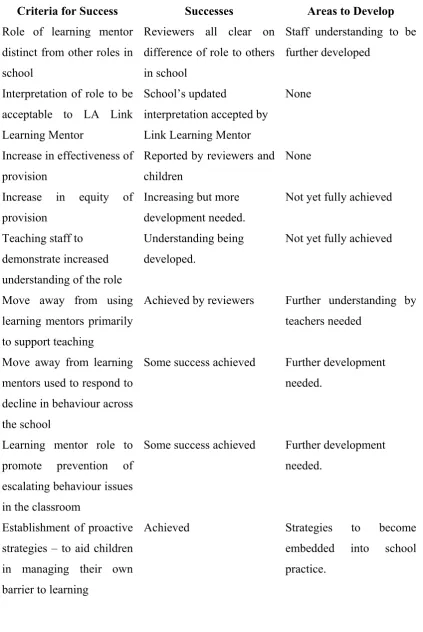
Table 6:3 – Summary of the Formal Review of School’s Provision of Learning Mentorship...102
Table 6:4 – Criteria for Success of Interim Review of Learning Mentorship.109 Table 6:5 - Effects of the Nurture Group Ethos...136
Table 6:6 - Evaluation of Learning Mentorship...155
Table 7:1 – Comparison of the End of Year SAT Levels with the Mid-Year Teacher Assessments in English and Maths...160
Table 8.1 – Successes within Learning Mentorship...185
Table 8.2 - Major Weaknesses in Learning Mentorship...186
Table 8.3 - Main Lessons Learned...188
Table 8:4 – Group 1 Responses to Question 3...230
Table 8:6 - Responses to Question 6...232
How would you describe your behaviour at the moment and has it changed since we were last on tape?...232
Table 8:7 - Children’s Views on Learning Mentors and Learning Mentorship ...234
Table 8:7a - Children’s Views on Learning Mentors and Learning Mentorship (continued)...235
Table 8:7b - Children’s Views on Learning Mentors and Learning Mentorship (continued)...236
Table 8:9 - Comparison of the End of Year SAT Levels of Previous Year with
End of Research Year SAT Levels in English and Maths...264
Figures
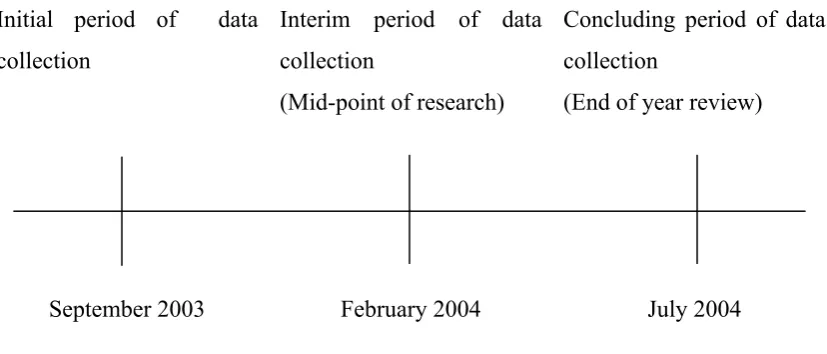
Figure 6:1 – Intended Timeline of Data Collection...93
Figure 6:2 – Amended Timeline of Data Collection...94
Figure 6:3 - Research Model...95
Based on the Kemmis and McTaggart Model (1982, p18)...95
Figure 7:1 - Research Review Flowchart...171
Figure 8:1 – Amendments made to Data Collection Timeline...176
Figure 9:1 - Process of Change of Head Teacher...277
Acronyms
BBC British Broadcasting Corporation BEP Behaviour Education Plan
DfEE Department for Education and Employment DfES Department for Education and Skills
DT Design and Technology
EAL English as an Additional Language ECM Every Child Matters
EiC Excellence in Cities
ICT Information and Communication Technology IEP Individual Education Plan
INSET Inservice Training LA Local Authority
LEA Local Education Authority LM Learning Mentor
NMN National Mentoring Network P.E. Physical Education
PFI Private Finance Initiative SATs Standard Attainment Tests
SEAL Social and Emotional Aspects of Learning SEN Special Educational Needs
TA Teaching Assistant
Acknowledgements
I would like to thank the staff and children from the school within which the research took place. In particular the cohort of children, the Bakers’ dozen, who were able to articulate well their thoughts and feelings and shared these with me whenever I asked them to. This took place during a year of change which impacted greatly on the children and so I am grateful for their participation in the research. I wish them well in their education and hope that the process, and the results, of the research benefited them.
The learning mentors at the school were committed to developing their practice and behaved with the utmost professionalism throughout. They fully engaged in the research process and, again, I hope the research has helped them in their chosen profession. Without the support of the Local Authority Link Learning Mentor I doubt the practice of the school learning mentors would have developed as markedly as it did and so I thank him too for his involvement in the research. The research process has continued in my new school and so I thank my present staff for their patience and support for the completion of the research report.
My own family are always supportive of my endeavours and so have aided me throughout the research period. They appreciate the time commitment I have made and have encouraged me at every stage. They have given freely of their advice and practical help when I have needed it and so I thank them for always being there when I have needed their unique support.
process he has provided me with the perfect balance of challenge and support; it is this that has enabled me to complete this thesis. Thank you.
Overview
Chapter one begins with an overview of the introduction of learning mentors into the primary school. It acknowledges that there are many misconceptions about the role, from why it was introduced into schools to what the role encompasses, from understanding what defines mentorship to how the role works in practice. This overview establishes the rationale for learning mentorship, within one primary school, to be the focus for research and begins to consider the research methodology to be used. Following a brief description of the institution in which the research took place the stages of the research are presented.
Chapter two sets the research in the context of both the background to the learning mentor initiative and to the school in which the research was to be carried out. It therefore builds on the overviews given in chapter one and, consequently, sets out the framework in which the study was carried out. The chapter looks at learning mentorship and, indeed, mentoring as a process in much more detail and considers the context of the school in terms of both its environment and the circumstances in which it operates.
on the development of a more effective provision of learning mentorship through the use of the nurture group ethos within a team approach.
Chapter four considers how the approach identified in chapter three would be put into practice. The chapter explores further the nurture group ideals and how the learning mentor provision within the school could be based upon them. It is within this chapter that the pupil participants in the research are introduced and data collection methods considered. Special consideration is given here to the collection of data from children.
Chapter five begins with the research aims, leading on to a discussion of the theoretical perspective and how this both influenced the theory and the practice of the research. The feminist perspective is discussed before the research is categorised as a case study telling the story of a setting. Data collection methods are then explored, together with the instruments to be used, followed by a consideration of the analysis of the resulting data.
Chapter six reports two of the three periods of data collection carried out within the research period. It explores how the informal and formal reviews of the learning mentor provision, together with the contextual data, forms the initial period of data collection. This was followed by changes to the provision and then the collection, and analysis, of interim data collected from all the participants in the research.
Chapter seven centres on a discussion about the school as a society. This was indicated by both the data collected, and its analysis, and by the reference to published sources. A consideration of the school as a community or society in its own right led onto an exploration of socialisation.
mentorship and considers a re-focusing of the research to continue telling the story of the development of learning mentorship through an investigation into the role of the learning mentor in the socialisation of the child. The chapter presents the final data collected from all participants in the research and analyses it with respect to the effects of the learning mentorship provision on the socialisation of the child.
Chapter 1 - Introduction
Learning mentors were first introduced as a new workforce into schools in 1999 through the Excellence in Cities (EiC) initiative (DfES, undated a) by the then Education Secretary David Blunkett, who stated that he wanted to address the culture of low expectations in England’s inner-city comprehensive schools (BBC, 1999a). Blunkett announced a package of measures totalling £350m, with the introduction of learning mentors as one of three main strands of the Excellence in Cities programme. By 2001 the School Standards Minister, Estelle Morris, was acknowledging the success of the initiative, stating that ‘…mentors are helping to change inner city pupils’ attitudes to schooling.’ (BBC, 2001) and announcing an extension to the initiative – that 900 learning mentors would be recruited to work in primary schools. In view of the success of the strand, and the intention to introduce it into the primary sector, it could be expected that the role of the learning mentor was one that was both easily definable and easy to implement and yet in the same year (2001) the DfES accepted that the role in practice was not clearly understood and that this lack of understanding of the role of the learning mentor was one of the key barriers to its successful implementation in schools (Hayward, 2001). This would appear contradictory to Morris’ views above and questions the decision to extend the provision into primary schools at this time.
protect and advise his son. From these origins the dictionary definition has become ‘…. experienced and trusted advisor.’ (Sykes, 1982). There is a seemingly endless supply of published material regarding mentorship in practice in various fields, from business (Clutterbuck & Megginson, 1999) and health care (Morton-Cooper & Palmer, 1999) to youth programmes (DuBois & Karcher, 2005) and the restaurant business (Parsa & Kwansa, 2002), together with the reported established practice of the use of mentoring within education (MacIntyre, 1996; Miller, 2002). Indeed it is used most successfully in Initial Teacher Training (Hobson, 2002; Tomlinson, 1995; Brooks & Sikes, 1997) and yet, despite the myriad of information available, Roberts (2000, p162) asserts that there is generally a ‘…lack of consensus as to what constitutes mentoring…’ and concludes that it is best described as a process. It may therefore not be so surprising that the specific role of a learning mentor is also not either easily definable or plainly understood, but merely reflects the general lack of understanding regarding the role of the mentor. It is therefore interesting that Malderez (2001, p57), when considering the role of the mentor in initial teacher training, suggests a description of the mentoring process rather than a definition of it, by stating that mentoring is
…the support given by one person for the growth and learning of another…and the…. integration into and acceptance by a specific community
The research described here is an exploration of the learning mentor role in theory and in practice, prompted by the statement from Hayward (2001) noted earlier, that a lack of understanding of the role is a key barrier to its successful implementation, and a later statement from Morris (2003, p1) that the impact of learning mentors in schools ‘…has exceeded all our expectations.’ and is a ‘…key element…’ in providing both inclusive schools and enabling all children to achieve their full potential. These published comments represent well the confusion surrounding the role that was evident in the school in which the research was carried out, as illustrated in the teacher questionnaires used in the research. It was this confusion that first prompted an exploration of the role in theory and practice, involving the development of further understanding of the role; an evaluation of the role within the school in which the research would be carried out and, ultimately, to the development of the practice of the Learning Mentors within the school through an informed approach. Bassey (1995, p6) defines such research as an enquiry to be ‘…carried out, in order to understand, evaluate and change.’ thus describing the exploration indicated at this early stage of the research process. Using Bassey’s model, the change stage was considered to be the establishing of a system of learning mentorship that reflects Morris’ views above; learning mentorship that would support the inclusion agenda, by enabling children to engage in school life and, in turn, to contribute to children reaching their potential.
The research proposed was therefore school-specific, it would explore fully how learning mentorship was delivered in one school and if, and consequently how, it could be improved. Bryman (2001, p48) would classify the research as a case study,
educational settings (Bassey, 1999; Merriam, 1988; Hammersley, Foster & Gomm, 2000) indicating the appropriateness of the approach to the research proposed. Bassey (1999) builds on the research model described earlier, by detailing three categories of case study, one related to testing or seeking theories, one related to telling the story of a social setting and one that evaluates a setting. The research proposed here was not concerned with testing or seeking theories; it was aimed at evaluating and developing practice. It was therefore to be an open-ended piece of research whereby the natural evolution of the role in practice would be documented rather than a system imposed that would then be tested to ascertain its worth. As it was to be concerned with much more than an evaluation of what was already in place, indeed such an evaluation formed only a small part of the research in its initial stages, the research certainly falls into the second category, that of telling the story of a setting, in that it tells the story of how the learning mentorship approach was developed in the school, how it is evolving and how it works in practice.
The telling of the story of the setting indicated clearly the need to collect data
influence the choice of data collection methods. Raghuram, Madge & Skelton (1998) and Dam and Volman (1995) suggest that the major advantage of the feminist perspective is that the researcher is not bound by a conventional, traditional methodology and is not only allowed but also indeed expected to push back the boundaries of data collection and analysis, in order to fully explore the setting, thus allowing for the research to use a range of data from which to draw conclusions. The use of case study, together with the feminist perspective, would consequently ensure an in-depth look at both the context of the research and the effects of the learning mentor approach in practice (Greig & Taylor, 1999), thus meeting the aims of the research.
and that the form of the analyses should be addressed at this stage of the research design. However, in keeping with the feminist perspective, the data analysis was not bound by conventions and was carried out when relevant to the story being told.
The institution in which the research was carried out is a large primary school in an area of high social deprivation in the north of England. Due to its location and size it was funded, through the Excellence in Cities initiative, for the equivalent of two full-time learning mentors, although this allocation was later supplemented by the school’s budget and resulted in the employment in 2002 of four part-time learning mentors, each working within specific year groups. At the end of the academic year 2002-2003 I carried out a review of the learning mentor practice, in the position of acting head at the school, as I believed that the role in practice could be more effective in the school at the heart of the research than it had been. This was an almost instinctive belief as, at this time, my knowledge of the role of the learning mentor was not based in theory, but solely on the previous head’s interpretation of the role. I found it quite difficult at this stage to articulate all my concerns and it was this disquiet that prompted a review with the learning mentors and the Local Education Authority (LEA) Link Learning Mentor and, in turn, to the identification of the research focus. It was this review that enabled me to verbalise and clarify my thoughts.
groups, and secondly a belief that the role could be carried out more effectively if there was further cooperation and sharing between the learning mentors themselves. During the review, the LEA Link Learning Mentor aided me in identifying a different approach to learning mentorship - based on the team approach used in many secondary schools but much less common in primary schools – that would address my main concerns. The identification of this approach was the critical incident that led to the recognition that research into the role of the learning mentor within the school was both indicated and necessary to the development of the role in practice.
overcome their specific barriers to learning or improve attendance. The barriers to learning may include behavioural problems, difficulties at home or problems within school; the expected results of the barriers to learning, without intervention, may include the failure to become engaged in school life as a whole and a failure to meet expected attainment levels within the curriculum. These failures relate well to the expected outcomes of poor attendance and so the dual areas of responsibility of the learning mentor do indeed sit well together. Additionally, Webb & Vulliamy (2002, p165) believe that the remit of the learning mentor to deal with barriers to learning and issues around attendance consequently removes much of the ‘…social work dimension of the primary teacher’s role’. In other words, the responsibilities of the learning mentors enable the teacher to concentrate on their core purpose of teaching and learning, although it must be noted that what constitutes teaching is itself the subject of much debate (Day, 2000; Cullingford, 1989). It can thus be appreciated how the role of the learning mentor could be interpreted and, as a result, begins to bring some clarity to the role. Although it must be acknowledged that the role will inevitably vary from both child to child and from school to school, the information provided above begins to indicate how wide the role is in practice. For that reason, in order to make this research manageable, one area of the learning mentor role needed to be identified for study.
Boxall, 2000) within the team approach to learning mentorship as it was considered to be an appropriate approach to support targeted children to engage more fully in school life and, in turn, to engage in their learning. Through the reflections carried out throughout the research period, Malderez’ description of mentoring (2001, p57) as the ‘…integration into and acceptance by a specific community.’ became key to the research and to its development. Malderez’ description not only reinforces what the role of the mentor involves but also began to point towards the notion of socialisation
within the school community; that the identified barrier to learning of engaging in
school life is actually that of socialisationof the child. This discovery is supported by
the dictionary definition of socialisation as ‘….the adoption of the behaviour patterns of the surrounding culture;’ (The People’s Dictionary, undated). The fundamental theme of the case study therefore developed throughout the research period, moving from considering the effects of the use of the nurture group ethos within the team approach to learning mentorship to exploring the wider role of the learning mentor in the socialisation of the child, whilst centring throughout on developing the engagement in school life of the mentored pupils.
adaptation of the role and to further develop practice within the school. The case study, using Bassey’s definition (1999), would hence tell the story of developing the team approach to learning mentorship in a primary school - how the approach was introduced, how it worked in practice and what the effects on the children were. In turn, the research would consequently aid the school in continuing to develop its commitment to effective learning mentorship.
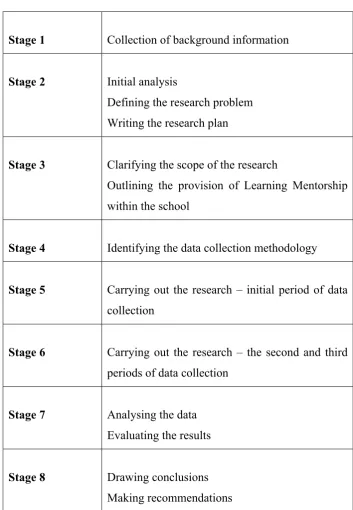
Table 1:1 – Stages of Research
Stage 1 Collection of background information
Stage 2 Initial analysis
Defining the research problem Writing the research plan
Stage 3 Clarifying the scope of the research
Outlining the provision of Learning Mentorship within the school
Stage 4 Identifying the data collection methodology
Stage 5 Carrying out the research – initial period of data
collection
Stage 6 Carrying out the research – the second and third
periods of data collection
Stage 7 Analysing the data
Evaluating the results
Stage 8 Drawing conclusions
Chapter 2 – The Context
It is important to the story of the research setting(Bassey 1999) that a range of contextual data regarding the role of the learning mentor in theory, both locally and nationally, is used to set out the framework in which the study was to be carried out. This context was consequently two-fold; the background to the learning mentor initiative and to the school in which the research was to be carried out. Indeed it is through the consideration of the background information that it will be appreciated how the learning mentor initiative, albeit a national initiative that is monitored by the DfES, is a flexible role that is to be tailored to each individual school’s needs (Hayward, 2001) and that the initiative cannot be considered in practice without an in-depth exploration of the school at the heart of the research. The background to the initiative is itself multi-faceted, from identifying why the initiative was introduced to where the term learning mentor originated, from the decision to use education monies on training and developing the practitioners to determining the parameters of the role in practice. The exploration of the school setting will focus on both the physical environment, which I believe to be relevant to the research due to its limited space and facilities, and on the circumstances under which the school is operating.
The Learning Mentor Initiative
mentoring, in order to reflect on why the approach may have been considered appropriate to pupils in the primary school, and to speculate why the title learning mentor was deemed fitting to this new workforce. Colley (2003, p523) shares my disquiet about the lack of evidence of the successful use of mentoring, albeit with disaffected young people when preparing for the world of work, by reporting that ‘…there is an irony…’ that a government so ‘…overtly committed to evidence-based practice…’ should devote so much funding to a scheme that had not been proven to be effective. Colley (2003, p523) then refers to Skinner & Fleming (1999) by stating overtly that there is ‘…little evidence to support the use of mentoring…’ on a wide scale; thus mirroring my concerns about the lack of information regarding the reasoning behind the introduction of the learning mentor role into the primary school. It can therefore be appreciated that an exploration of mentoring, although clearly indicated as being necessary to the study, is not as simple as it may first appear – as noted in chapter one.
As noted earlier, there is an accepted confusion about the definition of mentoring (Roberts, 2000), although much is written about mentoring in practice (Wilkin, 1992; Zachary & Daloz, 2000; Fletcher, 2000). The confusion regarding an accepted definition of mentoring is most clearly explained by the National Mentoring Network (undated), which states that the lack of a universally accepted definition is due to the range of activities that mentoring may encompass, that it is responsive to need and is thus dependant on why mentoring is being used, where it is being used
and with whom it is being used. This explanation may appear to suggest that a
appreciated why the term learning mentor was used, in that the initiative was introduced to enable all pupils to access the curriculum, in other words, to learn. The function of the learning mentor would thus be to support identified children to engage in their learning, yet this may be considered to be the role of teaching assistants; thus how the role of the learning mentor differs from that of a teaching assistant needed to be explored.
The role of the teaching assistant was also not clearly defined at this stage of the research, although this was addressed though the Workforce Reform Agenda (TDA, undated a) with the introduction of different grades of teaching assistant. What was accepted at the time of the introduction into schools of the learning mentor initiative was that teaching assistants work alongside teachers, supporting both teachers and pupils (Lee, 2002; O’Brien & Garner, 2001; Motion, 2002). Further guidance was considered at this time - Birkett (2001), Watkinson (2003) and O'Brien & Garner (2001), each providing direction for distinguishing between the roles of the teaching assistant and the learning mentor. Birkett (2001) suggested that the role of the teaching assistant was a formal role often associated with special educational needs; Watkinson (2003) considered that her observations of teaching assistants at work revealed them to be increasingly involved in supporting the curriculum through contributing to the planning, delivery and feedback of the curriculum, whereas O'Brien & Garner (2001) describe the role as that of educator, instructor or teacher. The learning mentor role is further described by the DfES (undated d) as providing support for children, listening to them, encouraging them and facilitating cooperation between the pupil and the school.
learning mentor being concerned with enabling the learner to learn. The roles of the support staff are thus simply indicated by their title, that a teaching assistant is concerned with teaching and a learning mentor is concerned with the learning process. Although simply stated, it can be appreciated that the work encompassed by each role continues to be the subject of much debate, looking at what actions are supportive of
teaching and what actions are supportive of learning. Smith (2005, p2) is mindful of
this debate and so stresses that the learning mentor provides a ‘…complementary service to otherprofessionals in school and beyond.’ thus indicating that the role is to be carried out alongside that of others, including teachers and teaching assistants.
concentrates on removing such barriers will inevitably improve the conditions for learning.
The exploration into the role thus far indicates clearly what the expected outcome of learning mentor intervention is to be without dictating exactly how the outcome is to be achieved. This then enables schools to use the initiative in response to individual needs, rather than it being a restrictive, prescriptive approach. Smith again (2000 p2) describes this as the specifics of the role, and that this is ‘…a matter for individual schools.’ to determine, although it is clear that there is a requirement for each mentor to ‘…devote the majority of their time to those needing extra support to realise their full potential,’ This reference to realising full potential is important to the school being studied, as this is cited as one of the aims of the school within the School Improvement Plan, and is thus a validation for the work of the learning mentors within the school. The requirement to ensure that the learning mentor role in practice was a complementary role within the school was also a major concern in the school in which the study was carried out. I believed strongly that the opportunities presented to the school by this new, fully funded, role could be exciting and beneficial to the whole school community and, in order to fulfil this potential, needed to be established as a separate and unique role whilst complimenting the work already being carried out within the school; indeed this belief formed a major part of the discussion during the initial review (chapter three).
references have been used to investigate the concept of mentoring and how this can be applied to learners in the primary school, specifically to learners who are experiencing difficulties in accessing the school curriculum. The lack of background information has therefore not unduly restricted the exploration of the identified first part of the context of the research and has set the scene for how the school is expected to individualise the initiative. Although the discussion may make the initiative appear difficult to put into practice, conversely it does allow each school to interpret it within the specific context of the individual school. A description of the school at the heart of this research is hence necessary, in order to set out the specific environment in which the initiative is to be put into practice and the needs of the school and its pupils.
The Primary School
The institution in which the research was carried out is a large primary school in the North of England, in an area designated by the Local Education Authority as one of high social deprivation. As noted earlier, the Excellence in Cities initiative funded the equivalent of two full-time learning mentors, later supplemented by the school’s budget to employ four part-time learning mentors, each working within specific year groups. The initial allocation, made through the Local Education Authority, was based on the school’s location, the school’s size (noted overleaf as being double the size of an average primary school) and on its allocation of free school meals, which hovers around 35%. It was on this basis that it was expected that a significant number of pupils would require specific help to both access the school and its curriculum and achieve their true potential.
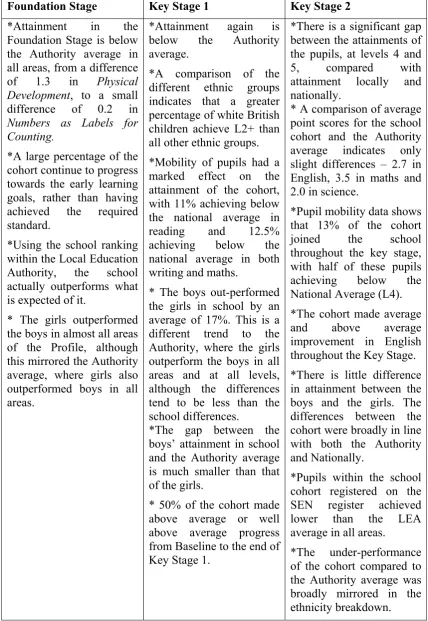
end of the Foundation Stage and teacher assessments and formal testing at the end of key stages one and two. The interpretation of the data includes a comparison to other data, both national and local, and considering similar schools and all schools. Such a comparison is deemed necessary as the Authority state that pupil background factors such as gender, entitlement to free school meals and ethnicity can influence educational achievement. The most recent data at the time the research was carried out concluded that:
• The school is much larger than the Authority average, having over 100% more children throughout school – 420 from age five to eleven.
• Eligibility for free school meals at 34.1% (as noted earlier) is also greater than the Authority average of 20.2% and the National average of 17.3%.
• The percentage of EAL pupils, 9.7%, is more than double that of the Authority average but slightly below the National average of 11%.
Table 2:1 – End of Key Stage Attainment Data
Foundation Stage Key Stage 1 Key Stage 2
*Attainment in the Foundation Stage is below the Authority average in all areas, from a difference of 1.3 in Physical
Development, to a small
difference of 0.2 in
Numbers as Labels for Counting.
*A large percentage of the cohort continue to progress towards the early learning goals, rather than having achieved the required standard.
*Using the school ranking within the Local Education Authority, the school actually outperforms what is expected of it.
* The girls outperformed the boys in almost all areas of the Profile, although this mirrored the Authority average, where girls also outperformed boys in all areas.
*Attainment again is below the Authority average.
*A comparison of the different ethnic groups indicates that a greater percentage of white British children achieve L2+ than all other ethnic groups. *Mobility of pupils had a marked effect on the attainment of the cohort, with 11% achieving below the national average in reading and 12.5% achieving below the national average in both writing and maths.
* The boys out-performed the girls in school by an average of 17%. This is a different trend to the Authority, where the girls outperform the boys in all areas and at all levels, although the differences tend to be less than the school differences.
*The gap between the boys’ attainment in school and the Authority average is much smaller than that of the girls.
* 50% of the cohort made above average or well above average progress from Baseline to the end of Key Stage 1.
*There is a significant gap between the attainments of the pupils, at levels 4 and 5, compared with attainment locally and nationally.
* A comparison of average point scores for the school cohort and the Authority average indicates only slight differences – 2.7 in English, 3.5 in maths and 2.0 in science.
*Pupil mobility data shows that 13% of the cohort joined the school throughout the key stage, with half of these pupils achieving below the National Average (L4). *The cohort made average and above average improvement in English throughout the Key Stage. *There is little difference in attainment between the boys and the girls. The differences between the cohort were broadly in line with both the Authority and Nationally.
*Pupils within the school cohort registered on the SEN register achieved lower than the LEA average in all areas.
The school building is a large, rambling Victorian building with many small teaching areas and classrooms; many of the teaching areas are open-plan, with all staff supporting each other in their teaching and management of the children. There are sixteen classes in total, each with less than thirty children but with almost full-time teaching assistant support. The curriculum is delivered within a topic-based approach and there is an emphasis within the whole curriculum on pastoral issues, including building self-esteem. (This aspect of the school will be discussed in more detail in chapter six.)
The internal environment is enhanced by attractive displays but there is an awareness by the Local Education Authority, and the school staff, that the building is inadequate for education in the twenty first century; in view of this the school was to be rebuilt in 2006 as part of the PFI (Private Finance Initiative). Externally the school is also inadequate in that there is no school field and only two small, uneven playgrounds for outdoor play to take place. The relevance of the building to the context of the school is that the restricted space inside and outside the school can lead to inappropriate behaviours in a small but significant minority of pupils. The effects on the pupils displaying a reluctance to engage in the curriculum could only be speculative, indeed the impact of this on pupils displaying barriers to learning will be considered in more detail in chapter six.
parents - it is recorded by the Authority that 43.4% of the adult population in the school’s traditional catchment area have no formal qualifications. Although the school operates an open-door policy for parents, many are reluctant to engage in their child’s school life; this is an area that is currently being addressed by both the school and the Local Authority who is promoting family learning within its schools. The designation of the area that the school serves as socially deprived reflects well the impoverished nature of many of our pupils and their home lives; the current school building unfortunately reinforces some of the pupils’ (and their parents’) low aspirations and expectations for behaviour. It can thus be accepted that the data regarding the locality of the school and the analysis of the end of key stage assessment data together reinforce the notion of the school as one where an emphasis on raising standards and raising aspirations is appropriate. The introduction of the learning mentor initiative into the school was therefore also appropriate, as it supports Morris’ view (2003) that the initiative will ensure that schools are both inclusive and enable all pupils to achieve their true potential; indeed it was noted earlier in the chapter how important this is to this piece of research. Morris (2003) also states that the work of the learning mentor is to be embedded into the on-going work of the school, thus ensuring that practice is responsive to the context of school.
Chapter 3 – Defining the Research
Chapters one and two have begun to identify the research to be carried out, considering the parameters of learning mentorship and why it is a suitable area for study. Chapter two in particular began to explore the context of the school in which the study would take place; this context will be expanded upon in later chapters as the research data is considered. However, in keeping with the narrative style of this report, a further event that prompted the identification of the research focus must now be introduced.
My acting headship, under which the review of learning mentorship in the school at the heart of this study was carried out, arose through the unexpected suspension and subsequent resignation of the headteacher of the school. The effects of this suspension and resignation were immediate, with staff, parents and children becoming unsettled and uncertain about the future. Behaviour across the school began to decline and it was quickly realised the effect the headteacher had had on behaviour management. It was clear that he had shouldered almost full responsibility for behaviour management across the school, thus disempowering and deskilling many of the staff and, perhaps more importantly, the children. For the overwhelming majority of the pupils this was not an issue that could not be resolved, but for a significant minority (around 5%) it proved to be a very de-stabilising event in their lives.
I spend a lot of time in my classroom refereeing behaviour instead of teaching and I have never had any support from the learning mentor team.
Another teacher also alluded to behaviour management as a role of the learning mentor, stating:
In my class and year group there are many issues of behaviour. It isn’t possible for one learning mentor to cover all of them regularly.
It was however pleasing that a third teacher recorded that the learning mentors’ responsibility towards behaviour management was limiting the support she had for other children in her class:
The children who exhibit barriers to learning due to behaviour are well supported by the team. However, I have other children who are identified for other reasons and are not supported adequately.
was in how the aims could be achieved. The teaching staff believed that the year group allocation of learning mentors was appropriate and requested that further learning mentors were employed, as they stated that one per year group was not sufficient to manage all the behaviour problems being presented. Although I was both mindful and understanding of the staff’s views, the employment of more learning mentors could not be funded and I retained the view that their role could not be limited to that of responding to incidences of misbehaviour as they occurred. For this reason, I continued to question the school’s interpretation of the role in practice and believed that it could be improved, and indeed could more effectively address the range of behaviour issues being presented through establishing a more structured, proactive approach to learning mentorship, which included work on behaviour management but was not used exclusively for this.
problems through school. Although it may be argued here that all pupils who display poor behaviour must accordingly hold a barrier to learning, and thus need to access the expertise of a learning mentor, a further consideration at this point for me was that the learning mentors would be more effective in aiding the children to regain responsibility for their own behaviour through the targeted use of their expertise in a proactive way rather than in the reactive way in which the teachers were asking for. This reactive nature of the role was emphasised by one teacher in the later questionnaire who reported that the learning mentor team:
…will discuss issues arising in the classroom, e.g. acts of aggression
and
Children who are ‘at risk’ [of misbehaving] are regularly targeted within the classroom or removed.
It can be appreciated that this part of the chapter has added to the first stage of the research, the collection of background information, as the school context at this time was particularly relevant to the identification of the research problem. Indeed the context required action to reverse the decline in behaviour and I, in my role as acting headteacher, needed to provide the action. I firmly believed that the learning mentors could be used more effectively in school and that, in turn, their role could impact favourably on behaviour across school whilst meeting the needs of more children exhibiting barriers to learning. By undertaking a piece of formal research, the success (or otherwise) of changes to learning mentorship within the school would be determined.
(Table 1.1); the Link Learning Mentor was contacted as it is his (or her) responsibility to ‘…play a key role in monitoring, evaluating and sharing good practice…’ (Hayward 2001, p10). I therefore wanted his support in evaluating the school’s current interpretation of the learning mentor initiative and to discuss my growing unease regarding the effectiveness of this interpretation. As noted earlier, it was this decision to carry out a formal review of the school’s interpretation of the learning mentor initiative, and the results of the review, that led directly to the identification of learning mentorship as a focus for research. In view of this, and for the purposes of the research report, the review was acknowledged as the initial analysis stage of the research.
Initial Analysis
The review of the school’s approach to learning mentorship, the initial analysis stage of the research, took place during the summer term of the academic year 2002-2003. The review involved myself, in the role of acting headteacher, the four learning mentors employed within the school and the Authority Link Learning Mentor. The current use of the learning mentors was discussed at length.
…working to develop reading skills. Developing academic skills
and
The learning mentors work on a regular basis with identified children and support the class teacher when in class.
The teacher questionnaire was issued following the changes to the provision of learning mentorship, to be outlined in chapter four, and demonstrate the misconceptions about the role held by the teaching staff. Although the reporting of some of the comments here are out of sequence with the chronology of this report, they are relevant as they record the lack of understanding of the learning mentor role by many of the teaching staff. Although some staff were beginning to develop an understanding of the learning mentors’ responsibility for removing barriers to learning, as evidenced by the response:
To support children who have problems in classroom situations.
others were slower to accept what the role could encompass. Perhaps the most disconcerting response, following staff input into the developing role of the learning mentor, was:
I do not know what their role is supposed to be….
year groups had resulted in a significant number of children being denied the expertise they needed to aid them in accessing school life. I also firmly believed that the learning mentor role could be strengthened by being used proactively rather than reactively. In simple terms, I was of the opinion that the role in practice could be much more effective in the school at the heart of the research than it had been, and yet at this point I continued to have difficulty in articulating these beliefs and, in turn, in formulating a way forward. Discussions with the learning mentors indicated that they themselves shared my concerns about their role and that they were eager to develop the response to learning mentorship I was trying to arrive at. It was then the Link Learning Mentor who identified for me the way forward I was trying to determine, that the learning mentors could successfully operate as a team across school rather than as individuals assigned to individual year groups, to facilitate the support targeted where and when it was needed, rather than blanket support for four specified year groups in school. He also agreed that, working as a team, programmes within school could be set up to address a range of behaviour issues, which would ensure the proactive action I considered essential to the development of behaviour management in school.
thoughts that the behaviour issues that arose at this time due to extrinsic factors, either home-related issues or related to the resignation of the previous headteacher, required more from the learning mentors than merely aiding the children to complete their work. I believed it was essential that the learning mentors worked with the children to develop strategies both to control their behaviour and to access the curriculum themselves. St James-Roberts & Singh (2001) therefore were key to identifying the next steps in learning mentorship provision within the school to more effectively meet targeted children’s needs and, in turn, the school’s needs by focusing on aiding individual children to address the issues affecting their ability to learn.
of the current context of the school and the growing behaviour management issues which needed to be addressed. Therefore, by carrying out a small-scale piece of research into this approach to learning mentorship, its relevance to the primary school would be formally documented and evaluated. The research would thus be used to establish the effects of the approach and draw conclusions regarding its effectiveness with regards to the individual pupils, the school and the needs of the teaching staff.
The Research Problem
It must be re-stated here that this report is a narrative of the research as it was conducted. A narrative style is being used as it allows the story of the research to unfold and enables the reader to fully understand the changes and choices made throughout the research, at what point they were made and in response to which event or piece of data. The research problem at this stage thus centred on the effectiveness of the team approach to learning mentorship within the school; the relevance of the approach to the primary school would thus be formally documented and evaluated, leading to establishing the effects of the approach and drawing conclusions regarding its effectiveness. The research problem hence could be identified with reference to Bassey’s (1999) first category of case study, the testing of a theory, with the theory being tested as:
The Team Approach to Learning Mentorship Within the Primary School is More Effective than the Individual Approach.
without significance. It was being mindful of this warning that the focus began to be identified; this began to be addressed through a discussion about the practicalities of the team approach. It was quickly agreed that a central area for a new learning mentor team to be based was needed. A room within the school was easily identified as being suitable; it was how the room would be presented and used that defined the focus of the research at this juncture.
provide a checklist of criteria for the effective nurture group; it will be explored in chapter four how this checklist of criteria was used when the learning mentor base was being established.
I therefore outlined my understanding of the ethos to the learning mentors and the Link Learning Mentor and explained how I thought it could support the team approach being developed, by providing a basis for the new pro-active and inclusive work. I believed that the use of the ethos would emphasise their commitment to promoting accessibility to the school and to the curriculum for all pupils. It was accepted at the review that this could be an appropriate starting point for establishing the team approach to learning mentorship but was also acknowledged that this would entail quite a radical change to the school’s current approach to learning mentorship, particularly in view of the current context of the school and the thoughts of the teaching staff on how learning mentorship needed to be used at this time. It was therefore anticipated that the approach being developed may not be welcomed and embraced by the teaching staff and pupils and, more importantly, although exciting to the reviewers in theory the changes may not necessarily lead to improvements in the effectiveness of the learning mentors in practice. Again this confirmed the need for a formal piece of research and the focus would be:
The use of the Nurture Group ethos within the Team Approach to Learning Mentorship within one Primary School.
The Research Plan
not concerned with proving that a team approach was better than the previous approach to learning mentorship; rather the research would be carried out to ensure that the developing approach was effective in meeting the needs of staff and children whilst establishing the team as a complementary workforce in the school. The research plan thus needed to allow for the approach to evolve and respond to need rather than be a rigid, scientific study, hence indicating that the research would lead the development of the approach. A case study that simply tested a theory was therefore not appropriate to the research aims. I was mindful here of previous reading around the use of the feminist perspective within research where Beasley (1999) states that the characteristics of feminist research provide a cautious, open-ended and wide-ranging approach to research problems and Robson (1993, p.289) cites the emphasising of commitment ‘…against detachment.’ by researchers using a feminist perspective. These references reflected my thoughts on the research I was proposing, that the testing of a theory was not relevant to my needs by it being too restrictive, and indeed may not yield the information I required regarding the effectiveness of learning mentorship within the school. The research I required would need to be open-ended, documenting and evaluating what was evolving in practice rather than that of a system to be imposed and then tested to ascertain its worth. Mies (1993) would agree with my growing assertion that this piece of research would be carried out with respect to the feminist perspective as I accepted from the outset that the changes proposed may not improve the effectiveness of learning mentorship within the school and so I would be approaching the research from a value-free, non-judgemental standpoint.
observations and other communications. This states precisely the methodology considered at this stage of the research plan.
The research thus became a case study that would tell the story of how a team approach to learning mentorship was developed in one primary school, taking the nurture group ethos as a basis for building the approach and exploring how it works in practice and the effects on individual children – on their behaviour and their access to the school and its curriculum. This style of case study closely reflects Bassey’s (1995) enquiry model of research rather than the theory testing model (Bassey, 1999). The enquiry model includes a formal evaluation stage and so criteria for the success (or otherwise) of the new approach to learning mentorship needed to be identified at this point in the research planning.
pupils was essential, to ascertain their attitudes towards the learning mentor provision - and indeed attitudes to school itself - and to reflect on their own learning and behaviour. This requirement added to the wide range of data and data collection methods alluded to earlier and now included the use of attitude and behaviour scales for the pupils, together with a comparison of attainment at the beginning of the newly identified provision to the attainment following one full academic year of the provision.
It must again be noted here that the research would not only be concerned with such data collection and analysis as considered above, but that background and contextual data would be as important to building up a picture of the role of the learning mentor as data to be collected from the participants in the research, the research plan was therefore now acknowledged as having four consecutive parts:
Part 1 – identifying the research.
Part 2 – developing the researcher’s knowledge of the learning mentor initiative. Part 3 – establishing, describing and then evaluating the school’s developing provision of learning mentorship.
Part 4 – drawing conclusions and further developing the provision.
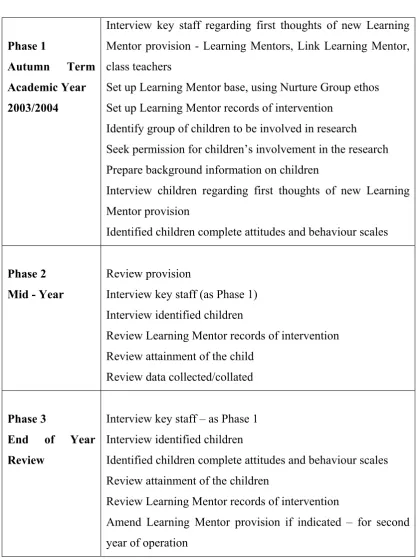
linked phases of data collection to be used to map the impact of the change in the provision of learning mentorship.
Table 3:1 - Part 3 of the Research Plan
Phase 1
Autumn Term Academic Year 2003/2004
Interview key staff regarding first thoughts of new Learning Mentor provision - Learning Mentors, Link Learning Mentor, class teachers
Set up Learning Mentor base, using Nurture Group ethos Set up Learning Mentor records of intervention
Identify group of children to be involved in research Seek permission for children’s involvement in the research Prepare background information on children
Interview children regarding first thoughts of new Learning Mentor provision
Identified children complete attitudes and behaviour scales
Phase 2 Mid - Year
Review provision
Interview key staff (as Phase 1) Interview identified children
Review Learning Mentor records of intervention Review attainment of the child
Review data collected/collated
Phase 3
End of Year Review
Interview key staff – as Phase 1 Interview identified children
Identified children complete attitudes and behaviour scales Review attainment of the children
Review Learning Mentor records of intervention
Chapter 4 – Clarifying the Scope of the Research
Following the review of learning mentorship, and the identification of the use of the team approach for learning mentorship within the primary school based on the nurture group ethos, how the approach would be put into practice was considered and actioned. The way in which this stage progressed will be explored within the first part of this chapter, indeed it is here that it will be demonstrated that although all the adults involved in the review of practice agreed that a team approach was indicated, determining how this would operate in practice presented a huge challenge to the reviewers, including both myself as the instigator of the new approach and the Link Learning Mentor who first suggested it. However, it was this challenge in identifying the practicalities of the approach that led directly to the plan to base the approach on the nurture group ideals; this was discussed and readily accepted and pointed the way to how the approach would be introduced in the school. Therefore, following the initial consideration of putting the approach into practice, the chapter goes on to explore further these ideals and how they were to be adopted by the newly-formed learning mentor team.
team approach could be identified, measured and used to aid the school in continuing to develop its commitment to effective learning mentorship. This chapter will therefore end with a consideration of the range of data that would contribute to the identification and measurement of the effects of the newly-introduced approach, thus establishing the participants in the data collection and specifically to the cohort of pupils that would be integral to the research process.
The Team Approach to Learning Mentorship
appropriate to both the national guidance and to school needs; and yet I continued to question whether this interpretation was suitably far-reaching.
Further guidance to be found within the school’s policy on the role of the learning mentor at this time included the need for the learning mentor to:
• Check on children giving concern, then become involved in the classes assigned to.
• If children are settled then work in classes with a group of children.
• If a child is unsettled, work with the child in the class. Only if the child is very unsettled or disruptive should they be removed from class.
• Children should be removed with a small group of other children, not individually.
• Continue to check throughout the day that all the children are settled and working on class activities.
• Ensure the majority of the learning mentor’s time is spent with children in the classroom environment, this is the essence of inclusion.
• Be concerned with prevention rather than cure, to work regularly with groups of children to prevent incidences of off-task behaviour.
It can also be appreciated here how this school guidance shaped very clearly the teachers’ interpretation of the role of the learning mentor as one that centred on in-class support for children with known behaviour problems, in order to ensure access to class activities. The view held by class teachers that learning mentors were employed solely to deal with behaviour issues was reinforced by the guidance given in bullet point three, that very unsettled or disruptive children should be removed from class. The review carried out by the learning mentors, the Link Learning Mentor and myself acknowledged that the staff presently worked with this guidance and that the move to a proactive approach based on equal access for all pupils may inevitably be viewed as a radical change in interpretation; indeed, although the reviewers considered this to be a most exciting prospect, it was recognised that it might not either be accepted so readily by the staff as an improvement in the provision of learning mentorship nor might bring about improvements in practice. As noted earlier, it was this recognition by the reviewers that firmly identified the provision of learning mentorship as a focus for research.
in the learning mentors’ responses to the question posed at a later stage, “What did you understand by the team approach to your role?”.
‘Well I understood it to literally mean that, to work as a team. Whatever systems we put into place we would …work alongside one another across the school incorporating all year groups…’
This response sums up what I believed was the collective understanding of what
we were trying to achieve through making the changes, but does not begin to address
how we would achieve it. The following response relates much more to the perceived advantages of the approach to the mentors themselves rather than to developing the effectiveness of learning mentorship for the school and its pupils:
I thought it would be easier…as some of these children are quite difficult and it’s quite straining that you’re working with the same children day in, day out.
The third response was even more disappointing as the mentor apparently could not begin to consider the role in practice:
I didn’t actually understand how it was going to work …what we would actually do. I understood that we would all work together, but until it all started I didn’t have a clue if it would work or how it would work.
be available throughout the school and not solely within identified year groups. It was hence these beliefs that were the starting point for shaping the approach in practice.
The Link Learning Mentor continued to be an important factor in the interpretation of the new approach in practice; indeed, it was predominantly his ideas that informed the practicalities of the approach and yet even he acknowledged later he found identifying the components of the approach quite difficult:
I was very excited by it, very excited by it. I must admit… I’ve got a bit of a clearer picture today than where originally I had it in my own head….
In practice, the approach developed over a period of two months in the summer term following the review of learning mentorship at the school. During this time the learning mentor team, as they now became known, the Link Learning Mentor and myself shared ideas and agreed that the approach would provide:
• A central area for the learning mentor team to work out of;
• A commitment to working predominantly out of this central area with in-class support for mentored pupils as needed;
• A team timetable supported by individual, focused timetables;
• Shared learning mentor records;
• An initial cohort of pupils requiring learning mentorship;
• A programme of one-to-one mentoring sessions, group mentoring sessions, focused activities within the learning mentor base supported by in-class mentoring;
• A system for informing staff, parents and pupils of the updated service provided by the mentor team.
Central Area
This provision was arrived at with reference to the learning mentor training materials (Liverpool Excellence Partnership, 2003) and our own thoughts on how learning mentorship should be delivered in the school. At this development stage, the establishment of the dedicated, central learning mentor room was deemed most important to the new approach, as it was here that the learning mentors would be seen
to work as a team and would carry out the proactive work we now believed was vital to effective learning mentorship within the school.
In-class support
Learning mentorship in the central base would be supplemented by in-class support as needed; to aid children in transferring the strategies for learning provided in the learning mentor base. This aspect of the developing provision was described well by one of the learning mentors as:
I like the idea of going to the class, watching, sitting in with the children, and looking at targeted children and pulling children out and talking to them [about how they’re coping].