INITIAL TRUST IN INTERNET BANKING SERVICE IN
JORDAN: MODELING AND INSTRUMENT VALIDATION
1ALI ALJAAFREH, 2AHMED AL-ANI, 3RAID ALADAILEH, 4RASHA ALJAAFREH
1, 2 Faculty of Engineering and Information Technology, University of Technology Sydney, Australia.
3
Faculty of Business Administration, Department of Management Information Systems, Mutah University, Jordan.
4 Ministry of Education, Directorate of Education of Al-Karak, Jordan.
E-mail: 1 [email protected] , 2 [email protected] .au, 3 [email protected], 4
ABSTARCT
As with many other e-services, the adoption rate of Internet banking services (IBS) in developing countries is relatively low compared to developed countries. It is well-established that customer’s trust plays an important role in adopting new technologies, and hence, initial trust could be the first issue that needs to be investigated when studying the adoption of online banking. The aim of this study is to develop and validate a research instrument empirically, and then use it to examine a proposed conceptual model of initial trust for IBS in developing countries. The model’s constructs are integrated from the trust literature, diffusion of innovation theory (DoI), and the Hofstede’s culture theory. This paper also aims to develop and validate a research instrument to examine the research model. We conducted a pilot study in Jordan, one of the developing countries in the Middle East. A survey was carried out, and a total of 75 responses were gathered in the study. The collected data was analyzed using IBM SPSS 22.0. Results of the pilot study are used to validate the instrument and to refine the proposed model. The validated and refined instrument will be used to examine the model in the intended primary study.
Keywords: Initial Trust, Developing Countries, Internet Banking Services, Customer Behavior, National Culture.
1.INTRODUCTION
Banks started offering new communication channels to deliver their services since early 1980’s [1]. Different methods have been used to make the bank’s services more convenient for customers, such as phone banking and internet banking. In the current study, we focus on the adoption of internet banking service (IBS), as that the adoption of IBS offers many advantages such as: saving time and cost, availability of the services at any time, and convenience. For the purpose of this study, we define IBS as the customer’s ability to interact with the bank through its website and perform his/her banking transactions without the need to be physically present at the bank branch.
A study published by Statista.com in April 2012 [2] showed that there is a substantial difference in the adoption rate of IBS between developed and developing countries. The study reported that 45% of the people of North America who browsed the internet in April that year used IBS; compared to, only 8.8% from Middle East and
[image:1.595.300.513.530.627.2]Africa. Table 1 shows the penetration rate of using IBS for different regions of the world.
Table 1. Global Online Banking Penetration [2]
Region Online banking
penetration
North America 45.0%
Europe 37.8%
Worldwide 28.7%
Latin America 25.1%
Asia Pacific 22.0%
Middle East & Africa 8.80%
Regulation Committee (TRC) of Jordan, the
penetration rate of internet in Jordan is quite high. Where based on a study conducted by TRC, 73% of Jordanians use general Internet [5].
Although the internet penetration in Jordan is relatively high and the majority of banks provide IBS through their website, a survey was conducted by the Department of Statistics (DOS) in Jordan indicated that the usage of IBS in Jordan was only 1.8% in 2012 (DOS 2012). Previous studies argued that many factors affect the penetration rate of using new technological innovations; and they have particularly considered trust to be the most influential factor to adopt new innovations [6], and IBS in particular [7]. Accordingly, banks should firstly seek to increase their customers’ trust in IBS to increase the rate of IBS adoption.
A number of studies that discussed the general effect of trust on the adoption of IBS adoption can be found in the literature [8]. However, only few studies investigated the effect of initial trust in IBS in developing countries [9]. To the best of our knowledge, the adoption of IBS from an initial trust perspective has not been investigated in the Jordanian context before [10]; thus, this study aims to fill the gap by proposing a unified theoretical as well as practical framework to understand and identify the factors that affect Jordanians’ initial trust in IBS. Also, this study develops and validate research instrument (questionnaire) to examine the proposed model.
More precisely, in this study, we propose a conceptual model and refine it based on the outcomes of the pilot study. This study also develops and validates an instrument that will be used in the main study.
This paper is organized as follows. Section 2 and section 3 provide a background and a review of related studies. Section 4 presents the research model and the developed instrument of this research. Section 5 presents the instrument development. Section 6 presents the methodology and the pilot study with its major results. Section 7 discusses the outcomes of the pilot study. Finally, the paper rounds off with a conclusion.
2.THEORETICAL BACKGROUND
In this section we discuss trust formation, trust antecedents, and other theories such as diffusion of innovation theory and national culture theory.
2.1.Trust Formation
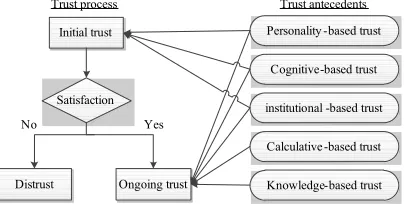
Trust has two different types, which are: ongoing trust and initial trust. In one hand, Gefen, Karahanna [11] stated that ongoing trust requires previous experience and takes relatively long time to be formed. On the other hand, initial trust is a temporary stage of trust which is formed in a short period of time [12]. It is defined as the status quo in which customer trusted an unfamiliar e-vendor [6] without any previous experience [13]. The transmission from initial trust to ongoing trust depends on a decision making process that is made by the consumer according to his/her satisfaction.
Gefen, Karahanna [11] defined a trust lifecycle for consumer’s purchasing behavior, and stated that the first stage of the trust lifecycle is the initial trust, which comes before the purchasing behavior. Decision making process will take place after the first purchase, which determines the level of customers’ satisfaction with his/her first purchase. If the customer is satisfied with the first purchase, then the final stage of the trust lifecycle is achieved and the customer will engage with an ongoing trust stage; however, if he/she is not satisfied, then the customer will distrust the product.
2.2Trust Antecedents
To date, five antecedents of trust have been introduced: Personality-based trust, cognition-based trust, institution-based trust, calculative-based trust, and Knowledge-based trust, [11, 14]. Below is a brief description of these antecedents.
2.2.1Personality-based trust:
initial trust can be built based on the
personality-based trust that the individual has.
2.2.2Cognition-based trust:
As personality-based trust, cognition-based trust is important in forming initial trust in the absence of firsthand experience. It represents the way that trust is formed during the first impression or meeting rather than firsthand knowledge or previous interaction (Meyerson et al. 1996). Cognitive-based trust is formed through a categorization process and illusion of control (McKnight et al. 1998). They also added that the categorization process proposes that individuals trust those who have similarity to them more than others and evaluate trustworthiness based on unit grouping (high trusting beliefs toward another from the same group), stereotyping (positive stereotyping lead to positive trusting beliefs), and reputation categorization (high reputation for one leads to high trust beliefs on that one). Both subcomponents, unit grouping and stereotyping, have been explored in previous studies and found to be related to the personal interaction. Li et al. (2008) examined the influence of cognition-based trust (reputation component) on trusting beliefs and excluded the other components. They justified the exclusion of unit grouping and stereotyping by the nature of their study which focused on users who have no previous observations of the system.
2.2.3Institutional-based trust:
This antecedent supposes the customer will has trust in the product or service provided by the provider if it fits a common standard [18]. Two institutional predictors of initial trust have been introduced [16]; situational normality and structural assurance. According to Baier [19] and Lewis and Weigert [20], situational normality means that the normality of such a situation make someone believe that his/her order is in a proper environment and will succeed. Structural assurance means that the existence of structures such as guarantees, regulations, rules, polices, security, legal resources, or other procedures will increase and promote success [16, 21]. Accordingly, if the provider provides significant cues and evidence that the situation is normal, then the customer will use these cues to build his/her trust in a short period of time [13].
2.2.4Calculative-based trust:
Also called economic-based trust, in this antecedent trust is built based on logical analysis
and rational assessment of the cost and benefits of the provider cheating or cooperating in the relationship [22]. Accordingly, calculative-based trust takes place on an existing (i.e. ongoing) relationship between two parties (i.e. customer and provider); thus, calculative –based trust is considered as a source of ongoing trust [11].
2.2.5Knowledge-based trust:
Knowledge or experience-based trust is the base in which the customer uses a firsthand data and/or his previous experiences with the provider to build his trust [11, 13, 23]. Obviously, knowledge-based trust is used when the relationship between the parties is already existed; so it is a source for ongoing trust. Moreover, knowledge-based trust does not suite individuals without firsthand knowledge or previous experience of an unknown or unfamiliar provider [16].
According to the above, personality-based trust, cognitive-based trust, and institutional-based trust may have influence on initial trust; however, all of these antecedents can be considered to be move related to ongoing trust. Figure 1, adapted from [13], explains the steps of trust formation with the antecedents considered as a source for each trust type.
Personality -based trust
Cognitive-based trust
institutional -based trust
Calculative -based trust
Knowledge-based trust Initial trust
Satisfaction
Distrust Ongoing trust
Trust antecedents Trust process
[image:3.595.307.509.470.572.2]Yes No
Figure 1: Trust Antecedents and Formation Process
2.3Diffusion of Innovation Theory
Innovation is defined as “ idea, practice, or object that is perceived as new by an individual or other unit of adoption” [24]. The diffusion of innovation theory (DoI) is used to discuss new technological
innovations based on the innovation’s
characteristics [25], and it has been applied to the adoption of IBS [26]. Rogers [24] introduced five
characteristics of new innovation: relative
DoI with factors from the trust literature to examine
initial trust formation in IBS [9, 27, 28]. 2.4National Culture
The human culture has been associated with a number of disciplines, such as anthropology, sociology, politics and psychology Hofstede [29] defined culture as “the collective programming of the mind which distinguishes the members of one group or category of people from another”.
According to Leidner and Kayworth [30], the Hofstede culture theory is the most used culture theory in the field of management information systems. The dimensions of Hofstede’s theory are: Power distance index (PDI), Uncertainty avoidance index (UAI), Individualism vs. collectivism (IDV), Masculinity vs. femininity (MAS), and Long-term vs. short-term orientation (LTO).
3.LITERATURE REVIEW
Initial trust is important for establishing new relationship between two entities and adopting new innovations in a poor firsthand knowledge and previous experience context [6]. In this section, we present the importance of initial trust in online environment.
In the context of online environment, the two engaged parties in a new relationship are users or customers who represent the trustor part and unknown e-vendor or new technological innovation or system which represent the trustee part. Initial trust is defined as the level of trust the trustor has before starting the relationship and before building the attitude on that relationship [6].
Initial trust has been considered as prerequisite for economic and social interactions [15, 20]. In online environment, initial trust has been addressed as crucial for: dealing with an unknown vendor [6], new and unfamiliar systems [14], ecommerce [31-33], e-government [34], and IBS and mobile banking services [7, 9, 27].
A systematic literature review of 21 studies was conducted by [35] showed some facts regarding previous studies in the context of initial trust in online environment. Firstly, most of the reviewed studies were conducted in developed countries; while only a small number of studies were conducted in developing countries. Secondly, most of the studies focused on online retailing, while technological innovation, such as
e-government [36], IBS [9], or mobile banking services [27] received little attention. Thirdly, large portion of the studies conceptualize their models based on a combination between technology theories and the trust literature.
Although the literature has widely investigated initial trust in online environment, a small number of studies focused on initial trust within the banking sector. In this study, we focuses on initial trust in IBS; therefore, the research model aims to extend previous models that investigate initial trust in online banking. The literature provides two studies that investigated initial trust in IBS [7, 9], and one study in mobile banking services [27]. Factors of the models presented in these studies will be examined when constructing our proposed model of initial trust.
Kim and Prabhakar [7] examined the impact of propensity to trust (personality-based trust), structural assurance (institutional-based trust), and word of mouth referrals (part of users’ culture). They found that these factors are significant predictors for initial trust in e-channels. Kim, Shin [27] extended the work of [7] to examine initial trust in mobile banking services. In addition to propensity to trust and structural assurance, they added a reputation and relative advantages which is one of the DoI characteristics. Results indicated that relative advantages (benefits), propensity to trust, structural assurance are significant predictors for initial trust in mobile banking services. Finally, Susanto, Lee [9] conceptualized a model of initial trust in IBS in Indonesia, which is one of the developing countries. They examined propensity to trust, relative advantages, and reputation from the previous models and added perceived security and perceived privacy instead of structural assurance, website usability, and government support. The findings show that all of the examined factors are significant predictors for initial trust in IBS. The following section explains the model component and development.
4.RESEARCH MODEL
assurance, reputation, relative advantages,
perceived security, and perceived privacy. It also includes new factors from the boarder literature, such as: organizational situational normality, dividing structural assurance into organizational structural assurance and technical structural assurance to guarantee deep analysis in both aspects. Also, the model includes new elements such as national culture dimensions, compatibility of the service, and computer and internet self-efficacy. Figure 2 shows the models’ elements and their relationships.
Trust antecedents
• Disposition to trust.
• Organisational structural assurance.
• Technical structural assurance.
• Organisational situational normality.
• Reputation.
Diffusion of innovation theory factors •Relative advantages of IBS.
•Compatibility of IBS.
National culture dimensions • Uncertainty avoidance.
• Power distance.
• Masculinity/femininity.
• Individualism/ collectivism.
• Long term/short term orientation.
Internet related factors •Computer and internet self-efficacy.
•Perceived security.
•Perceived privacy.
Initial trust in IBS
Intention to use IBS
Figure2: The Research Model: Proposed By the Researchers.
The model contains the following constructs: intention to use IBS, initial trust in IBS, trust antecedents constructs, diffusion of innovation constructs, national culture dimensions, and internet related constructs. The model is conceptualized based on: initial trust literature, information system adoption studies that have been conducted in developing countries, and certain characteristics of developing countries, especially national culture.
The model has three parts: predictors of initial trust in IBS, initial trust in IBS, and intention to use IBS. Initial trust in IBS is mediating the relationships between the predictors and intention to use IBS. Most of the relationships in this model have been examined previously; however, in this study, we will investigate them in new context which has never been examined before with initial trust in IBS. The significance of our study is represented by building a unified model to investigate initial trust issue from the point view of different disciplines. Relationships between the
model constructs will be summarized in the following sections.
4.1Relationship between Initial Trust and Intention to Use
Generally, initial trust is found to have a positive effect on the individual behavior such as intention to use. In the context of online environment, many researchers have investigated initial trust and agreed on the positive relationship between the individual’s initial trust and his/her behavior to adopt, accept, intention to use or to deal with the trustee part [6, 7, 9, 11, 13, 14, 16, 23, 27, 31, 33, 36-45]. In the context of online banking, the literature shows that initial trust significantly influence the customer’s behavior to adopt IBS. For example, Kim and Prabhakar [7] found that customer’s initial trust in e-channel significantly influence his/her intention to adopt internet banking. Kim, Shin [27] have also reached similar findings when they studied the relationship between initial trust and intention to adopt mobile banking. Their major results of their study indicated that the level of initial trust a customer has in mobile banking is positively associated with his/her intention to adopt it. Recently, Susanto, Lee [9] agreed with previous literature and stated that the degree of one’s initial trust in Internet banking is positively correlated with his/her intention to use.
4.2Initial Trust Predictors with Initial Trust
We provide an explanation for the independent variables, their definitions, and empirical evidences that these factors have significant effect on initial trust. This information is shown in Table 2.
5.INSTRUMENT DEVELOPMENT
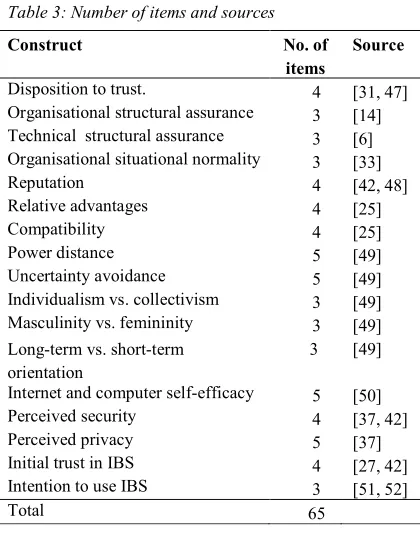
Table 3: Number of items and sources
Construct No. of
items
Source
Disposition to trust. 4 [31, 47] Organisational structural assurance 3 [14] Technical structural assurance 3 [6] Organisational situational normality 3 [33]
Reputation 4 [42, 48]
Relative advantages 4 [25]
Compatibility 4 [25]
Power distance 5 [49]
Uncertainty avoidance 5 [49] Individualism vs. collectivism 3 [49] Masculinity vs. femininity 3 [49] Long-term vs. short-term
orientation
3 [49]
Internet and computer self-efficacy 5 [50] Perceived security 4 [37, 42] Perceived privacy 5 [37] Initial trust in IBS 4 [27, 42] Intention to use IBS 3 [51, 52]
Total 65
6.METHODOLOGY
6.1The Pilot Study
It is well-established that performing a pilot study helps researchers in terms of refining the research instrument and increasing the accuracy of the method and the anticipating results [53, 54]. For instance, De Vaus [54] says “Do not take the risk, pilot study first”. Further, performing a pilot study helps in refining the research instrument and increasing the accuracy of the method and the anticipated results.
In this pilot study, the methodology has been started with validating the content of the instrument using face, content, and constructs validity. Then, we conduct detailed item analysis (person’s correlation) techniques to find the correlation between variables in order to remove redundant variables. Finally, a reliability test is used to clean up and optimize the measure of each variable.
6.2Participants
In this study, a convenient sample composed of 75 Jordanian citizens was surveyed. The returned surveys were 63, which compose 84% survey response rate. From those, seven were exempted, as three of the respondents had already used IBS in Jordan, and four surveys were filled arbitrarily. Therefore, 56 surveys were usable. 33% of the respondents were females (58.9%) and 23 were
males (41.1%). Most of the respondents working in the public sector (89.3%). Large portion of the respondents had considerable level of experience in using computer, (67.9% had more than 5 years of experience). Moreover, 53.6% of them used the internet at least once a day. However, only 8.9% of the respondents performed an online transaction.
6.3Validity and Reliability
Instrument validity process is essential before conducting the main survey. Generally, different types of validity are used to assess whether the instrument is valid: face, content, criterion, and construct validity. However, Sekaran [55] pointed that face validity is the base of the other types. Face validity is defined as the level in which a group of measurement items represent the concept under investigation.
To assess the validity of the instrument under study; we sent the instrument to four PhD students and four experts in the field of management information system. The process started by sending the questionnaire to the PhD students, who were asked to provide feedback on the wording of the items and their clarity level. The items were refined based on the received comments and sent to the four experts to examine if the items properly represented the variables and their degree of ambiguity and redundancy. Finally, the instrument has been modified based on the experts’ comments. After that, we sent the instrument (questionnaire) to a translator who was related to the study area. The translator was asked to translate the questionnaire to Arabic (the first language in Jordan), and then from Arabic to English to ensure consistency between the original questionnaire and the one resulted from translating the obtained Arabic questionnaire back to English.
According to Sekaran [55], reliability of a
research instrument is concerned with its
consistency and stability. Inter-item consistency (also known as internal consistency) of a group of items reflects the degree to which this group is homogeneous. To examine the internal consistency of the research instrument, we employ Cronbach’s alpha [56], as it has been widely adopted by many researchers [57].
current study, results of the reliability function are [image:7.595.83.287.340.529.2]
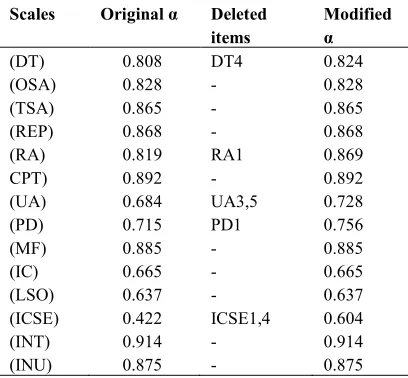
used to refine the research instrument. We assessed the items of the instrument, if the results revealed that one or more of the items decrease the reliability of the instrument, they were removed. Malhotra [58] considered a value of Cronbach’s alpha more than 0.6 as a satisfactory level, even though many researchers determined 0.7 as a cut-off for the accepted reliability. Moreover, to increase the reliability of a variable’s items, we used the “if item deleted” function to find the item with the lowest correlation with other items in the same group. Table 4 shows the value of Cronbach’s alpha and the number of items that measure a specific variable before and after applying the “if item deleted” function.
Table 4: Reliability Coefficient of Scales
Scales Original α Deleted items
Modified α
(DT) 0.808 DT4 0.824
(OSA) 0.828 - 0.828
(TSA) 0.865 - 0.865
(REP) 0.868 - 0.868
(RA) 0.819 RA1 0.869
CPT) 0.892 - 0.892
(UA) 0.684 UA3,5 0.728
(PD) 0.715 PD1 0.756
(MF) 0.885 - 0.885
(IC) 0.665 - 0.665
(LSO) 0.637 - 0.637
(ICSE) 0.422 ICSE1,4 0.604
(INT) 0.914 - 0.914
(INU) 0.875 - 0.875
6.4Data Analysis
The Pearson’s correlation coefficient reflects the strength of linear relationship between two variables. Thus, measuring the correlation between factors will help in determining the level of correlation between every variable pair; and consequently, will enable us to identify redundant factors. Statistically, correlation is denoted by r (-1 ≤ r ≤ +1). Sekaran [55] stated that “if correlations were higher (say, .75 and above), we might have had to suspect whether or not the correlated variables are two different and distinct variables ...” Accordingly, if the correlation is greater than .75, then the variables might not considered to be different and hence can be combined.
The correlation coefficient analysis of our data revealed that few variables have high correlation between them as follows:
• The correlation between technical
structural assurance and security is .867.
• The correlation between technical
structural assurance and privacy is .871.
• The correlation between organizational
structural assurance and organizational situational normality is .877.
Based on these results, we combined the two variables that were found to be highly correlated to avoid redundancy and multicollinearity.
7.DISCUSSION
The current paper has twofold: firstly it proposes a model of initial trust in IBS in the context of developing countries. The proposed model extends the previous models, which examined initial trust in IBS [7, 9] or mobile banking [27]. The model’s factors are mainly extracted from existing related models, as well as from the literature of initial trust and IT/IS adoption. In spite of the similarity between our model and previous models, our model has many distinctions. The model discusses initial trust in IBS in the context of developing countries where there is hardly any thorough study in this context. In addition, our model adds the crucial and important factor of national culture. Literature of IT/IS in developing counties showed the importance of national culture in adopting new technological innovations [59]. Also, the proposed model integrates factors from different perspectives such as psychological, technological, social, and organizational.
technical structural assurance to represent perceived
security and perceived privacy such as [60], where they named this variable “trust in the internet”.
Secondly, this paper shows the steps of developing an instrument to examine our research model. All the instrument’s items are adopted or adapted from existing empirical studies. After we created a pool of items, we validated the content of our instrument using the validity types: face, content, and construct validity. Further, we conducted the pilot study using the instrument and collected data from 56 subjects and analyzed it. Based on the reliability test results, we deleted some items to increase the value of Cronbach’s alpha.
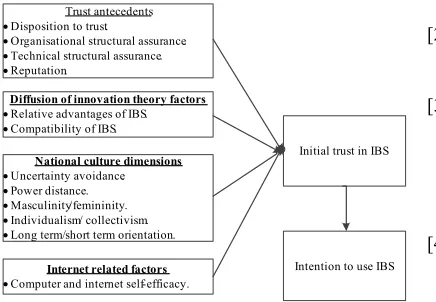
In summary, the results of the pilot study helped us in to achieve the aims of this paper. We refined the proposed model by combining the high correlated variables. Also, the instrument of this study has been validated in order to use it in the main study. Lastly, the results decreased the number of the items from 65 to 46. Figure 3 explains the new model after refining it.
Trust antecedents
• Disposition to trust.
• Organisational structural assurance.
• Technical structural assurance.
• Reputation.
Diffusion of innovation theory factors • Relative advantages of IBS.
• Compatibility of IBS.
National culture dimensions •Uncertainty avoidance.
•Power distance.
•Masculinity/femininity.
•Individualism/ collectivism.
•Long term/short term orientation.
Internet related factors •Computer and internet self-efficacy.
Initial trust in IBS
[image:8.595.87.305.428.579.2]Intention to use IBS
Figure 3: The Revised Model
8.CONCLUSION
This paper proposed a conceptual model of customer’s initial trust in IBS in developing countries. The model included factors from different disciplines and perspectives, these includes trust antecedents (disposition to trust,
organizational structural assurance, technical
structural assurance, organizational situational normality, and reputation), diffusion of innovation
factors (relative advantages, compatibility),
national culture factors (uncertainty avoidance,
power distance, masculinity/femininity,
individualism/collectivism, long term/short term orientation), and internet related factors (Computer and internet self-efficacy, perceived security, perceived privacy). In addition, we developed an instrument to analyze the model’s factors. The first version of the instrument has 65 items, which were reduced to 46 after analyzing the data of the pilot study. The final version of the instrument will be used to conduct our main study.
The major contributions of this paper are: Firstly, we developed a research instrument (questionnaire) and validated it empirically. Secondly, developing a unified model based on different disciplines and perspectives, and refining this model based on the empirical results of the pilot study. The validation process was started with content, face, and construct validity using experts in the field. Then, we used a statistical package (SPSS) to analyze the collected data and find the reliability of the questionnaire.
REFERENCES:
[1] Bidgoli H. The internet encyclopedia. New York: John Wiley and Sons; 2004.
[2] Statista c. development of global online banking penetration in April 2012 by region (percent) 2012.
[3] Awamleh R, Evans J, Mahate A. Internet Banking in Emergency Markets: The Case of Jordan – a note2003 20 September 2012; 8(1).
Available from:
http://www.arraydev.com/commerce/JIBC/0306 -03.htm.
[4] Al-Jaafreh A, Gill A, Al-Ani A, Al-adaileh R. Factors Influencing Customer’s Initial Trust of Internet Banking Services in the Jordanian Context: A Review. The 22nd International Business Information Management Association
(IBIMA): Creating Global Competitive
Economies: 2020 Vision Planning &
Implementation; 13,14-11-2013; Rome, Italy. USA: IBIMA Publishing; 2013. p. 281-8.
[5] TRC. Quarterly indicator Jordan
Telecommunications Regulatory Commission; 2014 [cited 2014 22/05/2014]. Available from: http://www.trc.gov.jo/index.php?option=com_c ontent&task=view&id=2599&Itemid=508&lan g=english&lang=english&lang=english. [6] McKnight H, Choudhury V, Kacmar C. The
Model. The Journal of Strategic Information
Systems. 2002;11(3):297-323.
[7] Kim KK, Prabhakar B. Initial Trust and the Adoption of B2C E-Commerce: The Case of Internet Banking. ACM sigmis database. 2004;35(2):50-64.
[8] Yousafzai S, Pallister J, Foxall G. Multi-Dimensional Role of Trust in Internet Banking Adoption. The Service Industries Journal. 2009;29(5):591-605.
[9] Susanto A, Lee H, Zo H, Ciganek AP. User Acceptance of Internet Banking in Indonesia:
Initial Trust Formation. Information
Development. 2013:1-14.
[10] Aljaafreh A, Gill A, Al Ani A, editors. TOWARDS THE DEVELOPMENT OF AN
INITIAL TRUST MODEL FOR THE
ADOPTION OF INTERNET BANKING
SERVICES IN JORDAN. The 18th Pacific Asia Conference on Information Systems (PACIS
2014); 2014; Chengdu, China:
http://aisel.aisnet.org/pacis2014/256.
[11] Gefen D, Karahanna E, Straub DW. Trust and TAM in Online Shopping: an Integrated Model. MIS quarterly. 2003;27(1):51-90.
[12] Kim E, Tadisina S. A model of customers' trust in e-businesses: micro-level inter-party trust formation. Journal of Computer Information Systems. 2007;48(1):88-104.
[13] Kim JB. An Empirical Study on Consumer First
Purchase Intention in Online Shopping:
Integrating Initial Trust and TAM. Electronic Commerce Research. 2012;12(2):125-50. [14] Li X, Hess TJ, Valacich JS. Why Do We Trust
New Technology? A Study of Initial Trust Formation with Organizational Information Systems. The Journal of Strategic Information Systems. 2008;17(1):39-71.
[15] Mayer RC, Davis JH, Schoorman FD. An integrative model of organizational trust.
Academy of management review.
1995;20(3):709-34.
[16] McKnight DH, Cummings LL, Chervany NL. Initial Trust Formation in New Organizational
Relationships. Academy of Management
review. 1998:473-90.
[17] Rotter JB. Generalized Expectancies for Interpersonal Trust. American psychologist. 1971;26(5):443-52.
[18] Bahmanziari T, Odom MD, Ugrin JC. An experimental evaluation of the effects of internal and external e-Assurance on initial trust formation in B2C e-commerce. International
Journal of Accounting Information Systems. 2009;10(3):152-70.
[19] Baier A. Trust and Antitrust. Ethics.
1986;96(2):231-60.
[20] Lewis JD, Weigert A. Trust As a Social Reality. Social forces. 1985;63(4):967-85.
[21] Shapiro SP. The Social Control of Impersonal
Trust. American journal of Sociology.
1987:623-58.
[22] Shapiro DL, Sheppard BH, Cheraskin L. Business on a Handshake. Negotiation journal. 1992;8(4):365-77.
[23] Doney PM, Cannon JP, Mullen MR.
Understanding the Influence of National Culture on the Development of Trust. Academy of Management review. 1998:601-20.
[24] Rogers EM. Diffusion of innovations. New York: Free press; 1995.
[25] Moore GC, Benbasat I. Development of an instrument to measure the perceptions of adopting an information technology innovation. Information systems research. 1991;2(3):192-222.
[26] Malek ALM. The Use of Theory Reasoned of Action to Study Information Technology in Jordan. Journal of Internet Banking and Commerce. 2011;16(2).
[27] Kim G, Shin B, Lee HG. Understanding dynamics between initial trust and usage intentions of mobile banking. Information Systems Journal. 2009;19(3):283-311.
[28] Lin J, Lu Y, Wang B, Wu S. Initial Trust and Adoption of Mobile Brokerage Service.
International Journal of Mobile
Communications. 2011;9(2):124-43.
[29] Hofstede G. Cultures and organizations: software of the mind. New York: McGraw-Hill; 1997.
[30] Leidner DE, Kayworth T. Review: A Review of Culture in Information Systems Research: Toward a Theory of Information Technology
Culture Conflict. MIS quarterly.
2006;30(2):357-99.
[31] Gefen D. E-commerce: The Role of Familiarity and Trust. Omega. 2000;28(6):725-37.
[32] Gefen D, Straub DW. Consumer Trust in B2C E-commerce and The Importance of Social Presence: Experiments in products and E-services. Omega. 2004;32(6):407-24.
[33] McKnight H, Choudhury V, Kacmar C. Developing and Validating Trust Measures for
Information systems research.
2002;13(3):334-59.
[34] Carter L, Bélanger F. The utilization of e‐ government services: citizen trust, innovation and acceptance factors*. Information Systems Journal. 2005;15(1):5-25.
[35] Al-Jaafreh A, Gill A, Al-Ani A, Al-adaileh R. A Review of Literature of Initial Trust in E-Services: The Case of Internet Banking Services in the Jordanian Context. Journal of
Electronic Banking Systems.
2014;2014(2014):10.
[36] Alsaghier H. An Investigation of Critical
Factors Affecting Citizen Trust in
E-Government: Empirical Evidence from Saudi Arabia. [PhD]. Australia2010.
[37] Chen Y-H, Barnes S. Initial Trust and Online Buyer Behaviour. Industrial Management & Data Systems. 2007;107(1):21-36.
[38] Eastlick MA, Lotz S. Cognitive and
Institutional Predictors of Initial Trust Toward an Online Retailer. International Journal of
Retail & Distribution Management.
2011;39(4):234-55.
[39] Gefen D, Heart TH. On the Need to Include National Culture as a Central Issue in E-commerce Trust Beliefs. Journal of Global
Information Management (JGIM).
2006;14(4):1-30.
[40] Kim E, Tadisina S. A model of customers' initial trust in unknown online retailers: an empirical study. International Journal of Business Information Systems. 2010;6(4):419-43.
[41] Kim H-W, Xu Y, Koh J. A Comparison of
Online Trust Building Factors Between
Potential Customers and Repeat Customers. Journal of the Association for Information Systems. 2004;5(10):392-420.
[42] Koufaris M, Hampton-Sosa W. The
Development of Initial Trust in an Online Company by New Customers. Information & Management. 2004;41(3):377-97.
[43] Wu I-L, Chen J-L. An Extension of Trust and TAM Model With TPB in The Initial Adoption
of On-line Tax: An Empirical Study.
International Journal of Human-Computer Studies. 2005;62(6):784-808.
[44] Zhou M, Tian D. An Integrated Model of Influential Antecedents of Online Shopping Initial Trust: Empirical Evidence in a Low-Trust Environment. Journal of International Consumer Marketing. 2010;22(2):147-67.
[45] Zhou T. An Empirical Examination of Initial Trust in Mobile Banking. Internet Research. 2011;21(5):527-40.
[46] Ajzen I, Fishbein M. Understanding attitudes and predicting social. Behaviour Englewood Cliffs, NJ: Prentice-Hall. 1980.
[47] Lee MK, Turban E. A Trust Model for Consumer Internet Shopping. International Journal of electronic commerce. 2001;6:75-92. [48] Jarvenpaa SL, Tractinsky N, Vitale M.
Consumer Trust in an Internet Store.
Information Technology and Management. 2000;1(1/2):45–71.
[49] Al Sukkar A, Hasan H. Toward a model for the acceptance of internet banking in developing
countries. Information Technology for
Development. 2005;11(4):381-98.
[50] Wang AY, Newlin MH. Predictors of web-student performance: the role of self-efficacy and reasons for taking an on-line class.
Computers in Human Behavior.
2002;18(2):151-63.
[51] Suh B, Han I. The impact of customer trust and perception of security control on the acceptance of electronic commerce. International Journal of electronic commerce. 2003;7:135-61.
[52] Venkatesh V, Davis FD. A theoretical extension of the technology acceptance model: four longitudinal field studies. Management science. 2000;46(2):186-204.
[53] Baker TL, Risley AJ. Doing Social Research. New York: McGraw-Hill 1994.
[54] De Vaus D. Research design in social research. London: UCL Press; 1993.
[55] Sekaran U. Research Methods for Business: A skill building approach. John Wiley and Sons Inc, New York. 2003.
[56] Nunnally JC. Psychomtietric Theory. New York: McGraw-Hill; 1978.
[57] Crocker L, Algina J. Introduction to Classical and Modern Test Theory: ERIC; 1986.
[58] Malhotra NK. Marketing Research: An Applied Orientation, 5/E: Pearson Education India; 2008.
[59] Al-Hujran O, Al-dalahmeh M, Aloudat A. The Role of National Culture on Citizen Adoption of E-government Services: An Empirical Study.
Electronic Journal of E-Government.
2011;9(2):93-106.
centric approach. Information Technology &
People. 2012;25(2):207-34.
[61] Yousafzai SY, Pallister J, Foxall GR. Strategies for Building and Communicating Trust in Electronic Banking: A Field Experiment. Psychology & Marketing. 2005;22(2):181-201. [62] Li X, Hess TJ, Valacich JS. Using Attitude and
Social Influence to Develop an Extended Trust Model for Information Systems. ACM sigmis database. 2006;37(2-3):108-24.
[63] Doney PM, Cannon JP. An examination of the nature of trust in buyer-seller relationships. the Journal of Marketing. 1997:35-51.
[64] Shih YY, Fang K. The use of a decomposed theory of planned behavior to study Internet
banking in Taiwan. Internet Research.
2004;14(3):213-23.
[65] An D, Kim S. Effects of National Culture on the Development of Consumer Trust in Online Shopping. 2008.
[66] Azam A, Qiang F, Abdullah MI, editors. Consumers' E-commerce Acceptance Model:
Antecedents of Trust and Satisfaction
Constructs. Business Engineering and Industrial Applications Colloquium (BEIAC), 2012 IEEE; 2012: IEEE.
Table 2: Factors’ Definitions and Relations with Initial Trust
Construct Definition Significant with initial trust
Disposition to trust (DT)
A propensity or tendency to believe in the positive attributes of others in general[33]
[6-9, 11, 15, 16, 27, 40, 45]
Organizational structural assurance
(OSA)
Safeguards such as promises, contracts, regulations, and guarantees are in place [14]
[14, 61]
Technical structural assurance
(TSA)
The belief that the web has protective legal or technical structures that assure that web business can be conducted in a safe and secure manner[6]
[6, 7, 11, 14, 27, 28, 33, 45, 62]
Organizational situational normality (OSN)
The belief that success is likely because the situation is normal[16]
[14]
Reputation (REP) The extent to which buyers (customers)
believe a selling organization (banks) is honest and concerned about its customers[63]
[8, 14, 27, 28, 38]
Relative advantages (RA)
The degree to which an innovation is perceived as being better than the idea it supersedes[24]
[9, 27]
Compatibility (CPT)
The degree to which an innovation is perceived as consistent with the existing values, past experiences, and needs of potential adopters[24]
[28]
Power distance
index (PDI)
The extent to which the less powerful members of organizations and institutions (like the family) accept and expect that power is distributed unequally[64]
[23, 39, 65]
Uncertainty
avoidance index
(UAI)
The extent to which the members of a culture feel threatened by uncertain or unknown situations[64]
[23, 39, 65]
Individualism vs. collectivism(IDV)
The extent to which individuals are integrated into groups[64]
[23, 39, 65]
Masculinity vs.
femininity (MAS)
The extent to which gender roles are assigned in a culture[64]
[23, 39, 65]
Long-term vs.
short-term orientation (LTO)
A society’s preference to be more forward looking or future oriented[64]
[23, 39, 65]
Perceived security (PS)
The level in which the users feel that their information on the internet is secure
[8, 9, 14, 33, 37, 42, 66]
Perceived privacy (PP)
The level in which the users feel that their information on the internet is private
[8, 9, 14, 33, 38, 66]
Computer and
internet self-efficacy (CISE)
An individual’s perception of his or her ability to use computer (and internet) in the accomplishment of a task[67]
APPENDIX 1. SURVEY ITEMS
Disposition to trust [31, 47]
1. a. I feel that people are generally reliable.
2. b. I generally have faith in humanity.
3. c. I generally trust other people unless they give me reason not to.
Organizational Structural Assurance
4. a. I feel assured that legal structures adequately protect me from any problem
with bank services.
5. b. I feel confident that regulations, laws, and social norms make it safe for me
to use bank services.
6. c. In general, bank services are robust and safe.
Technical Structural Assurance [6]
7. a. The Internet has enough safeguards to make me feel comfortable using it to
transact personal business
8. b. I feel assured that technological structures, such as encryption of data,
provide adequate level of protection when using Internet Banking Services.
9. c. The technological structures ensure privacy when using Internet Banking
Services.
10. d. In general, the Internet is now a robust and safe environment in which to transact business.
Reputation [42, 48]
11. a. My bank is well-known. 12. b. My bank has a good reputation. 13. c. My bank is recognized widely. 14. d. My bank offers good services.
Uncertainty Avoidance [49]
15. a. It is important to have job requirements and instructions spelled out in details so that people always know what they are expected to do.
16. b. Rules and regulation are important because they inform workers what the organization expects of them.
17. c. Order and structure are very important in a work environment.
18. d. Working in structural environment is better than working (rules and regulations) in an unstructured work environment.
Power Distance [49]
19. a. Managers should make most decision without consulting subordinates. 20. b. Employees should not question their manager’s decision.
21. c. Manager should not ask subordinates for advice, because they might appear less power.
22. d. Decision making power should stay with top management in the organization and not be delegated to lower level employees.
Masculinity vs. Femininity [49]
23. a. It is preferable to have a man in high level positions rather than a woman. 24. b. Men usually solve problems with logical analysis; unlike women who
usually solve problems with intuition
25. c. Solving organizational problems usually requires an active, forcible approach which is typical of men.
Individualism vs. collectivism [49]
27. b. Group success is more important than individual success.
28. c. Working within a team is better than working alone.
Long term vs. short term orientation [49]
29. a. Respect for tradition will not hamper performance. 30. b. The exchange of favours and gifts is not necessary to excel. 31. c. Upholding one’s personal image contributes in goal achievements.
Computer and internet self-efficacy [50]
I could use IBS
32. a. ...if I could call someone for help if I got stuck 33. b. ...if someone else had helped me get started 34. c. ...if someone showed me how to do it first.
Relative advantages [25]
35. a. I believe that internet banking is more convenient than off-line banking. 36. b. I believe that internet banking is more efficient than off-line banking.
37. c. I believe that internet banking is more effective than off-line banking in managing a bank account.
Compatibility [25]
38. a. I think internet banking services fits well with the most aspect of my banking activities.
39. b. I think using internet banking is compatible with my lifestyle.
40. c. I think using internet banking fits well with the way I like to manage my finance
Initial trust [27, 42]
41. a. The bank is trustworthy.
42. b. I believe in the information that the bank provides me.
43. c. I believe that internet banking always provides accurate financial services. 44. d. I believe that internet banking always provides reliable financial services.
Intention to use [51, 52]
45. a. I intend to use Internet Banking Service.
![Table 1. Global Online Banking Penetration [2]](https://thumb-us.123doks.com/thumbv2/123dok_us/8910796.959190/1.595.300.513.530.627/table-global-online-banking-penetration.webp)