ROTATION AND SCALE INVARIANT FEATURE
EXTRACTION FOR MRI BRAIN IMAGES.
1 NAVEEN KISHORE GATTIM, 2 V RAJESH.
1 Research Scholar, Dept. Of Electronics And Communications, K L University (Klef), Vaddeswaram,
Guntur, Ap.
2 Professor, Dept. Of Electronics And Communications, K L University (Klef), Vaddeswaram, Guntur, Ap
E-Mail: [email protected] 2 [email protected]
ABSTRACT
Texture classification of images with varied orientations and scale changes is a challenging and considered to be important in image analysis. Feature extraction can be used to increase the efficiency of texture classification using log polar wavelet energy signatures. For the image to be rotation and scale invariant two major steps are applied which involves applying log polar transform and adaptive row shift invariant wavelet transform. Log polar transform eliminates the rotation and scale effects and causes a row shifted log polar image, which undergoes adaptive row shift invariant wavelet transform to remove the row shift effects. Finally they obtained output wavelet coefficients are rotation and scale invariant. The complexity of O (n log n) is efficient with adaptive row shift invariant wavelet packet transform. From the log polar wavelet energy signatures a feature vector is generated which are extracted from each sub band of wavelet coefficients. In the experiments the features are extracted for images considering different orientation and scale changes and simultaneously experiment is simulated for few wavelet families. The experiment results show the efficiency of few wavelets in extracting the features of a given image. The overall accuracy rate for this approach is 87.05 percent representing that the extracted energy signatures are effective rotation and scale invariant features.
Keywords - Log polar transform, Row shift invariant wavelet transform, Rotation and scale invariance,
Feature extraction.
1. INTRODUCTION
Texture analysis has its importance in pattern recognition of different types of surface texture. It has an extensive range of applications in many practical areas like medical diagnosis, robotic sensing, Industrial monitoring, etc. Recent events of image analysis in time and frequency domains such as Gabor filters, the transformed wavelets and wavelet frames provide good resolution for feature extraction and classification tools. With this approach high accuracy rates can be achieved. The existing methods assumed the images to be with the same texture orientation and scale which is not realistic for most of the practical applications. Taking into consideration the example of the images obtained from scanning photographs, which are usually subject to certain random oblique angles and the photographs of the same objects at different distances cause different scales of objects. The performance of these methods is found inefficient
i.e. they undergo certain random skew angles and the assumption is not valid. Rotation and scale parameters are estimated with the extended 2D Gaussian markov random field (GMRF) model which is explained in Cohen et al. [2] A tuning algorithm which uses a single convolution mask to classify and segment rotated scaled textures was described in You and Cohen [14]. Rotation- invariant features are extracted by multi channel gabor filters. Fountain and Tan [3], Fountain et al. [4], Poter and Canagarajah [9]. Haley and Manjunath [5] explained about rotation-invariant texture classification with space-frequency gabor wavelet model showing a favorable result. However, high computational complexity for feature extraction is required. The discrete wavelet decomposition are combined with opposite energy signatures which are used as features for rotation invariant texture classification as explained by potter and canagarajah [9]. Rajesh and Rajesh Kumar [10] [11] explained the transformation of signals into feature sets and classify the robustness of data using wavelets. Thus the existing algorithms involve high computational complexity and are accurate over a small set of selected image classes. The efficiency of a texture classification/segmentation algorithm can be increased by using a module for feature extraction followed by classification. David G [15] proposed a method for matching objects which is robust to rotation and scale invariance which identifies the objects among clutters.
2. METHODOLOGY
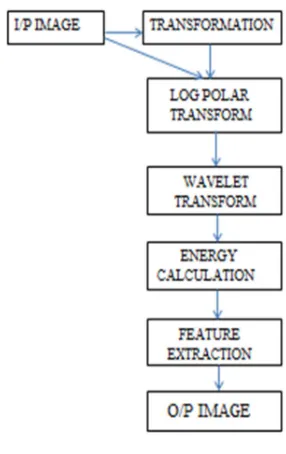
The method followed in this paper is to develop such a module for rotation and scale invariant feature extraction. The rotation and scale invariant feature extraction for a given image involves applying a log-polar transform to eliminate the rotation and scale effects, but at same time produce a row shifted log-polar image. Adaptive row shift invariant packet transform is incorporated to overcome the row shift effects. The adaptive row shift invariant wavelet packet transform is quite efficient with the complexity of O (n log n). A feature vector is generated from the most dominant log-polar wavelet energy signatures which are extracted from each sub band of wavelet coefficients as given in the block diagram fig. 1. In the experiments, the features are extracted for images
[image:2.595.307.450.268.495.2]considering different orientation and scale changes and at the same time the experiment is simulated for different waveletfamilies. The experimental results show the efficiency of few wavelets in extracting the features of a given image. The overall accuracy rate for joint rotation and scale invariance obtained is 87.05 percent demonstrating that the extracted energy signatures are effective rotation and scale invariant features. Concerning its robustness to noise, this extraction scheme performs better than the other methods.
Fig. 1 Block diagram
3. TRANSFORMATIONS
of image due to changes like angle and distance of capturing an image etc
4. LOG POLAR TRANSFORM
Log polar transform is applied to eradicate the rotation and scale effects of the input image. This log polar image is scale invariant and rotation invariant but is row shifted. The log polar transform algorithm is divided into two key steps. In the foremost step, the radius of the largest circle inside the given square image is used as scan line to sample S times from 0 to 360 degrees to create its equivalent S x S [N/2] polar form. Normally polar form p(a,r) of the given N x N image f(x,y) can be explained as follows:
, 2 2πa
S , N2 r sin 2πa
S
For a=0,…., S-1, and r=0,....,[N/2]-1
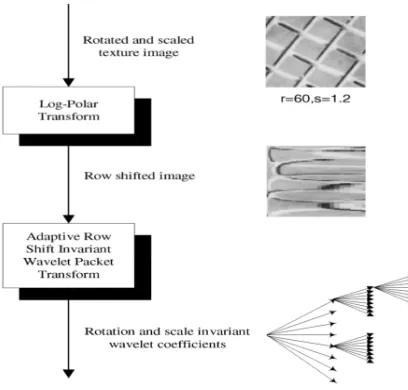
[image:3.595.91.295.503.698.2]The second step performs the logarithm functions where the radii values in the polar form and their outputs are then quantized into R bins. Hence the produced image is S x R log polar image for the given N x N image. The step wise procedure is as given in below fig. 2
Fig. 2 Process of rotation and scale invariant wavelet Coefficients
5. ADAPTIVE ROW SHIFT INVARIENT WAVELET TRANSFORM
In 2D-DWT analysis, an image is split into one approximation image and three detail images and the approximation image is further split into second level approximation image and detail images and this cycle is repeated continuously. Thus for an n level decomposition, there are n+1 levels to encode the image. The advantage of DWT over FFT is that, it can be analyzed in both time and frequency domains. Hence, this is a Multi resolution technique by which different frequencies are analyzed with different resolutions. And also by using this technique smooth and filtered outputs can be obtained.
By applying log polar transform, we get row shifted image .To eliminate these row shifts DWT is considered as its row shift invariant technique. This process computes wavelet coefficients which are used in the calculation of energy signatures
5.1 Log Polar Wavelet Energy Signatures For Rotation And Scale Invariant Images.
Discrete Wavelet Transforms gives the frequency and time locality are represented by wavelets with finite duration and has been found very useful for image investigation. The 1D Discrete wavelet transform uses a high pass and low pass filters that are derived from wavelet functions. The input signal is decomposed into two sub band components: approximation and detailed respectively
The approximation sub band is decomposed recursively to generate the succeeding level of the order. The distinct feature of the original signal can be obtained by using an orthonormal wavelet basis. Although DWT has a major drawback of invariance to the shifting of the input signal due to the dyadic structure of the wavelet expansion, where in 2D DWT have different wavelet coefficients with different rotational and scale changes
these directions which make it very tedious to extract the features of rotation invariant from the wavelet coefficients. In this section an algorithm is implemented for rotation and scale invariant feature extraction which can be obtained by applying a log polar transform and adaptive row shift invariant wavelet packet transform. After applying these two process an energy signature is computed for each sub band of the output rotation and scale invariant wavelet coefficients where the necessary feature extraction process is obtained.
5.2 Rotation And Scale Invariant Wavelet Energy Signature Extraction
In the former step of the process the image is directly given to the log polar transform and then non-linear transformation is done and their energies are calculated for their feature extraction.
Where as in the second step the image is undergone some transformations like rotation and scaling which can give some threshold increase which helps in visualizing the image with more fineness and then the log polar is applied and the remaining process is followed. But as per the process done in second step that is rotation and scaling the image will undergosome changes and the main idea of our project is to develop a model which will give a rotation and scale And then the image is gone for energy calculations and by selecting the more dominant values of the image pixels we will go for comparison with the image pixels of the first step image which is not transformed and will finally show the output image as a rotation and scale invariant image.
In this process we go for log polar transform because it reduces time or complexity when compared to Fourier coefficients as the total butterfly process is involve for FFT. and it is also useful for normalization which is nothing than merging same sort of image pixels that is grouping the pixels with same properties. And also used for removing pre-defined noises like additive white Gaussian noise and whatever the type of noise present in it. And also the process involved here is linear transformation where in the later step that is in wavelet transform the image undergoes some non-linear transformation which in turn helps to take the
pixels randomly for comparing with the first step process involved image.
In the wavelet transformation technique the main advantages are filtered and smooth output and the TOE (Time of Execution) is very less when compared with other transforms and it gives 85% accuracy theoretically and the remaining is due to the mismatch of images. And the total process involved is for feature extraction and these features are extracted by using the wavelet frequencies by considering more dominant values and also by LL, HL, LH, HH frequencies like which in turn gives A, H, V, D respectively and then we go for comparison that is whether the pixels are matching to the first step image or not. Due to the pixels match we can say that the images are rotation and scale invariant.
6. RESULTS
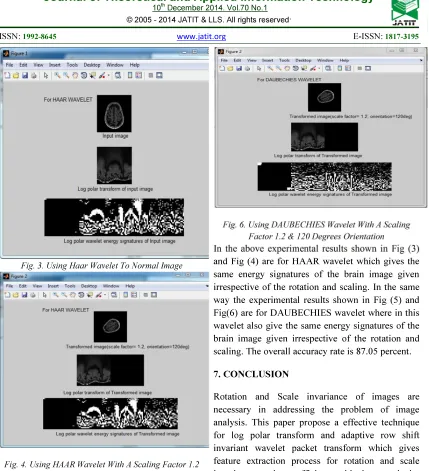
Fig. 3. Using Haar Wavelet To Normal Image
Fig. 4. Using HAAR Wavelet With A Scaling Factor 1.2 &120 Degrees Orientation
Fig. 5. Using DAUBECHIES Wavelet To Normal Image.
Fig. 6. Using DAUBECHIES Wavelet With A Scaling Factor 1.2 & 120 Degrees Orientation
In the above experimental results shown in Fig (3) and Fig (4) are for HAAR wavelet which gives the same energy signatures of the brain image given irrespective of the rotation and scaling. In the same way the experimental results shown in Fig (5) and Fig(6) are for DAUBECHIES wavelet where in this wavelet also give the same energy signatures of the brain image given irrespective of the rotation and scaling. The overall accuracy rate is 87.05 percent.
7. CONCLUSION
[image:5.595.89.294.556.718.2]research in rotation and scale invariant feature extraction can be done for illumination changes.
REFERENCES
[1] Chang. T and Kuo. C.C.J, Apr., “Texture Analysis and Classification with Tree-Structured Wavelet Transform,” IEEE Trans. Image Processing, vol. 2, 1993, pp. 429-441.
[2] Cohen.F.S, Fan. Z, and. Patel.M.A, “ Classification of Rotated And Scaled Textured Images Using Gaussian Markov Random Field Models,” IEEE Trans .Pattern Analysis and Machine Intelligence, vol. 13, no. 2, Feb 1991, pp. 192- 202.
[3] Fountain. S. R and Tan. T.N, “Extraction of Noise Robust Invariant Texture Features via Multichannel Filtering” Proc. Int’l Conf. Image Processing ‘97, vol. 3, 1997, pp. 197-200.
[4] Fountain. S.R, Tan. T.N and Baker. K.D, “ A Comparative Study of Rotation Invariant Classification and Retrieval of Texture Images,” Proc. Ninth British Machine Vision Conf., September 1998, pp. 266-275.
[5] Hayley. G.M and Manjunath. B.M, 1994, “Rotation Invariant Texture Classification using Modified Gabor Filters,” Proc. Int’l Conf. Image Processing ’95, 1994, pp. 262 - 265.
[6] Kashyap. R. L and Khotanzed. A, “A Model Based Method For Rotation Texture Classification, ” IEEE Trans. Pattern Analysis and Machine Intelligence, Vol. 8, July 1986, pp. 472-481.
[7] Laine. A and Fan. J, “Texture Classification by Wavelet Packet Signatures,” IEEE Trans. Pattern Analysis and Machine Intelligence, vol. 15, no. 11, Nov. 1993, pp. 1186-1191. [8] Leung. M and Peterson. A. M, “Scale and
Rotation Invariant Texture Classification,”
Proc. Int’l Conf. Acoustics, Speech, and Signal Processing, 1991, pp. 461-165.
[9] Porter. R and Canagarajah. N, “Robust Rotation- Invariant Texture Classification: Wavelet, Gabor Filter and GMRF Based Schemes,” IEE Proc.Vision Image Signal Processing, vol. 144, June 1997, pp. 1-3.
[10] Rajesh. V, Rajesh Kumar. V, “Myoelectric Signal Based Finger Motion Discrimination by using Wavelet’s and Pattern Recognition”, proceedings of Indian Journal of Biomechanics, March-2009, pp. 237- 240, ISSN 0974- 0783.
[11] Rajesh. V, Rajesh Kumar. P, “Hand gesture Recognisation based semg signal using
wavelets and pattern Recognisation”, International Journal On Recent trends in Engineering, Vol-1, no. 4, May 2009, pp 26-28, ISSN 1797-9617.
[12] Teuner. A, Pichler. O, and Hosticka. B. J,
“ Unsupervised Texture Segmentation of Images Using Tuned Matched Gabor Filters,”
IEEE Trans. Image Processing, vol. 6, no. 4,1995, pp. 863- 870.
[13] Unser. M, “ Texture Classification and Segmentation Using Wavelet Frames,” IEEE Trans. Image Processing, vol. 4, Nov.1995, pp. 1549-1560.
[14] You. J and Cohen. V, “Classification an Segmentation of Rotated and Scaled Textured
Images Using Texture ‘Tuned’ Masks,” Pattern Recognition, vol. 26, 1993, pp. 245-258.