SMART TRANSMISSION POWER ADJUSTMENT ROUTING
BASED ON CONNECTIVITY AND COVERAGE IN MOBILE
ADHOC NETWORKS
BHARATHIRAJA.R1, S.KARTHIK2 and V.P. ARUNACHALAM3
1
Research Scholar, Lead Engineer, Department of Quality Assurance FICO,
Bangalore - 560 017, Karnataka, India.
E-mail: [email protected]
2
Dean cum Professor and Joint Supervisor, Department of Computer Science Engineering
SNS College of Technology, Sathy Main Road, Coimbatore-641035
3Principal and Research Supervisor, SNS College of Technology, Coimbatore-641035.
ABSTRACT
The network connectivity of Mobile Ad hoc Networks (MANETs) is a multifaceted problem due to the uncertainty of the network topology. Since, wireless links have significantly limited capacity, they are affected by several errors that results in degradation of the received signal and consequently lead to the problem of coverage and connectivity. In this paper, we propose to develop a smart transmission power adjustment routing technique based on connectivity and coverage for MANETs. Initially traffic factor is calculated for each node which is based on the input and output capacity at each node and data generation rate. Then the path which has minimum transmission power and traffic factor is selected for transmission. The proposed technique also provides transmission of data to the node which is outside the coverage area. From the simulation results, we show that the proposed routing technique provides optimal power control in MANET by attaining good throughput and reduced energy consumption.
Keywords: Mobile Ad hoc Networks (MANETs), Quality of Service (QoS), Energy Consumption.
1. INTRODUCTION
1.1 Mobile Ad hoc Networks (MANET)
Mobile ad hoc networks (MANETs) are made up of mobile devices that use wireless transmission for communication. They can be set up anywhere and at any time because they require neither infrastructure nor central administration. The goal of MANET architecture is to provide communication facilities between end users without any centralized infrastructure. Mobile Ad-Hoc Network (MANET) is a mobile ad hoc network technology that can change locations, adaptive and configure itself on the move using Wi-Fi connection or any other medium to connect to various networks, while some are restricted to local area and others connected to internet. The main principle of MANET is that it can connect to available network nearby through which can connect to internet or to further more network to acquire internet. If A node needs to connect to B node and if the destination node is in the local area
within the range then connection is established to the neighboring network itself without passing on to internet. This enables network topology within the available neighboring network thus reducing congestion in server or internet. [1, 2, 3]
1.2 Applications of MANET
MANETs are useful in tactical applications such as emergency rescue or exploration missions. In addition, it is useful in commercial applications such as conferences, individual museum visits, freely city tours, peer-to-peer applications, e- gaming, etc. [5]
1.3 Quality of Service (QoS) in MANET
constraint, and so on [6].The actual form of QoS and the QoS parameter to be considered depends upon the specific requirements of an application. [7] [8].
1.4 Connectivity in MANET
MANETs are self-organisable, infrastructure less, wireless, peer-peer, multi hop networks. They adopt distributed control in providing connectivity from the source to the destination. Therefore the mobile units themselves need to take the responsibility of discovering its nearest neighbors who are ready to route data packets to the destination. Co-operation among all the mobile nodes is very essential in such cases. Typical applications of these networks are outdoor events such as conferences, concerts and festivals, places with no network infrastructure, outdoor emergencies and natural disasters and military operations. [9]
1.5 Coverage in MANET
MANET enables wireless communications between participating mobile nodes without the assistance of any base station. The two nodes which are not in each other transmission range calls for a supporting intermediate node that relays the message and sets up communication. Further the broadcast operation plays an important role in the MANETs by the way of radio transmission. The challenges may be tackled by selecting an ideal error free fully coverage environment with high transmission delivery ratio, forwarding node. [10]
1.6 Issues of Coverage and Connectivity
Connectivity with mobility is in great demand and the following describes the issues related to coverage and connectivity. The network connectivity of Mobile Ad hoc Networks (MANETs) is a multifaceted problem due to the uncertainty of the network topology. [11]
Nowadays, there is a huge increase of handled devices. Laptops, mobile phones and PDAs take an important place in the everyday life. Hence, the challenge is now to make all these devices communicate together in order to build a network. [12]
Since, wireless links have a significantly lower capacity than the wired ones; they are affected by several error sources that result in degradation of the received signal and consequently lead to the problem of coverage and connectivity [12].The process of maintaining coverage and connectivity incurs more energy. [9]
1.7 Problem and Proposed Work
There are many different paths to transmit the data packet from source to destination. Many works have been done for finding the shortest path, enhancing the power-level, dividing the coverage area into sectors, adding some more hardware to have a probability of more paths, scaling the power level to overcome noise interference level. But no work has been done to choose an alternative path which is not the shortest path still; it has a probability of transmitting the data in better energy level so far. Choosing an alternative path which is nearly equal to the shortest path having a comparative lower traffic intensity and a lower probability of collision of data packets will lead the data-packet transmission to a rapid and safe manner.
In this paper, we propose to develop a routing protocol using smart transmission power adjustment technique based on connectivity and coverage for MANETs.
2. RELATED WORK
Jishan Mehedi and Mrinal Kanti Naskar [13] has proposed a fuzzy-based distributed algorithm to maintain connected MANET considering freeway mobility model. According to the algorithm, each node will control itself in a way that it can maintain its connectivity with other nodes. In this approach each node is enabled with a Global Positioning System (GPS) receiver. Through GPS each and every node is getting its position and velocity. After getting the information all the nodes in a network transmit their position and velocity information periodically. Obtaining information from all other nodes, each node will decide its own velocity to maintain connectivity. Moreover, faults to a particular node have also been considered in this algorithm.
S.Smys and G.Josemin Bala [14] have introduced a connection balanced routing technique in mobile ad-hoc networks (MANETs). Their technique utilized the virtual backbone (VB) update messages. VB architecture is familiarly used to alleviate broadcast storm problem in wireless networks. To overcome the connection overhead problem, they have proposed a localized algorithm to support reducing the number of connection and maintain these connections by nearby VB nodes or identify the new VB for maintain the k-connections.
connectivity of a MANET. In this method four types of connectivity are defined: global message, worst case, network bisection, and k-connectivity. The method is formulated for the deployment and movement problems for the UAV and developed adaptive algorithms to provide a simple solution as well as good performance. By providing a theoretical analysis for a simple two-node one-UAV case, they demonstrated that the addition of the UAV provided an improvement in global message connectivity of 240%. By this method, the network bisection and k-connectivity are also improved by the addition of a UAV to the network.
Saleem Sheik Aalam and Dr.T.Arull Doss Albert Victorie [16] have proposed CP-AOMDV, Coverage Prediction Adaptive Routing in multi-path on Demand Mobile Ad Hoc Networks. CP-AOMDV tries to prevent link failures by estimating the routes using prediction of the coverage area. The key factor in CP-AOMDV design was to calculate the probabilistic coverage area at each node. In CP-AOMDV the routing overhead was reduced compared with AOMDV routing protocol. In CP-AOMDV, all the intermediate nodes always update the coverage information through the coverage prediction message.
3 PROPOSED SCHEME
3.1 Overview
In this paper, we propose to develop a routing protocol using smart transmission power adjustment technique based on connectivity and coverage for MANETs. Initially traffic intensity is calculated for each node. For calculation of traffic intensity we take the factors input and output capacity, buffer power at each node and data generation signal. Each node within a certain range has the capability of transmitting the data to a maximum distance. Each node should take their decision in choosing the data transition path. So every node maintains a database which is tracking the activities of different paths so that it is easy to take the routing decision at different times.
3.2 Calculation of Traffic Factor (TF)
For calculation of traffic factor at every node at different time intervals, we use this formula
Traffic Factor (TF)(t) = op ip+dg
(1)
Where op=output capacity
Ip= number of input packets at a time t, dg= data generation rate(kbps) required at time t,
Traffic Factor is calculated for regular time interval. The interval should be in milliseconds. The traffic factors are changed into a new level which is identical with the optimal power level. After modification we can add up the optimum power value and traffic factor to have the final result.
3.3 Estimation of Output Capacity
To find the available o/p capacity we consider two factors: available bandwidth and bandwidth required to pass one signal. Different type of signal requires different bandwidth. But in our method, we assume that all signals are identical.
OP = BWavail / BWreq (2)
where OP = output capacity
BWavail =available bandwidth
BWreq = bandwidth required for one signal
So output capacity is directly proportional to available bandwidth.
3.4 Effect of Traffic Factor on Inter Symbol Interference (ISI)
Figure 1. Shows ISI At Different Power Factor Levels
According to the equation-1 the traffic factor is inversely proportional to the summation of i/p and data generation rate. So the pressure on the output increases when the pressure of the transmitting signal increases. The above figure clears that, when the number of signal increases in a channel of certain bandwidth, the ISI is increasing.
[image:3.612.317.522.516.632.2]3.5 Determination of Optimum Path
Figure 2 Showing The Connectivity Of Nodes
Let us assume that the shortest path is a-k-p-s-e. Since the data packets of nodes ‘u’ and ‘v’ also pass through the intermediate node ‘k’, the inter symbol interference (ISI) is high at node k.
But there are two other paths to reach at point ‘e’, namely, a-b-c-d-e and a-r-t-e. Although these paths are not shortest; due to less traffic it can use a higher data generation rate in a lower power level to transmit the data. The ISI can be measured from the traffic factor since it is directly proportional to the ISI. Hence optimum path can be selected based on the traffic factor and power level.
Node ‘a’ cannot transfer data packets to node ‘h’, directly since it is out of coverage. It has to transmit the data through the end point, which is node ‘e’.
Here ‘e’ has to forward the data. When ‘a’ wants to send the data to ‘h’, it generates a data packet keeping a flag field whose value is set to 1. The flag field indicates the data is modifiable at the end points. Since ‘e’ is the end point for ‘a’, ‘a’ sends the data to ‘e’ keeping the flag 1. ‘e’ finds that ‘h’ is reachable from it. Hence ‘e’ forwards the data to ‘h’ and sets the flag 0.
To choose the path the node uses the formula min {max {required transmission power + traffic
factors}} of different paths (3)
3.6 Tables Maintained At Each Node
The maintained data table at each node is given as follow
Table 1. Table Maintained At Nodes For Packet Sent From ‘A’ To ‘E’ Node
ID
Maximum data generation according to existing power calculation
Summation of traffic factors till next node
Data generation rate + TF (where TF is converted in to identical of data generation)
Selected path
b k r
Data packet structure
Table 2. Data Packet Structure Flows In The Network
sender data flag
The figure3 shows the data packet is carrying a sender id data and flag to indicate permission.
The data packet send from a to e is given below. Here the flag is one.
Table 3. Data Packet From A To E
A’s id data Flag=1
The data packet send from e to h is given below. Here the flag is 0.
Table 4. Data Packet Flow From E To H
A’s id data Flag=0
3.7 Algorithm
Phase-1 (Transmission within coverage range) 1. Get the available bandwidth at each time
interval Ti
2. Calculate the output capacity (OP) of the node. 3. Get the numbers of data packets (IP) trying to
pass through a node Nj at time Ti
4. Calculate the data packet generation rate (data generation rate= no of data packet/unit time) at time Ti
5. Calculate the traffic factor of node Nj using (2).
6. Obtain the traffic factors of the next nodes through which the sender can transmit the data to the destination.
7. Update its data table of by Nj getting traffic factor and maximum power range to the different nodes.
8. Find the appropriate path which is the minimum of summation of identical traffic factor and minimum of the summation of maximum powers required to transmit the data packets and conform it for the data transmission.
9. Generate the data packet in decided power level and transmit it through chosen path. 10. Transmit the traffic factor to other nodes. So
that other nodes can also choose their data transmission paths.
Phase-2 (Transmission out of overage range) 1. Transmit the message to the node which is the
maximum distance to which the sender can transmit the message in the above given procedure.
2. Keep the flag value at 1 so it is indicating that end node can modify it.
4. If the node is available, set the flag 0 and keep all other field as same it was and send to the required node. It is also following the phase one procedure.
5. If it can not find the node availability in its range, then follow the step-1 of phase 2’.
3.8 Advantages
A smart algorithm is designed to detect the path according to the transmission power and traffic interference which has the following advantages: No need to increase the power to a greater
amount although the ISI increase at single node.
Collision is decreased to a lower possibility without impact of the base station.
As high speed processors are available, computations will not be an overhead.
It has been specially focused decreasing the collision with an alternative path. So the traffic and average generating power is decreased. Dynamic selection of path leads more paths to
available.
We get a better connectivity and coverage.
4. SIMULATION RESULTS
4.1 Simulation Parameters
We evaluate our Smart Transmission Power Adjustment (STPA) technique through Network simulator (NS-2) [18]. We use a square region of 500 x 500 sqm, in which nodes are placed using a uniform distribution. The number of nodes is varied as 50,100,150 and 200. We assign the power levels of the nodes such that the transmission range of the nodes varies from 250 meters to 400meters. We have modified the standard 802.11 CSMA MAC protocol to include the adaptive power control technique. The simulated traffic is Constant Bit Rate (CBR). We assumed that nodes have global knowledge of the network topology for adjusting their transmission power and no control packets and related overhead were included.
The following table summarizes the simulation parameters used
Table 5. Simulation Settings
No. of Nodes 50 and 200. Area Size 500 X 500
Mac Modified 802.11
Simulation Time 25 sec Traffic Source CBR Packet Size 500
Transmit Power 0.660 w Receiving Power 0.395 w Idle Power 0.035 w Initial Energy 10.3 J
Transmission Range 150,200,250 and 300 m CBR rate 100,150,200 and 250kb
4.2 Performance Metrics
We compare the performance of our proposed STPA method with “Power Control in Wireless Ad Hoc Networks for Energy Efficient Routing with Capacity Maximization” (PCEER) protocol [17]. We evaluate mainly the performance according to the following metrics:
Packet Delivery Ratio: It is the total number of packets received by the receiver during the transmission.
Average end-to-end delay: The
end-to-end-delay is averaged over all surviving data packets from the sources to the destinations.
Average Energy Consumption: The average energy consumed by the nodes in receiving and sending the packets.
A. Based on Transmission Range
In our initial experiment we vary the transmission range as 250,300,350 and 400m for 50 nodes with traffic rate of 100kb.
Range Vs Delay
0 2 4 6 8
150 200 250 300
Range
D
el
ay(
J) STPA
[image:5.612.316.518.83.175.2]PCEER
Figure 3: Range Vs Delay
Range Vs DeliveryRatio
0 0.5 1 1.5
150 200 250 300
Range
D
el
iver
yR
at
io
STPA
PCEER
[image:5.612.191.508.451.715.2]Range Vs Energy
7.5 8 8.5 9 9.5
150 200 250 300
Range
E
n
er
g
y(
J)
STPA
PCEER
Figure 5: Range Vs Energy
Range Vs Throughput
0 1000 2000 3000
150 200 250 300
Range
P
acket
s
STPA PCEER
Figure 6: Range Vs Throughput
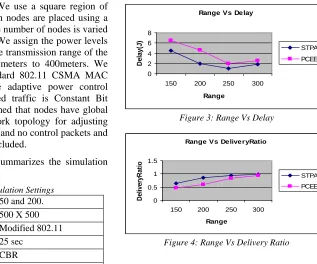
Figure 3 show the average end-to-end delay occurred for both STPA and PCEER approaches when the transmission range is increased. As we can see from the figure, the delay is less for STPA, when compared to PCEER.
Figure 4 show the Packet Delivery ratio occurred for both STPA and PCEER approaches when the transmission range is increased. As we can see from the figure, the delivery ratio is high for STPA, when compared to PCEER.
Figure 5 show the Energy consumption for both
STPA and PCEER approaches when the
transmission range is increased. As we can see from the figure, the energy consumption is low for STPA, when compared to PCEER.
Figure 6 show the Throughput for both STPA and PCEER approaches when the transmission range is increased. As we can see from the figure, the throughput is more for STPA, when compared to PCEER.
B. Based on Traffic Rate
In our second experiment we vary the traffic rate as 100,150,200 and 250kb for 200 nodes with transmission range 250m.
Rate Vs Delay
0 2 4 6 8 10
100 150 200 250
Rate(kb)
D
el
ay(
S
ec)
STPA PCEER
Figure 7: Rate Vs Delay
Rate Vs Packet DeliveryRatio
0 0.2 0.4 0.6 0.8 1
100 150 200 250
Rate (k b)
D
el
iver
yR
at
io
STPA
OT
Figure 8: Rate Vs Delivery Ratio
Rate Vs Energy
7 7.5 8 8.5
100 150 200 250
Rate(kb)
E
n
er
g
y(
J)
STPA
OT
Figure 9: Rate Vs Energy
Rate Vs Throughput
0 1000 2000 3000 4000
100 150 200 250
Rate(kb)
P
acket
s
STPA
OT
Figure 10: Rate Vs Throughput
Figure 7 show the average end-to-end delay occurred for both STPA and PCEER approaches when the rate is increased. As we can see from the figure, the delay is less for STPA, when compared to PCEER.
delivery ratio is high for STPA, when compared to PCEER.
Figure 9 show the Energy consumption for both APCT and PCEER approaches when the rate is increased. As we can see from the figure, the energy consumption is low for STPA, when compared to PCEER.
Figure 10 show the Throughput for both STPA and PCEER approaches when the rate is increased. As we can see from the figure, the throughput is more for STPA, when compared to PCEER.
6. CONCLUSION
In this paper, we have proposed to develop a smart transmission power adjustment routing technique based on connectivity and coverage for MANETs. Traffic factor is calculated for each node which is based on the factors input and output capacity at each node and data generation rate. Each node contains data tables to store the traffic factor values of its neighbor nodes. During data transmission the nodes with minimum transmission power and traffic factor is selected for forwarding the data. If the destination is not reachable or outside the coverage range it selects an end node for further transmission. From the simulation results, we have shown that the proposed routing technique provides optimal power control in MANET by attaining good throughput and reduced energy consumption.
REFERENCES
[1] Vahid Ayatollahi Tafti and Abolfazl Gandomi, “Performance of QoS Parameters in MANET Application Traffics in Large Scale Scenarios”,
World Academy of Science, Engineering and Technology 72 2010.
[2] Priyanka Goyal, Vinti Parmar and Rahul Rishi, “MANET: Vulnerabilities, Challenges, Attacks, Application”, IJCEM International Journal of Computational Engineering & Management, Vol. 11, January 2011, ISSN (Online): 2230-7893, www.IJCEM.org
[3] Jaydip Sen, “A Robust and Efficient Node Authentication Protocol for Mobile Ad Hoc Networks”, CIMSIM '10 Proceedings of the 2010 Second International Conference on Computational Intelligence, Modelling and Simulation, 2010.
[4] Shivanajay Marwaha, Jadwiga Indulska and Marius Portmann, “Challenges and Recent Advances in QoS Provisioning, Signaling, Routing and MAC protocols for MANETs”,
Telecommunication Networks and Applications Conference, 2008. ATNAC 2008. Australasian. [5] Jose L. Muñoz, Oscar Esparza, Mónica
Aguilar, Victor Carrascal and Jordi Forné, “RDSR-V. Reliable Dynamic Source Routing for video-streaming over mobile ad hoc networks”, Elsevier, Computer Networks xxx (2009) xxx–xxx, 9September2009. [6] Ying Ge, “Quality-of-Service Routing in
Ad-Hoc Networks Using OLSR” Technical report, Ottawa-Carleton Institute of Computer Science, December 2002.
[7] Ash Mohammad Abbas and Øivind Kure, “Quality of Service in mobile ad hoc networks: a survey”, Int. J. Ad Hoc and Ubiquitous Computing, 2008.
[8] Navid Nikaein and Christian Bonnet, “A Glance at Quality of Service Models for Mobile Ad Hoc Networks”, In Duke Network Analysis Center (DNAC), December 2002. [9] B R Sujatha and M V Satyanarayana,
“Improved Network Connectivity in MANETs” International Journal of Computer Networks & Communications (IJCNC), Vol.1, No.3, October 2009.
[10]R.Balakrishna, U.Rajeswara Rao and G.A.Ramachandra, “Reliability in MANET’s Using Enhanced Double Coverage Broadcasting (EDCB)” Int. J. of Advanced Networking and Applications 147 Volume: 01 Issue: 03 Page: 147-153 (2009).
[11]Chuan Heng Foh, Genping Liu, Bu Sung Lee, Boon-Chong Seet, Kai-Juan Wong, and Cheng Peng Fu, “Network Connectivity of One-Dimensional MANETs with Random Waypoint Movement” IEEE Communications Letters, Vol. 9, NO. 1, January 2005.
[12]Mrs. S.Gomathi Dr K.Duraiswamy, “Guaranteed Packet Transfer in MANET In and Out of Coverage Areas and Energy Saving Using Random Casting” (IJCSE) International Journal on Computer Science and Engineering, Vol. 02, No. 03, 2010, 865-869. [13]Jishan Mehedi and Mrinal Kanti Naskar, “A
[14]S.Smys and G.Josemin Bala, “K-Connection Maintenance Algorithm for Balanced Routing In Mobile Ad Hoc Networks”, International Journal of Computer Networks & Communications (IJCNC), Vol.1, No.3, October 2009.
[15]Zhu Han, A. Lee Swindlehurst and K. J. Ray Liu, “Optimization of MANET Connectivity
Via Smart Deployment/Movement of
Unmanned Air Vehicles” IEEE Transactions On Vehicular Technology, Vol. 58, NO. 7, September 2009.
[16]Saleem.Sheik Aalam and Dr.T.Arull Doss Albert Victorie, “A Probabilistic Approach of Coverage prediction in Mobile Ad hoc Networks” Saleem.Sheik Aalam et al. /
International Journal on Computer Science and Engineering (IJCSE), Vol. 3 No. 12 Dec 2011.
[17]Kichan BAE, Geunhwi LIM, Namgi KIM, and Hyunsoo YOON, “ Power Control in Wireless Ad Hoc Networks for Energy Efficient Routing with Capacity Maximization” Journal of Systemics, Cybernatics, Informatics, 2007
[18]Network Simulator,