R E S E A R C H
Open Access
Exploring and adjusting for potential
learning effects in ROLARR: a randomised
controlled trial comparing robotic-assisted
vs. standard laparoscopic surgery for rectal
cancer resection
Neil Corrigan
1*, Helen Marshall
1, Julie Croft
1, Joanne Copeland
1, David Jayne
2and Julia Brown
1Abstract
Background:Commonly in surgical randomised controlled trials (RCT) the experimental treatment is a relatively new technique which the surgeons may still be learning, while the control is a well-established standard. This can lead to biased comparisons between treatments. In this paper we discuss the implementation of approaches for addressing this issue in the ROLARR trial, and points of consideration for future surgical trials.
Methods:ROLARR was an international, randomised, parallel-group trial comparing robotic vs. laparoscopic surgery for the curative treatment of rectal cancer. The primary endpoint was conversion to open surgery (binary). A surgeon inclusion criterion mandating a minimum level of experience in each technique was incorporated. Additionally, surgeon self-reported data were collected periodically throughout the trial to capture the level of experience of every participating surgeon.
Multi-level logistic regression adjusting for operating surgeon as a random effect is used to estimate the odds ratio for conversion to open surgery between the treatment groups. We present and contrast the results from the primary analysis, which did not account for learning effects, and a sensitivity analysis which did.
Results:The primary analysis yields an estimated odds ratio (robotic/laparoscopic) of 0.614 (95% CI 0.311, 1.211;p= 0.16), providing insufficient evidence to conclude superiority of robotic surgery compared to laparoscopic in terms of the risk of conversion to open.
The sensitivity analysis reveals that while participating surgeons in ROLARR were expert at laparoscopic surgery, some, if not all, were still learning robotic surgery. The treatment-effect odds ratio decreases by a factor of 0.341 (95% CI 0.121, 0.960;p= 0.042) per unit increase in log-number of previous robotic operations performed by the operating surgeon. The odds ratio for a patient whose operating surgeon has the mean experience level in ROLARR–152.46 previous laparoscopic, 67.93 previous robotic operations–is 0.40 (95% CI 0.168, 0.953;p= 0.039).
Conclusions:In this paper we have demonstrated the implementation of approaches for accounting for learning in a practical example of a surgery RCT analysis. The results demonstrate the value of implementing such approaches, since we have shown that without them the ROLARR analysis would indeed have been confounded by the learning effects. Trial registration:International Standard Randomised Controlled Trial Number (ISRCTN) registry, ID: ISRCTN80500123. Registered on 27 May 2010.
Keywords:Randomised controlled trials, Surgery, Learning curve, Learning effects
* Correspondence:[email protected]
1Clinical Trials Research Unit, Leeds Institute of Clinical Trials Research,
University of Leeds, Leeds LS2 9JT, UK
Full list of author information is available at the end of the article
Background
Commonly in a surgical randomised controlled trial (RCT) the experimental treatment is a relatively new technique which the surgeons–both individually and as a community – may still be learning, while the control treatment is a well-established standard. One of the primary concerns when designing and analysing a surgical RCT is that this disparity between the levels of expertise that the participat-ing surgeons have in each treatment may distort the com-parison between the treatments, potentially leading to biased treatment-effect estimates [1–4].
The need to account for learning effects in surgical RCTs has long been recognised [1–4], and approaches for minimising and accounting for the potentially con-founding effects of learning have been developed in the methodological literature [3]. However, there has been limited uptake of these methods and few examples of their application in surgical trial literature [5]. In this paper we present the details of implementing these ap-proaches in a practical example of a surgery RCT to complement the more methodological papers such as Ramsay and Cook’s [3]. Specifically, we demonstrate that the results would have been vulnerable to the confound-ing effects of learnconfound-ing if these methods were not imple-mented, validating the concerns that motivated the development of the methodology. We demonstrate the value that these methods bring, and discuss points of consideration for their use in future surgical trials.
The practical example is the Robotic vs. Laparoscopic Resection for Rectal Cancer (ROLARR) trial, funded by the National Institute of Health Research (NIHR) Effi-cacy and Mechanism Evaluation Programme (EME) programme. The aim of the trial was to compare the safety, efficacy and short- and long-term outcomes of robotic-assisted as compared to standard laparoscopic rectal cancer surgery. In contrast to standard laparo-scopic surgery, robotic-assisted surgery was not a well-established approach at the beginning of the trial, with many participating centres obtaining their first sur-gical robot close to the time at which they began partici-pating in the trial. This disparity only accentuated the need to implement measures of estimating and adjusting for the learning effects.
Methods The ROLARR trial
ROLARR was an international, multicentre, randomised, unblinded, parallel-group trial comparing robotic vs. lap-aroscopic surgery for the curative treatment of rectal cancer. The trial received national ethical approval in the United Kingdom or either local Ethical Committee/ Institutional Review Board approval at international cen-tres. An independent Trial Steering Committee and Data Monitoring and Ethics Committee oversaw the trial
conduct. All participants provided written, informed consent. The trial design has been reported previously [6].
Consenting patients were randomised to receive either laparoscopic mesorectal resection as per standard prac-tice (referred to as ‘laparoscopic surgery’ hereafter) or robotic-assisted laparoscopic mesorectal resection (re-ferred to as ‘robotic surgery’ hereafter), which included both totally robotic operations and hybrid operations in-volving the use of standard laparoscopic techniques for some aspects of the otherwise robotic-assisted operation. Randomisation (minimisation incorporating a random element) was on a 1:1 basis and was stratified by treating surgeon and other selected prognostic patient factors such as sex and Body Mass Index (BMI). This meant that each participating surgeon in ROLARR was re-quired to perform both robotic and laparoscopic surgery on their trial patients.
The primary aim of the trial was to compare robotic surgery to laparoscopic surgery for rectal cancer resec-tion in terms of the technical difficulty of the operaresec-tion. The primary endpoint was intra-operative conversion to open surgery, which is a binary indicator of technical difficulty of the operation, and thus lower odds of con-version to open would imply a less technically challen-ging operation. A reduction of 50% to the odds of conversion to open was considered to be the minimum clinically important difference.
least 10 had to be laparoscopic and at least 10 robotic resections.
In addition to this, data were collected periodically throughout the trial to capture the level of experience of every participating surgeon in performing each of the in-terventions. All participating surgeons were asked to re-port the number of previous laparoscopic operations and the number of previous robotic operations that they had performed prior to randomising their first patient. Furthermore, throughout the recruitment period partici-pating surgeons were asked at approximately 3-monthly intervals to report how many laparoscopic and how many robotic operations they had performed–including operations performed outside of the ROLARR trial – since their last reported figure. For each patient, the level of experience of their operating surgeon at the time of their operation was calculated assuming that the oper-ation times within each interval between reported fig-ures were uniform. For example, for a patient whose operating surgeon had reported 98 laparoscopic opera-tions and 56 robotic operaopera-tions performed up to 30 June 2014, and a further three laparoscopic and one robotic operations between 1 July 2014 and 30 September 2014, and whose operation was on 24 September 2014 – 86 days into the 92-day interval between data captures for their surgeon – the derived number of laparoscopic operations performed by the operating surgeon at the time of the operation was 98 + 3×(86/92) = 100.8, and similarly for robotic, 56 + 1×(86/92) = 56.9.
Statistical analysis
The primary analysis included the use of multi-level lo-gistic regression to estimate the odds ratios for conver-sion to open surgery between the treatment groups adjusting for the stratification factors as fixed effects, ex-cept for operating surgeon which was adjusted for as a random effect via a random intercept term.
The primary analysis did not include an adjustment for the derived experience levels in laparoscopic and ro-botic surgery of the operating surgeon at the time of op-eration for each patient. The analysis of learning effects extended the primary analysis model to include both number of previous laparoscopic operations performed and number of previous robotic operations performed by the operating surgeon as main effects and also as in-teractions with the treatment effect. Both a main effect and an interaction effect with treatment for each of ro-botic and laparoscopic learning was forced into the model so that the effects of learning could be estimated in each treatment arm separately. The main effects esti-mate how learning affects outcomes in the laparoscopic arm, while the interaction effects allow us to estimate how learning affects outcomes in the robotic arm. To parsimoniously account for the fact that the effect of
learning may be non-linear, fractional polynomials of de-gree 1 were used to explore non-linear robotic and lap-aroscopic effects by including power parameters for each and selecting values for these parameters from a pre-specified restricted space – {−2,−1,−0.5, 0, 0.5, 1, 2, 3}–which maximised the likelihood (minimised the de-viance) of the model, as outlined by Royston and Altman [8] and Royston and Sauerbrei [9]. Note that a power of ‘0’ in this context is defined as the natural log function. The learning effects variables were also scaled and centred at their mean values to improve the interpret-ability of the corresponding regression coefficient esti-mates. The Stata (v13) command fp was used, and the selected fractional polynomial model was fitted in SAS v9.4, for consistency with the primary analysis.
Both the primary analysis and the learning effects ana-lysis were complete case analyses.
Missing data were minimal, and so sensitivity analyses to quantify the potential impact of missing data on the learning effects model were performed via brute-force model re-fitting under a large number of potential values of the missing fields.
Overly influential observations were identified for each of the regression coefficients for treatment, laparoscopic experience, robotic experience and the interaction terms between treatment and laparoscopic and robotic experi-ence in the learning effects analysis model via the deriv-ation of exponentiated delta-betas. The exponentiated delta-beta is calculated for each regression coefficient for each patient, e.g. for patient i, the exponentiated delta-beta for the treatment-effect regression coefficient is:
expβð Þ1i−β1¼
exp βð Þ1i
expð Þβ1 ;
whereβ1is the regression coefficient for the treatment
effect in the full model and βðiÞ1 is the treatment-effect regression coefficient in the model where patient i has been omitted. Note that this is the ratio of the estimated odds ratios from the two models, e.g. an exponentiated delta-beta for the treatment effect for patient i of 1.05 would imply that the omission of patient i increases the treatment-effect odds ratio estimate by 5% compared to the inclusion of patient i.
Results
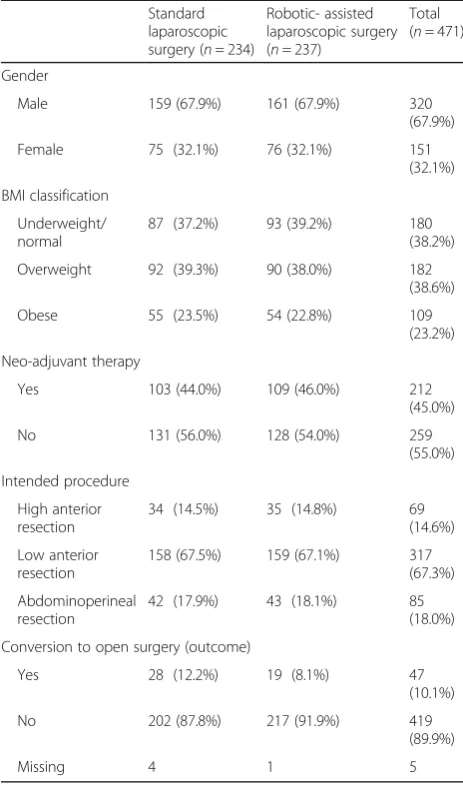
Figure 1 presents details on participant flow. A total of 471 patients were randomised, of which 466 (98.9%) were included in the primary analysis; reasons for with-drawals are given in Fig.1. Four hundred and sixty-four of the 466 patients from the primary analysis were in-cluded in the learning effects analysis; two patients were excluded due to missing experience data for their oper-ating surgeons. The two treatment groups were well bal-anced in terms of patient baseline characteristics (Table1).
The number of previous robotic and number of previ-ous laparoscopic operations performed by the operating surgeon at the time of operations was evaluated for each
patient (see‘Methods’section). The marginal summaries of these measures over patients are presented in Table 2 and the bivariate distribution of these mea-sured over patients is visualised in a histogram in Fig. 2. The average (median) patient in ROLARR re-ceived an operation from a surgeon with experience of 91.4 (interquartile range (IQR) 44.9, 180.1) previ-ous laparoscopic and 49.5 (IQR 30.4, 101.3) previprevi-ous robotic rectal cancer operations. As seen in Fig. 2, the large majority of operations were carried out by an operating surgeon with experience lying within the region bounded by 10–100 previous robotic and 10– 180 previous laparoscopic operations, with several clusters of observations lying on the peripheries at
[image:4.595.58.541.277.716.2]high-robotic-low-laparoscopic and high-laparoscopic regions. Conversions to open surgery were infrequent; 47/466 (10.1%) operations were converted to open, 28/230 (12.2%) in the laparoscopic group and 19/236 (8.1%) in the robotic group (Table 1). This made con-versions to open surgery for patients whose operating surgeon’s experience level was in these more periph-eral regions capable of producing overly influential observations in the learning effects analysis model.
Primary analysis (not adjusting for learning effects) The primary analysis model yielded an adjusted odds ratio of 0.614 (95% CI 0.311, 1.211; p= 0.16), suggesting that the odds of conversion to open is reduced by around 38.6% (95% CI -21.1%, 68.9%) under robotic surgery com-pared to laparoscopic. However, there is insufficient evi-dence to conclude that robotic surgery reduces the odds of conversion, since the confidence interval includes 1.
Learning effects analysis
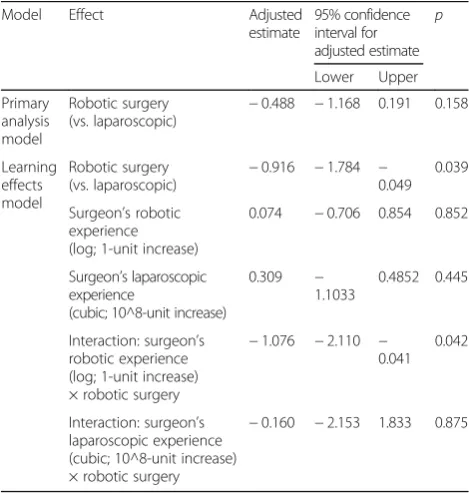
Fractional polynomial fitting determined that the func-tional forms for the robotic and laparoscopic learning ef-fects in the model which best fitted the data were natural log and cubed, respectively. The regression coef-ficient estimates from the model resulting from adding log robotic and cubic laparoscopic learning effects to the primary analysis model (referred to hereafter as the learning effects model) is presented in Table 3, and the corresponding odds ratios are presented in Table4.
The learning effects model yields an estimated odds ratio for a patient whose operation is being performed by a surgeon with the mean experience level in ROLARR–152.46 previous laparoscopic and 67.93 pre-vious robotic operations performed – of 0.40 (95% CI 0.168, 0.953;p= 0.039).
[image:5.595.56.288.99.492.2]Increasing operating surgeon laparoscopic and robotic experience are estimated to have no notable effect on the odds of conversion under laparoscopic surgery. This is clear from the main effects estimates presented in Table 3, which have negligible magnitude and non-significant Wald tests. The effect of increasing oper-ating surgeon laparoscopic experience is also estimated to have no notable effect on the odds of conversion under robotic surgery. This is reflected by the small ef-fect size and non-significant Wald test for the inter-action term for laparoscopic experience and treatment in Table 3. However, the effect of increasing operating surgeon robotic experience is clearly different under ro-botic surgery compared to laparoscopic surgery. This is clear from the significant Wald test for the interaction term for robotic experience and treatment in Table 3. The model suggests that the treatment-effect odds ratio (robotic/laparoscopic) decreases by a factor of 0.341 (95% CI 0.121, 0.960; p= 0.042) per unit increase in
Table 1Patient baseline characteristics and crude outcome data
Standard laparoscopic surgery (n= 234)
Robotic- assisted laparoscopic surgery (n= 237)
Total (n= 471)
Gender
Male 159 (67.9%) 161 (67.9%) 320
(67.9%)
Female 75 (32.1%) 76 (32.1%) 151
(32.1%)
BMI classification
Underweight/ normal
87 (37.2%) 93 (39.2%) 180
(38.2%)
Overweight 92 (39.3%) 90 (38.0%) 182
(38.6%)
Obese 55 (23.5%) 54 (22.8%) 109
(23.2%)
Neo-adjuvant therapy
Yes 103 (44.0%) 109 (46.0%) 212
(45.0%)
No 131 (56.0%) 128 (54.0%) 259
(55.0%)
Intended procedure
High anterior resection
34 (14.5%) 35 (14.8%) 69
(14.6%)
Low anterior resection
158 (67.5%) 159 (67.1%) 317
(67.3%)
Abdominoperineal resection
42 (17.9%) 43 (18.1%) 85
(18.0%)
Conversion to open surgery (outcome)
Yes 28 (12.2%) 19 (8.1%) 47
(10.1%)
No 202 (87.8%) 217 (91.9%) 419
(89.9%)
Missing 4 1 5
[image:5.595.57.290.637.731.2]Percentages given are calculated using non-missing data only. Note that out of the factors presented in this table, only‘conversion to open surgery (outcome)’had missing data.BMIBody Mass Index
Table 2Number of laparoscopic and robotic procedures performed before the current operation, summarised across patients
Number of. previous laparoscopic procedures performed by operating surgeon
Number of previous robotic procedures performed by operating surgeon
(n= 464) (n= 464)
Mean (SD) 152.5 (178.38) 67.9 (48.75)
Median (range) 91.4 (10.0, 853.0) 49.5 (10.3, 183.0)
log-number of previous robotic operations performed by the operating surgeon.
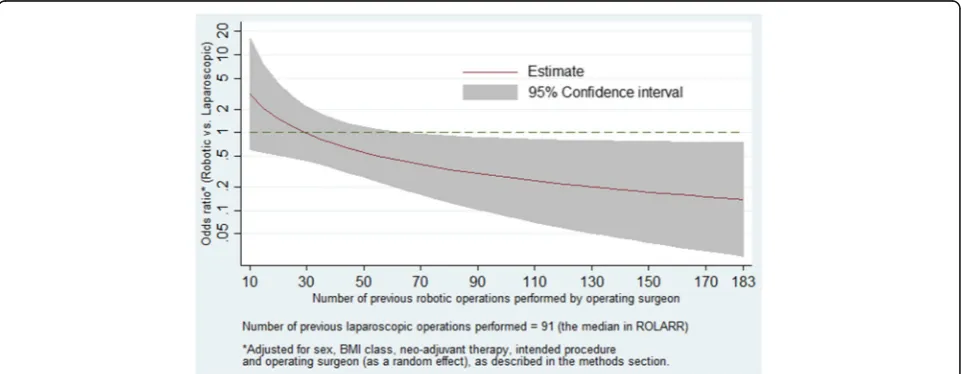
Table4presents the estimated treatment-effect odds ra-tio at various levels of operating surgeon laparoscopic and robotic experience, and illustrates that increasing operat-ing surgeon robotic experience notably affects the treatment-effect odds ratio in favour of robotic surgery re-gardless of the level of laparoscopic experience. Figure3
presents the estimated treatment-effect odds ratios across the entire range of robotic experience levels observed in
ROLARR while fixing laparoscopic experience at 91 (the median). It shows a clear reduction in the odds ratio as ro-botic experience increases. In particular, at levels of robotic experience beyond 70 previous operations, the model estimates clinically meaningful effect sizes (odds ra-tios less than 0.5) which are statistically significant (confi-dence intervals not spanning 1).
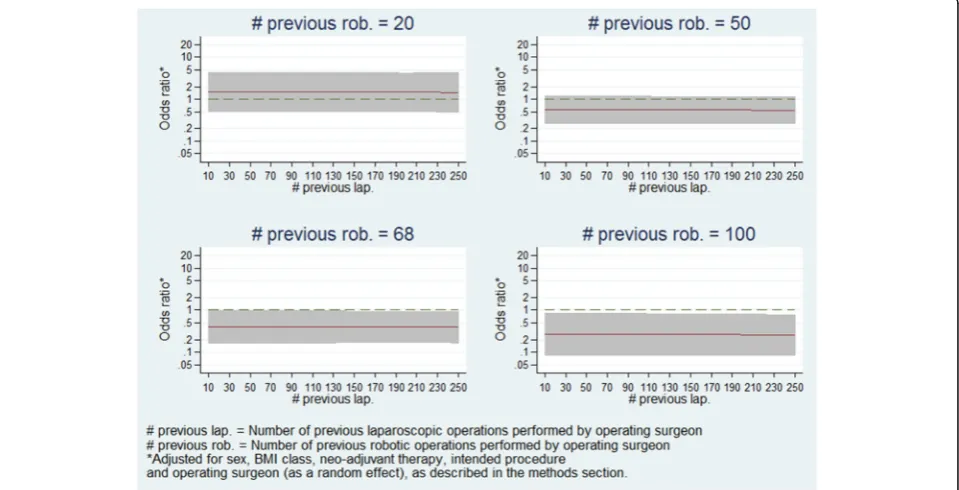
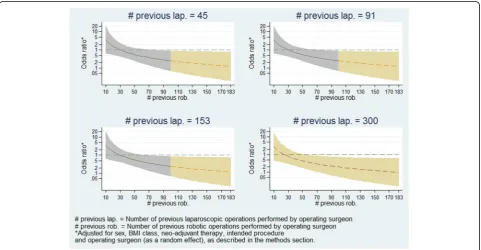
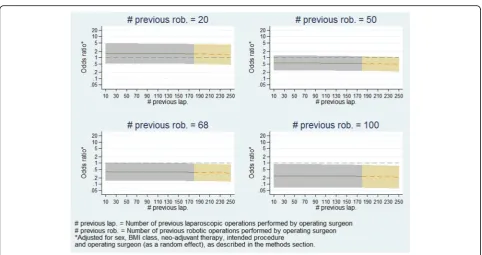
Furthermore, Fig. 4 presents the estimated treatment-effect odds ratios across the entire range of ro-botic experience levels at various selected levels of laparo-scopic experience, and demonstrates that the relationship seen in Fig. 3 holds regardless of laparoscopic experience level. Figure5presents estimates of treatment-effects odds ratios across a range of laparoscopic experience levels at various selected levels of robotic experience, and demon-strates that the estimated effect of laparoscopic experience on the treatment effect is negligible.
Learning effects analysis: missing data
In order to test the robustness of the model against po-tential effects of excluding the two patients with missing data, sets of values of laparoscopic and robotic operating surgeon experience were assumed for the two patients and the model repeatedly re-fitted under various values. In total this was done 625 times to cover all possible combinations of number of previous laparoscopic opera-tions in {10, 45, 91, 180, 500} and number of previous robotic operations in {10, 30, 50, 101, 183} for each pa-tient. None of the re-fitted models yielded estimates that were notably different to the model which excluded these two patients. The distributions of estimates from these 625 models are summarised in Table5.
[image:6.595.56.540.87.256.2]Learning effects analysis: highly influential observations To explore whether the learning effects analysis model results were being disproportionately determined by Fig. 2Histogram of the bivariate distribution of number of laparoscopic and robotic procedures performed before the current operation (viewed from two different angles)
Table 3Estimated regression coefficients (log-odds ratios), 95% confidence intervals and Wald testpvalues for the treatment and learning effects from the primary analysis and learning effects models
Model Effect Adjusted
estimate
95% confidence interval for adjusted estimate
p
Lower Upper
Primary analysis model
Robotic surgery (vs. laparoscopic)
−0.488 −1.168 0.191 0.158
Learning effects model
Robotic surgery (vs. laparoscopic)
−0.916 −1.784 − 0.049
0.039
Surgeon’s robotic experience (log; 1-unit increase)
0.074 −0.706 0.854 0.852
Surgeon’s laparoscopic experience
(cubic; 10^8-unit increase)
0.309 −
1.1033
0.4852 0.445
Interaction: surgeon’s robotic experience (log; 1-unit increase) × robotic surgery
−1.076 −2.110 − 0.041
0.042
Interaction: surgeon’s laparoscopic experience (cubic; 10^8-unit increase) × robotic surgery
[image:6.595.56.291.485.732.2]overly influential observations from regions of sparse data, the exponentiated delta-betas for the treatment ef-fect, main effects of laparoscopic and robotic experience, and interactions between treatment effect and lap-aroscopic and robotic experience were calculated. Several overly influential observations were identi-fied. For example, the most influential observation on the robotic experience by treatment-effect inter-action term had an exponentiated delta-beta of 0.730. When the model was fitted omitting that pa-tient, it estimated that the treatment-effects odds ra-tio (robotic/laparoscopic) decreases by a factor of 0.249 (95% CI 0.080, 0.773; p= 0.0163) per unit in-crease in log-number of previous robotic operations performed by the operating surgeon, rather than the
factor of 0.341 (95% CI 0.121, 0.960; p= 0.042) re-ported above. That patient was operated on by a sur-geon with 169.6 previous robotic and 21.02 previous laparoscopic operations – in a peripheral area of ex-perience with sparse data (see Fig. 2) – and was the only conversion to open surgery out of the 49 pa-tients operated on by two surgeons who lie in that region. All of the overly influential observations were similar to this example: legitimate observations, con-versions to open and with operating surgeon experi-ence towards the extremities of the observed distribution, in areas of relatively sparse data.
[image:7.595.61.539.110.308.2]A concern which naturally develops from that is that if the model estimates are being highly influ-enced by data in the extremities of the distribution of
Table 4Estimated adjusted odds ratios (robotic vs. laparoscopic) for conversion to open surgery vs. operating surgeon’s level of previous laparoscopic and robotic experience
Effect Surgeon’s
laparoscopic experience level (no. of previous operations)
Surgeon’s robotic experience level (no. of previous operations)
Adjusted odds ratio (robotic vs. laparoscopic)
95% confidence interval for adjusted odds ratio
Lower limit Upper limit
Primary analysis model Robotic surgery (vs. laparoscopic)
– – 0.614 0.311 1.211
Learning effects model Robotic surgery (vs. laparoscopic)
45 30 0.969 0.431 2.178
50 0.559 0.264 1.185
100 0.265 0.084 0.840
91 30 0.968 0.432 2.172
50 0.559 0.265 1.180
100 0.265 0.084 0.836
180 30 0.960 0.431 2.138
50 0.554 0.267 1.151
100 0.263 0.085 0.814
[image:7.595.58.539.515.702.2]experience levels, then the model may not be an ac-curate representation of the majority of ROLARR par-ticipants. Thus, in order to explore the robustness of model estimates, the model was fitted again including only patients whose operation was performed by a surgeon whose laparoscopic and robotic experience
levels were lower than the upper quartiles–i.e. between 10 and 101.3 previous robotic and between 10 and 180.1 previous laparoscopic operations. This limited model yielded very similar estimates. The estimated relationships of robotic experience vs. treatment effect and laparoscopic experience vs. treatment effect from this re-fitted model Fig. 4Panel plot of estimated odds ratio (robotic vs. laparoscopic) and 95% confidence interval for conversion to open surgery vs. operating surgeon previous robotic experience at various levels of laparoscopic experience
[image:8.595.62.538.88.333.2] [image:8.595.59.539.458.703.2]are presented in Figs. 6 and 7, and are clearly very similar to the relationships seen from the full model in Figs. 4 and5.
Discussion
The primary analysis for ROLARR provided insufficient evidence of superiority of robotic surgery. The estimated odds ratio did not show a clinically important reduction in the odds of conversion to open under robotic surgery compared to laparoscopic. In isolation, the primary
analysis suggests that robotic surgery, as compared with laparoscopic surgery, does not significantly reduce the risk of conversion to open surgery when performed by surgeons with varying experience of robotic surgery.
[image:9.595.57.539.110.282.2]The results of the learning effects analysis suggest that participating surgeons in ROLARR were already experts in laparoscopic surgery with respect to the need to con-vert to open surgery. This is clear from the negligible estimated effect of increasing operating surgeon laparo-scopic surgery experience on both the conversion rate in
Table 5Summary of regression coefficients and standard errors produced by the 625 models which incorporated a range of imputed operating experience data for the two patients who had missing data (see‘Methods’section)
Parameter Original learning effects
model parameter estimate
Median and range of parameter estimates from the 625 models of imputed data
Treatment effect: estimate −0.916 −0.946 (−0.964,−0.908)
Treatment effect: standard error 0.441 0.441 (0.438, 0.443)
Laparoscopic experience: estimate −0.309 −0.317 (−0.338,−0.205)
Laparoscopic experience: standard error 0.404 0.408 (0.349, 0.409)
Robotic experience: estimate 0.074 0.073 (−0.080, 0.168)
Robotic experience: standard error 0.397 0.392 (0.382, 0.397)
Treatment × laparoscopic experience interaction: estimate −0.160 −0.144 (−0.226,−0.135)
Treatment × laparoscopic experience interaction: standard error 1.014 1.012 (0.989, 1.015)
Treatment × robotic experience interaction: estimate −1.076 −1.077 (−1.149,−0.970)
Treatment × robotic experience interaction: standard error 0.526 0.524 (0.518, 0.527)
[image:9.595.58.540.434.684.2]the laparoscopic arm and on the difference between arms, adjusting for prognostic patient factors as well as other operating surgeon factors (caught by adjusting for operating surgeon as a random effect). However, it seems that the surgeon inclusion criterion did not fully accomplish the aim of ensuring that all participating sur-geons were experts in both treatments, since the results also suggest that some, if not all, participating surgeons in ROLARR were still learning robotic surgery. This is clear from the notable effect of increasing operating sur-geon robotic surgery experience on both the conversion rate in the robotic arm and on the difference between arms, again adjusting for prognostic patient factors as well as other operating surgeon factors (caught by adjusting for operating surgeon as a random effect).
Furthermore, the nature of the relationship between operating surgeon robotic experience and the treatment effect suggest that the desired clinically important differ-ence between the treatments occurs at higher levels of robotic surgery experience than the average (median) in ROLARR. Given this, it could be argued that the pri-mary analysis represents a comparison of laparoscopic surgery and robotic surgery when performed by a sur-geon who is an expert at laparoscopic surgery, but still learning robotic surgery. While this may be representa-tive of clinical practice during the period over which ROLARR took place, it could be argued that it does not tell us the whole story for the purpose of policy-making.
The learning effects analysis paints a clear picture, suggesting that robotic surgery does in fact confer an ad-vantage compared to laparoscopic surgery in terms of the risk of converting to open surgery when the operat-ing surgeon has more substantial previous experience with robotic surgery. Model diagnostics and sensitivity analyses for the learning effects model have shown it to be a significantly better fit than the primary analysis model, and have also shown it to be robust to the poten-tial effects of the two excluded patients and to the ef-fects of highly influential observations.
Limitations
One limitation of the learning effects analysis in ROLARR is that the experience variables were fitted as fixed effects in the model. This imposes the impli-cit assumption that every surgeon has exactly the same learning curve. This may be an overly strong assumption and it may be more appropriate to in-clude random effects for the experience variables – both their main effects and their interactions – which in particular would allow for the possibility that dif-ferent surgeons learn at difdif-ferent rates and plateau at different levels of proficiency. In this particular case, attempting the inclusion of random effects led to model convergence issues.
[image:10.595.57.540.83.338.2]derived only from the number of previous operations performed, and assumes that proficiency is monotonic non-decreasing. The former is a simplification of a com-plex mechanism by which an individual surgeon’s profi-ciency is affected via multiple sources including learning at an expert community level as well as from sheer case volume [4, 10, 11], e.g. a surgeon with 30 operations spread out over 3 years is perhaps not going to be as proficient as a surgeon with 30 cases performed over 3 months, all else being equal. The latter is a simplifica-tion of the nature of learning, which can involve deterio-rations in proficiency; e.g. due to length of time since the most recent operation [10]; e.g. a surgeon with 100 previous cases, but who has not performed a case in over 5 years, may be expected to be less proficient than a surgeon with 100 previous cases all performed within the last year, all else being equal.
Conclusions
The learning effects analysis presented suggests, in con-trast to the primary analysis, that robotic-assisted laparoscopic surgery does confer an advantage over standard laparoscopic surgery in terms of the risk of conversion to open surgery, when performed by an oper-ating surgeon with a substantial level of previous experi-ence with robotic surgery, regardless of their level of previous experience in standard laparoscopic surgery.
Beyond the ROLARR trial, in this paper we have dem-onstrated the implementation of these approaches for accounting for learning in a practical example of a surgery RCT analysis which would otherwise have been vulnerable to the confounding effects of learning. The results demonstrate the value of implementing such approaches since we can see that without them the analysis would indeed have been confounded.
Abbreviations
BMI:Body Mass Index; CI: Confidence interval; EME: Efficacy and Mechanism Evaluation Programme; IQR: Inter-quartile range; ITT: Intention-to-treat; NIHR: National Institute of Health Research; RCT: Randomised controlled trial; ROLARR: Robotic vs. Laparoscopic Resection for Rectal Cancer
Funding
This project was funded by the Efficacy and Mechanism Evaluation Programme, a Medical Research Council and National Institute for Health Research partnership with contributions from the Chief Scientist Office in Scotland, the National Institute for Social Care and Health Research in Wales, and the Health and Social Care Research and Development Division, Public Health Agency in Northern Ireland. Dr. Jayne was supported by the National Institute for Health Research. The funders had no role in the design and conduct of the study; collection, management, analysis and interpretation of the data; preparation, review, or approval of the manuscript; and decision to submit the manuscript for publication.
Availability of data and materials
The data that support the findings of this study are available on request from the University of Leeds. The data are not publicly available due to contractual obligations to our funder, the NIHR EME programme.
Authors’contributions
DJ, HM and JB were responsible for the original concept and design of the ROLARR trial. JC and JCo were responsible for the acquisition of data and administrative, technical and material support. NC, HM, DJ and JB were responsible for the statistical analysis and interpretation of the data. NC drafted the manuscript. All authors critically revised and reviewed the manuscript. All authors read and approved the final manuscript.
Ethics approval and consent to participate
The trial received national ethical approval in the United Kingdom from the Yorkshire & The Humber–Leeds West Research Ethics Committee (reference 10/H1307/27). Either local Ethical Committee or Institutional Review Board approval was obtained for international centres. An independent trial Steering Committee and Data Monitoring and Ethics Committee oversaw the trial conduct. All participants provided written informed consent.
Consent for publication Not applicable
Competing interests
The authors declare that they have no competing interests.
Publisher’s Note
Springer Nature remains neutral with regard to jurisdictional claims in published maps and institutional affiliations.
Author details
1
Clinical Trials Research Unit, Leeds Institute of Clinical Trials Research, University of Leeds, Leeds LS2 9JT, UK.2Department of Academic Surgery,
Leeds Institute of Biological and Clinical Sciences, Clinical Sciences Building, University of Leeds, St. James’s University Hospital, Leeds LS9 7TF, UK.
Received: 11 January 2018 Accepted: 7 June 2018
References
1. Russell I. Evaluating new surgical procedures. BMJ. 1995;311(7015):1243–4. 2. McLeod RS. Issues in surgical randomized controlled trials. World J Surg.
1999;23:1210.https://doi.org/10.1007/s002689900649.
3. Cook JA, Ramsay CR, Fayers P. Statistical evaluation of learning curve effects in surgical trials. Clin Trials. 2004;1:421–7.https://doi.org/10.1191/ 1740774504cn042oa.
4. Ergina PL, Cook JA, Blazeby JM, Boutron I, Clavien PA, Reeves BC, Seiler CM. The Balliol collaboration. Challenges in evaluating surgical innovation. Lancet. 2009;374:1097–104.
5. Conroy, Blazeby J, Burnside G, Cook J, Gamble C. Design and analysis of the learning curve and clustering effects in randomised controlled trials—a review of current practice. Trials. 2017;18(Suppl 1):P129.https://trialsjournal. biomedcentral.com/articles/supplements/volume-18-supplement-1. Accessed 19 June 2018.
6. Jayne D, Pigazzi A, Marshall H, Croft J, Corrigan N, Copeland J, Quirke P, West N, Rautio T, Thomassen N, Tilney H, Gudgeon M, Bianchi PP, Edlin R, Hulme C, Brown J. Effect of robotic-assisted vs conventional laparoscopic surgery on risk of conversion to open laparotomy among patients undergoing resection for rectal cancer. The ROLARR randomized clinical trial. JAMA. 2017;318(16):1569–80.https://doi.org/10.1001/jama.2017.7219. 7. Barrie J, Jayne DG, Wright J, et al. Ann Surg Oncol. 2014;21:829.https://doi.
org/10.1245/s10434-013-3348-0.
8. Royston P, Altman DG. Regression using fractional polynomials of continuous covariates: parsimonious parametric modelling. J R Stat Soc. 1994;43(3)):429–67. Series C (applied statistics)
9. Royston P, Sauerbrei W. A new approach to modelling interactions between treatment and continuous covariates in clinical trials by using fractional polynomials. Statist Med. 2004;23:2509–25.https://doi.org/10.1002/sim.1815. 10. Papachristofi O, Jenkins D, Sharples LD. Assessment of learning curves
in complex surgical interventions: a consecutive case-series study. Trials. 2016;17:266.