2016 Joint International Conference on Artificial Intelligence and Computer Engineering (AICE 2016) and International Conference on Network and Communication Security (NCS 2016)
ISBN: 978-1-60595-362-5
Face Illumination Processing Using Wavelet
Transform and Gradientfaces
Xue HE
1,a, Zhi-jun YANG
1,b, Xiang-fei NIE
1,c,*1College of Electronic and Information Engineering,
Chongqing Three Gorges University, Chongqing, China
a[email protected], b[email protected], c[email protected]
*Corresponding author
Keywords: Face Illumination Processing, Wavelet Transform, Gradientfaces, Face Recognition.
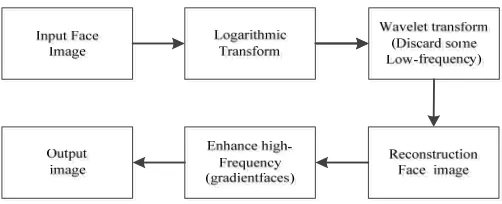
Abstract. In view of the problem of illumination, a new approach based on wavelet transform and gradientfaces for illumination processing is presented. Firstly, the method calculates wavelet transform and multilevel wavelet decomposition in logarithm domain. The low frequency coefficient is discarded partially. After reconstructed, the high frequency component of the face image is enhanced using gradientfaces. Secondly, the face invariant feature is extracted by Principal Component Analysis (PCA), the nearest neighborhood classifier using cosine distance is adopted for face classification. The experiment result on Yale B frontal face database demonstrates that the presented algorithm could recognize all of the test samples and the face recognition rate is 100%. Thus, this technique can overcome the effect of different degree of illumination efficiently.
Introduction
Currently, face recognition has become a hot topic in the research fields such as pattern recognition, image processing, machine vision, neural networks and cognitive science [1, 2]. FERET test showed that the changing of illumination and pose is the major challenge of current face recognition system [3]. The algorithms of processing light are mainly divided into three categories [4]: extracting illumination invariant feature, modelling the illumination changes and normalization the lighting conditions. The thought of extracting the illumination invariant feature is to extract illumination invariant feature component which is insensitive to light in the face image for face recognition [5]. The main idea of modelling the illumination changes is to explore the changing extent of the light conditions within the face image in some appropriate subspace or manifold of image space, then the model parameters of the characteristics of the face image are estimated by utilizing the methods such as self-quotient image method [6], light cone method [7] and the method based on spherical harmonic fundamental image [8], .etc. This kind of method needs to build a complete set of face images. However, building a complete set of face images is so complex in practice that the practical application of the above methods subjects to certain restrictions. The main idea of normalization the lighting conditions is that light was normalized to a standard form by image conversion or synthetic before human face recognition. Those methods are histogram equalization, gamma correction, logarithmic transformation, SFS (Shape Form Shading) [9] and 3D morphing technology [10]. etc. This transformation can achieve the purpose of the illumination elimination to reduce the impact of light, and then to recognize the normalized face.
Figure 1. Face illumination process flow diagram.
Algorithm
The Wavelet Transform of the Image
If L2
R has a multi-resolution analysis (MRA)
Vj jZ and the corresponding scalingfunction
x , a two-dimensional scale space j j 2j V V
V of scales j is defined, where the symbolrepresents space multiplied. Since the orthonormal basis of Vj is
j,n
x 2j/2
2jxn
,the orthonormal basis
j,n
xj,m x
n,mZ in 2 jV has been obtained. The Wj21is used for denoteing
the orthogonal complement ofVj21 inVj2 .The
x is used for denoting the correspondingone-dimensional wavelet with
x . So three wavelet functions
x y
1 ,
y x
2 and
y x
3 in 2
2 RL can be
obtained, which makes
i
2jxk,2jyl
, where j,k,lZ,i1,2,3constitute the orthonormalbasis. In the two-dimensional multi-resolution analysis, for the square integral two-dimensional
image signal
2
2,n L R
m
f , assumes thatC0,mn f
m,n
, the wavelet decomposition recurrence formula of two-dimensional image can be expressed as follows.
k,l n l m k kl jj,mn C h h
C 1, 2 2 . (1)
l k n l m k kl j mnj C h g
D , 2 2 , 1 1
, . (2)
l k n l m k kl j mnj C g h
D , 2 2 , 1 2
, . (3)
l k n l m k kl j mnj C g g
D , 2 2 , 1 3
, . (4)
Whereh
n ,1,n ,g
n ,1,n , and has:
n h n
g 1n 1 . (5)
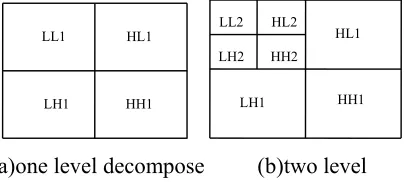
components HL2, LH2 and HH2, and the size is half of the LL1. If the next level of image decomposition is needed, then repeat the above steps for LL2 decomposition, and so on. Finally, the sub-image LLn which obtained after n-level wavelet decomposition of the original image is low-frequency approximation.
Figure 2. The Wavelet decomposition of the image.
Gradientfaces
Gradientfaces [11] is defined as follows:
For any direction gray imageI
x,y , xdirection neighborhood point of pixel point
x,y is
xx,y
, then:
x x y
R x x y
Lx x y
I
,
,
, . (6)Eq. (8) subtracts eq. (1) to get:
x
x
y
I
x
y
R
x
x
y
L
x
x
y
R
x
y
L
x
y
I
,
,
,
,
,
,
. (7)L is approximate smooth and slow to change, then:
Rx x Rx y
Lx yy x L y x R y x x L y x x R y x I y x x I , , , , , , , ,
. (8)
When x tends to 0, then:
x y x R y x L x y x I
( , ) ( , ) ( , ). (9)
Similarly, in the direction ofy:
y y x R y x L y y x I , ,, . (10)
Eq. (12) is divided by eq. (11), then:
x y x R y y x R x y x I y y x I ) , ( ) , ( ) , ( ) ,
( . (11)
HH2 LH2
HL2 LL2
HL1
LH1 HH1 LL1 HL1
LH1 HH1
Gradientfaces is defined as follows:
Iy Ix
Garctan . (12)
Where IyI
x,y yandIxI
x,y x are respectively the image gradient in the direction ofyandx, andG
,
. In practice, in order to calculate the gradientfaces, first need to calculatethe gradient of face image in the direction ofxandy. In order to successfully calculate gradient values, need to use Gaussian kernel to smooth face image, namely, the gradient in the direction ofx
and y are calculated after the convolution of face image and Gaussian kernel.Expression of Gaussian kernel function is shown as follows:
2 2 2 2
2 exp 2
1 ,
,
x yy x
G . (13)
Among them, is a standard difference of Gaussian kernel.
Experiments Face Database
Our experiment is conducted on the Yale database B, which contains images of ten individuals with nine pose and 64 illuminations per pose. The frontal face images of all subjects, each with 64 different illuminations are used for evaluation. All images are cropped and resized to128128. They are divided into five subsets based on the angle of the lighting source direction. The five subsets are: subset 1 (0o-12o), subset 2 (13o-25o), subset 3(26o-50o), subset 4 (51o-77o), subset
5(above 78o). There are total 640 images: 70,120,120,140,190 from subset 1 to subset 5,
respectively.
Experimental Results
PCA method (feature vector number dis 50) is used to extract feature in this paper, and the
[image:4.612.126.489.552.732.2]nearest neighbor classifier based cosine distance is used to classification determination. After light treatment, mean and variance of face images is respectively normalized to 0 and 1.
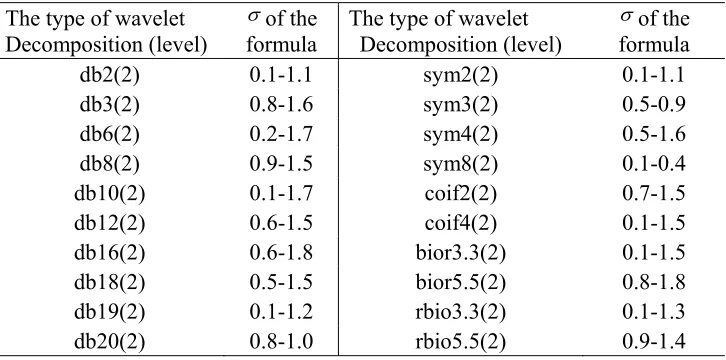
Table 1. Experiments of face recognition(Yale B face database).
The type of wavelet Decomposition (level)
of the
formula
The type of wavelet Decomposition (level)
of the
formula
db2(2) 0.1-1.1 sym2(2) 0.1-1.1
db3(2) 0.8-1.6 sym3(2) 0.5-0.9
db6(2) 0.2-1.7 sym4(2) 0.5-1.6
db8(2) 0.9-1.5 sym8(2) 0.1-0.4
db10(2) 0.1-1.7 coif2(2) 0.7-1.5
db12(2) 0.6-1.5 coif4(2) 0.1-1.5
db16(2) 0.6-1.8 bior3.3(2) 0.1-1.5
db18(2) 0.5-1.5 bior5.5(2) 0.8-1.8
db19(2) 0.1-1.2 rbio3.3(2) 0.1-1.3
To find the best type of wavelet, wavelet decomposition level and deviation range of the Gaussian kernel standard value of the formula (13) in experiment, the type of wavelet, wavelet decomposition level and the value of are tested in this paper. The parameters are selected through experiments. When correct recognition rate in Yale B face database was 100%, the parameter values are as shown in Table 1.
[image:5.612.205.407.206.326.2]As can be seen from Table 1, different types of wavelets such as db2, db3, db6, sym2, sym3, coif2, bior3.3, rbio3.3 are studied experimentally. The type of wavelet, wavelet decomposition level and the value of are selected appropriately. So the illumination of face image is efficiently processed. As shown in Table 1, the face recognition rate is 100% when the wavelet is db2 with level 2 and the value range ofis in 0.1-1.1.
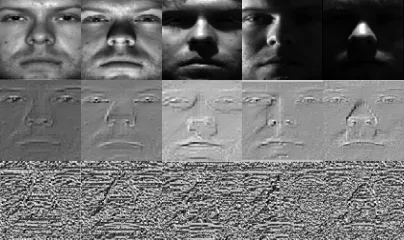
Figure 3. Face image processed with different methods.
The effect comparisons that the same person in different subsets of the face image after the light treatment are as shown in Fig. 3. The first line the original image, the second line displays the face images by wavelet transform processing, and the third line shows the face image after the processing of the proposed method. As we can see from the figure, the face image after the light treatment by used proposed method can display its general outline and retain important facial feature.
Comparison of Experiment Results
[image:5.612.148.466.591.679.2]Table 2 shows the face recognition error rate comparison of several different ways after the light treatment at Yale B face database. As we can see from Table 2, the average false recognition rate of face with directly gradientfaces algorithm [11] is 0.15%, the average false recognition rate of face with directly discrete cosine transform (DCT) [12] is 0.55%, the average false recognition rate of face with directly OLHE [13] is 0.90%, while the average false recognition rate of the use of the proposed method of treatment is zero. Comparison results can be seen from Table 2, the recognition effect of the proposed light treatment method is superior to several other light treatment methods.
Table 2. Comparison of experiment results.
Methods subset2 subset3 subset4 subset5 average The rate of face recognition(%)
gradientfaces 0 0 0.71 0 0.15
DCT 0 0 0.18 1.71 0.55
OLHE 0 0 2.60 1 0.90
Our method 0 0 0 0 0
Conclusion
Gradientfaces is processed after reconstructed image. Next, facial feature in the face image is extracted by the principal component analysis. Finally, face image is recognized using the neighbor classifier based on cosine distance. Experimental results in the Yale B face database show that the appropriate selection of the type of wavelet, wavelet decomposition level and the value of the Gaussian kernel function, face recognition rate can reach 100% after face illumination processing, which can weaken the effect of non-uniform illumination to the face image.
Acknowledgment
This research was financially supported by the Project Foundation of Chongqing Municipal Education Committee (KJ121114).
References
[1] Çağrı K., Sarıcı R., Uçar A. The Reform of Direct Taxation in Austria [J]. Machine Vision & Mechatronics in Practice, 2015, 8(30): 269-285.
[2] Wang W., Yang J., Xiao J., et al. Face Recognition Based on Deep Learning [M]. Human Centered Computing. Springer International Publishing, 2014: 812-820.
[3] Phillips P.J., Weehsler H., Huang J., Rauss P. The FERET Database and Evaluation Procedure for Face Recognition Algorithms.Image and Vision Computing Journal, 1998, 16(5): 295-306. [4] Shah J.H., Sharif M., Raza M., et al. Robust Face Recognition Technique under Varying Illumination [J]. Journal of Applied Research & Technology, 2015, 13 (1): 97-105.
[5] Gao Y., Leung M.K.H. Face recognition using line edge map. IEEE Trans. on Pattern Analysis and Machine Intelligence, 2002, 24(6): 764-779.
[6] Arandjelovic O. Making the most of the self- quotient image in face recognition [C]// Automatic Face and Gesture Recognition (FG), 2013 10th IEEE International Conference and Workshops on. IEEE, 2013: 1-7.
[7] Chen J., Xia C., Ying H., et al. Using facial symmetry in the illumination cone based 3D face reconstruction [C]// IEEE International Conference on Image Processing. 2013: 3700-3704.
[8] Wenyong Z., Shaolin C. Yuan Z., et al. Lighting Estimation of a Convex Lambertian Object Using Redundant Spherical Harmonic Frames [J]. Journal of Computer Science & Technology, 2013, 28(3): 454-467.
[9] Snape P., Zafeiriou S. Kernel-PCA Analysis of Surface Normals for Shape-from-Shading [C]// IEEE Conference on Computer Vision and Pattern Recognition. IEEE Computer Society, 2014: 1059 - 1066.
[10] Blanz V., Vetter T. Face recognition based on fitting a 3D mophaable model. IEEE Trans. on Pattern Analysis and Machine Intelligence, 2003, 25(9): 1063 -1074.
[11] Taiping Z., Yuan Yan T., Bin F., et al. Face recognition under varying illumination using gradientfaces. [J]. IEEE Trans. on Image Processing A Publication of the IEEE Signal Processing Society, 2009, 18(11): 2599-606.
[12] Weilong C., Meng J.E., and Shiqian W. Illumination processing and normalization for robust face recognition using discrete cosine transform in logarithm domain. IEEE Trans. on Systems, Man, and Cybernetics, Part B: Cybernetics. 2006, 36 (2): 458 -466.