© 2017, IRJET | Impact Factor value: 5.181 | ISO 9001:2008 Certified Journal | Page 256
Solar Power Generation with Capacitor Based Seven Level Inverter
System
D. Venkateswarlu Naik1 , Venkateswarareddy. G2
M. Tech scholar, Department of EEE , Sai Tirumala NVR Engineering College, Narasaraopet, India
Assistant professor, Department of EEE, Sai Tirumala NVR Engineering College, Narasaraopet, India
---***---Abstract - The proposed system is composed of
a dc/dc power converter and a new seven- level inverter, produced seven level output voltage. The proposed inverter reduced the switching losses, complexity, size and cost. This new seven-level inverter is configured using a capacitor selection circuit and a full-bridge converter. The capacitor selection circuit converts the two output voltage sources of dc– dc converter into a three-level dc voltage, and the full-bridge converter further converts three-level dc voltage into a seven-three-level ac voltage. The PWM signals are generated by using fuzzy logic controllers.
Key Words: seven-level inverter, capacitor selection circuit, fuzzy logic, dc-dc converter.
I. INTRODUCTION
The extensive use of fossil fuels has resulted in the global problem of greenhouse emissions. Moreover, as the supplies of fossil fuels are depleted in the future, they will become increasingly expensive. Thus, solar energy is becoming more important since it produces less pollution and the cost of fossil fuel energy is rising, while the cost of solar arrays is decreasing. In particular, small-capacity distributed power generation systems using solar energy may
be widely used in residential applications in the near future.
© 2017, IRJET | Impact Factor value: 5.181 | ISO 9001:2008 Certified Journal | Page 257 Conventional multilevel inverter topologies include
the diode clamped, the flying-capacitor, and the cascade H-bridge types, But it is difficult to regulate the voltage of these capacitors.
Since it is difficult to create an asymmetric voltage technology in both the diode-clamped and the flying capacitor topologies, the power circuit is complicated by the increase in the voltage levels and H-bridge inverter to allow more levels of output voltage in this eight power electronic switches are used more recently various topologies for seven level inverters has been proposed. This seven-level grid-connected inverter contains six power electronic switches. However, three dc capacitors are used to construct the three voltage levels, which results in that balancing the voltages of the capacitors is more complex. In a seven-level inverter topology, configured by a level generation part and a polarity generation part, is proposed. There, only power electronic switches of the level generation part switch in high frequency, but ten power electronic switches and three dc capacitors are used. In a modular multilevel inverter with a new modulation method is applied to the photovoltaic grid-connected generator.
The proposed solar power generation system is composed of a dc/dc power converter and a seven-level inverter.The seven level inverter is configured using a capacitor selection circuit and a full-bridge power converter, connected in cascade. The seven-level inverter contains only six power electronic switches, which simplifies the circuit configuration. Since only one power electronic switch is switched at high frequency at any time to generate the seven-level output voltage, the
switching power loss is reduced, and the power efficiency is improved. The inductance of the filter inductor is also reduced because there is a seven level output voltage.
II. BLOCK DIAGRAM
The proposed solar power generation system is composed of a solar system, a dc–dc power converter, and a new seven-level inverter. The solar cell array is connected to the dc–dc power converter, and the boost converter that incorporates a transformer with a turn ratio of 2:1. The dc–dc power converter converts the output power of the solar system into two independent voltage sources with multiple relationships, which are supplied to the seven-level inverter. This new seven-level inverter is composed of a capacitor selection circuit and a full-bridge power converter, connected in a cascade.
Fig.1 proposed block diagram II.A. DC-DC CONVERTER
© 2017, IRJET | Impact Factor value: 5.181 | ISO 9001:2008 Certified Journal | Page 258 the seven-level inverter. The current-fed
forward converter is composed of an inductor LD, power electronic switches SD1 and SD2, a transformer, and diodes DD1 and DD2. The current-fed forward converter charges capacitor C1 of the seven-level inverter. The inductor LD and the power electronic switch SD1 of the current-fed forward converter are also used in the boost converter.
(a)
Fig.2 Operation of DC-DC Converter
Capacitor C1 is connected to capacitor C2 in parallel through the transformer, so the energy of inductor LD and the solar cell array charge capacitor C2 through DD3 and charge capacitor C1 through the transformer and DD1 during the off state of SD1. Since capacitors C1 and C2 are charged in parallel by using the transformer, the voltage ratio of capacitors C1 and C2 is the same as the turn ratio (2:1) of the transformer. The boost converter is operated in the continuous conduction mode (CCM). The voltage of C2 can be represented as
(1)
Where VS is the output voltage of solar cell array and D is the duty ratio of SD1. The voltage of capacitor C1 can be represented as
(2)
In addition, the power circuit is simplified because the charging circuits for capacitors C1 and C2 are integrated. Capacitors C1 and C2 are charged in parallel by using the transformer, so their voltages automatically have multiple relationships.
II.B.SEVEN-LEVEL INVERTER
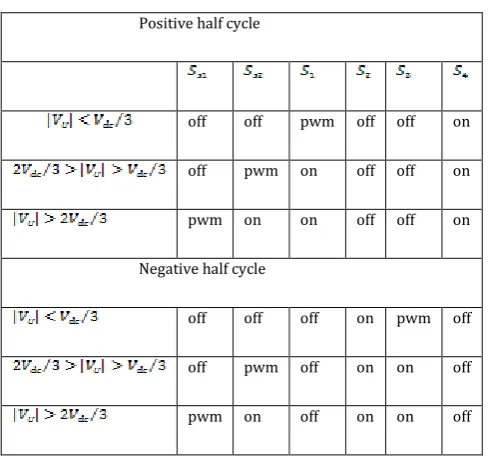
The seven-level inverter is composed of a capacitor selection circuit and a full-bridge power converter, which are connected in cascade. The operation of the seven level inverter can be divided into the positive half cycle and the negative half cycle of the utility. For ease of analysis, the power electronic switches and diodes are assumed to be ideal, while the voltages of both capacitors C1 and C2 in the capacitor selection circuit are constant and equal to Vdc/3 and 2Vdc/3, respectively.
Since the output current of the solar power generation system will be controlled to be sinusoidal and in phase with the utility voltage, the output current of the seven-level inverter is also positive in the positive half cycle of the utility.
© 2017, IRJET | Impact Factor value: 5.181 | ISO 9001:2008 Certified Journal | Page 259 levels, according to the utility voltage. One level of
the output voltage is higher than the utility voltage in order to increase the filter inductor current, and the other level of the output voltage is lower than the utility voltage, in order to decrease the filter inductor current. In this way, the output current of the seven-level inverter can be controlled to trace a reference current. Accordingly, the output voltage of the seven-level inverter must be changed in accordance with the utility voltage. . In the positive half cycle, when the utility voltage is smaller than Vdc/3, the seven-level inverter must be switched between modes 1 and 4 to output a voltage of Vdc/3 or 0. Within this voltage range, S1 is switched in
PWM. the duty ratio d of S1 can be represented as
(3)
Where vm and Vtri are the modulation signal and the amplitude of carrier signal in the PWM circuit, respectively. As The output voltage of the seven-level inverter.
(4)
Where kpwm is the gain of inverter
(5)
the simplified model for the seven-level inverter when the utility voltage is smaller than Vdc/3.The closed loop transfer function is
(6)
Where Gc is the current controller and ki is the gain of the current detector. in case of seven level inverter mode 1& 2 in order the output voltage range is (Vdc/3, 2Vdc/3).
The output voltage of seven level inverter is
(7)
The closed loop transfer function for utility voltage is within the range
© 2017, IRJET | Impact Factor value: 5.181 | ISO 9001:2008 Certified Journal | Page 260 (9)
(10)
the negative half cycle, the seven-level inverter is switched between modes 5 and 8, in order to output a voltage of−Vdc/3 or 0, when the absolute value of the utility voltage is smaller than Vdc/3. Accordingly, S3 is switched in PWM. The seven level inverter is switched in modes 6 and 5 to output a voltage of−2Vdc/3 or −Vdc/3 when the utility voltage is in the range (−Vdc/3, −2Vdc/3).Within this voltage range, SS2 is switched in PWM. The seven-level inverter is switched in modes 7 and 6 to output a voltage of−Vdc or−2Vdc/3, when the utility voltage is in the range (−2Vdc/3, −Vdc). At this voltage range, SS1 is switched in PWM and SS2 remains in the ON state to avoid switching of SS2. The simplified model for the seven-level inverter in the negative half cycle is the similar to that for the positive half cycle.
Only six power electronic switches are used in the proposed new seven-level inverter, only one power electronic switch is switched in PWM
within each voltage range and the change in the output voltage of the seven-level inverter for each switching operation is Vdc/3, so switching power loss is reduced and the conduction loss of the proposed seven-level inverter is also reduced slightly.
II.C.CONTROL BLOCK
© 2017, IRJET | Impact Factor value: 5.181 | ISO 9001:2008 Certified Journal | Page 261 Table -1: States for seven level inverter
[image:6.595.323.577.135.316.2]Fuzzy logic controller could control the switches in the boost and full bridge inverter, Membership function values are assigned to the linguistic variables, using seven fuzzy subsets: NB (negative big), NS(negative small), ZE(zero), PS(positive small), and PB (positive big). The set of rules designed in fuzzy logic controller are shown in Table 1. Based on the rules framed in the table, the fuzzy logic controller controls the switches present in the dc/dc boost converter and single H-bridge inverter.
Table -2: Rule based logic controller
E NB NS ZE PS PB
NB NB NB NS NS ZE
NS NB NS NS ZE PS
ZE NS NS ZE PS PS
PS NS ZE PS PS PB
PB ZE PS PS PB PB
III.D.SIMULATION RESULT
It is the simlink model diagram for solar power generation system with capacitor based seven level inverter. It consisting of full bridge converter with dc-dc converter and transformer. The transformer converts the output voltage of solar system into two independent voltage sources with multiple relationships.
Simulation results for the ac side of the seven-level inverter: (a) grid voltage, (b) inverter current (c ) output voltage of seven-level inverter
Positive half cycle
off off pwm off off on
off pwm on off off on
pwm on on off off on
Negative half cycle
off off off on pwm off
off pwm off on on off
pwm on off on on off
Volt
age
(V
)
Curr
en
t
(I
)
Volt
age
(V
[image:6.595.35.562.509.793.2]© 2017, IRJET | Impact Factor value: 5.181 | ISO 9001:2008 Certified Journal | Page 262
Simulation results for (a) grid voltage,(b) voltage of capacitor C1, (c) voltage of capacitor C2,and(d) output voltage of the capacitor selection circuit.
FFT analysis using Fuzzy controller
IV.CONCLUSION
The proposed technique has some features such as it reduces the cost of the overall system, compact size as well as an increased
efficiency. With the help of lower number of switches, seven-level of output voltages are generated and thus it reduces the switching loss and conduction losses. The fuzzy logic controller could control the switches present in the boost converter and H-bridge inverter. For the seven level of output, only six power electronic switches are used and only one switch will operate at high frequency at any time.
REFERENCES
[1] R. A. Mastromauro, M. Liserre, and A. Dell ‘Aquila, “Control issues in single-stage photovoltaic systems: MPPT, current and voltage control,” IEEE Trans. Ind. Informat., vol. 8, no. 2, pp. 241–254, May. 2012.
[2] Z. Zhao, M. Xu, Q. Chen, J. S. Jason Lai, and Y. H. Cho, “Derivation, analysis, and implementation of a boost– buck converter-based high-efficiency pv inverter,”IEEE Trans. Power Electron., vol. 27, no. 3, pp. 1304–1313, Mar. 2012.
[3] M.Hanif, M.Basu, and K. Gaughan, “Understanding the operation of a Z-source inverter for photovoltaic application with a design example,” IET Power Electron., vol. 4, no. 3, pp. 278–287, 2011.
[4] J.-M. Shen, H. L. Jou, and J. C. Wu, “Novel transformer-less grid connected power converter with negative grounding for photovoltaic generation system,”IEEE Trans. Power Electron., vol. 27, no. 4, pp. 1818–1829, Apr. 2012.
[5] N. Mohan, T. M. Undeland, and W. P. Robbins, Power Electronics Converters, Applications and Design, Media Enhanced 3rd ed. New York,NY, USA: Wiley, 2003. [6] K. Hasegawa and H. Akagi, “Low-modulation-index operation of a five level diode-clamped pwm inverter with a dc-voltage-balancing circuit for a motor
Volt
age
(V
)
Volt
age
(V)
Volt
age
(V
)
Volt
age
(V
© 2017, IRJET | Impact Factor value: 5.181 | ISO 9001:2008 Certified Journal | Page 263 drive,”IEEE Trans. Power Electron., vol. 27, no. 8, pp.
3495–3505, Aug. 2012.
[7] E. Pouresmaeil, D. Montesinos-Miracle, and O. Gomis-Bellmunt, “Control scheme of three-level NPC inverter for integration of renewable energy resources into AC grid,” IEEE Syst. J., vol. 6, no. 2, pp. 242–253, Jun. 2012. [8] S. Srikanthan and M. K. Mishra, “DC capacitor voltage equalization in neutral clamped inverters for DSTATCOM application,”IEEE Trans. Ind. Electron., vol. 57, no. 8, pp. 2768–2775, Aug. 2010.
[9] M. Chaves, E. Margato, J. F. Silva, and S. F. Pinto, “New approach in back-to-back m-level diode clamped multilevel converter modeling and direct current bus voltages balancing,”IET power Electron. vol. 3, no. 4, pp. 578–589, 2010.
[10] J. D. Barros, J. F. A. Silva, and E. G. A Jesus, “Fast-predictive optimal control of NPC multilevel converters,”IEEE Trans. Ind. Electron., vol. 60, no. 2, pp. 619–627, Feb. 2013.
[11] A. K. Sadigh, S. H. Hosseini, M. Sabahi, and G. B. Gharehpetian, “Double flying capacitor multicell converter based on modified phase-shifted pulse width modulation,”IEEE Trans. Power Electron., vol. 25, no. 6, pp. 1517–1526, Jun. 2010.
[12] S. Thielemans, A. Ruderman, B. Reznikov, and J. Melkebeek, “Improved natural balancing with modified phase-shifted PWM for single-leg five level flying-capacitor converters,” IEEE Trans. Power Electron., vol. 27, no. 4, pp. 1658–1667, Apr. 2012.
[13] S. Choi and M. Saeedifard, “Capacitor voltage balancing of flying capacitor multilevel converters by space vector PWM,”IEEE Trans. Power Delivery, vol. 27, no. 3, pp. 1154–1161, Jul. 2012.
[14] L. Maharjan, T. Yamagishi, and H. Akagi, “Active-power control of individual converter cells for a battery energy storage system based on a multilevel cascade pwm converter,”IEEE Trans. Power Electron., vol. 27, no. 3, pp. 1099–1107, Mar. 2012.
[15] X. She, A. Q. Huang, T. Zhao, and G. Wang, “Coupling effect reduction of a voltage-balancing controller in single-phase cascaded multilevel converters,”IEEE Trans. Power Electron., vol. 27, no. 8, pp. 3530–3543, Aug.2012. [16] J. Chavarria, D. Biel, F. Guinjoan, C. Meza, and J. J. Negroni, “Energy balance control of PV cascaded multilevel grid-connected inverters under level-shifted and phase-shifted PWMs,”IEEE Trans. Ind. Electron.,vol. 60, no. 1, pp. 98–111, Jan. 2013.
[17] J. Pereda and J. Dixon, “High-frequency link: A solution for using only one DC source in asymmetric cascaded multilevel inverters,”IEEE Trans.Ind. Electron., vol. 58, no. 9, pp. 3884–3892, Sep. 2011.
[18] N. A. Rahim, K. Chaniago, and J. Selvaraj, “Single-phase seven-level grid-connected inverter for photovoltaic system,”IEEE Trans. Ind. Electr., vol. 58, no. 6, pp. 2435–2443, Jun. 2011
[19] Y. Ounejjar, K. Al-Hadded, and L. A. Dessaint, “A novel six-band hysteresis control for the packed U cells seven-level converter: Experimental validation,”IEEE Trans. Ind. Electron., vol. 59, no. 10, pp. 3808–3816,Oct. 2012. [20] J. Mei, B. Xiao, K. Shen, and L. M. Jian Yong Zheng, “Modular multilevel inverter with new modulation method and its
application to photovoltaic grid-connected
generator,”IEEE Trans. Power Electron., vol. 28, no. 11, pp. 5063–5073, Nov. 2013.
[21] I. Abdalla, J. Corda, and L. Zhang, “Multilevel DC-link inverter and control algorithm to overcome the PV partial shading,”IEEE Trans. Power Electron., vol. 28, no. 1, pp. 11–18, Jan. 2013.
[22] J. M. Shen, H. L. Jou, and J. C. Wu, “Novel transformer-less grid connected power converter with negative grounding for photovoltaic generation system,”IEEE Trans. Power Electron., vol. 27, no. 4, pp. 1818–1829, Apr. 2012.
© 2017, IRJET | Impact Factor value: 5.181 | ISO 9001:2008 Certified Journal | Page 264 systems,”IEEE Trans. Power Electron., vol. 22, no. 2, pp.
693–697, Mar. 2007.
[24] N. Femia, G. Petrone, G. Spagnuolo, and M. Vitelli, “Optimization of perturb and observe maximum power point tracking method,”IEEE Trans. Power Electron., vol. 20, no. 4, pp. 963–973, Jul. 2005.
D.Venkateswarlu Naik received the B.Tech degree in electrical and electronic engineering from Jawaharlal Nehru technological university Kakinada, India in 2014. And he is currently working a post graduate fellow in the Sai Tirumala NVR engineering college, India, her research interests include power electronic and power system
Venkateswara Reddy.Golamari received the B. Tech degree in electrical and electronics engineering from
Jawaharlal Nehru
technological university Kakinada in 2012. And she received the M. Tech degree in power electronics &drives
from Jawaharlal Nehru
technological university
Kakinada in 2015. He