© 2017, IRJET | Impact Factor value: 5.181 | ISO 9001:2008 Certified Journal | Page 233
Fuzzy Logic based watermarking using non – blind HVS technique
M Suneetha
1, K Meenakshi
2,
1Assistant Professor, Department of ECE, GRIET, Hyderabad, India 2Assistant Professor, Department of ECE, GRIET, Hyderabad, India
---***---Abstract -
This article proposes a non-blind water-marking based on Human Visual System (HVS) and Fuzzy Inference System (FIS) with Discrete Cosine transform (DCT). The image transformed is segmented into 8 × 8 non over-lapping blocks and for each block parameters such as contrast sensitivity, luminous sensitivity, edge sensitivity, number of on pixels and number of regions are designed and are fed to FIS. The output of fuzzy system is a single value which gives a continuous value of analogous to each DCT coincident. A binary watermark is set in the original image based on perpetual weight premeditated through FIS. The robustness of proposed method is examined by subjecting watermarked image to several attacks. It is institute that fuzzy based watermarking achieves high imperceptibility and robustness to attacks.Key Words: HVS, FIS, DCT
1.INTRODUCTION
With the increase in the availability of digital data over internet, the images so distributed can be copied repeatedly with or without error, putting the rights of owner at risk. One way to arrest illegal duplication is to in-sert owner’s identity known as watermark into potentially vulnerable images so that watermarks are inseparable from the images itself. The important requirements of watermarking [1] are centered on three main issues -These are imperceptible quality of watermarked and attacked images, robustness and embedding capacity. Among these the former two parameters are important and these are found to be mutually conflicting. Because of this water-marking may be perceived as an optimization problem to obtain robust embedding and extraction scheme. This paper addresses the problem by constructing fuzzy perpet-ual masks. Human Visperpet-ual System is the ultimate receiver of most processed images. Incorporating. Just Noticeable Difference (JND) provides a means to model perpetual redundancy that is the maximum distortion which cannot be perceived by human eye. In [6]-[8] JND thresholds are computed based on background luminance adaption and spatial contrast masking. In [2] a more accurate JND map is deduced considering
the overlapping effect between luminous adaption and spatial contrast masking. But the drawback of the scheme is it does not consider contrast sensitivity function.A brief introduction of fuzzy logic is provided in section II. Proposed watermark embeding and extraction algorithms are presented in section III. Simulation results are presented in section IV. Conclusions are provided is in section V
2. FUZZY LOGIC
Fuzzy logic provides a means for incorporating human knowledge in the solution of problems whose formulation is based on vague concepts [1]. FIS is used to map a given input to output based on fuzzy logic. Unlike crisp sets, fuzzy sets are having infinite valued membership functions. The mapping then provides a framework for interpreting the data from which decisions can be made.
Principles of Fuzzy set theory: Let Z is a set of
elements with element of Z denoted by z. This set is called Universe of Discourse. A fuzzy set A in Z is denoted by µA(Z) that associates each element with an
interval between [0, 1].Therefore a fuzzy set is an ordered pair consists of values of z and a membership function that assigns a grade of membership to each z.
The FIS has the following blocks as given in Ref. [2].
• Fuzzification: for each scalar input, find the
corre-sponding fuzzy values by mapping the input to the interval [0, 1], using applicable rules defined in rule editor.
• Apply an implication method: It is way to use
© 2017, IRJET | Impact Factor value: 5.181 | ISO 9001:2008 Certified Journal | Page 234
• Defuzzification; Final step is converting fuzzy
out-put to crisp outout-put by comout-puting the center of gravity of aggregated fuzzy set.
Pn
v0= i=1 iQ(i) (1)
Pn
i=1 i
3. PROPOSED ALGORITHM
The proposed watermarking is a non-blind watermark-ing based on Fuzzy logic. The input parameters fed to FIS are contrast sensitivity, luminous sensitivity, edge sensitivity, number of objects, Number of active pixels.
3.1. WATERMARK EMBEDDING ALGORITHM
The watermark concealing algorithm is given in the following steps in fig.1:
1) Take original image of size 256 × 256 is taken and segment it into 8 × 8 blocks and compute number of on pixels and number of regions and apply DCT and compute luminous sensitivity, edge sensitivity and contrast sensitivity.
a) Luminous sensitivity : If the background is brighter, more information can be hidden in
original image [3] without noticing distortion. Luminous sensitivity is measure of brightness of back ground. In each block the first element (0, 0)
represent DC component of block and XDCM is the
mean of all D.C. coefficients of 8 × 8. It is defined in Eqn.2.
Luminous sensitivity =
XDC,i
(2)
XDCM
b)Contrast sensitivity: Watermark embedded in
textured region is harder to notice compared to smooth regions. The contrast sensitivity is measured by computing variance in each block using the matlab command “statxure ”. Where image_seg is 8 × 8 block of image and C is the second element of 7 row vector generated by this command.This parameter is obtained by Eqn 3
C = statxture(image_seg) (3)
c) Edge sensitivity: Watermark embedded in edge
regions are harder to perceive compared to smoother region. The edges are detected by matlab command
j = graythresh(image_seg) (4)
d) Number of on pixels: In Ref. [5] a pixel is said to be active if it has intensity less than mean value by a factor of where K(σ) where σ is taken 1.2.
e) Number of Regions: In Ref [5] it is calculated by converting image into binary image and count-ing the number of regions of connected pixels.
Rules used in Fuzzy inference system
i) If (luminous sensitivity is dark) and (contrast
sensitivity is low) and (edge sensitivity is small) then (weight is least) (1)
ii) If (luminous sensitivity is dark) and (contrast sensitivity is medium) and (edge sensitivity is low) then (weight is least) (1)
iii) If (luminous sensitivity is dark) and (contrast sensitivity is high) and (edge sensitivity is low) then (weight is least) (1)
© 2017, IRJET | Impact Factor value: 5.181 | ISO 9001:2008 Certified Journal | Page 235
v) If (luminous sensitivity is medium) and (con-trast sensitivity is medium) and (edge sensitiv-ity is low) then (weight is least) (1)
vi) If (luminous sensitivity is medium) and (con-trast sensitivity is high) and (edge sensitivity is low) then (weight is least) (1)
vii) If (luminous sensitivity is bright) and (contrast sensitivity is low) and (edge sensitivity is low) then (weight is least) (1)
viii)If (luminous sensitivity is bright) and (contrast sensitivity is medium) and (edge sensitivity is low) then (weight is least) (1)
ix) If (luminous sensitivity is bright) and (contrast sensitivity is high) and (edge sensitivity is low then (weight is least) (1)
x) If (luminous sensitivity is dark) and (con-trast sensitivity is low) and (edge sensitivity is medium) and (Number of active pixels is low) and (number of objects is high) then (weight is less.)
xi) If (luminous sensitivity is dark) and (contrast
sensitivity is high) and (edge sensitivity is medium) and (Number of on pixels is low) and ((number of regions is high) then (weight is Higher) (1)
xii) If (luminous sensitivity is dark) and (contrast sensitivity is medium) and (edge sensitivity is medium) and (Number of on pixels is low is low) and (number of regions is high) then (weight is Higher) (1)
xiii) If (luminous sensitivity is medium) and (con-trast sensitivity is low) and (edge sensitivity is medium) and (Number of on pixels is low) and ((number of regions is high) then (weight is less) (1)
xiv) If (luminous sensitivity is medium) and (con-trast sensitivity is medium) and (edge sensi-tivity is medium) and (Number of on pixels is high) and ((number of regions is low) then (weight is average) (1)
xv) If (luminous sensitivity is medium) and (con trast sensitivity is high) and (edge sensitivity is medium) and (Number of on pixels is high) (weight is and ((number of regions is low) then average) (1)
xvi) . If (luminous sensitivity is bright) and (con trast sensitivity is low) and (edge sensitivity is medium) and (Number of on pixels is high) and ((number of regions is low) then (weight is average) (1)
xvii) If (luminous sensitivity is bright) and (contrast sensitivity is medium) and (edge sensitivity is medium) and (Number of on pixels is high) and
((number regions is low) then (weight is average) (1)
xviii)If (luminous sensitivity is bright) and (con trast sensitivity is high) and (edge sensitivity is medium) and (Number of on pixels is low) and ((number of regions is high) then (weight is Higher) (1)
xix) If (luminous sensitivity is bright) and (con trast sensitivity is high) and (edge sensitivity is medium) and (Number of on pixels is low) and ((number of regions is high) then (weight is Higher) (1)
xx) . If (luminous sensitivity is dark) and (contrast sensitivity is low) and (edge sensitivity is large) and (Number of on pixels is high) and ((number of regions is low) then (weight is less)
xxi) If (luminous sensitivity is dark) and (contrast
sensitivity is medium) and (edge sensitivity is large) and (Number of on pixels is low) and ((number of regions is high) then (weight is Higher) (1)
xxii)If (luminous sensitivity is dark) and (contrast sensitivity is high) and (edge sensitivity is large) and (Number of on pixels is low) and ((number of regions is high) then (weight is high) (1)
xxiii) If (luminous sensitivity is medium) and (con
trast sensitivity is low) and (edge sensitivity is large) and (Number of on pixels is high) and ((number of regions is low) then (weight is average)
If (luminous sensitivity is medium) and (con trast sensitivity is medium) and (edge sensitiv ity is large) and (Number of on pixels is high) and ((number of regions is low) then (weight is average) (1)
xxv) If (luminous sensitivity is medium) and (con-trast sensitivity is high) and (edge sensitivity is large) and (Number of on pixels is low) and ((number of regions is high) then (weight is Higher) (1)
xxvi) If (luminous sensitivity is bright) and (contrast sensitivity is low) and (edge sensitivity is large) and (Number of active pixels is high) and (num-ber of objects is low) then (weight is Higher) (1)
xxvii)If (luminous sensitivity is bright) and (contrast sensitivity is low) and (edge sensitivity is large) and (Number of on pixels is high) and (number of regions is low) then (weight is Higher) (1) xxviii) If (luminous sensitivity is bright) and (contrast
© 2017, IRJET | Impact Factor value: 5.181 | ISO 9001:2008 Certified Journal | Page 236
f) Obtain weight α from fuzzy inference system for each 8 × 8 block using fuzzy inference logic. g) Take watermark of size 32 × 32 and using
rear-range bits to serially convert watermark into 1 dimensional vector.
h) Select, a robust location ACp at the same po-sition
from each 8 × 8 block.
i) Rearrange ACq in the same position where
watermark embedded.
j) Apply inverse DCT and obtain watermarked image.
ACp + T W hen W = 0
[image:4.595.360.505.111.557.2]ACq = ACp − T W hen W = 1 (5)
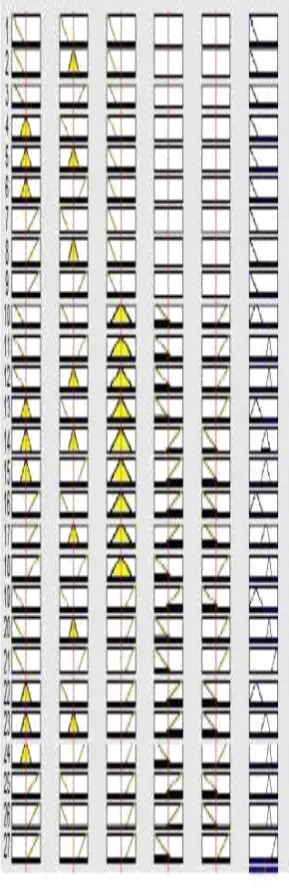
Fig. 3. Rule viewer of proposed scheme
3.2. Watermark Extraction
1) The input to watermark extraction is
watermarked image and original watermark.
2) Apply DCT and segment it into 8 × 8blocks to the
watermarked image and original image.
3) Apply FIS to both original and watermarked
image.
4) Identify the embedding location ACp and ACq and
before embedding the coefficient is and after embed-ding it becomes
5) if ACq >ACp then watermark bit is 1 else
watermark bit 0.
6) Concatenate all watermark bits.
7) Convert 2d Arrays into 1d array.
© 2017, IRJET | Impact Factor value: 5.181 | ISO 9001:2008 Certified Journal | Page 237
Fig. 4. Watermark Extraction Algorithm
4. Simulation results
The host images of size 512 × 512. gray scale cover images Lena, Mandril and Pirate are used. The watermark is 64 × 64 is a logo of Gokaraju Rangaraju institute of Engineering and Technology. The peak signal to noise ratio gives the measure of imperceptibility. Higher the P.S.N.R, the better imperceptibility.
4.1. Imperceptibility
Normally, in image processing, the quality of watermark is judged based on P.S.N.R. The P.S.N.R between water- marked and the original frame .
P SN R = 10log10 2552
(6)
M.S.E
As scaling factor is improved the imperceptibility is in-creased but the robustness against attacks reduced. A subjective evaluation test is conducted by 30 subjects and it unanimously confirmed that the perpetual invisibility of the watermark. The experimental set up was conducted on four images which consist of two copies of each image and the images are displayed on
[image:5.595.309.557.170.638.2]computer screen and the subjects were asked to carefully look at displayed image
© 2017, IRJET | Impact Factor value: 5.181 | ISO 9001:2008 Certified Journal | Page 238
and then report if there is any difference between the two images.
4.2. Robustness
To assess the robustness of proposed watermarking algo-rithms several attacks are applied. These attacks include JPEG compression, rotation, cropping on both sides and salt &pepper and Gaussian noise. The bit error rate and normalized cross correlation is computed between original watermark and extracted watermark.
5. CONCLUSIONS
The images having more number of objects and less number of active pixels the imperceptibility is less. Con-trary to this for smoother images, the proposed method yield high imperceptibility. Fuzzy output is
taken as nor-malized crisp output lying between 0 and 1. The pro-posed algorithm is found to be robust against number of attacks like JPEG compression (80%), Rotation, sym-metrical cropping up to The high peak signal to noise ratio and robustness against number of attacks signifies the proposed method is highly imperceptible and robust.
REFERENCES
[1]Charu Agarwal and Anurag Mishra and Arpita Sharma, Gray-scale image watermarking using GA-BPN hybrid network , 24rd ed, volume:7 Journal of Visual Communication and Image Representation, 2013.