© 2017, IRJET | Impact Factor value: 6.171 | ISO 9001:2008 Certified Journal
| Page 1677
Robot path planning in a dynamic and unknown environment based on
Colonial Competitive Algorithm (CCA) and Fuzzy Logic
Saeed Habibifar
1, Alireza Kashaninia
2, Fardad Farokhi
31
Student, Dept. of Electrical Engineering, Islamic Azad University Central Tehran Branch college, Tehran, Iran
2,3Professor, Dept. of Electrical Engineering, Islamic Azad University Central Tehran Branch college, Tehran, Iran
---***---Abstract -
Robot path planning has been one of the favoriteareas for many Machine Learning researchers from the past up to date. The trajectory designed for a robot can be simple or complex. The robot must pass through obstacles which are either movable or fixed. One of the considerable ways for robot path planning in the dynamic and unknown environment is a combination of Evolutionary algorithm and Fuzzy logic. There are different kinds of evolutionary algorithms such as Genetic algorithm, Ant Colony algorithm, Colonial Competitive algorithm, etc. A new approach has been proposed in this paper for robot path planning in the dynamic and unknown environment based on both the Colonial Competitive algorithm and fuzzy rules. The implemented results of the proposed method present its superiority over previous methods which used only fuzzy logic method.
Key Words: Colonial competitive Algorithm, Dynamic and unknown environment, Fixed and movable obstacles, Fuzzy Logic, Robot path planning
1. INTRODUCTION
Robot path planning in a trajectory has been one of the interesting areas for many Machine Learning and Pattern Recognition researchers from the past till date. Robot path planning can be simple and somewhat complex. The obstacles which are passed by the robot are either movable or fixed. Automated robot path planning for only one environment is one of the unsolved robotic challenges. Several methods that have been presented to solve these issues should be considered in two: classic and heuristic categories [1]. In the first twenty years of the advent of this field, scientists generally used classic routing method. But, this method had a notable problem named NP-Complete for robot path planning [2]. Thus, in order to overcome this issue, evolutionary method was designed. Evolutionary method is not performable in spite of its popularity because, in the beginning, all the paths are not accessible for the unknown environment with a movable obstacle. The method based on fuzzy logic is much appropriate for this type of problem. On the other hand, the table of the fuzzy rules has many rows in most of the cases.
This paper presents a method for detecting a trajectory in a dynamic and unknown environment. In this technique, colonial competitive algorithm has been carried out to optimize a number of the rules in the fuzzy table. This project also has been used another new method presented in
[3, 4] to obtain the number of optimized fuzzy rules. Path planning has been defined offline just once in the mentioned environment by using these optimized rules. Section 2 is the first stage of this project which reviews the previous studies. In addition, studied environment for path planning has been introduced in section 3. Moreover, in section 4, brief descriptions of the required colonial competitive algorithm and fuzzy logic have been mentioned. Eventually, the simulation results of the proposed method will be dedicated.
2. PREVIOUS STUDIES
© 2017, IRJET | Impact Factor value: 6.171 | ISO 9001:2008 Certified Journal
| Page 1678
not capable of path planning in this environment due to a lot of calculations. Likewise, the methods based on the evolutionary algorithm are offline and cannot be performed for online path planning because the whole path should be known from the beginning. On the other hand, path planning methods based on fuzzy logic are not appropriate because of its many rules [22]. In this project, a method based on a combination of colonial competitive algorithm and fuzzy logic will be presented for online path planning in the dynamic and unknown environment.
3. PROPOSED METHOD
3.1 Explanation of Issue in Fuzzy Logic
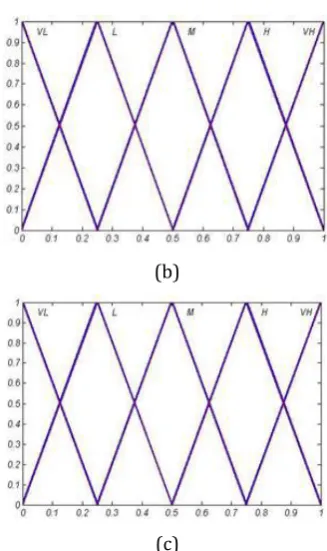
Fuzzy theory was first introduced by Zade in 1965 [23]. There are three significant steps in fuzzy logic. The first step is fuzzification of input, the Second step is creating fuzzy rules table which is usually determined by specialists and the final step is called the defuzzification step [24]. For Path planning in fuzzy logic, at any moment, the next node will be selected from among the eight available options by using the angle difference to the target and its distance to the nearest obstacle. Afterward, a selective preference coefficient is obtained as the next node, for each of those eight available nodes. After applying fuzzy logic, a defuzzified or final output is created for the inputs of each node. Eventually, when the node has the most defuzzification preference coefficient, it will be the next selective node in that procedure. Membership functions have been demonstrated in Fig. 1 for two inputs and fuzzy output (selective preference coefficient). In addition, a number of fuzzy rules for this issue are specified in Table I.
Table -1: A number of fuzzy rules for path planning
Preference
Coefficient Angle difference to target
Distance to the nearest obstacle
Extremely low Very high Very low
High Very low Low
⁞ ⁞ ⁞
Extremely high Extremely high Extremely high
(a)
(b)
(c)
Fig -1: (a) Fuzzy functions for input of the angle difference, (b) Fuzzy functions for input of the distance to the nearest
[image:2.595.350.514.93.369.2]obstacle, (c) Fuzzy functions for output (selective preference coefficient)
Table I shows the fuzzy rules for selecting the next node in the momentum path planning that is regulated via node by node. In this table, generally for every node, if the distance to the nearest obstacle is much higher and also the angle difference to the target is much lower, that node will be more likely to be chosen as a next node along the path. This paper utilized weighted average method to create a final and defuzzified output [25, 26].
3.2 Colonial Competitive Algorithm
[image:2.595.46.444.520.788.2]© 2017, IRJET | Impact Factor value: 6.171 | ISO 9001:2008 Certified Journal
| Page 1679
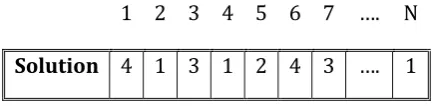
for the i-th rule, then “i” element is equal to the value of "j" in the corresponding string.
N
….
7
6
5
4
3
2
1
1
….
3
4
2
1
3
1
4
Solution
Fig -2: The structure of a country for path planning
Initially, the random primary population is generated from countries in the N-dimensional space where N is the total number of fuzzy rules. The values of parameters are continuously determined in the [0, Nout], where Nout is the number of membership functions considered for fuzzification of output. The suitability (power) evaluation of each country and overall power of each empire have been assessed by using (1). In other words, in this level, the power of the created solution via i-th country is evaluated by using (1).
1
i ifit
L
(1)
In the above equation, Li is the length of the traversed path via dynamic robot by using fuzzy rules table for i-th country
and 1 i
L is the power of i-th country. The total power of every empire in each repetition is equal to the sum of the power (suitability) of colonial countries and power average of the dominated countries in that empire. Therefore, after determining the power of all countries, the power of k-th empire will be obtained as stated by (2).
(
Power
)
k
fit imp
(
)
k
mean fit empire
(
(
) )
k(2)
In the above equation,
fit imp
(
)
k is the colonial suitability in k-th empire andmean fit empire
(
(
)
k is an average of the colonial countries suitability in k-th empire. Meanwhile, to update the colonial countries and after determination of all current countries power in each empire, if one of the colonies has more power than colonialism, then that colony will be specified as a new colonialism in the empire. The total power of k-th empire is obtained by (3).1
(
)
(
)
k
imp k M
j j
power
N
power
(3)
In the above equation, Nimp-k states the number of dominated countries of k-th empire. In addition,
(
power
)
k is the powerof the k-th empire and
1 ( ) M j j power
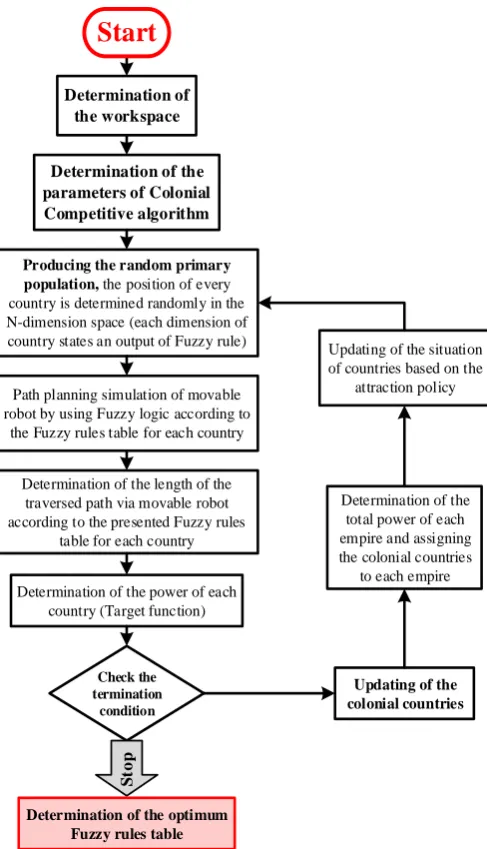
represents the totalpowers of all empires. The study of the termination condition for the above steps will be repeated as long as the termination condition is established. In this project, the end of number of algorithmic repetitions is considered as the termination condition of colonial competitive. Fig. 3 shows the main schematic of the proposed system.
4. SIMULATION
4.1 Introducing the Workspace
A 2D environment of the dynamic robot’s workspace is created, which includes the dimension of 500×500 square network with the same length. There are fixed obstacles with a variety of shapes, numbers, and coordinates. Moreover, movable obstacles are demonstrated with different speeds and directions via blue circles [28]. The target and starting points are also located in different positions. These diversities are selected due to the fact that the robot’s workspace becomes the same as the real world. According to a number of the fixed and movable obstacles, a workspace can be considered simple or complex. Therefore, in this paper, a complex environment with a robot as a moveable point has been designed. The starting point and end point are in the lower left corner and the upper right corner, respectively. The following Figure shows an example of a complex workspace with a number of fixed and movable obstacles at various speeds. In Fig. 4, the black and blue shapes represent fixed and moveable points at different speeds, respectively.
4.2 Simulation Results
[image:3.595.53.270.136.189.2]© 2017, IRJET | Impact Factor value: 6.171 | ISO 9001:2008 Certified Journal
| Page 1680
Determination of the workspace
Determination of the parameters of Colonial Competitive algorithm
Producing the random primary population, the position of every country is determined randomly in the N-dimension space (each dimension of country states an output of Fuzzy rule)
Path planning simulation of movable robot by using Fuzzy logic according to
the Fuzzy rules table for each country
Determination of the length of the traversed path via movable robot according to the presented Fuzzy rules
table for each country
Determination of the power of each country (Target function)
Check the termination
condition
S
to
p
Determination of the optimum Fuzzy rules table
Updating of the colonial countries
Determination of the total power of each empire and assigning the colonial countries
to each empire Updating of the situation of countries based on the
attraction policy
Start
Fig -3: General schematic of the proposed system
Fig -4: A view of the workspace
Fig -5: Path planning by using fuzzy logic
In Fig. 5, the length of the traversed path is 965.35 cm. But this length decreased to 925.5 cm by using a combination of colonial competitive algorithm and fuzzy logic.
Fig -6: Path planning by using combination Colonial Competitive algorithm and Fuzzy logic
[image:4.595.40.284.98.523.2] [image:4.595.323.543.99.288.2] [image:4.595.324.540.366.535.2] [image:4.595.60.263.561.718.2]© 2017, IRJET | Impact Factor value: 6.171 | ISO 9001:2008 Certified Journal
| Page 1681
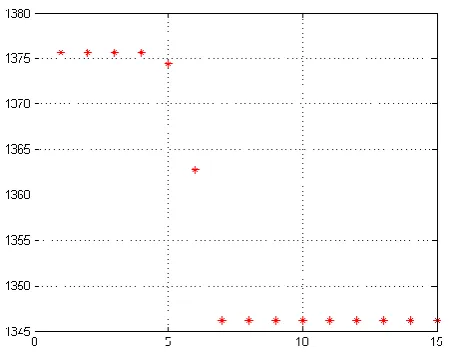
Fig -7: 15 different level of the system5. CONCLUSION
The application of evolutionary algorithm for path planning in an unknown environment with movable obstacles has been widely considered. Evolutionary method is not capable of path planning in the unknown environments, because in the beginning, roadmap must be specified [1, 2]. Furthermore, the number of rules in path planning is much when using Fuzzy logic method. Thus, this method is not qualified alone to be used in path planning. Afterward, a method which is a combination of colonial competitive algorithm and fuzzy logic was presented for online path planning in a dynamic and unknown environment. The implementation results of the proposed method states that colonial competitive algorithm for optimization of the fuzzy rules table reduced the length of the path and also this algorithm optimized a number of the fuzzy rules. Moreover, reduction of the number of fuzzy rules will diminish the computational complexity.
REFERENCES
[1] M. P. Garcia, O. Montiel, O. Castillo, R. Sepúlveda, and P. Melin, "Path planning for autonomous mobile robot navigation with ant colony optimization and fuzzy cost function evaluation," Applied Soft Computing, vol. 9, pp. 1102-1110, 2009.
[2] E. Masehian and D. Sedighizadeh, "Classic and heuristic approaches in robot motion planning-a chronological review," World Academy of Science, Engineering and Technology, vol. 23, pp. 101-106, 2007.
[3] E. Atashpaz-Gargari and C. Lucas, "Imperialist competitive algorithm: an algorithm for optimization inspired by imperialistic competition," in Evolutionary computation, 2007. CEC 2007. IEEE Congress on, 2007, pp. 4661-4667.
[4] F. Rahmani, F. Razaghian, and A. Kashaninia, "Novel Approach to Design of a Class-EJ Power Amplifier Using High Power Technology," World Academy of Science, Engineering and Technology, International Journal of Electrical, Computer, Energetic, Electronic and Communication Engineering, vol. 9, pp. 541-546, 2015.
[5] T. Lozano-Pérez and M. A. Wesley, "An algorithm for planning collision-free paths among polyhedral obstacles," Communications of the ACM, vol. 22, pp. 560-570, 1979.
[6] M. T. Andani and Z. Ramezani, "Robust Control of a Spherical Mobile Robot," 2017.
[7] Tahere Pourseif, M. T. Andani, Zahra Ramezani and Mahdi Pourgholi, "Model Reference Adaptive Control for Robot Tracking Problem: Design & Performance Analysis," International Journal of Control Science and Engineering, vol. 7, pp. 18-23, 2017.
[8] E. K. Chong and S. H. Zak, An introduction to optimization vol. 76: John Wiley & Sons, 2013.
[9] F. Najafi, M. Dadvar, A. Hosseini, S. Habibian, H. Haeri, M. Arvan, et al., "RoboCupRescue 2015-Robot League Team< MRL (Iran)."
[10] H. Mei, Y. Tian, and L. Zu, "A hybrid ant colony optimization algorithm for path planning of robot in dynamic environment," International Journal of Information Technology, vol. 12, pp. 78-88, 2006.
[11] A. F. Bastani, Z. Ahmadi, and D. Damircheli, "A radial basis collocation method for pricing American options under regime-switching jump-diffusion models," Applied Numerical Mathematics, vol. 65, pp. 79-90, 2013.
[12] A. F. Bastani and D. Damircheli, "An adaptive algorithm for solving stochastic multi-point boundary value problems," Numerical Algorithms, vol. 74, pp. 1119-1143, 2017.
[13] M. Rostaghi-Chalaki, A. Shayegani-Akmal, and H. Mohseni, "HARMONIC ANALYSIS OF LEAKAGE CURRENT OF SILICON RUBBER INSULATORS IN CLEAN-FOG AND SALT-FOG," in 18th International Symposium on High Voltage Engineering, 2013, pp. 1684-1688.
[14] M. Rostaghi-Chalaki, A. Shayegani-Akmal, and H. Mohseni, "A STUDY ON THE RELATION BETWEEN LEAKAGE CURRENT AND SPECIFIC CREEPAGE DISTANCE," in 18th International Symposium on High Voltage Engineering (ISH 2013), 2013, pp. 1629-1623.
[image:5.595.49.275.99.276.2]© 2017, IRJET | Impact Factor value: 6.171 | ISO 9001:2008 Certified Journal
| Page 1682
Profile Improvement in Distribution Networks Using Particle Swarm Optimization Algorithm," Journal of World’s Electrical Engineering and Technology, vol. 2322, p. 5114, 2014.
[16] K. Yousefpour, S. J. H. Molla, and S. M. Hosseini, "A Dynamic Approach for Distribution System Planning Using Particle Swarm Optimization," International Journal of Control Science and Engineering, vol. 5, pp. 10-17, 2015.
[17] T. Agarwal, D. Kumar, and N. R. Prakash, "Prolonging network lifetime using ant colony optimization algorithm on LEACH protocol for wireless sensor networks," Recent Trends in Networks and Communications, pp. 634-641, 2010.
[18] H. Pourgharibshahi, M. Abdolzadeh, and R. Fadaeinedjad, "Verification of computational optimum tilt angles of a photovoltaic module using an experimental photovoltaic system," Environmental Progress & Sustainable Energy, vol. 34, pp. 1156-1165, 2015.
[19] A. Rouholamini, H. Pourgharibshahi, R. Fadaeinedjad, and G. Moschopoulos, "Optimal tilt angle determination of photovoltaic panels and comparing of their mathematical model predictions to experimental data in Kerman," in Electrical and Computer Engineering (CCECE), 2013 26th Annual IEEE Canadian Conference on, 2013, pp. 1-4.
[20] M. H. Imani, P. Niknejad, and M. Barzegaran, "The impact of customers’ participation level and various incentive values on implementing emergency demand response program in microgrid operation," International Journal of Electrical Power & Energy Systems, vol. 96, pp. 114-125, 2018.
[21] S. H. Imani, S. Asghari, and M. Ameli, "Considering the load uncertainty for solving security constrained unit commitment problem in presence of plug-in electric vehicle," in Electrical Engineering (ICEE), 2014 22nd Iranian Conference on, 2014, pp. 725-732.
[22] F. Rahmani, F. Razaghian, and A. Kashaninia, "High Power Two-Stage Class-AB/J Power Amplifier with High Gain and Efficiency," Journal of Academic and Applied Studies (JAAS), vol. 4, pp. 56-68, 2014.
[23] L. A. Zadeh, "Fuzzy sets," Information and control, vol. 8, pp. 338-353, 1965.
[24] A. Mashat, A. Karambakhsh, M. Rahmani, A. H. M. Hosseini, M. Mashat, B. Mahdikhani, et al., "RoboCupRescue 2013-Robot League Team MRL Rescue Robot (Iran)."
[25] M. Ma, A. Kandel, and M. Friedman, "A new approach for defuzzification," Fuzzy Sets and Systems, vol. 111, pp. 351-356, 2000.
[26] A. Rahimnejad and M. Mirzaie, "Optimal corona ring selection for 230 kV ceramic I-string insulator using 3D simulation," International Journal of Scientific & Engineering Research, vol. 3, pp. 1-6, 2012.
[27] E. Akbari, M. Mirzaie, A. Rahimnejad, and M. B. Asadpoor, "Finite Element Analysis of Disc Insulator Type and Corona Ring Effect on Electric Field Distribution over 230-kV Insulator Strings," International Journal of Engineering & Technology, vol. 1, pp. 407-419, 2012.